Questions

4 Marks Questions

🎯

Test yourself on this topic

8 questions · timed · auto-graded

Question 14 Marks
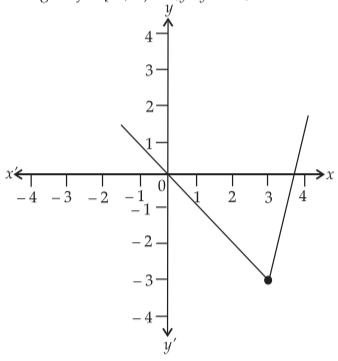
Find the domain and range of $f(x)=|2 x-3|-3$.
Answer
Given, $f(x)=|2 x-3|-3$
The domain of the expression is all real number except where the expression is undefined. In this case, there is not real number that makes the expression undefined.
$\therefore$ Domain of $f=(-\infty, \infty)= R$
The absolute value of expression has a ' $V$ ' shape. The range of a positive absolute value expression starts at its vertex and extends to infinity.
Range of $f=[-3, \infty)$ or $\{y: y \geq-3\}$
Image
View full question & answer
Question 24 Marks
Draw the graph of the function
$
f(x)=\left\{\begin{array}{ll}
\frac{|x|}{x}, & x \neq 0 \\
0 . & x=0
\end{array}\right.
$
Answer
Given, $f(x)=\left\{\begin{array}{cc}\frac{|x|}{x}, & x \neq 0 \\ 0, & x=0\end{array}\right.$
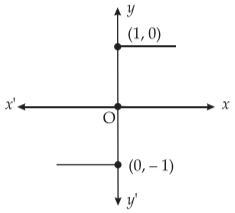
The given function is called the signum function and can be written as
$
f(x)=\left\{\begin{array}{ll}
1, & \text { when } x>0 \\
0, & \text { when } x=0 \\
-1, & \text { when } x<0
\end{array}\right.
$
Image
The domain of $f=R$ and the range of $f=\{-1,0,1\}$.
View full question & answer
Question 34 Marks
If $f(x)=\frac{4 x+3}{6 x-4}, x \neq \frac{2}{3}$, then show that $(f o f)(x)=x$ for all $x \neq \frac{2}{3}$. What is the inverse of $f$.
Answer

$\begin{aligned}(f \circ f)(x) & =f[f(x)] \\ & =f\left(\frac{4 x+3}{6 x-4}\right) \\ & =\frac{4\left(\frac{4 x+3}{6 x-4}\right)+3}{6\left(\frac{4 x+3}{6 x-4}\right)-4} \\ & \left.=\frac{\left(\frac{16 x+12}{6 x-4}\right)+3}{\left(\frac{24 x+18}{6 x-4}\right)-4}\right) \\ & =\frac{\left(\frac{16 x+12+3(6 x-4)}{6 x-4}\right)}{\left(\frac{24 x+18-4(6 x-4)}{6 x-4}\right)} \\ & =\frac{\left(\frac{16 x+12+18 x-12}{6 x-4}\right)}{\left(\frac{24 x+18-24 x+16}{6 x-4}\right)}=\frac{34 x}{34}\end{aligned}$
$\begin{aligned}(f \circ f)(x) & =x \\ \therefore \quad f^{-1}(x) & =f(x)=\frac{4 x+3}{6 x-4}, x \neq \frac{2}{3}\end{aligned}$
View full question & answer
Question 44 Marks
Redefine the function $
f(x)=|x-2|+|2+x|,-3 \leq x \leq 3
$
Answer

$\begin{array}{l}\therefore|x-2|=-(x-2), x<2 \\ \text { and } x-2, x \geq 2 \\ \text { Similarly, } \quad|2+x|=-(2+x), x<-2 \\ \text { and } \quad 2+x, x \geq-2\end{array}$
$f(x)=|x-2|+|2+x|,-3 \leq x \leq-3$
$=\left\{\begin{array}{cc}-(x-2)-(2+x), & -3 \leq x<-2 \\ -(x-2)+2+x, & -2 \leq x<2 \\ x-2+2+x, & 2 \leq x \leq 3\end{array}\right.$
$=\left\{\begin{array}{cc}-2 x & -3 \leq x<-2 \\ 4, & -2 \leq x<2 \\ 2 x, & 2 \leq x \leq 3\end{array}\right.$
View full question & answer
Question 54 Marks
Find the domain of function$
f(x)=\sqrt{4-x}+\frac{1}{\sqrt{x^2-1}}
$
Answer
Given, $f(x)=\sqrt{4-x}+\frac{1}{\sqrt{x^2-1}}$
Clearly, $f(x)$ is defined when $4-x \geq 0$ and $x^2-1>0$
$
\begin{array}{l}
\therefore \quad 4-x \geq 0 \\
\quad\quad x \leq 4 \\
\text { and } x^2-1>0 \\
(x-1)(x+1) \geq 0
\end{array}
$
Hence, Domain of $f$ is $(-\infty,-1) \cup(1,4]$
View full question & answer
Question 64 Marks
Find the domain and range of the real function \[f(x)=\frac{x^2-9}{x-3}\]
Answer
Given, $f(x)=\frac{x^2-9}{x-3}$
Domain : Clearly, $f(x)$ is defined for all $x \in R$ except $x=3$
$\therefore$ Domain of $f=R-\{3\}$
Range : Let $y=f(x)$
$\therefore \quad y=\frac{x^2-9}{x-3} \Rightarrow y=x+3$
It follows from the above relation that $y$ takes all real values except 6 when $x$ takes values in the set $R-\{3\}$.
$\therefore \quad$ Range of $f=R-\{6\}$
View full question & answer
Question 74 Marks
If $f(x)=x-\frac{1}{x}$, prove that
$[f(x)]^3=f(x)^3+3 f\left(\frac{1}{x}\right)$
Answer
We have,
$\therefore \quad f\left(x^3\right)=x^3-\frac{1}{x^3}$
and $[f(x)]^3=\left(x-\frac{1}{x}\right)^3$
Now, $[f(x)]^3=\left(x-\frac{1}{x}\right)^3$
$\begin{array}{l}{[f(x)]^3=x^3-\frac{1}{x^3}-3 x+\frac{3}{x}} \\ {[f(x)]^3=\left(x^3-\frac{1}{x^3}\right)-3\left(x-\frac{1}{x}\right)} \\ {[f(x)]^3=f\left(x^3\right)-3 f(x)} \\ {[f(x)]^3=f\left(x^3\right)+3 f\left(\frac{1}{x}\right) .} \\ \quad\left(\because f(x)=-f\left(\frac{1}{x}\right)\right)\end{array}$
View full question & answer
Question 84 Marks
Let $f(x)=\left\{\begin{array}{ll}x^2, & \text { when } 0 \leq x \leq 2 \\ 2 x, & \text { when } 2 \leq x \leq 5\end{array}\right.$
$
g(x)=\left\{\begin{array}{ll}
x^2, & \text { when } 0 \leq x \leq 3 \\
2 x, & \text { when } 3 \leq x \leq 5
\end{array}\right.
$
Show that $f$ is a function, while $g$ is not a function.
Answer
The relation $f$ is defined as
$
f(x)=\left\{\begin{array}{ll}
x^2, & 0 \leq x \leq 2 \\
2 x, & 2 \leq x \leq 5
\end{array}\right.
$
It is observed that for
$0 \leq x \leq 2, f(x)=x^2$
and $2 \leq x \leq 5, f(x)=2 x$
Also, at $x=2, f(x)=2^2=4$ or $f(x)=2 \times 2=4$
i.e., at $x=2, f(x)=4$.
Therefore, for $0 \leq x \leq 5$, the images of $f(x)$ are unique. Thus, the given relation ' $f$ ' is a function.
The relation g is defined as $g(x)=\left\{\begin{array}{ll}x^2, & 0 \leq x \leq 3 \\ 2 x, & 3 \leq x \leq 5\end{array}\right.$
It can be observed that for $x=3, g(x)=3^2=9$ and $g(x)=2 \times 3=6$
Hence, element 3 of the domain of relation ' $g$ ' corresponds to two different images i.e., 9 and 6 . Hence, this relation is not a function.
View full question & answer
4 Marks Questions - Applied Maths STD 11 Science Questions - Vidyadip