Questions

3 Marks Question

🎯

Test yourself on this topic

7 questions · timed · auto-graded

Question 13 Marks
If $A=\{1,2,3,4,5\}, B=\{2,3,4\}$ and $C=\{2,4,5\}$; state whether the following statements are true or false.
i. $\mathrm{A} \subset \mathrm{B}$
ii. $\mathrm{A} \subset \mathrm{C}$
iii. $B \subset A$
iv. $\mathrm{B} \subset\mathrm{C}$
v. $\mathrm{C} \subset \mathrm{A}$
vi. $C \subset B$
vii. $B=C$
viii. $\phi \subset \mathrm{B}$
ix. $\mathrm{A} \leftrightarrow \mathrm{B}$
x. $B \leftrightarrow C$
xi. $A \leftrightarrow C$
Answer
Given: $\mathrm{A}=\{1,2,3,4,5\}$
and $B=\{2,3,4\}$
$C=\{2,4,5\}$
i. $A \subset B$
Since $1 \in A$ but $1 \notin B \Rightarrow A \not \subset C$
So, Flase
ii. $\mathrm{A} \subset \mathrm{C}$
Since $1 \in \mathrm{~A}$ but $1 \notin C \Rightarrow A \not \subset C$
So, False
iii. $B \subset A$
Since, every element of B is also element of A, So B $\subset A$.
it is true statement
iv. $\mathrm{B} \subset \mathrm{C}$
Since $3 \in \mathrm{~B}$ but $3 \notin C \Rightarrow B \not \subset C$
So, False
v. C $\subset A$
Since every element of set $C$ is also element of set $A$, So $C \subset A$.
Therefore, It is true statement.
vi. $C \subset B$
Since $5 \in \mathrm{C}$ but $5 \notin B \Rightarrow C \not \subset B$
So, False
vii. B = C
Since $3 \in \mathrm{~B}$ but $3 \not \subset C \Rightarrow B \neq C$
So, False
viii. $\phi \subset \mathrm{B}$
We know that empty set is always subset of every set.
$\therefore \phi \subset \mathrm{B}$
Therefore, it is true statement
ix. False
x. False
xi. False
View full question & answer
Question 23 Marks
In a factory the production of scooters rose to 46,305 from 40,000 in 3 years. Find the annual rate of growth of the product of scooters.
Answer
Let the annual rate of growth be R.
$\therefore$ Production of scooters after three years $=\mathrm{P}\left(1+\frac{R}{100}\right)^{n}$
$46,305=4,000\left(1+\frac{R}{100}\right)^{3}$
$(1+0.01 \mathrm{R})^{3}=\frac{46,305}{40,000}$
$(1+0.01 R)^{3}=1.157625$
$(1+0.01 \mathrm{R})^{3}=(1.05)^{3}$
$1+0.01 \mathrm{R}=1.05$
$0.01 \mathrm{R}=0.05$
$\mathrm{R}=5$
Thus, the annual rate of growth is $5 \%$
View full question & answer
Question 33 Marks
Divide ₹ 15,500 into two parts such that if one part be lent out at $15 \%$ per annum and the other at $24 \%$ per annum, the total annual income is ₹ 3,000 .
Answer
Let one of the parts be ₹ $x$. Then the other part is ₹ $(15,500-x)$.
For the first part, we have
$P=x, r=\frac{15}{100}$ and $t=1$
$\therefore \mathrm{I}_{1}=$ Simple Interest $=\operatorname{Prt}=\mathrm{x} \times \frac{15}{100} \times 1=\frac{3 x}{20}$
For the second part, we have
$\mathrm{P}=(15,500-\mathrm{x}), \mathrm{r}=\frac{24}{100}=\frac{6}{25}$ and $\mathrm{t}=1$
$\therefore \mathrm{I}_{2}=$ Simple interest $=\operatorname{Prt}=(15,500-\mathrm{x}) \times \frac{6}{25} \times 1=\frac{1}{25}(93000-6 \mathrm{x})$
It is given that total annual interest is ₹ 3000.
$\therefore \mathrm{I}_{1}+\mathrm{I}_{2}=3000$
$\Rightarrow \frac{3 x}{20}+\frac{1}{25}(93,000-6 \mathrm{x})=3000$
$\Rightarrow 15 \mathrm{x}+372,000-24 \mathrm{x}=300,000 \Rightarrow 9 \mathrm{x}=72,000 \Rightarrow \mathrm{x}=8,000$
Hence, two parts are ₹ 8,000 and ₹ $(15,500-8,000)=$ ₹ $7,500$
View full question & answer
Question 43 Marks
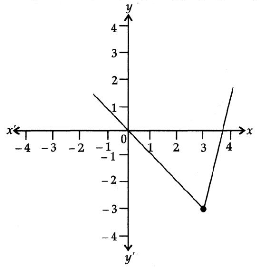
Find the domain and range of $f(x)=|2 x-3|-3$.
Answer
Given, $\mathrm{f}(\mathrm{x})=|2 \mathrm{x}-3|-3$
The domain of the expression is all real number except where the expression is undefined. In this case, there is not real number that makes the expression undefined.
$\therefore$ Domain of $\mathrm{f}=(-\infty, \infty)=\mathrm{R}$
The absolute value of expression has a 'V' shape. The range of a positive absolute value expression starts at its vertex and extends to infinity.
Range of $\mathrm{f}=[-3, \infty)$ or $\{y: y \geq-3\}$
Image
View full question & answer
Question 53 Marks
A line passes through $P(1,2)$ such that its intercept between the axes is bisected at $P$. Find the equation of line.
Answer
Equation of a line in intercept from is
$\frac{x}{a}+\frac{y}{b}=1$
Given, $\frac{a+0}{2}=1$ and $\frac{0+b}{2}=2$
$\Rightarrow \mathrm{a}=2 \Rightarrow \mathrm{~b}=4$
$\Rightarrow \frac{x}{2}+\frac{y}{4}=1$
$\Rightarrow 2 \mathrm{x}+\mathrm{y}-4=0$, is the required equation of the line.
View full question & answer
Question 63 Marks
In an A.P., if the pth term is $\frac{1}{q}$ and qth term is $\frac{1}{p}$. Prove that the sum of first pq term is $\frac{1}{2}(\mathrm{pq}+1)$.
Answer
$\because \mathrm{T}_{\mathrm{n}}=\mathrm{a}+(\mathrm{n}-1) \mathrm{d}$
Therefore, $\mathrm{T}_{\mathrm{p}}=\mathrm{a}+(\mathrm{p}-1) \mathrm{d}=\frac{1}{q}$ (given) $\ldots\text{(i)}$
and $\mathrm{a}+(\mathrm{q}-1)=\frac{1}{p}$ (given) $\ldots\text{(ii)}$
Subtracting Eq. (i) from Eq.(ii),
$\mathrm{d}(\mathrm{p}-1-\mathrm{q}+1)=\frac{1}{q}-\frac{1}{p}$
$\Rightarrow d(p-q)=\frac{p-q}{p q} \Rightarrow d=\frac{1}{p q}$
Putting the value of $d$ in Eq. (i) we get
$a+\frac{(p-1)}{p q}=\frac{1}{q}$
$\Rightarrow a=\frac{1}{q}-\frac{p-1}{p q}$
$\Rightarrow a=\frac{p-p+1}{p q}=\frac{1}{p q}$
Now,
$\Rightarrow S_{p q}=\frac{p q}{2}[2 a+(p q-1) d]$
$\left(\therefore S_{n}=\frac{n}{2}[2 a+(n-1) d]\right)$
$=\frac{p q}{2}\left[2 \times \frac{1}{p q}+(p q-1) \frac{1}{p q}\right]$
$=\frac{p q}{2} \times \frac{1}{p q}(2+\mathrm{pq}-1)$
$=\frac{1}{2}(\mathrm{pq}+1)$
View full question & answer
Question 73 Marks
The sum of the first four terms of an A.P. is 56 . The sum of the last four terms is 112 . If the first term is 11 , then find the number of terms.
Answer
Given $\mathrm{a}=11$ and the sum of first four terms is 56.
Let d be the common difference, then $56=\frac{4}{2}(2 \times 11+(4-1) \times \mathrm{d})$
$\Rightarrow 28=22+3 \mathrm{~d} \Rightarrow \mathrm{~d}=2$
Let n be the number of terms and l be the last term.
Then the last four terms are l-6,l-4,l-2, and l
According to given, $(\mathrm{l}-6)+(\mathrm{l}-4)+(\mathrm{l}2)+\mathrm{l}=112$
$\Rightarrow 4 \mathrm{l}-12=112$
$\Rightarrow$ $1=31$
$\Rightarrow 11+(\mathrm{n}-1) \times 2=31[1=\mathrm{a}+(\mathrm{n}-1) \mathrm{d}]$
$\Rightarrow \mathrm{n}-1=10$
$\Rightarrow \mathrm{n}=11$
View full question & answer
3 Marks Question - Applied Maths STD 11 Science Questions - Vidyadip