Questions

3 Marks Question

🎯

Test yourself on this topic

7 questions · timed · auto-graded

Question 13 Marks
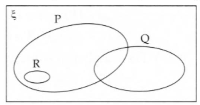
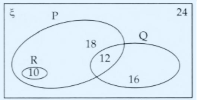
In the adjacent Venn diagram, if $n(\xi)=80, n(P)=40, n(Q)=28, n(P \cap Q)=12$ and $n(P \cap R)=10$,
Image
i. mark the number of elements in each region.
ii. determine the value of $n(P \cup Q)$ and $n\left((Q \cup R)^{\prime}\right)$.
View full question & answer
Question 23 Marks
₹ 2000 is invested at annual rate of interest of $10 \%$. What is the amount after two years if compounding is done
(a) Annually(b) semi-annually(c) Quarterly(d) monthly.
Answer
Here, $\mathrm{P}=₹ 2000, \mathrm{i}=10 \%=\frac{10}{100}=0.1$
a. Since, interest is compounded yearly
$\mathrm{n}=2$
Since, $A_{n}=P(1+i)^{n}$
$\therefore \mathrm{A}_{2}=2000(1+0.1)^{2}$
$=2000(1.1)^{2}$
$=2000 \times 1.21$
= ₹ 2420
b. For semi-annual compounding
$
n=2 \times 2=4
$
Since, $i=\frac{0.1}{2}=0.05$
$\therefore \mathrm{A}=2000(1+0.5)^{4}$
$=2000 \times(1.05)^{4}$
$=2000 \times 1.2155$
=₹ 2431
c. For quarterly compounding
$
\mathrm{n}=4 \times 2=8
$
Since, $i=\frac{0.1}{4}=0.025$
$\therefore \mathrm{A}_{4}=2000 \times(1+0.025)^{8}$
$=2000 \times(1.025)^{8}$
$=2000 \times 1.2184$
$=$ ₹ 2436.80
d. For monthly compounding
$\mathrm{n}=12 \times 2=24$
Since, $i=\frac{0.1}{12}=0.00833$
$
\begin{aligned}
& \therefore \mathrm{A}_{24}=2000 \times(1+0.00833)^{24} \\
& =2000 \times 1.22029 \\
& =\text { ₹ } 2440.58
\end{aligned}
$
View full question & answer
Question 33 Marks
An industry in Delhi consumed 285kL of water in a month. Calculate the water bill for the month. The tariff plan for the industrial units in Delhi is as given below:
Monthly Consumption (in kL)Service ChargeWater Consumption Charge per KL
Up to 6₹ 146.41₹17.57
6-15₹ 292.82₹26.35
15-25₹585.64₹35.14
25-50₹1024.87₹87.85
50-100₹1171.28₹140.56
> 100₹1317.69₹175.69
A water cess is levied at 0.20/kL and the sewerage charge is 60% of the consumption charge.
Answer
Here, the consumption of water is given to be 285 kL
According to the given tariff plan:
Water consumption charge =₹[(17.57 x 6 + (26.35 x 9) + (35.14 x 10)+(87.85 x 25)+(140.56 x 50)+(175.69 x 185)
=₹(105.42+237.15+351.40+2196.25+7028.00+32502.65)
= ₹ 42420.87
The service charge for consumption above 100 kL is ₹ 1317.69
$\therefore$ Service charge = ₹ 1317.69
Also, the sewerage charge is $60 \%$ of the consumption charge
$\therefore$ Sewerage charge $=60 \%$ of ₹ 42420.87
= ₹ 25452.52
Water Cess =₹ 0.20 per kL
=₹ 285 x 0.20) =₹ 57
$\therefore$ Total Water Bill $=$ Water Consumption charge + Service charge + Sewerage charge + Water Cess
= ₹ 42420.87 + ₹ 1317.69 + ₹ 25452.52 + ₹ 57.00
= ₹ 69248.08
View full question & answer
Question 43 Marks
Find $\lim _{x \rightarrow 1} f(x)$, where $f(x)=\left\{\begin{array}{l}x^{2}-1, x \leq 1 \\ -x^{2}-1, x>1\end{array}\right.$
Answer
When $\mathrm{x} \leq 1, \mathrm{f}(\mathrm{x})=\mathrm{x}^{2}-1$.
x 0.090 .0990 .9990 .9999
$\mathrm{f}(\mathrm{x})-0.19-0.199-001999-0.00019999$
$\therefore \lim _{x \rightarrow 1^{-}} \mathrm{f}(\mathrm{x})=0$
when $x>1 f(x)=-x^{2}-1$
x 1.11 .011 .00110001
$\mathrm{f}(\mathrm{x})-2.21-2.0201-2.002001-2.00020001$
$\therefore \lim _{x \rightarrow 1^{+}} \mathrm{f}(\mathrm{x})=-2$
Since $\lim _{x \rightarrow 1^{-}} \mathrm{f}(\mathrm{x}) \neq \lim _{x \rightarrow 1^{+}} \mathrm{f}(\mathrm{x})$
$\therefore \lim _{x \rightarrow 1} \mathrm{f}(\mathrm{x})$ does not exist.
View full question & answer
Question 53 Marks
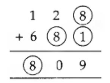
Find A and B in the addition
Image
View full question & answer
Question 63 Marks
Using the letters of the word, ARRANGEMENT how many different words (using all letters at a time) can be made such that both A , both E , both R and both H occur together.
Answer
There are 11 letters in the word 'ARRANGEMENT' out of which 2 A's, 2 E's, 2 R's and 2 M's. Considering both A , both E , both R and both M together, 8 letters should be counted as 4 .
So, there are total 7 letters (AA EE RR MM G M T)
These 7 letters can be arranged in 7! ways
Hence, total ways $=7$ !
$=7 \times 6 \times 5 \times 4 \times 3 \times 2 \times 1$
$=5040$
View full question & answer
Question 73 Marks
How many numbers greater than 1000000 can be formed by using the digits $1,2,0,2,4,2,4$ ?
Answer
There are seven digits - one 1 , three 2 's, one 0 , and two 4 's.
Since the number 1000000 has seven digits and the number greater than 1000000 must have at least 7 digits, so the required numbers are 7-digit numbers only.
All seven-digit numbers formed from given digits are greater than 1000000
The number of arrangements of given digits $=\frac{\mid \underline{7}}{|3 \times| 2}$
$=\frac{7 \times 6 \times 5 \times 4 \times 3 \times 2 \times 1}{3 \times 2 \times 1 \times 2 \times 1}=420$
But these include numbers which have 0 on the extreme left and hence are not of seven digits.
The number of such numbers $=\frac{\mid \underline{6}}{|\underline{3} \times| \underline{2}}=\frac{720}{6 \times 2}=60$
Hence, the required number of numbers $=420-60=360$
View full question & answer
3 Marks Question - Applied Maths STD 11 Science Questions - Vidyadip