Questions

5 Marks Questions

🎯

Test yourself on this topic

6 questions · timed · auto-graded

Question 15 Marks
A shopkeeper buys an article whose list price is ₹ 8000 at some rate of discount from a wholesaler. He sells the article to a consumer at the list price. The sales are intra-state and the rate of GST is $18 \%$. If the shopkeeper pay a tax (under GST) of ₹72 to the State Government, find the rate of discount at which he bought the article from the wholesaler.
Answer
Given:
List of price of an article $=$ ₹ 8000
Let the rate of discount given by wholesaler $=\mathrm{x} \%$
So,
Discount $=x \%$ of ₹ 8000
$=\left(\frac{x}{100}\right) \times$ ₹ 8000
$=₹ 80 \mathrm{x}$
CP of an article for shopkeeper $=₹ 8000-₹ 80 x$
It is given that, CP of article for consumer $=₹ 8000$
Since the sales are intra-state, rate of GST $=18 \%$
CGST $=$ SGST $=9 \%$
Amount of GST paid by shopkeeper to wholesaler,
SGST $=$ CGST $=9 \%$ of [₹8000-₹80x]
$=\left(\frac{9}{100}\right) \times[₹ 8000-₹ 80 \mathrm{x}]$
Amount of GST paid by consumer to shopkeeper,
CGST $=$ SGST $=9 \%$ of ₹ 8000
$=\left(\frac{9}{100}\right) \times ₹ 8000=₹ 720$
So, the tax paid by shopkeeper to state government $=₹ 720-\left(\frac{9}{100}\right) \times[₹ 8000-₹ 80 x]$
Also, tax paid by shopkeeper to state government $=₹ 72$
₹ $72-720-\left(\frac{9 \times 80}{100}\right)(100-x)$
$720-72=\left(\frac{720}{100}\right)(100-x)$
$648=\left(\frac{72}{10}\right)(100-x)$
$100-x=\frac{648 \times 10}{72}$
$100-x=90$
$x=100-90=10$
Hence, the required rate of discount $=10 \%$

View full question & answer
Question 25 Marks
Calculate the standard deviation for the following data:
Class0-3030-6060-9090-120120-150150-180180-210
Frequency9174382814424
Answer
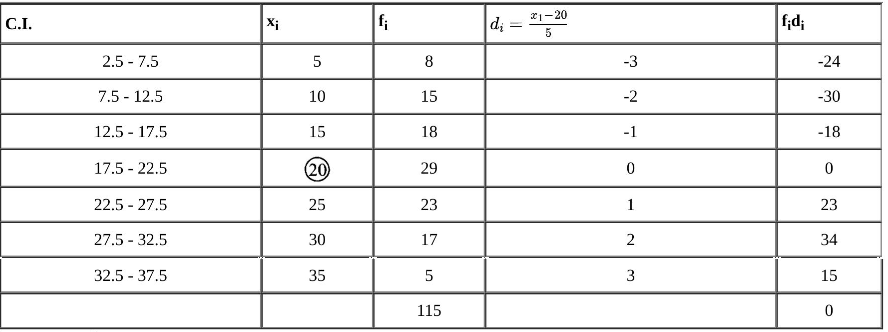
Class$f _{ i }$Mid point $\left( x _{ i }\right)$$y_{ i }=\frac{z_{ i }-105}{30}$$y_i^2$$f_i y_i$$f _{ i } y_i^2$
0-30915-39-2781
30-601745-24-3468
60-904375-11-4343
90-120821050000
120-15081135118181
150-180441652488176
180-210241953972216
 $\sum f_i=N=300$   $\sum f_i y_i=137$$\sum f _{ i } y_2^2=665$
$\bar{x}=\mathrm{a}+\mathrm{h}\left(\frac{1}{N} \Sigma f_{i} y_{i}\right)=105+30\left(\frac{137}{300}\right)=118.7$
Variance:
$\sigma^{2}=\frac{h^{2}}{N^{2}}\left[N \sum f_{i} y_{i}^{2}-\left(\sum f_{i} y_{i}\right)^{2}\right]$
$=\frac{900}{90000}[300 \times 665-18769]$
$=\frac{1}{100}$ [199500-18769]
$=\frac{180731}{100}=1807.31$
$\mathrm{SD}, \sigma=\sqrt{1807.31}=42.51$
View full question & answer
Question 35 Marks
View full question & answer
Question 45 Marks
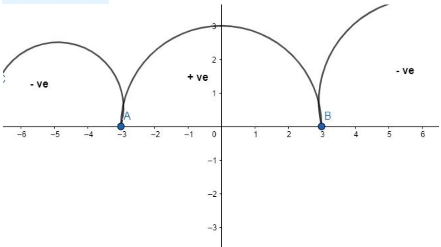
Find the domain and range of the real function: $f(x)=\sqrt{9-x^{2}}$
View full question & answer
Question 55 Marks
If $\mathrm{S}_{1}, \mathrm{~S}_{2}, \mathrm{~S}_{3}$ be respectively the sums of $\mathrm{n}, 2 \mathrm{n}, 3 \mathrm{n}$ terms of a G.P., then prove that $s_{1}^{2}+s_{2}^{2}=\mathrm{s}_{1}\left(\mathrm{~s}_{2}+\mathrm{s}_{3}\right)$.
Answer
$\mathrm{S}_{1}=$ sum of n terms,
$\mathrm{S}_{1}=$ sum of 2 n terms,
$\mathrm{S}_{1}=$ sum of 3 n terms,
Then, $s_{1}^{2}+s_{2}^{2}$
$=\left(\mathrm{s}_{\mathrm{n}}\right)^{2}+\left(\mathrm{s}_{2 \mathrm{n}}\right)^{2}$
$=\left(\frac{a\left(1-r^{n}\right)}{1-r}\right)^{2}+\left(\frac{a\left(1-r^{2 n}\right)}{1-r}\right)^{2}$
$=\frac{a^{2}}{(1-r)^{2}}\left[\left(1-(\mathrm{r})^{\mathrm{n}}\right)^{2}+\left(1-\mathrm{r}^{2 \mathrm{n}}\right)^{2}\right]$
$=\frac{a^2}{(1-r)^2}\left[1+ r ^{2 n }-2 r ^{ n }+1+ r ^{4 n }-2 r ^{2 n }\right]$
$=\frac{a^{2}}{(1-r)^{2}}\left[2-\mathrm{r}^{2 \mathrm{n}}-2 \mathrm{r}^{\mathrm{n}}+\mathrm{r}^{4 \mathrm{n}}\right]$$\quad \quad \ldots \ldots(i)$
Also, $\mathrm{S}_{1}\left(\mathrm{~S}_{2}+\mathrm{S}_{3}\right)$
$=\frac{a\left(1-r^{n}\right)}{1-r}\left(\frac{a\left(1-r^{2 n}\right)}{1-r}+\frac{a\left(1-r^{3 n}\right)}{1-r}\right)$
$=\frac{a^{2}}{(1-r)^{2}}\left[(1-\mathrm{r}) \mathrm{n}\left(1-\mathrm{r} 2^{\mathrm{n}}\right)+\left(1-\mathrm{r}^{\mathrm{n}}\right)\left(1-\mathrm{r}^{3 \mathrm{n}}\right)\right]$
$=\frac{a^{2}}{(1-r)^{2}}\left[1-\mathrm{r}^{2 \mathrm{n}}-\mathrm{r}^{\mathrm{n}}+\mathrm{r}^{3 \mathrm{n}}-\mathrm{r}^{3 \mathrm{n}}-\mathrm{r}^{\mathrm{n}}+1+\mathrm{r}^{4 \mathrm{n}}\right]$
$=\frac{a^2}{(1-r)^2}\left[2-r^{2 n}-2 r^n+r^{4 n}\right] \ldots$ (ii)
(i) $=$ (ii) Hence, $s_{1}^{2}+s_{2}^{2}=\mathrm{s}_{1}\left(\mathrm{~s}_{2}+\mathrm{s}_{3}\right)$
Hence, it is proved as per given condition.
View full question & answer
Question 65 Marks
There are $n$ A.M.s between 3 and 17. The ratio of the last mean to the first mean is $3: 1$. Find the value of $n$.
Answer
As per the question, we can write it as,
Let the n A.M's between 3 and 17 be $\mathrm{A}_{1}, \mathrm{~A}_{2}, \mathrm{~A}_{3}, \ldots, \mathrm{~A}_{\mathrm{n}}$ Then,
ATQ
$\frac{A_n}{A_1}=\frac{3}{1}\quad \quad \ldots \ldots(i)
$
We know that $3, \mathrm{~A}_{1}, \mathrm{~A}_{2}, \mathrm{~A}_{3}, \ldots, \mathrm{~A}_{\mathrm{n}}, 17$ are in A.P of $\mathrm{n}+2$ terms
So, 17 is the $(n+2)$ th terms. i.e. $17=3+(n+2-1) d\left[U \operatorname{sing} a_{n}=a+(n-1) d\right]$
or
$\mathrm{d}=\frac{14}{(n+1)}$
$\mathrm{A}_{\mathrm{n}}=3+(\mathrm{n}+1-1) \mathrm{d}$
$=3+\frac{14 n}{n+1}=\frac{17 n+3}{n+1}$
$\mathrm{A}_{1}=3+\mathrm{d}=\frac{3 n+17}{n+1}$
From (i), (iii) and iv
$\frac{A_{n}}{A_{1}}=\frac{17 n+3}{3 n+17}=\frac{3}{1}$
$\mathrm{n}=6$
There are 6 A.M.s between 3 and 17
View full question & answer
5 Marks Questions - Applied Maths STD 11 Science Questions - Vidyadip