Questions

3 Marks Question

🎯

Test yourself on this topic

7 questions · timed · auto-graded

Question 13 Marks
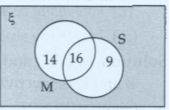
In a class of 50 students, 30 students like Mathematics, 25 like Science, and 16 like both. Find the number of students who like
i. either Mathematics or Science
ii. neither Mathematics nor Science.
View full question & answer
Question 23 Marks
Mr. Sharma in Delhi is using an MTNL connection with a monthly plan of ₹ 240 , which has no free calls. The call charges are ₹ 1 per minute. Calculate the telephone bill payable for Mr. Sharma if he talks for 470 minutes in a month. Assume the broadband charges to be Nil. A GST of $18 \%$ is levied on the total bill amount.
Answer
Here, the monthly charges are ₹ 240
Since the tariff plan chosen by Mr. Sharma has no free calls and he talks for 470 minutes
$\therefore$ Call charges @ ₹ 1 per minute $=₹(470 \times 1)=₹ 470$
Broband charges = Nil
$\therefore$ Total Bill Amount $=$ Monthly Charges + Call Charges
= ₹ $240+₹ 470=₹ 710$
A GST of $18 \%$ is levied on the total bill amount
GST= $18 \%$ of 710
= ₹ 127.80
$\therefore$ Total Bill Payable $=₹ 710+₹ 127.80$
= ₹ 837.80

View full question & answer
Question 33 Marks
A machinery can be purchased by paying ₹ 600,000 now or ₹ 200,000 initially and two instalments of ₹ 300,000 at the end of second year and ₹ 190,000 at the end of 4th year respectively. To pay cash now, the buyer would have to withdraw the money from an investment earning interest at $8 \%$ compounded annually. Which option is better and by how much in present value terms?
Answer
Let $P_{1}$ be the present value of ₹ 300,000 due 2 years hence at $i=\frac{8}{100}=0.08$ compounded annually. Also, let $P_{2}$ be the present value of ₹ 190,000 due 4 years hence at $i=\frac{8}{100}=0.08$ compounded annually. Then,
$\mathrm{P}_{1}=300,000(1+\mathrm{i})^{-2}$ and $\mathrm{P}_{2}=190,000(1+\mathrm{i})^{-4}$
$\Rightarrow \mathrm{P}_{1}=300,000(1.08)^{-2}$ and $\mathrm{P}_{2}=190,000(1.08)^{-4}$
$\Rightarrow \mathrm{P}_{1}=300,000 \times 0.85733882$ and $\mathrm{P}_{2}=190,000 \times 0.73502985$
$\Rightarrow \mathrm{P}_{1}=257,201.446$ and $\mathrm{P}_{2}=,655.6715$
$\Rightarrow \mathrm{P}_{1}+\mathrm{P}_{2}=396,857.3175 \simeq 396,857.32$
Thus, in the second option the machinery costs ₹ $(200,000+396,857.32)=₹ 596,857.32$
Clearly, in the second option the machinery costs less. Hence, second option is better and it is better by ₹ (600,000-596,857.32) = ₹ 3142.68

View full question & answer
Question 43 Marks
Find the domain of the function f defined by $f(x)=\sqrt{4-x}+\frac{1}{\sqrt{x^2-1}}$
View full question & answer
Question 53 Marks
Rohit is the husband of Vanshika. Sumita is the sister of Rohit. Anushka is the sister of Vanshika. How Anushka is related to Rohit?
View full question & answer
Question 63 Marks
If $\mathrm{A}_{1}$ and $\mathrm{A}_{2}$ are two A.M.'s between a and b , prove that
i. $\mathrm{A}_{1}+\mathrm{A}_{2}=\mathrm{a}+\mathrm{b}$
ii. $\left(2 \mathrm{~A}_{1}-\mathrm{A}_{2}\right)\left(2 \mathrm{~A}_{2}-\mathrm{A}_{1}\right)=a b$
Answer
Let $A_{1}, A_{2}$ be two A.M.'s between $a$ and $b$, then $a, A_{1}, A_{2}, b$ are in A.P.
As a, $\mathrm{A}_{1}, \mathrm{~A}_{2}$ are in A.P.
$\therefore 2 \mathrm{~A}_{1}=\mathrm{a}+\mathrm{A}_{2}$
$\Rightarrow 2 A_1- A _2= a \ldots(1)$
Similarly, $\mathrm{A}_{1}, \mathrm{~A}_{2}$, b are in A.P.
$\Rightarrow 2 \mathrm{~A}_{2}-\mathrm{A}_{1}=\mathrm{b} . .$. (2)
i. Adding (1) and (2), we get $\mathrm{A}_{1}+\mathrm{A}_{2}=\mathrm{a}+\mathrm{b}$
ii. Multiplying (1) and (2), we get $\left(2 \mathrm{~A}_{1}-\mathrm{A}_{2}\right)\left(2 \mathrm{~A}_{2}-\mathrm{A}_{1}\right)=a b$
View full question & answer
Question 73 Marks
If $\mathrm{a}, \mathrm{b}, \mathrm{c}, \mathrm{d}$ are in G.P, show that $\mathrm{a}^{2}+\mathrm{b}^{2}, \mathrm{~b}^{2}+\mathrm{c}^{2}, \mathrm{c}^{2}+\mathrm{d}^{2}$ are in G.P.
Answer
From the question, it is given that $\mathrm{a}, \mathrm{b}, \mathrm{c}, \mathrm{d}$ are in G.P
So, bc = ad
$b^{2}=\mathrm{ac}$
$c^{2}=b d$
We have to show that,
$a^{2}+b^{2}, b^{2}+c^{2}, c^{2}+d^{2}$ are in G.P.
Then, $\left(b^{2}+c^{2}\right)^{2}=\left(a^{2}+b^{2}\right)\left(c^{2}+d^{2}\right)$
Consider the LHS $=\left(b^{2}+c^{2}\right)^{2}$
$=b^{4}+c^{4}+2 b^{2} c^{2}$
From the equation (ii) and equation (iii)
$=a^{2} c^{2}+b^{2} d^{2}+a^{2} d^{2}+b^{2} c^{2}$
$=c^{2}\left(a^{2}+b^{2}\right)+d^{2}\left(a^{2}+b^{2}\right)$
$=\left(a^{2}+b^{2}\right)\left(c^{2}+d^{2}\right)$
Now consider the
RHS $=\left(a^{2}+b^{2}\right)\left(c^{2}+d^{2}\right)$
By comparing the LHS and RHS
LHS = RHS
Hence it is proved that, $a^{2}+b^{2}, b^{2}+c^{2}, c^{2}+d^{2}$ are in G.P.
View full question & answer
