Questions

Case study (4 Marks)

🎯

Test yourself on this topic

4 questions · timed · auto-graded

Question 14 Marks
Answer
Read the text carefully and answer the questions:
Five friends Mohit, Sachin, Rohit, Mohan and kapil were playing in a ground, where they sit in a row in a straight line.
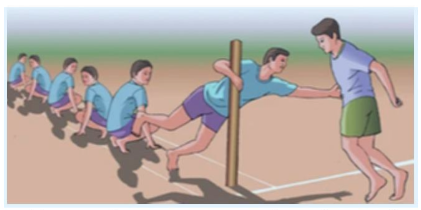
Image
(i) Total number of ways $=5!=120$
(ii) Two position are fixed for Mohit and Sachin therefore considering it as one unit, total students left $=3+1=4$
Total possible arrangement $=4!\times 2!=48$
(iii)Total possible arrangements $=3!\times 2!=12$
(iv)Total possible arrangements $=4$ ! $=24$
View full question & answer
Question 24 Marks
Read the text carefully and answer the questions:
A mobile number is having 10 digits. It is not just a group of numbers strung out at random. All mobile numbers have 3 things in common, a 2-digit Access code (AC), a 3-digit provider code (PC), and a 5 digit subscriber code (SC). AC code and PC code are fixed, then
(a) How many mobile number are possible if number start with 98073 and no other digit can repeat.
(b) How many AC code are possible if both digit in AC code are different and must be greater than 6.
(c) How may mobile number are possible if AC and PC code are fixed and digits can repeat
(d) How many mobile numbers are possible with AC code 98 and PC code 123 and digit used in AC and PC code will not be used in SC code.
Answer
Read the text carefully and answer the questions:
A mobile number is having 10 digits. It is not just a group of numbers strung out at random. All mobile numbers have 3 things in common, a 2-digit Access code (AC), a 3-digit provider code (PC), and a 5 digit subscriber code (SC). AC code and PC code are fixed, then
(i) 98073 V IV III II I
The digits which can be used are, $6,5,4,2,1$
Number of ways to fill the 5 places
=5!=120
(ii) Digits which can be used in AC code are 7, 8, 9
Total AC code $={ }^{3} \mathrm{P}_{2}=3!=6$
(iii) If AC and PC are fixed then only 5 digits is to be filled if digits can repeat then total ways $=100000=10^{5}$
(iv)Total ways $=5 \times 5 \times 5 \times 5 \times 5=3125$
View full question & answer
Question 34 Marks
Read the text carefully and answer the questions:
In class of Statistics, teacher was discussing the concept of Measures of Correlation, in which he was discussing about Karl Pearson's Coefficient of Correlation. During his class, he discussed the following few points on this: This is the best method for finding correlation between two variables provided the relationship between the two variables is linear. This method is also known as product moment correlation coefficient. Pearson's correlation coefficient may be defined as the ratio of covariance between the two variables to the product of the standard deviations of the two variables.
If the two variables are denoted by x and y and of the corresponding bivariates data are $\left(\mathrm{x}_{\mathrm{i}}, \mathrm{y}_{\mathrm{i}}\right)$ for $\mathrm{i}=1,2,3, \ldots$, n , then the coefficent of correlation between x and y due to Karl Pearson, is given by:
$r=r_{x y}$
or, $\mathrm{r}_{\mathrm{xy}}=\frac{\operatorname{Cov}(x, y)}{\sqrt{\operatorname{Var} x} \cdot \sqrt{\operatorname{Var} y}}$
$=\frac{\operatorname{Cov}(x, y)}{\sigma_{x} \cdot \sigma_{y}}$
where,
$\operatorname{cov}(\mathrm{X}, \mathrm{y})=\frac{\Sigma(x-\bar{x})(y-\bar{y})}{N}$
$=\frac{\Sigma x y}{N}-\bar{x} \cdot \bar{y}$
$\sigma_{x}=\sqrt{\frac{\Sigma(x-\bar{x})^{2}}{N}}=\sqrt{\frac{\Sigma x^{2}}{N}-x^{-2}}$
$\sigma_{y}=\sqrt{\frac{\Sigma(y-\bar{y})^{2}}{N}}=\sqrt{\frac{\Sigma y^{2}}{N}-y^{-2}}$
If $\mathrm{x}-\bar{x}-\bar{y}$ are small fractions, we use
$\mathrm{r}=\frac{\Sigma(x-\bar{x})(y-\bar{y})}{\sqrt{\Sigma(x-\bar{x})^{2}} \sqrt{\Sigma(y-\bar{y})^{2}}}$
If $x, y$ are small numbers, we use
$r=\frac{\Sigma x y-\frac{1}{N} \Sigma x \Sigma y}{\sqrt{\Sigma x^{2}-\frac{1}{N}(\Sigma x)^{2}} \sqrt{\Sigma y^{2}-\frac{1}{N}(\Sigma y)^{2}}}$
If $x, y$ are large numbers, we use assumed mean $A$ and $B$ and $u=x-A, v=y-B$
$\mathrm{r}=\frac{\Sigma u v-\frac{1}{N} \Sigma u \Sigma v}{\sqrt{\Sigma u^{2}-\frac{1}{N}(\Sigma u)^{2}} \sqrt{\Sigma v^{2}-\frac{1}{N}(\Sigma v)^{2}}}$
For example:
Find Karl Pearson's coefficient of correlation between X and Y for the following:
x54321
y421086

Following problem was given to students on the same concept:
(a) What is the value $\Sigma x y$ in this data?
(b) What is the value $\Sigma x^{2}$?
(c) What is the value of $\Sigma y^{2}$?
OR
What is the value of Karl Pearson's Coefficient of Correlation between x and y?
Answer
Read the text carefully and answer the questions:
In class of Statistics, teacher was discussing the concept of Measures of Correlation, in which he was discussing about Karl Pearson's Coefficient of Correlation. During his class, he discussed the following few points on this:This is the best method for finding correlation between two variables provided the relationship between the two variables is linear. This method is also known as product moment correlation coefficient. Pearson's correlation coefficient may be defined as the ratio of covariance between the two variables to the product of the standard deviations of the two variables.
If the two variables are denoted by x and y and of the corresponding bivariates data are $\left(\mathrm{x}_{\mathrm{i}}, \mathrm{y}_{\mathrm{i}}\right)$ for $\mathrm{i}=1,2,3, \ldots, \mathrm{n}$, then the coefficent of correlation between x and y due to Karl Pearson, is given by:
$r=r_{x y}$
or, $\mathrm{r}_{\mathrm{xy}}=\frac{\operatorname{Cov}(x, y)}{\sqrt{\operatorname{Var} x} \cdot
\sqrt{\operatorname{Var} y}}$
$=\frac{\operatorname{Cov}(x, y)}{\sigma_{x} \cdot \sigma_{y}}$
where,
$\operatorname{cov}(\mathrm{x}, \mathrm{y})=\frac{\Sigma(x-\bar{x})(y-\bar{y})}{N}$
$=\frac{\Sigma x y}{N}-\bar{x} \cdot \bar{y}$
$\sigma_{x}=\sqrt{\frac{\Sigma(x-\bar{x})^{2}}{N}}=\sqrt{\frac{\Sigma x^{2}}{N}-x^{-2}}$
$\sigma_{y}=\sqrt{\frac{\Sigma(y-\bar{y})^{2}}{N}}=\sqrt{\frac{\Sigma y^{2}}{N}-y^{-2}}$
If $\mathrm{x}-\bar{x}-\bar{y}$ are small fractions, we use
$\mathrm{r}=\frac{\Sigma(x-\bar{x})(y-\bar{y})}{\sqrt{\Sigma(x-\bar{x})^{2}} \sqrt{\Sigma(y-\bar{y})^{2}}}$
If $x, y$ are small numbers, we use
$r=\frac{\Sigma x y-\frac{1}{N} \Sigma x \Sigma y}{\sqrt{\Sigma x^{2}-\frac{1}{N}(\Sigma x)^{2}} \sqrt{\Sigma y^{2}-\frac{1}{N}(\Sigma y)^{2}}}$
If $\mathrm{x}, \mathrm{y}$ are large numbers, we use assumed mean A and B and $\mathrm{u}=\mathrm{x}-\mathrm{A}, \mathrm{v}=\mathrm{y}-\mathrm{B}$
$\mathrm{r}=\frac{\Sigma u v-\frac{1}{N} \Sigma u \Sigma v}{\sqrt{\Sigma u^{2}-\frac{1}{N}(\Sigma u)^{2}} \sqrt{\Sigma v^{2}-\frac{1}{N}(\Sigma v)^{2}}}$
For example:
Find Karl Pearson's coefficient of correlation between $X$ and $Y$ for the following:
x54321
y421086

Following problem was given to students on the same concept:
(i)
xyxy
5420
428
31030
2816
166
Total80

(ii)
$x$$x^2$
525
416
39
24
11
$\Sigma x^2$55

(iii)
$y$$y^2$
416
24
10100
864
636
$\Sigma y^2$220

OR
$x$$x^2$$y$$y^2$xy
52541620
416248
391010030
2486416
116366
$\sum x$ = 15$\sum x^2$ = 55$\sum y$ = 30$\sum y^2$ = 220$\sum x y$ = 80

\[\begin{aligned}
& =\frac{\Sigma x y-\frac{1}{N} \Sigma x \Sigma y}{\sqrt{\Sigma x^{2}-\frac{(\Sigma x)^{2}}{N}} \sqrt{\Sigma y^{2}-\frac{(\Sigma y)^{2}}{N}}} \\
& =\frac{80-\frac{1}{5} \times 15 \times 30}{\sqrt{55-\frac{(15)^{2}}{5}}\sqrt{220-\frac{(30)^{2}}{5}}} \\& =\frac{-10}{\sqrt{10} \sqrt{40}}=\frac{-10}{20}=-0.5\end{aligned}\]
Therefore, Karl Pearson's Coefficient of Correlation between x and y is -0.5 .
View full question & answer
Question 44 Marks
Answer
Read the text carefully and answer the questions:
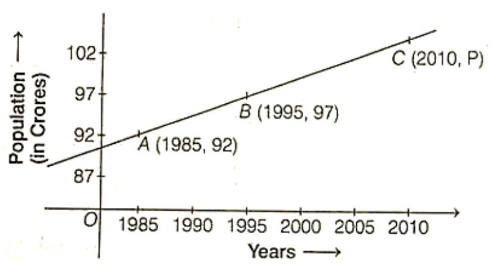
Population vs Year graph given below.
Image
(i) Equation of line AB is,
$x-2 y=1801$
Putting y $=110$,
$\therefore \mathrm{x}=1801+220$
$\Rightarrow \mathrm{x}=2021$
(ii) $\because$ Slope of $A B=\frac{1}{2}$
Slope of the perpendicular of $\mathrm{AB}=\frac{-1}{\frac{1}{2}}=-2$
$\therefore$ Equation of line perpendicular to AB passing through $(1995,97)$ is
$\Rightarrow \mathrm{y}-97=-2(\mathrm{x}-1995)$
$\Rightarrow \mathrm{y}-97=-2 \mathrm{x}+3990$
$\Rightarrow 2 \mathrm{x}+\mathrm{y}=4087$
(iii)Equation of line $A B$ is,
$\Rightarrow \mathrm{y}-\mathrm{y}_{1}=\mathrm{m}\left(\mathrm{x}-\mathrm{x}_{1}\right)$
$\therefore \mathrm{y}-92=\frac{1}{2}(\mathrm{x}-1985)$
$2 y-184=x-1985$
$\Rightarrow \mathrm{x}-2 \mathrm{y}=1801$
OR
Slope of line $A B$ joining points $A(1985,92)$ and $B(1995,97)$
$\mathrm{m}=\frac{97-92}{1995-1985}=\frac{5}{10}=\frac{1}{2}$
View full question & answer
Case study (4 Marks) - Applied Maths STD 11 Science Questions - Vidyadip