Questions

2 Marks Questions

🎯

Test yourself on this topic

7 questions · timed · auto-graded

Question 12 Marks
Convert the given decimal number 569 to the binary number.
Answer
Given: decimal number $=569$
Quotient Remainder
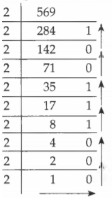
Image
$\therefore(569)_{10}=(1000111001)_{2}$


View full question & answer
Question 22 Marks
Differentiate the following function w.r.t. $\mathrm{x}: \frac{\sqrt{x^{2}+1}-x}{\sqrt{x^{2}+1}+x}$
Answer
Let $\mathrm{y}=\frac{\sqrt{x^{2}+1}-x}{\sqrt{x^{2}+1}+x}=\frac{\sqrt{x^{2}+1}-x}{\sqrt{x^{2}+1}+x} \times \frac{\sqrt{x^{2}+1}-x}{\sqrt{x^{2}+1}-x}$
$=\frac{\left(x^{2}+1\right)+x^{2}-2 x \sqrt{x^{2}+1}}{\left(x^{2}+1\right)-x^{2}}=\frac{2 x^{2}+1-2 x \sqrt{x^{2}+1}}{1}$
$=2 \mathrm{x}^{2}+1-2 \mathrm{x} \sqrt{x^{2}+1}$, differentiating w.r.t. x , we get
$\frac{d y}{d x}=2 \cdot 2 \mathrm{x}+0-2\left[\mathrm{x} \cdot \frac{1}{2}\left(x^{2}+1\right)^{\frac{-1}{2}} \cdot 2 \mathrm{x}+\sqrt{x^{2}+1} \cdot 1\right]$
$=4 \mathrm{x}-2\left[\frac{x^{2}}{\sqrt{x^{2}+1}}+\sqrt{x^{2}+1}\right]=4 \mathrm{x}-2 \cdot \frac{x^{2}+\left(x^{2}+1\right)}{\sqrt{x^{2}+1}}=2\left[2 x-\frac{2 x^{2}+1}{\sqrt{x^{2}+1}}\right]$
View full question & answer
Question 32 Marks
Find the derivative of $\frac{x}{2 x+1}$, with respect to x .
Answer
Let $\mathrm{y}=\frac{x}{2 x+1}$
Differentiating w.r.t. x , we get
$\frac{d y}{d x}=\frac{d}{d x}\left(\frac{x}{2 x+1}\right)$
$=\frac{(2 x+1) \frac{d x}{d x}-x \cdot \frac{d}{d x}(2 x+1)}{(2 x+1)^{2}}$
$=\frac{(2 x+1) \cdot 1-x \cdot 2}{(2 x+1)^{2}}$
$=\frac{2 x+1-2 x}{(2 x+1)^{2}}$
$=\frac{1}{(2 x+1)^{2}}$
View full question & answer
Question 42 Marks
In covering a distance of 40 km Sachin takes 3 hours more than Utkarsh. If Sachin doubles his speed then he would take 1 hour less than Utkarsh. Find their speeds.
Answer
Let Sachin's speed be $S_{1} \mathrm{~km} / \mathrm{h}$ and Utkarsh's speed be $S_{2} \mathrm{~km} / \mathrm{h}$, then
$\frac{40}{S_{1}}-\frac{40}{S_{2}}=3$ and $\frac{40}{S_{2}}-\frac{40}{2 S_{1}}=1$
On adding, we get $\frac{40}{S_{1}}-\frac{40}{2 S_{1}}=4 \Rightarrow \frac{40-20}{S_{1}}=4 \Rightarrow \mathrm{~S}_{1}=5 \mathrm{~km} / \mathrm{h}$
Putting this value of $\mathrm{S}_{1}$ in equation $\frac{40}{S_{1}}-\frac{40}{S_{2}}=3$, we get $\frac{40}{5}-\frac{40}{S_{2}}=3 \Rightarrow \mathrm{~S}_{2}=8 \mathrm{~km} / \mathrm{h}$.
$\therefore$ Sachin speed is $5 \mathrm{~km} / \mathrm{h}$ and Utkarsh speed is $8 \mathrm{~km} / \mathrm{h}$.
View full question & answer
Question 52 Marks
If $A$ and $B$ are two sets such that $n(A)=37, n(B)=26$ and $n(A \cup B)=51$, find $n\{A \cap B)$.
Answer
Given: $n(A)=37$
$n(B)=26$
$n(A \cup B)=51$
To Find: $\mathrm{n}(\mathrm{A} \cap \mathrm{B})$
We know that,
$|A \cup B|=|A|+|B|-|A \cap B|$ (where $A$ and $B$ are two finite sets)
Thus,we have
$\mathrm{n}(\mathrm{A} \cup \mathrm{B})=\mathrm{n}(\mathrm{A})+\mathrm{n}(\mathrm{B})-\mathrm{n}(\mathrm{A} \cap \mathrm{B})$
$51=37+26-n(A \cap B)$
$\mathrm{n}(\mathrm{A} \cap \mathrm{B})=63-51=12$
Thus,
$\mathrm{n}(\mathrm{A} \cap \mathrm{B})=12$
View full question & answer
Question 62 Marks
Prove that $\mathrm{A}-\mathrm{B}=\mathrm{A} \cap \mathrm{B}^{\prime}$.
Answer
Suppose $x$ be some element in set $A-B$ that is $x \in(A-B)$
Now if we prove that $x \in\left(A \cap B^{\prime}\right)$ then $(A-B)=\left(A \cap B^{\prime}\right)$
$x \in(A-B)$ means $x \in A$ and $x \notin B$
Now $x \notin B$ means $x \in B ’$
Therefore, we can say that $x \in A$ and $x \in B$ '
Thus $x \in A \cap B$.'
And as $\mathrm{x} \in \mathrm{A} \cap \mathrm{B}$ ' and also $\mathrm{x} \in \mathrm{A}-\mathrm{B}$ we can conclude that
$\mathrm{A}-\mathrm{B}=\mathrm{A} \cap \mathrm{B}$,
View full question & answer
Question 72 Marks
A and B undertake to do a piece of work for ₹ 600 , A alone can do it in 6 days while $B$ alone can do it in 8 days. With the help of C , they finish it in 3 days find the share of each.
Answer
C's 1 days' work $=\frac{1}{3}-\left(\frac{1}{6}+\frac{1}{8}\right)=\frac{1}{24}$
$\therefore$ A : B:C = Ratio of their 1 day's work
$=\frac{1}{6}: \frac{1}{8}: \frac{1}{24}=4: 3: 1$
$\therefore$ A's share $=$ ₹ $\left(600 \times \frac{4}{8}\right)=$ ₹ $300$
B's share $=$ ₹$\left(600 \times \frac{3}{8}\right)=$ ₹ $225$
C's share $=$ ₹ $\left(600 \times \frac{1}{8}\right)=$ ₹ $75$
View full question & answer
2 Marks Questions - Applied Maths STD 11 Science Questions - Vidyadip