Questions

5 Marks Questions

🎯

Test yourself on this topic

6 questions · timed · auto-graded

Question 15 Marks
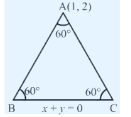
Find the equations of two straight lines passing through $(1,2)$ and making an angle of $60^{\circ}$ with the line $x+y=$ [5]0 . Find also the area of the triangle formed by the three lines.
View full question & answer
Question 25 Marks
Find the mean deviation about the mean for the data
Income per day in 0-100100-200200-300300-400400-500500-600600-700700-800
Number of persons489107543
Answer
Income per dayMid values $X _{ i }$$f _{ i }$$f _{ i } x _{ i }$$x_i-358 \mid$$f _{ j }\left| x _{ i }-358\right|$
0-1005042003081232
100-200150812002081664
200-30025092250108972
300-400350103500880
400-5004507315092644
500-60055052750192960
600-700650426002921168
700-800750322503921176
  5017900 7896
Mean $\bar{x}=\frac{1}{N} \sum f_{i} x_{i}=\frac{1}{50} \times 17900=358$
Mean deviation about mean $=\frac{1}{N} \sum_{i=1}^{n} f_{i}\left|x_{i}-\bar{x}\right|$
$=\frac{1}{50} \times 7896=157.92$
View full question & answer
Question 35 Marks
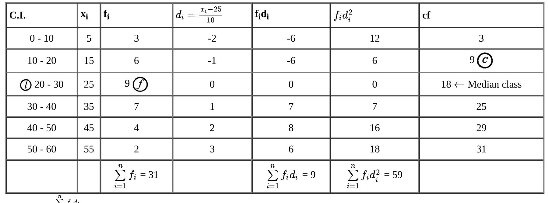
Calculate Karl Pearson's coefficient of skewness for the following data:
CI0-1010-2020-3030-4040-5050-60
r369742
View full question & answer
Question 45 Marks
Evaluate: $\lim _{x \rightarrow 0} \frac{\sqrt{1+x}-\sqrt{1-x}}{x}$
Answer
$\lim _{x \rightarrow 0} \frac{1+x-1+x}{x[\sqrt{1+x}+\sqrt{1-x}]}$ [By rationalising]
$=\lim _{x \rightarrow 0} \frac{2}{\sqrt{1+x}+\sqrt{1-x}}=\frac{2}{1+1}=1$
View full question & answer
Question 55 Marks
$60 \%$ students read Hindi newspaper, $40 \%$ students read Tamil newspaper and $20 \%$ students read both Hindi and Tamil newspaper. Find the probability that a student selected at random reads
i. Tamil newspaper given that he has already read Hindi newspaper.
ii. Hindi newspaper given that he has already read Tamil newspaper.
iii. neither Hindi nor Tamil newspaper.
Answer
Let H denote the event that the student reads Hindi newspaper and T denotes the event that the student reads Tamil newspaper.
Given $\mathrm{P}(\mathrm{H})=\frac{60}{100}, \mathrm{P}(\mathrm{T})=\frac{40}{100}$ and $\mathrm{P}(\mathrm{H} \cap \mathrm{T})=\frac{20}{100}$.
i. $\mathrm{P}(\mathrm{T} \mid \mathrm{H})=\frac{P(T \cap H)}{P(H)}=\frac{\frac{20}{100}}{\frac{60}{100}}=\frac{1}{3}$.
ii. $\mathrm{P}(\mathrm{H} \mid \mathrm{T})=\frac{P(H \cap T)}{P(T)}=\frac{\frac{20}{100}}{\frac{40}{100}}=\frac{1}{2}$.
iii. $\mathrm{P}\left(\mathrm{H}^{\prime} \cap \mathrm{T}^{\prime}\right)=1-\mathrm{P}(\mathrm{H} \cup \mathrm{T})=1-(\mathrm{P}(\mathrm{H})+\mathrm{P}(\mathrm{T})-\mathrm{P}(\mathrm{H} \cap \mathrm{T}))$
$
=1-\left(\frac{60}{100}+\frac{40}{100}-\frac{20}{100}\right) \cdot=\frac{20}{100}=\frac{1}{5}
$
View full question & answer
Question 65 Marks
Three persons A, B and C apply for a job of Manager in a private company. Chances of their selection (A, B and C are in the ratio 1:2:4. The probabilities that $\mathrm{A}, \mathrm{B}$ and C can introduce changes to improve profits of the company are $0.8,0.5$ and 0.3 , respectively. If the change does not take place, find the probability that it is due to the appointment of C .
Answer
Let us define the following events
$\mathrm{A}=$ selecting person A
$B=$ selecting person $B$
$\mathrm{C}=$ selecting person C
$\mathrm{P}(\mathrm{A})=\frac{1}{1+2+4}, \mathrm{P}(\mathrm{B})=\frac{2}{1+2+4}$
and $\mathrm{P}(\mathrm{C})=\frac{4}{1+2+4}$
$\mathrm{P}(\mathrm{A})=\frac{1}{7}, \mathrm{P}(\mathrm{B})=\frac{2}{7}$
and $\mathrm{P}(\mathrm{C})=\frac{4}{7}$
Let $\mathrm{E}=$ Event to introduce the changes in their profit.
Also given $P\left(\frac{E}{A}\right)=0.8, P\left(\frac{E}{B}\right)=0.5$ and $P\left(\frac{E}{C}\right)=0.3$
$\Rightarrow P\left(\frac{\bar{E}}{A}\right)=1-0.8=0.2, P\left(\frac{\bar{E}}{B}\right)=1-0.5=0.5$
and $P\left(\frac{\bar{E}}{C}\right)=1-0.3=0.7$
The probability that change does not take place by the appointment of C ,
$P\left(\frac{C}{E}\right)=\frac{P(C) \cdot P\left(\frac{\bar{E}}{C}\right)}{P(A) \times P\left(\frac{\bar{E}}{A}\right)+P(B) \times P\left(\frac{\bar{E}}{B}\right)+P(C) \times P\left(\frac{\bar{E}}{C}\right)}$
$=\frac{\frac{4}{7} \times 0.7}{\frac{1}{7} \times 0.2+\frac{2}{7} \times 0.5+\frac{4}{7} \times 0.7}$
$=\frac{2.8}{0.2+1.0+2.8}=\frac{2.8}{4}=0.7$
View full question & answer