Questions

MCQ

🎯

Test yourself on this topic

18 questions · timed · auto-graded

MCQ 11 Mark
Let $A=\{1,2,3\}$, then the domain of the relation $R=\{(1,1),(2,3),(2,1)\}$ defined on $A$ is
  • A
    $\{1,3\}$
  • $\{1,2\}$
  • C
    None of these
  • D
    $\{2,3\}$
Answer
Correct option: B.
$\{1,2\}$
(b) $\{1,2\}$
Explanation:
Since the domain is represented by the x - coordinate of the ordered pair ( $\mathrm{x}, \mathrm{y}$ ). Therefore, the domain of the given relation is $\{1,2\}$.
View full question & answer
MCQ 21 Mark
20 students can compete for a race. The number of ways in which they can win the first three places is (given that no two students finish in the same place).
  • A
    1140
  • B
    8000
  • 6840
  • D
    6000
Answer
Correct option: C.
6840
(c) 6840
Explanation:
For first place we have 20 students, for second we have 19 and for the third we have 18
${ }^{20} \mathrm{P}_{3}=20 \times 19 \times 18$
View full question & answer
MCQ 31 Mark
The present value of an annuity of ₹ 3993 payable at the end of each year for 3 years, if money is worth $10 \%$ effective.
  • A
    ₹ 9039
  • B
    ₹ 9903
  • ₹ 9930
  • D
    ₹ 9390
Answer
Correct option: C.
₹ 9930
(c) ₹ 9930
Explanation:
R = ₹ 3993, n = 3, i = 0.1
$\therefore$ Present value = ₹ 3993 $\left[\frac{1-(1.1)^{-3}}{0.1}\right]$
= ₹ 39930[1-0.7513] = ₹ 9930.
View full question & answer
MCQ 41 Mark
If $A$ and $B$ are independent events, then $P(A \cap B)$ is equal to:
  • A
    $\frac{P(A)}{P(B)}$
  • $\mathrm{P}(\mathrm{A}) \cdot \mathrm{P}(\mathrm{B})$
  • C
    $P(A)-P(B)$
  • D
    $P(A)+P(B)$
Answer
Correct option: B.
$\mathrm{P}(\mathrm{A}) \cdot \mathrm{P}(\mathrm{B})$
(b) $\mathrm{P}(\mathrm{A}) \cdot \mathrm{P}(\mathrm{B})$
Explanation:
Given A and B are independent events, then
$P(A \cap B)=P(A) \cdot P(B)$
View full question & answer
MCQ 51 Mark
There are three coins. One is a two headed coin (having head on both faces), another is a biased coin that comes up heads $75 \%$ of the time and third is an unbiased coin. One of the three coins is chosen at random and tossed, it shows heads, what is the probability that it was the two headed coin?
  • $\frac{4}{9}$
  • B
    $\frac{5}{9}$
  • C
    $\frac{1}{9}$
  • D
    $\frac{2}{9}$
Answer
Correct option: A.
$\frac{4}{9}$
(a) $\frac{4}{9}$
Explanation: Let
$E_{1}, E_{2}$ and $E_{3}$ and are events of selection of a two headed coin, biased coin and unbiased coin respectively.
$\therefore P\left(E_{1}\right)=P\left(E_{2}\right)=P\left(E_{2}\right)=\frac{1}{3}$.
Let $\mathrm{A}=$ event of getting head.
$P\left(A / E_{1}\right)=1, P\left(A / E_{2}\right)=\frac{3}{4}, P\left(A / E_{3}\right)=\frac{1}{2}$.
$P\left(E_{1} / A\right)=\frac{P\left(A / E_{1}\right) \cdot P\left(E_{1}\right)}{P\left(A / E_{1}\right) \cdot P\left(E_{1}\right)+P\left(A / E_{2}\right) \cdot P\left(E_{2}\right)+P\left(A / E_{3}\right) \cdot P\left(E_{3}\right)}$
$=\frac{\frac{1}{3} \cdot 1}{\frac{1}{3} \cdot 1+\frac{1}{3} \cdot \frac{3}{4}+\frac{1}{3} \frac{1}{2}}=\frac{4}{9}$
View full question & answer
MCQ 61 Mark
The number of ways in which the letters of the word CONSTANT can be arranged without changing the relative positions of the vowels and consonants is
  • A
    444
  • B
    372
  • 360
  • D
    256
Answer
Correct option: C.
360
(c) 360
Explanation:
The word CONSTANT consists of two vowels that are placed at the $2^{\text {nd }}$ and $6^{\text {th }}$ position, and six consonants.
The two vowels can be arranged at their respective places, i.e. $2^{\text {nd }}$ and $6^{\text {th }}$ place, in 2 ! ways.
The remaining 6 consonants can be arranged at their respective places in $\frac{6!}{2!2!}$ ways.
$\therefore$ Total number of arrangements $=360$
View full question & answer
MCQ 71 Mark
Find the simple interest on ₹ 5200 for 2 years at $6 \%$ per annum:
  • A
    ₹ 600
  • ₹ 624
  • C
    ₹ 524
  • D
    ₹ 450
Answer
Correct option: B.
₹ 624
(b) ₹ 624
Explanation:
Given, $\mathrm{P}=5200, \mathrm{n}=2, \mathrm{i}=6 \%=\frac{6}{100}=0.06$
I = Pit
$\therefore \mathrm{I}=5200 \times 0.06 \times 2$
or, $\mathrm{I}=624$.
View full question & answer
MCQ 81 Mark
The product $\sqrt[3]{2} \cdot \sqrt[4]{2} \cdot \sqrt[12]{32}$ equals
  • A
    $\sqrt[12]{2}$
  • B
    $\sqrt[12]{32}$
  • 2
  • D
    $\sqrt{2}$
Answer
Correct option: C.
2
(c) 2
Explanation:
$\sqrt[3]{2} \cdot \sqrt[4]{2} \cdot \sqrt[12]{32}=2^{\frac{1}{3}} \cdot 2^{\frac{1}{4}} \cdot\left(2^{5}\right)^{\frac{1}{12}}=2^{\frac{1}{3}} \cdot 2^{\frac{1}{4}} \cdot 2^{\frac{5}{12}}=2^{\frac{1}{3}+\frac{1}{4}+\frac{5}{12}}$
$=2^{\frac{12}{12}}=2^{1}$
View full question & answer
MCQ 91 Mark
The mean deviation of the data $3,10,10,4,7,10,5$ from the mean is
  • A
    3.75
  • 2.57
  • C
    3
  • D
    2
Answer
Correct option: B.
2.57
(b) 2.57
Explanation:
Given data is $3,10,10,4,7,10,5$. They are total 7 .
Here mean, $\bar{x}=\frac{3+10+10+4+7+10+5}{7}=\frac{49}{7}=7$
This can be written in table form as,
Data (xi)$d _{ i }=\left| x _{ i }-\bar{x}\right|$
3=|3-7|=4
10=|10-7|=3
10=|10-7|=3
4=|4-7|=3
7=|7-7|=0
10=|10-7|=3
5=|5-7|=2
Total$\Sigma d _{ i }=18$
Hence Mean Deviation becomes,
$
\text { M.D }=\frac{\sum d_i}{7}=\frac{18}{7}=2.57
$
Therefore, the mean deviation about the mean of the distribution is 2.57
View full question & answer
MCQ 101 Mark
How many odd days are there in a century?
  • A
    4
  • B
    2
  • C
    3
  • 5
Answer
Correct option: D.
5
(d) 5
Explanation:
In a century, we have 24 leap years and 76 non-leap years, so number of odd days
$=2 \times 24+1 \times 76=48+76=124$
$=7 \times 17+5=5$ odd days
View full question & answer
MCQ 111 Mark
Equation of the circle with centre lies on the $y$-axis and passing through the origin and the point $(2,3)$ is:
  • $3 x^{2}+3 y^{2}-13 y=0$
  • B
    $x^{2}+y^{2}+13 y=0$
  • C
    $6 x^{2}+6 y^{2}-13 x=0$
  • D
    $x^{2}+y^{2}+13 x+3=0$
Answer
Correct option: A.
$3 x^{2}+3 y^{2}-13 y=0$
(a) $3 x^{2}+3 y^{2}-13 y=0$
Explanation:
Given that the circle with centre lies on the $y$-axis and passing through the origin.
General equation of the circle is
$(x-0)^{2}+(y-k)^{2}=k^{2}$
It passes through $(2,3)$
i.e. $2^{2}+(3-k)^{2}=k^{2}$
$\Rightarrow 4+9+\mathrm{k}^{2}-6 \mathrm{k}=\mathrm{k}^{2}$
$\Rightarrow k=\frac{13}{6}$
Therefore, the required equation of the circle is
$x^{2}+\left(y-\frac{13}{6}\right)^{2}=\left(\frac{13}{6}\right)^{2}$
$\Rightarrow 3 x^{2}+3 y^{2}-13 y=0$
$3 x^{2}+3 y^{2}-13 y=0$
View full question & answer
MCQ 121 Mark
6 boys and 6 girls sit in a row at random. The probability that all the girls sit together is
  • A
    $\frac{12}{431}$
  • B
    $\frac{1}{432}$
  • C
    $\frac{1}{112}$
  • $\frac{1}{132}$
Answer
Correct option: D.
$\frac{1}{132}$
(d) $\frac{1}{132}$
Explanation:
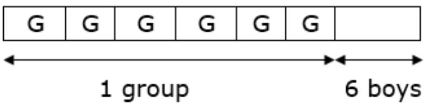
If all the girls sit together, then consider it as 1 group.
Image
Total number of persons $=6+1=7$ persons
$\therefore$ Total number of arrangements in a row of 7 persons $=7$ !
and the girls interchanges their seats in 6 ! ways.
Required Probability $=\frac{\text { Number of favourable outcome }}{\text { Total number of outcomes }}$
$\therefore$ Required probability $=\frac{6!7!}{12!}$
$=\frac{6 \times 5 \times 4 \times 3 \times 2 \times 1 \times 7!}{12 \times 11 \times 10 \times 9 \times 8 \times 7!}$
$=\frac{6 \times 5 \times 4 \times 3 \times 2}{12 \times 11 \times 10 \times 9 \times 8}$
$=\frac{1}{2 \times 11 \times 2 \times 3 \times 2}$
$=\frac{1}{132}$
Hence, the correct option
View full question & answer
MCQ 131 Mark
Standard form of 192.8 is
  • A
    $19.28 \times 10^{1}$
  • $1.928 \times 10^{2}$
  • C
    1.928
  • D
    $0.1928 \times 10^{-1}$
Answer
Correct option: B.
$1.928 \times 10^{2}$
(b) $1.928 \times 10^{2}$
Explanation:
Standard farm of
192.8
$=1.928 \times 10^{2}$
View full question & answer
MCQ 141 Mark
A relation $\phi$ from $C$ to $R$ is defined by $x \phi \Leftrightarrow|x|=y$. Which one is correct?
  • A
    $(1+i) \phi 2$
  • B
    $3 \phi(-3)$
  • i $\phi 1$
  • D
    $(2+3 i) \phi 13$
Answer
Correct option: C.
i $\phi 1$
(c) i $\phi 1$
Explanation:
We have $x \phi$ g given by, $|x|=y$
i $\phi 1$
$\mathrm{x}=\mathrm{i}$;
$|x|=\sqrt{1^{2}}$
$=1$
$1=1$
$|x|=y$.
View full question & answer
MCQ 151 Mark
If $\frac{\log 243}{\log 27}=\mathrm{x}$, then x is
  • $\frac{5}{3}$
  • B
    $\frac{3}{5}$
  • C
    3
  • D
    5
Answer
Correct option: A.
$\frac{5}{3}$
(a) $\frac{5}{3}$
Explanation:
$\frac{\log 243}{\log 27}=\mathrm{x}$
$\frac{\log 3^{5}}{\log 3^{3}}=\mathrm{x}$
$x \log 3^{3}=\log 3^{5}$
$\log \left(3^{3}\right)^{x}=\log 3^{5}$
$\log 3^{3 x}=\log 3^{5}$
$\therefore 3 x=5$
$\mathrm{x}=\frac{5}{3}$
View full question & answer
MCQ 161 Mark
The amount at the compound interest which is calculated yearly on a certain sum of money is ₹ 1250 is one year and ₹ 1375 in two years. The rate of interest per annum is:
  • A
    9 %
  • 10 %
  • C
    8 %
  • D
    11 %
Answer
Correct option: B.
10 %
(b) 10 %
Explanation:
₹ 1250 is the interest of first year and ₹ 1375 is the interest in second year. Here, the difference is of ₹ 125 which is the interest obtained ₹ 1250 .
Let rate be r%
$\therefore \frac{1250 \times r \times 1}{100}=125$
$\Rightarrow r=\frac{125 \times 100}{1250}=10$.
View full question & answer
MCQ 171 Mark
How many types of measures of dispersion are there?
  • A
    3
  • 5
  • C
    2
  • D
    4
Answer
Correct option: B.
5
(b) 5
Explanation:
There are five most commonly used measures of dispersion. These are range, variance, standard deviation, mean deviation and quartile deviation.
View full question & answer
MCQ 181 Mark
If $\mathrm{P}(\mathrm{A} \cap \mathrm{B})=\frac{1}{2}$ and $\mathrm{P}\left(A^{\prime} \cap B^{\prime}\right)=\frac{1}{3}, \mathrm{P}(\mathrm{A})=\mathrm{p}$ and $\mathrm{P}(\mathrm{B})=2 \mathrm{p}$, then the value of p is:
  • A
    $\frac{4}{9}$
  • B
    $\frac{1}{3}$
  • $\frac{7}{18}$
  • D
    $\frac{1}{9}$
Answer
Correct option: C.
$\frac{7}{18}$
(c) $\frac{7}{18}$
Explanation:
Given $\mathrm{P}\left(\mathrm{A}^{\prime} \cap \mathrm{B}^{\prime}\right)=\frac{1}{2}, \mathrm{P}^{\prime}\left(\mathrm{A}^{\prime} \cap \mathrm{B}^{\prime}\right)=\frac{1}{3}, \mathrm{P}(\mathrm{A})=\mathrm{p}, \mathrm{P}\left(\mathrm{B}^{\prime}\right)=2 \mathrm{p}$
Now, $\mathrm{P}\left(\mathrm{A}^{\prime} \cap \mathrm{B}^{\prime}\right)=(\mathrm{A} \cup \mathrm{B})^{\prime}=1-(\mathrm{A} \cup \mathrm{B})=\frac{1}{3}$
$\therefore \mathrm{P}(\mathrm{A} \cup \mathrm{B})=1-\frac{1}{3}=\frac{2}{3}$
$\Rightarrow \mathrm{P}(\mathrm{A})+\mathrm{P}(\mathrm{B})-\mathrm{P}(\mathrm{A} \cap \mathrm{B})=\frac{2}{3}$
$\Rightarrow \mathrm{p}+2 \mathrm{p}-\frac{1}{2}=\frac{2}{3}$
$\Rightarrow 3 \mathrm{p}=\frac{2}{3}+\frac{1}{2}=\frac{4+3}{6}=\frac{7}{6} \Rightarrow \mathrm{p}=\frac{7}{18}$
View full question & answer
MCQ - Applied Maths STD 11 Science Questions - Vidyadip