Questions

2 Marks Questions

🎯

Test yourself on this topic

12 questions · timed · auto-graded

Question 12 Marks
$(108)_{16}=(?)_{10}$
Answer
(vi) $(108)_{16}$
$\begin{array}{lll}\text { Digits } & 1 & 0 & 8\end{array}$
$\begin{array}{llll}\text { Position Number } & 2 & 1 & 0\end{array}$
$\begin{array}{lccc}\text { Position Value } & 16^2 & 16^1 & 16^0 \\ \text { Decimal Value } & 1 \times 16^2 & 0 \times 16^1 & 8 \times 16^0\end{array}$
$\begin{array}{l}=256+0+8 \\ =264\end{array}$
Thus, $\quad(108)_{16}=(264)_{10}$
View full question & answer
Question 22 Marks
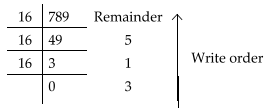
$(798)_{10}=(?)_{16}$
Answer
(v) $(789)_{10}$
To change decimal into hexadecimal, we divide given decimal number repeatedly by 16 .
Image
Thus, $\quad(789)_{10}=(315)_{16}$
View full question & answer
Question 32 Marks
$(889)_{10}=(?)_8$
Answer
(iv) $(889)_{10}$
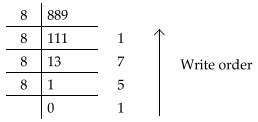
To change decimal number into octal number, the decimal number is repeatedly divided by 8 .
Image
Thus, $\quad(889)_{10}=(1571)_8$
View full question & answer
Question 42 Marks
$(76 F)_{16}=(?)_8$
Answer
(iii) $(76 F)_{16}$
$\begin{array}{cccc}\text { Hexadecimal Digits } & 7 & 6 & \text { F } \\ & \downarrow & \downarrow & \downarrow \\ & 0111 & 0110 & 1111\end{array}$
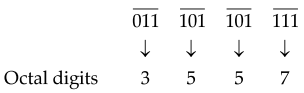
Now, group these digits from right to left in 3-bit form
Image
Thus, $\quad(76 F)_{10}=(3557)_8$
View full question & answer
Question 52 Marks
$(220)_8=(?)_2$
Answer
(ii) $(220)_8$
Octal Digits           2      2      0
3-bit binary digit  010  010  000
Thus, $\quad(220)_8=(010010000)_2$
View full question & answer
Question 62 Marks
$(514)_8=(?)_{10}$
Answer
(i) (514) 8
$\begin{array}{llll}\text { Digit } & 5 & 1 & 4\end{array}$
$\begin{array}{llll}\text { Position Number } & 2 & 1 & 0\end{array}$
$\begin{array}{llll}\text { Positional Value } & 8^2 & 8^1 & 8^0\end{array}$
Decimal Number $\quad 5 \times 8^2 \quad 1 \times 8^1 \quad 4 \times 8^0$
$\begin{array}{l}=5 \times 64+1 \times 8+4 \times 1 \\ =320+8+4=332\end{array}$
Hence, $\quad(514)_8=(332)_{10}$
View full question & answer
Question 72 Marks
Multiply $(1011.01)_2$ to $(110.1)_2$.
Answer

$\begin{array}{r}1011.01 \\ \hline \times \quad 110.1 \\ 101101 \\ 000000 \times \\ 101101 \times \times \\ \hline 101101 \times \times \times \\ \hline 1001001.001\end{array}$
Hence, $(1011.01)_2 \times(110.1)_2=(1001001.001)_2$
View full question & answer
Question 82 Marks
Convert $(10101100.010111)_2$ to hexadecimal.
Answer
Making perfect group of $\overline{1010} \quad \overline{1100} \quad . \overline{0101} \quad \overline{1100}$ 4 bits
Writing hexadecimal A  C . 5  C
symbol foe each group
Therefore, $(10101100.010111)_2=( AC .5 C )_{16}$
View full question & answer
Question 102 Marks
Convert $(0.675)_{10}$ to binary.
Answer

Image
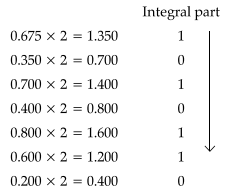
Since, the fraction part ( 0.400 ) is the repeating value in the calculation, the multiplication is stopped.
Now, we have to write the integral part from top to bottom to get binary number for the given fraction part.
Therefore, $\quad(0.675)_{10}=(0.1010110)_2$

View full question & answer
Question 112 Marks
Find Decimal equivalent of Binary Number $(1011.011)_2$
Answer
Binary to Decimal conversion is obtained by multiplying 2 to the power of base index along with the value at that index position.
$\begin{array}{lcccccccc}\text { Digit } & 1 & 0 & 1 & 1 & . & 0 & 1 & 1 \\ \text { Fractional Value} & 2^3 & 2^2 & 2^1 & 2^0 & . & 2^{-1} & 2^{-2} & 2^{-3}\end{array}$
$\begin{array}{l}\text { Decimal value} \quad\quad 1 \times 2^3 0 \times 2^2 1 \times 2^1 1 \times 2^0 .0 \times 2^{-1} 1 \times 2^{-2}
\\=8+0+2+1.0+0.25+0.125 \\ =11.375 \\ \text { Hence, } \quad(1011.011)_2=(11.375)_{10}\end{array}$
View full question & answer
Question 122 Marks
Find decimal equivalent of the octal number $(645)_8$.
Answer
Octal to Decimal conversion is obtained by multiplying 8 to the power of base index along with the value at that index portion.
The decimal equivalent of the octal number $(648)_8$ is
Given digits         $\begin{array}{lll}6 &\ 4 &\ 8\end{array}$
Position Number $\begin{array}{lll}2 &\ 1 &\ 0\end{array}$
Decimal value     $8^2 \quad 8^1 \quad 8^0$
$\begin{array}{ll}\text { Decimal Number } & 6 \times 8^2+4 \times 8^1+8 \times 8^0 \\ & =6 \times 64+4 \times 8+8 \times 1 \\ & =384+32+8 \\ & =424 \\ \text { Hence, } \quad(648)_8 & =(424)_{10}\end{array}$
View full question & answer
2 Marks Questions - Applied Maths STD 11 Science Questions - Vidyadip