Questions

4 Marks Questions

🎯

Test yourself on this topic

5 questions · timed · auto-graded

Question 14 Marks
$A \cap(B-C)=(A \cap B)-(A \cap C)$
Answer

$\begin{array}{l}\text {  Let } x \in\{A \cap(B-C)\} \\ x \in A \text { and } x \in B-C \\ x \in A \text { and } x \in B \text { and } x \notin C \\ (x \in A \text { and } x \in B) \text { and }(x \in A \text { and } x \notin C) \\ x \in A \cap B \text { and } x \notin A \cap C \\ x \in(A \cap B)-(A \cap C)\end{array}$
$A \cap(B-C) \subseteq(A \cap B)-(A \cap C) \ldots(i) $
Again, let
$
\begin{array}{l}
y \in(A \cap B) \cap(A-C) \\
y \in A \text { and }(y \in B \text { and } y \notin C) \\
y \in A \text { and } y \in B-C \\
y \in\{A \cap(B-C)\} \\
(A \cap B)-(A \cap C) \subseteq A \cap(B-C) \ldots(ii)
\end{array}
$
From eqs. (i) and (ii), we get
$
A \cap(B-C)=(A \cap B)-(A \cap C)
$
Hence Proved
View full question & answer
Question 24 Marks
Out of $2 5$ members in a family, 12 like to take tea, 15 like to take coffee and 7 like to take coffee and tea both. How many like (i) at least one of the two drinks (ii) only tea but not coffee (iii) only coffee but not tea (iv) neither tea nor coffee.
Answer
Given that,
$
\begin{aligned}
n(T) & =12 \\
n(C) & =15 \\
n(T \cap C) & =7
\end{aligned}
$

(i)
$
\begin{aligned}
n(T \cup C) & =n(T)+n(C)-n(T \cap C) \\
& =12+15-7 \\
n(T \cup C) & =20
\end{aligned}
$
20 members like at least one of the two drinks.

(ii) Only tea but not coffee
$
\begin{array}{l}
=n(T)-n(T \cap C) \\
=12-7 \\
=5
\end{array}
$

(iii) Only coffee but not tea
$
\begin{array}{l}
=n(C)-n(T \cup C) \\
=15-7 \\
=8
\end{array}
$

(iv) Neither tea nor coffee
$
\begin{array}{l}
=n(U)-n(T \cup C) \\
=25-20 \\
=5
\end{array}
$
View full question & answer
Question 34 Marks
Using properties of sets and their complements prove that:
(i) $(A \cup B) \cap\left(A \cap B^{\prime}\right)=A$
(ii) $A-(A \cap B)=A-B$
Answer
(i) $(A \cup B) \cap\left(A \cap B^{\prime}\right)=A$
$
\begin{array}{rlr}
\text { L. H. S. } & =(A \cup B) \cap\left(A \cap B^{\prime}\right) \\
& =A \cup\left(B \cap B^{\prime} \right)\quad(\text { By distributive law }) \\
& =A \cup \phi \ \left(B \cap B^{\prime}=\phi\right)\\
& =A \\
& =\text { R.H.S. } \text { Hence proved. } 
\end{array}
$

(ii)
$
\begin{aligned}
A-(A \cap B)= & A-B \\
\text { L.H.S. }= & A-(A \cap B) \\
= & A \cap(A \cap B)^{\prime} \\
& \quad\left[\therefore A-B=A \cap B^{\prime}\right] \\
= & A \cap\left(A^{\prime} \cup B^{\prime}\right) \\
& (B y \text { Demorgan's law }) \\
= & \left(A \cap A^{\prime}\right) \cup\left(A \cap B^{\prime}\right) \\
& \quad(\text { By distributive law }) \\
= & \phi \cup A \cap B^{\prime}\left(\therefore A \cap A^{\prime}=\phi\right) \\
= & A \cap B^{\prime} \\
= & A-B \\
= & \text { R.H.S } \quad \text { Hence Proved } 
\end{aligned}
$
View full question & answer
Question 44 Marks
If $(2 a+b, a-b)=(8,3)$, find $a$ and $b$.
Answer
We know that, two ordered pairs are equal, if their corresponding first and second elements are equal We have, $(2 a+b, a-b)=(8,3)$
$\therefore 2 a+b=8\quad \ldots(i)$
and $a-b=3\quad \ldots(ii)$
From eq. (ii), we get $b=a-3\quad \ldots(iii) $
On substituting, $b=a-3$, in eq. (i), we get
$
\begin{aligned}
\Rightarrow & & 2 a+(a-3) & =8 \\
\Rightarrow & & 3 a & =11 \\
\Rightarrow & & a & =\frac{11}{3}
\end{aligned}
$
Again, on substituting $a=\frac{11}{3}$ in eq. (iii), we get
$
\begin{array}{ll}
\Rightarrow & b=\frac{11}{3}-3 \\
\Rightarrow & b=\frac{2}{3} \\
\therefore & a=\frac{11}{3} \text { and } b=\frac{2}{3}
\end{array}
$
View full question & answer
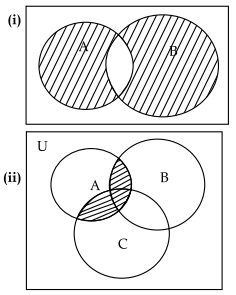
Question 54 Marks
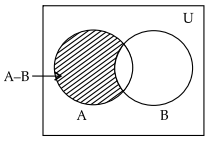
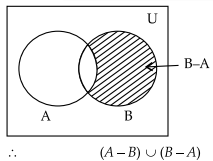
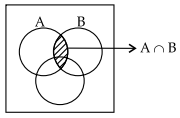
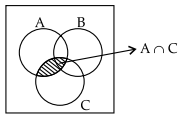
What is represented by the shaded regions in each of the following Venn-diagrams
Image
Answer
(i)
Image
Image

(ii)
Image
Image
$\begin{array}{lr}\therefore & (A \cap B) \cup(A \cap C) \\ \text { or } & A \cap(B \cup C)\end{array}$
View full question & answer
4 Marks Questions - Applied Maths STD 11 Science Questions - Vidyadip