Questions

3 Marks Question

🎯

Test yourself on this topic

15 questions · timed · auto-graded

Question 13 Marks
Reduce the equation $3 x-2 y+4=0$ to intercept form. Hence, find the length of the segment intercepted between the axes.
Answer
The given equation is $3 x-2 y+4=0$
⇒$3 x-2 y=-4$
On dividing both sides by -4 , we get
$\frac{3 x}{-4}-\frac{2 y}{-4}=1$
⇒ $\frac{x}{\frac{-4}{3}}+\frac{y}{2}=1$,
which is required intercept form.
Here, $a(x$-intercept $)=\frac{-4}{3}$ and $b(y$-intercept $)=2$
$\therefore$ The length of the segment intercepted between the axes
$=\sqrt{a^2+b^2}$
$\begin{array}{l}=\sqrt{\left(\frac{-4}{3}\right)^2+(2)^2} \\ =\sqrt{\frac{16}{9}+4} \\ =\sqrt{\frac{52}{9}} \\ =\frac{\sqrt{52}}{3} \text { units } \\ =\frac{2 \sqrt{13}}{3} \text { units. }\end{array}$
View full question & answer
Question 23 Marks
Find the condition, if the two lines $a x+b y=c$ and $a^{\prime} x+b^{\prime} y=a^{\prime} b^{\prime}$ are perpendicular.
Answer
The given lines are :
$a x+b y=c$
⇒$y=\frac{-a x}{b}+\frac{c}{b}$
$\therefore$ $m_1=\frac{-a}{b}$
and $a^{\prime} x+b^{\prime} y=c^{\prime}$
⇒ $y=\frac{-a^{\prime}}{b^{\prime}} x+\frac{c^{\prime}}{b^{\prime}}$
$\therefore$ $m_2=\frac{-a^{\prime}}{b^{\prime}}$
Since, the lines are perpendicular, then
$m_1 m_2=-1$
⇒ $\left(\frac{-a}{b}\right)\left(-\frac{a^{\prime}}{b^{\prime}}\right)=-1$
⇒ $\frac{a a^{\prime}}{b b^{\prime}}=-1$
$\Rightarrow a a^{\prime}+b b^{\prime}=0$, which is the required condition.
View full question & answer
Question 33 Marks
Prove that the lines $3 x+y-14=0, x-2 y=0$ and $3 x-8 y+4=0$ are concurrent.
Answer
Given equation of lines are
$\begin{array}{r}3 x+y-14=0\ldots(i) \\ x-2 y=0\ldots(ii) \\ 3 x-8 y+4=0\ldots(iii)\end{array}$
From eqs. (i) and (ii), i.e., eq. (i) $-3 \times$ eq. (ii),
$\Rightarrow(3 x+y-14)-3(x-2 y)=0$
$\Rightarrow  y+6 y-14=0$
⇒$y=2$
Putting value of $y$ in $x-2 y=0$, we get
$x=4$
$\therefore(4,2)$ is the common point of eq. (i) and eq. (ii). Substituting this point in eq. (iii), we get
$\begin{aligned} \text { L.H.S } & =3.4-8.2+4 \\ & =0=\text { R.H.S }\end{aligned}$
Thus, the point of intersection of eqs. (i) and (ii) satisfies the eq. (iii).
So, the given three points are concurrent.
View full question & answer
Question 43 Marks
Reduce the equation $6 x+2 y+5=0$ into intercept form and find its intercepts on the axes.
Answer
The given equation is
$6 x+2 y+5=0$
Here, $A=6, B=2, C=5$
$\therefore$ Equation in intercepts form is
$\frac{x}{-\frac{C}{A}}+\frac{y}{-\frac{C}{B}}=1$
⇒$\frac{x}{-\frac{5}{6}}+\frac{y}{-\frac{5}{2}}=1$
where intercept on $x$-axis
$\begin{aligned}
& =-\frac{5}{6} \\
\text { and intercept on } y \text {-axis } & =-\frac{5}{2} .
\end{aligned}$
View full question & answer
Question 53 Marks
Find the equation of the line passing through the point $(-1,3)$ and perpendicular to the line $3 x-4 y-16=0$
Answer
The given equation is
$3 x-4 y-16=0$
⇒ $y=\frac{3}{4} x-4$
$\therefore$ Slope of the line, $m_1=\frac{3}{4}$
$\therefore$ Slope of the perpendicular line, $m_2=-\frac{4}{3}$.
Since, the line passes through $(-1,3)$, so the equation of the line is
$y-y_0=m\left(x-x_0\right)$
⇒ $y-3=m_2(x+1)$ $\left[\right.$ Here, $\left.\left(x_0, y_0\right)=(-1,3)\right]$
⇒ $y-3=-\frac{4}{3}(x+1)$
⇒ $3 y-9=-4 x-4$
⇒ $4 x+3 y-5=0.$
View full question & answer
Question 63 Marks
The intercept cuts-off by a line from $Y$-axis is twice than that from $X$-axis and the line passes through the point $(1,2)$. Find the equation of the line.
Answer
The equation of a line in intercept form is
$\frac{x}{a}+\frac{y}{b}=1\ldots(i)$
Given,$b=2 a$
From eq. (i), we get
$\frac{x}{a}+\frac{y}{2 a}=1$
$\Rightarrow 2 x+y=2 a$
Since, the line passes through the point $(1,2)$, therefore,
$2.1+2=2 a$
$\begin{array}{l}\Rightarrow a=2 \\
\therefore \text { Equation of the line is }\end{array}$
$2 x+y-4=0$
View full question & answer
Question 73 Marks
Find the equation of the line which cut-off intercepts on the axes whose sum and products are 1 and - 6 respectively
Answer
Equation of a line in intercept form is
$\frac{x}{a}+\frac{y}{b}=1$
Given, $ a+b=1$
and $ a \times b=-6$
$\Rightarrow a-\frac{6}{a}=1$
$\Rightarrow a^2-a-6=0$
$\Rightarrow (a-3)(a+2)=0$
$\Rightarrow a=3,-2$
If $a=3, b=-2$ and if $a=-2, b=3$.
$\therefore$ Equation of the line is
$\frac{x}{3}-\frac{y}{2}=1$
or $\quad \frac{x}{-2}+\frac{y}{3}=1$
$\begin{array}{lr}
\Rightarrow & 2 x-3 y-6=0 \\
\text { or } & 3 x-2 y+6=0
\end{array}$
$2 x-3 y-6=0$ or $3 x-2 y+6=0$, is the required equation of the line.
View full question & answer
Question 83 Marks
Find the equation of the line, which passes through the point $(2,3)$ and makes an angle of $30^{\circ}$ with the positive direction of $X$-axis.
Answer
Given, inclination of the line, $\theta=30^{\circ}$.
$\therefore$ Slope of the line, $m=\tan 30^{\circ}=\frac{1}{\sqrt{3}}$
Equation of a line in one-point form is
$y-y_0=m\left(x-x_0\right)$
Since, $m=\frac{1}{\sqrt{3}}$ and $\left(x_0, y_0\right)=(2,3)$
$\therefore$ $y-3=\frac{1}{\sqrt{3}}(x-2)$
⇒$\sqrt{3} y-3 \sqrt{3}=x-2$
$\Rightarrow x-\sqrt{3} y+(2-3 \sqrt{3})=0$, is the required equation of the line.
View full question & answer
Question 93 Marks
If the line $\frac{x}{a}+\frac{y}{b}=1$ passes through the points $(2,-3)$ and $(4,-5)$, find the value of $a$ and $b$.
Answer
Equation of a line in intercept form is
$\frac{x}{a}+\frac{y}{b}=1\ldots(i)$
Since, the line passes through $(2,-3)$ and $(4,-5)$.
$\therefore$ $\frac{2}{a}-\frac{3}{b}=1$
⇒ $2 p-3 q=1 \quad\left[\right.$ let $\left.\frac{1}{a}=p, \frac{1}{b}=q\right]\ldots(ii)$
and $ \frac{4}{a}-\frac{5}{b}=1$
⇒$4 p-5 q=1\ldots(iii)$
From equations (ii) and (iii),
$p=-1, q=-1$
$\therefore$ $a=-1, b=-1$.
View full question & answer
Question 103 Marks
The slope of a line is double the slope of another line. If tangent of the angle between them is $\frac{1}{3}$, find the slope of the line.
Answer
Let the slope of line be m,
$\therefore$ Slope of the another line be 2m
$\because$ $\tan \theta=\left|\frac{m_1-m_2}{1+m_1 m_2}\right|$
⇒$\frac{1}{3}=\left|\frac{2 m-m}{1+2 m^2}\right|$
⇒ $\frac{1}{3}=\left|\frac{m}{1+2 m^2}\right|$
⇒ $\frac{1}{3}=\frac{m}{1+2 m^2}$
⇒ $2 m^2+1=3 m$
⇒ $2 m^2-3 m+1=0$
⇒ $(m-1)(2 m-1)=0$
If $m-1=0 \Rightarrow m=1$
If $2 m-1=0 \Rightarrow m=\frac{1}{2}$
Hence, slope of lines (1 and 2) or $\left(\frac{1}{2}\right.$ and 1$)$.
View full question & answer
Question 113 Marks
Show that the triangle whose vertices are (8, 2), (5, -3) and (0, 0) is an isosceles.
Answer
Let, the given vertices be $A\left(x_1, y_1\right)=(8,2), B\left(x_2, y_2\right)$ $=(5,-3)$ and $C\left(x_3, y_3\right)=(0,0)$
$\therefore$ $A B=\left|\sqrt{\left(x_1-x_2\right)^2+\left(y_1-y_2\right)^2}\right|$
$=\left|\sqrt{(8-5)^2+(2+3)^2}\right|$
$=\sqrt{34}$ units.
$B C=\left|\sqrt{\left(x_2-x_3\right)^2+\left(y_2-y_3\right)^3}\right|$
$=\left|\sqrt{(5-0)^2+(-3-0)^2}\right|$
$=\sqrt{34}$ units.
$\therefore A B=B C$ i.e; $\angle A C B=\angle B A C$
Hence, $\triangle A B C$ is isosceles.
View full question & answer
Question 123 Marks
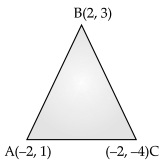
Determine $\angle B$ of the triangle with vertices $A (-2,1), B(2,3)$ and $C(-2,-4)$.
Answer
The given vertices are $A\left(x_1, y_1\right)=(-2,1), B\left(x_2, y_2\right)=$ $(2,3)$ and $C\left(x_3, y_3\right)=(-2,-4)$.
Slope of $AB , m_1=\frac{y_2-y_1}{x_2-x_1}$
$\begin{array}{l}=\frac{3-1}{2-(-2)} \\ =\frac{1}{2}\end{array}$
and slope of $B C, m_2=\frac{y_3-y_2}{x_3-x_2}=\frac{-4-3}{-2-2}=\frac{7}{4}$.
$\therefore$ Angle B, which is the angle between $A B$ and $B C$ is given by
Image
$\theta=\tan ^{-1}\left|\frac{m_2-m_1}{1+m_1 m_2}\right|$
$=\tan ^{-1}\left|\frac{\frac{7}{4}-\frac{1}{2}}{1+\frac{7}{4} \cdot \frac{1}{2}}\right|$
$=\tan ^{-1}\left|\left(\frac{5}{4} \times \frac{8}{15}\right)\right|$
$=\tan ^{-1}\left|\left(\frac{2}{3}\right)\right|$
View full question & answer
Question 133 Marks
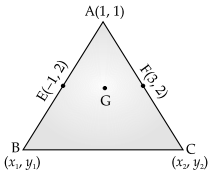
If a vertex of a triangle is (1, 1) and the mid-points of two sides through this vertex are (-1, 2) and (3, 2). Find the centroid of the triangle.
View full question & answer
Question 143 Marks
Co-ordinates of centroid of $\triangle A B C$ are $(1,-1)$. Vertices of $\triangle A B C$ are $A(-5,3), B(p,-1)$ and $C(6, q)$. Find $p$ and $q$.
Answer
Co-ordinates of centroid of a triangle with vertices $\left(x_1, y_1\right),\left(x_2, y_2\right)$ and $\left(x_3, y_3\right)$ are given by
$\left(\frac{x_1+x_2+x_3}{3}, \frac{y_1+y_2+y_3}{3}\right)$
Since the given vertices are $A(-5,3), B(p,-1)$ and $C(6, q)$. So the coordinates of the centroid of $\triangle A B C$ are
$\left(\frac{-5+p+6}{3}, \frac{3-1+q}{3}\right)=\left(\frac{p+1}{3}, \frac{2+q}{3}\right)$
Given, $\left(\frac{p+1}{3}, \frac{2+q}{3}\right)=(1,-1)$
⇒ $\frac{p+1}{3}=1$ and $\frac{2+q}{3}=-1$
⇒ $p=2$ and $q=-5$.
View full question & answer
Question 153 Marks
In what ratio Y-axis divides the line segment joining the points (3, 4) and (-2, 1) ?
Answer
Let the given points be A(x1, y1) = (3, 4) and B(x2, y2) = (-2, 1). Let m : n be the ratio in which the line segment is divided by Y-axis (the co-ordinates of the point are (0, y)).
$\therefore$ $(0, y)=\left(\frac{m x_2+n x_1}{m+n}, \frac{m y_2+n y_1}{m+n}\right)$
⇒ $(0, y)=\left(\frac{-2 m+3 n}{m+n}, \frac{m+4 n}{m+n}\right)$
⇒ $0=\frac{-2 m+3 n}{m+n}$, and $y=\frac{m+4 n}{m+n}$
⇒ $-2 m+3 n=0$
⇒ $2 m=3 n$
⇒ $m: n=3: 2$
View full question & answer
3 Marks Question - Applied Maths STD 11 Science Questions - Vidyadip