Questions

4 Marks Questions

🎯

Test yourself on this topic

8 questions · timed · auto-graded

Question 14 Marks
Obtain the equation of the line passing through the intersection of lines $4 x-3 y-1=0$ and $2 x-5 y$ $+3=0$ and equally inclined to the axes.
Answer
Given lines are
$4 x-3 y-1=0 \quad\ldots\text{(i)}$
$2 x-5 y+3=0\quad\ldots\text{(ii)}$
Now, eq. (i) $-2 \times$ eq. (ii),
$\Rightarrow 7 y-7 =0$
$\Rightarrow y =1$
Putting the values of $y$ in equation (i),
we get $x=1$
$\therefore(1,1)$ is the point of intersection of the lines (i) and (ii).
Now, let the equation of the line which is equally inclined to the axes be
$\frac{x}{a}+\frac{y}{a}=1$
$\Rightarrow$ $x+y=a\ldots(ii)$
Since, (iii) passes through $(1,1)$
$\therefore$ $1+1=a$
$\Rightarrow$ $a=2$
$\therefore$ Equation of the line is
$x+y-2=0$
View full question & answer
Question 24 Marks
Find the image of the point (3, 8) with respect to the line x + 3y = 7 assuming the line to be a plane mirror.
Answer
Let the image of point P(3,8) be Q(a, b) with respect to line AB which is given by
x + 3y - 7 = 0 $\ldots( i )$
The mid-point of $P$ and $Q$ is $\left(\frac{3+a}{2}, \frac{8+b}{2}\right)$, which lies on line (i).
From (i), $\frac{3+a}{2}+3 \cdot \frac{8+b}{2}-7=0$
⇒ 3 + a + 24 + 3b - 14 = 0
⇒ a + 3b + 13 = 0 $\ldots( ii )$
Now, slope of $A B=-\frac{1}{3}$
and slope of $P Q=\frac{b-8}{a-3}$
$\therefore$ $-\frac{1}{3} \times \frac{b-8}{a-3}=-1$
⇒ 3a - b - 1 = 0 $\ldots( iii )$
Solving (ii) and (iii), we arrive at a = - 1 b = - 4
$\therefore$ Image of (3, 8) is (-1,-4).
View full question & answer
Question 34 Marks
Find the equation of a straight line which makes acute angle with positive direction of X-axis, passes through point (-5, 0) and is at a perpendicular distance of 3 units from the origin.
Answer
Let ' $\alpha$ ' be the acute angle made by the line with positive $x$-axis.
∴ Equation of the line is
$x \cos \alpha+y \sin \alpha=3\ldots(i)$
Since the line passes through (-5, 0),
So $-5 \cos \alpha+0 \cdot \sin \alpha=3$
⇒$\cos \alpha=-\frac{3}{5}$
$\sin \alpha=\sqrt{1-\left(-\frac{3}{5}\right)^2}$
$=\sqrt{1-\frac{9}{25}}=\frac{4}{5}$
From (i), $x\left(-\frac{3}{5}\right)+y\left(\frac{4}{5}\right)=3$
$\Rightarrow 3 x-4 y+15=0$ is the required equation of line.
View full question & answer
Question 44 Marks
Find the foot of the perpendicular from the point (3, 8) to the line x + 3y = 7.
Answer
The given equation of the line is
x + 3y = 7
$\Rightarrow$ $y=-\frac{1}{3} x+\frac{7}{3}$
$\therefore$ Slope of the line, $m_1=-\frac{1}{3}$
Let m2 be the slope of the perpendicular line
$\therefore$ m1m2 = - 1
$\Rightarrow$ $-\frac{1}{3} \times m_2=-1$
$\Rightarrow$ m2 = 3
$\therefore$ Equation of the perpendicular line with slope 3 and passing through (3, 8) is
y - 8 = 3(x - 3)
$\Rightarrow$ 3x - y - 1 = 0
$\therefore$ The foot of perpendicular is the point of intersection of the lines x + 3y - 7 = 0 and 3x - y - 1 = 0.
Solving these equations, we get
x = 1 y = 2 So (1, 2) is the foot of the perpendicular.
View full question & answer
Question 54 Marks
The line $2 x-3 y=4$ is the perpendicular bisector of the line segment $A B$. If coordinates of $A$ are $(-3,1)$, find the coordinates of $B$.
Answer
Let the co-ordinates of $B$ are $(p, q)$.
Then, slope of line $A B, m_1=\frac{q-1}{p+3}$.
And, slope of line $2 x-3 y=4$ is $\frac{2}{3}=m_1$.
Since the lines are perpendicular, so
$m_1 m_2=-1$
$\Rightarrow$ $\frac{q-1}{p+3} \times \frac{2}{3}=-1$
$\Rightarrow$ $2 q-2=-3 p-9$
$\Rightarrow 3 p+2 q+7=0\quad\ldots\text{(i)}$
The mid-point of $A B$ is $\left(\frac{p-3}{2}, \frac{q+1}{2}\right)$, which lies on the line $A B$,
$\therefore 2\left(\frac{p-3}{2}\right)-3 \cdot\left(\frac{q+1}{2}\right)=4$
$\Rightarrow 2 p-6-3 q-3=8$
$\Rightarrow 2 p-3 q-17=0\quad\ldots\text{(ii)}$
Solving (i) and (ii), we get $p=1, q=-5$.
View full question & answer
Question 64 Marks
Find the equation of the straight line which bisects the distance between the points $A(a, b)$ and $B\left(a^{\prime}, b^{\prime}\right)$ and also bisects the distance between the points $C(-a, b)$ and $D\left(a^{\prime},-b^{\prime}\right)$.
Answer
Co-ordinates of mid-point of $A(a, b), B\left(a^{\prime}, b^{\prime}\right)$ are $\left(\frac{a+a^{\prime}}{2}, \frac{b+b^{\prime}}{2}\right)$, and co-ordinates of mid-point of $C(-a, b), D\left(a^{\prime},-b^{\prime}\right)$ are $\left(\frac{-a+a^{\prime}}{2}, \frac{b-b^{\prime}}{2}\right)$. Now, the equation of the line passing through $\left(x_1, y_1\right)$ and $\left(x_2, y_2\right)$ is
$y-y_1=\frac{y_2-y_1}{x_2-x_1}\left(x-x_1\right)$
$\begin{array}{ll}\text{Here,}\quad x_1=\frac{a+a^{\prime}}{2}, & y_1=\frac{b+b^{\prime}}{2} \\x_2=\frac{-a+a^{\prime}}{2}, & y_2=\frac{b-b^{\prime}}{2}\end{array}$
$\begin{array}{l}\Rightarrow \quad y-\left(\frac{b+b^{\prime}}{2}\right)=\frac{\frac{b-b^{\prime}}{2}-\frac{b+b^{\prime}}{2}}{\frac{-a+a^{\prime}}{2}-\frac{a+a^{\prime}}{2}}\left(x-\left(\frac{a+a^{\prime}}{2}\right)\right) \\ \Rightarrow \quad y-\left(\frac{b+b^{\prime}}{2}\right)=\frac{-b^{\prime}}{-a}\left(x-\left(\frac{a+a^{\prime}}{2}\right)\right)\end{array}$
$\Rightarrow -a y+\frac{a\left(b+b^{\prime}\right)}{2}=-b^{\prime} x+\frac{b^{\prime}\left(a+a^{\prime}\right)}{2}$
$\Rightarrow b^{\prime} x-a y+\frac{a b+a b^{\prime}-a b^{\prime}-a^{\prime} b^{\prime}}{2}=0$
$\Rightarrow \quad b^{\prime} x-a y+\frac{a b-a^{\prime} b^{\prime}}{2}=0$
$\Rightarrow 2 b^{\prime} x-2 a y+\left(a b-a^{\prime} b^{\prime}\right)=0$, is the required equation of the line.
View full question & answer
Question 74 Marks
The area of a triangle is 5 sq. units and two of its vertices are $(2,1)$ and $(3,-2)$. If the third vertex is $(x, y)$, where $y=x+3$, then find the co-ordinates of the third vertex.
Answer
The area of a triangle with vertex $\left(x_1, y_1\right),\left(x_2, y_2\right)$ and $\left(x_3, y_3\right)$ is
$\Delta=\frac{1}{2}\left|x_1\left(y_2-y_3\right)+x_2\left(y_3-y_1\right)+x_3\left(y_1-y_2\right)\right|$
$\begin{array}{l}\text { Here, } x_1=2, x_2=3, x_3=x \\ y_1=1, y_2=-2, y_3=x+3\end{array}$
$\Delta=\frac{1}{2}|2(-2-x-3)+3(x+3-1)+x(1+2)|$
$5=\frac{1}{2}|2(-5-x)+3(x+2)+3 x|$
$\begin{array}{l}\Rightarrow 10=|-10-2 x+3 x+6+3 x| \\ \Rightarrow|4 x-4|=10\end{array}$
⇒ $4 x-4=10$ or $4 x-4=-10$
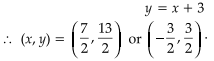
⇒ $x=\frac{7}{2}$ or $x=-\frac{3}{2}$
$y=x+3$
⇒ $y=\frac{13}{2}$ or $y=\frac{3}{2}$
Image
View full question & answer
Question 84 Marks
In what ratio the line joining $(-1,1)$ and $(5,7)$ is divided by the line $x+y=4$ ?
Answer
Let the given points be $A\left(x_1, y_1\right)=(-1,1)$ and $B\left(x_2, y_2\right)=(5,7)$ and $P\left(x_3, y_3\right)$ be the point which divides $A B$ in the ratio $m: n$.
$\therefore$ Co-ordinates of $P$ are $\left(\frac{m x_2+n x_1}{m+n}, \frac{m y_2+n y_1}{m+n}\right)$
$=\left(\frac{5 m-n}{m+n}, \frac{7 m+n}{m+n}\right)$
Since, the point $P$ lies on line $x+y=4$.
$\therefore \quad \frac{5 m-n}{m+n}+\frac{7 m+n}{m+n}=4$
⇒ $\frac{12 m}{m+n}=4$
⇒ $8 m=4 n$
⇒ $m: n=1: 2$
View full question & answer