Questions · Page 1 of 4

M.C.Q (1 Marks)

🎯

Test yourself on this topic

50 questions · timed · auto-graded

MCQ 11 Mark
Which is the correct sequence of mitotic cell division?
  • A
    Prophase Anaphase Metaphase Telophase.
  • B
    Prophase Telophase Metaphase Anaphase.
  • C
    Prophase Anaphase Telophase Metaphase.
  • Prophase Metaphase Anaphase Telophase.
Answer
Correct option: D.
Prophase Metaphase Anaphase Telophase.
View full question & answer
MCQ 21 Mark
Between mitosis, a cell is said to be in the:
  • Resting stage
  • B
    Sleeping stage
  • C
    Active stage
  • D
    None of the above
Answer
Correct option: A.
Resting stage
Interphase is a complex of changes that occur in a newly formed cell before it is able to divide.
Interphase is also called preparatory phase, inter$-$mitosis or energy phase.
Previously, it was known as a resting phase.
It is characterized by three substages, $G1​ ($growth phase $1$ or gap $1), S ($ synthesis $)$ and $G2​ ($ growth phase $2$ or gap $2).$ It is an active part of a cell's life cycle and in $G1$​ many metabolic reactions occur including protein synthesis.
During $S$ phase, $\text{DNA}$ replication occurs and $G2$​ is marked by synthesis of $\text{RNA}$ and proteins.
View full question & answer
MCQ 31 Mark
Meiosis occurs for the human female in $.............$
  • A
    Pancreas
  • B
    Liver
  • Ovary
  • D
    Kidney
Answer
Correct option: C.
Ovary
Ovary
View full question & answer
MCQ 41 Mark
Which of the following constituent protein are present in mitotic spindle:
  • Tubulin
  • B
    Myosin
  • C
    Tropomyocin
  • D
    Dynein
Answer
Correct option: A.
Tubulin
The mitotic spindle is made up of the protein tubulin.
A spindle fiber consists of $4 - 20$ microtubules formed of the protein tubulin.
It is a cytoskeleton protein composed of two types of subunits called as $\alpha$ and $\beta$ subunits.
View full question & answer
MCQ 51 Mark
In which phase of cell cycle, proteins are synthesised?
  • A
    $G_0$
  • B
    $G_1$
  • $G_2$
  • D
    $S$
Answer
Correct option: C.
$G_2$
In $G_2$ phase of cell cycle, proteins are synthesised for mitosis and cell growth continues.
View full question & answer
MCQ 61 Mark
Extra nuclear chromosomes occur in:
  • A
    Peroxisome, ribosome.
  • Chloroplast, mitochondria.
  • C
    Mitochondria, ribosome.
  • D
    Chloroplast, lysosome.
Answer
Correct option: B.
Chloroplast, mitochondria.
View full question & answer
MCQ 71 Mark
Four daughter cells formed after meiosis are:
  • Genetically different.
  • B
    Multinucleate.
  • C
    Genetically similar.
  • D
    Anucleate.
Answer
Correct option: A.
Genetically different.
View full question & answer
MCQ 81 Mark
The point, at which polytene chromosomes appear to be attached together, is called:
  • A
    Centriole.
  • B
    Centromere.
  • C
    Chromomere.
  • Chromocentre.
Answer
Correct option: D.
Chromocentre.
Chromocentre.
View full question & answer
MCQ 91 Mark
If a diploid cell is treated with colchicine then it becomes.
  • A
    Triploid.
  • Tetraploid.
  • C
    Diploid.
  • D
    Monoploid.
Answer
Correct option: B.
Tetraploid.
Tetraploid.
View full question & answer
MCQ 101 Mark
Lampbrush chromosomes are seen in which typical stage?
  • Meiotic prophase.
  • B
    Mitotic prophase.
  • C
    Mitotic anaphase.
  • D
    Mitotic metaphase.
Answer
Correct option: A.
Meiotic prophase.
Meiotic prophase.
View full question & answer
MCQ 111 Mark
Cells which are not dividing are likely to be at:
  • A
    $G_1$.
  • B
    $G_2$.
  • $G_0$.
  • D
    $S$ phase.
Answer
Correct option: C.
$G_0$.
Cells that do not divide further and exit $G_1$ phase to enter an inactive stage called quiescent stage $(G_0)$ of the cell cycle. Cells in this stage remain metabolically active but do not grow and differentiate unless stimulated by appropriate signal depending on the requirement of the organism.
View full question & answer
MCQ 121 Mark
Which of the following cells usually do not undergo cell division?
  • A
    Cells of skin.
  • B
    Cells of buccal cavity.
  • Cells of hearts.
  • D
    All of these.
Answer
Correct option: C.
Cells of hearts.
Cells of hearts.
View full question & answer
MCQ 131 Mark
Which of the following characters is not related to telophase:
  • A
    Formation of nuclear membrane
  • B
    Formation of nucleolus
  • Increase in the number of chromosome
  • D
    Formation of two daughter nuclei
Answer
Correct option: C.
Increase in the number of chromosome
Telophase stage is the stage of reconstitution of nuclei.
Chromosomes uncoil, elongate, lose their stainability and form chromatin fibers.
Nucleoplasm and nuclear envelope appear so that two daughter nuclei are formed.
View full question & answer
MCQ 141 Mark
During anaphase$-I$ of meiosis.
  • Homologous chromosomes separate.
  • B
    Non$-$homologous chromosomes separate.
  • C
    Sister chromatids separate.
  • D
    Non-sister chromatids separate.
Answer
Correct option: A.
Homologous chromosomes separate.
During anaphase $I,$ from each tetrad, two chromatids of a chromosome move as a unit $($dyad$)$ to one pole of a spindle, and the remaining two chromatids of its homologue migrate to the opposite pole. ‘Thus, the homologous chromosomes of each pair, rather than the chromatids of a chromosome, are separated. As a result, half of the chromosomes, which appear in early prophase, go to each pole. It is in the anaphase $I$ that the actual reduction in the number of chromosomes occurs.
View full question & answer
MCQ 151 Mark
Which phase marks the splitting of chromatids during meiosis?
  • A
    Anaphase $I.$
  • B
    Telophase $I.$
  • Anaphase $II.$
  • D
    Telophase $II.$
Answer
Correct option: C.
Anaphase $II.$
Anaphase $II.$
View full question & answer
MCQ 161 Mark
Diploid cells have:
  • A
    Two chromosomes
  • B
    One set of chromosomes
  • C
    Two pairs of chromosomes
  • Two sets of chromosomes
Answer
Correct option: D.
Two sets of chromosomes
Diploid cells have two sets of chromosomes one inherited from a female parent and one inherited from a male parent.
This chromosomal constitution is designated $2n,$ where n denotes basic haploid chromosome set.
View full question & answer
MCQ 171 Mark
Chiasmata formation takes place during:
  • Prophase $I$
  • B
    Metaphase $I$
  • C
    Anaphase $II$
  • D
    Telophase $I$
Answer
Correct option: A.
Prophase $I$
The chiasmata formation occurs during diplotene phase of prophase $I$ of meiosis $I.$
Chiasmata are the points of attachment between non$-$sister chromatids of two homologous chromosomes.
It leads to an exchange of segments and creates variation.
View full question & answer
MCQ 181 Mark
During cell division, the spindle fibres attach to of the chromosomes.
  • A
    Chromatidse.
  • Kinetochores.
  • C
    Centromere.
  • D
    Satellites.
Answer
Correct option: B.
Kinetochores.
Kinetochores.
View full question & answer
MCQ 191 Mark
Which of the following is true of kineto$-$chores?
  • A
    They are localized at the centromere of each chromosome.
  • B
    They are the sites where microtubules attach to separate the chromosomes.
  • C
    They are organized so that there is one per sister chromatid in meiosis.
  • All of the above.
Answer
Correct option: D.
All of the above.
All of the above.
View full question & answer
MCQ 201 Mark
Which is correct w.r.t. anaphase?
  • Centromeres split and chromatids separate.
  • B
    Chromosomes are moved to spindle equator.
  • C
    Chromatid splits by recombinase activity.
  • D
    None of these.
Answer
Correct option: A.
Centromeres split and chromatids separate.
View full question & answer
MCQ 211 Mark
Which event does not occur during prophase in an animal cell:
  • A
    Nuclear envelope disperses
  • Chromosomes replicate
  • C
    Spindle begins to form
  • D
    Chromosomes condense
Answer
Correct option: B.
Chromosomes replicate
The prophase is the first phase of mitosis or cell division.
In the prophase, the nuclear membrane disappears.
It is followed by the initiation of condensation of the thread chromatid material into chromosomes.
The spindle fibres begin to appear.
In the metaphase, the chromosomes then align at the equatorial plane with their centromeres on the spindle fibres.
$\text{DNA}$ replication takes place in the $S$ phase of the interphase.
View full question & answer
MCQ 221 Mark
Centromere is a part of:
  • A
    Ribosomes.
  • Chromosome.
  • C
    Mitochondria.
  • D
    Endoplasmic reticulum.
Answer
Correct option: B.
Chromosome.
Chromosome.
View full question & answer
MCQ 231 Mark
In meiosis, the chromosomes replicate during.
  • A
    Prophase $I.$
  • Interphase.
  • C
    Prophase $II.$
  • D
    Interkinesis.
Answer
Correct option: B.
Interphase.
Interphase.
View full question & answer
MCQ 241 Mark
In a somatic cell cycle
  • $\text{DNA}$ replication takes place in $S-$phase.
  • B
    $G,$ phase follows mitotic phase.
  • C
    A short interphase is followed by a long mitotic phase.
  • D
    In $G,$ phase, the $\text{DNA}$ content is double the amount of $\text{DNA}$ in the mother cell.
Answer
Correct option: A.
$\text{DNA}$ replication takes place in $S-$phase.
View full question & answer
MCQ 251 Mark
Number of chromatids at metaphase is:
  • Two each in mitosis and meiosis.
  • B
    Two in mitosis and one in meiosis.
  • C
    Two in mitosis and four in meiosis.
  • D
    One in mitosis and two in meiosis.
Answer
Correct option: A.
Two each in mitosis and meiosis.
View full question & answer
MCQ 261 Mark
Which one ensures maintainance of chromosome number from generation to generation:
  • A
    Mitosis
  • Meiosis
  • C
    Splicing
  • D
    Metamorphosis
Answer
Correct option: B.
Meiosis
Meiosis occurs in the life cycle of all organisms that reproduce sexually. In meiosis, four daughter cells are produced, each with one member of each homologous pair of the chromosomes of the parent cell, known as the haploid $(n)$ state.Meiosis ensures the maintenance of the chromosome number in body cells from generation to generation.It is a source of variation.
View full question & answer
MCQ 271 Mark
Nucleoproteins are synthesized in:
  • A
    Nucleoplasm.
  • B
    Nuclear envelope.
  • C
    Nucleolus.
  • Cytoplasm.
Answer
Correct option: D.
Cytoplasm.
Cytoplasm.
View full question & answer
MCQ 281 Mark
What are those structures that appear as ‘beads$-$on$-$string’ in the chromosomes, when viewed under electron microscope?
  • A
    Genes.
  • B
    Nucleotides.
  • Nucleosomes.
  • D
    Base pairs.
Answer
Correct option: C.
Nucleosomes.
Nucleosomes.
View full question & answer
MCQ 291 Mark
The term eumitosis is used for:
  • Mitosis is higher plants
  • B
    Mitosis in animals
  • C
    Mitosis where spindle is extranuclear
  • D
    Mitosis with intranuclear spindle
Answer
Correct option: A.
Mitosis is higher plants
Eumitosis is a type of mitosis in which the nuclear membrane dissolves during prometaphase so that there remains no distinction between cytoplasm and nucleoplasm.
The chromosomes remain attached to the spindles through their centromeres.
Mitosis, where the spindle is extranuclear, occurs in the case of true eumitosis or mitosis.
View full question & answer
MCQ 301 Mark
Synapsis occurs between:
  • A
    Spindle fibres and centromere.
  • Two homologous chromosomes.
  • C
    A male and a female gamete.
  • D
    $\text{mRNA}$ and ribosomes.
Answer
Correct option: B.
Two homologous chromosomes.
View full question & answer
MCQ 311 Mark
The meiosis is involved in:
  • A
    Asexual reproduction
  • Sexual reproduction
  • C
    Both
  • D
    None of these
Answer
Correct option: B.
Sexual reproduction
Meiosis is the process of nuclear division which takes place in reproductive cells.
The daughter nuclei formed by this process contain only half the number of chromosomes present in the parent nucleus.
View full question & answer
MCQ 321 Mark
The $3'-5'$ phosphodiester linkages inside a polynucleotide chain serve to join.
  • A
    One nucleoside with another nucleoside.
  • One nucleotide with another nucleotide.
  • C
    One nitrogenous base with pentose sugar.
  • D
    One $\text{DNA}$ strand with the other $\text{DNA}$ strand.
Answer
Correct option: B.
One nucleotide with another nucleotide.
View full question & answer
MCQ 331 Mark
Crossing over is advantageous because it brings about:
  • Variation
  • B
    Linkage
  • C
    Inbreeding
  • D
    Stability
Answer
Correct option: A.
Variation
Meiosis is the type of cell division in which homologous chromosomes separate after exchange of fragments.
As a result, of meiosis four haploid cells are produced which are all genetically different from each other.
This is due to the process of crossing over or exchange of segments between homologous chromosomes.
View full question & answer
MCQ 341 Mark
Which of the following occurs only in meiosis:
  • Pairing of homologous chromosomes.
  • B
    Separation of duplicated strand.
  • C
    Cytokinesis.
  • D
    Disappearance of nucleolus.
Answer
Correct option: A.
Pairing of homologous chromosomes.
Organisms show two types of cell division$-$Mitosis and Meiosis.
Meiosis is a specialized cell division which occurs in germ cells and produces haploid gametes.
The meiosis is characterised by pairing of homologous chromosomes, exchange of segments between homologous chromosomes and reduction in chromosome number to half.
View full question & answer
MCQ 351 Mark
Meiosis involves:
  • Two nuclear and two cell divisions.
  • B
    Two nuclear and one cell division.
  • C
    One nuclear and two cell divisions.
  • D
    One nuclear and four cell divisions.
Answer
Correct option: A.
Two nuclear and two cell divisions.
View full question & answer
MCQ 361 Mark
In mitosis, nuclear envelope and nucleolus disappear during:
  • A
    Metaphase
  • B
    Interphase
  • Prophase
  • D
    Telophase
Answer
Correct option: C.
Prophase
Prophase
View full question & answer
MCQ 371 Mark
In which stage of the cell cycle histone proteins synthesized in a eukaryotic cell?
  • During $S-$phase.
  • B
    During entire prophase.
  • C
    During telophase.
  • D
    During $G$ stage of prophase.
Answer
Correct option: A.
During $S-$phase.
During $S-$phase.
View full question & answer
MCQ 381 Mark
Cytoskeleton is made up of:
  • A
    Cellulosic microfibrils.
  • Proteinaceous filaments.
  • C
    Calcium carbonate granules.
  • D
    Callose deposits.
Answer
Correct option: B.
Proteinaceous filaments.
View full question & answer
MCQ 391 Mark
A bivalent consists of:
  • A
    Two chromatids and one centromere.
  • B
    Two chromatids and two centromeres.
  • Four chromatids and two centromeres.
  • D
    Four chromatids and four centromeres.
Answer
Correct option: C.
Four chromatids and two centromeres.
View full question & answer
MCQ 401 Mark
Chromosomes can be counted best at the stage of:
  • A
    Telophase
  • B
    Late Anaphaie
  • Metaphase
  • D
    Late Prophase
Answer
Correct option: C.
Metaphase
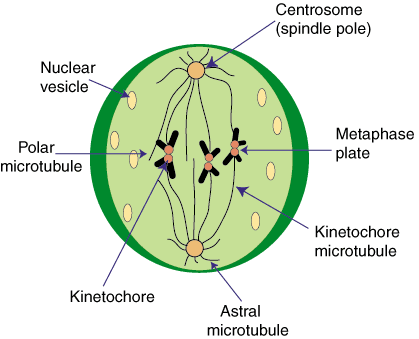
Metaphase is the best stage to count the total number of chromosomes in any species and to establish a detailed study of the morphology of the chromosomes.
As mitotic cells are easy to obtain, morphological studies are generally based on mitotic metaphase chromosomes.
In this stage, the centrioles are at opposite poles of the cell.
The homologous chromosome pairs $($the bivalents$)$, are tightly coiled and condensed and become arranged on a plane called the metaphase plate or equatorial plate.
This plate is equidistant from the poles.
Discontinuous fibres radiate out from the two poles and get connected to kinetochores at the surface of the centromere.
A kinetochore is complex protein structure and a point where microtubules attach themselves to the chromosome.
When the chromosomes get arranged at the metaphase plate, smaller chromosomes get directed towards the centre while the larger ones are peripheral in position on the equator.
The centromeres of all the chromosomes lie on the equator forming an apparent plate called metaphasic or equatorial plate while arms are directed towards the poles.
View full question & answer
MCQ 411 Mark
The two chromatids of a metaphase chromosome represent.
  • Replicated chromosomes to be separated at anaphase.
  • B
    Homologous chromosomes of a diploid set.
  • C
    Non$-$homologous chromosomes joined at the centromere.
  • D
    Maternal and paternal chromosomes joined at the centromere.
Answer
Correct option: A.
Replicated chromosomes to be separated at anaphase.
View full question & answer
MCQ 421 Mark
During which stages $($or prophase $I$ substages$)$ of meiosis do you expect to find the bivalents and $\text{DNA}$ replication respectively?
  • Zygotene and $S$ phase $($of interphase prior to prophase $I).$
  • B
    Both.
  • C
    Pachytene and interphase $($just prior to prophase $I).$
  • D
    None of these.
Answer
Correct option: A.
Zygotene and $S$ phase $($of interphase prior to prophase $I).$
View full question & answer
MCQ 431 Mark
$\text{DNA}$ is mainly found in:
  • Nucleus only.
  • B
    Cytoplasm only.
  • C
    Both $(a)$ and $(b)$.
  • D
    Nucleolus.
Answer
Correct option: A.
Nucleus only.
Nucleus only.
View full question & answer
MCQ 441 Mark
During which stage of meiosis the recombination of genes takes place?
  • Prophase $I.$
  • B
    Prophase $II.$
  • C
    Metaphase $I.$
  • D
    Metaphase $II.$
Answer
Correct option: A.
Prophase $I.$
Prophase $I.$
View full question & answer
MCQ 451 Mark
Choose the correct sequence.
  1. Pachytene
  2. Zygotene
  3. Leptotene
  4. Diakinesis
  5. Diplotene
  • A
    $\text{C, B, A, D, E}$
  • $\text{C, A, B, E, D}$
  • C
    $\text{C, B, A, E, D}$
  • D
    $\text{D, B, C, E, A}$
Answer
Correct option: B.
$\text{C, A, B, E, D}$
Duplication of centrioles occurs in $S-$phase. Protein synthesis occurs in $G_2$ phase. Chromatin condensation is followed by centrioles movement towards the poles. $($Prophase$)$
View full question & answer
MCQ 461 Mark
Meiosis occurs in:
  • A
    Megaspore
  • Meiocyte
  • C
    Conidia
  • D
    Gemmule
Answer
Correct option: B.
Meiocyte
Megaspore is a spore which develops into a female gametophyte and forms egg.
A cell that differentiates into a gamete through the process of meiosis is known as meiocyte.The resulting cell is a haploid.
Conidia are asexually produced spores that are borne on the conidiophores which is a specialized hyphal structure.
In sponges, a part of parent body produces internal buds known as gemmule which separates from the parent body and forms a new organism.The gemmules are formed in the mesoglea layer of the body wall.
View full question & answer
MCQ 471 Mark
During the meiotic division, the:
  • Homologous chromosomes are separated.
  • B
    The linkage is disturbed.
  • C
    The homologous chromosomes do not segregate.
  • D
    All of the above.
Answer
Correct option: A.
Homologous chromosomes are separated.
Meiosis is a type of division in which mother cell divides twice after one round of $\text{DNA}$ replication.
In meiosis $I$ homologous chromosomes pair, exchange segments and then separate, i.e., each chromosome of a homologous pair goes to opposite pole.
Thus, reducing the number of chromosomes to one half.
Second division or meiosis $II$ is normal equational division like mitosis.
View full question & answer
MCQ 481 Mark
The plant material suited for studying mitosis is:
  • A
    Anther
  • B
    Shoot apex
  • Root apex
  • D
    Cork/ leaf tip
Answer
Correct option: C.
Root apex
Root apex
View full question & answer
MCQ 491 Mark
The process by which the chromosomes are separated in the sex cells and their number reduced from the diploid to haploid condition is known as:
  • A
    Division
  • B
    Mitosis
  • C
    Conjugation
  • Meiosis
Answer
Correct option: D.
Meiosis
Meiosis is the type of cell division in which homologous chromosomes separate after the exchange of fragments.
As a result of meiosis, four haploid cells are produced which are all genetically different from each other.
It mainly occurs in reproductive cell.
View full question & answer
MCQ 501 Mark
The major event that occurs during the anaphase of mitosis, which brings about the equal distribution of chromosomes, is:
  • Splitting of the centromeres.
  • B
    Splitting of the chromatids.
  • C
    Replication of the genetic material.
  • D
    Condensation of the chromatin.
Answer
Correct option: A.
Splitting of the centromeres.
View full question & answer
M.C.Q (1 Marks) - Biology STD 11 Science Questions - Vidyadip