MCQ 511 Mark
Which of the following process is not used in the concentration of $\ce{H_2O_2}$?
- A
Distillation under reduced pressure
- B
Evaporation on a water bath
- C
Fractional crystallization
- ✓
AnswerSublimation is not involved in concentration of $\ce{H_2O_2}$.
Concentration of Hydrogen peroxide involves the following steps:
- Evaporation of solution to obtain $30\%$ solution.
- Distillation under pressure to get $90\%$ pure solution.
- Fractional Distillation to get $100\%$ pure $\ce{H_2O_2}$
View full question & answer→MCQ 521 Mark
The melting point of ice is:
- ✓
$0^{\circ}C$
- B
$37^{\circ}C$
- C
$4^{\circ}C$
- D
$100^{\circ}C$
AnswerCorrect option: A. $0^{\circ}C$
Melting point of solid is defined as the temperature at which solid changes into liquid.
Melting point of ice is $0^{\circ}C.$
View full question & answer→MCQ 531 Mark
Which of the following can not be reduced by $\ce{H_2O_2}$ :
- ✓
$ \mathrm{K}_2 \mathrm{Cr}_2 \mathrm{O}_7 / \mathrm{H}_2 \mathrm{SO}_2$
- B
$ \mathrm{KMnO}_4 / \mathrm{H}_2 \mathrm{SO}_4 $
- C
$ \mathrm{Ag}_2 \mathrm{O} $
- D
$ \mathrm{Fe}^{3+}(\mathrm{eq}) $
AnswerCorrect option: A. $ \mathrm{K}_2 \mathrm{Cr}_2 \mathrm{O}_7 / \mathrm{H}_2 \mathrm{SO}_2$
It forms $\ce{CrO_5}$, in $+ 6$ oxidation state.
View full question & answer→MCQ 541 Mark
Which of the following is a true structure of $\ce{H_2O_2}$?
View full question & answer→MCQ 551 Mark
Elements of which of the following group$(s)$ of periodic table do not form hydrides?
- ✓
Groups $7, 8, 9$
- B
Group $13$
- C
Group $15, 16, 17$
- D
Group $14$
AnswerCorrect option: A. Groups $7, 8, 9$
The metals of group $7, 8, 9$ do not form hydrides.
View full question & answer→MCQ 561 Mark
Which of the following reactions increases production of dihydrogen from synthesis gas?
- A
$\text{CH}_4(\text{g})+\text{H}_2\text{O}(\text{g})\xrightarrow[\text{Ni}]{1270\text{k}}\text{CO(g)}+3\text{H}_2(\text{g})$
- B
$\text{C(s)}+\text{H}_2\text{O(g)}\xrightarrow{1270\text{k}}\text{CO(g)}+\text{H}_2(\text{g})$
- ✓
$\text{CO(g)}+\text{H}_2\text{O}(\text{g})\xrightarrow[\text{Catalyst}]{673\text{k}}\text{CO}_2\text{(g)}+\text{H}_2\text{(g)}$
- D
$\text{C}_2\text{H}_6+2\text{H}_2\text{O}\xrightarrow[\text{Ni}]{1270\text{ k}}2\text{CO}+5\text{H}_2$
AnswerCorrect option: C. $\text{CO(g)}+\text{H}_2\text{O}(\text{g})\xrightarrow[\text{Catalyst}]{673\text{k}}\text{CO}_2\text{(g)}+\text{H}_2\text{(g)}$
To increase the production of $H_2$ from synthesis gas, $CO$ is oxidized to $CO_2$ by passing it over steam at $673K$ in presence of a catalyst.
$\text{CO(g)}+\text{H}_2\text{O}(\text{g})\xrightarrow[\text{Catalyst}]{673\text{k}}\text{CO}_2\text{(g)}+\text{H}_2\text{(g)}$
Thus, option $(c)$ is correct.
View full question & answer→MCQ 571 Mark
Hydrogen resembles halogens in many respects for which several factors are responsible. Of the following factors which one is most important in this respect?
- A
Its tendency to lose an electron to form a cation.
- ✓
Its tendency to gain a single electron in its valence shell to attain stable electronic configuration.
- C
Its low negative electron gain enthalpy value.
- D
AnswerCorrect option: B. Its tendency to gain a single electron in its valence shell to attain stable electronic configuration.
Halogens have the tendency to gain one electron and acquire inert gas configuration. Hydrogen also accepts one electron and acquires helium configuration.
$\text{F}\xrightarrow{ \ \ \ \ \ \ \ \ \ \ \ \ \ \ \ \ \ \ \ \ }\text{Ne};\ \ \ \ \ \ \ \ \ \text{Cl}\xrightarrow{\ \ \ \ \ \ \ \ \ \ \ \ \ \ \ \ \ \ \ }\text{Ar};\ \ \ \ \ \ \ \ \ \text{Br}\xrightarrow{\ \ \ \ \ \ \ \ \ \ \ \ \ \ \ \ \ \ \ \ \ }\text{Kr}\ \ \ \ \ \ \ \ \ \ \text{H}\xrightarrow{\ \ \ \ \ \ \ \ \ \ \ \ \ \ \ \ \ \ \ \ \ \ \ }\text{He}\\2\text{s}^22\text{p}^5\ \ \ \ 2\text{s}^22\text{p}^6\ \ \ \ \ \ \ \ \ \ 3\text{s}^23\text{p}^5\ \ \ \ \ 3\text{s}^23\text{p}^6\ \ \ \ \ \ \ \ \ \ 4\text{s}^24\text{p}^5\ \ \ \ \ 4\text{s}^24\text{p}^6\ \ \ \ \ \ \ \ \ \ 1\text{s}^1\ \ \ \ \ \ \ \ \ \ \ \ \ \ \ \ 1\text{s}^2$
View full question & answer→MCQ 581 Mark
Decomposition of $\ce{H_2O_2}$ is retarded by $.........$
AnswerDecomposition of $\ce{H2O2}$ can be retarded small amounts of acid, glycerol, alcohol, acetanilide.
View full question & answer→MCQ 591 Mark
Which one of the following will not produce hydrogen?
AnswerCorrect option: C. Copper and $\ce{HCl}$
It is became $'Cu\ '$ is less reactive than $H_2$.
View full question & answer→MCQ 601 Mark
Which one of the following is not a physical property of water?
AnswerCorrect option: A. Water has low specific heat capacity
Water has high specific heat capacity.
The other options are physical properties of water.
View full question & answer→MCQ 611 Mark
Which one of the following reactions represent the oxidising property of $\ce{H_2O_2}$?
- A
$2\text{KMnO}_4+3\text{H}_2\text{SO}_4+5\text{H}_2\text{O}_2\xrightarrow{\ \ \ \ \ \ \ \ }\\\text{K}_2\text{SO}_4+2\text{MnSO}_4+8\text{H}_2\text{O}+5\text{O}_2$
- B
$2\text{K}_3[\text{Fe}(\text{CN})_6]+2\text{KOH}+\text{H}_2\text{O}_2\xrightarrow{\ \ \ \ \ }2\text{K}_4[\text{Fe}(\text{CN})_6]\\+2\text{H}_2\text{O}+\text{O}_2$
- C
$\text{HOCl}+\text{H}_2\text{O}_2\xrightarrow{\ \ \ \ \ \ \ \ \ }\text{H}_3\text{O}^++\text{Cl}^-+\text{O}_2$
- ✓
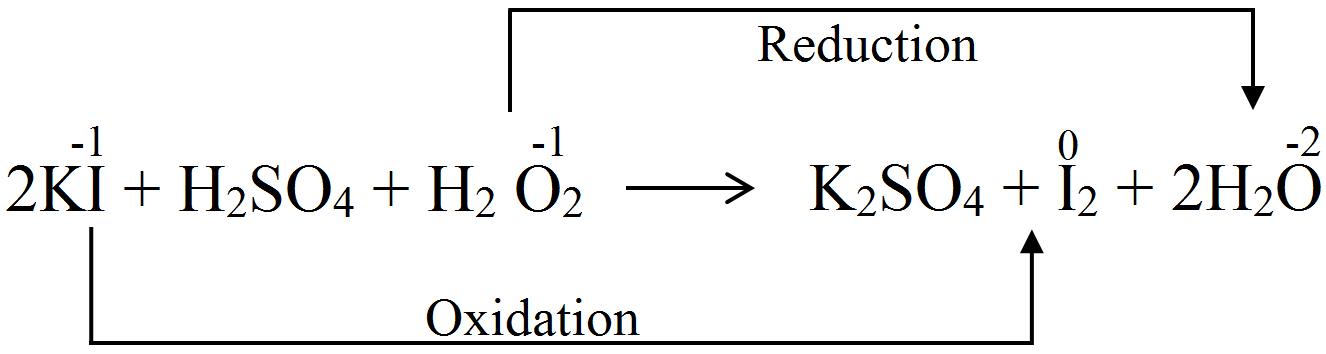
$2\text{KI}+\text{H}_2\text{SO}_4+\text{H}_2\text{O}_2\xrightarrow{\ \ \ \ \ \ \ }\text{K}_4\text{SO}_4+\text{I}_2+2\text{H}_2\text{O}$
AnswerCorrect option: D. $2\text{KI}+\text{H}_2\text{SO}_4+\text{H}_2\text{O}_2\xrightarrow{\ \ \ \ \ \ \ }\text{K}_4\text{SO}_4+\text{I}_2+2\text{H}_2\text{O}$
The reaction in which $\ce{H2O}$, is reduced while the other reactant is oxidised, represents the oxidizing property of $\ce{H_2O_2}$.
View full question & answer→MCQ 621 Mark
Sodium reacts with cold water to form a compound that burns with a flame. Guess the colour of flame:
AnswerSodium reacts with cold water to form a compound that burns with a golden yellow flame.
View full question & answer→MCQ 631 Mark
Calgon is used as water softening agent because it:
- ✓
Forms soluble complexes with cationic species.
- B
Frms soluble complexes with anionic species.
- C
Forms soluble complexes with both cationic and anionic species.
- D
Forms precipitate with cation species.
AnswerCorrect option: A. Forms soluble complexes with cationic species.
View full question & answer→MCQ 641 Mark
Heavy water is obtained by :
AnswerCorrect option: C. Prolonged electrolysis of $\ce{H_2O}$.
View full question & answer→MCQ 651 Mark
The co-ordination number of $Na$ in solid $\ce{NaH}$ is:
AnswerCoordination number of $Na$ in $\ce{NaH}$ is $6$ as its shape is octahedral.
View full question & answer→MCQ 661 Mark
Hydrogen has the tendency to lose one electron and form $H+$. In this respect, it resembles:
AnswerAlkali metals also have a tendency to lose one electron and form cations, so this similar property of hydrogen matches with alkali metals.
Carbon has a tendency to form covalent bonds.
Alkaline earth metals have a tendency to lose two electrons and Halogens have a tendency to gain electrons.
View full question & answer→MCQ 671 Mark
Water boils and freezes exactly at $100^{\circ} C$ and $0 ^{\circ}C$ respectively; find the reason for it from the following:
- A
Water desolve anything however springly the dissolution will be
- B
Water is a polar molecule
- ✓
Boiling and freezing temperature of water is used to define temperature scales
- D
AnswerCorrect option: C. Boiling and freezing temperature of water is used to define temperature scales
This is a fact that boiling and freezing temperature of water at atmospheric pressure is used to define temperature scale as it makes easy.
View full question & answer→MCQ 681 Mark
Which of the following equatibns depicts the oxidizing nature of $\ce{H_2O_2}$?
- A
$ 2 \mathrm{MnO}_4^{-}+6 \mathrm{H}^{+}+5 \mathrm{H}_2 \mathrm{O}_2 \rightarrow 2 \mathrm{Mn}^{2+}+8 \mathrm{H}_2 \mathrm{O}+5 \mathrm{O}_2 $
- B
$ 2 \mathrm{Fe}^{3+}+2 \mathrm{H}^{+}+\mathrm{H}_2 \mathrm{O}_2 \rightarrow 2 \mathrm{Fe}^{2+}+2 \mathrm{H}_2 \mathrm{O}+\mathrm{O}_2 $
- ✓
$ 2 \mathrm{I}^{-}+2 \mathrm{H}^{+}+\mathrm{H}_2 \mathrm{O}_2 \rightarrow \mathrm{I}_2+2 \mathrm{H}_2 \mathrm{O} $
- D
$ \mathrm{KIO}_4+\mathrm{H}_2 \mathrm{O}_2 \rightarrow \mathrm{KIO}_3+\mathrm{H}_2 \mathrm{O}+\mathrm{O}_2$
AnswerCorrect option: C. $ 2 \mathrm{I}^{-}+2 \mathrm{H}^{+}+\mathrm{H}_2 \mathrm{O}_2 \rightarrow \mathrm{I}_2+2 \mathrm{H}_2 \mathrm{O} $
$2\stackrel{{-1}}{\hbox{I}^-}+2\stackrel{{+1}}{\hbox{H}^+}+\stackrel{{+1}}{\hbox{H}_2}\stackrel{{-1}}{\hbox{O}_2}\xrightarrow{ \ \ \ }\stackrel{{0}}{\hbox{I}_2}+2\stackrel{{+1}}{\hbox{H}_2}\stackrel{{-2}}{\hbox{O}}$
ions are oxidized to $I_2 ($increases in $O.N$. from $-1$ to $0)$. Hence, $\ce{H_2O_2<}$ acts as an oxidizing agent.
View full question & answer→MCQ 691 Mark
Temporary hardness of water is due to the presence of:
- A
Calcium and magnesium chlorides.
- B
Calcium and magnesium sulphates.
- C
Calcium and magnesium phosphate.
- ✓
Calcium and magnesium hydrogen carbonates.
AnswerCorrect option: D. Calcium and magnesium hydrogen carbonates.
Temporary hardness of water is due to the presence of calcium and magnesium hydrogen carbonates.
View full question & answer→MCQ 701 Mark
When sodium peroxide is treated with dilute sulphuric acid, we get.
- A
Sodium sulphate and water.
- B
Sodium sulphate and oxygen.
- C
Sodium sulphate, hydrogen and oxygen.
- ✓
Sodium sulphate and hydrogen peroxide.
AnswerCorrect option: D. Sodium sulphate and hydrogen peroxide.
$\ \ \text{Na}_2\text{O}_2\ \ \ \ \ +\ \ \ \ \ \ \ \text{H}_2\text{SO}_4\ \xrightarrow{\ \ \ \ \ \ \ \ \ \ \ \ \ \ \ \ \ }\ \text{Na}_2\text{SO}_4\ \ \ \ \ \ \ \ \ +\ \ \ \ \ \ \ \ \ \ \text{H}_2\text{O}_2\\\text{Sodium peroxide}\ \ \ \ \ \ \ \ \ \ \ \ \ \ \ \ \ \ \ \ \ \ \ \text{Sodium sulphate}\ \ \ \ \ \ \ \ \ \ \text{Hydrogen peroxide}$
View full question & answer→MCQ 711 Mark
The major components of water gas $($or synthesis gas or syn gas$)$ which is used for the synthesis of methanol and a number of hydrocarbons are:
AnswerCorrect option: B. $\text{CO}+\text{H}_2$
View full question & answer→MCQ 721 Mark
Which of the following is a true structure of $\ce{H_2O_2}$ ?
View full question & answer→MCQ 731 Mark
Which of the following is a universal solvent?
AnswerWater is a universal solvent. Water is capable of dissolving a variety of different substances.
It dissolves more substances than any other liquid.
Water is important to every living thing on earth.
Wherever water goes, either through the ground or through our bodies, it takes along valuable chemicals, minerals, and nutrients.
View full question & answer→MCQ 741 Mark
Water is a kind of $.........$ oxide:
AnswerWater is a neutral oxide.
Neutral oxides are oxides which are neither acidic nor basic.
View full question & answer→MCQ 751 Mark
As the rain water is the purest form of water, this can be used in lab due to:
AnswerRainwater is considered to the purest form of water. Impurities and salts present in the water on earth are left behind during vapourization by the sun.
This water can be used in labs due to the absence of ions. This water is similar to distilled water. Distilled water is used in Labs because of a little combination of impure water could affect the experiment.
View full question & answer→MCQ 761 Mark
In $\ce{H_2O_2}$, the degree of hydrogen bonding is:
AnswerDue to the presence of two oxygen atoms in $\ce{H_2O_2}$, there would be four hydrogen bonds corresponding to each molecule.
Whereas, in water there would be only three hydrogen bonds per molecule.
View full question & answer→MCQ 771 Mark
Aquatic animals use $.........$ dissolved in water to respire:
- A
$\ce{CO_2}$
- B
$H_2$
- ✓
$O_2$
- D
$\ce{H_2O_2}$
AnswerCorrect option: C. $O_2$
Aquatic animals use oxygen gas dissolved in water to respire.
The oxygen dissolve in marine water by diffusion from the surrounding air.
This dissolved oxygen is then used by marine animals for respiration.
View full question & answer→MCQ 781 Mark
Elements of which of the following groups do not form hydrides?
- A
$1, 2, 3$
- B
$3, 4, 5$
- ✓
$7, 8, 9$
- D
$6, 7, 8$
AnswerCorrect option: C. $7, 8, 9$
The region of the periodic table from the group $7$ to $9$ is referred to as the hydride gap as they do not form hydrides.
Examples of such elements are $Mn, Fe, Co, Ru$ etc. These elements do not form hydrides on account of low affinity for hydrogen in their normal oxidation states.
View full question & answer→MCQ 791 Mark
The metal which gives $H_2$ with dil acid as well as $\ce{NaOH}$ is.
Answer$\text{Zn}+2\text{HCl}\text{ dil}\rightarrow\text{Zn cl}_2+\text{H}_2$
$\text{Zn}+2\text{NaOH}\rightarrow\text{Na}_2\text{NaO}_2+\text{H}_2$
View full question & answer→MCQ 801 Mark
Ionic hydrides are usually:
- A
good electrical conductors when solid
- B
- ✓
- D
liquid at room temperature
AnswerIonic hydrides are usually good reducing agents.
$ 2 \mathrm{CO}+\mathrm{NaH} \rightarrow \mathrm{HCOONa}+\mathrm{C} $
$ \mathrm{PbSO}_4+2 \mathrm{CaH}_2 \rightarrow \mathrm{PbS}+2 \mathrm{Ca}(\mathrm{OH})_2 $
$ \mathrm{Fe}_3 \mathrm{O}_4+\mathrm{NaH} \rightarrow 3 \mathrm{Fe}+4 \mathrm{NaOH} $
View full question & answer→MCQ 811 Mark
Last molecule of $\ce{H_2O}$ is evolved from $\ce{H_2O_2}$ by :
- ✓
- B
- C
Distillation under reduced pressure
- D
AnswerThe last molecule of water is separated from hydrogen peroxide by crystallization.$ 90\%$ solution of hydrogen peroxide is concentrated by cooling with solid carbon dioxide and ether bath. The crystals of hydrogen peroxide are separated, melted and refrozen.
View full question & answer→MCQ 821 Mark
Hydrogen resembles $\text{IV-A}$ elements in what respect?
AnswerCorrect option: D. They have half$-$filled electronic configuration.
$\text{IV A}$ group has half filled valence shell like carbon or silicon and it shares it with the hydrogen singly filled $s$ orbital. They resemble have comparable $I.P.$ and $E.A.$
View full question & answer→MCQ 831 Mark
Which of the following statements is$/$are correct about fuel cells?
- A
- B
- C
They run till reactants are active.
- ✓
View full question & answer→MCQ 841 Mark
Water in its pure form is a :
- A
- ✓
bad conductor of electricity
- C
good conductor of electricity
- D
AnswerCorrect option: B. bad conductor of electricity
Water in pure form is a bad conductor of electricity because of the absence of free electrons $($salts and minerals$)$ that allow the flow of electricity.
View full question & answer→MCQ 851 Mark
Temporary hardness of water is due to the presence of :
AnswerPermanent hardness is the hardness that cannot be removed by boiling. It is usually caused by the presence of calcium sulphate or magnesium sulphates or chlorides, nitrates of $Ca, Mg$ in the water which does not precipitate out as the temperature increases
View full question & answer→MCQ 861 Mark
Among $I-A$ elements which is the only non-metal?
AnswerIn alkali metals group, hydrogen is the only non metal diatomic hydrogen gas.
View full question & answer→MCQ 871 Mark
When water is cooled it contracts until it reaches $.........$ and then it starts expanding :
- A
$37^{\circ}C$
- B
$40^{\circ}C$
- C
$0^{\circ}C$
- ✓
$4^{\circ}C$
AnswerCorrect option: D. $4^{\circ}C$
Lowering of a temperature of water reduces the translation motion and thus brings the molecules closer. This is apparent in the contraction of water upon cooling. But at $4^{\circ}C$, the water molecules form extensive hydrogen bonding. As a result, each water molecules is surrounded by four molecules and this increases the vacant space between the molecules. This results in expansion of the system.
View full question & answer→MCQ 881 Mark
In which property listed below hydrogen does not resemble alkali metals?
- A
- ✓
- C
Combination with halogens
- D
AnswerHydrogen shows all other properties like alkali metals $($form cation, combine with halogens, reducing nature$)$ but nature of oxide is different than metals because oxide of metals are basic in nature whereas oxide of Hydrogen are amphoteric in nature i.e. $\ce{H_2O}$.
View full question & answer→MCQ 891 Mark
Consider the reactions.
A. $\mathrm{H}_2 \mathrm{O}_2+2 \mathrm{HI} \rightarrow \mathrm{I}_2+2 \mathrm{H}_2 \mathrm{O}$
B. $\mathrm{HOCl}+\mathrm{H}_2 \mathrm{O}_2 \rightarrow \mathrm{H}_3 \mathrm{O}^{+}+\mathrm{Cl}^{-}+\mathrm{O}_2$
Which of the following statements is correct about $\ce{H_2O_2}$ with reference to these reactions? Hydrogen peroxide is $.........$
- A
An oxidizing agent in both $(A)$ and $(B)$
- ✓
An oxidizing agent in $(A)$ and reducing agent in $(B)$
- C
A reducing agent in $(A)$ and oxidizing agent in $(B)$
- D
A reducing agent in both $(A)$ and $(B)$
AnswerCorrect option: B. An oxidizing agent in $(A)$ and reducing agent in $(B)$
$\stackrel{{+1}}{\hbox{H}}_2\stackrel{-1}{\hbox{O}}_2+2\stackrel{+1}{\hbox{H}}\stackrel{-1}{\hbox{I}}\xrightarrow{\ \ \ \ \ \ \ }\stackrel{0}{\hbox{I}}_2+2\stackrel{+1}{\hbox{H}}_2\stackrel{-2}{\hbox{O}}$
$O.N$. of oxygen is decreased from $\ce{-1(H_2O_2)}$ to $\ce{-2 (H_2O})$, therefore, it is reduced and acts as an oxidizing agent.
$\text{HOCl}+\text{H}_2\stackrel{-1}{\hbox{O}}_2\xrightarrow{\ \ \ \ \ \ \ }\text{H}_3\text{O}^++\text{Cl}^-+\stackrel{0}{\hbox{O}}_2$
$O.N$. of oxygen is increased from $\ce{-1 (H_2O_2)}$ to $O(O_2$), therefore, it is oxidized and acts as a reducing agent.
View full question & answer→MCQ 901 Mark
Metal hydride on treatment with water give:
- A
- B
- ✓
Metal hydroxide $+ H_2$
- D
AnswerCorrect option: C. Metal hydroxide $+ H_2$
$\text{NaH}+\text{H}_2\text{O}\xrightarrow{\ \ \ \ }\text{N}\text{aOH}+\text{H}_2$
$\because\text{E}^{\circ}\text{Zn}^{2+}/\text{Zn}=-0.76\text{V}.$ It is more reactive than $H_2$.
View full question & answer→MCQ 911 Mark
The element symbol for hydrogen is:
AnswerExplanation: (B) H
Hydrogen is a chemical element with chemical symbol H and atomic no.1 with atomic weight 1.00794 amu, hydrogen is the lightest element on the periodic table. Its monatomic form is the most abundant in nature.
View full question & answer→MCQ 921 Mark
Dihydrogen is prepared by the reaction of $Zn$ with $\ce{(aq) NaOH}$. Which of the following compounds is produced with dihydrogen during the course of reaction?
View full question & answer→MCQ 931 Mark
Which one of the following methods can be used to test the presence of water?
- A
- ✓
Add anhydrous copper sulphate and look for a colour change
- C
- D
Litmus paper with the solution
AnswerCorrect option: B. Add anhydrous copper sulphate and look for a colour change
The reaction between anhydrous copper sulfate and water is reversible:
Anhydrous copper sulfate $($white$) +$ water $=$ Hydrated copper sulfate $($blue$)$
$\mathrm{CuSO}_4+5 \mathrm{H}_2 \mathrm{O} \rightarrow \mathrm{CuSO}_4 \cdot 5 \mathrm{H}_2 \mathrm{O}$.
White anhydrous amorphous copper sulfate combines with $5$ molecules of water to form hydrous blue copper sulfate $($blue vitriol$)$.
View full question & answer→MCQ 941 Mark
Which of the following reactions is an example of use of water gas in the synthesis of other compounds?
- A
$\text{CH}_4(\text{g})+\text{H}_2\text{O}(\text{g})\xrightarrow[\text{Ni}]{1270\text{ k}}\text{CO(g)}+\text{H}_2\text{(g)}$
- B
$\text{CO(g)}+\text{H}_2\text{O(g)}\xrightarrow[\text{Catalyst}]{673\text{ k}}\text{CO}_2\text{(g)}+\text{H}_2(\text{g})$
- C
$\text{C}_\text{n}\text{H}_{2\text{n}+1}+\text{nH}_2\text{O(g)}\xrightarrow[\text{Ni}]{1270\text{ k}}\text{nCO}+(2\text{n}+1)\text{H}_2$
- ✓
$\text{CO(g)}+2\text{H}_2(\text{g})\xrightarrow[\text{Catalyst}]{\text{Cobalt}}\text{CH}_3\text{OH}(1)$
AnswerCorrect option: D. $\text{CO(g)}+2\text{H}_2(\text{g})\xrightarrow[\text{Catalyst}]{\text{Cobalt}}\text{CH}_3\text{OH}(1)$
The reaction shown in equation $(iv)$ shows the synthesis of methanol from water gas.
View full question & answer→MCQ 951 Mark
Pure water is a $.........$ conductor of electricity:
AnswerPure water is a bad conductor of electricity. This is because free electrons are not present in pure water which allow the flow of electricity.
Pure water is a bad conductor of electricity.
View full question & answer→MCQ 961 Mark
What are the percentages of water present in human body and plants, respectively?
- A
$95$ and $65$
- ✓
$65$ and $95$
- C
$90$ and $70$
- D
$30$ and $70$
AnswerCorrect option: B. $65$ and $95$
The major part of all living organisms is made up of water. Human body has about $65\%$ and some plants have as much as $95\%$ water.
View full question & answer→MCQ 971 Mark
Hydrogen is a non$-$metal having $.........$ electron in the valence shell:
AnswerHydrogen is a non$-$metal having $1e^-$ in its outer most shell $($valence shell$)$.
View full question & answer→MCQ 981 Mark
$\mathrm{CH}_3, \mathrm{NH}_3, \mathrm{H}_2 \mathrm{O}$ and $HF$ are the examples of:
AnswerDihydrogen forms molecular compounds with many $p-$block elements. Most familiar examples are $\mathrm{CH}_3, \mathrm{NH}_3, \mathrm{H}_2 \mathrm{O}$ and $HF$.
View full question & answer→MCQ 991 Mark
$.........$ does not expand on melting and does not contract on freezing:
AnswerIn melting process, ice changes to water and in freezing, water changes to ice. Both occur at $0^{\circ}C$ only.
Only change of state occurs here and not volume.
View full question & answer→MCQ 1001 Mark
Aluminium carbide reacts with water to give $.........$
AnswerAluminium carbide reacts with water gives methane gas.
View full question & answer→