Questions

True False[1 Marks ]

Take a timed test

8 questions · self-marked practice — reveal the answer and mark yourself.

Question 11 Mark
State True or False for the following:
Let $z_1$ and $z_2$ be two complex numbers such that $|z_1 + z_2| = |z_1| + |z_2|$, then $arg(z_1 - z_2) = 0.$
Answer
False.Solution:
$|\text{z}_1+\text{z}_2|=|\text{z}_1|+|\text{z}_2|$
$\Rightarrow|\text{z}_1+\text{z}_2|^2=|\text{z}_1|^2+|\text{z}_2|^2+2|\text{z}_1||\text{z}_2|$
$\Rightarrow|\text{z}_1|^2+|\text{z}_2|^2+2\text{Re}
(\text{z}_1\bar{\text{z}}_2)=|\text{z}_1|^2+|\text{z}_2|^2+2|\text{z}_1||\text{z}_2|$
$\Rightarrow2\text{Re}(\text{z}_1\bar{\text{z}}_2)=2|\text{z}_1||\text{z}_2|$
$\Rightarrow\cos(\theta_1-\theta_2)=1$
$\Rightarrow\theta_1-\theta_2=0$
$\Rightarrow\arg(\text{z}_1)-\arg(\text{z}_2)=0$
View full question & answer
Question 21 Mark
State True or False for the following:
2 is not a complex number.
Answer
False.
Solution:
We know that, any real number is also a complex number.
View full question & answer
Question 31 Mark
State True or False for the following:
The order relation is defined on the set of complex numbers.
Answer
False.Solution:
We can compare two complex numbers when they are purely real. Otherwise comparison of complex numbers is not possible or has no meaning.
View full question & answer
Question 41 Mark
State True or False for the following:
If $z$ is a complex number such that $z \neq 0$ and Re $(z) = 0,$ then Im $(z^2) = 0.$
Answer
False.Solution:
Let $z = x +$ iy, $z ≠ 0$ and $Re(z) = 0$ i.e., $x = 0 $
$\therefore z = iy\ Im(z^2) = i^2y^2 = -y^2 \neq 0$
View full question & answer
Question 51 Mark
State True or False for the following:
The inequality |z - 4| < |z - 2| represents the region given by x > 3.
Answer
True.Solution:
We have, |z - 4| < |z - 2| Putting z = x + iy, we get $|\text{x}-4+\text{iy}|<|\text{x}-2+\text{iy}|$ $\Rightarrow\sqrt{(\text{x}-4)^2+\text{y}^2}<\sqrt{(\text{x}-2)^2+\text{y}^2}$ $\Rightarrow(\text{x}-4)^2+\text{y}^2<(\text{x}-2)^2+\text{y}^2$ $\Rightarrow\text{x}^2-8\text{x}+16+\text{y}^2<\text{x}^2-4\text{x}+4+\text{y}^2$ $\Rightarrow-8\text{x}+16<-4\text{x}+4$ $\Rightarrow4\text{x}>12$ $\Rightarrow\text{x}>3$
View full question & answer
Question 61 Mark
State True or False for the following:
For any complex number z the minimum value of |z| + | z - 1| is 1.
Answer
True.Solution:
We know that $|\text{z}_1|+|\text{z}_2|\geq|\text{z}_1-\text{z}_1|$ $\Rightarrow|\text{z}|+|\text{z}-1|\geq|\text{z}-(\text{z}-1)|$ $\Rightarrow|\text{z}|+|\text{z}-1|\geq1$ So, minimum value of |z| + |z - 1| is 1. Alternative method Let A(z) and B(1) $\Rightarrow|\text{z}|+\text{z}-1|=\text{OA}+\text{AB},$ where O is origin From triangular inequality, we get $\text{OA}+\text{AB}\geq\text{OB}$ $\Rightarrow(\text{OA}+\text{AB})_{\text{min}}=\text{OB}=1$
View full question & answer
Question 71 Mark
State True or False for the following:
The locus represented by$| z - 1| = |z - i|$ is a line perpendicular to the join of $(1, 0)$ and $(0, 1).$
Answer
True.
Solution:
We have, $|z - 1| = |z - i|$ Putting $z = x + iy,$
we get $\Rightarrow |x - 1 + iy| = |x - i(1 - y)| $
$\Rightarrow (x - 1)^2 + y^2 = x^2 + (1 - y)^2 $
$\Rightarrow x^2 - 2x + 1 + y^2 = x^2 + 1 + y^2 - 2y $
$\Rightarrow -2x + 1 = 1 - 2y \Rightarrow -2x + 2y = 0 $
$\Rightarrow x - y = 0$
Now, equation of a line through the points $(1, 0)$ and $(0, 1)$ is,
$\text{y}-0=\frac{1-0}{0-1}(\text{x}-1)$ Or $x + y = 1$
This line is perpendicular to the line $x - y = 0$
View full question & answer
Question 81 Mark
State True or False for the following:
Multiplication of a non zero complex number by -i rotates the point about origin through a right angle in the anti-clockwise direction.
Answer
False.Solution:
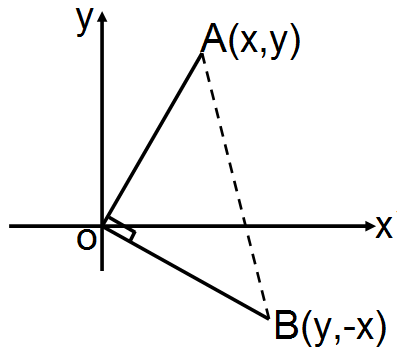
Let $z = x + iy,$ where $x, y > 0$
i.e., $z$ or point $A(x, y)$ lies in first quadrant.
Now, $-iz = -i(x + iy) = -ix - i^2y = y - ix$
Now, point $B(y, -x)$ lies in fourth quadrant.
Also, $\angle AOB = 90^\circ$
Thus, $B$ is obtained by rotating $A$ in clockwise direction about origin.
View full question & answer