Questions

3 Marks Question

Take a timed test

16 questions · self-marked practice — reveal the answer and mark yourself.

Question 13 Marks
Find the equation of a circle passing through the point $(7, 3)$ having radius $3$ units and whose centre lies on the line $y = x - 1.$
Answer
Given that circle passes through the point $A(7, 3)$ and its radius is $3.$
Also$,$ centre of the circle lies on the line $y = x - 1$
Therefore$,$ centre of the circle is $C(h, h - 1)$
Now, radius of the circle is $AC = 3($given$)$
$\therefore (h - 7)^2 + (h - 1 - 3)^2 = 9$
$\Rightarrow 2h^2 - 22h + 56 = 0$
$\Rightarrow h^2 - 11h + 28 = 0$
$\Rightarrow (h - 4)(h - 7) = 0$
$\Rightarrow h = 4, 7$
Thus$,$ centre of the circle is $C(4, 3)$ or $C(7, 6)$
Hence, equation of the circle can be$,$
$(x - 4)^2 + (y - 3)^2 = 9$ and $(x - 7)^2 + (y - 6)^2 = 9$
$\Rightarrow x^2+ y^2 - 8x - 6y + 16 = 0$ and $x^2 + y^2 - 14x - 12y + 76 = 0$
View full question & answer
Question 23 Marks
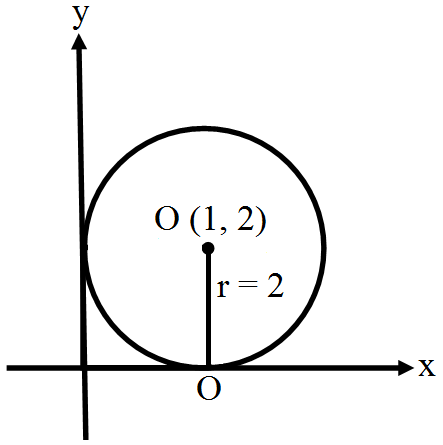
Find the equation of the circle which touches $x-$axis and whose centre is $(1, 2).$
Answer
Since the circle whose centre is $(1, 2)$ thouch $x-$axis.
$\therefore r = 2$

So, the equation of the circle is,
$(x - h)^2 + (y - k)^2 = r^2$
$\Rightarrow (x - 1)^2 + (y - 2)^2= (2)^2$
$\Rightarrow x^2- 2x + 1 + y^2 - 4y + 4 = 4$
$\Rightarrow x^2 + y^2 - 2x - 4y + 1 = 0$
Hence, the required equation is,
$x^2 + y^2 - 2x - 4y + 1 = 0$
View full question & answer
Question 33 Marks
Find the equation of the circle which passes through the points $(2, 3)$ and $(4, 5)$ and the centre lies on the straight line $y - 4x + 3 = 0.$
Answer
Let the centre of the circle be $C(h, k).$
Given that the centre lies on the line $y - 4x + 3 = 0.$
$k - 4h + 3 = 0 or k = 4h - 3$
So, the centre is $C(h, 4h - 3)$
Now point $A(2, 3)$ and $B(4, 5)$ lies on the circle.
$\therefore AC^2 = BC^2$
$\Rightarrow (h - 2)^2 + (4h - 3 - 3)^2 = (h - 4)^2 + (4h - 3 - 5)^2$
$\Rightarrow (h - 2)^2 + (4h - 6)^2 = (h - 4)^2 + (4h - 8)^2$
$\Rightarrow -4h + 4 - 48h + 36 = -8h + 16 - 64h + 64$
$\Rightarrow 20h = 40$
$\Rightarrow h = 2$
So, the centre is $C(2, 5)$
and radius $=\text{AC}=\sqrt{(2-2)^2+(3-5)^2}=2$
Therefore, equation of the circle is,
$(x - 2)^2 + (y - 5)^2 = 4$
$\Rightarrow x^2 + y^2 - 4x - 10y + 25 = 0$
View full question & answer
Question 43 Marks
Show that the point (x, y) given by $\text{x}=\frac{2\text{at}}{1+\text{t}^2}$ and $\text{y}=\frac{\text{a}(1-\text{t}^2)}{1+\text{t}}$ lies on a circle for all real values of t such that $-1\leq\text{y}\leq1$ where a is any given real numbers.
Answer
Given $\text{x}=\frac{2\text{at}}{1+\text{t}^2}$ and $\text{y}=\frac{\text{a}(1-\text{t}^2)}{1+\text{t}}$
$\text{x}^2+\text{y}^2=\Big(\frac{2\text{a}}{1+\text{t}^2}\Big)+\Big(\frac{\text{a}(1-\text{t}^2)}{1+\text{t}^2}\Big)^2$
$=\frac{4\text{a}^2\text{t}^2}{(1+\text{t}^2)^2}+\frac{\text{a}^2(1-\text{t}^2)^2}{(1+\text{t}^2)^2}$
$=\frac{4\text{a}^2\text{t}^2+\text{a}^2(1+\text{t}^4-2\text{t}^2)}{(1+\text{t}^2)^2}$
$=\frac{4\text{a}^2\text{t}^2+\text{a}^2+\text{a}^2\text{t}^4-2\text{a}^2\text{t}^2}{(1+\text{t}^2)^2}$
$=\frac{\text{a}^2+\text{a}^2\text{t}^4+2\text{a}^2\text{t}^2}{(1+\text{t}^2)^2}$
$=\frac{\text{a}^2(1+\text{t}^4+2\text{t}^2)}{(1+\text{t}^2)^2}$
$=\frac{\text{a}^2(1+\text{t}^2)^2}{(1+\text{t}^2)^2}$
$=\text{a}^2$
$\therefore\ \text{x}^2+\text{y}^2=\text{a}^2$ which is the equation of a circle.
Hence, the given point lie on a circle.
View full question & answer
Question 53 Marks
If the line $y = mx + 1$ is tangent to the parabola $y^2 = 4x$ then find the value of m.
$[$Hint: Solving the equation of line and parabola, we obtain a quadratic equation and then apply the tangency condition giving the value of m$]$
Answer
Given that $y^2 = 4x ....(i)$
and $y = mx + 1 ....(ii)$
From eq. $(i)$ and $(ii)$ we get
$(mx + 1)^2 = 4x$
$\Rightarrow m^2x^2 + 1 + 2mx - 4x = 0$
$\Rightarrow m^2x^2 + (2m - 4)x + 1 = 0$
Applying condition of tangency, we have
$(2m - 4)^2 - 4m^2 \times 1 = 0$
$\Rightarrow 4m^2 + 16 - 16m - 4m^2 = 0$
$\Rightarrow -16m = -16$
$\Rightarrow m = 1$
Hence, the required value of m is $1$
View full question & answer
Question 63 Marks
Find the equation of the hyperbola with eccentricity $\frac{3}{2}$ and foci at $(\pm2,0)$
Answer
Let the equation of the hyperbola be $\frac{\text{x}^2}{\text{a}^2}-\frac{\text{y}^2}{\text{b}^2}=1$
Given that eccentricity, $\text{e}=\frac{3}{2}$ and foci $(\pm\text{ae},0)\equiv(\pm2,0)$
$\therefore\text{ ae}=2$
$\Rightarrow\text{a}\times\frac{3}{2}=2$
$\Rightarrow\text{a}=\frac{4}{3}$
We know that, $\text{b}^2=\text{a}^2(\text{e}^2-1)$
$\Rightarrow\text{b}^2=\frac{16}{9}\Big(\frac{9}{4}-1\Big)$
$\Rightarrow\text{b}^2=\frac{16}{9}\times\frac{5}{4}=\frac{20}{9}$
So, the equation of hyperbola is,
$\frac{\text{x}^2}{\frac{16}{9}}-\frac{\text{y}^2}{\frac{20}{9}}=1$
$\Rightarrow\frac{\text{x}^2}{16}-\frac{\text{y}^2}{20}=\frac{1}{9}$
View full question & answer
Question 73 Marks
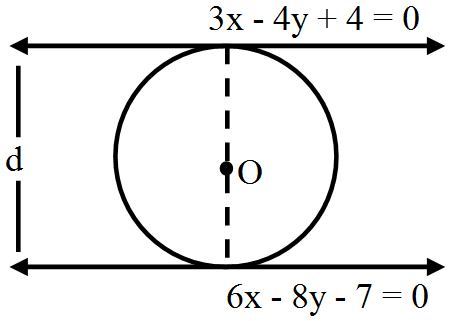
If the lines 3x - 4y + 4 = 0 and 6x - 8y - 7 = 0 are tangents to a circle, then find the radius of the circle.
[Hint: Distance between given parallel lines gives the diameter of the circle]
Answer
Given equation are 3x - 4y + 4 = 0
and 6x - 8y - 7 = 0
$\Rightarrow3\text{x}-4\text{y}-\frac{7}{2}=0$
Since $\frac{3}{6}=\frac{-4}{-8}=\frac{1}{2}$ then the lines are parallel.
So, the distance between the parallel lines,

$=\bigg|\frac{\text{c}_1-\text{c}_2}{\sqrt{\text{a}^2+\text{b}^2}}\bigg|=\Bigg|\frac{4+\frac{7}{2}}{\sqrt{(3)^2+(-4)^2}}\Bigg|$
$=\Bigg|\frac{\frac{15}{2}}{5}\Bigg|=\frac{3}{2}$
$\text{Diameter}=\frac{3}{2}$
$\therefore\text{ Redius}=\frac{3}{4}$
Hence, the required radius $=\frac{3}{4}$ 
View full question & answer
Question 83 Marks
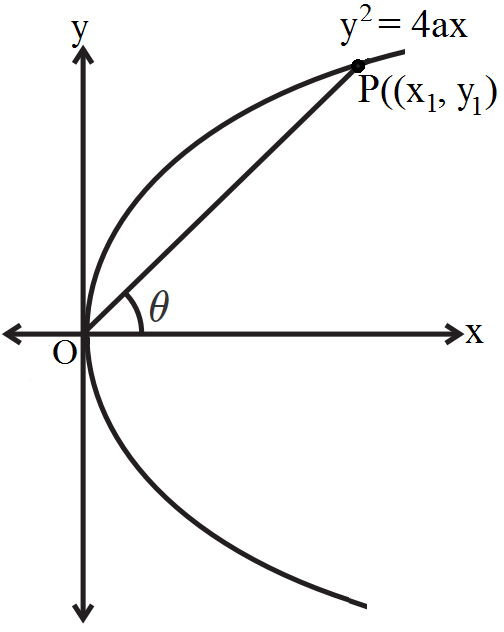
Find the length of the line$-$segment joining the vertex of the parabola $y^2 = 4ax$ and a point on the parabola where the line$-$segment makes an angle $\theta$ to the $x-$axis.
Answer
Given equation of the parabola is $y^2 = 4ax.$
Let the point on the parabola be $P(x_1, y_1)$​​​​​​​

From the figure, slope of $\text{OP}=\tan\theta=\frac{\text{y}_1}{\text{x}_1}$
Also$, \text{y}_1^2=4\text{ax}_1$
Now$, \text{OP}=\sqrt{\text{x}^2_1+\text{y}^2_1}=\sqrt{\text{x}^2_1+\tan^2\theta\text{x}^2_1}$
$\text{OP}=\sqrt{\text{x}^2_1\sec^2\theta}=\text{x}_1\sec\theta$
From $(i)$ and $(ii),$ we have
$\tan^{2}\theta\text{x}_1^2=4\text{ax}_1$
$\Rightarrow\text{x}_1=\frac{4\text{a}}{\tan^{2}\theta}$
$\therefore\ \text{OP}=\frac{4\text{a}\sec\theta}{\tan^{2}\theta}=\frac{4\text{a}\cos\theta}{\sin^2\theta}$
View full question & answer
Question 93 Marks
Find the equation of the following parabolas:
Focus at (-1, -2), directrix x - 2y + 3 = 0
Answer
We know that the distance of any point on the parabola from its focus and its directrix is same.
Given that, focus at (-1, -2) and directrix x - 2y + 3 = 0
So, the equation of parabola is,
$\sqrt{(\text{x}+1)^2+(\text{y}+2)^2}=\Big|\frac{\text{x}-2\text{y}+3}{\sqrt{1+4}}\Big|$
$\Rightarrow\text{x}^2+2\text{x}+1+\text{y}^2+4\text{y}+4\\=\frac{1}{5}\big[\text{x}^2+4\text{y}^2+9+6\text{x}-4\text{xy}-12\text{y}\big]$
$\Rightarrow4\text{x}^2+4\text{xy}+\text{y}^2+4\text{x}+32\text{y}+16=0$
View full question & answer
Question 103 Marks
Find the equation of the following parabolas:
Vertex at (0, 4), focus at (0, 2).
Answer
We know that the distance of any point on the parabola from its focus and its directrix is same.
Given that, vertex = (0,4) and focus = (0, 2)
Now distance between the vertex and directrix is same as the distance between the vertex and focus.
Directrix is y - 6 = 0
For any point of P(x, y) on the parabola
Distance of P from directrix = Distance of P from focus
$\Rightarrow|\text{y}-6|=\sqrt{(\text{x}-0)^2+(\text{y}-2)^2}$
$\Rightarrow\text{y}^2-12\text{y}+36=\text{x}^2+\text{y}^2-4\text{y}+4$
$\Rightarrow\text{x}^2=32-8\text{y}$
View full question & answer
Question 113 Marks
If the distance between the foci of a hyperbola is $16$ and its eccentricity is $\sqrt{2},$ then obtain the equation of the hyperbola.
Answer
Equation of hyperbola is $\frac{\text{x}^2}{\text{a}^2}-\frac{\text{y}^2}{\text{b}^2}=1$
Distance between the foci $= 2ae$
$2\text{ae}=16$
$\Rightarrow\text{ae}=8$
$\Rightarrow\text{a}\times\sqrt{2}=8$
$\Rightarrow\text{a}=\frac{8}{\sqrt{2}}=4\sqrt{2}$ $\big[\because\text{e}=\sqrt{2}\big]$
Now, $b^2 = a^2(e^2 - 1) [$for hyperbola$]$
$\Rightarrow\text{b}^2=4\big(4\sqrt{2}\big)^2(2-1)$
$\Rightarrow\text{b}^2=32$
$\Rightarrow\text{a}=4\sqrt{2}$
$\Rightarrow\text{a}^2=32$
Hence, the required equation is $\frac{\text{x}^2}{32}-\frac{\text{y}^2}{32}=1$
$\Rightarrow\text{x}^2-\text{y}^2=32$
View full question & answer
Question 123 Marks
Show that the set of all points such that the difference of their distances from (4, 0) and (-4, 0) is always equal to 2 represent a hyperbola.
Answer
Let the points be P(x, y)
Accordinag to the question,
Distance of P from (4, 0) - Distance of P from (-4, 0) = 2
$\Rightarrow\sqrt{(\text{x}+4)^2+\text{y}^2}-\sqrt{(\text{x}-4)^2+\text{y}^2}=2$
$\Rightarrow\sqrt{(\text{x}+4)^2+\text{y}^2}=2+\sqrt{(\text{x}-4)^2+\text{y}^2}$
Squaring both sides, we get
$\text{x}^2+8\text{x}+16+\text{y}^2=4+\text{x}^2-8\text{x}+16+\text{y}^2\\+4\sqrt{(\text{x}-4)^2+\text{y}^2}$
$\Rightarrow(4\text{x}-1)=\sqrt{(\text{x}-4)^2+\text{y}^2}$
Again squaring both sides we get
$16\text{x}^2-8\text{x}+1=\text{x}^2+16-8\text{x}+\text{y}^2$
$\Rightarrow15\text{x}^2-\text{y}^2=15$ which is a parabola.
View full question & answer
Question 133 Marks
If the points (0, 4) and (0, 2) are respectively the vertex and focus of a parabola, then find the equation of the parabola.
Answer

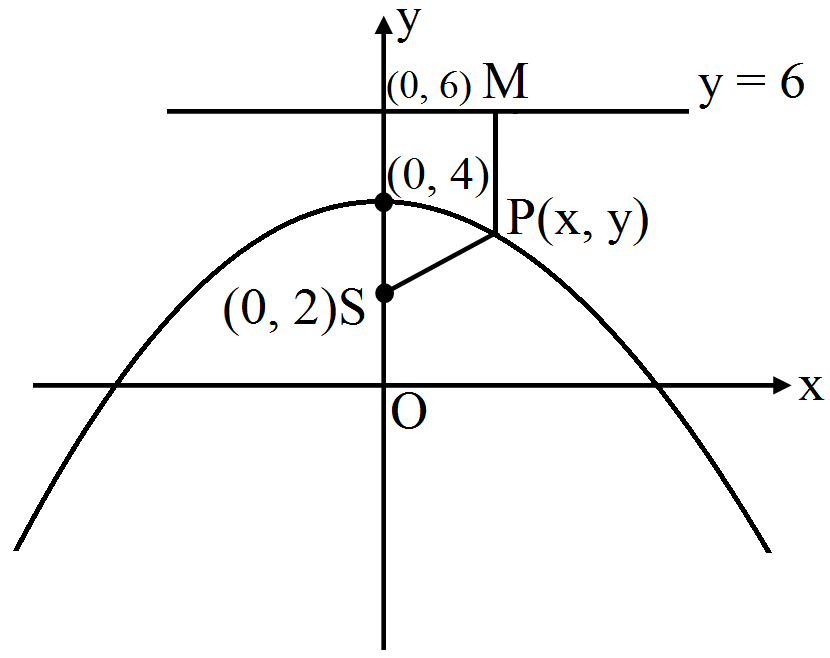
Given that the vertex of the parabola is A(0, 4) and its focus is S(0, 2)
 So, directrix of the parabola is y = 6
Now by definition of the parabola for any point P(x, y) on the parabola,
$\text{SP}=\text{PM}$
$\sqrt{(\text{x}-0)^2+(\text{y}-2)^2}=\Big|\frac{0+\text{y}-6}{\sqrt{0+1}}\Big|$
$\Rightarrow\text{x}^2+\text{y}^2-4\text{y}+4=\text{y}^2-12\text{y}+36$
$\Rightarrow\text{x}^2+8\text{y}=32$
View full question & answer
Question 143 Marks
Find the equation of the set of all points whose distance from $(0, 4)$ are $\frac{2}{3}$ of their distance from the line $y = 9.$
Answer
Let $P(x, y)$ be a point.
According to question$,$ we get
$\sqrt{(\text{x}-0)^2+(\text{y}-4)^2}=\frac{2}{3}\Big|\frac{\text{y}-9}{1}\Big|$
Squaring both sides$,$ we have
$\text{x}^2+(\text{y}-4)^2=\frac{4}{9}\big(\text{y}^2+-81-18\text{y}\big)$
Squaring both sides$,$ we have
$\text{x}^2+(\text{y}-4)^2=\frac{4}{9}\big(\text{y}^2+81-18\text{y}\big)$
$\Rightarrow9\text{x}^2+9(\text{y}-4)^2=4\text{y}^2+324-72\text{y}$
$\Rightarrow9\text{x}^2+9\text{y}^2+144-72\text{y}=4\text{y}^2+324-72\text{y}$
$\Rightarrow9\text{x}^2+5\text{y}^2+144-324=0$
$\Rightarrow9\text{x}^2+5\text{y}^2-180=0$
Hence$,$ the required equation is $9x^2 + 5y^2 - 180 = 0$
View full question & answer
Question 153 Marks
Find the equation of the hyperbola with:
$(0,\pm\sqrt{10}) $passing through $(2,3)$
Answer
Given that, $\text{foci}=(0,\pm\sqrt{10})$
$\therefore\text{ be}=\sqrt{10}$
Also, $\text{a}^2=\text{b}^2(\text{e}^2-1)$
$\Rightarrow\text{a}^2=\text{b}^2\text{e}^2-\text{b}^2=10-\text{b}^2$
$\therefore$ Equation of the hyperbola is,
$\frac{\text{x}^2}{\text{a}^2}-\frac{\text{y}^2}{\text{b}^2}=-1$ or $\frac{\text{x}^2}{10-\text{b}^2}-\frac{\text{y}^2}{\text{b}^2}=-1$
Since, hyperbola passes through the point $(2, 3)$
$\therefore\ \frac{4}{10-\text{b}^2}-\frac{9}{\text{b}^2}=-1$
$\Rightarrow4\text{b}^2-9(10-\text{b}^2)=-\text{b}^2(10-\text{b}^2)$
$\Rightarrow\text{b}^4-23\text{b}^2+90=0$
$\Rightarrow(\text{b}^2-18)(\text{b}^2-5)=0$
$\Rightarrow\text{b}^2=5 (b^2 = 18$ not possible as $a^2 + b^2 = 10)$
$\therefore\ \text{b}^2=10-5=5$
So, the equation of hyperbola is $\frac{\text{x}^2}{5}-\frac{\text{y}^2}{5}=-1$ or $y^2 - x^2 = 5.$
View full question & answer
Question 163 Marks
Find the equation of ellipse whose eccentricity is $\frac{2}{3},$ latus rectum is 5 and the centre is (0, 0).
Answer
Let equation of the ellipse be $\frac{\text{x}^2}{\text{a}^2}+\frac{\text{y}^2}{\text{b}^2}=1(\text{a}>\text{b})$
Given that, $\text{e}=\frac{2}{3}$ and latus rectum = 5
$\therefore\ \frac{2\text{b}^2}{\text{a}}=5$
$\Rightarrow\text{b}^2=\frac{5\text{a}}{2}$
We know that, $\text{b}^2=\text{a}^2(1-\text{e})^2$
$\Rightarrow\frac{5\text{a}}{2}=\text{a}^2\Big(1-\frac{4}{9}\Big)$
$\Rightarrow\frac{5}{2}=\frac{5\text{a}}{9}$
$\Rightarrow\text{a}=\frac{9}{2}$
$\therefore\ \text{b}^2=\frac{5\times9}{2\times2}=\frac{45}{4}$
So, the required equation of the ellipse is $\frac{4\text{x}^2}{81}+\frac{4\text{y}^2}{45}=1$
View full question & answer