Questions

5 Marks Questions

Take a timed test

9 questions · self-marked practice — reveal the answer and mark yourself.

Question 15 Marks
Find the equation of a circle concentric with the circle $x^2 + y^2 - 6x + 12y + 15 = 0$ and has double of its area.
$[$Hint: Concentric circles have the same centre$]$
Answer
Given equation of the circle is$,$
$x^2 + y^2 - 6x + 12y + 15 = 0 .....(i)$
Centre $= (-g, -f) = (3, -6)$
$\because 2g = -6$
$\Rightarrow g = -3, 2f = 12$
$\Rightarrow f = 6$
Since the circle is concentric with the given circle$,$
$\therefore$ Centre $= (3, -6)$
Now let the radius of the circle is $r,$
$\therefore\ \text{r}=\sqrt{\text{g}^2+\text{f}^2-\text{c}}$
$=\sqrt{9+36-15}=\sqrt{30}$
Area of the given circle $(i) =\pi\text{r}^2=30\pi\text{ sq. unit}$
Area of the required circle $=2\times30\pi=60\pi\text{ sq.units}$
If $r_1$ be the radius of the required circle.
$\pi\text{r}^2_1=60\pi$
$\Rightarrow\text{r}^2_1=60$
So$,$ the required equation of the circle is,
$(x - 3)^2 + (y + 6)^2 = 60$
$\Rightarrow x^2+ 9 - 6x + y^2 + 36 + 12y - 60 = 0$
$\Rightarrow x^2 + y^2 - 6x + 12y - 15 = 0$
Hence$,$ the required equation is $x^2 + y^2 - 6x + 12y - 15 = 0$
View full question & answer
Question 25 Marks
Find the coordinates of a point on the parabola $y^2 = 8x$ whose focal distance is $4.$
Answer
Given parabola is $y^2 = 8x .....(i)$
Comparing with the equation of parabola $y^2 = 4ax$
$4a = 8$
$\Rightarrow a = 2$
Now focal distance $= |x + a|$
$\Rightarrow|\text{x}+\text{a}|=4$
$\Rightarrow(\text{x}+\text{a})=\pm4$
$\Rightarrow\text{x}+2=\pm4$
$\Rightarrow\text{x}=4-2=2$ and $\text{x}=-6$
But $\text{x}\neq-6\ \therefore\text{ x}=2$
Put $x = 2$ in equation $(i)$ we get
$\text{y}^2=8\times2=16$
$\therefore\ \text{y}=\pm4$
So, the coordinates of the point are $(2, 4), (2, -4)$
Hence, the required coordinates are $(2, 4)\  and\  (2, -4)$
View full question & answer
Question 35 Marks
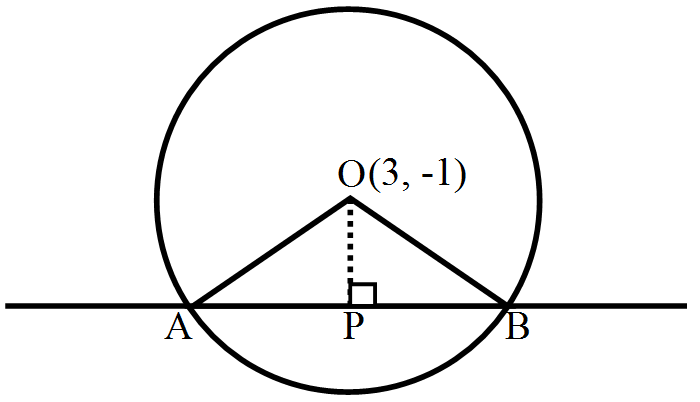
Find the equation of a circle whose centre is $(3, -1)$ and which cuts off a chord of length $6$ units on the line $2x - 5y + 18 = 0.$
$[$Hint: To determine the radius of the circle$,$ find the perpendicular distance from the centre to the given line$]$
Answer
Given centre of the circle $0(3, -1)$
Chord of the circle is $AB.$​​​​​​​

Given that equation of $AB$ is $2x - 5y + 18 = 0$
Also$, AB = 6$
Perpendicular distance from $O$ is $AB$ is$,$
$\text{OP}=\bigg|\frac{2(3)-5(-1)+18}{\sqrt{4+25}}\bigg|=\frac{29}{\sqrt{29}}=\sqrt{29}$
In $\triangle\text{OPB},$ we have
$OB^2 = OP^2 + PB^2$
$\Rightarrow OB^2 = 29 + 9 = 38$
So$,$ the radius of circle is $\sqrt{38}$
Thus$,$ equation of the circle is$,$
$(x - 3)^2 + (y + 1)^2 = 38$
$\Rightarrow x^2 - 6x + 9 + y^2 + 2y + 1 = 38$
$\Rightarrow x^2 + y^2- 6x + 2y = 28$
View full question & answer
Question 45 Marks
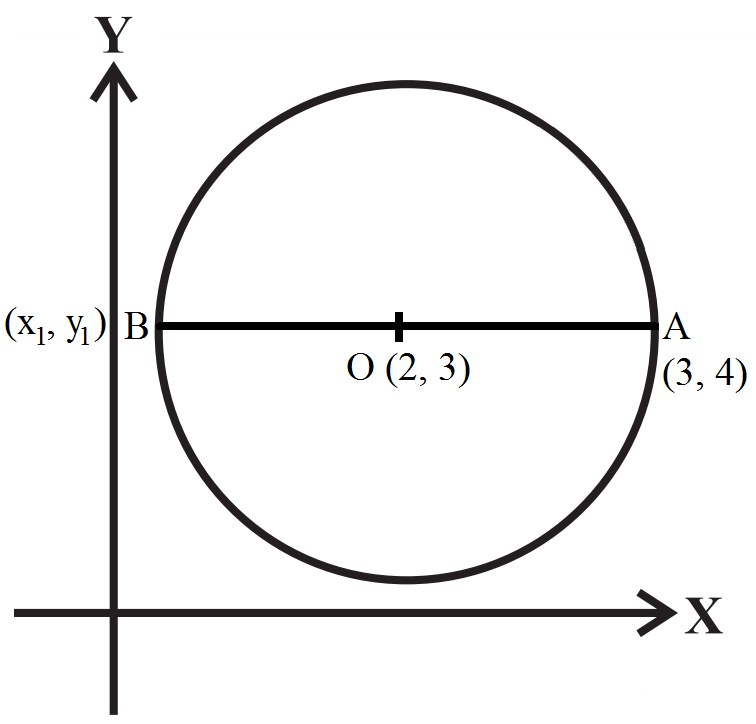
If one end of a diameter of the circle $x^2 + y^2 - 4x - 6y + 11 = 0$ is $(3, 4),$ then find the coordinate of the other end of the diameter.
Answer

Equation of given circle is $x^2 + y^2 - 4x - 6y + 11 = 0$
Centre $= (-g, -f) = (2, 3)$
$\therefore\ \frac{\text{x}_1+3}{2}=2$
$\Rightarrow\text{ x}_1+3=4$
$\Rightarrow\text{ x}_1=1$
and $\frac{\text{y}_1+4}{2}=3$
$\Rightarrow\text{ y}_1+4=6$
$\Rightarrow\text{ y}_1=2$
Hence, the required coordinates are $(1, 2).$
View full question & answer
Question 55 Marks
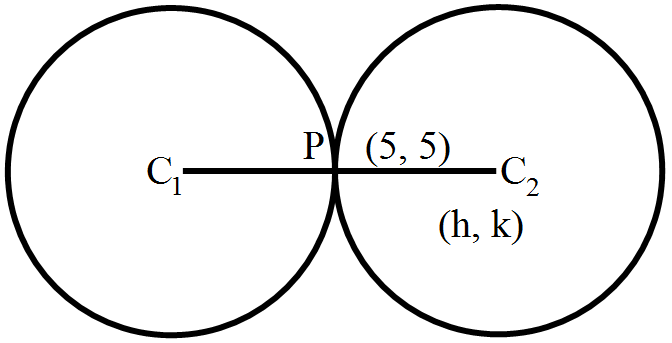
Find the equation of a circle of radius $5$ which is touching another circle $x^2 + y^2 - 2x - 4y - 20 = 0$ at $(5, 5).$
Answer
Given circle is,
$x^2 + y^2 - 2x - 4y - 20 = 0$
$2\ g = -2 \Rightarrow g = -1$
$2\ f = -4 \Rightarrow f = -2$​​​​​​​

$\therefore\text{ Centre C}_2=(1,2)$
and $\text{r}=\sqrt{\text{g}^2+\text{f}^2-\text{c}}$
$=\sqrt{1+4+20}=5$
Let the centre of the required circle be $(h, k).$
Clearly, $P$ is the mid-point of $C_1C_2$
$\therefore\ 5=\frac{1+\text{h}}{2}$
$\Rightarrow\text{h}=9$
and $5=\frac{2+\text{k}}{2}$
$\Rightarrow\text{k}=8$
radius of the required circle $= 5$
$\therefore$ Eq. of the circle is $(x - 9)^2 + (y - 8)^2 = (5)^2$
$\Rightarrow x^2 + 81 - 18x + y^2 + 64 - 16y = 25$
$\Rightarrow x^2 + y^2 - 18x - 16y + 145 - 25 = 0$
$\Rightarrow x^2+ y^2 - 18x - 16y + 120 = 0$
Hence the required equation is $x^2 + y^2 - 18x - 16y + 120 = 0$
View full question & answer
Question 65 Marks
If the eccentricity of an ellipse is $\frac{5}{8}$ and the distance between its foci is 10, then find latus rectum of the ellipse.
Answer
Equation of an ellipse is $\frac{\text{x}^2}{\text{a}^2}+\frac{\text{y}^2}{\text{b}^2}=1$
Eccentricity, $\text{e}=\frac{5}{8},\text{ foci}=(\pm\text{ae},0)$
Distance between its foci = ae + ae = 2ae
$\therefore\ 2\text{ae}=10$
$\Rightarrow\text{ae}=5$
$\Rightarrow\text{a}\times\frac{5}{8}=5$
$\Rightarrow\text{a}=8$
Now, $\text{b}^2=\text{a}^2(1-\text{e}^2)$
$\Rightarrow\text{b}^2=64\Big(1-\frac{25}{64}\Big)$
$\Rightarrow\text{b}^2=64\times\frac{39}{64}$
$\Rightarrow\text{b}^2=39$
So, the length of the latus rectum $=\frac{2\text{b}^2}{\text{a}}=\frac{2\times39}{8}=\frac{39}{4}$
Hence, the length of the latus rectum $=\frac{39}{4}$
View full question & answer
Question 75 Marks
If the lines 2x - 3y = 5 and 3x - 4y = 7 are the diameters of a circle of area 154 square units, then obtain the equation of the circle.
Answer
We know that the intersection point of the diameter gives the centre of the circle.
Given equation of diameters are
2x - 3y = 5 ....(i)
3x - 4y = 7 ......(ii)
From eq. (i) we have $\text{x}=\frac{5+3\text{y}}{2}\ ...(\text{iii})$
Putting the value of x in eq. (ii) we have
$3\Big(\frac{5+3\text{y}}{2}\Big)-4\text{y}=7$
$\Rightarrow15+9\text{y}-8\text{y}=14$
$\Rightarrow\text{y}=14-15$
$\Rightarrow\text{y}=-1$
Now, from eq. (iii) we have
$\text{x}=\frac{5+3(-1)}{2}$
$\Rightarrow\text{x}=\frac{5-3}{2}$
$\Rightarrow\text{x}=1$
So, the centre of the circle = (1, -1)
Given that area of the circle = 154
$\Rightarrow\pi\text{r}^2=154$
$\Rightarrow\frac{22}{7}\times\text{r}^2=154$
$\Rightarrow\text{r}^2=154\times\frac{7}{22}$
$\Rightarrow\text{r}^2=7\times7$
$\Rightarrow\text{r}=7$
So, the equation of the circle is,
$\Rightarrow(\text{x}-1)^2+(\text{y}+1)^2=(7)^2$
$\Rightarrow\text{x}^2+1-2\text{x}+\text{y}^2+1+2\text{y}=49$
$\Rightarrow\text{x}^2+\text{y}^2-2\text{x}+2\text{y}=47$
Hence, required of the circle is,
$\text{x}^2+\text{y}^2-2\text{x}+2\text{y}=47$
View full question & answer
Question 85 Marks
Find the equation of the set of all points the sum of whose distances from the points $(3, 0)$ and $(9, 0)$ is $12.$
Answer
Let $(x, y)$ be any point.
Given points are $(3, 0)$ and $(9, 0)$ is $12$
According to the quation, we have
$\sqrt{(\text{x}-3)^2+(\text{y}-0)^2}+\sqrt{(\text{x}-9)^2+(\text{y}-0)^2}=12$
$=\sqrt{\text{x}^2+9-6\text{x}+\text{y}^2}+\sqrt{\text{x}^2+81+18\text{x}+\text{y}^2}=12$
Putting $\text{x}^2+9-6\text{x}+\text{y}^2=\text{k}$
$\Rightarrow\sqrt{\text{k}}+\sqrt{72-12\text{x}+\text{k}}=12$
$\Rightarrow\sqrt{72-12\text{x}+\text{k}}=12-\sqrt{\text{k}}$
Squaring sides, we have
$\Rightarrow72-12\text{x}+\text{k}=144+\text{k}-24\sqrt{\text{k}}$
$\Rightarrow24\sqrt{\text{k}}=144-72+12\text{x}$
$\Rightarrow24\sqrt{\text{k}}=72+12\text{x}$
$\Rightarrow2\sqrt{\text{k}}=6+\text{x}$
Again squaring both sides, we get
$4\text{k}=36+\text{x}^2+12\text{x}$
Putting the value of $k$, we get
$4(\text{x}^2+9-6\text{x}+\text{y}^2)=36+\text{x}^2+12\text{x}$
$\Rightarrow4\text{x}^2+36-24\text{x}+4\text{y}^2=36+\text{x}^2+12\text{x}$
$\Rightarrow3\text{x}^2+4\text{y}^2-36\text{x}=0$
Hence, the required equation is $3x^2 + 4y^2 - 36x = 0$
View full question & answer
Question 95 Marks
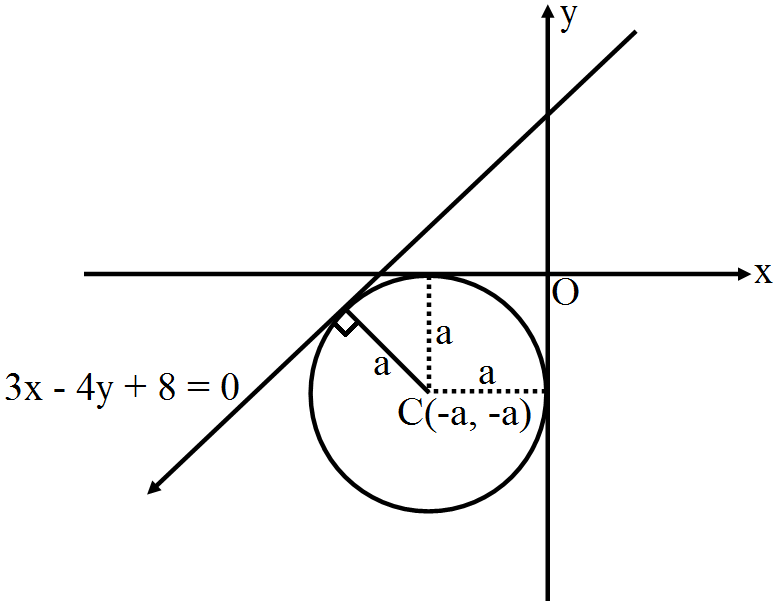
Find the equation of a circle which touches both the axes and the line 3x - 4y + 8 = 0 and lies in the third quadrant.
[Hint: Let a be the radius of the circle, then (-a, -a) will be centre and perpendicular distance from the centre to the given line gives the radius of the circle]
Answer

Since circle touches both the axes, its centre is C(-a, -a) and radius is a.
Also, circle touches the line 3x - 4y + 8 - 0
Distance from centre C to this is radius of the circle.
$\therefore$ Radius of the circle, $\text{a}=\Big|\frac{-3\text{a}+4\text{a}+8}{\sqrt{9+16}}\Big|=\Big|\frac{\text{a}+8}{5}\Big|$
$\therefore\ \frac{\text{a}+8}{5}=\pm\text{a}$
$\Rightarrow\text{a}+8=5\text{a}\text{ or }\text{a}+8=-5\text{a}$
$\Rightarrow\text{a}=2\text{ or }\text{a}=\frac{-4}{3}$
$\therefore\text{ a}=2$
So, the equation of the required circle is,
$(\text{x}+2)^2+(\text{y}+2)^2=2^2$
$\Rightarrow\text{ x}^2+\text{y}^2+4\text{x}+4\text{y}+4=0$
View full question & answer