Questions

3 Marks Question

Take a timed test

9 questions · self-marked practice — reveal the answer and mark yourself.

Question 13 Marks
In a class, $18$ students took Physics $, 23$ students took Chemistry and $24$ students took
Mathematics of these $13$ took both Chemistry and Mathematics, $12$ took both Physics and Chemistry and $11$ took both Physics an Mathematics. If $6$ students offered all the three subjects, find:
$i$. The total number of students.
$ii$. How many took Maths but not Chemistry.
$iii$. How many took exactly one of the three subjects.
Answer
Given $, n(p)=18, n(C)=23, n(M)=24, n(C \cap M)=13$
$n(P \cap C)=12, n(P \cap M)=11 $ and $ n(P \cap C \cap M)=6$
$i$. Total no. of students in the class
$=n(P \cup C \cup M)$
$=n(P)+n(C)+n(M)-n(P \cap C)-n(P \cap M)-n(C \cap M)+n(P \cap C \cap M)$
$=18+23+24-12-11-13+6=35$
$ii$. No. of students who took Mathematics but not Chemistry
$=n(M-C)$
$=n(M)-n(M \cap C)$
$=24-13=11$
$iii.$ No. of students who took exactly one of the three subjects
$=n(P)+n(C)+n(M)-2 n(M \cap P)-2 n(P \cap C)-2 n(M \cap C)+3 n(P \cap C \cap M)$
$=18+23+24-2 \times 11-2 \times 12-2 \times 13+3 \times 6$
$=65-22-24-26+18$
$=83-72=11$
View full question & answer
Question 23 Marks
Evaluate: $\sum_{k=1}^{11}\left(2+3^k\right)$
Answer
Given: $\sum_{k=1}^{11}\left(2+3^k\right)$
$=\left(2+3^1\right)+\left(2+3^2\right)+\left(2+3^3\right)+\left(2+3^{11}\right)$
$=(2+2+2+\ldots \ldots \ldots 11$ times $)+\left(3+3^2+3^3+\ldots \ldots . .+3^{11}\right)$
$=22+\left(3+3^2+3^3+\ldots \ldots+3^{11}\right) \ldots \ldots \ldots$ (i)
Here $3,3^2, 3^3 \ldots \ldots . ., 3^{11}$ is in G.P.
$\therefore a=3$ and $r=\frac{3^2}{3}=3$
$S _n=\frac{3\left(3^{11}-1\right)}{3-1}=\frac{3}{2}\left(3^{11}-1\right)$
Putting the value of $S _{ n }$ in eq. (i), we get $\sum_{k=1}^{11}\left(2+3^k\right)=22+\frac{3}{2}\left(3^{11}-1\right)$
View full question & answer
Question 33 Marks
If the $AM$ and $GM$ of two positive numbers $a$ and $b$ are in the ratio $m : n$, show that $a : b =\left(m+\sqrt{m^2-n^2}\right):\left(m-\sqrt{m^2-n^2}\right)$
Answer
$\frac{a+b}{2}=\frac{m}{n}$
$\frac{a+b}{2 \sqrt{a b}}=\frac{m}{n}$
By $C$ and $D$
$\frac{a+b+2 \sqrt{b}}{a+b-2 \sqrt{b}}=\frac{m+n}{m-n}$
$\frac{(\sqrt{a}+\sqrt{b})^2}{(\sqrt{a}-\sqrt{b})^2}=\frac{m+n}{m-n}$
$\frac{\sqrt{a}+\sqrt{b}}{\sqrt{a}-\sqrt{b}}=\frac{\sqrt{m+n}}{\sqrt{m-n}}$
By $C$ and $D$
$\frac{\sqrt{a}}{\sqrt{b}}=\frac{\sqrt{m+n}+\sqrt{m-n}}{\sqrt{m+n}-\sqrt{m-n}}$
Squaring both side
$\frac{a}{b}=\frac{m+n+m-n+2 \sqrt{m^2-n^2}}{m+n+m-n-2 \sqrt{m^2-n^2}}$
$\frac{a}{b}=\frac{m+\sqrt{m^2-n^2}}{m-\sqrt{m^2-n^2}}$
View full question & answer
Question 43 Marks
Find the derivative of $\frac{(x-1)(x-2)}{(x-3)(x-4)}$.
Answer
Let $y=\frac{(x-1)(x-2)}{(x-3)(x-4)}$
On differentiating both sides $w.r.t.\ x,$ we get
$\frac{d y}{d x}=\frac{\left[{[x-3)(x-4) \frac{d}{d x}[(x-1)(x-2)]-(x-1)}$
$(x-2) \frac{d}{d x}[(x-3)(x-4)]\right]}{[(x-3)(x-4)]^2}$
${\left[\because \frac{d}{d x}\left(\frac{u}{v}\right)=\frac{v \frac{d u}{d x}-u \frac{d v}{d x}}{v^2}\right]}$
$=\frac{(x-3)(x-4)\left[(x-1) \frac{d}{d x}(x-2)+(x-2) \frac{d}{d x}(x-1)\right]-(x-1)(x-2)\left[(x-3) \frac{d}{d x}(x-4)+(x-4) \frac{d}{d x}(x-3)\right]}{(x-3)^2(x-4)^2}$
$=\frac{(x-3)(x-4)[(x-1) \cdot 1+(x-2) \cdot 1]-(x-1)(x-2)[(x-3) \cdot 1+(x-4) \cdot 1)]}{(x-3)^2(x-4)^2}$
$=\frac{(x-3)(x-4)[2 x-3]-(x-1)(x-2)[2 x-7]}{(x-3)^2(x-4)^2}$
$=\frac{\left(x^2-7 x+12\right)(2 x-3)-\left(x^2-3 x+2\right)(2 x-7)}{(x-3)^2(x-4)^2}$
$=\frac{2 x^3-14 x^2+24 x-3 x^2+21 x-36-2 x^3+6 x^2-4 x+7 x^2-21 x+14}{\left.(x-3)^{2( } x-4\right)^2}$
$=\frac{-4 x^2+20 x-22}{(x-3)^2(x-4)^2}$
View full question & answer
Question 53 Marks
Find the derivative of $x^{-4}\left(3-4 x^{-5}\right)$
Answer
Here $f(x)=x^{-4}\left(3-4 x^{-5}\right)$
$f^{\prime}(x)=\frac{d}{d x}\left[x^{-4}\left(3-4 x^{-5}\right)\right]$
$=x^{-4} \frac{d}{d x}\left(3-4 x^{-5}\right)+\left(3-4 x^{-5}\right) \frac{d}{d x}\left(x^{-4}\right)$
$=x^{-4}\left(20 x^{-6}\right)+\left(3-4 x^{-5}\right)\left(-4 x^{-5}\right)$
$=20 x^{-10}-12 x^{-5}+16 x^{-10}$
$=36 x^{-10}-12 x^{-5}$
$=\frac{36}{x^{10}}$
$=\frac{12}{x^5}$
View full question & answer
Question 63 Marks
Show that $2^{4 n+4}-15 n-16$ where $n \in N$ is divisible by $225$
Answer
From the given equation we have $2^{4 n+4}-15 n-16=2^{4(n+1)}-15 n-16$
$=16^{n+1}-15 n-16$
$=(1+15)^{n+1}-15 n-16$
Using binomial expression we have
$={ }^{n+1} C _0 15^0+{ }^{n+1} C _1 15^1+{ }^{n+1} C _2 15^2+{ }^{n+1} C _3 15^3+\ldots+x+[C],(15)^{n+1}-15 n-16$
$=1+(n+1) 15+{ }^{n+1} C _2 15^2+{ }^{n+1} C _3 15^3+\ldots+n+1 C_{n+1}(15)^{n+1}-15 n-16$
$=1+15 n+15+{ }^{n+1} C _2 15^2+{ }^{n+1} C _3 15+\ldots+{ }^{n+1} C _{n+1}(15)^{n+1}-15 n-16$
$=15^2\left[{ }^{n+1} C _2+{ }^{n+1} C _3 15+\ldots \text { so on }\right]$
Thus, $2^{4 n+4}-15 n-16$ is divisible $225 .$
View full question & answer
Question 73 Marks
Using binomial theorem, expand: $\left(x^2-\frac{2}{x}\right)^7$.
Answer
To find: Expansion of $\left(x^2-\frac{3 x}{7}\right)^7$
Formula used: ${ }^n C_r=\frac{n!}{(n-r)!(r)!}$
We know that, $(a+b)^n={ }^n C_0 a^n+{ }^n C_1 a^{n-1} b+{ }^n C_2 a^{n-2} b^2+\ldots \ldots .+{ }^n C_{n-1} a^{n-1}+{ }^n C_n b^n$
Here We have, $\left(x^2-\frac{3 x}{7}\right)^7$
$\Rightarrow\left[{ }^7 C _0\left( x ^2\right)^{7-0}\right]+\left[7 C _1\left( x ^2\right)^{7-1}\left(-\frac{3 x }{7}\right)^1\right]+\left[7 c_2\left(x^2\right)^{7-2}\left(-\frac{3 x}{7}\right)^2\right]+\left[7 C _3\left( x ^2\right)^{7-3}\left(-\frac{3 x }{7}\right)^3\right]+\left[7 C _4\left( x ^2\right)^{7-4}\left(-\frac{3 x }{7}\right)^4\right]$
$+\left[7 C _5\left( x ^2\right)^{7-5}\left(-\frac{3 x }{7}\right)^5\right]+\left[7 C _6\left( x ^2\right)^{7-6}\left(-\frac{3 x }{7}\right)^6\right]+\left[7 C _7\left(-\frac{3 x }{7}\right)^7\right]$
$\Rightarrow\left[\frac{7!}{0!(7-0)!}\left(x^2\right)^7\right]-\left[\frac{7!}{1!(7-1)!}\left(x^2\right)^6\left(\frac{3 x}{7}\right)\right]+\left[\frac{7!}{2!(7-2)!}\left(x^2\right)^5\left(\frac{9 x^2}{49}\right)\right]-\left[\frac{7!}{3!(7-3)!}\left(x^2\right)^4\left(\frac{27 x^3}{343}\right)\right]$
$+\left[\frac{7!}{4!(7-4)!}\left(x^2\right)^3\left(\frac{81 x^4}{2401}\right)\right]-\left[\frac{7!}{5!(7-5)!}\left(x^2\right)^2\left(\frac{243 x^5}{16807}\right)\right]+\left[\frac{7!}{6!(7-6)!}\left(x^2\right)^1\left(\frac{729 x^6}{117649}\right)\right]-\left[\frac{7!}{7!(7-7)!}\left(\frac{2187 x^7}{823543}\right)\right]$
$-\left[\frac{7!}{7!(7-7)!}\left(\frac{2187 x^7}{823543}\right)\right]+\left[21\left(x^{10}\right)\left(\frac{9 x^2}{49}\right)\right]-\left[35\left(x^8\right)\left(\frac{27 x^3}{343}\right)\right]$
$+\left[35\left(x^6\right)\left(\frac{81 x^4}{2401}\right)\right]-\left[21\left(x^4\right)\left(\frac{243 x^5}{16807}\right)\right]+\left[7\left(x^2\right)\left(\frac{729 x^6}{117649}\right)\right]-\left[1\left(\frac{2187 x^7}{823543}\right)\right]$
$\Rightarrow x^{24}-3 x^{13}+\left(\frac{27}{7}\right) x^{12}-\left(\frac{135}{49}\right) x^{11}+\left(\frac{405}{343}\right) x^{10}-\left(\frac{729}{2401}\right) x^9+\left(\frac{729}{16807}\right) x^8-\left(\frac{2187}{823543}\right) x^7$
$x^{14}-3 x^{13}+\left(\frac{27}{7}\right) x^{12}-\left(\frac{135}{49}\right) x^{11}+\left(\frac{405}{343}\right) x^{10}-\left(\frac{729}{2901}\right) x^9+\left(\frac{729}{12807}\right) x^8-\left(\frac{2187}{825353}\right) x^7$
View full question & answer
Question 83 Marks
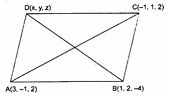
Three vertices of a parallelogram $\text{ABCD}$ are $A(3, -1, 2), B(1, 2, -4)$ and $C(-1, 1, 2).$ Find the coordinates of the fourth vertex.
Answer
Let $D (x, y, z)$ be the fourth vertex of parallelogram $\text{ABCD.}$
We know that diagonals of a parallelogram bisect each other. So the mid points of $AC$ and $BD$ coincide.
Image

$\therefore$ Coordinates of mid point of $AC \left(\frac{3-1}{2}, \frac{-1+1}{2}, \frac{2+2}{2}\right)$
$= (1, 0, 2) $
Also coordinates of mid point of $BD \left(\frac{x+1}{2}, \frac{y+2}{2}, \frac{z-4}{2}\right)$
$\therefore \frac{x+1}{2}=1$
$\Rightarrow x+1=2$
$\Rightarrow x=1$
$\frac{y+2}{2}=0$
$\Rightarrow y+2=0$
$\Rightarrow y=-2$
$\frac{z-4}{2}=2$
$\Rightarrow z-4=4$
$\Rightarrow z=8$
Thus the coordinates of point $D$ are $(1, -2, 8)$
View full question & answer
Question 93 Marks
If ${ }^{22} P_{r+1}:{ }^{20} P_{r+2}=11: 52$. find $r .$
Answer
Here ${ }^{22} P_{r+1}:{ }^{20} P_{r+2}=11: 52$
$\Rightarrow \frac{22!}{(21-r)!} \times \frac{(18-r)!}{20!}=\frac{11}{52}$
$\Rightarrow=\frac{22 \times 21 \times 20!}{(21-r)(20-r)(19-r)(18-r)!} \times \frac{(18-r)!}{20!}=\frac{11}{52}$
$\Rightarrow \frac{22 \times 21}{(21-r)(20-r)(19-r)}=\frac{11}{52}$
$\Rightarrow(21-r)(20-r)(19-r)=2 \times 21 \times 52$
$\Rightarrow(21-r)(20-r)(19-r)=14 \times 13 \times 12$
$\Rightarrow(21-r)(20-r)(19-r)=(21-7)(20-7)(19-7)$
$\Rightarrow r=7$
View full question & answer