Questions

2 Marks Questions

Take a timed test

7 questions · self-marked practice — reveal the answer and mark yourself.

Question 12 Marks
Find the angles between the pairs of straight lines $x - 4y = 3$ and $6x - y = 11.$
Answer
Given that equations of the lines are, 
$x - 4y = 3 .... (i) $
$6x - y = 11 .... (ii) $
Let $m_1$ and $m_2$ be the slopes of these lines.
Here, $m_1=\frac{1}{4}, m_2=6$
Let $\theta$ be the angle between the lines.
Then, $\tan \theta=\left|\frac{m_1-m_2}{1+m_1 m_2}\right|$
$=\left|\frac{\frac{1}{4}-6}{1+\frac{3}{2}}\right|$
$=\frac{23}{10}$
$\Rightarrow \theta=\tan ^{-1}\left(\frac{23}{10}\right)$
Therefore, the acute angle between the lines is $\tan ^{-1}\left(\frac{23}{10}\right)$
View full question & answer
Question 22 Marks
Two sets $A$ and $B$ are, such that $n(A \cup B)=21, n(A)=10, n(B)=15$, find $n(A \cap B)$ and $n(A-B)$.
Answer
Using identity,
$n(A \cup B)=n(A)+n(B)-n(A \cap B)$
$21=10+15-n(A \cap B)$
$\therefore n(A \cap B)=(10+15)-21$
$=25-21=4$
$\therefore n(A-B)=n\left(A \cap B^{\prime}\right)$
$=n(A)-n(A \cap B)$
$=10-4$
$=6$
View full question & answer
Question 32 Marks
Find the vertex, focus, axis, directrix and latus$-$rectum of the following parabolas $4 x^2+y=0$.
Answer
We are given that
$4 x^2+y=0$
$\Rightarrow \frac{-y}{4}=x^2$
Comparing the given equation with $x^2=-4 a y$
$4 a=\frac{1}{4} a=\frac{1}{16}$
$\therefore \text { Vertex }=(0,0)$
Focus $=(0,-a)=\left(0, \frac{-1}{16}\right)$
Equation of the directrix:
$y=a$
i.e. $y=\frac{1}{16}$
 Axis $=x=0$
Therefore, length of the latus rectum $=4 a=\frac{1}{4}$
View full question & answer
Question 42 Marks
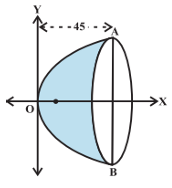
The focus of a parabolic mirror as shown in is at a distance of 5 cm from its vertex. If the mirror is 45 cm deep, find the distance AB
Image
Answer
Since the distance from the focus to the vertex is 5 cm. We have, a = 5. If the origin is taken at the vertex and the axis of the mirror lies along the positive x-axis, the equation of the parabolic section is 
$y^2=4(5) x=20 x=\Rightarrow>$ required eqution of parabola $y^2=20 x$
Note that $x=45$. Thus
$y^2=900$
Therefore $y = \pm 30$
Hence $A B=2 y =2 \times 30=60 cm$
View full question & answer
Question 52 Marks
Differentiate $\frac{x}{\sin x}$ respect to $x .$
Answer
$\text { Let } f ( x )=\frac{x}{\sin x}$
$\therefore f ( x )=\frac{d}{d x}\left(\frac{x}{\sin x}\right)$
$=\frac{\sin x \frac{d}{d x} x-x \frac{d}{d x} \sin x}{(\sin x)^2}$
$=\frac{\sin x \cdot 1-x \cdot \cos x}{\sin ^2 x}$
$=\operatorname{cosec} x-x \cot \times \operatorname{cosec} x$
$=(1-x \cot x) \cdot \operatorname{cosec} x$
View full question & answer
Question 62 Marks
Find the domain and range of the real function $f(x)=\sqrt{9-x^2}$.
Answer
It is clear that, $f ( x )=\sqrt{9-x^2}$ is not defined when $\left(9- x ^2\right)<0$,
i.e.  When $x^2>9$
i,e when $x>3$ or $x<-3$
$\operatorname{dom}( f )=|x \in R:-3 \leq x \leq 3|$
Also,$y =\sqrt{9-x^2} \Rightarrow y^2=\left(9-x^2\right)$
$\Rightarrow x=\sqrt{9-y^2}$
clearly, $x$ is not defined when $\left(9-y^2\right)<0$
but $\left(9-y^2\right)<0$
$\Rightarrow y^2>9$
$\Rightarrow y>3$  or  $y<-3$
range $(f)=\{y \in R:-3 \leq y \leq 3\}$
View full question & answer
Question 72 Marks
Write the domain of the real function $f(x)=\frac{1}{\sqrt{|x|-x}}$
Answer
Case $I :$ When $x > 0.$
Then,we have, $|x|= x$
$\Rightarrow \frac{1}{\sqrt{|x|-x}}=\frac{1}{\sqrt{x-x}}=\frac{1}{0}=\infty$
Case $II :$ When $x < 0$
$| x |=- x$
$\Rightarrow \frac{1}{\sqrt{|x|-x}}=\frac{1}{\sqrt{-x-x}}=\frac{1}{\sqrt{-2 x}}(\text { exists because when } x <0,-2 x >0)$
$\Rightarrow f ( x )$ is defined when $x <0$
Therefore, domain $=(-\infty, 0)$
View full question & answer