Questions

3 Marks Question

Take a timed test

9 questions · self-marked practice — reveal the answer and mark yourself.

Question 13 Marks
There are $200$ individuals with a skin disorder, $120$ had been exposed to the chemical $C_1, 50$ to chemical $C_2$ and $30$ to both the chemicals $C _1$ and $C _2$. Find the number of individuals exposed to $(i)$ chemical $C _1$ but not chemical $C _2\ (ii)$ Chemical $C _2$ but not chemical $C _1\ (iii)$ Chemical $C _2$ or chemical $C _1$.
Answer
Let $S$ denote the universal set consisting of individuals suffering from the skin disorder, A denote the set of individuals exposed to chemical $C _1$ and $B$ denote the set of individuals exposed to chemical $C _2$.
Now,
$n(S) = 200$
$n(A) = 120$
$n(B) = 50$
and $n(A \cap B)=30$
$i.$ Chemical $C _1$ but not chemical $C _2$
Number of individuals exposed to chemical $C _1$ but not chemical $C _2$ is
$=n\left(A \cap B^{\prime}\right)$
$= n ( A )-n(A \cap B)$
$=120-30=90$
$ii.$ Number of individuals exposed to chemical $C _2$ but not chemical $C _1$
$=n\left(A^{\prime} \cap B\right)$
$= n ( B )- n ( A \cap B )$
$=50-30=20$
$iii.$ Number of individuals exposed to chemical $C_1$ or chemical $C_2$
$=n(A \cup B)$
$= n ( A )+ n ( B )- n ( A \cap B )$
$=120+50-30$
$=140$
View full question & answer
Question 23 Marks
Find the square root of $3 - 4i$
Answer
Let $x + yi =\sqrt{3-4 i}$
Squaring both sides, we get
$x^2-y^2+2 x y i=3-4 i$
Equating the real and imaginary parts
$x^2-y^2=3 \ldots . \text { (i) }$
and $2 x y=-4$
$\Rightarrow x y=-2$
Now from the identity, we know
$\left(x^2+y^2\right)=\left(x^2-y^2\right)^2+4 x^2 y^2$
$\left(x^2+y^2\right)^2=(3)^2+4(-2)^2$
$=9+16=25$
$\therefore x^2+y^2=5 \ldots (ii) [$Neglecting $(-)$ sign as $\left.x^2+y^2>0\right]$
Solving $(i)$ and $(ii)$ we get
$ x ^2=4$ and $y ^2=1$
$x= \pm 2$ and $y= \pm 1$
Since the sign of $xy$ is negative
$\therefore$ if, $x =2, y =-1$
and if $x =-2, y =1$
$\therefore \sqrt{-5+12 i}= \pm(2-i)$
View full question & answer
Question 33 Marks
Express the complex number $\left(-2-\frac{1}{3} i\right)^3$ in the form of $a+i b$.
Answer
$\left(-2-\frac{1}{3} i\right)^3=-\left(2+\frac{1}{3} i\right)^3$
$=-\left[(2)^3+\left(\frac{1}{3} i\right)^3+3 \times(2)^2 \times \frac{1}{3} i+3 \times 2 \times\left(\frac{1}{3} i\right)^2\right]$
$=-\left[8+\frac{1}{27} i^3+4 i+\frac{2}{3} i^2\right]$
$=-\left[8-\frac{1}{27} i+4 i-\frac{2}{3}\right][\because i^3=-i ,i^2=-1]$
$=\left[\left(8-\frac{2}{3}\right)+\left(4-\frac{1}{27}\right) i\right.$
$=-\left[\frac{22}{3}+\frac{107}{27} i\right]$
$=\frac{-22}{3}-\frac{107}{27} i$
View full question & answer
Question 43 Marks
Find $(a+b)^4-(a-b)^4$. Hence, evaluate $(\sqrt{3}+\sqrt{2})^4-(\sqrt{3}-\sqrt{2})^4$
Answer
$( a + b )^4=\left[{ }^4 C_0 a^4+{ }^4 C_1 a^3 b+{ }^4 C_2 a^2 b^2+{ }^4 C_3 a b^3+{ }^4 C_4 b^4\right]$
 and $ (a-b)^4=\left[{ }^4 C_0 a^4-{ }^4 C_1 a^3 b+{ }^4 C_2 a^2 b^2-{ }^4 C_3 a b^3+{ }^4 C_4 b^4\right]$
$\therefore(a+b)^4-(a-b)^4=2\left[{ }^4 C_1 a^3 b+{ }^4 C_3 a b^3\right]$
$=2\left[4 a^3 b+4 a b^3\right]=8 a b\left[a^2+b^2\right]$
$\therefore(\sqrt{3}+\sqrt{2})^4-(\sqrt{3}-\sqrt{2})^4=8 \cdot \sqrt{3} \cdot \sqrt{2}\left[(\sqrt{3})^2+(\sqrt{2})^2\right]$
$=8 \cdot \sqrt{3} \cdot \sqrt{2}[3+2]$
$=40 \cdot \sqrt{3} \cdot \sqrt{2}$
$=40 \sqrt{6}$
View full question & answer
Question 53 Marks
Using binomial theorem, expand: $\left(\frac{2 x}{3}-\frac{3}{2 x}\right)^6$
Answer
To find: Expansion of $\left(\frac{2 x}{3}-\frac{3}{2 x}\right)^6$ by means of binomial theorem
Formula used: ${ }^n C_r=\frac{n!}{(n-r)(r)!}$
$(a+b)^{n}={ }^n C_0 a^n+{ }^n C_1 a^{n-1} b+{ }^n C_2 a^{n-2} b^2+\ldots \ldots+{ }^n C_{n-1} a b^{n-1}+n C_n b^n$
Now here We have, $\left(\frac{2 x}{3}-\frac{3}{2 x}\right)^6$
$=\left[6 c_0\left(\frac{2 x}{3}\right)^{6-0}\right]+\left[6 c_1\left(\frac{2 x}{3}\right)^{6-1}\left(-\frac{3}{2 x}\right)^1\right]+\left[6 c_2\left(\frac{2 x}{3}\right)^{6-2}\left(-\frac{3}{2 x}\right)^2\right]$
$+\left[6 c_3\left(\frac{2 x}{3}\right)^{6-3}\left(-\frac{3}{2 x}\right)^3\right]+\left[6 C _4\left(\frac{2 x}{3}\right)^{6-4}\left(-\frac{3}{2 x}\right)^4\right]$
$+\left[6 c_5\left(\frac{2 x}{3}\right)^{6-5}\left(-\frac{3}{2 x}\right)^5\right]+\left[6 c_6\left(-\frac{3}{2 x}\right)^6\right]$
$=\left[\frac{6!}{01(6-0)!}\left(\frac{2 x}{3}\right)^6\right]-\left[\frac{6!}{11(6-1)!}\left(\frac{2 x}{3}\right)^5\left(\frac{3}{2 x}\right)\right]+\left[\frac{6!}{2!(6-2)!}\left(\frac{2 x}{3}\right)^4\left(\frac{9}{4 x^2}\right)\right]-\left[\frac{6!}{3!(6-3)!}\left(\frac{2 x}{3}\right)^3\left(\frac{27}{8 x^3}\right)\right]$
$+\left[\frac{6!}{4!(6-4)!}\left(\frac{2 x}{3}\right)^2\left(\frac{81}{16 x^4}\right)\right]-\left[\frac{6!}{5!(6-5)!}\left(\frac{2 x}{3}\right)^1\left(\frac{243}{32 x^5}\right)\right]+\left[\frac{6!}{6!(6-6)!}\left(\frac{729}{64 x^6}\right)\right]$
$=\left[1\left(\frac{64 x^5}{729}\right)\right]-\left[6\left(\frac{32 x^5}{243}\right)\left(\frac{3}{2 x}\right)\right]+\left[15\left(\frac{16 x^4}{81}\right)\left(\frac{9}{4 x^2}\right)\right]-\left[20\left(\frac{8 x^3}{27}\right)\right]$
$\left.\left(\frac{27}{8 x^3}\right)\right]+\left[15\left(\frac{4 x^2}{9}\right)\left(\frac{81}{16 x^4}\right)\right]-\left[6\left(\frac{2 x}{3}\right)\left(\frac{243}{32 x^5}\right)\right]+\left[1\left(\frac{729}{64 x^6}\right)\right]$
$=\frac{64}{729} x^6-\frac{32}{27} x^4+\frac{20}{3} x^2-20+\frac{135}{4} \frac{1}{x^2}-\frac{243}{8} \frac{1}{x^4}+\frac{729}{64} \frac{1}{x^6}$
View full question & answer
Question 63 Marks
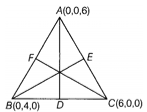
Find the lengths of the medians of the triangle with vertices $A (0, 0, 6), B (0, 4, 0)$ and $C (6, 0, 0).$
Answer
$\text{ABC}$ is a triangle with vertices $A (0, 0, 6), (0, 4, 0)$ and $C (6, 0, 0).$
Let points $\text{D, E}$ and $F$ are the mid$-$points of $\text{BC, AC}$ and $\text{AB,}$ respectively.
So, $\text{AD, BE}$ and $\text{CF}$ will be the medians of the triangle.
Image

Coordinates of point $D=\left(\frac{0+6}{2}, \frac{4+0}{2}, \frac{0+0}{2}\right)=(3,2,0)$
$\left[\because\right.$ coordinates of mid-point $\left.\left(\frac{x_1+x_2}{2}, \frac{y_1+y_2}{2}, \frac{z_1+z_2}{2}\right)\right]$
Coordinates of point $E=\left(\frac{0+6}{2}, \frac{0+0}{2}, \frac{6+0}{2}\right)=(3,0,3)$
and coordinates of point $F=\left(\frac{0+0}{2}, \frac{0+4}{2}, \frac{6+0}{2}\right)=(0,2,3)$
Now, length of median
$AD =$ Distance between point $A$ and $D$
$A D=\sqrt{(0-3)^2+(0-2)^2+(6-0)^2}$
${\left[\because \text { distance }=\sqrt{\left(x_1-x_2\right)^2+\left(y_1-y_2\right)^2+\left(z_1-z_2\right)^2}\right]}$
$=\sqrt{9+4+36}$
$=\sqrt{49}=7$
Similarly, $B E=\sqrt{(0-3)^2+(4-0)^2+(0-3)^2}$
$=\sqrt{9+16+9}=\sqrt{34}$
and $C F=\sqrt{(6-0)^2+(0-2)^2+(0-3)^2}$
$=\sqrt{36+4+9}=\sqrt{49}=7$
Hence, length of the medians are $7, \sqrt{34}$ and 7 .
View full question & answer
Question 73 Marks
Find the point on the $y-$axis which is equidistant from the points $A(3, 1, 2)$ and $B(5, 5, 2).$
Answer
Consider, $C(0, y, 0)$ point which lies on the $y-$axis and is equidistant from points $A(3, 1, 2)$ and $B(5, 5, 2).$
$\therefore AC = BC$
$\sqrt{(0-3)^2+(y-1)^2+(0-2)^2}=\sqrt{(0-5)^2+(y-5)^2+(0-2)^2}$
Squaring both sides,
$\Rightarrow(0-3)^2+(y-1)^2+(0-2)^2=(0-5)^2+(y-5)^2+(0-2)^2$
$\Rightarrow 9+y^2-2 y+1+4=25+y^2-10 y+25+4$
$\Rightarrow 8 y=40$
$\Rightarrow y=5$
The coordinate of $C$ is $(0, 5, 0).$
View full question & answer
Question 83 Marks
To receive Grade $A,$ in a mathematics course, one must obtain an average of $90$ marks or more in five examinations $($each of $100$ marks$)$. If Ragini's marks in first four examinations are $87, 92, 94$ and $95,$ find minimum marks that Ragini must obtain in fifth examination to get Grade $A$ in the course.
Answer
Let the marks obtained by Ragini in fifth examination be $x.$
Then average of five examinations $=\frac{87+92+94+95+x}{5}$
Now $\frac{87+92+94+95+x}{5} \geq 90$
$\Rightarrow \frac{368+x}{5} \geq 90$
Multiplying both sides by $5,$
we have $368+x \geq 450$
$\Rightarrow x \geq 450-368$
$\Rightarrow x \geq 82$
Thus the minimum marks needed to be obtained by Ragini $= 82.$
View full question & answer
Question 93 Marks
Find the domain and range of the function $f(x)=\frac{x^2-9}{x-3}$
Answer
Here $f(x)=\frac{x^2-9}{x-3}$
$f(x)$ assume real values for all real values of $x$ except for $x - 3 = 0$
i.e $x = 3$
Thus domain of $f (x) = R - {3}$
Let $f (x) = y$
$\therefore y=\frac{x^2-9}{x-3}$
$=\frac{(x+3)(x-3)}{(x-3)}$
$\Rightarrow y=x+3$
$y$ takes all real values except $6$ as domain $=R-{3}$
Thus range of $f(x) = R - {6}.$
View full question & answer