Questions

3 Marks Question

Take a timed test

9 questions · self-marked practice — reveal the answer and mark yourself.

Question 13 Marks
Out of $100$ students; $15$ passed in English, $12$ passed in Mathematics, $8$ in Science, $6$ in English and Mathematics, $7$ in Mathematics and Science, $4$ in English and Science, $4$ in all the three. Find how many passed
$i.$ in English and Mathematics but not in Science
$ii$. in Mathematics and Science but not in English
$iii.$ in Mathematics only
$iv$. in more than one subject only
Answer
Let the set of students who passed in Mathematics be $M,$ the set of students who passed in English be $E$ and the set of students who passed in Science be $S$.
Then $n(U)=100, n(M)=12, n(E)=15, n(S)=8, n(E \cap M)=6, n(M \cap S)=7, n(E \cap S)=4$ and $n(E \cap M \cap S)=4$
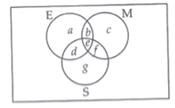
Let us draw a Venn diagram
Image
According to the Venn diagram,
$n(E \cap S)=4 \Rightarrow e=4$
$n(E \cap M)=6 \Rightarrow b+e=6 \Rightarrow b+4=6 \Rightarrow b=2$
$n(M \cap S)=7 \Rightarrow e+f=7 \Rightarrow 4+f=7 \Rightarrow f=3$
$n(E \cap S)=4 \Rightarrow d+e=4 \Rightarrow d+4=4 \Rightarrow d=0$
$n(E)=15 \Rightarrow a+b+d+e=15 \Rightarrow a+2+0+4=15 \Rightarrow a=9$
$n(M)=12 \Rightarrow b+c+e+f=12 \Rightarrow 2+c+4+3=12 \Rightarrow c=3$
$n(S)=8 \Rightarrow d+e+f+g=8 \Rightarrow 0+4+3+g=8 \Rightarrow g=1$
Hence we get,
$i$. Number of students who passed in English and Mathematics but not in Science, $b=2$.
$ii.$ Number of students who passed in Mathematics and Science but not in English, $f =3$.
$iii$. Number of students who passed in Mathematics only, $c =3$.
$iv$. Number of students who passed in more than one subject $= b + e + d + f =2+4+0+3=9$.
View full question & answer
Question 23 Marks
Find a $G.P.$ for which sum of the first two term is $-4$ and the fifth term is $4$ times the third term.
Answer
$S_2=-4, a_5=4 a_3$
$\frac{a\left(1-r^2\right)}{1-r}=-4$
$ a (1+ r )=-4$
$ar ^4=4 ar ^2$
$r= \pm 2$
when $r = 2 , a=-4 / 3$
sequence is $\frac{-4}{3}, \frac{-8}{3}, \frac{-16}{3}, \ldots \ldots$
when $r = -2 , a = 4$
sequence is $4, 8, 16, 32, 64,......$
View full question & answer
Question 33 Marks
If the $p^{\text {th }}$ and $q^{\text {th }}$ terms of a $GP$ are $q$ and $p$ respectively, then show that $(p+q)^{\text {th }}$ term is $\left(\frac{q^p}{p^f}\right)^{\frac{1}{p-q}}$.
Answer
Let first term be $A$ and common ratio be $R$ of a $GP.$
Given, $p ^{\text {th }}$ term, $T _{ p }= q$ and $q ^{\text {th }}$ term, $T _{ q }= p$
Then, $AR ^{ p -1}= q$ and $AR ^{ q -1}= p \ldots( i )$
$\therefore \frac{A R^{p-1}}{A R^{i^{-1}}}=\frac{q}{p}$
$\Rightarrow R ^{p-q}=\frac{q}{p}$
$\Rightarrow R =\left(\frac{q}{p}\right)^{\frac{1}{\rho-q}}\left[\because\right.$ rasisint power $\frac{1}{p-q}$ on both sides $]$
On putting the value of $R$ in Eq. $(i),$
we get $A \cdot\left(\frac{q}{p}\right)^{\frac{p-1}{p-q}}=q$
$\Rightarrow A=q \cdot\left(\frac{p}{q}\right)^{\frac{p-1}{p-q}}$
Now. $( D + q )^{\text {th }}$ term.
$ T _{ p + q }= AR ^{ p + q -1}=q \cdot\left(\frac{p}{q}\right)^{\frac{p-1}{p-q}} \times\left(\frac{q}{p}\right)^{\frac{p+q-1}{p-q}}$
$=\frac{q^{1-\frac{p-1}{p-q}+\frac{p+q-1}{p-q}}}{\frac{p+q-1}{p-q}-\frac{p-1}{p-q}}=\frac{\frac{p-q-p+1+p+q-1}{p-q}}{\frac{p+q-1-p+1}{p-q}}$
$=\frac{q^{\frac{p}{p-q}}}{p^{\frac{q}{p-q}}}=\left(\frac{q^p}{p^q}\right)^{\frac{1}{p-q}}$
Hence proved.
View full question & answer
Question 43 Marks
Find the derivative of function $\frac{a x+b}{c x+d} ($it is to be understood that $a , b , c , d , p , q , r$ and $s$ are fixed non$-$zero constants and $m$ and $n$ are integers$).$
Answer
Here,
$\therefore f^{\prime}(x)=\frac{d}{d x}\left[\frac{a x+b}{c x+d}\right]$
$=\frac{(c x+d) \frac{d}{d x}(a x+b)-(a x+b) \frac{d}{d x}(c x+d)}{(c x+d)^2}$
$=\frac{(c x+d)(a)-(a x+b)(c)}{(c x+d)^2}$
$=\frac{a c x+a d-a c x-b c}{(c x+d)^2}$
$=\frac{a d-b c}{(c x+d)^2}$
View full question & answer
Question 53 Marks
Differentiate $\frac{x^2-1}{x}$ from first principle.
Answer
We need to find derivative of $f(x)=\frac{x^2-1}{x}$
Derivative of a function f(x) from first principle is given by
$f ^{ f }( x )=\underset{{h \rightarrow 0}}{\lim}=\frac{f(x+h)-f(x)}{h} \{$where $h$ is a very small positive number $\}$
$\therefore$ Derivative of $f(x)=\frac{x^2-1}{x}$ is given as
$f ^{\prime}( x )=\underset{{h \rightarrow 0}}{\lim}=\frac{f(x+h)-f(x)^x}{h}$
$\Rightarrow f ^{\prime}( x )=\underset{{h \rightarrow 0}}{\lim}\frac{\frac{(x+h)^2-1}{x+h}-\frac{x^2-1}{\alpha}}{h}$
$\Rightarrow f ^{\prime}(x)=\underset{{h \rightarrow 0}}{\lim}\frac{\left\{(x+h)^2-1\right\} x-(x+h)\left(x^2-1\right)}{h x(x+h)}$
$\Rightarrow f ^{\prime}(x)=\underset{{h \rightarrow 0}}{\lim} \frac{\left\{(x+h)^2-1\right\} x-(x+h)\left(x^2-1\right)}{h} \times \underset{{h \rightarrow 0}}{\lim} \frac{1}{x(x+h)}$
$\Rightarrow f ^{\prime}(x)=\frac{1}{x^2} \underset{{h \rightarrow 0}}{\lim} \frac{\left\{(x+h)^2-1\right\} x-(x+h)\left(x^2-1\right)}{h}$
$\Rightarrow f^{\prime}(x)=\frac{1}{x^2} \underset{{h \rightarrow 0}}{\lim} \frac{\left\{x^2+h^2+2 x h-1\right\} x-\left\{x^3+h x^2-x-h\right\}}{h}$
$\Rightarrow f^{\prime}(x)=\frac{1}{x^2} \underset{{h \rightarrow 0}}{\lim} \frac{x^3+h^2 x+2 x^2 h-x-x^3-h x^2+x+h}{h}$
$\Rightarrow f ^{\prime}(x)=\frac{1}{x^2} \underset{{h \rightarrow 0}}{\lim} \frac{h^2 x+x^2 h+h}{h}$
$\Rightarrow f ^{\prime}(x)=\frac{1}{x^2} \underset{{h \rightarrow 0}}{\lim} \frac{h\left(h x+x^2+1\right)}{h}$
$\Rightarrow f ^{\prime}( x )=\frac{1}{x^2} \underset{{h \rightarrow 0}}{\lim}\left(h h+x^2+1\right)$
$\Rightarrow f^{\prime}(x)=\frac{1}{x^2}\left(0 \times x+x^2+1\right)=\frac{x^2+1}{x^2}=1+\frac{1}{x^2}$
$\therefore f^{\prime}(x)=1+\frac{1}{x^2}$
Hence,
Derivative of $f(x)=\frac{x^2-1}{x^2}=1+\frac{1}{x^2}$
View full question & answer
Question 63 Marks
Find $a , b$ and $n$ in the expansion of $( a + b )^{ n }$ if the first three terms of the expansion are $729,7290$ and $30375$ respectively.
Answer
We have $T_1={ }^n C_0 a^n b^0=729 \ldots$
$T_2={ }^n C_1 a^{n-1} b=7290 \ldots \text { (ii) }$
$T_3={ }^n C_2 a^{n-2} b^2=30375 \ldots \text { (iii) }$
From $(i)\ a^{ n }=729 \ldots (iv)$
From $(ii)\ n a^{ n -1} b=7290 \ldots (v)$
From $(iii)\ \frac{n(n-1)}{2} a^{n-2} b^2=30375 \ldots(vi)$
Multiplying $(iv)$ and $(vi),$ we get
$\frac{n(n-1)}{2} a^{2 n-2} b^2=729 \times 30375 \ldots (vii)$
Squaring both sides of $(v)$ we get
$n^2 a^{2 n-2} b^2=(7290)(7290)( viii )$
Dividing $(vii)$ by $(viii),$ we get
$\frac{n(n-1) a^{2 n-2} b^2}{2 n^2 a^{2 n-2} b^2}=\frac{729 \times 30375}{7290 \times 7290}$
$\Rightarrow \frac{(n-1)}{2 n}=\frac{30375}{72900}$
$\Rightarrow \frac{n-1}{2 n}=\frac{5}{12}$
$\Rightarrow 12 n-12=10 n$
$\Rightarrow 2 n=12$
$\Rightarrow n=6$
From $(iv) a^6=729$
$\Rightarrow a^6=(3)^6$
$\Rightarrow a=3$
From $(v) 6 \times 3^5 \times b=7290$
$\Rightarrow b=5$
Thus $a = 3, b = 5$ and $n = 6.$
View full question & answer
Question 73 Marks
Show that the coefficient of the middle term in the expansion of $(1+ x )^{2 n }$ is equal to the sum of the coefficients of middle terms in the expansion of $(1+x)^{2 n -1}$.
Answer
As discussed in the previous example, the middle term in the expansion of $(1+ x )^{2 n }$ is given by $T_{n+1}={ }^{2 n} C_n x^n$ So, the coefficient of the middle term in the expansion of $(1+x)^{2 n }$ is ${ }^{2 n} C _n$.
Now, consider the expansion $(1+x)^{2-1}$
Here, the index $(2 n-1)$ is odd.
So, $\left(\frac{(2 n-1)+1}{2}\right)^{t h}$ and $\left(\frac{(2 n-1)+1}{2}+1\right)^{\text {th }}$ i.e., $n ^{\text {th }}$ and $( n +1)^{ th }$ terms are middle terms.
Now, $T_n=T_{(n-1)+1}={ }^{2 n-1} C_{n-1}(1)^{(2 n-1)-(n-1)} x^{n-1}={ }^{2 n-1} C_{n-1} x^{n-1}$
and, $T _{ n +1}={ }^{2 n-1} C_n(1)^{(2 n-1)-n} x^n={ }^{2 n-1} C_n x^n$
So, the coefficients of two middle terms in the expansion of $(1+ x )^{2 n -1}$ are ${ }^{2 n-1} C_{n-1}$ and ${ }^{2 n-1} C_n$.
$\therefore$ Sum of these coefficients $={ }^{2 n-1} C_{n-1}+{ }^{2 n-1} C_n$
$={ }^{(2 n-1)+1} C_n\left[\because{ }^n C_{r-1}+{ }^n C_r={ }^{n+1} C_r\right]$
$={ }^{2 n} C_n$
$=$ Coefficient of middle term in the expansion of $(1+x)^{2 n}$.
View full question & answer
Question 83 Marks
If the origin is the centroid of the triangle $PQR$ with vertices $P(2a, 2, 6), Q(-4, 3b, -10)$ and $R(8, 14, 2c),$ then find the values of $a, b$ and $c.$
Answer
Here $P (2 a , 2,6), Q(-4,3 b,-10)$ and $R (8,14,2 c )$ are vertices of triangle $PQR.$
$\therefore$ Coordinates of centriod of $\triangle P Q R$ is $\left(\frac{2 a-4+8}{3}, \frac{2+3 b+14}{3}, \frac{6-10+2 c}{3}\right)$
$=\left(\frac{2 a+4}{3}, \frac{3 b+16}{3}, \frac{2 c-4}{3}\right)$
But is it given that coordinates of centroid is $(0, 0, 0)$
$=\frac{2 a+4}{3}=0 $
$\Rightarrow 2 a+4=0 $
$\therefore a=-2 \frac{3 b+16}{3}=0$
$\Rightarrow 3 b+16=0 $
$\Rightarrow b=\frac{-16}{3} \frac{2 c-4}{3}=0 $
$\Rightarrow 2 c-4=0 $
$\Rightarrow c=2$
View full question & answer
Question 93 Marks
The letters of the word SURITI are written in all possible orders and these words are written out as in a dictionary. Find the rank of the word SURITI.
Answer
Given the word SURITI.
Arranging the permutations of the letters of the word SURITI in a dictionary:
To find: Rank of word SURITI in dictionary. 
First comes, words starting with letter I = 5! = 120 
words starting from letter $R =\frac{51}{21}=60$
words starting from $SI =4!=24$ (4 letters no repetation)
words starting from $SR =\frac{4!}{2!}=12$ (4 letters, one repetation of I $)$
words starting from $ST =\frac{4!}{2!}=12$ (4 letters, one repetation of I )
words starting from SUI $=3!=6$ (3 letters no repetation)
words starting from SUR; SURIIT = 1
SURITI = 1 
Rank of the word SURITI =120+60+24+12+12+6+1+1
=236
View full question & answer