Questions

2 Marks Questions

Take a timed test

7 questions · self-marked practice — reveal the answer and mark yourself.

Question 12 Marks
Find the equation of the perpendicular bisector of the line joining the points $(1, 3)$ and $(3, 1).$
Answer
Given points are, $A(1, 3)$ and $B(3, 1).$
Let $C$ be the mid point of $AB.$
$\therefore$ Coordinates of $C=\left(\frac{1+3}{2}, \frac{3+1}{2}\right)=(2,2)$
Slope of $AB =\frac{1-3}{3-1}=-1$
$\therefore$ Slope of the perpendicular bisector of $AB =1$
Hence, the equation of the perpendicular bisector of $AB$ is
$y-2=1(x-2)$
$\Rightarrow x-y=0$ or, $y = x$
View full question & answer
Question 22 Marks
Let $A=\{(x: x \in N), B=(x: x=2 n, n \in N)\}, C=\{x: x=2 n-1, n \in N\}$ and, $D=\{x: x$ is a prime natural number$\}.$ Find: $A \cap B$.
Answer
According to the question ,
we can state, $A =$ All natural numbers i.e. $\{1, 2, 3…..\}$
$B =$ All even natural numbers i.e. $\{2, 4, 6, 8…\}$
$C =$ All odd natural numbers i.e. $\{1, 3, 5, 7……\}$
$D =$ All prime natural numbers i.e. $\{1, 2, 3, 5, 7, 11, …\}$
$A \cap B$
$A$ contains all elements of $B$
$\therefore B \subset A$
$\therefore A \cap B=B$
View full question & answer
Question 32 Marks
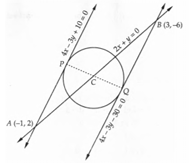
Find the equation of the circle which touches the lines $4 x-3 y+10=0$ and $4 x-3 y-30=0$ and whose centre lies on the line $2 x + y =0$.
Answer
Clearly, the lines $4x - 3y + 10 = 0$ and $4x - 3y - 30 = 0$ are parallel and are touching the circle.
It is given that the centre of the circle lies on the line $2x + y = 0$ which intersects the lines $4x - 3y + 10 = 0$ and $4x - 3y - 30 = 0$ at $A (-1, 2)$ and $B (3, - 6)$ respectively.
Therefore, the centre of the circle is the mid $-$ point of $AB.$
So, the coordinates of the centre $C$ are $(1, - 2)+$
Image
Let d be the distance between parallel lines $4x -3y + 10 =0$ and $4x -3y - 30 = 0$
Then
$ PQ =d=\left|\frac{10-(-30)}{\sqrt{4^2+(-3)^2}}\right|=8$
$\Rightarrow PQ = d =8$
$\text { Radius }=\frac{1}{2}(P Q)$
​​​​​​​$=\frac{1}{2} \times 8=4$
$\Rightarrow \text { Radius }=4$
Thus, the required circle has its centre at $C (1, - 2) $ and radius $= 4$
Hence, its equation is $(x-1)^2+(y+2)^2=4^2$
View full question & answer
Question 42 Marks
Find the equation of the parabola whose: focus is $(2,3)$ and the directrix $x-4 y+3=0$.
Answer
Let $P(x, y)$ be any point on the parabola whose focus is $S(2, 3)$ and the directrix is $x - 4y + 3 = 0$
Draw PM perpendicular to $x - 4y + 3 = 0$
Thus, we have:
$\ce{SP = PM}$
$\Rightarrow \ce{SP^2= PM^2}$
$\Rightarrow( x -2)^2+( y -3)^2=\left|\frac{x-4 y+3}{\sqrt{1+16}}\right|^2$
$\Rightarrow( x -2)^2+( y -3)^2=\left(\frac{x-4 y+3}{\sqrt{17}}\right)^2$
$\Rightarrow 17\left( x ^2+4-4 x + y ^2-6 y+9\right)= x ^2+16 y ^2+9-8 xy -24 y +6 x$
$\Rightarrow\left(17 x ^2-68 x -102 y +17 y ^2+13 \times 17\right)= x ^2+16 y ^2+9-8 xy -24 y +6 x$
$\Rightarrow 16 x ^2+ y ^2+8 xy -74 x -78 y +212=0$
Which is the required equation of parabola.
View full question & answer
Question 52 Marks
Find the of derivative of the function from the first principle: $\sin x^2$.
Answer
Let $y=\sin x^2$
Then, $y+\delta y=\sin (x+\delta x)^2$
$\Rightarrow \delta y=\sin (x+\delta x)^2-\sin x^2$
Using first principle,
$\Rightarrow \frac{\delta y}{\delta x}=\frac{\sin (x+\delta x)^2-\sin x^2}{\delta x}$
$\Rightarrow \frac{d y}{d x}=\lim _{\delta x \rightarrow 0} \frac{\delta y}{\delta x}$
$=\lim _{\delta x \rightarrow 0} \frac{\sin (x+\delta x)^2-\delta \sin x^2}{\delta x}$
$=\lim _{\delta x \rightarrow 0} \frac{2 \cos \left[\frac{(x+\delta x)^2+x^2}{2}\right] \sin \left[\frac{(x+\delta x)^2-x^2}{2}\right]}{\delta x}$
${\left[\text { using }(\sin C-\sin D)=2 \cos \left(\frac{C+D}{2}\right) \sin \left(\frac{C-D}{2}\right)\right]}$
$=\lim _{\delta x \rightarrow 0} 2 \cos \left[\frac{(x+\delta x)^2+x^2}{2}\right] \frac{\sin \left[\left(x+\frac{\delta x}{2}\right) \cdot \delta x\right]}{\left(x+\frac{\delta x}{2}\right) \cdot \delta x}\left(x+\frac{\delta x}{2}\right)$
$=2 \cdot \lim _{\delta x \rightarrow 0} \cos \left[\frac{(x+\delta x)^2+x^2}{2}\right] \cdot \lim _{\delta x \rightarrow 0} \frac{\sin \left[\left(x+\frac{\delta x}{2}\right) \cdot \delta x\right]}{\left(x+\frac{\delta x}{2}\right) \cdot \delta x}$
$\cdot \lim _{\delta x \rightarrow 0}\left(x+\frac{\delta x}{2}\right)$
$=\left[2 \times \cos x^2 \times 1 \times x\right]=2 x \cos x^2$
Hence, $\frac{d}{d x}\left(\sin x^2\right)=2 x \cos x^2$
View full question & answer
Question 62 Marks
Find the domain and range of the real valued function $f(x)=\frac{1}{\sqrt{16-x^2}}$.
Answer
We know the square of a real number is never negative.
Clearly, $f ( x )$ takes real values only when $16- x ^2 \geq 0$
$=16 \geq x ^2$
$= x ^2 \leq 16$
$= x ^2-16 \leq 0$
$= x ^2-4^2 \leq 0$
$=( x +4)( x -4) \leq 0$
$= x \geq-4$ and $x \leq 4$
$\therefore x \in[-4,4]$
In addition, $f ( x )$ is also undefined when $16- x ^2=0$ because denominator will be zero and the result will be indeterminate.
$16-x^2=0$
$\Rightarrow x= \pm 4$
Hence, $x \in[-4,4]-\{-4,4\}$
$\therefore x \in(-4,4)$
Thus, domain of $f=(-4,4)$
Let $f ( x )= y$
$\Rightarrow \frac{1}{\sqrt{16-x^2}}=y$
$\Rightarrow\left(\frac{1}{\sqrt{16-x^2}}\right)^2=y^2$
$\Rightarrow \frac{1}{16-x^2}=y^2$
$=1=\left(16-x^2\right) y ^2$
$=1=16 y^2-x^2 y^2$
$=x^2 y^2+1-16 y^2=0$
$=\left(y^2\right) x^2+(0) x +\left(1-16 y^2\right)=0$
As $x \in R$, the discriminant of this quadratic equation in $x$ must be non$-$negative.
$=0^2-4\left(y^2\right)\left(1-16 y^2\right) \geq 0$
$=-4 y^2\left(1-16 y^2\right) \geq 0$
$=4 y^2\left(1-16 y^2\right) \leq 0$
$=1-16 y^2 \leq 0\left[\because y^2 \geq 0\right]$
$=16 y^2-1 \geq 0$
$\Rightarrow(4 y)^2-1^2 \geq 0$
$=(4 y+1)(4 y-1) \geq 0$
$=4 y \leq-1$ and $4 y \geq$
$\Rightarrow y \leq-\frac{1}{4}$ and $y \geq \frac{1}{4}$
$\Rightarrow y \in\left(-\infty,-\frac{1}{4}\right] \cup\left[\frac{1}{4}, \infty\right)$
$\Rightarrow f(x) \in\left(-\infty,-\frac{1}{4}\right] \cup\left[\frac{1}{4}, \infty\right)$
However, $y$ is always positive because it is the reciprocal of a non$-$zero square root.
$\therefore f(x) \in\left[\frac{1}{4}, \infty\right)$
Thus, range of $f =\left[\frac{1}{4}, \infty\right)$
Thus , is the required domain and range of the function
View full question & answer
Question 72 Marks
If $A=\{1,2,3), B=\{3,4\}$ and $C=\{4,5,6\}$, find
i. $A \times(B \cap C)$
ii. $(A \times B) \cap(A \times C)$
Answer
We have,
$ A =\{1,2,3), B =\{3,4\} \text { and } C =\{4,5,6\}$
$i .$
$ \therefore B \cap C=\{3,4\} \cap\{4,5,6\}=\{4\}$
$ \therefore A \times(B \cap C)$
$=\{1,2,3,\} \times\{4\}$
$=\{(1,4),(2,4),(3,4)\}$
$ \Rightarrow A \times(B \cap C)$
$=\{(1,4),(2,4),(3,4)\}$
$ii.$
$ \therefore A \times B=\{1,2,3,\} \times\{3,4\}$
$=\{(1,3),(1,4),(2,3),(2,4),(3,3),(3,4)\}$
$ \therefore A \times C$
$=\{1,2,3\} \times\{4,5,6\}$
$=\{(1,4),(1,5),(1,6),(2,4),(2,5),(2,6),(3,4),(3,5),(3,6)\}$
$(A \times B) \cap(A \times C)$
$=\{(1,4),(2,4),(3,4)\}$
View full question & answer