Questions

3 Marks Question

Take a timed test

9 questions · self-marked practice — reveal the answer and mark yourself.

Question 13 Marks
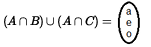
Let $A=\{a, e, i, o, u\}, B=\{a, d, e, o, v)$ and $C=\{e, o, t, m]$. Using Venn diagrams, verify that: $A \cap(B \cup C)=$ $(A \cap B) \cup(A \cap C)$
Answer
Here, it is given: $A=\{a, e, i, o, u\}, B=\{a, d, e, o, v\}$ and $C=\{e, o, t, m\}$ 
$B \cup C=\{a, d, v, e, o, t, m\}$ and $A \cap(B \cup C)=\{a, e, o\}$ 
LHS
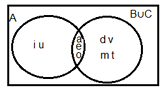
Image
R.H.S: $A \cap B=\{a, e, o\}$ and $A \cap C=\{ e , o \}$
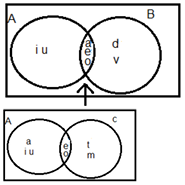
Image
Image
$(A \cap B) \cup(A \cap C)=\{a, e, o\}$ 
L.H.S = R.H.S. [Verified]

View full question & answer
Question 23 Marks
Evaluate $\left[\frac{1}{1-4 i}-\frac{2}{1+i}\right]\left[\frac{3-4 i}{5+i}\right]$ to the standard form.
Answer
${\left[\frac{1}{1-4 i}-\frac{2}{1+i}\right]\left[\frac{3-4 i}{5+i}\right]=\left[\frac{1+i-2+8 i}{(1-4 i)(1+i)}\right]\left[\frac{3-4 i}{5+i}\right]}$
$=\left[\frac{-1+9 i}{1+i-4 i-4 i^2}\right]\left[\frac{3-4 i}{5+i}\right]$
$=\left[\frac{-1+9 i}{5-3 i}\right]\left[\frac{3-4 i}{5+i}\right]$
$=\frac{-3+4 i+27 i-36 i^2}{25+5 i-15 i-3 i^2}=\frac{33+31 i}{28-10 i} \times \frac{28+10 i}{28+10 i}$
$=\frac{924+330 i+868 i+3102^2}{(28)^2-(10 i)^2}$
$=\frac{614+1198 i}{784+100}\left(\because i^2=-1\right)$
$=\frac{2(307+599 i)}{884}$
$=\frac{307+599 i}{442}$
View full question & answer
Question 33 Marks
If $( a + ib )=\frac{c+i}{c-i}$, where c is real, prove that $a ^2+ b ^2=1$ and $\frac{b}{a}=\frac{2 c}{c^2-1}$.
Answer
$\text { Here } a+i b=\frac{c+i}{c-i}$
$=\frac{c+i}{c-i} \times \frac{c+i}{c+i}=\frac{(c+i)^2}{c^2-i^2}$
$=\frac{c^2+2 c i+i^2}{c^2+1}$
$=\frac{c^2-1}{c^2+1}+\frac{2 c}{c^2+1} i$
Comparing real and imaginary parts on both sides, we have
$a=\frac{c^2-1}{c^2+1}$ and $b=\frac{2 c}{c^2+1}$
Now $a^2+b^2=\left(\frac{c^2-1}{c^2+1}\right)^2+\left(\frac{2 c}{c^2+1}\right)^2$
$=\frac{\left(c^2-1\right)^2+4 c^2}{\left(c^2+1\right)^2}=\frac{\left(c^2+1\right)^2}{\left(c^2+1\right)^2}=1$
Also $\frac{b}{a}=\frac{\frac{2 c}{c^2+1}}{\frac{c^2-1}{c^2+1}}=\frac{2 c}{c^2-1}$
View full question & answer
Question 43 Marks
Expand the given expression $\left(x+\frac{1}{x}\right)^6$
Answer
Using binomial theorem for the expansion of $\left(x+\frac{1}{x}\right)^6$
we have $\left(x+\frac{1}{x}\right)^6$
$={ }^6 C_0(x)^6+{ }^6 C_1(x)^5\left(\frac{1}{x}\right)+{ }^6 C_2(x)^4\left(\frac{1}{x}\right)^2+{ }^6 C_3(x)^3\left(\frac{1}{x}\right)^3+{ }^6 C_4(x)^2\left(\frac{1}{x}\right)^4+{ }^6 C_5(x)\left(\frac{1}{x}\right)^5+{ }^6 C_6\left(\frac{1}{6}\right)^6$
$=x^6+6 \cdot x^5 \cdot \frac{1}{x}+15 \cdot 4 x^4 \cdot \frac{1}{x^2}+20 \cdot x^3 \cdot \frac{1}{x^3}+15 \cdot x^2 \cdot \frac{1}{x^4}+6 \cdot x \cdot \frac{1}{x^5}+\frac{1}{x^6}$
$=x^6+6 x^4+15 x^2+20+\frac{15}{x^2}+\frac{6}{x^4}+\frac{1}{x^6}$
View full question & answer
Question 53 Marks
Using binomial theorem, prove that $\left(2^{3 n }-7 n -1\right)$ is divisible by $49 ,$ where $n \in N$
Answer
To prove: $\left(2^{3 n}-7 n-1\right)$ is divisible by $49 ,$ where $n \in N$
$=\left(2^{3 n}-7 n-1\right)$
$=\left(2^3\right) n-7 n-1$
$=8^n-7 n-1$
$=(1+7)^n-7 n-1$
Now using binomial theorem..
$\Rightarrow{ }^n C_0 1^n+{ }^n C_1 1^{n-1} 7+{ }^n C_2 1^{n-2} 7^2+\ldots \ldots+{ }^n C_{n-1} 7^{n-1}+{ }^n C_n 7^n-7 n-1$
$={ }^n C_0+{ }^n C_1 7+{ }^n C_2 7^2+\ldots \ldots+{ }^n C_{n-1} 7^{n-1}+{ }^n C_n 7^n-7 n-1$
$=1+7 n+7^2\left[{ }^n C_2+{ }^n C_3 7+\ldots+{ }^n C_{n-1} 7^{n-3}+{ }^n C_n 7^{n-2}\right]-7 n-1$
$=7^2\left[{ }^n C_2+{ }^n C_3 7+\ldots+{ }^n C_{n-1} 7^{n-3}+{ }^n C_n 7^{n-2}\right]$
$=49\left[{ }^n C_2+{ }^n C_3 7+\ldots+{ }^n C_{n-1} 7^{n-3}+{ }^n C_n 7^{n-2}\right]$
$=49 K, $
$\text { where } K=\left({ }^n C_2+{ }^n C_3 7+\ldots++{ }^n C_{n-1} 7^{n-3}+{ }^n C_n 7^{n-2}\right)$
Now, $\left(2^{3 n}-7 n-1\right)=49 K$
Therefore $\left(2^{3 n}-7 n-1\right)$ is divisible by $49 .$
View full question & answer
Question 63 Marks
Show that the points $(a, b, c), (b, c, a)$ and $(c, a, b)$ are the vertices of an equilateral triangle.
Answer
Let $A(a, b, c) B(b, c, a)$, and $C(c, a, b)$ be the vertices of $\triangle A B C$. Then.
$AB=\sqrt{(b-a)^2+(c-b)^2+(a-c)^2}$
$=\sqrt{b^2-2 a b+a^2+c^2-2 b c+b^2+a^2-2 c a+c^2}$
$=\sqrt{2 a^2+2 b^2+2 c^2-2 a b-2 b c-2 c a}$
$AB=\sqrt{2\left(a^2+b^2+c^2-a b-b c-c a\right)}$
$BC=\sqrt{(c-b)^2+(a-c)^2+(b-a)^2}$
$=\sqrt{c^2-2 b c+b^2+a^2-2 c a+c^2+b^2-2 a b+a^2}$
$=\sqrt{2 a^2+2 b^2+2 c^2-2 a b-2 b c-2 c a}$
$BC=\sqrt{2\left(a^2+b^2+c^2-a b-b c-c a\right)}$
$CA=\sqrt{(a-c)^2+(b-a)^2+(c-b)^2}$
$=\sqrt{a^2-2 c a+c^2+b^2-2 a b+a^2+c^2-2 b c+b^2}$
$=\sqrt{2 a^2+2 b^2+2 c^2-2 a b-2 b c-2 c a}$
$CA=\sqrt{2\left(a^2+b^2+c^2-a b-b c-c a\right)}$
$\therefore A B=B C=C A$
Therefore, $\triangle ABC$ is an equilateral triangle.
View full question & answer
Question 73 Marks
Find the point in $yz-$plane which is equidistant from the points $A(3, 2, -1), B(1, -1, 0)$ and $C(2, 1, 2).$
Answer
The general point on $yz$ plane is $D(0, y, z).$ Consider this point is equidistant to the points $A(3, 2, -1), B(1, -1, 0)$ and $C(2, 1, 2).$
$\therefore \ce{AD=BD}$
$\sqrt{(0-3)^2+(y-2)^2+(z+1)^2}=\sqrt{(0-1)^2+(y+1)^2+(z-0)^2}$
Squaring both sides,
$(0-3)^2+(y-2)^2+(z+1)^2=(0-1)^2+(y+1)^2+(z-0)^2$
$9+y^2-4 y+4+z^2+2 z+1=1+y^2+2 y+1+z^2$
$-6 y+2 z+12=0 \ldots(1)$
Also, $\ce{AD = CD}$
$\sqrt{(0-3)^2+(y-2)^2+(z+1)^2}=\sqrt{(0-2)^2+(y-1)^2+(z-2)^2}$
Squaring both sides,
$(0-3)^2+(y-2)^2+(z+1)^2=(0-2)^2+(y-1)^2+(z-2)^2$
$9+y^2-4 y+4+z^2+2 z+1=4+y^2-2 y+1+z^2-4 z+4$
$-2 y+6 z+5=0 \ldots(2)$
By solving equation $(1)$ and $(2)$
we get $y=\frac{31}{16} z=\frac{-3}{16}$
The point which is equidistant to the points $A (3,2,-1), B (1,-1,0)$ and $C (2,1,2)$ is $\left(\frac{31}{16}, \frac{-3}{16}\right)$.
View full question & answer
Question 83 Marks
Solve inequation and represent the solution set on the number line: $\frac{2 x-1}{12}-\frac{x-1}{3}<\frac{3 x+1}{4}$ where $x \in R$
Answer
Given:
$\frac{2 x-1}{12}-\frac{x-1}{3}<\frac{3 x+1}{4}$, where $x \in R$.
Multiply by $12$ on both sides in the above equation
$\Rightarrow 12\left(\frac{2 x-1}{12}\right)-12\left(\frac{x-1}{3}\right)<12\left(\frac{3 x+1}{4}\right)$
$\Rightarrow(2 x-1)-4(x-1)<3(3 x+1)$
$\Rightarrow 2 x-1-4 x+4<9 x+3$
$\Rightarrow 3-2 x<9 x+3$
Now, subtracting $3$ on both sides in the above equation
$\Rightarrow 3-2 x-3<9 x+3-3$
$\Rightarrow-2 x<9 x$
Now, subtracting $9x$ from both the sides in the above equation
$\Rightarrow-2 x-9 x<9 x-9 x$
$\Rightarrow-11 x<0$
Multiplying $-1$ on both the sides in above equation
$\Rightarrow(-11 x)(-1)>(0)(-1)$
$\Rightarrow 11 x>0$
Dividing both sides by $11$ in above equation
$\Rightarrow \frac{11 x}{11}>\frac{0}{11}$
Therefore,
$\Rightarrow>x>0$
Image
View full question & answer