Questions

Case study (4 Marks)

Take a timed test

3 questions · self-marked practice — reveal the answer and mark yourself.

Question 14 Marks
Read the following text carefully and answer the questions that follow:
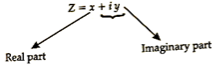
A number of the form $Z=x+i y$, where $x$ and $y$ are real and $i=\sqrt{-1}$ is called a complex number. Consider the complex number $Z_1=2+3 i$ and $Z_2=4-3 i$.
Image
$i$. Find the imaginary part of $Z_1 \overline{Z_1}... (1)$
$ii$. Find the real part of $\frac{z_1}{z_2}. (1)$
$iii$. Find the imaginary part of $Z_1-Z_2. (2)$
OR
Find the real part of $Z _1. (2)$
Answer
$i.Z_1 \overline{Z_1}=(2+3 i)(2-3 i)$
$=4-9 i^2=4+9=13$
Imaginary part $=0$
$ii.\frac{Z_1}{Z_2}=\frac{2+3 i}{4-3 i} \times \frac{4+3 i}{4+3 i}$
$=\frac{8+6 i+12 i-9}{16+9}$
$=\frac{-1+18 i}{25}$
Real part $=\frac{-1}{25}$
$iii.Z_1-Z_2$
$=(2+3 i)-(4-3 i)$
$=-2+6 i$
Imaginary part $=6$
OR
The real part of $Z _1=2$.
View full question & answer
Question 24 Marks
There are $4$ red, $5$ blue and $3$ green marbles in a basket.
$i.$ If two marbles are picked at randomly, find the probability that both red marbles. $(1)$
$ii.$ If three marbles are picked at randomly, find the probability that all green marbles. $(1)$
$iii.$ If two marbles are picked at randomly then find the probability that both are not blue marbles. $(2)$
OR
If three marbles are picked at randomly, then find the probability that atleast one of them is blue. $(2)$
Answer
$i.$ Total marbles $=4+5+3=12$
Required probability $=\frac{{ }^4 C_2}{{ }^{12} C_2}=\frac{\frac{4 \times 3}{2 \times 1}}{\frac{12 \times 11}{2 \times 1}}=\frac{1}{11}$
$ii.$ Total marbles $=4+5+3=12$
Required probability $=\frac{{ }^3 C_3}{{ }^{12} C_3}=\frac{1}{\frac{12 \times 11 \times 10}{3 \times 2}}=\frac{1}{220}$
$iii.$ Total marbles $=4+5+3=12$
Required probability $=\frac{{ }^7 C_2}{{ }^{12} C_2}=\frac{\frac{7 \times 6}{2 \times 1}}{\frac{12 \times 11}{741}}=\frac{21}{66}=\frac{7}{22}$
OR
Total marbles $= 4 + 5 + 3 = 12$
Required probability $= 1 - P ($None is blue$)$
$=1-\frac{{ }^7 C_3}{{ }^{12} C_3}$
$=1-\frac{\frac{7 \times 6 \times 5}{3 \times 2}}{\frac{12 \times 11 \times 10}{3 \times 2}}$
$=1-\frac{7}{44}=\frac{37}{44}$
View full question & answer
Question 34 Marks
Read the following text carefully and answer the questions that follow: Representation of a Relation
A relation can be represented algebraically by roster form or by set $-$ builder form and visually it can be represented by an arrow diagram which are given below
$i$. Roster form In this form, we represent the relation by the set of all ordered pairs belongs to $R$.
$ii$. Set-builder form In this form, we represent the relation $R$ from set $A$ to set $B$ as $R=\{(a, b): a \in A, b \in B\}$ and the rule which relate the elements of $A$ and $B$.
$iii$. Arrow diagram To represent a relation by an arrow diagram, we draw arrows from first element to second element of all ordered pairs belonging to relation $R$.
Questions
$i$. If $n(A) = 3$ and $B = \{2, 3, 4, 6, 7, 8\}$ then find the number of relations from $A$ to $B. (1)$
$ii$. If $A = {a, b}$ and $B = {2, 3},$ then find the number of relations from $A$ to $B. (1)$
$iii$. If $A = {a, b}$ and $B = {2, 3},$ write the relation in set-builder form. $(2)$
OR
Express of $R =\{( a , b ): 2 a + b =5 ; a , b \in W \}$ as the set of ordered pairs $($in roster form$). (2)$
Answer
$i.$ Number of relations $=2^{ mn }$
$=2^{3 \times 6}=2^{18}$
$ii$. Number of relations $=2^{ mn }$
$=2^{2 \times 2}=2^4=16$
$iii. R=\{(x, y): x \in P, y \in Q\}$ and $x$ is the square of $y$
OR
Here, $W$ denotes the set of whole numbers.
We have $2 a + b =5$ where $a , b \in W$
$\therefore a=0 $
$\Rightarrow b=5$
$\Rightarrow a=1 $
$\Rightarrow b=5-2=3$
and $ a=2 $
$\Rightarrow b=1$
For $a > 3,$ the values of $b$ given by the above relation are not whole numbers.
$\therefore A=\{(0,5),(1,3),(2,1)\}$
View full question & answer