Questions

3 Marks Question

Take a timed test

3 questions · self-marked practice — reveal the answer and mark yourself.

Question 13 Marks
For a G.P., if $(m+n)^{\text {th }}$ term is $P$ and $(m-n)$ th term is $q$, then prove that $m^{\text {th }}$ and $q^{\text {th }}$ term are $\sqrt{p q}$ and $p\left(\frac{q}{p}\right)^{m / 2 n}$ respectively.
Answer
Let first term of sequence be $a$ and common ratio be $r$, then
\[
\begin{array}{rlrl} 
& & T_{m+n} & =p \\
\Rightarrow & & \text { and } \quad T_{m-n}=q \\
\Rightarrow & & \frac{a \cdot r^{m+n-1}}{} & =p \\
a \cdot r^{m-n-1} & & \text { and } \quad a \cdot \frac{p}{q} &
\end{array}
\]
$\begin{array}{rlrl}\Rightarrow & & r^{2 n} & =\frac{p}{q} \\ \Rightarrow & & r & =\left(\frac{p}{q}\right)^{1 / 2 n} \\ \Rightarrow & & \frac{1}{r} & =\left(\frac{q}{p}\right)^{\frac{1}{2 n}} \\ \text { Now, } & T _m & =a \cdot r^{m-1} \\ & & & a \cdot r^{m+n-1}\left(\frac{1}{r}\right)^n \\ & & & T_{m+n}\left(\frac{1}{r}\right)^n\end{array}$
\[
\begin{array}{l}
=p \cdot\left(\frac{q}{p}\right)^{\frac{n}{2 n}} \\
{\left[\because T_{m+n}=p \text { and } \frac{1}{r}=\left(\frac{q}{p}\right)^{\frac{1}{2 n}}\right]} \\
\Rightarrow \quad T_m=p \cdot\left(\frac{q}{p}\right)^{1 / 2}=\sqrt{p q} \text { Hence proved. } \\
\text { and } \quad T_n=a . r^{n-1} \\
=a \cdot r^{m+n-1}\left(\frac{1}{r}\right)^m=T_{m+n}\left(\frac{1}{r}\right)^m \\
=p \cdot\left(\frac{q}{r}\right)^{\frac{m}{2 n}} \\
\text { Hence proved. }
\end{array}
\]
View full question & answer
Question 23 Marks
If $S_1, S_2, S_3$ are respectively the sum of $n, 2 n$ and $3 n$ terms of G.P. then prove that $S_1{ }^2+S_2{ }^2=S_1$ $\left(S_2+S_3\right)$.
Answer
Let first term of A.P. be $a$ and common ratio be $r$.
Then,
\[
\begin{aligned}
S_1 & =\frac{a\left(r^n-1\right)}{r-1}, S_2=\frac{a\left(r^{2 n}-1\right)}{r-1} \\
\text { and } S_3 & =\frac{a\left(r^{3 n}-1\right)}{r-1}
\end{aligned}
\]
Now,
\[
\begin{array}{l} 
S_1^2+S_2^2=\frac{a^2\left(r^n-1\right)^2}{(r-1)^2}+\frac{a^2\left(r^{2 n}-1\right)^2}{(r-1)^2} \\
=\frac{a^2}{(r-1)^2}\left[\left(r^n-1\right)^2+\left(r^{2 n}-1\right)^2\right] \\
=\frac{a^2\left(r^n-1\right)^2}{(r-1)^2}\left\{1+\left(r^n+1\right)^2\right\} \\
{\left[\because r^{2 n}-1=\left(r^n-1\right)\left(r^n+1\right)\right] } \\
=\frac{a^2\left(r^n-1\right)^2\left(r^{2 n}+2 r^n+2\right)}{(r-1)^2}
\end{array}
\]
and $S _1\left(S_2+ S _3\right)=\frac{a\left(r^n-1\right)}{r-1}\left[\frac{a\left(r^{2 n}-1\right)}{r-1}+\frac{a\left(r^{3 n}-1\right)}{r-1}\right]$
\[
\begin{array}{l}
=\frac{a^2}{(r-1)^2}\left(r^n-1\right) \cdot\left[\left(r^{2 n}-1\right)+\right. \\
\left.\left(r^{3 n}-1\right)\right] \\
=\frac{a^2\left(r^n-1\right)}{(r-1)^2}\left[\left(r^n-1\right)\left(r^n+1\right)+\right. \\
{\left[\because a^3-b^3=\left(r^n-1\right)\left(r^{2 n}+r^n+1\right)\right]} \\
\left.=\frac{a^2\left(r^n-1\right)^2}{(r-1)^2}\left(r^{2 n}+2 b+r^2\right)\right]
\end{array}
\]
From equations (i) and (ii)
\[
S_1^2+S_2^2=S_1\left(S_2+S_3\right) \quad \text { Hence proved. }
\]
View full question & answer
Question 33 Marks
If $a, b, c$ are in G.P. prove that:
(i) $\log a^n, \log b^n, \log c^n$ are in G.P.
(ii) $\log a, \log b, \log c$ are in G.P.
(iii) $\left(a^2+b^2\right)\left(a^2+c^2\right)=(a b+b c)^2$
(iv) $a\left(b^2+c^2\right)=c\left(a^2+b^2\right)$
Answer
(i) $a, b, c$ are in G.P.
$\Rightarrow \quad b^2=a c$
$\Rightarrow \quad\left(b^2\right)^n=(a c)^n$
$\Rightarrow \quad b^{2 n}=a^n c^n$
$\Rightarrow \quad\left(b^n\right)^2=a^n \times c^n$
Taking $\log$ both sides
$\begin{aligned} & \quad \log \left(b^n\right)^2=\log \left(a^n \cdot c^n\right) \\ \Rightarrow \quad & 2 \log b^n=\log a^n+\log c^n\end{aligned}$
$\Rightarrow \quad \log b^n=\frac{\log a^n+\log c^n}{2}$
$\Rightarrow \log a^n, \log b^n, \log c^n \text { are in A.P. }$
Hence proved.
(ii) Given $a, b, c$ are in GP.
$\Rightarrow \quad b=\sqrt{a c}$
$\Rightarrow \quad b^2=a c$
taking log both sides
$\begin{aligned} \log b^2 & =\log (a c) \\ \Rightarrow \quad 2 \log b & =\log a+\log c\end{aligned}$
$\Rightarrow \quad \log b=\frac{\log a+\log c}{2}$
$\Rightarrow \quad \log a, \log b, \log c$ are in A.P. Hence proved.
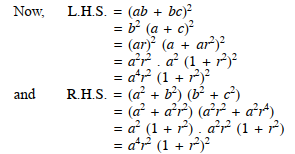
(iii) If $a, b, c$ are in G.P., then
let $\quad a=a, b=a r, c=a r^2$
To prove :
$(a b+b c)^2=\left(a^2+b^2\right)\left(b^2+c^2\right)$
Image
$\begin{array}{l}
\text { So, } \quad \text { L.H.S. }=\text { R.H.S. } \\
\Rightarrow \quad(a b+b c)^2=\left(a^2+b^2\right)\left(b^2+c^2\right)
\end{array}$
Hence proved.
(iv) If $a, b, c$ are in GP.,
let $\quad a=a, b=a r, c=a r^2$ then
To prove :
$\begin{aligned}
a\left(b^2+c^2\right) & =c\left(a^2+b^2\right) \\
\text { L.H.S. } & =a\left(b^2+c^2\right)
\end{aligned}$
$\begin{array}{l}=a\left(a^2 r^2+a^2 r^4\right)=a \cdot a^2 r^2\left(1+r^2\right) \\ =a^3 r^2\left(1+r^2\right) \\ \text { and } \quad \begin{aligned} \text { R.H.S. } & =c\left(a^2+b^2\right) \\ & =a r^2\left(a^2+a^2 r^2\right)=a r^2 \cdot a^2\left(1+r^2\right) \\ & =a^3 r^2\left(1+r^2\right)\end{aligned} \\ \text { Hence, } \quad \text { L.H.S. }=\text { R.H.S. }\end{array}$
View full question & answer