Questions

M.C.Q (1 Marks)

Take a timed test

12 questions · auto-graded multiple-choice test.

MCQ 11 Mark
In a non$-$leap year, the probability of having $53$ tuesdays or $53$ wednesdays is:
  • $\frac{1}{7}$
  • B
    $\frac{2}{7}$
  • C
    $\frac{3}{7}$
  • D
    none os these.
Answer
Correct option: A.
$\frac{1}{7}$
There are $365$ days in non$-$leap year and there are $7$ days in a week
$\therefore\ 365\div7=52$ weeks $+ 1$ days
So, this day may be Tuesday or Wednesday.
So, the required probability $=\frac{1}{7}$
View full question & answer
MCQ 21 Mark
Three numbers are chosen from $1$ to $20.$ Find the probability that they are not consecutive:
  • A
    $\frac{186}{190}$
  • $\frac{187}{190}$
  • C
    $\frac{188}{190}$
  • D
    $\frac{18}{^{20}\text{C}_3}$
Answer
Correct option: B.
$\frac{187}{190}$
Since, the set of three consecutive numbers from $1$ to $20$ are $(1, 2, 3), (2, 3, 4), (3, 4, 5), ....... , (18, 19, 20),$
i.e., $18$
$P($numbers are consecutive$)$
$=\frac{18}{^{20}\text{C}_3}=\frac{18}{\frac{20\times19\times18}{3!}}=\frac{3}{190}$
$P($three number are not consecutive$)$
$=1-\frac{3}{190}$
$=\frac{187}{190}$
View full question & answer
MCQ 31 Mark
If the probabilities for $A$ to fail in an examination is $0.2$ and that for $B$ is $0.3,$ then the probability that either $A$ or $B$ fails is:
  • A
    $>0.5$
  • B
    $0.5$
  • $\leq0.5$
  • D
    $0$
Answer
Correct option: C.
$\leq0.5$
Given, $P(A$ fail$) = 0.2$
and $P(B$ fail$) = 0.3$
$\therefore\ \text{P(either A or B fail)}\leq\text{P(A fail)}+\text{P(B fail)}$
$\leq0.2+0.3$
$\leq0.5$
View full question & answer
MCQ 41 Mark
Seven persons are to be seated in a row. The probability that two particular persons sit next to each other is:
  • A
    $\frac{1}{3}$
  • B
    $\frac{1}{6}$
  • $\frac{2}{7}$
  • D
    $\frac{1}{2}$
Answer
Correct option: C.
$\frac{2}{7}$
If two persons sit next to each other,
then consider these two person as $1$ geoup.
Now, we have to arrange $6$ persons.
$\therefore$ Number of arrangement $= 2! \times 6!$
Total number of arrangement of $7$ person $= 7!$
$\therefore\ \text{Required probability}=\frac{2!6!}{7!}=\frac{2}{7}$
View full question & answer
MCQ 51 Mark
The probability that at least one of the events $A$ and $B$ occurs is $0.6.$ If $A$ and $B$ occur simultaneously with probability $0.2,$ then $\text{P}(\bar{\text{A}})+\text{P}(\bar{\text{B}})$ is:
  • A
    $0.4$
  • B
    $0.8$
  • $1.2$
  • D
    $1.6$
Answer
Correct option: C.
$1.2$
We have, $\text{P}(\text{A}\cup\text{B})=0.6$ and $\text{P}(\text{A}\cap\text{B})=0.2$
$\therefore\ \text{P}(\text{A}\cup\text{B})=0.6$ and $\text{P}(\text{A}\cap\text{B})=0.2$
$\Rightarrow0.6=\text{P(A)}+\text{P(B)}-0.2$
$\Rightarrow\text{P(A)}+\text{P(B)}=0.8$
$\therefore\ \text{P}(\bar{\text{A}})+\text{P}(\bar{\text{B}})=1-\text{P(A)}+1-\text{P(B)}$
$=2-\big[\text{P(A)}+\text{P(B)}\big]$
$=2-0.8$
$=1.2$
View full question & answer
MCQ 61 Mark
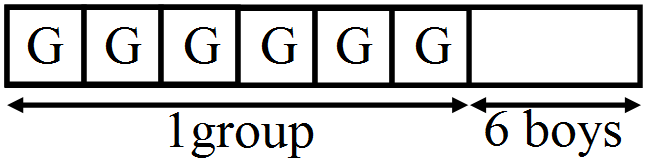
$6$ boys and $6$ girls sit in a row at random. The probability that all the girls sit together is:
  • A
    $\frac{1}{432}$
  • B
    $\frac{12}{431}$
  • $\frac{1}{132}$
  • D
    none of these.
Answer
Correct option: C.
$\frac{1}{132}$
If all the girls sit together, then we consider it as $1$ group

$\therefore$ Total number of arrangement of $6 + 1 = 7$ persons in a row $= 7!$ And the girls also interchanged their places with $6!$ Ways.
$\therefore\ \text{Required probability}=\frac{6!7!}{12!}$
$=\frac{6\times5\times4\times3\times2\times7!}{12\times11\times10\times9\times8\times7!}$
$=\frac{1}{132}$
View full question & answer
MCQ 71 Mark
If $\text{P}(\text{A}\cup\text{B})=\text{P}(\text{A}\cap\text{B})$ for any two events $A$ and $B,$ then:
  • $\text{P(A)}=\text{P(B)}$
  • B
    $\text{P(A)}>\text{P(B)}$
  • C
    $\text{P}(\text{A})<\text{P(B)}$
  • D
    none of these.
Answer
Correct option: A.
$\text{P(A)}=\text{P(B)}$
Given that, $\text{P}(\text{A}\cup\text{B})=\text{P}(\text{A}\cap\text{B})$
$\Rightarrow\text{P}(\text{A})+\text{P}(\text{B})-\text{P}(\text{A}\cap\text{B})=\text{P}(\text{A}\cap\text{B})$
$\Rightarrow\big[\text{P(A)}-\text{P}(\text{A}\cap\text{B})\big]+\big[\text{P(B)}-\text{P}(\text{A}\cap\text{B})\big]=0$
But $\text{P(A)}-\text{P}(\text{A}\cap\text{B})\geq0\ ....(\text{i})$
$\big[\because\ \text{P}(\text{A}\cap\text{B})\leq\text{P(A)}\text{ or }\text{P(B)}\big]$
And $\text{P}(\text{B})-\text{P}(\text{A}\cap\text{B})\geq0\ ...(\text{ii})$
From eq. $(i)$ and $(ii)$ we get
$\text{P(A)}=\text{P(B)}$
View full question & answer
MCQ 81 Mark
If $A$ and $B$ are mutually exclusive events, then:
  • $\text{P(A)}\leq\text{P}(\bar{\text{B}})$
  • B
    $\text{P(A)}\geq\text{P}(\bar{\text{B}})$
  • C
    $\text{P}(\text{A})<\text{P}(\bar{\text{B}})$
  • D
    none of these.
Answer
Correct option: A.
$\text{P(A)}\leq\text{P}(\bar{\text{B}})$
For mutually exclusive events,
$\text{P}(\text{A}\cap\text{B})=0$
$\therefore\ \text{P}(\text{A}\cup\text{B})=\text{P(A)}+\text{P(B)}$ $\big[\because\text{ P}(\text{A}\cap\text{B})=0\big]$
$\Rightarrow\text{P}(\text{A})+\text{P(B)}\leq1$
$\Rightarrow\text{P(A)}+1-\text{P}(\bar{\text{B}})\leq1$ $\big[\text{P(B)}=1-\text{P}(\bar{\text{B}})\big]$
$\Rightarrow\text{P(A)}-\text{P}(\bar{\text{B}})\leq0$
$\Rightarrow\text{P(A)}-\text{P}(\bar{\text{B}})$
View full question & answer
MCQ 91 Mark
While shuffling a pack of $52$ playing cards, $2$ are accidentally dropped. Find the probability that the missing cards to be of different colours:
  • A
    $\frac{29}{52}$
  • B
    $\frac{1}{2}$
  • $\frac{26}{51}$
  • D
    $\frac{27}{51}$
Answer
Correct option: C.
$\frac{26}{51}$
We know that out of $52$ playing cards $26$ are of red and $26$ are of black colour.
$\therefore$ $P($both cards of differents colour$)$
$=\frac{26}{52}\times\frac{26}{51}+\frac{26}{52}\times\frac{26}{51}$
$=2\times\frac{26}{52}\times\frac{26}{51}$
$=\frac{26}{51}$
View full question & answer
MCQ 101 Mark
Without repetition of the numbers, four digit numbers are formed with the numbers $0, 2, 3, 5.$ The probability of such a number divisible by $5$ is:
  • A
    $\frac{1}{5}$
  • B
    $\frac{4}{5}$
  • C
    $\frac{1}{30}$
  • $\frac{5}{9}$
Answer
Correct option: D.
$\frac{5}{9}$
We have digite $0, 2, 3, 5.$
Number of divisible by $5$ if unit place digit is $'0\ '$ or $'5\ '$
If unit place is $'0\ '$ then first three places can be filled in $3!$ ways.
If unit place is $'5\ '$ then first place can be filled in two ways and second and thried place can be filled in $2!$ ways.
So, number of numbers ending with digit $'5\ '$ is $2 \times 2! = 4$
$\therefore$ Total number of numbers divisible by $5 = 3! + 4 = 110 = n(E)$
Also total number of numbers $= 3 \times 3! = 18$
$\therefore\ \text{Required probability}=\frac{10}{18}=\frac{5}{9}$
View full question & answer
MCQ 111 Mark
A single letter is selected at random from the word $\text{‘PROBABILITY’.}$ The probability that it is a vowel is:
  • A
    $\frac{1}{3}$
  • $\frac{4}{11}$
  • C
    $\frac{2}{11}$
  • D
    $\frac{3}{11}$
Answer
Correct option: B.
$\frac{4}{11}$
Total number of alphabets in probability $= 11$
Number of vowels $= 4$
$\therefore\ \text{Required probability}=\frac{4}{11}$
View full question & answer
MCQ 121 Mark
If $M$ and $N$ are any two events, the probability that at least one of them occurs is:
  • A
    $\text{P(M)}+\text{P(N)}-2\text{P(M}\cap\text{N)}$
  • $\text{P(M)}+\text{P(N)}-\text{P(M}\cap\text{N)}$
  • C
    $\text{P(M)}+\text{P(N)}+\text{P(M}\cap\text{N)}$
  • D
    $\text{P(M)}+\text{P(N)}+2\text{P(M}\cap\text{N)}$
Answer
Correct option: B.
$\text{P(M)}+\text{P(N)}-\text{P(M}\cap\text{N)}$
If $M$ and $N$ are any two events.
$\text{P(M}\cup\text{N)}=\text{P(M)}+\text{P(N)}-\text{P(M}\cap\text{N)}$
View full question & answer