Questions

5 Marks Questions

Take a timed test

7 questions · self-marked practice — reveal the answer and mark yourself.

Question 15 Marks
Match the following sets for all sets $A, B$ and $C.$
$(i)$ $((\text{A}'\cup\text{B}')-\text{A})'$ $(a)$ $\text{A} - \text{B}$
$(ii)$ $[\text{B}'\cup(\text{B}'-\text{A})]'$ $(b)$ $\text{A}$
$(iii)$ $(\text{A} - \text{B}) - (\text{B} - \text{C})$ $(c)$ $\text{B}$
$(iv)$ $(\text{A}-\text{B})\cap(\text{C}-\text{B})$ $(d)$ $(\text{A}\times\text{B})\cap(\text{A}\times\text{C})$
$(v)$ $\text{A}\times(\text{B}\cap\text{C})$ $(e)$ $(\text{A}\times\text{B})\cup(\text{A}\times\text{C})$
$(vi)$ $\text{A}\times(\text{B}\cup\text{C})$ $(f)$ $(\text{A}\cap\text{C})-\text{B}$
Answer
$(i)$ $((\text{A}'\cup\text{B}')-\text{A})'$ $(b)$ $\text{A}$
$(ii)$ $[\text{B}'\cup(\text{B}'-\text{A})]'$ $(c)$ $\text{B}$
$(iii)$ $(\text{A} - \text{B}) - (\text{B} - \text{C})$ $(a)$ $\text{A}-\text{B}$
$(iv)$ $(\text{A}-\text{B})\cap(\text{C}-\text{B})$ $(f)$ $(\text{A}\cap\text{C})-\text{B}$
$(v)$ $\text{A}\times(\text{B}\cap\text{C})$ $(d)$ $(\text{A}\times\text{B})\cap(\text{A}\times\text{C})$
$(vi)$ $\text{A}\times(\text{B}\cup\text{C})$ $(e)$ $(\text{A}\times\text{B})\cup(\text{A}\times\text{C})$
Solution:
  1. $((\text{A}'\cup\text{B}')-\text{A})'=\big[(\text{A}'\cup\text{B}')\cap\text{A})'\big]\ \big[\because \text{A}-\text{B}=\text{A}\cap\text{B}'\big]$
$=\big[(\text{A}\cap\text{B})'\cap\text{A})'\big]'\ \big[\because\text{A}'\cup\text{B}'=(\text{A}\cap\text{B})'\big]$ $=\big[(\text{A}\cap\text{B})'\big]'\cup(\text{A}')' \ \big[\because (\text{A}')'=\text{A}\big]$ $=(\text{A}\cap\text{B})\cup\text{A}$ $=\text{A}.$
So $(i)$ is mathc with $(b).$​​​​​​​
  1. $\big[\text{B}'\cup(\text{B}'-\text{A})\big]'=\big[\text{B}'\cup(\text{B}'\cap\text{A}')\big]'\ \big[\because \text{A}-\text{B}=\text{A}\cap\text{B}'\big]$
$=(\text{B}')'\cap(\text{B}'\cap\text{A}')'\ \big[\because \text{A}'\cap\text{B}'=(\text{A}\cup\text{B})'\big]$ $=\text{B}\cap(\text{B}\cup\text{A})=\text{B}$
So $(ii)$ is matched with $(c).$​​​​​​​
  1. $(\text{A}-\text{B})-(\text{B}-\text{C})=(\text{A}\cap\text{B}')-(\text{B}\cap\text{C}') \ \big[\because \text{A}-\text{B}=(\text{A}\cap\text{B}')\big]$
$=(\text{A}\cap\text{B}')\cap(\text{B}\cap\text{C}')'$
$=(\text{A}\cap\text{B}')\cap(\text{B}\cap\text{C}')')\ \big[(\text{A}\cap\text{B})'=\text{A}'\cup\text{B}'\big]$
$=(\text{A}\cap\text{B}')\cap(\text{B}'\cap\text{C})$ $=\big[\text{A}\cap(\text{B}'\cup\text{C})\big]\cap\big[\text{B}'\cap(\text{B}'\cup\text{C})\big]$ $=\big[\text{A}\cap(\text{B}'\cup\text{C})\big]\cap\text{B}'$
$=(\text{A}\cap\text{B}')\cap(\text{B}'\cup\text{C})\cap\text{B}'$
$=(\text{A}\cap\text{B}')\cap\text{B}'=(\text{A}\cap\text{B}')=\text{A}-\text{B}$
So, $(iii)$ is matched with $(a)$.
  1. $(\text{A}-\text{B})\cap(\text{C}-\text{B})=(\text{A}\cap\text{B}')\cap(\text{C}\cap\text{B}') \ \big[\because \text{A}-\text{B}=(\text{A}-\text{B}')\big]$
$=(\text{A}\cap\text{C})\cap\text{B}'$ $=(\text{A}\cap\text{C})-\text{B}\ \big[\because \text{A}\cap\text{B}'=\text{A}-\text{B}\big]$
Hence, $(iv)$ is matched with $(f).$​​​​​​​
  1. $\text{A}\times(\text{B}\cup\text{C})=(\text{A}\times\text{B})\cap(\text{A}\times\text{C})$
So, $(v)$ is mathced with $(d).$​​​​​​​
  1. $\text{A}\times(\text{B}\cup\text{C})=(\text{A}\times\text{B})\cup(\text{A}\times\text{C})$
So, $(vi)$ is matched with $(e).$
View full question & answer
Question 25 Marks
For all sets A, B and C, show that $(\text{A} - \text{B}) \cap (\text{C} - \text{B}) = \text{A} - (\text{B} \cup \text{C})$
Determine whether each of the statement in Exercises 13 - 17 is true or false. Justify your answer.
Answer
To prove $(\text{A} - \text{B}) \cap (\text{C} - \text{B}) = \text{A} - (\text{B} \cup \text{C})$
Let $\text{x}\in (\text{A} - \text{B}) \cap (\text{A} - \text{C})$
$\Rightarrow \text{x}\in (\text{A} - \text{B})$ and $ \text{x}\in (\text{A} - \text{C})$
$\Rightarrow (\text{x}\in\text{A and x}\notin\text{B})$ and $(\text{x}\in\text{A and x}\notin\text{C})$
$\Rightarrow \text{x}\in\text{A}$ and $(\text{x}\notin\text{B and x}\notin\text{C})$
$\Rightarrow \text{x}\in\text{A}$ and $\text{x}\notin(\text{B}\cup\text{C})$
$\Rightarrow \text{x}\in\text{A}-(\text{B}\cup\text{C})$
So $(\text{A}-\text{B})\cap(\text{A}-\text{C})\subset\text{A}-(\text{B}\cup\text{C})\ .....(\text{i})$
Let $\text{y}\in\text{A}-(\text{B}\cup\text{C})$
$\Rightarrow \text{y}\in\text{A}$ and $\text{y}\notin(\text{B}\cup\text{C})$
$\Rightarrow \text{y}\in\text{A}$ and $(\text{y}\notin\text{B and y}\notin\text{C})$
$\Rightarrow (\text{y}\notin \text{A and y}\notin\text{B})$ and $ (\text{y}\notin \text{A and y}\notin\text{C})$
$\Rightarrow \text{y}\in(\text{A}-\text{B})$ and $\text{y}\in(\text{A}-\text{C})$
$\Rightarrow \text{y}\in(\text{A}-\text{B})\cap(\text{A}-\text{C})$
So, $\text{A}-(\text{B}\cup\text{C})\subset(\text{A}-\text{B})\cap(\text{A}-\text{C})\ .....(\text{ii})$
From eqn. (i) and (ii), we get
$\text{A}-(\text{B}\cup\text{C}) = (\text{A}-\text{B})\cap(\text{A}-\text{C})$
View full question & answer
Question 35 Marks
Let A, B and C be sets. Then show that $\text{A}\cap(\text{B}\cup\text{C})=(\text{A}\cap\text{B})\cup(\text{A}\cap\text{C}).$
Answer
Let $\text{x}\in\text{A}\cap(\text{B}\cup\text{C})$
$\Rightarrow \text{x}\in\text{A}$ and $\text{x}\in(\text{B}\cup\text{C})$
$\Rightarrow \text{x}\in\text{A}$ and $(\text{x}\in\text{B or x}\in\text{C}) $
$\Rightarrow (\text{x}\in\text{A and x}\in \text{B})$ or $(\text{x}\in\text{A and x}\in\text{C})$
$\Rightarrow \text{x}\in\text{A}\cap\text{B}$ or $\Rightarrow \text{x}\in\text{A}\cap\text{C}$
$\Rightarrow \text{x}\in(\text{A}\cap\text{B})\cup(\text{A}\cap\text{C})$
$\Rightarrow\text{A}\cap(\text{B}\cup\text{C})\subset(\text{A}\cap\text{B})\cup(\text{A}\cap\text{C})$
Now, let $\text{y}\in(\text{A}\cap\text{B})\cup(\text{A}\cap\text{C})$
$\Rightarrow \text{y}\in(\text{A}\cap\text{B})$ or $\text{y}\in(\text{A}\cap\text{C})$
$\Rightarrow (\text{y}\in\text{A and y}\in\text{B})$ or $(\text{y}\in\text{A and y}\in\text{C})$
$\Rightarrow \text{y}\in\text{A}$ and $(\text{y}\in\text{B or y}\in\text{C})$
$\Rightarrow \text{y}\in\text{A}$ and $\text{y}\in\text{B}\cup\text{C}$
$\Rightarrow \text{y}\in\text{A}\cap(\text{B}\cup\text{C})$
$\Rightarrow (\text{A}\cap\text{B})\cup(\text{A}\cap\text{C})\subset\text{A}\cap(\text{B}\cup\text{C})$
Form (i) and (ii), we get.
$\text{A}\cap(\text{B}\cup\text{C})=(\text{A}\cap\text{B})\cup(\text{A}\cap\text{C})$
View full question & answer
Question 45 Marks
In a survey of 200 students of a school, it was found that 120 study Mathematics, 90 study Physics and 70 study Chemistry, 40 study Mathematics and Physics, 30 study Physics and Chemistry, 50 study Chemistry and Mathematics and 20 none of these subjects. Find the number of students who study all the three subjects.
Answer
Let the set of student who study Mathematics be M, the set of student who study Physics be P and the set of students who study Chmistry be C.
According to the question,
n(U) = 200, n(M) = 120, n(P) = 90, n(C) = 70, $\text{n}(\text{M}\cap\text{P})=40,\text{n}(\text{P}\cap\text{C})=30,\text{n}(\text{C}\cap\text{M})=50,$ and $\text{n}(\text{M}'\cap\text{P}'\cap\text{C}')=20$
$\therefore \text{n(U)}-\text{n(M)'}\cap\text{P}'\cap\text{C}')$
$=\text{n}(\text{M}\cap\text{P}\cap\text{C})=200-20=180$
Now, $\text{n}(\text{M}\cup\text{P}\cup\text{C})=\text{n(M)}+\text{n(P)}+\text{n(C)}-\text{n}(\text{M}\cap\text{P}) \\ -\text{n}(\text{P}\cap\text{C})-\text{n}(\text{M}\cap\text{C})+\text{n}(\text{M}\cap\text{P}\cap\text{C})$
$\Rightarrow 180=120+90+70-40-30-50 + \text{n}(\text{M}\cap\text{P}\cap\text{C})$
$\Rightarrow 180-160=\text{n}(\text{M}\cap\text{P}\cap\text{C})$
$\Rightarrow \text{n}(\text{M}\cap\text{P}\cap\text{C})=20$
Hence, the number of students who study all the three subjects = 20.
View full question & answer
Question 55 Marks
In a town of $10,000$ families it was found that $40\%$ families buy newspaper $A, 20\%$ families buy newspaper $B, 10\%$ families buy newspaper $C, 5\%$ families buy $A$ and $B, 3\%$ buy $B$ and $C$ and $4\%$ buy $A$ and $C.$ If $2\%$ families buy all the three newspapers. Find
  1. The number of families which buy newspaper $A$ only.
  2. The number of families which buy none of $A, B$ and $C.$
Answer
Let $A$ be the set of families which buy newspaper $A, B$ be the set of families which buy newspaper $B$ and $C$ be the set of families which buy newspaper $C.$ The
Then, $n(U) = 1000, n(A) = 40\%, n(B) = 20\%$ and $n(C) = 10\%, \text{n}(\text{A}\cap\text{B})=5\%,\text{n}(\text{B}\cap\text{C})=3\%,\text{n}(\text{A}\cap\text{C})=4\%$ and $\text{n}(\text{A}\cap\text{B}\cap\text{C})=2\%$
  1. Percentage of families which buy newspaper $A$ only
$=\text{n(A)}-\text{n}(\text{A}\cap\text{B})-\text{n}(\text{A}\cap\text{C})+\text{n}(\text{A}\cap\text{B}\cap\text{C})$
$=(40-5-4+2)\%$
$=30\%$
$\therefore$ Number of families which buy newspaper $A$ only $=1000\times\frac{33}{100}=3300$
  1. Percentage of families which buy none of $A, B$ and $C$
$=\text{n(U)}-\text{n}(\text{A}\cup\text{B}\cup\text{C})$
$=\text{n(U)}-\big[\text{n(A)}+\text{n(B)}+\text{n(C)}-\text{n}(\text{A}\cup\text{B})-\text{n}(\text{B}\cap\text{C})
-\text{n}(\text{A}\cap\text{C})+\text{n}(\text{A}\cap\text{B}\cap\text{C})\big]$
$=100-\big[40+20+10-5-3-4+2]$
$=100-60$
$=40\%$
Number of families which buy none of $A, B$ and $C =10000\times\Big(\frac{40}{100}\Big)=4000$
View full question & answer
Question 65 Marks
Out of $100$ students; $15$ passed in English, $12$ passed in Mathematics, $8$ in Science, $6$ in English and Mathematics, $7$ in Mathematics and Science; $4$ in English and Science; $4$ in all the three. Find how many passed.
  1. In English and Mathematics but not in Science.
  2. In Mathematics and Science but not in English.
  3. In Mathematics only.
  4. In more than one subject only.
Answer
Let the ser of student who passed in Mathematics be $M,$ the set of student who passed in English be $E$ and the set of studnet who passed in Science be $S.$
Then $m(U) = 100, n(M) = 12, n(E) = 15, n(S) = 8, \text{n}(\text{E}\cap\text{M})=6,\text{n}(\text{M}\cap\text{S})=7,\text{n}(\text{E}\cap\text{S})=4$ and $\text{n}(\text{E}\cap\text{M}\cap\text{S})=4$
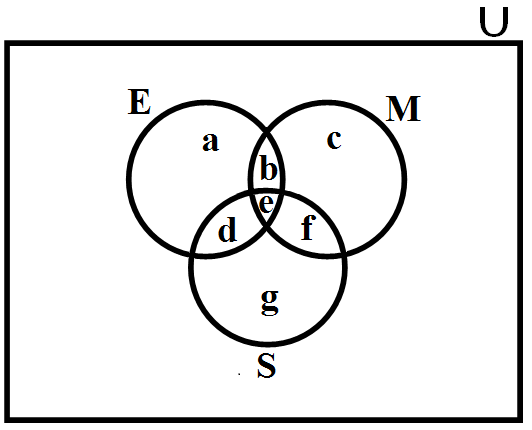
Let us draw a Venn diagram

According to the Venn diagram
$\text{n}(\text{E}\cap\text{M}\cap\text{S})=4$
$\Rightarrow \text{e}=4$
$\text{n}(\text{E}\cap\text{M})=6$
$\Rightarrow \text{b}+\text{e}=6$
$\Rightarrow \text{b}+4=6$
$\Rightarrow \text{b}=2$
$\text{n}(\text{M}\cap\text{S})=7$
$\Rightarrow \text{e}+\text{f}=7$
$\Rightarrow 4+\text{f}=7$
$\Rightarrow \text{f}=3$
$\text{n}(\text{E}\cap\text{S})=4$
$\Rightarrow\text{d}+\text{e}=4$
$\Rightarrow \text{d}+4=4$
$\Rightarrow \text{d}=0$
$n(E) = 15$
$\Rightarrow a + b + d + e = 15$
$\Rightarrow a + 2 + 0 + 4 = 15$
$\Rightarrow a = 9$
$n(M) = 12$
$\Rightarrow b + c + e + f = 12$
$\Rightarrow 2 + c + 4 +3 = 12$
$\Rightarrow c = 3$
$n(S) = 8$
$\Rightarrow d + e + f + g = 8$
$\Rightarrow 0 + 4 + 3 + g = 8$
$\Rightarrow g = 1$
Hence we get,
  1. Number of students who passed in English and Mathematics but not in Science, $b = 2.$
  2. Number of students who passed in Mathematics and Science but not in English, $f = 3.$
  3. Number of students who passed in Mathematics only, $c = 3.$
  4. Number of studnets who passed in mote than one subject $= b + e + d + f = 2 + 4 + 0 + 3 = 9.$
View full question & answer
Question 75 Marks
In a group of $50$ students, the number of students studying French, English, Sanskrit were found to be as follows:
French $= 17,$ English $= 13,$ Sanskrit $= 15$
French and English $= 09,$ English and Sanskrit $= 4$
French and Sanskrit $= 5,$ English, French and Sanskrit $= 3.$ Find the number of students who study.
  1. French only.
  2. English only.
  3. Sanskrit only.
  4. English and Sanskrit.
  5. French and Sanskrit but not English.
  6. French and English but not Sanskrit.
  7. At least one of the three languages but not French.
  8. None of the three languages.
Answer
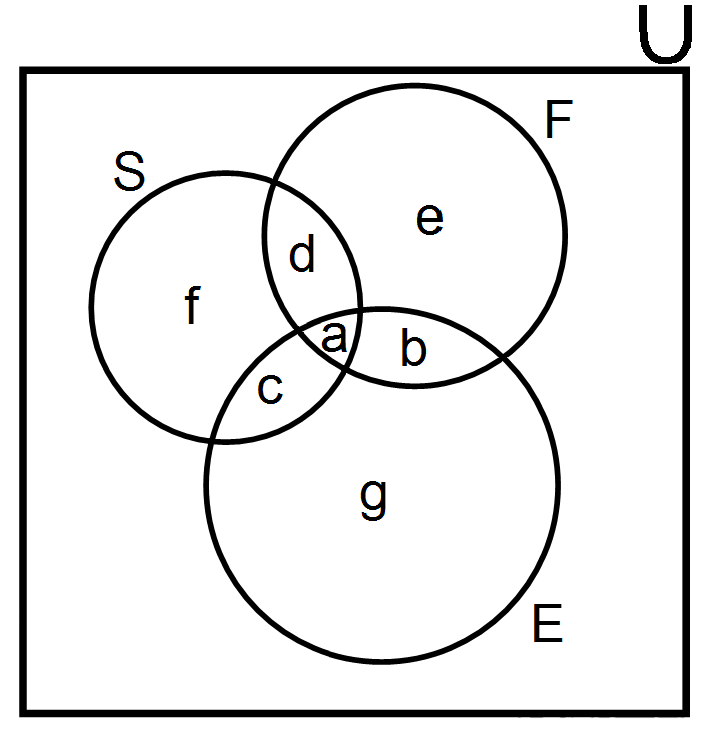
Let $F$ be the set of students who study French, $E$ be the set of students who study English and $S$ be the set of students who study Sanskrit.
Then, $n(U) = 50, n(F) =17, n(E) = 13,$ and $n(S) = 15, \text{n}(\text{F} \cap \text{E}) = 9, \text{n}(\text{E} \cap \text{S}) = 4, \text{n}(\text{F} \cap \text{S}) = 5, \text{n}(\text{F} \cap \text{E} \cap \text{S}) = 3$

From the figure, we have
$\text{a}=\text{n}(\text{E}\cap\text{F}\cap\text{S})=3$
$\text{a}+\text{d}=\text{n}(\text{F}\cap\text{S})=5 \ \therefore \text{d}=2$
$\text{a}+\text{b}=\text{n}(\text{F}\cap\text{E})=9 \ \therefore \text{b}=6$
$\text{a}+\text{c}=\text{n}(\text{S}\cap\text{E})=4 \ \therefore \text{c}=1$
$a + b + d + e = n(F) = 17$ or $3 + 6 + 2 + e = 17 \therefore e = 6$
$a + b + c + g = n(E) = 13$ or $3 + 6 + 1 + g = 13 \therefore g = 3$
$a + c + d + f = n(S) = 15$ or $3 + 1 + 2 + f = 15 \therefore f = 9$
  1. Number of students studying French only $= e = 6$
  2. Number of students studying English only $= g = 3$
  3. Number of students studying Sanskrit only $= f = 9$
  4. Number of students studying English and Sanskrit but not French $= c = 1$
  5. Number of students studying French and Sanskrit but not English $= d = 2$
  6. Number of students studying French and English but not Sanskrit $= b = 6$
  7. Number of students studying at least one of the three languages $= a + b + c + d + e + f + g = 30$
  8. Number of students studying none of the three languages but not French $= 50 - 30 = 20.$
View full question & answer