MCQ 11 Mark
If $A = \{1, 3, 5, 7, 9, 11, 13, 15, 17\}, B = \{2, 4, ....., 18 \}$ and $N$ the set of natural numbers is the universal set, then $\text{A}' \cup (\text{A} \cup \text{B}) \cup \text{B}')$ is
Answer$A = \{1, 3, 5, 7, 9, 11, 13, 15, 17\}$
$B = \{2, 4, ...., 18\}$
$U = N = \{1, 2, 3, 4, 5, .....\}$
$\text{A}'\cup(\text{A}\cup\text{B})\cap\text{B}'=\text{A}'\big[(\text{A}\cap\text{B}')\cup(\text{B}\cap\text{B}')\big]$
$=\text{A}'\cup(\text{A}\cap\text{B}')\cup\phi \ \big[\because \text{A}\cap\text{A}'=\phi\big]$
$=\text{A}'\cup(\text{A}\cap\text{B}')$
$=(\text{ A}'\cup\text{A})\cap(\text{A}'\cup\text{B}')$
$=\text{N}\cup(\text{A}'\cup\text{B}')\ \big[\because \text{A}'\cup\text{A}=\text{N}\big]$
$=\text{A}'\cup\text{B}'$
$=(\text{A}\cup\text{B}')=(\phi)'=\text{N} \ \big[\because \text{A}\cap\text{B}=\phi\big]$
Hence, the correct option is $(b).$
View full question & answer→MCQ 21 Mark
Let $S = \{x | x$ is a positive multiple of $3$ less than $100\} P = \{x | x$ is a prime number less than $20\}.$ Then $n(S) + n(P)$ is.
AnswerGiven that: $S = \{x | x$ is a positive multiple of $3 < 100\}$
$\therefore S = \{3, 6, 9, 12, 15 18, ....., 99\}$
$n(S) = 33$
$T = (x | x$ is a prime number $< 20)$
$\therefore T = \{2, 3, 5, 7, 11, 13, 17, 19\}$
$n(T) = 8$
So, $n(S) + n(T) = 33 + 8 = 41$
Hence, the correct option is $(b).$
View full question & answer→MCQ 31 Mark
If $A$ and $B$ are two sets, then $\text{A} \cap (\text{A} \cup \text{B})$ equals.
- ✓
$\text{A}$
- B
$\text{B}$
- C
$\phi$
- D
$\text{A}\cap\text{B}$
AnswerCorrect option: A. $\text{A}$
Given that: $\text{A}\cap(\text{A}\cup\text{B})$
Let $\text{x}\in\text{A}\cap(\text{A}\cup\text{B})$
$\Rightarrow \text{x}\in\text{A}$ and $\text{x}\in(\text{A}\cup\text{B})$
$\Rightarrow \text{x}\in\text{A}$ and $(\text{x}\in\text{A}\text{ or x}\in\text{B})$
$\Rightarrow (\text{x}\in\text{A}$ and $\text{x}\in\text{A})$ or $(\text{x}\in\text{A}$ and $\text{x}\in\text{B})$
$\Rightarrow \text{x}\in\text{A}$ or $\text{x}\in(\text{A}\cap\text{B})$
$\Rightarrow \text{x}\in\text{A}$
Hence, the correct option is $(a).$
View full question & answer→MCQ 41 Mark
Suppose $A_1, A_2, ..., A_{30}$ are thirty sets each having $5$ elements and $B_1, B_2, ...,$ Bn are $n$ sets each with $3$ elements$,$ let $\bigcup\limits_{\text{i}=1}^{30}\text{A}_\text{i}=\bigcup\limits_{\text{j}=1}^\text{n}\text{B}_\text{j}=\text{S}$ and each element of $S$ belongs to exactly $10$ of the $A_i ’s$ and exactly $9$ of the $B, 'S.$ then $n$ is equal to.
AnswerNumber of elements in $\text{A}_1\cup\text{A}_2\cup\text{A}_3\ ..... \cup \text{A}_{30}=30\times5=150 ($When repetition is not allowed$)$
But each element is repeated $10$ times
$\therefore \text{n(S)}=\frac{30\times5}{10}=\frac{150}{10}=15\ .....\text{(i)}$
Number of elements in $\text{B}_1\cup\text{B}_2\cup\text{B}_3\ ...... \text{B}_\text{n}=3\text{n}($when repetitiom is not allowed$)$
But each element is repeated $09$ times
$\therefore \text{n(S)}=\frac{3\text{n}}{9}=\frac{\text{n}}{3}\ .....\text{(ii)}$
From $(i)$ and $(ii)$ we get
$\frac{\text{n}}{3}=15\Rightarrow \text{n}=15\times3=45$
Hence$,$ the corrrect option is $(c).$
View full question & answer→MCQ 51 Mark
Let $F_1$ be the set of parallelograms$, F_2$ the set of rectangles$, F_3$ the set of rhombuses$, F_4$ the set of squares and $F_5$ the set of trapeziums in a plane. Then $F_1$ may be equal to$,$
- A
$\text{F}_2\cap\text{F}_3$
- B
$\text{F}_3\cap\text{F}_4$
- C
$\text{F}_2\cup\text{F}_5$
- ✓
$\text{F}_2\cup\text{F}_3\cup\text{F}_4\cup\text{F}_1$
AnswerCorrect option: D. $\text{F}_2\cup\text{F}_3\cup\text{F}_4\cup\text{F}_1$
Every rectangel$,$ rhombus$,$ square in a plane is a parallelogram but every trapezium is not a parallelogram.
$\text{F}_1=\text{F}_2\cup\text{F}_3\cup\text{F}_4\cup\text{F}_1$
View full question & answer→MCQ 61 Mark
If $X = \{8n - 7n - 1 | n \in N\}$ and $Y = \{49n - 49 | n \in N\}$. Then
- ✓
$\text{X} \subset \text{Y}$
- B
$\text{Y} \subset \text{X}$
- C
$\text{X} = \text{Y}$
- D
$\text{X} \cap \text{Y} = \phi$
AnswerCorrect option: A. $\text{X} \subset \text{Y}$
$X = \{8n - 7n - 1| n \in N\} = \{0, 49, 490, .....\}$
$Y = \{49n - 49 | n \in N\} = \{0, 49, 147, ....., 490, .....\}$
Clearlut, every element of $X$ is in $Y$ but every element of $Y$ is not in $X.$
$\therefore \text{X}\subset\text{Y}$
View full question & answer→MCQ 71 Mark
Let $R$ be set of points inside a rectangle of sides $a$ and $b (a, b > 1)$ with two sides along the positive direction of $x-$axis and $y-$axis. Then
- A
$R = \{(x, y) : 0 ≤ x ≤ a, 0 ≤ y ≤ b\}.$
- B
$R = \{(x, y) : 0 ≤ x < a, 0 ≤ y ≤ b\}$.
- C
$R = \{(x, y) : 0 ≤ x ≤ a, 0 < y < b\}.$
- ✓
$R = \{(x, y) : 0 < x < a, 0 < y < b\}$.
AnswerCorrect option: D. $R = \{(x, y) : 0 < x < a, 0 < y < b\}$.
Since, $R$ be the set of points inside the rectangle.
$\therefore R = \{(x, y) : 0 < x < a, 0 < y < b\}.$
View full question & answer→MCQ 81 Mark
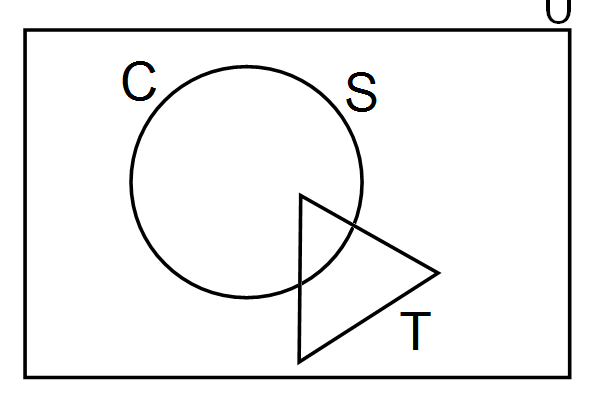
Let $S =$ set of points inside the square, $T =$ the set of points inside the triangle and $C =$ the set of points inside the circle. If the triangle and circle intersect each other and are contained in a square. Then
- A
$\text{S}\cap\text{T}\cap\text{C}=\phi$
- B
$\text{S}\cup\text{T}\cup\text{C}=\text{C}$
- ✓
$\text{S}\cup\text{T}\cup\text{C}=\text{S}$
- D
$\text{S}\cup\text{T} = \text{S}\cap\text{C}$
AnswerCorrect option: C. $\text{S}\cup\text{T}\cup\text{C}=\text{S}$
The given conditions of the question may be represented by the following Venn diagram. From the given Venn diagram, we conclude thta
$\text{S}\cup\text{T}\cup\text{C}=\text{S}$
Hence, the correct option is $(c).$ View full question & answer→MCQ 91 Mark
Two finite sets have $m$ and $n$ elements. The number of subsets of the first set is $112$ more than that of the second set. The values of $m$ and $n$ are$,$ respectively$,$
- A
$4, 7$
- B
$7, 4$
- C
$4, 4$
- ✓
$7, 7$
AnswerCorrect option: D. $7, 7$
According to the question$,$
$\Rightarrow 2^m - 2^n = 12$
$\Rightarrow 2^n(2^{m-n} - 1) 2^4. 7$
$\Rightarrow 2n = 2^4$ and $2^{m-n} - 1 = 7$
$\Rightarrow n = 2$ and $2^{m-n} = 8$
$\Rightarrow 2^{m-n} = 2^3$
$\Rightarrow m - n = 3$
$\Rightarrow m - 4 = 3$
$\Rightarrow m = 7$
View full question & answer→MCQ 101 Mark
The set $(\text{A} \cap \text{B}')' \cup (\text{B} \cap \text{C})$ is equal to.
AnswerCorrect option: B. $\text{A}'\cup\text{B}$
We konw that: $(\text{A}\cap\text{B})'=\text{A}'\cup\text{B}'$ [De Morgan's law]
$\therefore (\text{A}\cap\text{B}')'\cup(\text{B}\cap\text{C})=\big[\text{A}'\cup(\text{B}')\big]\cup(\text{B}\cap\text{C})$
$=(\text{A}'\cap\text{B})\cup(\text{B}\cap\text{C})\big[\because (\text{B}')'=\text{B}\big]$
$=\text{A}'\cup\text{B}$
Hence, the correct optiom is $(b).$
View full question & answer→MCQ 111 Mark
In a town of $840$ persons, $450$ persons read Hindi, $300$ read English and $200$ read both. Then the number of persons who read neither is,
AnswerLet $H$ be the set of persons who read Hindi and $E$ be the ser of persons who read English.
Then, $n(U) = 840, n(H) = 450, n(E) 300, \text{n}(\text{H}\cap\text{E})=200$
Number of persons who read neither $=\text{n}(\text{H}'\cap\text{F}')$
$=\text{n}(\text{H}\cup\text{E})'=\text{n(U)}-\text{n}(\text{H}\cup\text{E})$
$=840-\big[\text{n(H)}+\text{n(E)}-\text{n}(\text{H}\cap\text{E})\big]$
$=840-(450+300-200)$
$=290$
View full question & answer→MCQ 121 Mark
If $X$ and $Y$ are two sets and $X′$ denotes the complement of $X,$ then $\text{X}\cap(\text{X}\cup\text{Y})'$ is equal to.
- A
$\text{X}.$
- B
$\text{Y}.$
- ✓
$\phi.$
- D
$\text{X}\cap\text{Y}.$
AnswerCorrect option: C. $\phi.$
Let $\text{x}\in\text{X}\cap(\text{X}\cup\text{Y})'$
$\Rightarrow \text{x}\in\text{X}\cap(\text{X}'\cup\text{Y})'$
$\Rightarrow \text{x}\in(\text{X}\cap\text{X})\cap(\text{X}\cap\text{Y}')$
$\Rightarrow \text{x}\in\phi\cap(\text{x}\cap\text{Y}')\ \big[\because \text{A}\cap\text{A}'=\phi\big]$
$\Rightarrow \text{x}\in\phi$
Hence, the correct option is $(c).$
View full question & answer→MCQ 131 Mark
In a class of $60$ students, $25$ students play cricket and $20$ students play tennis, and $10$ students play both the games. Then, the number of students who play neither is.
AnswerTotal number of students $= 60$
Number of students who play cricket $= 25$
Number of students who play tennis $= 20$
Number of students who play cricket and tennis both $= 10$
$\Rightarrow \text{n}(\text{C}\cap\text{T})=10$
$\therefore \text{n}(\text{C}\cap\text{T}) =\text{n(C)}+\text{n(T)}-\text{n}(\text{C}\cap\text{T})$
$=25+20-10=45-10=35$
$\therefore \text{n}(\text{C}'\cap\text{T}') = \text{n(U)}-\text{n}(\text{C}\cap\text{T})$
$=60-35=25$
Hence, the correct option is $(b).$
View full question & answer→MCQ 141 Mark
If sets $A$ and $B$ are defined as $\text{A}=\Big\{(\text{x},\text{y})|\text{y}=\frac{1}{\text{x}},0\neq\text{x}\in\text{R}\Big\}\ \text{B}=\{(\text{x},\text{y})|\text{y}=-\text{x},\text{x}\in\text{R}\},$ then
- A
$\text{A}\cap\text{B}=\text{A}$
- B
$\text{A}\cap\text{B}=\text{B}$
- ✓
$\text{A}\cap\text{B}=\phi$
- D
$\text{A}\cup\text{B}=\text{A}$
AnswerCorrect option: C. $\text{A}\cap\text{B}=\phi$
Given that: $\text{A}=\Big\{(\text{x},\text{y}|\text{y}=\frac{1}{\text{x}},0\neq\text{x}\in\text{R}\Big\},$
and $\text{B}=\big\{(\text{x},\text{y}|\text{y}=\text{x},\text{x}\in\text{R}\big\}$
It is very clear that $\text{y}=\frac{1}{\text{x}}$ and y = -x
$\because \frac{1}{\text{x}}\neq -\text{x}$
$\therefore \text{A}\cap\text{B}=\phi$
Hence, the correct option is $(c).$
View full question & answer→MCQ 151 Mark
A survey shows that $63\%$ of the people watch a News Channel whereas $76\%$ watch another channel. If $x\%$ of the people watch both channel, then
AnswerCorrect option: C. $39 \leq \text{x} \leq 63$
Let $p\%$ of the people watch a channel and $q\%$ of the people watch another channel
$\because \text{n}(\text{p}\cap\text{q})=\text{x}\%$ and $n(\text{p}\cup\text{q})\leq100$
So, $\text{n}(\text{p}\cap\text{q})\geq\text{n(p)}+\text{n(q)}-\text{n}(\text{p}\cap\text{q})$
$100\geq63+76-\text{x}$
$100\geq139-\text{x}$
$\Rightarrow\text{x}\geq139-100$
$\Rightarrow \text{x}\geq39$
Now $n(p) = 63$
$\therefore \text{n}(\text{p}\cap\text{q})\leq\text{n(p)}$
$\Rightarrow \text{x}\geq63$
So $39\leq\text{x}\geq63.$
Hence, the correcr option is $(c).$
View full question & answer→