MCQ 511 Mark
Let $n \geq 3$. A list of numbers $x_1, x, \ldots, x_n$ has mean $\mu$ and standard deviation $\sigma$. A new list of numbers $y_1, y_2, \ldots, y_n$ is made as follows $y_1=\frac{x_1+x_2}{2}, y_2=\frac{x_1+x_2}{2}$ and $y_j=x_j$ for $j=3,4, \ldots, n$.
The mean and the standard deviation of the new list are $\hat{\mu}$ and $\hat{\sigma}$. Then, which of the following is necessarily true?
AnswerCorrect option: B. $\mu=\hat{\mu}$ and $\sigma \geq \hat{\sigma}$
b
(b)
Given,
$\mu=\frac{\sum x_i}{n}$
$\sigma=\sqrt{\frac{\sum x_1^2}{n}-(\mu)^2}$
$\hat{\mu}=\frac{\Sigma y_i}{n}$
$=\frac{\frac{x_1+x_2}{2}+\frac{x_1+x_2}{2}+x_3+x_4+\ldots+x_n}{n}$
$\hat{\mu}=\frac{x_1+x_2+x_3 \ldots+x_n}{n}=\frac{\Sigma x_i}{n}=\mu$
$\sigma=\sqrt{\frac{\sum y_1^2}{n}-\left(\mu^{\prime}\right)^2}=\sqrt{\frac{\sum y_1^2}{n}-\mu^2}$
$\sum x_1^2=x_1^2+x_2^2+x_3^2+\ldots+x_n^2$
$\sum y_1^2=$
$\frac{\left(x_1+x_2\right)^2}{4}+\frac{\left(x_1+x_2\right)^2}{4}+x_3^2+x_4^2+\ldots+x_n^2$
$\Sigma x_1^y-\Sigma y_1^2=x_1^2+x_2^2-2 x_1 x_2=\left(x_1-x_2\right)^2 \geq 0$
$\sum x_1^2 \geq \Sigma y_1^2$
View full question & answer→MCQ 521 Mark
Let $n \geq 3$. A list of numbers $0 < x_1 < x_2 < \ldots < x_n$ has mean $\mu$ and standard deviation $\sigma$. A new list of numbers is made as follows: $y_1=0, y_2=x_2, \ldots, x_{n-1}$ $=x_n-1, y_n=x_1+x_n$. The mean and the standard deviation of the new list are $\hat{\mu}$ and $\hat{\sigma}$. Which of the following is necessarily true?
- ✓
$\mu=\hat{\mu}, \sigma \leq \hat{\sigma}$
- B
$\mu=\hat{\mu}, \sigma \geq \hat{\sigma}$
- C
$\sigma=\hat{\sigma}$
- D
$\mu$ may or may not be equal to $\hat{\mu}$
AnswerCorrect option: A. $\mu=\hat{\mu}, \sigma \leq \hat{\sigma}$
a
(a)
We have,
$\operatorname{Mean}(\mu)=\frac{x_1+x_2+x_3+\ldots+x_n}{n}$
$\mu=\frac{\Sigma x_i}{n}$
Standard deviation $\sigma=\sqrt{\frac{\Sigma x_i^2}{n}-(\mu)^2}$
Mean of other observations
$\operatorname{Mean}\left(\mu^{\prime}\right)=\frac{y_1+y_2+y_3+\ldots+y_{n-1}+y_n}{n}$
$=\frac{0+x_2+x_3+\ldots+x_{n-1}+x_1+x_n}{n}$
$=\frac{\Sigma x_i}{n}=\mu$
$\mu^{\prime} =\mu$
$\mu^{\prime} =\sqrt{\frac{\sum y_i^2}{n}-\left(\mu^{\prime}\right)^2}$
$\sigma^{\prime}=\sqrt{\frac{0+x_2^2+x_3^2+\ldots+x_{n-1}^2}{+\left(x_1+x_n\right)^2}-\mu}$
$\quad \Sigma x_1^2=x_1^2+x_2^2+\ldots+x_n^2$
$\quad \Sigma y_1^2=0+x_2^2+\ldots+x_{n-1}^2+x_1^2+x_n^2+2 x_1 x_n$
$\text { Clearly, } \Sigma y_1^2 \geq \Sigma x_1^2$
$\therefore \quad \sigma^{\prime} \geq \sigma$
Hence, option (a) is correct.
View full question & answer→MCQ 531 Mark
In a city, the total income of all people with salary below $₹ 10000$ per annum is less than the total income of all people with salary above $₹ 10000$ per annum. If the salaries of people in the first group increases by $5 \%$ and the salaries of people in the second group decreases by $5 \%$, then the average income of all people
- A
- ✓
- C
- D
cannot be determined from the data
Answerb
(b)
Let total number of people whose salary less than $10000\,Rupees$ per annum $=x$ and annual salary of each person $=a$
$\therefore$ Total salary $=a x$
and total number of people whose salary more than $10000\,Rupees$ per annum $=y$ and annual salary of each person $=b$
$\therefore$ Total salary $=b x$
When $5 \%$ increase of salary of people $x$ i.e. $\quad x(a+5 \%$ of $a)=\frac{105 a x}{100}$
and $5 \%$ decrease of salary of people $y$ i.e. $y(b-5 \%$ of $b)=\frac{95 b y}{100}$
$\frac{\text { Average salary after }}{\text { Average salary before }} =\frac{105 a x+95 b y}{a x+b y}$
$=1+\frac{5}{100}\left(\frac{a x-b y}{a x+b y}\right)$
$a x-b y < 0$
$\therefore$ Average salary af ter be decreases.
View full question & answer→MCQ 541 Mark
The frequency distribution of the age of students in a class of $40$ students is given below.
| Age |
$15$ |
$16$ |
$17$ |
$18$ |
$19$ |
$20$ |
| No. of students |
$5$ |
$8$ |
$5$ |
$12$ |
$X$ |
$Y$ |
If the mean deviation about the median is $1.25$ , then $4 x+5 y$ is equal to :
Answerb
$ \mathrm{x}+\mathrm{y}=10 \ldots \ldots \ldots(1) $
$ \text { Median }=18=\mathrm{M} $
$ \text { M.D. }=\frac{\sum \mathrm{f}_{\mathrm{i}}\left|\mathrm{x}_{\mathrm{i}}-\mathrm{M}\right|}{\sum \mathrm{f}_{\mathrm{i}}} $
$ 1.25=\frac{36+\mathrm{x}+2 \mathrm{y}}{40} $
$ \mathrm{x}+2 \mathrm{y}=14 \ldots \ldots \ldots .(1)$
$ \text { by (1) \& (2) } $
$ x=6, y=4 $
$ \Rightarrow 4 x+5 y=24+20=44$
| $\operatorname{Age}\left(\mathrm{x}_{\mathrm{i}}\right)$ |
$f$ |
$\left|\mathrm{x}_{\mathrm{i}}-\mathrm{M}\right|$ |
$\mathrm{f}_{\mathrm{i}}\left|\mathrm{x}_{\mathrm{i}}-\mathrm{M}\right|$ |
| $15$ |
$5$ |
$3$ |
$15$ |
| $16$ |
$8$ |
$2$ |
$16$ |
| $17$ |
$5$ |
$1$ |
$5$ |
| $18$ |
$12$ |
$0$ |
$0$ |
| $19$ |
$X$ |
$1$ |
$X$ |
| $20$ |
$Y$ |
$2$ |
$2Y$ |
View full question & answer→MCQ 551 Mark
Let $a, b \in R$. Let the mean and the variance of $6$ observations $-3,4,7,-6$, $a,\ b$ be $2$ and $23$ , respectively. The mean deviation about the mean of these $6$ observations is :
- ✓
$\frac{13}{3}$
- B
$\frac{16}{3}$
- C
$\frac{11}{3}$
- D
$\frac{14}{3}$
AnswerCorrect option: A. $\frac{13}{3}$
a
$ \frac{\sum x_i}{6}=2 \text { and } \frac{\sum x_i^2}{N}-\mu^2=23 $
$ \alpha+\beta=10 $
$ \alpha^2+\beta^2=52$
solving we get $\alpha=4, \beta=6$
$\frac{\sum\left|\mathrm{x}_{\mathrm{i}}-\overline{\mathrm{x}}\right|}{6}=\frac{5+2+5+8+2+4}{6}=\frac{13}{3}$
View full question & answer→MCQ 561 Mark
If the mean and variance of the data $65,68,58,44$, $48,45,60, \alpha, \beta, 60$ where $\alpha>\beta$ are $56$ and $66.2$ respectively, then $\alpha^2+\beta^2$ is equal to
- A
$6435$
- B
$6798$
- ✓
$6344$
- D
$4312$
AnswerCorrect option: C. $6344$
c
$ \overline{\mathrm{x}}=56 $
$ \sigma^2=66.2 $
$ \Rightarrow \frac{\alpha^2+\beta^2+25678}{10}-(56)^2=66.2 $
$ \therefore \alpha^2+\beta^2=6344$
View full question & answer→MCQ 571 Mark
The variance $\sigma^2$ of the data is $ . . . . . .$
| $x_i$ |
$0$ |
$1$ |
$5$ |
$6$ |
$10$ |
$12$ |
$17$ |
| $f_i$ |
$3$ |
$2$ |
$3$ |
$2$ |
$6$ |
$3$ |
$3$ |
Answerb
| $x_i$ |
$f_i$ |
$f_ix_i$ |
$f_ix_i^2$ |
| $0$ |
$3$ |
$0$ |
$0$ |
| $1$ |
$2$ |
$2$ |
$2$ |
| $5$ |
$3$ |
$15$ |
$75$ |
| $6$ |
$2$ |
$12$ |
$72$ |
| $10$ |
$6$ |
$60$ |
$600$ |
| $12$ |
$3$ |
$36$ |
$432$ |
| $17$ |
$3$ |
$51$ |
$867$ |
| |
$\sum f_i = 22$
|
|
$\sum f_ix_i^2 = 2048$ |
$ \therefore \quad \sum \mathrm{f}_{\mathrm{i}} \mathrm{x}_{\mathrm{i}}=176$
$ \text { So } \overline{\mathrm{x}}=\frac{\sum \mathrm{f}_{\mathrm{i}} \mathrm{x}_{\mathrm{i}}}{\sum \mathrm{f}_{\mathrm{i}}}=\frac{176}{22}=8 $
$ \text { for } \sigma^2=\frac{1}{\mathrm{~N}} \sum \mathrm{f}_{\mathrm{i}} \mathrm{x}_{\mathrm{i}}^2-(\overline{\mathrm{x}})^2 $
$ \quad=\frac{1}{22} \times 2048-(8)^2$
$ \quad=93.090964 $
$\quad=29.0909$
View full question & answer→MCQ 581 Mark
The mean and standard deviation of $20$ observations are found to be $10$ and $2$, respectively. On respectively, it was found that an observation by mistake was taken $8$ instead of $12$ . The correct standard deviation is
- A
$\sqrt{3.86}$
- B
$ 1.8$
- ✓
$\sqrt{3.96}$
- D
$1.94$
AnswerCorrect option: C. $\sqrt{3.96}$
c
Mean $(\bar{x})=10$
$ \Rightarrow \frac{\Sigma \mathrm{x}_{\mathrm{i}}}{20}=10 $
$ \Sigma \mathrm{x}_{\mathrm{i}}=10 \times 20=200$
If $8$ is replaced by $12$ , then $\Sigma x_1=200-8+12=204$
$\therefore$ Correct mean $(\overline{\mathrm{x}})=\frac{\Sigma \mathrm{x}_{\mathrm{i}}}{20}$
$=\frac{204}{20}=10.2$
$ \because$ Standard deviation $=2$
$ \therefore$ Variance $=( S.D.)^2=2^2=4 $
$ \Rightarrow \frac{\Sigma \mathrm{x}_{\mathrm{i}}^2}{20}-\left(\frac{\Sigma \mathrm{x}_{\mathrm{i}}}{20}\right)^2=4 $
$ \Rightarrow \frac{\Sigma \mathrm{x}_{\mathrm{i}}^2}{20}-(10)^2=4 $
$ \Rightarrow \frac{\Sigma \mathrm{x}_{\mathrm{i}}^2}{20}=104 $
$ \Rightarrow \Sigma \mathrm{x}_{\mathrm{i}}^2=2080$
Now, replaced $'8'$ observations by $'12'$
$\text { Then, } \Sigma \mathrm{x}_{\mathrm{i}}^2=2080-8^2+12^2=2160$
$\therefore$ Variance of removing observations
$ \Rightarrow \frac{\Sigma x_i^2}{20}-\left(\frac{\Sigma x_i}{20}\right)^2 $
$ \Rightarrow \frac{2160}{20}-(10.2)^2 $
$ \Rightarrow 108-104.04 $
$ \Rightarrow 3.96$
Correct standard deviation
$=\sqrt{3.96}$
View full question & answer→MCQ 591 Mark
If the variance of the frequency distribution is $160$ , then the value of $\mathrm{c} \in \mathrm{N}$ is
| $X$ |
$c$ |
$2c$ |
$3c$ |
$4c$ |
$5c$ |
$6c$ |
| $f$ |
$2$ |
$1$ |
$1$ |
$1$ |
$1$ |
$1$ |
Answerc
| $x$ |
$C$ |
$2C$ |
$3C$ |
$4C$ |
$5C$ |
$6C$ |
| $f$ |
$2$ |
$1$ |
$1$ |
$1$ |
$1$ |
$1$ |
$\bar{x}=\frac{(2+2+3+4+5+6) C}{7}=\frac{22 C}{7}$
$ \operatorname{Var}(\mathrm{x})=\frac{\mathrm{c}^2\left(2+2^2+3^2+4^2+5^2+6^2\right)}{7} $
$ -\left(\frac{22 c}{7}\right)^2 $
$ =\frac{92 c^2}{7}-\mathrm{c}^2 \times \frac{484}{49} $
$ =\frac{(644-484) c^2}{49}=\frac{160 c^2}{49} $
$ 160=\frac{160 \times c^2}{49} \Rightarrow c=7$
View full question & answer→MCQ 601 Mark
Let $\mathrm{M}$ denote the median of the following frequency distribution.then $20$ $M$ is equal to :
| Class |
$0-4$ |
$4-8$ |
$8-12$ |
$12-16$ |
$16-20$ |
| Freq |
$3$ |
$9$ |
$10$ |
$8$ |
$6$ |
Answerd
| Class |
Frequency |
Cumulative frequency |
| $0-4$ |
$3$ |
$3$ |
| $4-8$ |
$9$ |
$12$ |
| $8-12$ |
$10$ |
$22$ |
| $12-16$ |
$8$ |
$30$ |
| $16-20$ |
$6$ |
$36$ |
$ \mathrm{M}=1+\left(\frac{\frac{\mathrm{N}}{2}-\mathrm{C}}{\mathrm{f}}\right) \mathrm{h} $
$ \mathrm{M}=8+\frac{18-12}{10} \times 4 $
$ \mathrm{M}=10.4 $
$ 20 \mathrm{M}=208$
View full question & answer→MCQ 611 Mark
Let the median and the mean deviation about the median of $7$ observation $170,125,230,190,210$, $a, b$ be 1$70$ and $\frac{205}{7}$ respectively. Then the mean deviation about the mean of these $7$ observations is :
Answerc
$\text { Median }=170 \Rightarrow 125, \mathrm{a}, \mathrm{b}, 170,190,210,230$
Mean deviation about
Median $=$ $\frac{0+45+60+20+40+170-a+170-b}{7}=\frac{205}{7}$
$\Rightarrow \mathrm{a}+\mathrm{b}=300$
Mean=$\frac{50+175-a+175-b+5+15+35+55}{7}=30$
Mean deviation
About mean $=$ $\frac{50+175-a+175-b+5+15+35+55}{7}=30$
View full question & answer→MCQ 621 Mark
Let $a_1, a_2, \ldots . a_{10}$ be $10$ observations such that $\sum_{\mathrm{k}=1}^{10} \mathrm{a}_{\mathrm{k}}=50$ and $\sum_{\forall \mathrm{k}<\mathrm{j}} \mathrm{a}_{\mathrm{k}} \cdot \mathrm{a}_{\mathrm{j}}=1100$. Then the standard deviation of $a_1, a_2, \ldots, a_{10}$ is equal to :
- A
$5$
- ✓
$\sqrt{5}$
- C
$10$
- D
$\sqrt{115}$
AnswerCorrect option: B. $\sqrt{5}$
b
$ \sum_{\mathrm{k}=1}^{10} \mathrm{a}_{\mathrm{k}}=50 $
$ \mathrm{a}_1+\mathrm{a}_2+\ldots+\mathrm{a}_{10}=50$ $.........(i)$
$ \sum_{\forall \mathrm{k}<\mathrm{j}} \mathrm{a}_{\mathrm{k}} \mathrm{a}_{\mathrm{j}}=1100 $ $...........(ii)$
$ \text { If } \mathrm{a}_1+\mathrm{a}_2+\ldots+\mathrm{a}_{10}=50$ .
$ \left(\mathrm{a}_1+\mathrm{a}_2+\ldots+\mathrm{a}_{10}\right)^2=2500 $
$\Rightarrow \sum_{\mathrm{i}=1}^{10} \mathrm{a}_{\mathrm{i}}^2+2 \sum_{\mathrm{k}<\mathrm{j}} \mathrm{a}_{\mathrm{k}} \mathrm{a}_{\mathrm{j}}=2500$
$ \Rightarrow \sum_{\mathrm{i}=1}^{10} \mathrm{a}_{\mathrm{i}}^2=2500-2(1100) $
$ \sum_{\mathrm{i}=1}^{10} \mathrm{a}_{\mathrm{i}}^2=300, \text { Standard deviation ' } \sigma \text { ' } $
$ \frac{\sum^{\frac{a_i^2}{2}}}{10}-\left(\frac{\sum \mathrm{a}_{\mathrm{i}}}{10}\right)^2=\sqrt{\frac{300}{10}-\left(\frac{50}{10}\right)^2}$
$ =\sqrt{30-25}=\sqrt{5}$
View full question & answer→MCQ 631 Mark
The mean and standard deviation of $15$ observations were found to be $12$ and $3$ respectively. On rechecking it was found that an observation was read as $10$ in place of $12$ . If $\mu$ and $\sigma^2$ denote the mean and variance of the correct observations respectively, then $15\left(\mu+\mu^2+\sigma^2\right)$ is equal to$...................$
- ✓
$2521$
- B
$3562$
- C
$1245$
- D
$2356$
AnswerCorrect option: A. $2521$
a
Let the incorrect mean be $\mu^{\prime}$ and standard deviation be $\sigma^{\prime}$
We have
$\mu^{\prime}=\frac{\Sigma x_i}{15}=12 \Rightarrow \Sigma x_i=180$
As per given information correct $\Sigma x_i=180-10+12$
$\Rightarrow \mu(\text { correct mean })=\frac{182}{15}$
Also
$ \sigma^{\prime}=\sqrt{\frac{\sum \mathrm{x}_{\mathrm{i}}^2}{15}-144}=3 \Rightarrow \Sigma \mathrm{x}_{\mathrm{i}}^2=2295 $
$\text { Correct } \Sigma \mathrm{x}_{\mathrm{i}}^2=2295-100+144=2339 $
$ \sigma^2(\text { correct variance })=\frac{2339}{15}-\frac{182 \times 182}{15 \times 15}$
Required value
$ =15\left(\mu+\mu^2+\sigma^2\right) $
$ =15\left(\frac{182}{15}+\frac{182 \times 182}{15 \times 15}+\frac{2339}{15}-\frac{182 \times 182}{15 \times 15}\right) $
$ =15\left(\frac{182}{15}+\frac{2339}{15}\right) $
$ =2521$
View full question & answer→MCQ 641 Mark
If the mean and variance of five observations are $\frac{24}{5}$ and $\frac{194}{25}$ respectively and the mean of first four observations is $\frac{7}{2}$, then the variance of the first four observations in equal to
- A
$\frac{4}{5}$
- B
$\frac{77}{12}$
- ✓
$\frac{5}{4}$
- D
$\frac{105}{4}$
AnswerCorrect option: C. $\frac{5}{4}$
c
$\bar{X}=\frac{24}{5} ; \sigma^2=\frac{194}{25}$
Let first four observation be $\mathrm{x}_1, \mathrm{x}_2, \mathrm{x}_3, \mathrm{x}_4$
Here, $\frac{x_1+x_2+x_3+x_4+x_5}{5}=\frac{24}{5}$.
Also, $\frac{\mathrm{x}_1+\mathrm{x}_2+\mathrm{x}_3+\mathrm{x}_4}{4}=\frac{7}{2}$
$\Rightarrow \mathrm{x}_1+\mathrm{x}_2+\mathrm{x}_3+\mathrm{x}_4=14$
Now from eqn $-1$
$\mathrm{x}_5$=$10$
Now, $\sigma^2=\frac{194}{25}$
$ \frac{\mathrm{x}_1^2+\mathrm{x}_2^2+\mathrm{x}_3^2+\mathrm{x}_4^2+\mathrm{x}_5^2}{5}-\frac{576}{25}=\frac{194}{25} $
$ \Rightarrow \mathrm{x}_1^2+\mathrm{x}_2^2+\mathrm{x}_3^2+\mathrm{x}_4^2=54$
Now, variance of first $4$ observations
Var $=\frac{\sum_{i=1}^4 x_i^2}{4}-\left(\frac{\sum_{i=1}^4 x_i}{4}\right)^2$
$ =\frac{54}{4}-\frac{49}{4}=\frac{5}{4}$
View full question & answer→MCQ 651 Mark
Let the mean and the variance of 6 observation $a, b$, $68,44,48,60$ be $55$ and $194 $, respectively if $a>b$, then $a+3 b$ is
Answerc
$\mathrm{a}, \mathrm{b}, 68,44,48,60$
Mean $=55$ $a>b$
Variance $=194$ $a+3 b$
$\frac{a+b+68+44+48+60}{6}=55$
$\Rightarrow 220+a+b=330$
$\therefore a+b=110 \ldots . .(1)$
Also,
$\sum \frac{\left(\mathrm{x}_{\mathrm{i}}-\overline{\mathrm{x}}\right)^2}{\mathrm{n}}=194 $
$\Rightarrow(\mathrm{a}-55)^2+(\mathrm{b}-55)^2+(68-55)^2+(44-55)^2$
$+(48-55)^2+(60-55)^2=194 \times 6$
$\Rightarrow(\mathrm{a}-55)^2+(\mathrm{b}-55)^2+169+121+49+25=1164$
$\Rightarrow(\mathrm{a}-55)^2+(\mathrm{b}-55)^2=1164-364=800$
$\mathrm{a}^2+3025-110 \mathrm{a}+\mathrm{b}^2+3025-110 \mathrm{~b}=800$
$\Rightarrow \mathrm{a}^2+\mathrm{b}^2=800-6050+12100$
${a}^2+\mathrm{b}^2=6850 \ldots \ldots .(2)$
Solve $(1) \& (2);$
$a=75, b=35$
$\therefore$ $a+3 b=75+3(35)=75+105=180$
View full question & answer→MCQ 661 Mark
Consider $10$ observation $\mathrm{x}_1, \mathrm{x}_2, \ldots, \mathrm{x}_{10}$. such that $\sum_{i=1}^{10}\left(x_i-\alpha\right)=2$ and $\sum_{i=1}^{10}\left(x_i-\beta\right)^2=40$, where $\alpha, \beta$ are positive integers. Let the mean and the variance of the observations be $\frac{6}{5}$ and $\frac{84}{25}$ respectively. The $\frac{\beta}{\alpha}$ is equal to :
- ✓
$2$
- B
$\frac{3}{2}$
- C
$\frac{5}{2}$
- D
$1$
Answera
$ \mathrm{x}_1, \mathrm{x}_2 \ldots \ldots . \mathrm{x}_{10} $
$ \sum_{\mathrm{i}=1}^{10}\left(\mathrm{x}_{\mathrm{i}}-\alpha\right)=2 \Rightarrow \sum_{\mathrm{i}=1}^{10} \mathrm{x}_{\mathrm{i}}-10 \alpha=2 $
$ \text { Mean } \mu=\frac{6}{5}=\frac{\sum \mathrm{x}_{\mathrm{i}}}{10} $
$ \therefore \quad \sum_{\mathrm{i}}=12 $
$ \quad 10 \alpha+2=12 \quad \therefore \alpha=1 $
$ \text { Now } \sum_{\mathrm{i}=1}^{10}\left(\mathrm{x}_{\mathrm{i}}-\beta\right)^2=40 \text { Let } \mathrm{y}_{\mathrm{i}}=\mathrm{x}_{\mathrm{i}}-\beta $
$ \therefore \sigma_{\mathrm{y}}^2=\frac{1}{10} \sum \mathrm{y}_{\mathrm{i}}^2-(\overline{\mathrm{y}})^2 $
$ \sigma_{\mathrm{x}}^2=\frac{1}{10} \sum\left(\mathrm{x}_{\mathrm{i}}-\beta\right)^2-\left(\frac{\sum_{\mathrm{i}=1}^{10}\left(\mathrm{x}_{\mathrm{i}}-\beta\right)}{10}\right)^2 $
$ \frac{84}{25}=4-\left(\frac{12-10 \beta}{10}\right)^2 $
$ \therefore\left(\frac{6-5 \beta}{5}\right)^2=4-\frac{84}{25}=\frac{16}{25} $
$ 6-5 \beta= \pm 4 \Rightarrow \beta=\frac{2}{5} \text { (not possible) or } \beta=2$
Hence $\frac{\beta}{\alpha}=2$
View full question & answer→MCQ 671 Mark
From a lot of $12$ items containing $3$ defectives, a sample of $5$ items is drawn at random. Let the random variable $\mathrm{X}$ denote the number of defective items in the sample. Let items in the sample be drawn one by one without replacement. If variance of $X$ is $\frac{m}{n}$, where $\operatorname{gcd}(m, n)=1$, then $n-m$ is equal to..........
Answera
$ \mathrm{a}=1-\frac{{ }^3 \mathrm{C}_5}{{ }^{12} \mathrm{C}_5} $
$ \mathrm{~b}=3 \cdot \frac{{ }^9 \mathrm{C}_4}{{ }^{12} \mathrm{C}_5} $
$ \mathrm{c}=3 \cdot \frac{{ }^9 \mathrm{C}_3}{{ }^{12} \mathrm{C}_5} $
$ \mathrm{~d}=1 \cdot \frac{{ }^9 \mathrm{C}_2}{{ }^{12} \mathrm{C}_5} $
$ \mathrm{u}=0 \cdot \mathrm{a}+1 \cdot \mathrm{b}+2 \cdot \mathrm{c}+3 \cdot \mathrm{d}=1.25 $
$ \sigma^2=0 \cdot \mathrm{a}+1 \cdot b+4 \cdot c+9 \mathrm{~d}-\mathrm{u}^2 $
$ \sigma^2=\frac{105}{176}$
Ans. $176-105=71$
View full question & answer→MCQ 681 Mark
Let $\mathrm{a}, \mathrm{b}, \mathrm{c} \in \mathrm{N}$ and $\mathrm{a}<\mathrm{b}<\mathrm{c}$. Let the mean, the mean deviation about the mean and the variance of the $5$ observations $9$,$25$, $a$, $b$, $c$ be $18$,$4$ and $\frac{136}{5}$, respectively. Then $2 \mathrm{a}+\mathrm{b}-\mathrm{c}$ is equal to ..............
Answerd
$ a, b, c \in N \quad a < b < c $
$ \bar{x}=\text { mean }=\frac{9+25+a+b+c}{5}=18 $
$ a+b+c=56 $
$ \text { Mean deviation }=\frac{\sum\left|x_i-\bar{x}\right|}{n}=4 $
$ =9+7+|18-a|+|18-b|+|18-c|=20 $
$ =|18-a|+|18-b|+|18-c|=4 $
$ \text { Variance }=\frac{\Sigma\left|x_i-\bar{x}\right|^2}{n}=\frac{136}{5} $
$ =81+49+|18-a|^2+|18-b|^2+|18-c|^2=136 $
$ =(18-a)^2+(18-b)^2+(18-c)^2=6 $
$ \text { Possible values }(18-a)^2=1, \quad(18-b)^2=1 \quad(18-c)^2=4 $
$ \mathrm{a}<\mathrm{b}<\mathrm{c} \quad 18-\mathrm{a}=1 \quad 18-b=-1 \quad 18-\mathrm{c}=-2 $
$ \text { so } \quad \quad \quad \mathrm{a}=17 \quad \mathrm{~b}=19 \quad \mathrm{c}=20 $
$ \mathrm{a}+\mathrm{b}+\mathrm{c}=56 \quad 2 \mathrm{a}+\mathrm{b}-\mathrm{c} \quad 34=19-20=33$
View full question & answer→MCQ 691 Mark
Let the mean of 6 observation $1,2,4,5, x$ and $y$ be $5$ and their variance be $10$ . Then their mean deviation about the mean is equal to $........$.
- A
$\frac{10}{3}$
- B
$\frac{7}{3}$
- C
$3$
- ✓
$\frac{8}{3}$
AnswerCorrect option: D. $\frac{8}{3}$
d
$x+y=18\{\because$ mean $=5\}$
$10=\frac{1+4+16+25+ x ^2+ y ^2}{6}-25$
$x ^2+ y ^2=164 \ldots \ldots \text { (ii) }$
By solving $(i)$ and $(ii)$
$x =8, y =10$
$\text { M.D. }(\overline{ x })=\frac{\sum\left| x _{ i }-\overline{ x }\right|}{6}=\frac{8}{3}$
View full question & answer→MCQ 701 Mark
Let the six numbers $a_1, a_2, a_3, a_4, a_5, a_6$ be in $A.P.$ and $a_1+a_3=10$. If the mean of these six numbers is $\frac{19}{2}$ and their variance is $\sigma^2$, then $8 \sigma^2$ is equal to
Answerb
$a_1+a_3=10=a_1+d \Rightarrow 5$
$a_1+a_2+a_3+a_4+a_5+a_6=57$
$\Rightarrow \frac{6}{2}\left[a_1+a_6\right]=57$
$\Rightarrow a_1+a_6=19$
$\Rightarrow 2 a_1+5 d=19 \text { and } a_1+d=5$
$\Rightarrow a_1=2, d=3$
$\text { Numbers }: 2,5,8,11,14,17$
$\text { Variance }=\sigma^2=\text { mean of squares }-\text { square of mean }$ $=\frac{2^2+5^2+8^2+(11)^2+(14)^2+(17)^2}{6}-\left(\frac{19}{2}\right)^2 ~\\ =\frac{699}{6}-\frac{361}{4}=\frac{105}{4}$
$8 \sigma^2=210$
View full question & answer→MCQ 711 Mark
The mean and variance of the marks obtained by the students in a test are $10$ and $4$ respectively. Later, the marks of one of the students is increased from $8$ to $12$ . If the new mean of the marks is $10.2.$ then their new variance is equal to :
- A
$4.04$
- B
$4.08$
- ✓
$3.96$
- D
$3.92$
AnswerCorrect option: C. $3.96$
c
$\sum \limits_{ i =1}^{ n } x _{ i }=10\,n$
$\text { Now } \frac{\sum \limits_{ i =1}^{ n } x _{ i }^2}{20} x _{ i }-8+12=(10.2) n \quad \therefore n =20$
$\frac{\sum \limits_{ i =1}^{20} x _{ i }2-8^2+12^2}{20}-4 \Rightarrow \sum \limits_{ i =1}^{20} x _{ i }^2=2080$
$=108-104.04=3.96$
View full question & answer→MCQ 721 Mark
Let $X=\{11,12,13, \ldots ., 40,41\}$ and $Y=\{61,62$, $63, \ldots ., 90,91\}$ be the two sets of observations. If $\bar{x}$ and $\bar{y}$ are their respective means and $\sigma^2$ is the variance of all the observations in $X \cup Y$, then $\left|\overline{ x }+\overline{ y }-\sigma^2\right|$ is equal to $.................$.
Answera
$\overline{ x }=\frac{\sum \limits_{ i =11}^{41} i }{31}=\frac{11+41}{2}=26 \quad(31 \text { elements) }$
$\overline{ y }=\frac{\sum \limits_{ j =61}^{91} j }{31}=\frac{61+91}{2}=76 \quad \text { (31 elements) }$
$\text { Combined mean, }$
$\mu =\frac{31 \times 26+31 \times 76}{31+31}$
$=\frac{26+76}{2}=51$
$\sigma^2=\frac{1}{62} \times\left(\sum_{i=1}^{31}\left(x_i-\mu\right)^2+\sum_{i=1}^{31}\left(y_i-\mu\right)^2\right)=705$
Since, $x _{ i } \in X$ are in $A.P.$ with $31$ elements and common difference $1$,same is $y _{ i } \in y$, when written
in increasing order.
$\therefore \sum \limits_{i=1}^{31}\left(x_i-\mu\right)^2=\sum \limits_{i=1}^{31}\left(y_i-\mu\right)^2$
$=10^2+11^2+\ldots . .+40^2$
$=\frac{40 \times 41 \times 81}{6}-\frac{9 \times 10 \times 19}{6}=21855$
$\therefore \left|\bar{x}+\bar{y}-\sigma^2\right|=|26+76-705|=603$
View full question & answer→MCQ 731 Mark
The mean and variance of $7$ observations are $8$ and $16$ respectively. If one observation $14$ is omitted a and $b$ are respectively mean and variance of remaining $6$ observation, then $a+3 b-5$ is equal to $..........$.
Answerd
$\frac{x_1+x_2+\ldots .+x_7}{7}=8$
$\frac{x_1+x_2+x_3 \ldots .+x_6+14}{7}=8$
$\Rightarrow x_1+x_2+\ldots .+x_6=42$
$\therefore \frac{x_1+x_2 \ldots .+x_6}{6}=\frac{42}{6}=7=a$
$\frac{\sum x_i^2}{7}-8^2=16$
$\Rightarrow x^2=560$
$\Rightarrow x_1^2+x_2^2+\ldots+x_6^2=364$
$b=\frac{x_1^2+x_2^2+\ldots . .+x_6^2}{6}-7^2$
$=\frac{364}{6}-49$
$b=\frac{70}{6}$
$a+3 b-5=7+3 \times \frac{70}{6}-5$
$=37$
View full question & answer→MCQ 741 Mark
Let $S$ be the set of all values of $a_1$ for which the mean deviation about the mean of $100$ consecutive positive integers $a _1, a _2, a _3, \ldots ., a _{100}$ is $25$. Then $S$ is
- A
$\phi$
- B
$\{99\}$
- ✓
$N$
- D
$\{9\}$
Answerc
let $a_1$ be any natural number
$a_1, a_1+1, a_1+2, \ldots ., a_1+99 \text { are values of } a_i ' S$
$\bar{x}=\frac{a_1+\left(a_1+1\right)+\left(a_1+2\right)+\ldots . .+a_1+99}{100}$
$=\frac{100 a_1+(1+2+\ldots . .+99)}{100}=a_1+\frac{99 \times 100}{2 \times 100}$
$=a_1+\frac{99}{2}$
$\text { Mean deviation about mean }=\frac{\sum \limits_{i=1}^{100}\left|x_i-\bar{x}\right|}{100}$
$=\frac{2\left(\frac{99}{2}+\frac{97}{2}+\frac{95}{2}+\ldots .+\frac{1}{2}\right)}{100}$
$=\frac{1+3+\ldots .+99}{100}$
$=\frac{\frac{50}{2}[1+99]}{100}$
$=25$
So, it is true for every natural no. ' $a_1{ }^{\prime}$
View full question & answer→MCQ 751 Mark
Let the mean and standard deviation of marks of class $A$ of $100$ students be respectively $40$ and $\alpha( > 0)$, and the mean and standard deviation of marks of class $B$ of $n$ students be respectively $55$ and $30-\alpha$. If the mean and variance of the marks of the combined class of $100+ n$ students are respectively $50$ and $350$,then the sum of variances of classes $A$ and $B$ is
Answera
| $A$ |
$B$ |
$A+B$ |
| $\overline{ x }_1=40$ |
$\overline{ x }_2=55$ |
$\overline{ x }=50$ |
| $\sigma_1=\alpha$ |
$\sigma_2=30-\alpha$ |
$\sigma^2=350$ |
| $n _1=100$ |
$n _2= n$ |
$100+ n$ |
$\overline{ x }=\frac{100 \times 40+55 n }{100+ n }$
$5000+50 n =4000+55 n$
$1000=5 n$
$n =200$
$\sigma_1{ }^2=\frac{\sum x _{ i }^2}{100}-40^2$
$\sigma_2{ }^2=\frac{\sum x _{ j }^2}{100}-55^2$
$350=\sigma^2=\frac{\sum x _{ i }^2+\sum x _{ j }^2}{300}-(\overline{ x })^2$
$350=\frac{\left(1600+\alpha^2\right) \times 100+\left[(30-\alpha)^2+3025\right] \times 200}{300}-(50)^2$
$2850 \times 3=\alpha^2+2(30-\alpha)^2+1600+6050$
$8550=\alpha^2+2(30-\alpha)^2+7650$
$\alpha^2+2(30-\alpha)^2=900$
$\alpha^2-40 \alpha+300=0$
$\alpha=10,30$
$\sigma_1^2+\sigma_2^2=10^2+20^2=500$
View full question & answer→MCQ 761 Mark
The mean and variance of $5$ observations are $5$ and $8$ respectively. If $3$ observations are $1,3,5$, then the sum of cubes of the remaining two observations is
- ✓
$1072$
- B
$1792$
- C
$1216$
- D
$1456$
AnswerCorrect option: A. $1072$
a
$\frac{1+3+5+a+b}{5}=5$
$a+b=16 \ldots \ldots(1)$
$\sigma^2=\frac{\sum x_1^2}{5}-\left(\frac{\sum x}{5}\right)^2$ $8=\frac{1^2+3^2+5^2+a^2+b^2}{5}-25$
$a^2+b^2=130 \ldots \ldots(2)$
$b y(1),(2)$
$a=7, b=9$
View full question & answer→MCQ 771 Mark
Let $9 < x_1 < x_2 < \ldots < x_7$ be in an $A.P.$ with common difference $d$. If the standard deviation of $x_1, x_2 \ldots$, $x _7$ is $4$ and the mean is $\overline{ x }$, then $\overline{ x }+ x _6$ is equal to:
Answerb
$9=x_1 < x_2 < \ldots \ldots < x_7$
$9,9+d, 9+2 d, \ldots \ldots .9+6 d$
$0, d, 2 d, \ldots \ldots \cdot 6$
$\bar{x}_{\text {new }}=\frac{21 d }{7}=3 d$
$16=\frac{1}{7}\left(0^2+1^2+\ldots \ldots+6^2\right) d^2-9 d^2$
$=\frac{1}{7}\left(\frac{6 \times 7 \times 13}{6}\right) d ^2-9 d ^2$
$16=4 d^2$
$d^2=4$
$d=2$
$\bar{x}+x_6=6+9+10+9$
View full question & answer→MCQ 781 Mark
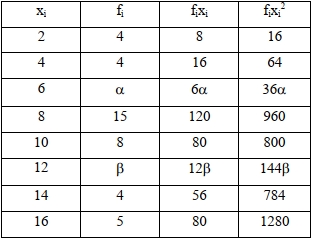
If the mean and variance of the frequency distribution
| $x_i$ |
$2$ |
$4$ |
$6$ |
$8$ |
$10$ |
$12$ |
$14$ |
$16$ |
| $f_i$ |
$4$ |
$4$ |
$\alpha$ |
$15$ |
$8$ |
$\beta$ |
$4$ |
$5$ |
are $9$ and $15.08$ respectively, then the value of $\alpha^2+\beta^2-\alpha \beta$ is $............$.
Answerc
$N=\sum f_i=40+\alpha+\beta$
$\sum f_i x_i=360+6 \alpha+12 \beta$
$\sum f _{ i } x _{ i }^2=3904+36 \alpha+144 \beta$
$\operatorname{Mean}(\overline{ x })=\frac{\sum f _{ i } x _{ i }}{\sum f _{ i }}=9$
$\Rightarrow 360+6 \alpha+12 \beta=9(40+\alpha+\beta)$
$3 \alpha=3 \beta \Rightarrow \alpha=\beta$
$\sigma^2=\frac{\sum f _{ i } x _1^2}{\sum f _{ i }}-\left(\frac{\sum f _{ i } x _{ i }}{\sum f _{ i }}\right)^2$
$\Rightarrow \frac{3904+36 \alpha+144 \beta}{40+\alpha+\beta}-(\overline{ x })^2=15.08$
$\Rightarrow \frac{3904+180 \alpha}{40+2 \alpha}-(9)^2=15.08$
$\Rightarrow \alpha=5$
Now, $\alpha^2+\beta^2-\alpha \beta=\alpha^2=25$
View full question & answer→MCQ 791 Mark
Let the mean and variance of $8$ numbers $x , y , 10$, $12,6,12,4,8$, be $9$ and $9.25$ respectively. If $x > y$, then $3 x-2 y$ is equal to $...........$.
Answerb
$\frac{x+y+52}{8}=9 \Rightarrow x+y=20$
For variance
$x-9, y-9,3,3,1,-5,-1,-3$
$\bar{x}=0$
$\therefore \frac{(x-9)^2+(y-9)^2+54}{8}-0^2=9.25$
$(x-9)^2+(11-x)^2=20$
$x=7 \text { or } 13 \therefore y=13,7$
$3 x-2 y=3 \times 13-2 \times 7=25$
View full question & answer→MCQ 801 Mark
Let the mean and variance of $12$ observations be $\frac{9}{2}$ and $4$ respectively. Later on, it was observed that two observations were considered as $9$ and $10$ instead of $7$ and $14$ respectively. If the correct variance is $\frac{m}{n}$, where $m$ and $n$ are co-prime, then $m + n$ is equal to
Answerc
$\frac{\sum x }{12}=\frac{9}{2}$
$\sum x =54$
$\frac{\Sigma x ^2}{12}-\left(\frac{9}{2}\right)^2=4$
$\sum x ^2=291$
$\sum x _{\text {new }}=54-(9+10)+7+14=56$
$\sum x _{\text {new }}^2=291-(81+100)+49+196=355$
$\sigma_{\text {new }}^2=\frac{355}{12}-\left(\frac{56}{12}\right)^2$
$\sigma_{\text {new }}^2=\frac{281}{36}=\frac{ m }{ n }$
$m + n =317$
View full question & answer→MCQ 811 Mark
If the mean of the frequency distribution
| Class: |
$0-10$ |
$10-20$ |
$20-30$ |
$30-40$ |
$40-50$ |
| Frequency |
$2$ |
$3$ |
$x$ |
$5$ |
$4$ |
is $28$ , then its variance is $........$.
Answerd
Given mean is $=28$
$\frac{2 \times 5+3 \times 15+x \times 25+5 \times 35+4 \times 45}{14+x}=28$
$x =6$
$\text { Variance }=\left(\frac{\sum x_i^2 f_i}{\sum f_i}\right)-(\text { mean })^2$
$\text { Variance }==\frac{2 \times 5^2+3 \times 15^2+6 \times 25^2+5 \times 35^2+4 \times 45^2}{20}-(28)^2$
$=151$
View full question & answer→MCQ 821 Mark
Let $\mu$ be the mean and $\sigma$ be the standard deviation of the distribution
| $X_i$ |
$0$ |
$1$ |
$2$ |
$3$ |
$4$ |
$5$ |
| $f_i$ |
$k+2$ |
$2k$ |
$K^{2}-1$ |
$K^{2}-1$ |
$K^{2}-1$ |
$k-3$ |
where $\sum f_i=62$. if $[x]$ denotes the greatest integer $\leq x$, then $\left[\mu^2+\sigma^2\right]$ is equal $.........$.
Answera
$\sum f _{ i }=62$
$3 k ^2+16 k -12 k -64=0$
$k =\text { or }-\frac{16}{3}(\text { rejected) }$
$\mu=\frac{\sum f _{ i } x _{ i }}{\sum f _{ i }}$
$\mu=\frac{8+2(15)+3(15)+4(17)+5}{62}=\frac{156}{62}$
$\sigma^2=\sum f _{ i } x _{ i }^2-\left(\sum f _{ i } x _{ i }\right)^2$
$=\frac{8 \times 1^2+15 \times 13+17 \times 16+25}{62}-\left(\frac{156}{62}\right)^2$
$\sigma^2=\frac{500}{62}-\left(\frac{156}{62}\right)^2$
$\sigma^2+\mu^2=\frac{500}{62}$
${\left[\sigma^2+\mu^2\right]=8}$
View full question & answer→MCQ 831 Mark
Let sets $A$ and $B$ have $5$ elements each. Let the mean of the elements in sets $A$ and $B$ be $5$ and $8$ respectively and the variance of the elements in sets $A$ and $B$ be $12$ and $20$ respectively $A$ new set $C$ of $10$ elements is formed by subtracting $3$ from each element of $A$ and adding 2 to each element of B. Then the sum of the mean and variance of the elements of $C$ is $.......$.
Answerb
$\omega A=\left\{a_1, a_2, a_3, a_4, a_5\right\}$
$B=\left\{b_1, b_2, b_3, b_4, b_5\right\}$
$\text { Given, } \sum_{ i =1}^3 ai =25, \sum_{ i =1}^3 bi =40$
$\frac{\sum_{ i =1}^5 a _{ i }^2}{5}-\left(\frac{\sum_{ i =1}^5 a _{ i }}{5}\right)^2=12, \frac{\sum_{ i =1}^5 b _{ i }^2}{5}-\left(\frac{\sum_{ i =1}^5 b _{ i }}{5}\right)^2=20$
$\sum_{ i =1}^5 a _{ i }^2=185 \quad, \quad \sum_{ i =1}^5 b _{ i }^2=420$
$\text { Now, } C =\left\{ C _1, C _2, \ldots . C _{10}\right\}$
$\text { s.f. } C_i=a_i=3 \text { or } b_i+2$
$\therefore \text { Mean of } C , \overline{ C }=\frac{\left(\sum a _{ i }-15\right)+\left(\sum b _{ i }+10\right)}{10}$
$\overline{ C }=\frac{10+50}{10}=6$
$\therefore \quad \sigma^2=\frac{\sum \limits_{ i =1}^{10} C _{ i }^2}{10}=(\overline{ C })^2$
$=\frac{\sum\left( a _{ i }-3\right)^2+\sum\left( b _{ i }+2\right)^2}{10}-(6)^2$
$=\frac{\sum a _{ i }{ }^2+\sum b _{ i }{ }^2-6 \sum a _{ i }+4 \sum b _{ i }+65}{10}-36$
$=\frac{185+420-150+160+65}{10}-36$
$=32$
$\therefore \quad$ Mean + Variance $=\overline{ C }+\sigma^2=6+32=38$
View full question & answer→MCQ 841 Mark
Let the mean of the data
| $X$ |
$1$ |
$3$ |
$5$ |
$7$ |
$9$ |
| $(f)$ |
$4$ |
$24$ |
$28$ |
$\alpha$ |
$8$ |
be $5.$ If $m$ and $\sigma^2$ are respectively the mean deviation about the mean and the variance of the data, then $\frac{3 \alpha}{m+\sigma^2}$ is equal to $..........$.
Answerc
$5=\bar{x}=\frac{\sum x_i f_i}{\sum f_i}=\frac{4+72+140+7 \alpha+72}{64+\alpha}$
$\Rightarrow 320+5 \alpha=288+7 \alpha \Rightarrow 2 \alpha=32 \Rightarrow \alpha=16$
$\text { M.. }(\bar{x})=\frac{\sum f _{ i }\left| x _{ i }-\overline{ x }\right|}{\sum f _{ i }} \text { where } \sum f _{ i }=64+16=80$
$\text { M.D. }(\bar{x})=\frac{4 \times 4+24 \times 2+28 \times 0+16 \times 2+8 \times 4}{80}$
$=\frac{8}{5}$
$\text { Variance }=\frac{\sum f _{ i }\left( x _{ i }-\overline{ x }\right)^2}{\sum f _{ i }}$
$=\frac{4 \times 16+24 \times 4+0+16 \times 4+8 \times 16}{80}=\frac{352}{80}$
$\therefore \frac{3 \alpha}{m+\sigma^2}=\frac{3 \times 16}{\frac{128}{80}+\frac{352}{80}}=8$
View full question & answer→MCQ 851 Mark
The mean and standard deviation of the marks of $10$ students were found to be $50$ and $12$ respectively. Later, it was observed that two marks $20$ and $25$ were wrongly read as $45$ and $50$ respectively. Then the correct variance is $............$.
Answerb
Sol. $\bar{x}=50$
$\sum x_i=500$
$\sum x_{i \text { correct }}=500+20+25-45-50=450$
$\sigma^2=144$
$\frac{\sum x_i^2}{10}-(50)^2=144$
$\sum x_{i c o r r e c t}^2=\left(144+(50)^2\right) \times 10-(45)^2-(50)^2+(20)^2+(25)^2$
$22940$
Correct variance $=\frac{\sum\left(x_{\text {icorrect }}\right)^2}{10}-\left(\frac{\sum x_{\text {icorrect }}}{10}\right)^2$
$=2294-(45)^2$
$=2294-2025=269$
View full question & answer→MCQ 861 Mark
The mean and standard deviation of $10$ observations are $20$ and $84$ respectively. Later on, it was observed that one observation was recorded as $50$ instead of $40$. Then the correct variance is:
Answerb
$\mu=20, \sigma=8$
$\mu_{\text {Corrected }}=\frac{200-50+40}{10}=19$
$\sigma^2=\frac{1}{10} \sum x_i^2-20^2$
$(64+400) 10=\sum x_i^2$
$\sigma_{\text {Corrected }}^2=\frac{1}{10}[(64+400) 10-2500+1600]-19^2$
$=374-361$
$=13$
View full question & answer→MCQ 871 Mark
The mean and variance of a set of $15$ numbers are $12$ and $14$ respectively. The mean and variance of another set of $15$ numbers are $14$ and $\sigma^2$ respectively. If the variance of all the $30$ numbers in the two sets is $13$,then $\sigma^2$ is equal to $.........$.
Answerd
$\text { Combine var. }=\frac{ n _1 \sigma^2+ n _2 \sigma^2}{ n _1+ n _2}+\frac{ n _1 n _2\left( m _1- m _2\right)^2}{\left( n _1+ n _2\right)^2}$
$13=\frac{15.14+15 \cdot \sigma^2}{30}+\frac{15.15(12-14)^2}{30 \times 30}$
$13=\frac{14+\sigma^2}{2}+\frac{4}{4}$
$\sigma^2=10$
View full question & answer→MCQ 881 Mark
The mean and standard deviation of $50$ observations are $15$ and $2$ respectively. It was found that one incorrect observation was taken such that the sum of correct and incorrect observations is $70$ . If the correct mean is $16$ , then the correct variance is equal to
Answerc
No. of observations: - $50$
mean $(\bar{x})=15$
Standard deviation $(\sigma)=2$
Let incorrect observation is $x_{1}$ and correct observation is $\left( x _{1}^{\prime}\right)$
Given $x_{1}+x_{1}^{\prime}=70$
$\bar{x}=\frac{x_{1}+x_{2}+\ldots+x_{\text {s0 }}}{50}=15(\text { given })$
$\Rightarrow x_{1}+x_{2}+\ldots . x_{50}=750$ $\ldots(i)$
Now
Mean of correct observation is $16$
$\frac{x_{1}^{\prime}+x_{2}+\ldots+x_{50}}{50}=16$
$x_{1}^{\prime}+x_{2}+x_{3}+\ldots x_{s 0}=16 \times 50$ $\ldots(ii)$
eq. $(ii)$ - eq. $(i)$
$\Rightarrow x_{1}^{\prime}-x_{1}=16 \times 50-15 \times 50$
$x_{1}^{\prime}-x_{1}=50 and x_{1}+x_{1}^{\prime}=70$
$x_{1}^{\prime}=60$
$x_{1}=10$
$\Rightarrow 4=\frac{x_{1}^{2}+x_{2}^{2}+\ldots .+x_{50}^{2}}{50}-15^{2}$ $\ldots(iii)$
$\Rightarrow \sigma^{2}=\frac{x_{1}^{\prime 2}+x_{2}^{2}+\ldots . x_{50}^{2}}{50}-16^{2}$ $\ldots(iv)$
from $(iii)$
$\Rightarrow 4=\frac{(10)^{2}}{50}+\frac{x_{2}^{2}+x_{3}^{2}+\ldots .+x_{50}^{2}}{50}-225$
$\Rightarrow 4=2-225+\frac{\left(x_{2}^{2}+x_{3}^{2}+\ldots .+x_{90}^{2}\right)}{50}$
$\Rightarrow 227=\frac{\left(x_{2}^{2}+x_{3}^{2}+\ldots x_{50}^{2}\right)}{50}$
$\text { From }( iv )$
$\sigma^{2}=\frac{(60)^{2}}{50}+\left(\frac{x_{2}^{2}+x_{3}^{2}+\ldots+x_{90}^{2}}{50}\right)-(16)^{2}$
$\sigma^{2}=\frac{60 \times 60}{50}+227-256$
$\sigma^{2}=72+227-256$
$\sigma^{2}=43$
View full question & answer→MCQ 891 Mark
If the mean deviation about the mean of the numbers $1,2,3, \ldots ., n$, where $n$ is odd, is $\frac{5(n+1)}{n}$, then $n$ is equal to
Answerd
Mean deviation about mean of first $n$ natural numbers is $\frac{ n ^{2}-1}{4 n }$
$\therefore n =21$
View full question & answer→MCQ 901 Mark
Suppose a class has $7$ students. The average marks of these students in the mathematics examination is $62$, and their variance is $20$ . A student fails in the examination if $he/she$ gets less than $50$ marks, then in worst case, the number of students can fail is
Answerd
$20=\frac{\sum\limits_{ i =1}^{7}\left| x _{ i }-62\right|^{2}}{7}$
$\Rightarrow\left| x _{1}-62\right|^{2}+\left| x _{2}-62\right|^{2}+\ldots .+\left| x _{7}-62\right|^{2}=140$
$If$ $x _{1}=49$
$|49-62|^{2}=169$
then, $\left| x _{2}-62\right|^{2}+\ldots .+\left| x _{7}-62\right|^{2}=$ Negative Number which is not possible, therefore, no student can fail.
View full question & answer→MCQ 911 Mark
The mean and standard deviation of $15$ observations are found to be $8$ and $3$ respectively. On rechecking it was found that, in the observations, $20$ was misread as $5$ . Then, the correct variance is equal to......
Answerd
We have
$\text { Variance }=\frac{\sum\limits_{ r =1}^{15} x _{ r }^{2}}{15}-\left(\frac{\sum\limits_{ r =1}^{15} x _{ r }}{15}\right)^{2}$
Now, as per information given in equation
$\frac{\sum x _{ r }^{2}}{15}-8^{2}=3^{2} \Rightarrow \sum x _{ T }^{2}=\log 5$
Now, the new $\sum x _{ r }^{2}=\log 5-5^{2}+20^{2}=1470$
And, new $\sum x _{ r }=(15 \times 8)-5+(20)=135$
Variance $=\frac{1470}{15}-\left(\frac{135}{15}\right)^{2}=98-81=17$
View full question & answer→MCQ 921 Mark
The number of values of $a \in N$ such that the variance of $3,7,12 a, 43-a$ is a natural number is (Mean $=13$)
Answera
Mean $=13$
Variance $=\frac{9+49+144+ a ^{2}+(43- a )^{2}}{5}-13^{2} \in N$
$\Rightarrow \frac{2 a^{2}-a+1}{5} \in N$
$\Rightarrow 2 a^{2}-a+1-5 n=0$ must have solution as natural numbers
its $D=40 n-7$ always has $3$ at unit place
$\Rightarrow D$ can't be perfect square
So, a can't be integer.
View full question & answer→MCQ 931 Mark
If the mean deviation about median for the number $3,5,7,2\,k , 12,16,21,24$ arranged in the ascending order, is $6$ then the median is
Answerd
Median $=\frac{2 k+12}{2}=k+6$
Mean deviation $=\sum \frac{\left|x_{i}-M\right|}{n}=6$
$(k+3)+(k+1)+(k-1)+(6-k)+(6-k)$
$\frac{+(10-k)+(15-k)+(18-k)}{8}$
$\therefore \quad \frac{58-2 k}{8}=6$
$k=5$
Median $=\frac{2 \times 5+12}{2}=11$
View full question & answer→MCQ 941 Mark
The mean and variance of $10$ observations were calculated as $15$ and $15$ respectively by a student who took by mistake $25$ instead of $15$ for one observation. Then, the correct standard deviation is$.....$
Answerc
$n =10, \bar{x}=\frac{\sum x_{i}}{10}=15$
$6^{2}=\frac{\sum x_{i}^{2}}{10}-(\bar{x})^{2}=15$
$\sum_{i=1}^{10} x_{i}=150$
$\sum_{i=1}^{9} x_{i}+25=150$
$\sum_{i=1}^{9} x_{i}=125$
$\sum_{i=1}^{9} x_{i}+15=140$
Actual mean $=\frac{140}{10}=14=\bar{x}_{\text {nev }}$
$\sum_{i=1}^{9} \frac{x_{i}^{2}+25^{2}-15^{2}}{10}=15$
$\sum_{i=1}^{9} x_{i}^{2}+625=2400$
$\sum_{i=1}^{9} x_{i}^{2}=1775$
$\sum_{i=1}^{9} x_{i}^{2}+15^{2}=2000=\left(\sum x_{i}^{2}\right)_{\text {acnaal }}$
$6_{\text {actual }}^{2}=\frac{\left(\sum x_{i}^{2}\right)_{\text {actual }}-\left(\bar{x}_{\text {new }}\right)^{2}}{10}$
$=\frac{2000}{10}-14^{2}$
$=200-196=4$
$(\text { S.D })_{\text {attul }}=6=2$
View full question & answer→MCQ 951 Mark
The mean and variance of the data $4, 5,6,6,7,8, x$, $y$ where $x < y$ are $6$ , and $\frac{9}{4}$ respectively. Then $x^{4}+y^{2}$ is equal to
Answerb
mean $\bar{x}=\frac{4+5+6+6+7+8+x+y}{8}=6$
$\Rightarrow x+y=48-36=12$
Variance
$=\frac{1}{8}\left(16+25+36+36+49+64+x^{2}+y^{2}\right)-36=\frac{9}{4}$
$\Rightarrow x^{2}+y^{2}=80$
$\therefore x=4 ; y=8$
$x^{4}+y^{2}=256+64=320$
View full question & answer→MCQ 961 Mark
The mean of the numbers $a, b, 8,5,10$ is $6$ and their variance is $6.8$. If $M$ is the mean deviation of the numbers about the mean, then $25\; M$ is equal to
Answera
$\sigma^{2}=\frac{\sum\limits_{i=1}^{5}\left(x_{i}-\bar{x}\right)^{2}}{n}$
Mean $=6$
$\frac{a+b+8+5+10}{5}=6$
$a+b=7$
$b=7-a$
$6.8=\frac{(a-6)^{2}+(b-6)^{2}+(8-6)^{2}+(5-6)^{2}+(10-6)^{2}}{5}$
$34=(a-6)^{2}+(7-a-6)^{2}+4+1+18$
$a^{2}-7 a+12=0 \Rightarrow a=4$ or $a=3$
$a=4 \quad a=3$
$b=3 \quad b=4$
$M=\frac{\sum\limits_{i=1}^{5}\left|x_{i}-x\right|}{n}$
$M=\frac{|a-6|+|b-6|+|8-6|+|5-6|+|10-6|}{5}$
when $a =3, b =4 \quad$
$M =\frac{3+2+2+1+4}{5}$
$M =\frac{12}{5}$
when $a =4, b =3$
$ M =\frac{2+3+2+1+7}{5}$
$M =\frac{12}{5}$
$25\;M =25 \times \frac{12}{5}=60$
View full question & answer→MCQ 971 Mark
Let the mean and the variance of $5$ observations $x_{1}, x_{2}, x_{3}, x_{4}, x_{5}$ be $\frac{24}{5}$ and $\frac{194}{25}$ respectively. If the mean and variance of the first $4$ observation are $\frac{7}{2}$ and $a$ respectively, then $\left(4 a+x_{5}\right)$ is equal to
Answerb
$\bar{x}=\frac{\sum x_{i}}{5}=\frac{24}{5} \Rightarrow \sum x_{i}=24$
$\sigma^{2}=\frac{\sum x_{i}^{2}}{5}-\left(\frac{24}{5}\right)^{2}=\frac{194}{25}$
$\Rightarrow \sum x_{i}^{2}=154$
$x_{1}+x_{2}+x_{3}+x_{4}=14$
$\Rightarrow x_{5}=10$
$\sigma^{2}=\frac{x_{1}^{2}+x_{2}^{2}+x_{3}^{2}+x_{4}^{2}}{4}-\frac{49}{4}=a$
$x_{1}^{2}+x_{2}^{2}+x_{3}^{2}+x_{4}^{2}=4 a+49$
$x_{5}^{2}=154-4 a-49$
$\Rightarrow 100=105-4 a \Rightarrow 4 a=5$
$4 a+x_{5}=15$
View full question & answer→MCQ 981 Mark
The mean and standard deviation of $40$ observations are $30$ and $5$ respectively. It was noticed that two of these observations $12$ and $10$ were wrongly recorded. If $\sigma$ is the standard deviation of the data after omitting the two wrong observations from the data, then $38 \sigma^{2}$ is equal to$.........$
Answera
Wrong mean $=\mu_{1}=30$
Wrong $S.D$ $=\sigma_{1}=5$
$\frac{\sum x _{ i }}{40}=30$
$\sum x _{ i }=1200$
$\sigma_{1}^{2}=25$
$\frac{\sum x _{ i }^{2}}{40}-30^{2}=25$
$\sum x _{ i }^{2}=925 \times 40=37000$
New sum $=\sum x _{ i }^{\prime}=1200-10-12=1178$
New mean $=\mu_{1}^{\prime}=\frac{1178}{38}=31$
New $\sum x _{ i }^{2}=37000-(10)^{2}-(12)^{2}=36756$
New $S.D$, $\sigma_{1}^{\prime}=\sqrt{\frac{36756}{38}-(31)^{2}}=\sigma$
$36756-(31)^{2} \times 38=38 \sigma^{2}$
$38 \sigma^{2}=238$
View full question & answer→MCQ 991 Mark
Let the mean and the variance of $20$ observations $x_{1}, x_{2}, \ldots x_{20}$ be $15$ and $9 ,$ respectively. For $\alpha \in R$, if the mean of $\left( x _{1}+\alpha\right)^{2},\left( x _{2}+\alpha\right)^{2}, \ldots,\left( x _{20}+\alpha\right)^{2}$ is $178 ,$ then the square of the maximum value of $\alpha$ is equal to $...........$
Answerd
$\sum x_{1}=15 \times 20=300 \quad \ldots(i)$
$\frac{\sum x_{1}^{2}}{20}-(15)^{2}=9$
$\sum x_{1}^{2}=234 \times 20=4680$
$\frac{\sum\left(x_{1}+\alpha\right)^{2}}{20}=178 \Rightarrow \sum\left(x_{1}+\alpha\right)^{2}=3560$
$\Rightarrow \sum x_{1}^{2}+2 \alpha \sum x_{1}+\sum \alpha^{2}=3560$
$4680+600 \alpha+20 \alpha^{2}=3560$
$\Rightarrow \alpha^{2}+30 \alpha+56=0$
$\Rightarrow(\alpha+28)(\alpha+2)=0$
$\alpha=-2,-28$
Square of maximum value of $\alpha$ is $4$
View full question & answer→MCQ 1001 Mark
The mean of $6$ distinct observations is $6.5$ and their variance is $10.25$. If $4$ out of $6$ observations are $2,4,5$ and $7 ,$ then the remaining two observations are:
- ✓
$10,11$
- B
$8,13$
- C
$1,20$
- D
$3,18$
AnswerCorrect option: A. $10,11$
a
Let other two numbers be $a$, (21-a)
Now,
$10.25=\frac{\left(4+16+25+49+a^{2}+(21-a)^{2}\right)}{6}$
(Using formula for variance)
$\Rightarrow 6(10.25)+6(6.5)^{2}=94+a^{2}+(21-a)^{2}$
$\Rightarrow a 2+\left(21-a^{2}\right)=221$
$\therefore a=10 \text { and }(21-a)=21-10=11$
so, remaining two observations are $10,11 .$
View full question & answer→