MCQ 1011 Mark
How many ways are there to arrange the letters of the word EDUCATION so that all the following three conditions hold?
- the vowels occur in the same order $(EUAIO)$,
- the consonants occur in the same order $(DCTN)$,
- no two consonants are next to each other.
Answera
(a)
Given, $EDUCATION$ Vowel occurs in same order
$\text { _E_U_A_I_O- }$
There are $6$ place for letter $DCTN$ $\therefore$ Total number of arrangement is ${ }^6 C_4=15$
View full question & answer→MCQ 1021 Mark
An urn contains marbles of four colours : red, white, blue and green. When four marbles are drawn without replacement, the following events are equally likely
$1.$ the selection of four red marbles.
$2.$ the selection of one white and three red marbles.
$3.$ the selection of one white, one blue and two red marbles.
$4.$ the selection of one marble of each colour.
The smallest total number of marbles satisfying the given condition is
Answerb
(b)
Let the number of red, white, blue, green balls be $r, w, b, g$ respectively and $r + w + b + g=n$.Given,
$\frac{{ }^r C_4}{{ }^n C_4}=\frac{{ }^w C_1 \times{ }^{\prime} C_4}{{ }^n C_4}$
$=\frac{{ }^w C_1 \times{ }^b C_1 \times{ }^r C_2}{{ }^n C_4}$
$=\frac{{ }^r C_1 \times{ }^{\infty} C_1 \times{ }^b C_1 \times{ }^5 C_1}{{ }^n C_4}$
$\Rightarrow \quad{ }^r C_4={ }^r C_3 \cdot{ }^w C_1$
$\Rightarrow \quad r-3=4 w \Rightarrow r=4 w+3$
${ }^r C_{ d }{ }^w C_1={ }^w C_1{ }^b C_1{ }^r C_2 \Rightarrow r=3 b+2$
${ }^r C_2{ }^w C_1^b C_1={ }^r C_1^w C_1^b C_1 C_1$
$\Rightarrow \quad r=2 g+1$
Now, LCM of $(4,3,2)=12$
$\therefore r_{\min }=11 \Rightarrow w_{\min }=2$
$\Rightarrow b_{\min }=3 \Rightarrow g_{\min }=5$
$\therefore$ Minimum number of ball
$=r + w + b + g=11+2+3+5=21$
View full question & answer→MCQ 1031 Mark
The largest non-negative integer $k$ such that $24^k$ divides $13\,!$ is
Answerb
(b)
$13 !=2 \times 3 \times 4 \times 5 \times 6 \times 7\times 8 \times 9 \times 10 \times 11 \times 12 \times 13$
$=2^{10} \times 3^5 \times 5^2 \times 7 \times 11 \times 13$
$24^k=\left(2^3 \times 3\right)^k$
When $13\,!$ is divide by $24^k$
$\therefore 2^{10} \times 3^5 \times 5^2 \times 7 \times 11 \times 13$
$\quad 2^{3 k} \cdot 3^k$
$\quad=2^{10-3 k} \cdot 3^{5-k} \cdot 5^2 \times 7 \times 11 \times 13$
$\therefore \quad 10-3 k=\text { integer }$
Then, maximum value of $k=3$
View full question & answer→MCQ 1041 Mark
Let $S=\{(a, b) a, b \in Z, 0 \leq a, b \leq 18\} .$ The number of lines in $R^2$ passing through $(0,0)$ and exactly one other point in $S$ is
Answera
(a)
We have,
$S=\{(a, b): a, b \in Z, 0 \leq a, b \leq 18\}$
Number of line in $R^2$ passing through $(0,0)$ and one other point in $S$ is $34 .$
$(1,17),(2,17),(3,17), \ldots,(18,17)=17$ points
$(17,1),(17,2),(17,3), \ldots,(17,18)=17$ points
$\therefore$ Total number of lines $=34$
View full question & answer→MCQ 1051 Mark
Let $X$ be set of $5$ elements. The number $d$ of ordered pairs $(A, B)$ of subsets of $X$ such that $A \neq \phi, B \neq \phi, A \cap B \neq \phi$ satisfies
- A
$50 \leq d \leq 100$
- B
$101 \leq d \leq 150$
- ✓
$151 \leq d \leq 200$
- D
$201 \leq d$
AnswerCorrect option: C. $151 \leq d \leq 200$
c
(c)
We have,
$(A, B)$ is subset of $X$, where $X$ has 5 elements $A \neq \phi, B \neq \phi, A \cap B=\phi$
The order pairs if $(A, B)$ is
${ }^5 C_2 \times 2 !+{ }^5 C_3\left({ }^3 C_2 \times 2 !\right)+{ }^5 C_4\left({ }^4 C_3 \times 2\right.$
$\left.+{ }^4 C_2\right)+{ }^5 C_5\left({ }^5 C_4 \times 2 !+{ }^5 C_3 \times 2 !\right)$
$=20+60+70+30=180$
$\therefore 151 \leq d \leq 200$
Hence, option $(c)$ is correct.
View full question & answer→MCQ 1061 Mark
For each positive integer $n$, let $A_n=\max \left\{\left(\begin{array}{l}n \\ r\end{array}\right) \mid 0 \leq r \leq n\right\}$. Then, the number of elements $n$ is $\{1,2, \ldots, 20\}$ for which $1.9 \leq \frac{A_n}{A_{n-1}} \leq 2$ is
Answerc
(c)
We have,
$A_n =\max \left\{{ }^n C_r \mid 0 \leq r \leq n\right\}$
$n \in\{1,2,3, \ldots, 20\}$
Case $I$ When $n$ is even
$A_n={ }^n C_{n / 2}$
$\therefore \quad \frac{A_n}{A_{n-1}}=\frac{{ }^n C_{n ' 2}}{{ }^{n-1} C_{\frac{n-1-1}{}}^2}=2$
So for all $n$ even given relation is true.
Case II When $n$ is odd
$A_n={ }^n C_{\frac{n-1}{}}^2$
$\therefore \quad \frac{A_n}{A_{n-1}} =\frac{{ }^n C_{n-1}}{{ }^{n-1} C_{n-1}}=\frac{2 n}{n+1}$
$19 \leq \frac{2 n}{n+1} \leq n \text { if } n=19$
$\therefore$ Total number of elements are 10 even number and $19=10+1=11$
View full question & answer→MCQ 1071 Mark
Let $S=\{(a, b): a, b, \in Z, 0 \leq a, b \leq 18\}$. The number of elements $(x, y)$ in $S$ such that $3 x+4 y+5$ is divisible by $19$ , is
Answerb
(b)
We have,
$S=\{(a, b): a, b, \in Z, 0 \leq a, b \leq 18\}$
$3 x+4 y+5(x, y) \in S$
$S \leq 3 x+4 y+5 \leq 131$
$[\because \min (x, y)=(0,0), \max (x, y)=(15,18)]$
Given, $3 x+4 y+5$ is divisible by 19
$\therefore 3 x+4 y+5=19,38,57,76,95,114$
Case $I$
$\begin{array}{r}3 x+4 y+5=19 \\3 x+4 y=14\end{array}$
Only $(2,2)$ satisfies
Case $II$
$\begin{array}{r}3 x+4 y+5=38 \\3 x+4 y=33\end{array}$
Possible values of $(x, y)$ is $(3,6),(7,3)$, $(11,0)$
Case $III$
$\begin{array}{r}3 x+4 y+5=57 \\3 x+4 y=52\end{array}$
Possible values of $(x, y)$ is $(0,13),(4,10)$, $(8,7),(12,4),(16,1)$
Case $IV$
$3 x+4 y+5=76$
Possible values of $(x, y)$ is $(1,17),(5,14)$,
$(9,11),(13,8),(17,5)$
Case $V$
$3 x+4 y+5=95$
Possible values of $(x, y)$ is
$(6,18),(10,15),(14,12),(18,9)$
Case $VI$
$\begin{aligned}3 x+4 y+5 &=114 \$x, y) &=(15,15)\end{aligned}$
$\therefore$ Total solution $=19$
View full question & answer→MCQ 1081 Mark
The number of $6-$digit numbers of the form $a b a b a b$ (in base $10$) each of which is a product of exactly $6$ distinct primes is
Answerc
(c)
We have,
$6-$digits number are $a b a b a b$.
$\because a b a b a b=10^5 a+10^4 b+10^3 a+10^2 b+10a+b$
$=\left(10^5+10^3+10\right) a+\left(10^4+10^2+1\right) b$
$=\left(10^4+10^2+1\right)(10 a+b)$
$=(10000+100+1)(10 a+b)$
$=(10101)(10 a+b)$
$=3 \times 7 \times 13 \times 37(10 a+b)$
Since, $6-$digit number are product of exactly $6$ primes.
$\because 10 a+b$ is product of $2$ primes,
$10 a+b$ is lie between $10$ to $99$
$10 a+b=10=2 \times 5$
$22=2 \times 11$
$34=2 \times 17$
$38=2 \times 19$
$46=2 \times 23$
$55=5 \times 11$
$58=2 \times 29$
$62=2 \times 31$
$74=2 \times 37$
$82=2 \times 41$
$85=5 \times 17$
$94=2 \times 47$
$95=5 \times 19$
$\because 13,6$-digits number.
View full question & answer→MCQ 1091 Mark
Suppose $a_2, a_3, a_4, a_5, a_6, a_7$ are integers such that $\frac{5}{7}=\frac{a_2}{2 !}+\frac{a_3}{3 !}+\frac{a_4}{4 !}+\frac{a_5}{5 !}+\frac{a_6}{6 !}+\frac{a_7}{7 !}$
where $0 \leq a_j < j$ for $j=2,3,4,5,6,7$. The sum of $a_2+a_3+a_4+a_5+a_6+a_7$ is
Answerb
(b)
We have, $a_2, a_3, a_4, a_5, a_6, a_7$ are integers.
$\frac{5}{7}=\frac{a_2}{2 !}+\frac{a_3}{3 !}+\frac{a_4}{4 !}+\frac{a_5}{5 !}+\frac{a_6}{6 !}+\frac{a_7}{7 !}$
and $0 \leq a_j < j$
$5=\frac{2520 a_2+840 a_3+210 a_4+42 a_5+7 a_6+a_7}{7 !}$
$\Rightarrow 3600=2520 a_2+840 a_3+210 a_4 +42 a_5+7 a_6+a_7$
$0 \leq a_j < j a_2 =1 a_3 \in\{1,2\}$
If $a_3=2$, then $2520+(840) \times 2 > 3600$
$\because a_3$ must be $1$
$a_4 \in\{1,2,3\}$
If $a_4=2$, then $2520+840+210(2) > 3600$ $\because a_4$ must be $1$
$\because \quad 3600=2520+840+210+42 a_5+7a_6+a_7$
$30=42 a_5+7 a_6+a_7$
$a_5 \in\{1,2,3,4\}$
$if\,\,a_5=1$
$30 < 42+7 a_6+a_7$
$a_5=0$
Put $a_5=0$, then $30=7 a_6+a_7$ $\because a_6=4$ and $a_7=2$
$\because a_2+a_3+a_4+a_5+a_6+a_7=1+1+1+0+4+2=9$
View full question & answer→MCQ 1101 Mark
The number of all $3-$digit numbers $a b c$ (in base $10$ ) for which $(a \times b \times c)+(a \times b)+$ $(b \times c)+(c \times a)+a+b+c=29$ is
Answerd
(d)
abcis three-digits number $a b c=100 a+10 b+c$
$100 \leq a b c<999, a \in\{1,2,3, \ldots, 9\} b, c \in\{0$, $1,2,3, \ldots, 9\}$
Now, $(a \times b \times c)+(a \times b)+(b \times c) +(c \times a)+a+b+c=29$
$(a \times b)(c+1)+b(c+1)+a(c+1) +(c+1)=30$
$\Rightarrow(c+1)(b(a+1)+1(a+1))=30$
$\Rightarrow \quad(a+1))(b+1)(c+1)=30$
$\leq a \leq 9,0 \leq b, c \leq 9$
$\because$ Total number of solution $=18$
View full question & answer→MCQ 1111 Mark
Let $P$ be a closed polygon with $10$ sides and $10$ vertices (assume that the sides do not intersect except at the vertices). Let $k$ be the number of interior angles of $P$ that are greater than $180^{\circ}$. The maximum possible value of $k$ is
Answerc
(c)
We have,
A polygon of $10$ sides.
$\therefore$ Sum of total interior angle of $10$ sided polygon $=(10-2) \times \pi=8 \pi$
Let $k$ be the number of interior angle of $P$ that are greater than $180^{\circ}$.
$\therefore \quad h \times 180^{\circ}$
$\therefore \quad k \pi+x=8 \pi$
$\therefore$ Maximum value of $k$ is $7, x$ is the sum of three angles can be less than $\pi$.
View full question & answer→MCQ 1121 Mark
Ten points lie in a plane so that no three of them are collinear. The number of lines passing through exactly two of these points and dividing the plane into two regions each containing four of the remaining points is
- A
$1$
- ✓
$5$
- C
$10$
- D
dependent on the configuration of points
Answerb
(b)
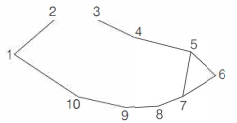
We have $10$ points lie a plane such that no three of them are collinear.
According to question only $5$ ways are
possible i.e. $1-6,2-7,3-8,4-9$ and $5-10$
View full question & answer→MCQ 1131 Mark
In a tournament with five teams, each team plays against every other team exactly once. Each game is won by one of the playing teams and the winning team scores one point, while the losing team scores zero. Which of the following is $NOT$ necessarily true?
- A
There are at least two teams which have at most two points each.
- B
There are at least two teams which have at least two points each.
- C
There are at most three teams which have at least three points each.
- ✓
There are at most four teams which have at most two points each.
AnswerCorrect option: D. There are at most four teams which have at most two points each.
d
(d)
We have,
Five teams in a tournament and each team plays against every team.
$\therefore$ Total number of one team $=4$
Possible number of distribution
| $T_1$ |
$T_2$ |
$T_3$ |
$T_4$ |
$T_5$ |
| $4$ |
$4$ |
$2$ |
$0$ |
$0$ |
| $4$ |
$4$ |
$1$ |
$1$ |
$0$ |
| $4$ |
$3$ |
$2$ |
$1$ |
$0$ |
| $4$ |
$3$ |
$3$ |
$0$ |
$0$ |
| $4$ |
$3$ |
$1$ |
$1$ |
$1$ |
| $4$ |
$2$ |
$2$ |
$2$ |
$0$ |
| $4$ |
$2$ |
$2$ |
$1$ |
$1$ |
| $4$ |
$2$ |
$2$ |
$1$ |
$1$ |
| $3$ |
$3$ |
$2$ |
$1$ |
$1$ |
| $3$ |
$2$ |
$2$ |
$2$ |
$1$ |
| $3$ |
$3$ |
$3$ |
$1$ |
$0$ |
| $3$ |
$3$ |
$2$ |
$2$ |
$0$ |
| $2$ |
$2$ |
$2$ |
$2$ |
$2$ |
View full question & answer→MCQ 1141 Mark
The number of integers $n$ with $100 \leq n \leq 999$ and containing at most two distinct digits is
Answera
(a)
We have,
Integer $n$ with $100 \leq n \leq 999$
$n=999-99=900$
$n$ containing three distinct digits are $9 \times 9 \times 8=648$
$n$ containing at most two distinct digit is
Total number $-n$ containing three
distinct digits $=900-648=252$
View full question & answer→MCQ 1151 Mark
Three children, each accompanied by a guardian, seek admission in a school. The principal wants to interview all the $6$ persons one after the other subject to the condition that no child is interviewed before its guardian. In how many ways can this be done?
Answerb
(b)
We have,
Three children with their guardians
$\therefore$ Total number of persons $=6$
Total number of ways when principal want to interview all the 6 persons such that no child interviewed before their guardians is $\frac{6 !}{2 ! 2 ! 2 !}=\frac{720}{8}=90$ ways
View full question & answer→MCQ 1161 Mark
How many ordered pairs of $(m, n)$ integers satisfy $\frac{m}{12}=\frac{12}{n} ?$
Answera
(a)
We have,
$\frac{m}{12} =\frac{12}{n}$
$m n =144$
$m n =2^4 \times 3^2$
Total number of divisor of $144$ is $(4+1)(2+1)=15$
When $m$ and $n$ are positive integers.
If $m$ and $n$ are negative integers, then also number of divisor is $15 .$
$\therefore$ Total ordered pairs of $(m, n)$ when $m$ and $n$ are integers $=15+15=30$
View full question & answer→MCQ 1171 Mark
There are $30$ questions in a multiple-choice test.$A$ student gets $1$ mark for each unattempted question, $0$ mark for each wrong answer and $4$ marks for each correct answer. A student answered $x$ questions correctly and scored $60$.Then, the number of possible value of $x$ is
Answerc
(c)
Let the student answered correct $=x$
Student answer wrong $=y$
Student unattempted $=z$
According to the question,
$x+y+z=30$, and $4 x+z=60$
$x=15, y=15, z=0$
$x=14, y=12, z=4$
$x=13, y=9, z=8$
$x=12, y=6, z=12$
$x=11, y=3, z=16$
$x=10, y=0, z=20$
Total number of cases $=6$
View full question & answer→MCQ 1181 Mark
A certain $12-$hour digital clock displays the hour and the minute of a day. Due to a defect in the clock whenever the digit $1$ is supposed to be displayed it displays $7$. What fraction of the day will the clock show the correct time?
- ✓
$\frac{1}{2}$
- B
$\frac{5}{8}$
- C
$\frac{3}{4}$
- D
$\frac{5}{6}$
AnswerCorrect option: A. $\frac{1}{2}$
a
(a)
Digit $1$ appears in $1,10,11$, and $12$ in hour.
$\therefore$ The clock will show the incorrect time between $1-2,10-11,11-12,12-1$ day and night both incorrect time $(8 \times 60)=480\,min$
Digit $1$ appear in minutes $1,10,11,12$,
$13,14,15,16,17,18,19,21,31,41,51$
$=15\,min$
$\therefore$ It will shows the incorrect time
$=16 \times 15$
$=240\,min$
Total incorrect time $=240+480$
$=720\,min$
Correct time $=24 \times 60-720$
Fraction of correction time
$\frac{=24 \times 60-720}{24 \times 60}$
$=\frac{1}{2}$
View full question & answer→MCQ 1191 Mark
How many six-digit numbers are there in which no digit is repeated, even digits appear at even places, odd digits appear in odd places and the number is divisible by $4$ ?
- A
$3600$
- B
$2700$
- C
$2160$
- ✓
$1440$
AnswerCorrect option: D. $1440$
d
(d)
$6-$digit number are there in which no digits is repeated and even digits appear on even places and odd digits appear in odd place. Such $6$ digit number which is divisible by $4$. If last two digits are divisible by $4$
i.e. $12,16,32,36,52,56,72,76,92,96$
$\therefore$ Last digits appears only $2$ and $6$
$3$ way $3$ ways $4$ ways $4$ way $5$ way $2 / 6$
$Total numbers =3 \times 3 \times 3,5,7,9$
$=1440$
View full question & answer→MCQ 1201 Mark
The number of rectangles that can be obtained by joining four of the twelve vertices of a $12$ -sided regular polygon is
Answerd
(d)
We have,
$12$ -sided regular polygon the diagonal of rectangle are equal.
$\therefore$ Diagonals of rectangle passes through the centre of $12$ -sided regular polygon $=6$
$\therefore$ Number of rectangles $={ }^6 C_2=\frac{6 !}{2 ! 4 !}=15$
View full question & answer→MCQ 1211 Mark
Three players play a total of $9$ games. In each game, one person wins and the other two lose; the winner gets $2$ points and the losers get $-1$ each. The number of ways in which they can play all the $9$ games and finish each with a zero score is
AnswerCorrect option: B. $1680$
b
(b)
Total number of game $=9$
Total number of player $=3$
Total score be zero
If every team wins $3$ games and lose their $6$ games, then final score be zero.
$\therefore$ Total number of ways
${ }^9 C_3 \times{ }^6 C_2 \times{ }^3 C_3$
$\Rightarrow \quad \frac{9 !}{3 ! 6 !} \times \frac{6 !}{3 ! 3 !} \times 1=\frac{9 !}{3 ! 3 ! 3 !}=1680$
View full question & answer→MCQ 1221 Mark
An envelope has space for at most $3$ stamps. If you are given three stamps of denomination $1$ , and three stamps of denomination $a,(a > 1)$, the least positive integer for which there is no stamp value is
Answera
(a)
An envelope has space for at most 3 stamps. Three stamps of denomination is 1 and three stamps of denomination is $a$.
The value of stamps of envelope must be
$1+1+1=3, a+a+a=3 a$
$a+a+1=2 a+1, a+1+1=a+2$
$a > 1, \text { If } a=2$
then maximum value of stamps is
$3 \times 2=6$
$\therefore$ Least positive integer has not stamp value is $7 .$
View full question & answer→MCQ 1231 Mark
The positive integer $k$ for which $\frac{(101)^{k 2}}{k !}$ is a maximum is
Answerb
(b)
We have, $\frac{(101)^{k / 2}}{k !}$
$\sqrt{10} \overline{1} > 10$
$\frac{(\sqrt{101})^9}{9 !}-\frac{(\sqrt{10}) 1)^{10}}{10 !}$
$\frac{(\sqrt{10} 1)^9}{9 !}\left[1-\frac{\sqrt{10} \overline{0}}{10}\right] < 0 \quad\left[\because \frac{\sqrt{101}}{10} > 1\right]$
$\therefore \quad \frac{(\sqrt{10} \overline{1})^9}{9 !} < \frac{(\sqrt{101})^{10}}{10 !}$
$\frac{(\sqrt{101})^{10}}{10 !}-\frac{ \quad(\sqrt{101})^{11}}{11!}$
$=\frac{(\sqrt{10} \overline{0})^{10}}{10 !}\left[1-\frac{\sqrt{10} \overline{1}}{11} > 0\left[\because \frac{\sqrt{101}}{11} < 1\right]\right.$
$\frac{(\sqrt{101})^{10}}{10 !} > \frac{(\sqrt{101})^{11}}{11 !}$
$=\frac{\sqrt{101}}{10 !}$ $\left[1-\frac{(\sqrt{101})^{91}}{11 \times 12 \ldots 101}\right] > 0$
$\therefore$ For $k=10$, Maximum value of $\frac{(101)^{k / 2}}{k !}$
View full question & answer→MCQ 1241 Mark
If $\mathrm{n}$ is the number of ways five different employees can sit into four indistinguishable offices where any office may have any number of persons including zero, then $\mathrm{n}$ is equal to:
Answerc
Total ways to partition $5$into $4$ parts are :
$5,0,0,0 \Rightarrow 1$ Ways
$4,1,0,0 \Rightarrow \frac{5 !}{4 !}=5$
$3,2,0,0, \Rightarrow \frac{5 !}{3 ! 2 !}=10$ ways
$2,2,0,1 \Rightarrow \frac{5 !}{2 ! 2 ! 2 !}=15$ ways
$2,1,1,1 \Rightarrow \frac{5 !}{2 !(1 !)^3 3 !}=10$ ways
$3,1,1,0 \Rightarrow \frac{5 !}{3 ! 2 !}=10$ ways
Total $\Rightarrow 1+5+10+15+10+10=51$ ways
View full question & answer→MCQ 1251 Mark
$60$ words can be made using all the letters of the word $BHBJO,$ with or without meaning. If these words are written as in a dictionary, then the $50^{\text {th }}$ word is :
- A
$OBBHJ$
- B
$HBBJO$
- ✓
$\mathrm{OBBJH}$
- D
$\mathrm{JBBOH}$
AnswerCorrect option: C. $\mathrm{OBBJH}$
c
$\mathrm{B} \mathrm{B} \mathrm{H} \mathrm{J} \mathrm{O}$
$ \mathrm{B} \_4 !=24 $
$ \mathrm{H} \_\frac{4 !}{2 !}=12 $
$ \mathrm{~J} \_\frac{4 !}{2 !}=12$
$O B B H J$
$O B B J H$ $\rightarrow 50^{\text {th }}$ rank
View full question & answer→MCQ 1261 Mark
If all the words with or without meaning made using all the letters of the word $"NAGPUR"$ are arranged as in a dictionary, then the word at $315^{\text {th }}$ position in this arrangement is :
- A
$NRAGUP$
- B
$ NRAGPU$
- ✓
$ NRAPGU$
- D
$NRAPUG$
AnswerCorrect option: C. $ NRAPGU$
c
$NAGPUR$
$A \rightarrow 5 !=120$
$\mathrm{G} \mathbb{\circledR} 5 !=120 \quad 240$
NA $\mathbb{\circledR} 4 !=24 \quad 264$
$\mathrm{NG} \mathbb{\circledR} 4 !=24 \quad 288$
$N P {\circledR} 4 !=24 \quad 312$
$NRAGPU$ $=1 \quad 313$
$NRAGUP $$\quad 314$
$NRAPGU $ $\quad 315$
View full question & answer→MCQ 1271 Mark
The number of $3-$digit numbers, formed using the digits $2,3,4,5$ and $7$ , when the repetition of digits is not allowed, and which are not divisible by $3$ , is equal to ..........
Answerd
$2,3,4,5,7$
total number of three digit numbers not divisible by $3$ will be formed by using the digits
$ (4,5,7) $
$ (3,4,7) $
$ (2,5,7) $
$ (2,4,7) $
$ (2,4,5) $
$ (2,3,5) $
number of ways $=6 \times 3 !=36$
View full question & answer→MCQ 1281 Mark
The number of ways in which $21$ identical apples can be distributed among three children such that each child gets at least $2$ apples, is
Answerd
After giving $2$ apples to each child $15$ apples left now $15$ apples can be distributed in ${ }^{15+3-1} \mathrm{C}_2={ }^{17} \mathrm{C}_2$ ways
$=\frac{17 \times 16}{2}=136$
View full question & answer→MCQ 1291 Mark
The lines $\mathrm{L}_1, \mathrm{~L}_2, \ldots, \mathrm{L}_{20}$ are distinct. For $\mathrm{n}=1,2,3, \ldots, 10$ all the lines $\mathrm{L}_{2 \mathrm{n}-1}$ are parallel to each other and all the lines $L_{2 n}$ pass through a given point $P$. The maximum number of points of intersection of pairs of lines from the set $\left\{\mathrm{L}_1, \mathrm{~L}_2, \ldots, \mathrm{L}_{20}\right\}$ is equal to :
Answerb
$\mathrm{L}_1, \mathrm{~L}_3, \mathrm{~L}_5,--\mathrm{L}_{19}$ are Parallel
$\mathrm{L}_2, \mathrm{~L}_4, \mathrm{~L}_6,--\mathrm{L}_{20}$ are Concurrent
Total points of intersection $={ }^{20} \mathrm{C}_2-{ }^{10} \mathrm{C}_2-{ }^{10} \mathrm{C}_2+1$
$=101$
View full question & answer→MCQ 1301 Mark
There are $5$ points $\mathrm{P}_1, \mathrm{P}_2, \mathrm{P}_3, \mathrm{P}_4, \mathrm{P}_5$ on the side $\mathrm{AB}$, excluding $\mathrm{A}$ and $\mathrm{B}$, of a triangle $\mathrm{ABC}$. Similarly there are $6$ points $\mathrm{P}_6, \mathrm{P}_7, \ldots, \mathrm{P}_{11}$ on the side $\mathrm{BC}$ and $7$ points $\mathrm{P}_{12}, \mathrm{P}_{13}, \ldots, \mathrm{P}_{18}$ on the side $\mathrm{CA}$ of the triangle. The number of triangles, that can be formed using the points $\mathrm{P}_1, \mathrm{P}_2, \ldots, \mathrm{P}_{18}$ as vertices, is :
- A
$776$
- ✓
$751$
- C
$796$
- D
$771$
Answerb
$ { }^{18} \mathrm{C}_3-{ }^5 \mathrm{C}_3-{ }^6 \mathrm{C}_3-{ }^7 \mathrm{C}_3 $
$ =751$
View full question & answer→MCQ 1311 Mark
The number of triangles whose vertices are at the vertices of a regular octagon but none of whose sides is a side of the octagon is
Answerc
$\because$ no. of triangles having no side common with a $\mathrm{n}$ sided polygon $=\frac{{ }^n C_1 \cdot{ }^{n-4} C_2}{3}$
$=\frac{{ }^8 \mathrm{C}_1 \cdot{ }^4 \mathrm{C}_2}{3}=16$
View full question & answer→MCQ 1321 Mark
Let $\alpha=\frac{(4 !) !}{(4 !)^{3 !}}$ and $\beta=\frac{(5 !) !}{(5 !)^{4 !}}$. Then :
- A
$\alpha \in \mathrm{N}$ and $\beta \notin \mathrm{N}$
- B
$\alpha \notin \mathrm{N}$ and $\beta \in \mathrm{N}$
- ✓
$\alpha \in \mathrm{N}$ and $\beta \in \mathrm{N}$
- D
$\alpha \notin \mathrm{N}$ and $\beta \notin \mathrm{N}$
AnswerCorrect option: C. $\alpha \in \mathrm{N}$ and $\beta \in \mathrm{N}$
c
$\alpha=\frac{(4 !) !}{(4 !)^{3 !}}, \beta=\frac{(5 !) !}{(5 !)^{4 !}} $
$ \alpha=\frac{(24) !}{(4 !)^6}, \beta=\frac{(120) !}{(5 !)^{24}}$
Let $24$ distinct objects are divided into $6$ groups of $4$ objects in each group.
No. of ways of formation of group $=\frac{24 !}{(4 !)^6 \cdot 6 !} \in \mathrm{N}$
Similarly,
Let $120$ distinct objects are divided into $24$ groups of $5$ objects in each group.
No. of ways of formation of groups
$=\frac{(120) !}{(5 !)^{24} \cdot 24 !} \in N$
View full question & answer→MCQ 1331 Mark
All the letters of the word $"GTWENTY"$ are written in all possible ways with or without meaning and these words are written as in a dictionary. The serial number of the word $"GTWENTY"$ IS
Answerb
Words starting with $\mathrm{E}=360$
Words starting with $\mathrm{GE}=60$
Words starting with $\mathrm{GN}=60$
Words starting with $GTE$ $=24$
Words starting with $GTN$ $=24$
Words starting with $GTT$ $=24$
GTWENTY $=1$
Total $=553$
View full question & answer→MCQ 1341 Mark
Number of ways of arranging $8$ identical books into $4$ identical shelves where any number of shelves may remain empty is equal to
Answerd
$3$ Shelf empty $:(8,0,0,0) \rightarrow 1$ way
$2$ shelf empty : $\left.\begin{array}{c}(7,1,0,0) \\ (6,2,0,0) \\ (5,3,0,0) \\ (4,4,0,0)\end{array}\right] \rightarrow 4$ ways
$1$ shelf empty: $\left.: \begin{array}{cc}(6,1,1,0) & (3,3,2,0) \\ (5,2,1,0) & (4,2,2,0) \\ (4,3,1,0) & \end{array}\right] \rightarrow 5$ ways
$0$ Shelf empty : $\left.\begin{array}{ll}(1,2,3,2) & (5,1,1,1) \\ (2,2,2,2) \\ (3,3,1,1) & \\ (4,2,1,1) & \end{array}\right] \rightarrow 5$ ways
total = $15$ ways
View full question & answer→MCQ 1351 Mark
The total number of words (with or without meaning) that can be formed out of the letters of the word $'DISTRIBUTION'$ taken four at a time, is equal to...............
- A
$3733$
- B
$3736$
- ✓
$3734$
- D
$3735$
AnswerCorrect option: C. $3734$
c
We have $III, TT, D, S, R, B, U, O, N$
Number of words with selection ( $a, a, a, b)$
$={ }^8 \mathrm{C}_1 \times \frac{4 !}{3 !}=32$
Number of words with selection $(a, a, b, b)$
$=\frac{4 !}{2 ! 2 !}=6$
Number of words with selection ( $a, a, b, c)$
$={ }^2 C_1 \times{ }^8 C_2 \times \frac{4 !}{2 !}=672$
Number of words with selection $(a, b, c, d)$
$={ }^9 \mathrm{C}_4 \times 4 !=3024$
$\therefore \text { total }=3024+672+6+32$
$=3734$
View full question & answer→MCQ 1361 Mark
The number of integers, between $100$ and $1000$ having the sum of their digits equals to $14$ , is ............
Answerd
$\mathrm{N}=\mathrm{abc}$
($i$) All distinct digits
$ a+b+c=14 $
$ a \geq 1 $
$ b, c \in\{0 \text { to } 9\}$
by hit and trial : $8$ cases
$(6,5,3)$ $(8,6,0)$ $(9,4,1)$
$(7,6,1)$ $(8,5,1)$ $(9,3,2)$
$(7,5,2)$ $(8,4,2)$
$(7,4,3)$ $(9,5,0)$
($ii$) $2$ same, $1$ diff $\quad a=b$;
$2 \mathrm{a}+\mathrm{c}=14$
by values :
$\left.\begin{array}{l}(3,8) \\ (4,6) \\ (5,4) \\ (6,2) \\ (7,0)\end{array}\right\} \frac{3 !}{2 !} \times 5-1$
$=14$ cases
$(iii)$ all same
$ 3 a=14 $
$ a=\frac{14}{3} \times$ rejected
$0$ cases
Hence, Total cases :
$ 8 \times 3 !+2 \times(4)+14 $
$ =48+22 $
$ =70$
View full question & answer→MCQ 1371 Mark
${ }^{n-1} C_r=\left(k^2-8\right){ }^n C_{r+1}$ if and only if:
- ✓
$2 \sqrt{2}<\mathrm{k} \leq 3$
- B
$2 \sqrt{3}<\mathrm{k} \leq 3 \sqrt{2}$
- C
$2 \sqrt{3}<\mathrm{k}<3 \sqrt{3}$
- D
$2 \sqrt{2}<\mathrm{k}<2 \sqrt{3}$
AnswerCorrect option: A. $2 \sqrt{2}<\mathrm{k} \leq 3$
a
$ { }^{n-1} C_r=(k^2-8){ }^n C_{T+1} $
$\underbrace{r+1 \geq 0, \quad r \geq 0}_{r \geq 0}$
$\frac{{ }^{n-1} C_{\mathrm{r}}}{{ }^n C_{\mathrm{r}+1}}=\mathrm{k}^2-8$
$\frac{\mathrm{r}+1}{\mathrm{n}}=\mathrm{k}^2-8$
$\Rightarrow \mathrm{k}^2-8>0$
$(\mathrm{k}-2 \sqrt{2})(\mathrm{k}+2 \sqrt{2})>0$
$\mathrm{k} \in(-\infty,-2 \sqrt{2}) \cup(2 \sqrt{2}, \infty)$ $......(I)$
$\therefore \mathrm{n} \geq \mathrm{r}+1, \frac{\mathrm{r}+1}{\mathrm{n}} \leq 1$
$ \Rightarrow \mathrm{k}^2-8 \leq 1 $
$\mathrm{k}^2-9 \leq 0$
$ -3 \leq \mathrm{k} \leq 3 $ $......(II)$
From equation $(I)$ and $(II)$ we get
$\mathrm{k} \in[-3,-2 \sqrt{2}) \cup(2 \sqrt{2}, 3]$
View full question & answer→MCQ 1381 Mark
In an examination of Mathematics paper, there are $20$ questions of equal marks and the question paper is divided into three sections : $\mathrm{A}, \mathrm{B}$ and $\mathrm{C}$. A student is required to attempt total $15$ questions taking at least $4$ questions from each section. If section $A$ has $8$questions, section $\mathrm{B}$ has $6$ questions and section $\mathrm{C}$ has $6$ questions, then the total number of ways a student can select $15$ questions is
- A
$11370$
- ✓
$11376$
- C
$11375$
- D
$11350$
AnswerCorrect option: B. $11376$
b
If $4$ questions from each section are selected
Remaining $3$ questions can be selected either in $(1,1,1)$ or $(3,0,0)$ or $(2,1,0)$
$\therefore$ Total ways $={ }^8 \mathrm{c}_5 \cdot{ }^6 \mathrm{c}_5 \cdot{ }^6 \mathrm{c}_5+{ }^8 \mathrm{c}_6{ }^6 \mathrm{c}_5 \cdot{ }^6 \mathrm{c}_4 \times 2+$
${ }^8 \mathrm{c}_5 \cdot{ }^6 \mathrm{c}_6 \cdot{ }^6 \mathrm{c}_4 \times 2+{ }^8 \mathrm{c}_4 \cdot{ }^6 \mathrm{c}_6 \cdot{ }^6 \mathrm{c}_5 \times 2+{ }^8 \mathrm{c}_7 \cdot{ }^6 \mathrm{c}_4 \cdot{ }^6 \mathrm{c}_4 $
$ =56 \cdot 6 \cdot 6+28 \cdot 6 \cdot 15 \cdot 2+56 \cdot 15 \cdot 2+70 \cdot 6 \cdot 2 $
$ +8 \cdot 15 \cdot 15 $
$ =2016+5040+1680+840+1800=11376$
View full question & answer→MCQ 1391 Mark
If for some $\mathrm{m}, \mathrm{n} ;{ }^6 \mathrm{C}_{\mathrm{m}}+2\left({ }^6 \mathrm{C}_{\mathrm{m}+1}\right)+{ }^6 \mathrm{C}_{\mathrm{m}+2}>{ }^8 \mathrm{C}_3$ and ${ }^{n-1} P_3:{ }^n P_4=1: 8$, then ${ }^n P_{m+1}+{ }^{n+1} C_m$ is equal to
Answerd
${ }^6 \mathrm{C}_{\mathrm{m}}+2\left({ }^6 \mathrm{C}_{\mathrm{m}+1}\right)+{ }^6 \mathrm{C}_{\mathrm{m}+2}>{ }^8 \mathrm{C}_3$
${ }^7 \mathrm{C}_{\mathrm{m}+1}+{ }^7 \mathrm{C}_{\mathrm{m}+2}>{ }^8 \mathrm{C}_3$
${ }^8 \mathrm{C}_{\mathrm{m}+2}>{ }^8 \mathrm{C}_3$
$\therefore \mathrm{m}=2$
$\text { And }{ }^{\mathrm{n}-1} \mathrm{P}_3:{ }^{\mathrm{n} P_4=1: 8}$
$\frac{(n-1)(n-2)(n-3)}{n(n-1)(n-2)(n-3)}=\frac{1}{8}$
$\therefore \mathrm{n}=8$
$\therefore{ }^{\mathrm{n}} \mathrm{P}_{\mathrm{m}+1}+{ }^{\mathrm{n}+1} \mathrm{C}_{\mathrm{m}}={ }^8 \mathrm{P}_3+{ }^9 \mathrm{C}_2$
$=8 \times 7 \times 6+\frac{9 \times 8}{2}$
$=372$
View full question & answer→MCQ 1401 Mark
The number of ways five alphabets can be chosen from the alphabets of the word $MATHEMATICS$, where the chosen alphabets are not necessarily distinct, is equal to :
Answerd
$AA$, $MM$, $TT$, $H$, $I$, $C$, $S$, $E$
($1$) All distinct
${ }^8 \mathrm{C}_5 \rightarrow 56$
($2$) $2$ same, $3$ different
${ }^3 \mathrm{C}_1 \times{ }^7 \mathrm{C}_3 \rightarrow 105$
($3$) 2 same $I^{\text {st }}$ kind, 2 same $2^{\text {nd }}$ kind, 1 different
${ }^3 \mathrm{C}_2 \times{ }^6 \mathrm{C}_1 \rightarrow 18$
Total $\rightarrow 179$
View full question & answer→MCQ 1411 Mark
There are $4$ men and $5$ women in Group $A$, and $5$ men and $4$ women in Group $B.$ If $4$ persons are selected from each group, then the number of ways of selecting $4$ men and $4$ women is....................
- A
$9856$
- ✓
$5626$
- C
$4521$
- D
$3574$
AnswerCorrect option: B. $5626$
b
|
From
Group $A$
|
From
Group $B$
|
Ways of selection |
| $4M$ |
$4W$ |
${ }^4 \mathrm{C}_4{ }^4 \mathrm{C}_4=1$ |
| $3M\ \ 2W$ |
$1M\ \ 3W$ |
${ }^4 \mathrm{C}_3{ }^5 \mathrm{C}_1{ }^5 \mathrm{C}_1{ }^4 \mathrm{C}_3=400$ |
| $2M\ \ 2W$ |
$2M\ \ 2W$ |
${ }^4 \mathrm{C}_2{ }^5 \mathrm{C}_2{ }^5 \mathrm{C}_2{ }^4 \mathrm{C}_2=3600$ |
| $1M\ \ 3W$ |
$3M\ \ 1W$ |
${ }^4 \mathrm{C}_1{ }^5 \mathrm{C}_3{ }^5 \mathrm{C}_3{ }^4 \mathrm{C}_1=1600$ |
| $4W$ |
$4M$ |
${ }^5 \mathrm{C}_4{ }^5 \mathrm{C}_4=25$ |
| Total |
|
$5626$ |
View full question & answer→MCQ 1421 Mark
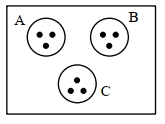
Let the set $\mathrm{S}=\{2,4,8,16, \ldots . .512\}$ be partitioned into $3$ sets $A, B, C$ with equal number of elements such that $\mathrm{A} \cup \mathrm{B} \cup \mathrm{C}=\mathrm{S}$ and $\mathrm{A} \cap \mathrm{B}=\mathrm{B} \cap \mathrm{C}=\mathrm{A} \cap \mathrm{C}=\phi$. The maximum number of such possible partitions of $S$ is equal to :
- ✓
$1680$
- B
$1520$
- C
$1710$
- D
$1640$
AnswerCorrect option: A. $1680$
a
$\frac{9 !}{(3 ! 3 ! 3 !) 3 !} \times 3 !$
View full question & answer→MCQ 1431 Mark
The number of $9$ digit numbers, that can be formed using all the digits of the number $123412341$ so that the even digits occupy only even places, is $..........$
Answerc
Even digits occupy at even places
$\frac{4 !}{2 ! 2 !} \times \frac{5 !}{2 ! 3 !}=\frac{24 \times 120}{4 \times 12}=60$
View full question & answer→MCQ 1441 Mark
The number of integers, greater than $7000$ that can be formed, using the digits $3,5,6,7,8$ without repetition, is
Answerb
Four digit numbers greater than $7000$
$=2 \times 4 \times 3 \times 2=48$
Five digit number $=5 !=120$
Total number greater than $7000$
$=120+48=168$
View full question & answer→MCQ 1451 Mark
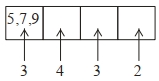
The number of numbers, strictly between $5000$ and $10000$ can be formed using the digits $1,3,5,7,9$ without repetition, is $..........$.
Answerd
Numbers between $5000$ and $10000$
Using digits $1,3,5,7,9$
Total Numbers $=3 \times 4 \times 3 \times 2=72$
View full question & answer→MCQ 1461 Mark
All the letters of the word $PUBLIC$ are written in all possible orders and these words are written as in a dictionary with serial numbers. Then the serial number of the word $PUBLIC $ is
Answerb
$ B \ldots \ldots \ldots \ldots \ldots \rightarrow 5 !=120 $
$ C \ldots \ldots \ldots \ldots \ldots \ldots \rightarrow 5 !=120 $
$ I \ldots \ldots \ldots \ldots \ldots \ldots \rightarrow 5 !=120$
$L \ldots \ldots \ldots \ldots \ldots \ldots 5 !=120 $
$ PB \ldots \ldots \ldots \ldots \ldots \rightarrow 4 !=24 $
$ PC \ldots \ldots \ldots \ldots \ldots \ldots \rightarrow 4 !=24 $
$ PL \ldots \ldots \ldots \ldots \ldots \rightarrow 4 !=24 $
$ PI \ldots \ldots \ldots \ldots \ldots \rightarrow 4 !=24$
$ P \cup BC \ldots \ldots \ldots \rightarrow 2 !=2$
$ P \cup BI \ldots \ldots \ldots \rightarrow 2 !=2$
$ P \cup BLC \ldots \ldots . \rightarrow 1 !=1 $
$ P \cup BLIC \ldots \ldots \rightarrow=1 $
Serial number $=4(120)+4(24)+6=582$
View full question & answer→MCQ 1471 Mark
The number of arrangements of the letter of the word "$INDEPENDENCE$" in which all the vowels always occur together is
- ✓
$16800$
- B
$14800$
- C
$18000$
- D
$33600$
AnswerCorrect option: A. $16800$
a
$IEEEE$,
$NNN , DD , P , C$
$\frac{8 !}{3 ! 2 !} \times \frac{6 !}{41}=16800$
View full question & answer→MCQ 1481 Mark
Some couples participated in a mixed doubles badminton tournament. If the number of matches played, so that no couple played in a match, is $840$, then the total numbers of persons, who participated in the tournament, is $........$.
Answerd
${ }^n C_2 \times{ }^{n-2} C_2 \times 2=840$
$\Rightarrow n=8$
Therefore total persons $=16$
View full question & answer→MCQ 1491 Mark
Eight persons are to be transported from city $A$ to city $B$ in three cars of different makes. If each car can accommodate at most three persons, then the number of ways, in which they can be transported, is $...........$.
- A
$3360$
- ✓
$1680$
- C
$560$
- D
$1120$
AnswerCorrect option: B. $1680$
b
$\text { Ways }=\frac{8 !}{3 ! 3 ! 2 ! 2 !} \times 3 !$
$=\frac{8 \times 7 \times 6 \times 5 \times 4}{4}$
$=56 \times 30$
$=1680$

View full question & answer→MCQ 1501 Mark
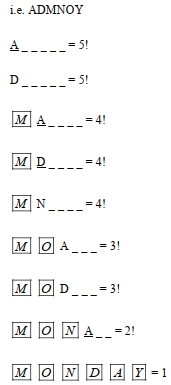
All words, with or without meaning, are made using all the letters of the word $MONDAY$. These words are written as in a dictionary with serial numbers. The serial number of the word $MONDAY$ is
Answera
View full question & answer→