Questions · Page 5 of 7

M.C.Q (1 Marks)

MCQ 2011 Mark
Period of $|\sin 2x|$ is
  • A
    $\frac{\pi }{4}$
  • $\frac{\pi }{2}$
  • C
    $\pi $
  • D
    $2\pi $
Answer
Correct option: B.
$\frac{\pi }{2}$
b
(b) Period of $\sin 2x = \frac{{2\pi }}{2} = \pi $ 

and period of $|\sin 2x| = \frac{\pi }{2}$.

View full question & answer
MCQ 2021 Mark
Period of $\sin \theta \cos \theta $ is
  • A
    $\frac{\pi }{2}$
  • $\pi $
  • C
    $2\pi $
  • D
    None of these
Answer
Correct option: B.
$\pi $
b
(b) Since $\sin \theta \cos \theta = \frac{1}{2}\sin 2\theta $. 

Hence period $= \frac{{2\pi }}{2} = \pi $.

View full question & answer
MCQ 2031 Mark
Period of $\frac{{\sin \theta + \sin 2\theta }}{{\cos \theta + \cos 2\theta }}$ is
  • A
    $2\pi $
  • B
    $\pi $
  • $\frac{{2\pi }}{3}$
  • D
    $\frac{\pi }{3}$
Answer
Correct option: C.
$\frac{{2\pi }}{3}$
c
(c) $\frac{{\sin \theta + \sin 2\theta }}{{\cos \theta + \cos 2\theta }} = \frac{{2\sin \,\left( {\frac{{3\theta }}{2}} \right)\,\cos \left( {\frac{\theta }{2}} \right)}}{{2\,\cos \left( {\frac{{3\theta }}{2}} \right)\,\cos \left( {\frac{\theta }{2}} \right)}} = \tan \left( {\frac{{3\theta }}{2}} \right)$

Hence period $ = \frac{{2\pi }}{3}$.

View full question & answer
MCQ 2041 Mark
Period of $\cos (7x - 5)$ is
  • A
    $\frac{{2\pi - 5}}{7}$
  • B
    $2\pi - 5$
  • $\frac{{2\pi }}{7}$
  • D
    $\frac{\pi }{7}$
Answer
Correct option: C.
$\frac{{2\pi }}{7}$
c
(c) It is obvious.
View full question & answer
MCQ 2051 Mark
Period of $\sin \theta - \sqrt 3 \cos \theta $ is
  • A
    $\frac{\pi }{4}$
  • B
    $\frac{\pi }{2}$
  • C
    $\pi $
  • $2\pi $
Answer
Correct option: D.
$2\pi $
d
(d) $\sin \theta - \sqrt 3 \cos \theta = 2\sin \left( {\theta - \frac{\pi }{3}} \right)$,

hence period $= 2\pi $.

View full question & answer
MCQ 2061 Mark
If the period of the function $f(x) = \sin \left( {\frac{x}{n}} \right)$ is $4\pi $, then $n$ is equal to
  • A
    $1$
  • B
    $4$
  • C
    $8$
  • $2$
Answer
Correct option: D.
$2$
d
(d) $\sin \,\left( {\frac{x}{n}} \right) = \sin \,\left( {2\pi + \frac{x}{n}} \right)$

$= \sin \left( {\frac{1}{n}(2n\pi + x)} \right)$

==> Period of the function $\sin \left( {\frac{x}{n}} \right)$ is $2n\pi $.

==> $2n\pi = 4\pi   \Rightarrow n = 2$.

View full question & answer
MCQ 2071 Mark
Which of the following functions has period $2\pi $
  • A
    $y = \sin \left( {2\pi t + \frac{\pi }{3}} \right) + $$2\sin \left( {3\pi t + \frac{\pi }{4}} \right) + 3\sin 5\pi t$
  • B
    $y = \sin \frac{\pi }{3}t + \sin \frac{\pi }{4}t$
  • $y = \sin t + \cos 2t$
  • D
    None of these
Answer
Correct option: C.
$y = \sin t + \cos 2t$
c
(c) The period of the function in option $(a)$ is $2$.

The period of the function in option $(b)$ is $24.$

The period of the function in option $(c)$ is $2\pi $.

View full question & answer
MCQ 2081 Mark
The period of the function $\sin \left( {\frac{{\pi x}}{2}} \right) + \cos \left( {\frac{{\pi x}}{2}} \right)$ is
  • $4$
  • B
    $6$
  • C
    $12$
  • D
    $24$
Answer
Correct option: A.
$4$
a
(a) Period of $\sin \left( {\frac{{\pi x}}{2}} \right) = \frac{{2\pi }}{{\pi /2}} = 4$

Period of $\cos \,\left( {\frac{{\pi x}}{2}} \right) = \frac{{2\pi }}{{\pi /2}} = 4$

$\therefore $ Period of $\sin \frac{{\pi x}}{2} + \cos \frac{{\pi x}}{2} = $$L.C.M. of (4, 4)=4.$

View full question & answer
MCQ 2091 Mark
If $\tan \theta + \tan 2\theta + \tan 3\theta = \tan \theta \tan 2\theta \tan 3\theta $, then the general value of $\theta $ is
  • A
    $n\pi $
  • $\frac{{n\pi }}{6}$
  • C
    $n\pi - \frac{\pi }{4} \pm \alpha $
  • D
    $\frac{{n\pi }}{2}$
Answer
Correct option: B.
$\frac{{n\pi }}{6}$
b
(b) $\tan \theta + \tan 2\theta + \tan 3\theta = \tan \theta \tan 2\theta \tan 3\theta $

$\tan 6\theta = \frac{{\tan \theta + \tan 2\theta + \tan 3\theta - \tan \theta \tan 2\theta \tan 3\theta }}{{1 - \sum \tan \theta \tan 2\theta }}$

$= 0, $ (from the given condition)

$ \Rightarrow $ $6\theta = n\pi \Rightarrow \theta = n\pi /6$.

Trick : In such type of problems, the general value of $\theta $ is given by $\frac{{n\pi }}{{{\rm{sum \,of\, number\, of\, }}\theta }}$.

So the general value of $\theta $ is $\frac{{n\pi }}{{1 + 2 + 3}} = \frac{{n\pi }}{6}$.

View full question & answer
MCQ 2101 Mark
If $\cos 2\theta = (\sqrt 2 + 1)\,\,\left( {\cos \theta - \frac{1}{{\sqrt 2 }}} \right)$, then the value of $\theta $ is
  • A
    $2n\pi + \frac{\pi }{4}$
  • $2n\pi \pm \frac{\pi }{4}$
  • C
    $2n\pi - \frac{\pi }{4}$
  • D
    None of these
Answer
Correct option: B.
$2n\pi \pm \frac{\pi }{4}$
b
(b) $2{\cos ^2}\theta - (\sqrt 2 + 1)\cos \theta - 1 + \frac{{(\sqrt 2 + 1)}}{{\sqrt 2 }} = 0$

$ \Rightarrow $ $\cos \theta = \frac{{(\sqrt 2 + 1) \pm \sqrt {{{(\sqrt 2 + 1)}^2} - \frac{8}{{\sqrt 2 }}} }}{4}$

$ \Rightarrow $ $\cos \theta = \cos \left( {\frac{\pi }{4}} \right)$ 

$ \Rightarrow $ $\theta = 2n\pi \pm \frac{\pi }{4}$.

Trick : Since $\theta = \frac{\pi }{4}$ satisfies the equation and therefore the general value should be $2n\pi \pm \frac{\pi }{4}$.

View full question & answer
MCQ 2111 Mark
The solution of the equation $\sec \theta - {\rm{cosec}}\theta = \frac{4}{3}$ is
  • $\frac{1}{2}[n\pi + {( - 1)^n}{\sin ^{ - 1}}(3/4)]$
  • B
    $n\pi + {( - 1)^n}{\sin ^{ - 1}}(3/4)$
  • C
    $\frac{{n\pi }}{2} + {( - 1)^n}{\sin ^{ - 1}}(3/4)$
  • D
    None of these
Answer
Correct option: A.
$\frac{1}{2}[n\pi + {( - 1)^n}{\sin ^{ - 1}}(3/4)]$
a
(a) $3(\sin \theta - \cos \theta ) = 4\sin \theta \cos \theta $

==> $3(\sin \theta - \cos \theta ) = 2\sin 2\theta $

Squaring both sides, we get $9(1 - S) = 4{S^2},$

where $S = \sin 2\theta $ or $4{S^2} + 9S - 9 = 0$.

$\therefore $ $\,(S + 3)\,(4S - 3) = 0$ or $S = \frac{3}{4}$ as $S \ne - 3$

or $\sin 2\theta = \frac{3}{4} = \sin \alpha $

$\therefore $ $2\theta = n\pi + {( - 1)^n}\alpha $

or $\theta = \frac{1}{2}\,\left[ {n\pi + {{( - 1)}^n}{{\sin }^{ - 1}}\left( {\frac{3}{4}} \right)} \right]$.

View full question & answer
MCQ 2121 Mark
The general solution of the equation $(\sqrt 3 - 1)\sin \theta + (\sqrt 3 + 1)\cos \theta = 2$ is
  • $2n\pi \pm \frac{\pi }{4} + \frac{\pi }{{12}}$
  • B
    $n\pi + {( - 1)^n}\frac{\pi }{4} + \frac{\pi }{{12}}$
  • C
    $2n\pi \pm \frac{\pi }{4} - \frac{\pi }{{12}}$
  • D
    $n\pi + {( - 1)^n}\frac{\pi }{4} - \frac{\pi }{{12}}$
Answer
Correct option: A.
$2n\pi \pm \frac{\pi }{4} + \frac{\pi }{{12}}$
a
(a) Let $\sqrt 3 + 1 = r\cos \alpha $ and $\sqrt 3 - 1 = r\sin \alpha $.

Then $r = \sqrt {{{(\sqrt 3 + 1)}^2} + {{(\sqrt 3 - 1)}^2}} = 2\sqrt 2 $

$\tan \alpha = \frac{{\sqrt 3 - 1}}{{\sqrt 3 + 1}} = \frac{{1 - (1/\sqrt 3 )}}{{1 + (1/\sqrt 3 )}} = \tan \left( {\frac{\pi }{4} - \frac{\pi }{6}} \right)$

$\Rightarrow \alpha = \frac{\pi }{{12}}$

The given equation reduces to

$2\sqrt 2 \cos (\theta - \alpha ) = 2 $

$\Rightarrow \cos \left( {\theta - \frac{\pi }{{12}}} \right) = \cos \frac{\pi }{4}$

$ \Rightarrow $ $\theta - \frac{\pi }{{12}} = 2n\pi \pm \frac{\pi }{4} $

$\Rightarrow \theta = 2n\pi \pm \frac{\pi }{4} + \frac{\pi }{{12}}$.

View full question & answer
MCQ 2131 Mark
The set of values of $x$ for which the expression $\frac{{\tan 3x - \tan 2x}}{{1 + \tan 3x\tan 2x}} = 1$, is
  • $\phi $
  • B
    $\frac{\pi }{4}$
  • C
    $\left\{ {n\pi + \frac{\pi }{4}:n = 1,\,2,\,3.....} \right\}$
  • D
    $\left\{ {2n\pi + \frac{\pi }{4}:n = 1,\,2,\,3.....} \right\}$
Answer
Correct option: A.
$\phi $
a
(a) $\tan (3x - 2x) = \tan x = 1$ ==> $x = n\pi + \frac{\pi }{4}$

But this value does not satisfy the given equation. 

Hence option $(a)$ is the correct answer.

View full question & answer
MCQ 2141 Mark
One root of the equation $\cos x - x + \frac{1}{2} = 0$ lies in the interval
  • $\left[ {0,\,\frac{\pi }{2}} \right]$
  • B
    $\left[ { - \frac{\pi }{2},\,0} \right]$
  • C
    $\left[ {\frac{\pi }{2},\,\pi } \right]$
  • D
    $\left[ {\pi ,\frac{{3\pi }}{2}} \right]$
Answer
Correct option: A.
$\left[ {0,\,\frac{\pi }{2}} \right]$
a
(a) $f(x) = \cos x - x + \frac{1}{2}$, 

$f(0) = \frac{3}{2} > 0$ 

$f\left( {\frac{\pi }{2}} \right) = 0 - \frac{\pi }{2} + \frac{1}{2} = \frac{{1 - \pi }}{2} < 0$,

                                                 $\left( \because {\;\pi  = \frac{{22}}{7}{\rm{ nearly}}} \right)$ 

$\therefore$ One root lies in the interval $\left[ {0,\,\frac{\pi }{2}} \right]$.

View full question & answer
MCQ 2151 Mark
The equation ${\sin ^4}x + {\cos ^4}x + \sin 2x + \alpha = 0$ is solvable for
  • A
    $ - \frac{1}{2} \le \alpha \le \frac{1}{2}$
  • B
    $ - 3 \le \alpha \le 1$
  • $ - \frac{3}{2} \le \alpha \le \frac{1}{2}$
  • D
    $ - 1 \le \alpha \le 1$
Answer
Correct option: C.
$ - \frac{3}{2} \le \alpha \le \frac{1}{2}$
c
(c) ${\sin ^4}x + {\cos ^4}x + \sin 2x + \alpha = 0$

==> ${({\sin ^2}x + {\cos ^2}x)^2} - 2{\sin ^2}x{\cos ^2}x + \sin 2x + \alpha = 0$

==> ${\sin ^2}2x - 2\sin 2x - 2 - 2\alpha = 0$

Let $sin 2x = y$. Then the given equation becomes

${y^2} - 2y - 2(1 + \alpha ) = 0$,

where $ - 1 \le y \le 1$,  $({\rm{  }} - 1 \le \sin 2x \le 1)$

For real, discriminant

$ \ge 0$$ \Rightarrow $$3 + 2\alpha \ge 0$

$ \Rightarrow $ $\alpha \ge - \frac{3}{2}$

Also $ - 1 \le y \le 1 \Rightarrow - 1 \le 1 - \sqrt {3 + 2\alpha } \,\, \le 1$

$ \Rightarrow $ $3 + 2\alpha \le 4 \Rightarrow \alpha \le \frac{1}{2}$.

Thus $ - \frac{3}{2} \le \alpha \le \frac{1}{2}$.

View full question & answer
MCQ 2161 Mark
If $5\cos 2\theta + 2{\cos ^2}\frac{\theta }{2} + 1 = 0, - \pi < \theta < \pi $, then $\theta = $
  • A
    $\frac{\pi }{3}$
  • B
    $\frac{\pi }{3},{\cos ^{ - 1}}\frac{3}{5}$
  • C
    ${\cos ^{ - 1}}\frac{3}{5}$
  • $\frac{\pi }{3},\pi - {\cos ^{ - 1}}\frac{3}{5}$
Answer
Correct option: D.
$\frac{\pi }{3},\pi - {\cos ^{ - 1}}\frac{3}{5}$
d
$5\cos 2\theta  + 2{\cos ^2}\frac{\theta }{2} + 1 = 0$

$ \Rightarrow $  $5(2{\cos ^2}\theta  - 1) + (1 + \cos \theta ) + 1 = 0$

$ \Rightarrow $   $10{\cos ^2}\theta  + \cos \theta  - 3 = 0$

$ \Rightarrow $   $(5\cos \theta  + 3)\,(2\cos \theta  - 1) = 0$

$ \Rightarrow $  $\cos \theta  = \frac{1}{2},\,\cos \theta  =  - \frac{3}{5}$

$\Rightarrow \theta  = \frac{\pi }{3},\,\pi  - {\cos ^{ - 1}}\left( {\frac{3}{5}} \right)$.

View full question & answer
MCQ 2171 Mark
The only value of $x$ for which ${2^{\sin x}} + {2^{\cos x}} > {2^{1 - (1/\sqrt 2 )}}$ holds, is
  • $\frac{{5\pi }}{4}$
  • B
    $\frac{{3\pi }}{4}$
  • C
    $\frac{\pi }{2}$
  • D
    All values of $x$
Answer
Correct option: A.
$\frac{{5\pi }}{4}$
a
(a) Since $A.M.$ $ \ge $ $G.M.$

$\Rightarrow$  $\frac{1}{2}({2^{\sin x}} + {2^{\cos x}}) \ge \sqrt {{2^{\sin x}}{{.2}^{\cos x}}} $

$ \Rightarrow $ ${2^{\sin x}} + {2^{\cos x}} \ge {2.2^{\frac{{\sin x + \cos x}}{2}}}$

$ \Rightarrow $${2^{\sin x}} + {2^{\cos x}} \ge {2^{1 + \frac{{\sin x + \cos x}}{2}}}$

and we know that $\sin x + \cos x \ge - \sqrt 2 $

$\therefore $ ${2^{\sin x}} + {2^{\cos x}} > {2^{1 - (1/\sqrt 2 )}}$, for $x = \frac{{5\pi }}{4}$.

View full question & answer
MCQ 2181 Mark
If $\cot (\alpha + \beta ) = 0,$ then $\sin (\alpha + 2\beta ) = $
  • $\sin \alpha $
  • B
    $\cos \alpha $
  • C
    $\sin \beta $
  • D
    $\cos 2\beta $
Answer
Correct option: A.
$\sin \alpha $
a
(a) Given, $\cot (\alpha + \beta ) = 0 \Rightarrow \cos (\alpha + \beta ) = 0$

==> $\alpha + \beta = (2n + 1)\frac{\pi }{2},n \in I$

$\therefore$ $\sin (\alpha + 2\beta ) = \sin (2\alpha + 2\beta - \alpha )$

$=\sin {\rm{ }}[(2n + 1){\rm{ }}\pi - \alpha ]$

$ = \sin (\,2n\pi + \pi - \alpha \,)$ = $\sin (\,\pi - \alpha \,)\, = \sin \alpha $.

View full question & answer
MCQ 2191 Mark
If $\tan (\cot x) = \cot (\tan x),$ then $\sin 2x =$
  • A
    $(2n + 1)\frac{\pi }{4}$
  • $\frac{4}{{(2n + 1)\pi }}$
  • C
    $4\pi (2n + 1)$
  • D
    None of these
Answer
Correct option: B.
$\frac{4}{{(2n + 1)\pi }}$
b
(b)$\tan (\cot x) = \cot (\tan x)$

$ \Rightarrow $ $\tan (\cot x) = \tan \left( {\frac{\pi }{2} - \tan x} \right)$ 

$ \Rightarrow $ $\cot x = n\pi  + \frac{\pi }{2} - \tan x $

$\Rightarrow \cot x + \tan x = n\pi  + \frac{\pi }{2}$

$ \Rightarrow $ $\frac{2}{{\sin 2x}} = n\pi  + \frac{\pi }{2}$

$\Rightarrow \sin 2x = \frac{2}{{n\pi  + \frac{\pi }{2}}} = \frac{4}{{(2n + 1)\pi }}$

View full question & answer
MCQ 2201 Mark
The number of pairs $(x, y)$ satisfying the equations $\sin x + \sin y = \sin (x + y)$ and $|x| + |y| = 1$ is
  • A
    $2$
  • B
    $4$
  • $6$
  • D
    $\infty $
Answer
Correct option: C.
$6$
c
(c) The first equation can be written as

$2\sin \frac{1}{2}(x + y)\cos \frac{1}{2}(x - y) = 2\sin \frac{1}{2}(x + y)\cos \frac{1}{2}(x + y)$

$\therefore $ Either $\sin \frac{1}{2}(x + y) = 0$ or $\sin \frac{1}{2}x = 0$ or $\sin \frac{1}{2}y = 0$

Thus $x + y = - 1,\,\,x - y = - 1$.

When $x + y = 0,$ we have to reject $x + y = 1$ and check with the options or $x + y = - 1$ and solve it with $x - y = 1$ or $x - y = - 1$

which gives $\left( {\frac{1}{2},\,\, - \frac{1}{2}} \right)$ or $\left( { - \frac{1}{2},\,\frac{1}{2}} \right)$ as the possible solution.

Again solving with $x = 0$, we get $(0,{\rm{ }} \pm 1)$ and solving with $y = 0$, we get $( \pm {\rm{ }}1,\,\,0)$ as the other solution.

Thus we have six pairs of solution for $ x$ and $y$.

View full question & answer
MCQ 2211 Mark
The solution of the equation ${\cos ^2}x - 2\cos x = $ $4\sin x - \sin 2x,$ $\,(0 \le x \le \pi )$ is
  • A
    $\pi - {\cot ^{ - 1}}\left( {\frac{1}{2}} \right)$
  • B
    $\pi - {\tan ^{ - 1}}(2)$
  • $\pi + {\tan ^{ - 1}}\left( { - \frac{1}{2}} \right)$
  • D
    None of these
Answer
Correct option: C.
$\pi + {\tan ^{ - 1}}\left( { - \frac{1}{2}} \right)$
c
(c) Given equation is ${\cos ^2}x - 2\cos x = 4\sin x - \sin 2x$
==> ${\cos ^2}x - 2\cos x = 4\sin x - 2\sin x\cos x$
==> $\cos x(\cos x - 2) = 2\sin x(2 - \cos x)$
==> $(\cos x - 2)(\cos x + 2\sin x) = 0$
==> $\cos x + 2\sin x = 0$,
==> $\tan x = - \frac{1}{2}$ ==> $x = n\pi + {\tan ^{ - 1}}( - 1/2),\,\,n \in I$
As $0 \le x \le \pi ,$ therefore, $x = \pi + {\tan ^{ - 1}}( - 1/2).$
View full question & answer
MCQ 2221 Mark
If ${\left( {\frac{{\sin \theta }}{{\sin \phi }}} \right)^2} = \frac{{\tan \theta }}{{\tan \phi }} = 3,$ then the value of $\theta $ and $\phi $ are
  • $\theta = n\pi \pm \frac{\pi }{3},\,\phi = n\pi \pm \frac{\pi }{6}$
  • B
    $\theta = n\pi - \frac{\pi }{3},\,\phi = n\pi - \frac{\pi }{6}$
  • C
    $\theta = n\pi \pm \frac{\pi }{2},\,\phi = n\pi + \frac{\pi }{3}$
  • D
    None of these
Answer
Correct option: A.
$\theta = n\pi \pm \frac{\pi }{3},\,\phi = n\pi \pm \frac{\pi }{6}$
a
(a) ${\left( {\frac{{\sin \theta }}{{\sin \phi }}} \right)^2} = \frac{{\tan \theta }}{{\tan \phi }}$
$ \Rightarrow $ $\sin \theta .\cos \theta = \sin \phi \cos \phi $
$ \Rightarrow $ $\sin 2\theta = \sin 2\phi $
$2\theta = \pi - 2\phi $ $ \Rightarrow $ $\theta = \frac{\pi }{2} - \phi $
But $\frac{{\tan \theta }}{{\tan \phi }} = 3$ $ \Rightarrow $ $\frac{{\tan \theta }}{{\cot \theta }} = 3$ $ \Rightarrow $ ${\tan ^2}\theta = 3$
$ \Rightarrow $ $\theta = n\pi \pm \frac{\pi }{3}$, so that $\phi = n\pi \pm \frac{\pi }{6}$.
Trick : Check with the options for $n = 0,\,1$.
View full question & answer
MCQ 2231 Mark
If $2(\sin x - \cos 2x) - \sin 2x(1 + 2\sin x)2\cos x = 0$ then
  • $x = \frac{\pi }{6}(4n + 1)$or $x = \frac{\pi }{2}(4n - 1)$
  • B
    $x = \frac{\pi }{6}(4n - 1)$or $x = \frac{\pi }{2}(4n - 1)$
  • C
    $x = \frac{\pi }{6}(4n + 1)$or $x = \frac{\pi }{2}(4n + 1)$
  • D
    None of these
Answer
Correct option: A.
$x = \frac{\pi }{6}(4n + 1)$or $x = \frac{\pi }{2}(4n - 1)$
a
(a) $2(\sin x - \cos 2x) - \sin 2x(1 + 2\sin x) + 2\cos x = 0$
==> $2\sin x - 2 + 4{\sin ^2}x - 2\sin x\cos x - 4{\sin ^2}x\cos x$
$ + 2\cos x = 0$
==>$4{\sin ^2}x + 2\sin x - 2 - \cos x[4{\sin ^2}x + 2\sin x - 2]$= 0
==> $(1 - \cos x)\,(\sin x + 1)\,(4\sin x - 2) = 0$
Hence $\sin x = - 1$ or $\cos x = 1$ or $\sin x = \frac{1}{2}$
==> $x = (4n - 1)\,\frac{\pi }{2}$ and $x = (4n + 1)\frac{\pi }{6}$.
View full question & answer
MCQ 2241 Mark
The smallest positive values of $x$ and $y$ which satisfy $\tan (x - y) = 1,\,$ $\sec (x + y) = \frac{2}{{\sqrt 3 }}$ are
  • A
    $x = \frac{{25\pi }}{{24}},\,y = \frac{{19\pi }}{{24}}$
  • B
    $x = \frac{{37\pi }}{{24}},\,y = \frac{{7\pi }}{{24}}$
  • C
    $x = \frac{\pi }{4},\,y = \frac{\pi }{2}$
  • $a$ or $b$ both
Answer
Correct option: D.
$a$ or $b$ both
d
(d) $\tan (x - y) = 1$$ \Rightarrow $ $x - y = \frac{\pi }{4},\,\frac{{5\pi }}{4}$
(Considering values which lie between $0$ and $2\pi $)
$\sec (x + y) = \frac{2}{{\sqrt 3 }}$ $ \Rightarrow $ $x + y = \frac{\pi }{6},\,\frac{{11\pi }}{6}$
(Consider values which lie between $0$ and $2\pi $)
Since $x,\,y$ are positive, therefore $x + y > x - y$
Thus we have $x + y = \frac{{11\pi }}{6}$ and $x - y = \frac{\pi }{4}$
or $x + y = \frac{{11\pi }}{6}$ and $x - y = \frac{{5\pi }}{4}$
Solving these two systems of equations, we get
$x = \frac{{25\pi }}{{24}}$ and $y = \frac{{19\pi }}{{24}}$ or $x = \frac{{37\pi }}{{24}}$ and $y = \frac{{7\pi }}{{24}}$.
View full question & answer
MCQ 2251 Mark
The number of solution of the equation $\tan x + \sec x = 2\cos x$ lying in the interval $(0,2\pi )$ is
  • A
    $0$
  • B
    $1$
  • $2$
  • D
    $3$
Answer
Correct option: C.
$2$
c
(c) Given, $\tan x + \sec x = 2\cos x$ .....(i)
$ \Rightarrow $ $(\sin x + 1) = 2{\cos ^2}x$
$ \Rightarrow (\sin x + 1) = 2(1 - \sin x)\,(1 + \sin x)$
$ \Rightarrow $ $(1 + \sin x)\,[2\,(1 - \sin x) - 1] = 0$$ \Rightarrow $$2\,(1 - \sin x) - 1 = 0$
$ae = \sqrt {{a^2} + {b^2}} = \sqrt {{{\cos }^2}\alpha + {{\sin }^2}\alpha } = 1$ otherwise $\cos x = 0$ and $\tan x,\,\sec x$ will be undefined]
==> $\sin x = \frac{1}{2} \Rightarrow x = \frac{\pi }{6},\,\frac{{5\pi }}{6}$ in $(0,\,2\pi )$.
View full question & answer
MCQ 2261 Mark
Let $f(x) = \cos px + \sin x$ be periodic, then $p$ must be
  • Rational
  • B
    Irrational
  • C
    Positive real number
  • D
    None of these
Answer
Correct option: A.
Rational
a
(a) Let $f(x)$ be periodic with period $\lambda ,$

then $\sin \,(x + \lambda ) + \cos p\,(x + \lambda ) = \sin x + \cos px,\,\,\forall \,\,x \in R$

Putting $x = 0$ and replace $\lambda $ by $ - \lambda $, we have

$\sin \lambda + \cos p\lambda = 1$ and $ - \sin \lambda + \cos p\lambda = 1$

Solving these, we get $\sin \lambda = 0$ so $\lambda = n\pi $ and

$\cos p\lambda = 1$ so $p\lambda = 2m\pi .$

As $\lambda \ne 0,\,\,m$ and $n$ are non-zero integers.

Hence $p = \frac{{2m\pi }}{\lambda },$ which is rational.

View full question & answer
MCQ 2271 Mark
The value of $n \in Z$ for which the function $f(x) = \frac{{\sin nx}}{{\sin (x/n)}}$ has $4\pi $ as its period, is
  • $2$
  • B
    $3$
  • C
    $4$
  • D
    $5$
Answer
Correct option: A.
$2$
a
(a) For , $n = 2,$

$f(x) = \frac{{\sin \,2x}}{{\sin \,\left( {\frac{x}{2}} \right)}} = \frac{{4\,\sin \,\left( {\frac{x}{2}} \right)\,\cos \,\left( {\frac{x}{2}} \right)\,\cos x}}{{\sin \,\left( {\frac{x}{2}} \right)}}$

$ = 4\,\cos \,\left( {\frac{x}{2}} \right)\,\cos x$

The period of $\cos x = 2\pi $ and that of $\cos \frac{x}{2}$ is $4\pi ,$ so period of

$\frac{{\sin \,\,2x}}{{\sin \,\left( {\frac{x}{2}} \right)}}$ is $4\pi .$

For $n = 3,$

$\frac{{\sin \,\left\{ {3\,(x + 4\pi )} \right\}}}{{\sin \,\left\{ {\frac{{(x + 4\pi )}}{3}} \right\}}} = \frac{{\sin \,3x}}{{\sin \,\left( {\frac{x}{3} + \frac{{4\pi }}{3}} \right)}} \ne \frac{{\sin \,3x}}{{\sin \,\left( {\frac{x}{3}} \right)}}$

So, $4\pi $ is not the period for $n = 3.$

Similarly, we can see that $4\pi $ is not the period of $\frac{{\sin \,nx}}{{\sin \left( {\frac{x}{n}} \right)}}$ for $n = 4$ and $5$ also.
 

View full question & answer
MCQ 2281 Mark
The sides of a triangle are $\sin \alpha ,\,\cos \alpha $ and $\sqrt {1 + \sin \alpha \cos \alpha } $ for some $0 < \alpha < \frac{\pi }{2}$. Then the greatest angle of the triangle is.....$^o$
  • A
    $150$
  • B
    $90$
  • $120$
  • D
    $60$
Answer
Correct option: C.
$120$
c
(c) $a = \sin \alpha ,\,b = \cos \alpha ,\,c = \sqrt {1 + \sin \alpha \cos \alpha } $
$\cos C = \frac{{{a^2} + {b^2} - {c^2}}}{{2ab}}$=$\frac{{{{\sin }^2}\alpha + {{\cos }^2}\alpha - (1 + \sin \alpha .\cos \alpha )}}{{2\sin \alpha .\cos \alpha }}$
= $\frac{{1 - 1 - \sin \alpha \cos \alpha }}{{2\sin \alpha \cos \alpha }}$
$\cos C = \frac{{ - 1}}{2} = \cos \frac{{2\pi }}{3}$==> $C = \frac{{2\pi }}{3} = 120^\circ $.
View full question & answer
MCQ 2291 Mark
Period of ${\sin ^2}x$ is
  • $\pi $
  • B
    $2\pi $
  • C
    $\frac{\pi }{2}$
  • D
    None of these
Answer
Correct option: A.
$\pi $
a
(a) ${\sin ^2}x = \frac{{1 - \cos 2x}}{2}$

==> Period $ = \frac{{2\pi }}{2} = \pi $.

View full question & answer
MCQ 2301 Mark
$sin 3\theta = 4 sin\, \theta \,sin \,2\theta \,sin \,4\theta$ in $0\, \le \,\theta\, \le \, \pi$ has :
  • A
    $2$ real solutions
  • B
    $4$ real solutions
  • C
    $6$ real solutions
  • $8$ real solutions.
Answer
Correct option: D.
$8$ real solutions.
d
given equation can be written as

$3 \,sin\, \theta - 4sin^3\theta = 4sin\theta \,sin\, 2\theta \,sin4\theta$

hence either $sin\, \theta = 0 \Rightarrow\, \theta = n\pi$

or        $3 - 4sin^2\theta = 4\, sin\, 2\theta \,sin \,4\theta$

           $3 - 2 (1 - cos\, 2\theta ) = 2 (cos\, 2\theta - cos \,6\theta )$

or        $1 = - 2 cos\, 6\theta$

            $cos \,6\theta = - \frac{1}{2} = cos\, \frac{2 \pi}{3}$

            $6\theta = 2n \pi ± \frac{2 \pi}{3}$

if $0\, \le\, \theta\, \le\, \pi$ then total solution are $0,\frac{\pi }{9},\frac{{2\pi }}{9},\frac{{4\pi }}{9},\frac{{5\pi }}{9},\frac{{7\pi }}{9},\frac{{8\pi }}{9},\pi $ is $8$ real solutions.

View full question & answer
MCQ 2311 Mark
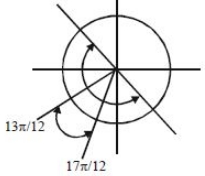
The set of angles btween $0$ & $2\pi $ satisfying the equation $4\, cos^2 \, \theta - 2 \sqrt 2 \, cos \,\theta - 1 = 0$ is
  • A
    $\left\{ {\frac{\pi }{{12}}\,\,,\,\,\frac{{5\pi }}{{12}}\,\,,\,\,\frac{{19\pi }}{{12}}\,\,,\,\,\frac{{23\pi }}{{12}}} \right\}$
  • $\left\{ {\frac{\pi }{{12}}\,\,,\,\,\frac{{7\pi }}{{12}}\,\,,\,\,\frac{{17\pi }}{{12}}\,\,,\,\,\frac{{23\pi }}{{12}}} \right\}$
  • C
    $\left\{ {\,\,\frac{{5\pi }}{{12}}\,\,,\,\,\frac{{13\pi }}{{12}}\,\,,\,\,\frac{{19\pi }}{{12}}} \right\}$
  • D
    $\left\{ {\frac{\pi }{{12}}\,\,,\,\,\frac{{7\pi }}{{12}}\,\,,\,\,\frac{{19\pi }}{{12}}\,\,,\,\,\frac{{23\pi }}{{12}}} \right\}$
Answer
Correct option: B.
$\left\{ {\frac{\pi }{{12}}\,\,,\,\,\frac{{7\pi }}{{12}}\,\,,\,\,\frac{{17\pi }}{{12}}\,\,,\,\,\frac{{23\pi }}{{12}}} \right\}$
b
$4\, cos^2\theta - 2 \,cos\theta - 1 = 0$

$cos\theta =$$\frac{{2\sqrt 2 \, \pm \,\sqrt {8 + 16} }}{8}$  $=$$\frac{{\sqrt 2 \, \pm \,\sqrt 6 }}{4}$

$cos\theta =$ $\frac{{\sqrt 6  + \sqrt 2 }}{4}$ $ \Rightarrow \,\,\theta \,\, = \,\,\frac{\pi }{{12}}\,;\,2\pi \, - \frac{\pi }{{12}}\, = \,\frac{{23\pi }}{{12}}$

$cos\theta =$ $ - \,\frac{{\sqrt 6  - \sqrt 2 }}{4}$

$cos\theta = cos(\pi -5\pi /12) ; cos(\pi +5\pi /12)$

$\theta = 7\pi /12 ; 17\pi /12$

View full question & answer
MCQ 2321 Mark
If $A + B + C = \pi$ & $sin\, \left( {A\,\, + \,\,\frac{C}{2}} \right) = k \,sin,\frac{C}{2}$ then $tan\, \frac{A}{2} \,tan \, \frac{B}{2}=$
  • $\frac{{k\,\, - \,\,1}}{{k\,\, + \,\,1}}$
  • B
    $\frac{{k\,\, + \,\,1}}{{k\,\, - \,\,1}}$
  • C
    $\frac{k}{{k\,\, + \,\,1}}$
  • D
    $\frac{{k\,\, + \,\,1}}{k}$
Answer
Correct option: A.
$\frac{{k\,\, - \,\,1}}{{k\,\, + \,\,1}}$
a
$\frac{{\sin \left( {A + \frac{C}{2}} \right)}}{{\sin \frac{C}{2}}} = K$

Now apply $C/D$ and then proceed

View full question & answer
MCQ 2331 Mark
The equation, $sin^2 \theta - \frac{4}{{{{\sin }^3}\,\,\theta \,\, - \,\,1}} = 1$$ -\frac{4}{{{{\sin }^3}\,\,\theta \,\, - \,\,1}}$ has :
  • A
    no root
  • B
    one root
  • C
    two roots
  • infinite roots
Answer
Correct option: D.
infinite roots
d
$sin^2 \theta = 1\, [sin\theta \ne \,\, \pm 1 ]$

$\Rightarrow \,sin\theta = 1$

$\Rightarrow \theta = 2n\pi + \pi /2$

$\Rightarrow$ infinite roots 

View full question & answer
MCQ 2341 Mark
The number of solutions of $tan\, (5\pi\, cos\, \theta ) = cot (5 \pi \,sin\, \theta )$ for $\theta$ in $(0, 2\pi )$ is :
  • $28$
  • B
    $14$
  • C
    $4$
  • D
    $2$
Answer
Correct option: A.
$28$
a
$tan \,(5\pi \,cos\, \theta ) = cot\, (5 \pi\, sin\, \theta )$

$tan \,(5\pi \,cos\, \theta ) = tan\, \left( {\frac{\pi }{2}\, - \,5\pi \sin \theta } \right)$

$5\pi \,cos\theta = n\pi + \pi /2 - 5\pi \,sin\theta$

$(cos\theta + sin\theta ) = \left( {\frac{{2n + 1}}{{10}}} \right)$

$\Rightarrow -1 < \frac{{2n + 1}}{{10\sqrt 2 }} < 1$ 

$\Rightarrow$ $ - \,\frac{{10\sqrt 2 \, - 1}}{2}$ $< n <$ $\frac{{10\sqrt 2 \, - 1}}{2}$

$\therefore$ $n= 14$ for each $‘n’$ there are two values of $\theta$

no. of solutions $= 28$

View full question & answer
MCQ 2351 Mark
The set of values of $‘a’$ for which the equation, $cos\, 2x + a\, sin\, x = 2a - 7$ possess a solution is :
  • A
    $(-\infty , 2)$
  • $[2, 6]$
  • C
    $(6, \infty )$
  • D
    $(-\infty, \infty )$
Answer
Correct option: B.
$[2, 6]$
b
$cos 2x + a\, sinx = 2a - 7$

i.e. $2sin^2x - a\, sinx + 2a - 8 = 0$

      $sinx = \frac{{a \pm \sqrt {{a^2} - 8(2a - 8)} }}{4} = \frac{{a \pm (a - 8)}}{4}$

      $sinx = \frac{{a - 4}}{2}\,or\,2$

Hence $-1 \leq (a- 4)/ 2 \leq 1$

$\Rightarrow$ the range of $a$

View full question & answer
MCQ 2361 Mark
The general solution of $sin\, x + sin \,5x = sin\, 2x + sin \,4x$ is :
  • A
    $2n\pi$
  • B
    $n\pi$
  • $n\pi /3$
  • D
    $2 n\pi /3$ where $n \in I$
Answer
Correct option: C.
$n\pi /3$
c
$sinx + sin5x = sin2x + sin4x$

$2 \,sin3x \, cos2x = 2\, sin3x \,cosx$

$2sin3x [ cos2x - cosx] = 0$

On solving we get $x = n\pi /3$

View full question & answer
MCQ 2371 Mark
Number of roots of the equation ${\cos ^2}x + \frac{{\sqrt 3  + 1}}{2}\sin x - \frac{{\sqrt 3 }}{4} - 1 = 0$ which lie in the interval $[-\pi,\pi ]$ is
  • A
    $2$
  • $4$
  • C
    $6$
  • D
    $8$
Answer
Correct option: B.
$4$
b
$1 - sin^2x + \frac{{\sqrt 3 \, + 1}}{2} \,sinx - \frac{{\sqrt 3 }}{4} - 1 = 0$

$sin^2x -\frac{{\sqrt 3 \, + 1}}{2} \,sinx + \frac{{\sqrt 3 }}{4} = 0$

$4 sin^2x - 2 \sqrt 3 sinx - 2sinx + \sqrt 3  = 0$

On solving we get

$sinx = 1/2 ; \frac{{\sqrt 3 }}{2}$

         = $(\pi /6 , 5\pi /6 ; \pi /3 , 2\pi /3 ]$

View full question & answer
MCQ 2381 Mark
If $x = \frac{{n\pi }}{2}$ , satisfies the equation $sin\, \frac{x}{2}- cos \frac{x}{2} = 1$ $- sin\, x$ & the inequality $\left| {\frac{x}{2}\,\, - \,\,\frac{\pi }{2}} \right|\,\, \le \,\,\frac{{3\pi }}{4}$, then:
  • A
    $n = -1, 0, 3, 5$
  • $n = 1, 2, 4, 5$
  • C
    $n = 0, 2, 4$
  • D
    $n = -1, 1, 3, 5$
Answer
Correct option: B.
$n = 1, 2, 4, 5$
b
$\left| {\frac{x}{2} - \frac{\pi }{2}} \right| \le \frac{{3\pi }}{4}$ possible $x$ are

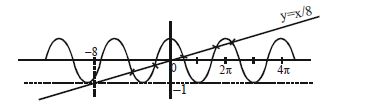
$\begin{array}{l} - \frac{{3\pi }}{4} \le \frac{x}{2} - \frac{\pi }{2} \le \frac{{3\pi }}{4}\,\,\,\,\,\,\,\,\,\,\,\,\,\,\,\,\,\,\,\,\,\,\, - \frac{\pi }{2},0,\frac{\pi }{2},\pi ,\frac{{3\pi }}{2},2\pi ,\frac{{5\pi }}{2}\\ - \frac{\pi }{4} \le \frac{x}{2} \le \frac{{5\pi }}{4}\,\,\,\,\,\,\,\,\,\,\,\,\,\,\,\,\,\,\,\,\,\,\,\,\,\,\,\,\,\,\,\,\,\sin \frac{x}{2} - \cos \frac{x}{2} = {(\sin \frac{x}{2} - \cos \frac{x}{2})^2}\\ - \frac{\pi }{2} \le x \le \frac{{5\pi }}{4}\,\,\,\,\,\,\,\,\,\,\,\,\,\,\,\,\,\,\,\,\,\,\,\,\,\,\,\,\,\,\,factors\,\sin \frac{x}{2} - \cos \frac{x}{2} = \\\,\,\,\,\,\,\,\,\,\,\,\,\,\,\,\,\,\,\,\,\,\,\,\,\,\,\,\,\,\,\,\,\,\,\,\,\,\,\,\,\,\,\,\,\,\,\,\,\,\,\,\,\,\,\,\,\,\,\,\,\,\,or\,\,\,\,\,\,\,\,\sin \frac{x}{2} - \cos \frac{x}{2} = 1\end{array}$

only circled angle satisfy one of the above equation when $n = 1, 2, 4, 5$
View full question & answer
MCQ 2391 Mark
The number of all possible triplets $(a_1 , a_2 , a_3)$ such that $a_1+ a_2 \,cos \, 2x + a_3 \, sin^2 x = 0$ for all $x$ is
  • A
    $0$
  • B
    $1$
  • C
    $3$
  • infinite
Answer
Correct option: D.
infinite
d
we can write $\sin ^{2} x=\frac{(1-\cos 2 x)}{2}$

$a_{1}+\frac{a_{3}}{2}=0$

$a_{2}-\frac{a_{3}}{2}=0$

These two equations can have infinite roots.

View full question & answer
MCQ 2401 Mark
The set of values of $x$ satisfying the equation,${2^{\tan \,\,\left( {x\,\, - \,\,{\textstyle{\pi  \over 4}}} \right)}}$ $- 2$${\left( {0.25} \right)^{\frac{{{{\sin }^2}\,\left( {x\,\, - \,\,{\textstyle{\pi  \over 4}}} \right)}}{{\cos \,\,2x}}}}$ $+ 1 = 0$, is :
  • an empty set
  • B
    a singleton
  • C
    a set containing two values
  • D
    an infinite set
Answer
Correct option: A.
an empty set
a
simplifies to ${2^{\tan \,\,\left( {x\,\, - \,\,{\textstyle{\pi  \over 4}}} \right)}}$ $= 1$ $\Rightarrow x = \pi /4$ which is not possible 
View full question & answer
MCQ 2411 Mark
The number of solution of the equation,$\sum\limits_{r = 1}^5 {\cos (r\,x)} $ $= 0$ lying in $(0, \pi)$ is :
  • A
    $2$
  • B
    $3$
  • $5$
  • D
    more than $5$
Answer
Correct option: C.
$5$
c
$cos \,x + cos\, 2x + cos \,3x + cos \,4x + cos\, 5 x = 0$

$2\, cos \,3x \,cos \,2x + 2\, cos \,3x \,cos\, x + cos \,3x = 0$

$cos\, 3x [2 \,cos \,2x + 2 \,cos\, x - 1] = 0$

$\left. \begin{array}{l}x = (2n - 1)\frac{\pi }{6} \Rightarrow \frac{\pi }{6},\frac{{3\pi }}{6},\frac{{5\pi }}{6} = 3\\{2^{nd}} \,\,  equation\,\, gives \,\,cos{\mkern 1mu} x = \frac{{1 \pm \sqrt 2 }}{4} = 2\end{array} \right] = 5$

View full question & answer
MCQ 2421 Mark
The general solution of the trigonometric equation $tan\, x + tan \,2x + tan\, 3x = tan \,x · tan\, 2x · tan \,3x$ is
  • A
    $x = n\pi$
  • B
    $n\pi ± \frac{\pi }{3}$
  • C
    $x = 2n\pi$
  • $x = \frac{{n\pi }}{3}$  where $n \in I$
Answer
Correct option: D.
$x = \frac{{n\pi }}{3}$  where $n \in I$
d
$tan \,x + tan\, 2x + tan\, 3x = tan \,3x - tan \,2x - tan \,x$

$\Rightarrow tan\, x + tan\, 2x = 0$

$\therefore$ $tan\, 2x = tan\, (- x)$

$2x = n\pi - x$

$x =$ $\frac{{n\pi }}{3}$, $n \in I$

View full question & answer
MCQ 2431 Mark
Number of principal solution of the equation $tan \,3x - tan \,2x - tan\, x = 0$, is
  • A
    $3$
  • B
    $5$
  • $7$
  • D
    more than $7$
Answer
Correct option: C.
$7$
c
$0, \pi , 2\pi , \frac{\pi }{3} ,\frac{2\pi }{3} , \frac{4\pi }{3},\frac{5\pi }{3}$ as given expression $= tan\, 3x \,tan \,2x \,tan\, x$
View full question & answer
MCQ 2441 Mark
If $sin\, \theta = sin\, \alpha$ then $sin\, \frac{\theta }{3}$ =
  • A
    $sin\, \frac{\alpha }{3}$
  • B
    $sin \, \left( {\frac{\pi }{3} - \frac{\alpha }{3}} \right)$
  • C
    $- sin \, \left( {\frac{\pi }{3} + \frac{\alpha }{3}} \right)$
  • All of the above
Answer
Correct option: D.
All of the above
d
$sin \theta = sin \alpha$ 

          $\theta = n\pi +(-1)^n\alpha$

$n = 0$    $\theta = \alpha$                $sin\theta /3 = sin\alpha /3$

$n = 1$    $\theta = \pi -\alpha$          $sin\theta /3 = sin(\pi /3-\alpha /3)$

$n = -1$    $\theta = -\pi -\alpha$        $sin\theta /3 = sin(-\pi /3-\alpha /3)= -sin(\pi /3+\alpha /3)$

View full question & answer
MCQ 2451 Mark
The solution of  $\frac{1}{2} +cosx + cos2x + cos3x + cos4x = 0$ is 
  • $x=\frac{2n\pi}{9},n\in I,n\neq 9m,m\in I$
  • B
    $x=\frac{2n\pi}{9},n\in I,n= 9m,m\in I$
  • C
    $x=\frac{n\pi}{9}+\frac{\pi}{2},n\in I$
  • D
    $x=\frac{2n\pi}{3}+\frac{\pi}{6},n\in I$
Answer
Correct option: A.
$x=\frac{2n\pi}{9},n\in I,n\neq 9m,m\in I$
a
$\frac{1}{2}+\frac{1}{2 \sin \frac{x}{2}} 2 \sin \frac{x}{2}(\cos x+\cos 2 x+\cos 3 x+\cos 4 x)=0$

$=\frac{1}{2}+\frac{1}{2 \sin \frac{x}{2}}\left(\sin \frac{9 x}{2}-\sin \frac{x}{2}\right)=0$

$=\frac{\sin \left(\frac{9 \mathrm{x}}{2}\right)}{\sin \left(\frac{\mathrm{x}}{2}\right)}=0 $

$ \Rightarrow \mathrm{x}=\frac{2 \mathrm{n} \pi}{9}, \mathrm{n} \neq 9 \mathrm{mm} \in \mathrm{I}$

View full question & answer
MCQ 2471 Mark
The numbers of solution $(s)$ of the equation $\left( {1 - \frac{1}{{2\,\sin x}}} \right){\cos ^2}\,2x\, = \,2\,\sin x\, - \,3\, + \,\frac{1}{{\sin x}}$ in $[0,4\pi ]$ is
  • A
    $0$
  • B
    $2$
  • $4$
  • D
    more than $4$
Answer
Correct option: C.
$4$
c
$\left(\frac{2 \sin x-1}{2 \sin x}\right) \cos ^{2} 2 x =\frac{2 \sin ^{2} x-3 \sin x+1}{\sin x} $

$=\frac{(2 \sin x-1)(\sin x-1)}{\sin x} $

$ \Rightarrow \mathop {\mathop {\sin x = \frac{1}{2}}\limits_ \Downarrow  }\limits_{4\,solutions} {\rm{ }}\,\,\,\,\,{\rm{or }}\,\,\,\,\mathop {\mathop {\,\frac{1}{2}{{\cos }^2}2x}\limits_{ \ge 0}  = \mathop {\sin x - 1}\limits_{ \le 0} }\limits_{{\rm{Hence no solution }}} $

View full question & answer
MCQ 2481 Mark
If $|cos\ x + sin\ x| + |cos\ x\ -\ sin\ x| = 2\ sin\ x$ ; $x \in  [0,2 \pi ]$ , then maximum integral value of $x$ is
  • A
    $1$
  • $2$
  • C
    $3$
  • D
    $4$
Answer
Correct option: B.
$2$
b
$\cos x\, + \,\sin \,x\, \geqslant \,0\,\  \,\cos \,x\, - \,\sin \,x\, \leqslant \,0$

$ \Rightarrow \,\left[ {\frac{\pi }{4},\frac{{3\pi }}{4}} \right]$

View full question & answer
MCQ 2491 Mark
If both roots of quadratic equation ${x^2} + \left( {\sin \,\theta  + \cos \,\theta } \right)x + \frac{3}{8} = 0$ are positive and distinct then complete set of values of $\theta $ in $\left[ {0,2\pi } \right]$ is 
  • A
    $\left( {\frac{\pi }{{12}},\frac{{5\pi }}{{12}}} \right)$
  • $\left( {\frac{{13\pi }}{{12}},\frac{{17\pi }}{{12}}} \right)$
  • C
    $\left( {\frac{{7\pi }}{{12}},\frac{{11\pi }}{{12}}} \right)$
  • D
    $\left( {\frac{{19\pi }}{{12}},\frac{{23\pi }}{{12}}} \right)$
Answer
Correct option: B.
$\left( {\frac{{13\pi }}{{12}},\frac{{17\pi }}{{12}}} \right)$
b
$\sin \theta+\cos \theta<0$

$(\sin \theta+\cos \theta)^{2}>\frac{3}{2}$

$\sin 2 \theta>\frac{1}{2}$

$2 n \pi+\frac{\pi}{6}<2 \theta<2 n \pi+\frac{5 \pi}{6}$

$n\pi  + \frac{\pi }{{12}} < \theta  < n\pi  + \frac{{5\pi }}{{12}}$

View full question & answer
MCQ 2501 Mark
Number of solutions of $5$ $cos^2 \theta  -3 sin^2 \theta  + 6 sin \theta  cos \theta  = 7$ in the interval $[0, 2 \pi] $ is :-
  • A
    $2$
  • B
    $4$
  • $0$
  • D
    None of these
Answer
Correct option: C.
$0$
c
$5 \cos ^{2} \theta-3 \sin ^{2} \theta+6 \sin \theta \cos \theta=7$

$5\left(\frac{1+\cos 2 \theta}{2}\right)-3\left(\frac{1-\cos 2 \theta}{2}\right)+3 \sin 2 \theta=7$

$4 \cos 2 \theta+3 \sin 2 \theta=6$

but $4 \cos 2 \theta+3 \sin 2 \theta \leq \sqrt{4^{2}+3^{2}}=5$

$\therefore $ Solution does not exist.

View full question & answer