Question 515 Marks
Sketch the graphs of the following trigonometric functions:
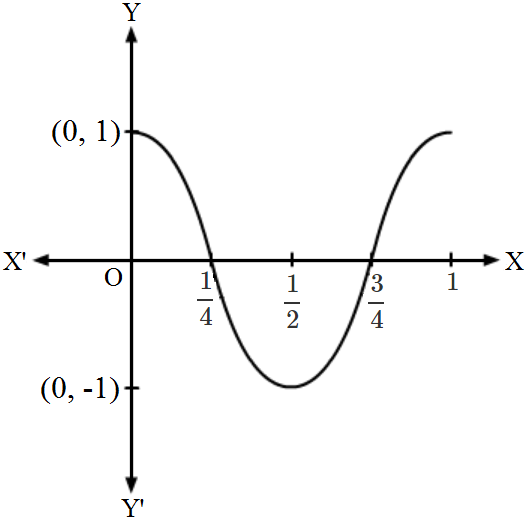
$\text{g(x)}=\cos2\pi\text{x}$
Answer$\text{g(x)}=\cos2\pi\text{x}$
$\text{y}=\cos2\pi\text{x}$
The following graph is:
View full question & answer→Question 525 Marks
Sketch the graphs of the following trigonometric functions:
$\text{h(x)}=\cos^22\text{x}$
Answer$\text{h(x)}=\cos^22\text{x}$ $\text{y}=\cos^22\text{x}$ The following graph is: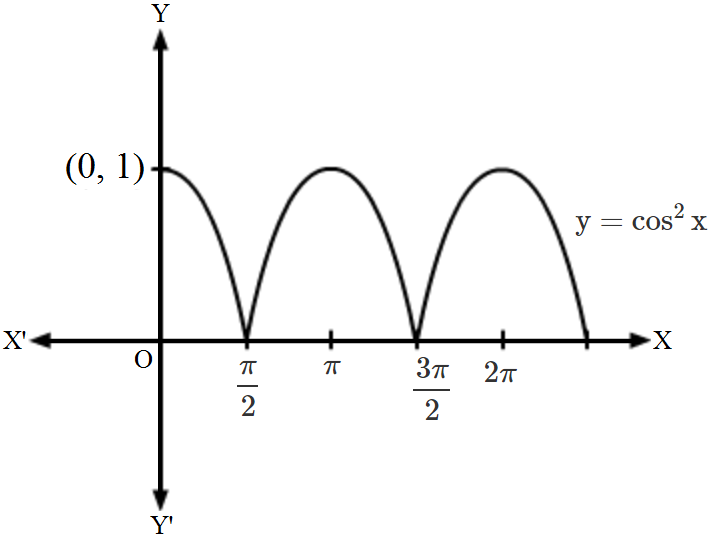
View full question & answer→Question 535 Marks
Sketch the graphs of the following functions:
$\text{f(x)}=\cot2\text{x}$
Answer$\text{f(x)}=\cot2\text{x}$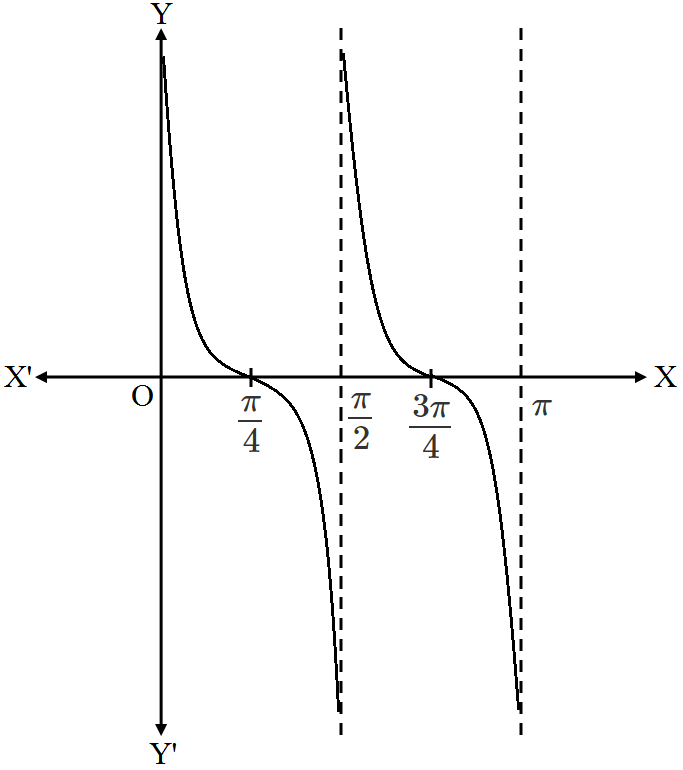
View full question & answer→Question 545 Marks
Sketch the graphs of the following functions:
$\text{f(x)}=3\sec\text{x}$
Answer$\text{f(x)}=3\sec\text{x}$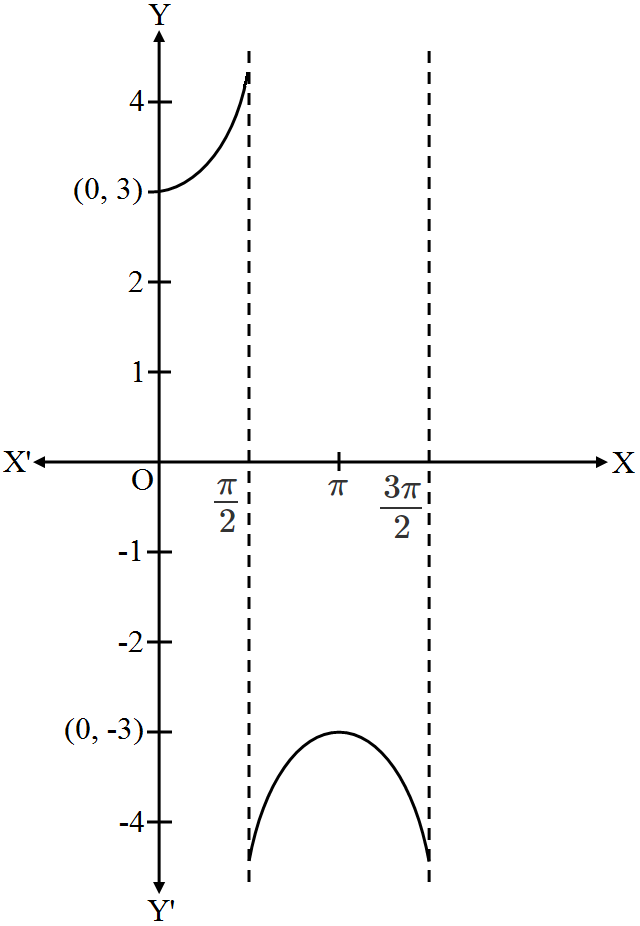
View full question & answer→Question 555 Marks
Prove that:
$\frac{\sin11\text{A}\sin\text{A}+\sin7\text{A}\sin3\text{A}}{\cos11\text{A}\sin\text{A}+\cos7\text{A}\sin3\text{A}}=\tan8\text{A}$
AnswerWe have,
$\text{LHS}=\frac{\sin11\text{A}\sin\text{A}+\sin7\text{A}\sin3\text{A}}{\cos11\text{A}\sin\text{A}+\cos7\text{A}\sin3\text{A}}$
$=\ \frac{2(\sin11\text{A}\sin\text{A}+\sin7\text{A}\sin3\text{A})}{2(\cos11\text{A}\sin\text{A}+\cos7\text{A}\sin3\text{A})}$
$=\ \frac{2\sin11\text{A}\sin\text{A}+2\sin7\text{A}\sin3\text{A}}{2\sin11\text{A}\sin\text{A}+2\cos7\text{A}\sin3\text{A}}$
$=\ \frac{\cos(11\text{A}-\text{A})-\cos(11\text{A}+\text{A})+\cos(7\text{A}-3\text{A})-\cos(7\text{A}+3\text{A})}{\sin(11\text{A}+\text{A})-\sin(11\text{A}-\text{A})+\sin(7\text{A}+3\text{A})-\sin(7\text{A}-3\text{A})]}$
$=\ \frac{\cos10\text{A}-\cos12\text{A}+\cos4\text{A}-\cos10\text{A}}{\sin12\text{A}-\sin10\text{A}+\sin10\text{A}-\sin4\text{A}}$
$=\ \frac{-(\cos12\text{A}-\cos4\text{A})}{\sin12\text{A}-\sin4\text{A}}$
$=\ \frac{-\Big[2\sin\Big(\frac{12\text{A}+4\text{A}}{2}\Big)\sin\Big(\frac{12\text{A}-4\text{A}}{2}\Big)\Big]}{2\sin\Big(\frac{12\text{A}-4\text{A}}{2}\Big)\cos\Big(\frac{12\text{A}+4\text{A}}{2}\Big)}$
$=\ \frac{2\sin8\text{A}\sin4\text{A}}{2\sin4\text{A}\cos8\text{A}}$
$=\ \frac{\sin8\text{A}}{\cos8\text{A}}$
$=\ \tan8\text{A}$
$=\ \text{RHS}$
$\therefore\ \frac{\sin11\text{A}\sin\text{A}+\sin7\text{A}\sin3\text{A}}{\cos11\text{A}\sin\text{A}+\cos7\text{A}\sin3\text{A}}=\tan8\text{A}$ Hence proved.
View full question & answer→Question 565 Marks
If $\cos\alpha+\cos\beta=0=\sin\alpha+\sin\beta,$ then prove that $\cos2\alpha+\cos2\beta=-2\cos(\alpha+\beta).$
$\big[$Hint: $(\cos\alpha+\cos\beta)^2-(\sin\alpha+\sin\beta)^2=0\big]$
AnswerGiven that: $\cos\alpha+\cos\beta=0\ \dots\dots(\text{i})$
and $\sin\alpha+\sin\beta=0\ \dots\dots(\text{ii})$
From (i) and (ii) we have
$(\cos\alpha+\cos\beta)^2-(\sin\alpha+\sin\beta)^2=0$
View full question & answer→Question 575 Marks
Sketch the graphs of the following functions:
$\text{f(x)}=\cot^2\text{x}$
Answer$\text{f(x)}=\cot^2\text{x}$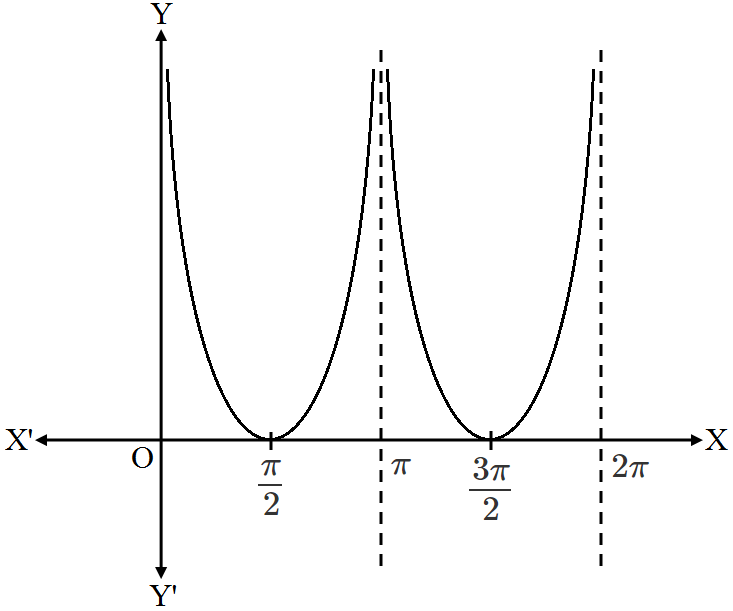
View full question & answer→Question 585 Marks
$\text{a}\cos\text{A + b}\cos\text{B + c}\cos\text{C = 2b}\sin\text{A}\sin\text{C}$
AnswerBy sine rule, we know that
$\frac{\text{a}}{\sin\text{A}}=\frac{\text{b}}{\sin\text{B}}=\frac{\text{c}}{\sin\text{C}}=\text{k }\text{(say)}$
$\Rightarrow\text{a = k}\sin\text{A, b = k}\sin\text{B, c = k}\sin\text{C}$
Now,
$\text{LHS}=\text{a}\cos\text{A + b}\cos\text{B + c}\cos\text{C}$
$=\text{k}\sin\text{A}\cos\text{A + k}\sin\text{B}\cos\text{B + k}\sin\text{C}\cos\text{C}$
$=\frac{\text{k}}{2}(2\sin\text{A}\cos\text{A}+2\sin\text{B}\cos\text{B}+2\sin\text{C}\cos\text{C})$
$=\frac{\text{k}}{2}(\sin2\text{A}+\sin2\text{B}+2\sin\text{C}\cos\text{C})$
$=\frac{\text{k}}{2}\Big(2\sin\frac{2\text{A}+2\text{B}}{2}\cos\frac{2\text{A}-2\text{B}}{2}+2\sin\text{C}\cos\text{C}\Big)$
$=\frac{\text{k}}{2}(2\sin(\text{A + B})\cos(\text{A}-\text{B})+2\sin\text{C}\cos\text{C})$
$=\frac{\text{k}}{2}(2\sin(\pi-\text{C})\cos(\text{A}-\text{B})+2\sin\text{C}\cos\text{C})$ $(\because\text{A + B + C}=\pi)$
$=\frac{\text{k}}{2}(2\sin\text{C}\cos(\text{A}-\text{B})+2\sin\text{C}\cos\text{C})$
$=\frac{\text{k}}{2}\times2\sin\text{C}(\cos(\text{A}-\text{B})+\cos\text{C})$
$=\text{k}\sin\text{C}\Big(2\cos\Big(\frac{\text{A}-\text{B + C}}{2}\Big)\cos\Big(\frac{\text{A}-\text{B}-\text{C}}{2}\Big)\Big)$
$=\text{k}\sin\text{C}\Big(2\cos\Big(\frac{\pi-\text{B}-\text{B}}{2}\Big)\cos\Big(\frac{\text{B}+\text{C}-\text{A}}{2}\Big)\Big)$ $(\because\text{A + B + C}=\pi)$
$=\text{k}\sin\text{C}\Big(2\cos\Big(\frac{\pi-2\text{B}}{2}\Big)\cos\Big(\frac{\pi-2\text{A}}{2}\Big)\Big)$ $(\because\text{A + B + C}=\pi)$
$=\text{k}\sin\text{C}\Big(2\cos\Big(\frac{\pi}{2}-\text{B}\Big)\cos\Big(\frac{\pi}{2}-\text{A}\Big)\Big)$
$=2\text{k}\sin\text{C}(\sin\text{B}\sin\text{A})$
$=2(\text{k}\sin\text{B})\sin\text{A}\sin\text{C}$
$=2\text{b}\sin\text{A}\sin\text{C}$
$=\text{RHS}$
$\therefore\text{LHS = RHS}$
Hence, $\text{a}\cos\text{A + b}\cos\text{B + c}\cos\text{C = 2 b}\sin\text{A}\sin\text{C}.$
View full question & answer→Question 595 Marks
Prove that:
$\frac{\sin\text{A}+\sin\text{B}}{\sin\text{A}-\sin\text{B}}=\tan\Big(\frac{\text{A}-\text{B}}{2}\Big)\cot\Big(\frac{\text{A}-\text{B}}{2}\Big)$
AnswerWe have,
$\text{LHS}=\frac{\sin\text{A}+\sin\text{B}}{\sin\text{A}-\sin\text{B}}$
$=\ \frac{2\sin\Big(\frac{\text{A}+\text{B}}{2}\Big)\cos\Big(\frac{\text{A}-\text{B}}{2}\Big)}{2\sin\Big(\frac{\text{A}-\text{B}}{2}\Big)\cos\Big(\frac{\text{A}+\text{B}}{2}\Big)}$
$=\ \frac{\sin\Big(\frac{\text{A}+\text{B}}{2}\Big)\cos\Big(\frac{\text{A}-\text{B}}{2}\Big)}{\cos\Big(\frac{\text{A}+\text{B}}{2}\Big)\sin\Big(\frac{\text{A}-\text{B}}{2}\Big)}$
$= \tan\Big(\frac{\text{A+B}}{2}\Big)\cot\Big(\frac{\text{A}-\text{B}}{2}\Big)$
$=\ \text{RHS}$
$\therefore\ \frac{\sin\text{A}+\sin\text{B}}{\sin\text{A}-\sin\text{B}}=\tan\Big(\frac{\text{A+B}}{2}\Big)\cot\Big(\frac{\text{A}-\text{B}}{2}\Big).$ Hence proved.
View full question & answer→Question 605 Marks
Prove that:
$\frac{\cos\text{A}+\cos\text{B}}{\cos\text{B}-\cos\text{A}}=\cot\Big(\frac{\text{A}-\text{B}}{2}\Big)\cot\Big(\frac{\text{A}-\text{B}}{2}\Big)$
AnswerWe have,
$\text{LHS}=\frac{\cos\text{A}+\cos\text{B}}{\cos\text{B}-\cos\text{A}}$
$=\ \frac{2\cos\Big(\frac{\text{A}+\text{B}}{2}\Big)\cos\Big(\frac{\text{A}-\text{B}}{2}\Big)}{-2\sin\Big(\frac{\text{B}+\text{A}}{2}\Big)\sin\Big(\frac{\text{B}-\text{A}}{2}\Big)}$
$=\ \frac{-\cos\Big(\frac{\text{A}+\text{B}}{2}\Big)\cos\Big(\frac{\text{A}-\text{B}}{2}\Big)}{\sin\Big(\frac{\text{A}+\text{B}}{2}\Big)\sin\Big(\frac{\text{B}-\text{A}}{2}\Big)}$
$=\ \frac{-\cos\Big(\frac{\text{A}+\text{B}}{2}\Big)\cos\Big(\frac{\text{A}-\text{B}}{2}\Big)}{-\sin\Big(\frac{\text{A}+\text{B}}{2}\Big)\sin\Big(\frac{\text{A}-\text{B}}{2}\Big)}$
$= \cot\Big(\frac{\text{A+B}}{2}\Big)\cot\Big(\frac{\text{A}-\text{B}}{2}\Big)$
$=\ \text{RHS}$
$\therefore\ \frac{\cos\text{A}+\cos\text{B}}{\cos\text{B}-\cos\text{A}}=\cot\Big(\frac{\text{A+B}}{2}\Big)\cot\Big(\frac{\text{A}-\text{B}}{2}\Big).$ Hence proved.
View full question & answer→Question 615 Marks
Find the general solution of the equation $5\cos^2\theta+7\sin^2\theta-6=0$
Answer$5\cos^2\theta+7\sin^2\theta-6=0$
$\Rightarrow5\cos^2\theta+7(1-\cos^2\theta)-6=0$ $[\because\cos^2\alpha+\sin^2\alpha=1]$
$\Rightarrow5\cos^2\theta+7-7\cos^2\theta-6=0\Rightarrow-2\cos^2\theta+1=0$
$\Rightarrow2\cos^2\theta=1\Rightarrow\cos^2\theta=\frac{1}{2}$
$\Rightarrow\cos^2\theta=\cos^2\frac{\pi}{4}$
$\Rightarrow\frac{1+\cos2\theta}{2}=\frac{1+\cos\frac{\pi}{2}}{2}\Rightarrow\cos2\theta=\cos\frac{\pi}{2}$
$\Rightarrow2\theta=2\text{n}\pi\pm\frac{\pi}{2}$ $[\because\cos\theta=\cos\alpha\Rightarrow\theta=2\text{n}\pi\pm\alpha,\text{n}\in\text{z}]$
$\therefore\theta=\text{n}\pi\pm\frac{\pi}{4}$
Hence, the general solution of $\theta=\text{n}\pi\pm\frac{\pi}{4},\text{n}\in\text{Z}.$
View full question & answer→Question 625 Marks
Show that:
$\sin25^\circ\cos115^\circ=\frac{1}{2}(\sin140^\circ-1)$
Answer$\text{LHS}=\ \sin25^\circ\cos115^\circ$
$=\ \frac{2\sin25^\circ\cos115^\circ}{2}$
We Know that
$2\sin\text{A}\cos\text{B}=\sin(\text{A+B})+\sin(\text{A}-\text{B})$
$=\ \frac{1}{2}[\sin(25^\circ+115^\circ)+\sin(25^\circ-115^\circ)]$
$=\ \frac{1}{2}[\sin140^\circ+\sin(-90^\circ)]$
$\sin(-\theta)=-\sin\theta$
$\text{And},\sin(90^\circ+\theta)=\cos\theta$
$\Rightarrow\ \frac{1}{2}[\sin(90^\circ+50^\circ)-\sin90^\circ]$
$=\ \frac{1}{2}[\cos50^\circ-1]$
Also,
$\cos\theta=\sin(90^\circ+\theta)$
$\cos50^\circ=\sin(90^\circ+50^\circ)=\sin140^\circ$
$\frac{1}{2}[\sin140^\circ-1]=\text{RHS}$
View full question & answer→Question 635 Marks
Find the general solutions of the following equations:
$3\cos^{2}\text{x}-2\sqrt{3}\sin\text{x}\cos\text{x}-3\sin^{2}\text{x}=0$
AnswerWe have,
$3\cos^{2}\text{x}-2\sqrt{3}\sin\text{x}\cos\text{x}-3\sin^{2}\text{x}=0$
$\sqrt{3}\cos^{2}\text{x}-2\sin\text{x}\cos\text{x}-\sqrt{3}\sin^{2}\text{x}=0$ $(\text{Divided by}\sqrt{3})$
$\sqrt{3}\cos^{2}\text{x}-\sin\text{x}\cos\text{x}-3\sin\text{x}\cos\text{x}\sqrt{3}\sin^{2}\text{x}=0$
$\cos\text{x}(\sqrt{3}\cos\text{x}+\sin\text{x})-\sqrt{3}\sin\text{x}(\sqrt{3}\cos\text{x}+\sin\text{x})=0$
$(\sqrt{3}\cos\text{x}+\sin\text{x})(\cos\text{x}-\sqrt{3}\sin\text{x})=0$
$\sqrt{3}\cos\text{x}+\sin\text{x}=0$ or $\cos\text{x}-\sqrt{3}\sin\text{x}=0$
$\tan\text{x}=-\sqrt{3}=-\tan\frac{\pi}{3}$ or $\tan\text{x}=\frac{1}{\sqrt{3}}=\tan\frac{\pi}{6}$
$\text{x}=\text{n}\pi-\frac{\pi}{3}$ or $\text{x}=\text{m}\pi-\frac{\pi}{6}$
$\text{n,m}\in\text{z}$
View full question & answer→Question 645 Marks
Sketch the graphs of the following curves on the same scale and the same axes:
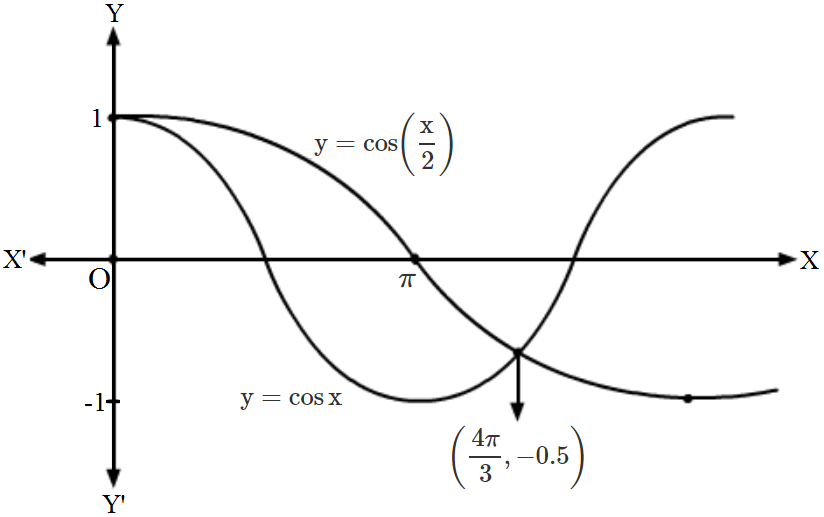
$\text{y}=\cos\text{x}$ and $\text{y}=\cos\frac{\text{x}}{2}$
AnswerFirst, we draw the graph of $\text{y}=\cos\text{x}.$
Let us now draw the graph of $\text{y}=\cos\Big(\frac{\text{x}}{2}\Big).$
$\Rightarrow\text{y}=\cos\frac{1}{2}(\text{x})$
Then, we will obtain the following graph:
View full question & answer→Question 655 Marks
Solve the following equations:
$\sin2\text{x}-\sin4\text{x}+\sin6\text{x}=0$
Answer$\sin2\text{x}-\sin4\text{x}+\sin6\text{x}=0$
$(\sin2\text{x}+\sin6\text{x})-\sin4\text{x}=0$
$2.\sin\Big(\frac{8\text{x}}{2}\Big).\cos\Big(\frac{4\text{x}}{2}\Big)-\sin4\text{x}=0$
$2\sin4\text{x}.\cos2\text{x}-\sin4\text{x}=0$
$\sin4\text{x}(2\cos2\text{x}-1)=0$
$\sin4\text{x}=0$ or $2\cos2\text{x}-1=0$
$4\text{x}=\text{n}(\pi)$ or $\cos2\text{x}=\frac{1}{2}$
$\text{x}=[\frac{\text{n}\pi}{4}]$ or $\cos2\text{x}=\cos[\frac{\pi}{3}]$
$\text{x}=[\frac{\text{n}\pi}{4}]$ or $\text{x}=\text{n}(\pi)\pm[\frac{\pi}{6}]$
View full question & answer→Question 665 Marks
Prove that:
$\frac{\sin(\theta+\phi)-2\sin\theta+\sin(\theta-\phi)}{\cos(\theta+\phi)-2\cos\theta+\cos(\theta-\phi)}=\tan\theta$
AnswerWe have,
$\text{LHS}=\frac{\sin(\theta+\phi)-2\sin\theta+\sin(\theta-\phi)}{\cos(\theta+\phi)-2\cos\theta+\cos(\theta-\phi)}$
$=\ \frac{\sin(\theta+\phi)+\sin(\theta-\phi)-2\sin\theta}{\cos(\theta+\phi)+\cos(\theta-\phi)-2\cos\theta}$
$=\ \frac{2\sin\Big[\frac{(\theta+\phi)+(\theta-\phi)}{2}\Big]\cos\Big[\frac{(\theta+\phi)-(\theta-\phi)}{2}\Big]-2\sin\theta}{2\cos\Big[\frac{(\theta+\phi)+(\theta-\phi)}{2}\Big]\cos\Big[\frac{(\theta+\phi)-(\theta-\phi)}{2}\Big]-2\cos\theta}$
$=\ \frac{2\sin(\theta)\cos(\phi)-2\sin(\theta)}{2\cos(\theta)\cos(\phi)-2\cos\theta}$
$=\ \frac{2\sin\theta(\cos\phi-1)}{2\cos\theta(\cos\phi-1)}$
$=\ \frac{\sin\theta}{\cos\theta}=\tan\theta$
$=\ \text{RHS}$
$\therefore\ \frac{\sin(\theta+\phi)-2\sin\theta+\sin(\theta-\phi)}{\cos(\theta+\phi)-2\cos\theta+\cos(\theta-\phi)}=\tan\theta$ Hence proved.
View full question & answer→Question 675 Marks
If $\alpha\text{ and }\beta$ are two solutions of the equation $\text{a}\tan\text{x+b}\sec\text{x}=\text{c},$ the find the value of $\sin(\alpha+\beta)\text{ and }\cos(\alpha+\beta).$
Answer$\text{a}\tan\text{x}+\text{b}\sec\text{x}=\text{c}$
$\Rightarrow(\text{c}-\text{a}\tan\text{x})=\text{b}\sec\text{x}$
$\Rightarrow(\text{c}-\text{a}\tan\text{x})^2=(\text{b}\sec\text{x})^2$
$\Rightarrow\text{c}^2+\text{a}^2\tan^2\text{x}-2\text{a}\text{c}\tan\text{x}=\text{b}^2\sec^2\text{x}$
$\Rightarrow\text{c}^2+\text{a}^2\tan^2\text{x}-2\text{a}\text{c}\tan\text{x}=\text{b}^2(1+\tan^2\text{x)}$
$\Rightarrow(\text{a}^2-\text{b}^2)\tan^2\text{x}-2\text{a}\text{c}\tan\text{x}+\text(\text{c}^2-\text{b}^2)=0$
This is a quadratic in $\tan\text{x}.$
It has two solutions $\tan\alpha\text{ and }\tan\beta.$
$\tan\alpha\text{ and }\tan\beta=\frac{2\text{ac}}{\text{a}^2-\text{b}^2}$
$\tan\alpha\times\tan\beta=\frac{\text{c}^2-\text{b}^2}{\text{a}^2-\text{b}^2}$
$\therefore\tan(\alpha+\beta)=\frac{\tan\alpha+\tan\beta}{1-\tan\alpha\tan\beta}$
$=\frac{\frac{2\text{ac}}{\text{a}^2-\text{b}^2}}{1-\frac{\text{c}^2-\text{b}^2}{\text{a}^2-\text{b}^2}}=\frac{2\text{ac}}{\text{a}^2-\text{c}^2}$
Hence, $\sin(\alpha+\beta)=\frac{ 2\text{ac}}{\text{a}^2-\text{b}^2}\text{ and }\cos(\alpha+\beta)=\frac{\text{a}^2-\text{c}^2}{\text{a}^2+\text{b}^2}.$
View full question & answer→Question 685 Marks
$\text{If}\ \text{x}\cos\theta=\text{y}\cos\Big(\theta+\frac{2\pi}{3}\Big)=\text{z}\cos\Big(\theta+\frac{4\pi}{3}\Big),$
prove that $\text{xy}+\text{yz}+\text{zx}=0.$
AnswerGiven $\text{x}\cos\theta=\text{y}\cos\Big(\theta+\frac{2\pi}{3}\Big)=\text{z}\cos\Big(\theta+\frac{4\pi}{3}\Big)=\text{k}(\text{say})$
$\text{x}=\frac{\text{k}}{\cos\theta}$
$\text{y}=\frac{\text{k}}{\cos\Big(\theta+\frac{2\pi}{3}\Big)}$
$\text{z}=\frac{\text{k}}{\cos\Big(\theta+\frac{4\pi}{3}\Big)}$
$\text{xy}+\text{yz}+\text{zx}=\text{k}^2\Bigg[\frac{1}{\cos\theta\cos\big(\theta+\frac{2\pi}{3}\big)}+\frac{1}{\cos\big(\theta+\frac{2\pi}{3}\big)\cos\big(\theta+\frac{4\pi}{3}\big)}+\frac{1}{\cos\big(\theta+\frac{4\pi}{3}\big)\cos\theta}\Bigg]$
$=\ \text{k}^2\Bigg[\frac{\cos\big(\theta+\frac{4\pi}{3}\big)+\cos\theta+\cos\big(\theta+\frac{2\pi}{3}\big)}{\cos\theta\cos\big(\theta+\frac{2\pi}{3}\big)\cos\big(\theta+\frac{4\pi}{3}\big)}\Bigg]$
$=\ \text{k}^2\Bigg[\frac{\cos\theta\cos\frac{4\pi}{3}-\sin\theta\sin\frac{4\pi}{3}+\cos\theta+\cos\theta\cos\frac{2\pi}{3}-\sin\theta\sin\frac{2\pi}{3}}{\cos\theta\cos\big(\theta+\frac{2\pi}{3}\big)\cos\big(\theta+\frac{4\pi}{3}\big)}\Bigg]$
$=\ \text{k}^2\Bigg[\frac{\cos\theta\big(\frac{-1}{2}\big)-\sin\theta\big(\frac{-\sqrt3}{2}\big)+\cos\theta+\cos\theta\big(\frac{-1}{2}\big)-\sin\theta\big(\frac{\sqrt3}{2}\big)}{\cos\theta\cos\big(\theta+\frac{2\pi}{3}\big)\cos\big(\theta+\frac{4\pi}{3}\big)}\Bigg]$
$=\ \text{k}^2\Bigg[\frac{-\cos\theta+\sin\theta\big(\frac{\sqrt3}{2}\big)+\cos\theta+-\sin\theta\big(\frac{\sqrt3}{2}\big)}{\cos\theta\cos\big(\theta+\frac{2\pi}{3}\big)\cos\big(\theta+\frac{4\pi}{3}\big)}\Bigg]$
$=\ 0$
Hence proved.
View full question & answer→Question 695 Marks
If $\sin(\alpha+\beta)=1$ and $\sin(\alpha-\beta)=\frac{1}{2}$ where $0\leq\alpha,\beta\leq\frac{\pi}{2}$ than find the values of $\tan(\alpha+2\beta)$and $\tan(2\alpha+\beta).$
AnswerWe have,
$\sin(\alpha+\beta)=1$
$\Rightarrow\sin(\alpha-\beta)=\frac{\pi}{2}$
$\Rightarrow\alpha+\beta=\frac{\pi}{2}\ ...(1)$
and, $\sin(\alpha-\beta)=\frac{1}{2}$
$\Rightarrow\sin(\alpha-\beta)=\sin\frac{\pi}{6}$
$\Rightarrow\alpha-\beta=\frac{\pi}{6}\ ...(2)$
Adding equations (1) and (2), we get
$2\alpha=\frac{\pi}{2}+\frac{\pi}{6}=\frac{4\pi}{6}=\frac{2\pi}{3}$
$\Rightarrow\alpha=\frac{\pi}{3}$
Putting in equation (1), we get
$\frac{\pi}{3}+\beta =\frac{\pi}{2}$
$\Rightarrow\beta=\frac{\pi}{2}-\frac{\pi}{2}$$\Rightarrow \beta=\frac{3\pi-2\pi}{6}$$=\frac{\pi}{6}$
$\Rightarrow\beta=\frac{\pi}{6}$
Now, $\tan(\alpha+2\beta)=\tan\Big(\frac{\pi}{3}+2\times\frac{\pi}{6}\Big)$
$=\tan\Big(\frac{\pi}{3}+\frac{\pi}{3}\Big)$$=-\cot\frac{\pi}{6}$$=-\sqrt{3}$$[\because\tan\theta $ negative in second quadrant and, $\tan(2\alpha+\beta)=\tan\Big(2\times\frac{\pi}{3}+\frac{\pi}{3}\Big)$
$=\tan\Big(\frac{2\pi}{3}+\frac{\pi}{6}\Big)$$=\tan\Big(\frac{4\pi+\pi}{6}\Big)$$=\tan\Big(\frac{5\pi}{6}\Big)$
$=\tan\Big(\frac{\pi}{2}+\frac{\pi}{3}\Big)$$=-\cot\frac{\pi}{3}$$[\because\tan\theta$ is negative in second quadrant$]$
$\because\tan(2\alpha+\beta)=\frac{-1}{\sqrt{3}}$
View full question & answer→Question 705 Marks
Prove that:
$\cos10^\circ\cos30^\circ\cos50^\circ\cos70^\circ=\frac{3}{16}$
Answer$\cos10^\circ\cos30^\circ\cos50^\circ\cos70^\circ=\frac{3}{16}$
$\text{LHS}=\cos10^\circ\cos30^\circ\cos50^\circ\cos70^\circ$
$=\ \cos30^\circ\cos10^\circ\cos50^\circ\cos70^\circ$
$=\ \frac{\sqrt3}{2}(\cos10^\circ\cos50^\circ\cos70^\circ)$
$=\ \frac{\sqrt3}{2}(\cos10^\circ\cos50^\circ)\cos70^\circ$
$=\ \frac{\sqrt3}{2}(2\cos10^\circ\cos50^\circ)\cos70^\circ$$[\text{Multiplying and dividing by 2}]$
Also,
$\Rightarrow\ 2\cos\text{A}\cos\text{B}=\cos(\text{A+B})+\cos(\text{A}-\text{B})\ \dots(\text{i})$
$=\ \frac{\sqrt3}{4}\cos70^\circ(\cos(50^\circ+10^\circ)+\cos(10^\circ-50^\circ))$
$=\ \frac{\sqrt3}{4}\cos70^\circ(\cos60^\circ+(-40^\circ))$
Now,
$\cos(-\theta)=\cos\theta$
$=\ \frac{\sqrt3}{4}\cos70^\circ\Big(\frac{1}{2}+\cos40^\circ\Big)\Big[\because\cos60^\circ=\frac{1}{2}\Big]$
$=\ \frac{\sqrt3}{8}\cos70^\circ+\frac{\sqrt3}{4}\cos70^\circ\cos40^\circ$
$=\ \frac{\sqrt3}{8}\cos70^\circ+\frac{\sqrt3}{8}(2\cos70^\circ\cos40^\circ)$
$=\ \frac{\sqrt3}{8}[\cos70^\circ+\cos(70^\circ+40^\circ)+\cos(70^\circ-40^\circ)][\text{from(i)}]$
$=\ \frac{\sqrt3}{8}[\cos70^\circ+\cos110^\circ+\cos30^\circ]$
$=\ \frac{\sqrt3}{8}\Big[\cos70^\circ+\cos(180^\circ-70^\circ)+\frac{\sqrt3}{2}\Big]$
$=\ \frac{\sqrt3}{8}\Big[\cos70^\circ-\cos70^\circ+\frac{\sqrt3}{2}\Big][\because\cos(180^\circ-\theta)=-\cos\theta]$
$=\ \frac{\sqrt3}{8}\times\frac{\sqrt3}{2}=\frac{3}{16}$
$=\ \text{RHS}$
View full question & answer→Question 715 Marks
Solve the following equation:
$2\cos^{2}\text{x}-5\cos\text{x}+2=0$
AnswerWe have,
$2\cos^{2}\text{x}-5\cos\text{x}+2=0$
$\Rightarrow2\cos^{2}\text{x}-4\cos\text{x}-\cos\text{x}+2=0$ [Use factorization]
$\Rightarrow2\cos\text{x}(\cos\text{x}-2)-1(\cos\text{x}-2)=0$
$\Rightarrow(2\cos\text{x}-1)(\cos\text{x}-2)=0$
$\Rightarrow\text{Either}$
$2\cos\text{x}-1=0$ or $\cos\text{x}-2=0$
$\Rightarrow\cos\text{x}=\frac{1}{2}$ or $\cos\text{x}=2$
$\Rightarrow\cos\text{x}=\cos\frac{\pi}{3}$ $\big[$This is not possible as $-1<\cos\text{x}<1\big]$
$\Rightarrow\text{x}=2\text{n}\pi\pm\frac{\pi}{3},\text{n}\in\text{z}$
Thus,
$\text{x}=2\text{n}\pi\pm\frac{\pi}{3},\text{n}\in\text{z}$
View full question & answer→Question 725 Marks
Prove that:
$\cos6^\circ\cos42^\circ\cos66^\circ\cos78^\circ=\frac{1}{16}$
Answer$\text{LHS}=\cos6^\circ\cos42^\circ\cos66^\circ\cos78^\circ$
$=\frac{1}{4}(2\cos6^\circ\cos66^\circ)(2\cos42^\circ\cos78^\circ)$
$=\frac{1}{4}(\cos72^\circ+\cos60^\circ)(\cos120^\circ+\cos36^\circ)$ $[\because2\cos\text{A}\cos\text{B}=\cos(\text{A+B})+\cos(\text{A}-\text{B})]$
$=\frac{1}{4}\big\{\cos(90^\circ-72^\circ)+\frac{1}{2}\big\}\Big\{-\frac{1}{2}+\frac{\sqrt{5}+1}{4}\Big\}$
$=\frac{1}{4}\big(\sin18^\circ+\frac{1}{2}\big)\Big(-\frac{1}{2}+\frac{\sqrt{5}+1}{4}\Big)$
$=\frac{1}{4}\Big(\frac{\sqrt{5}-1}{4}+\frac{1}{2}\Big)\Big(\frac{\sqrt{5}+1}{4}+\frac{1}{2}\Big)$
$=\frac{1}{4}\Big(\frac{\sqrt{5}-1+2}{4}\Big)\Big(\frac{\sqrt{5}+1-2}{4}\Big)$
$=\frac{1}{64}(\sqrt{5}+1)(\sqrt{5}-1)$
$=\frac{1}{64}(5-1)$
$=\frac{1}{16}=\text{RHS}$
Hence proved
View full question & answer→Question 735 Marks
Prove that:
$\tan20^\circ\tan30^\circ\tan40^\circ\tan80^\circ=1$
Answer$\text{LHS}=\tan20^\circ\tan30^\circ\tan40^\circ\tan80^\circ$
$\frac{1}{\sqrt3}(\tan20^\circ\tan40^\circ\tan80^\circ)$$\Big[\because\ \tan30^\circ=\frac{1}{\sqrt3}\Big]$
$=\ \frac{(\sin20^\circ\sin40^\circ\sin80^\circ)}{(\cos20^\circ\cos40^\circ\cos80^\circ)\sqrt3}$
$=\ \frac{(2\sin20^\circ\sin40^\circ)\sin80^\circ}{\sqrt3(2\cos20^\circ\cos40^\circ)\cos80^\circ}$
Applying
$\Rightarrow\ 2\sin\text{A}\sin\text{B}=\cos(\text{A}-\text{B})-\cos(\text{A+B})$
$2\cos\text{A}\cos\text{B}=\cos(\text{A+B})+\cos(\text{A}-\text{B})$
$=\ \frac{(\cos(40^\circ-20^\circ)-\cos(20^\circ+40^\circ))\sin80^\circ}{\cos(20^\circ+40^\circ)+\cos(40^\circ-20^\circ)\cos80^\circ\sqrt3}$
$=\ \frac{(\cos20^\circ-\cos60^\circ)\sin80^\circ}{\sqrt3(\cos60^\circ+\cos20^\circ)\cos80^\circ}$
$=\ \frac{\Big(\cos20^\circ-\frac{1}{2}\Big)\sin80^\circ}{\sqrt3\Big(\frac{1}{2}+\cos20^\circ\Big)\cos80^\circ}$
$=\ \frac{2\sin20^\circ\sin80^\circ-\sin80^\circ}{\sqrt3(\cos80^\circ+2\cos20^\circ\cos80^\circ)}$
Now,
$\Rightarrow\ 2\sin\text{A}\cos\text{B}=\sin(\text{A+B})+\sin(\text{A}-\text{B})$
$=\ \frac{\sin(80^\circ+20^\circ)+\sin(80^\circ-20^\circ)-\sin80^\circ}{\sqrt3(\cos80^\circ+\cos(20^\circ+80^\circ)+\cos(80^\circ-20^\circ))}$
$=\ \frac{\sin100^\circ+\sin60^\circ-\sin80^\circ}{\sqrt3(\cos80^\circ+\cos100^\circ+\cos60^\circ)}$
$=\ \frac{\sin100^\circ+\sin60^\circ-\sin(80^\circ-100^\circ)}{\sqrt3(\cos80^\circ+\cos(1800^\circ-80^\circ)+\sin60^\circ)}$
$=\ \frac{\sin100^\circ+\frac{\sqrt3}{2}-\sin100^\circ}{\sqrt3(\cos80^\circ-\cos80^\circ+\cos60^\circ)}$
$=\ \frac{\frac{\sqrt3}{2}}{\sqrt3\big(\frac{1}{2}\big)}=1=\ \text{RHS}$
View full question & answer→Question 745 Marks
Prove that: $\frac{\tan\text{(A}+\text{B)}}{\cot\text{(A}-\text{B)}}=\frac{\tan^2\text{A}-\tan^2\text{B}}{1-\tan^2\text{A}\tan^2\text{B}}$
Answer$\text{L.H.S}=\frac{\tan\text{(A}+\text{B)}}{\cot\text{(A}-\text{B)}}$
$=\frac{\frac{\tan\text{(A}+\text{B)}}{1}}{\tan\text{(A}-\text{B)}}$
$=\tan\text{(A}+\text{B)}\tan\text{(A}-\text{B)}$
$=\Big[\frac{\tan\text{A}+\tan\text{B}}{1-\tan\text{A}\tan\text{B}}\Big]\Big[\frac{\tan\text{A}-\tan\text{B}}{1+\tan\text{A}\tan\text{B}}\Big]$
$=\frac{(\tan\text{A}+\tan\text{B)}(\tan\text{A}-\tan\text{B)}}{(1-\tan\text{A}\tan\text{B)}(1+\tan\text{A}\tan\text{B)}}$
$=\frac{\tan^2\text{A}-\tan^2\text{B}}{1-(\tan\text{A}\tan\text{B)}^2}$
$=\frac{\tan^2\text{A}-\tan^2\text{B}}{1-\tan^2\text{A}\tan^2\text{B}}$ $\big[\because\text{(a}-\text{b)}\text{(a}+\text{b)}=\text{a}^2-\text{b}^2\big]$
$=\text{R.H.S}$
$\therefore\text{L.H.S}=\text{R.H.S}$
Hence proved.
View full question & answer→Question 755 Marks
Solve the following equations:
$\cot\text{x}+\tan\text{x}=2$
Answer$\cot\text{x}+\tan\text{x}=2$
$\Rightarrow\frac{1}{\tan\text{x}}+\tan\text{x}=2$
$\Rightarrow\tan^{2}\text{x}+1=2\tan\text{x}$
$\Rightarrow\tan^{2}\text{x}-2\tan\text{x}+1=0$
$\Rightarrow(\tan\text{x}-1)^{2}=0$
$\Rightarrow\tan\text{x}=1=\tan\frac{\pi}{4}$
$\Rightarrow\text{x}=\text{n}\pi+\frac{\pi}{4},\text{n}\in\text{Z}$ $(\tan\text{x}=\tan\alpha\Rightarrow\text{x}=\text{n}\pi+\alpha,\text{n}\in\text{z)}$
View full question & answer→Question 765 Marks
$\text{a}^2=(\text{b + c})^2-4\text{bc}\cos^2\frac{\text{A}}{2}$
Answer$\text{RHS}=(\text{b + c})^2-4\text{bc}\cos^2\frac{\text{A}}{2}$
$=\text{b}^2+\text{c}^2+2\text{bc}-4\text{bc}\Big(\frac{1+\cos\text{A}}{2}\Big)$
$=\text{b}^2+\text{c}^2+2\text{bc}-2\text{bc}(1+\cos\text{A})$
$=\text{b}^2+\text{c}^2+2\text{bc}(1-1-\cos\text{A})$
$=\text{b}^2+\text{c}^2-2\text{bc}\cos\text{A}$
$=\text{b}^2+\text{c}^2-2\text{bc}\Big(\frac{\text{b}^2+\text{c}^2-\text{a}^2}{2\text{bc}}\Big)$ $\Big(\because\cos\text{A}=\frac{\text{b}^2+\text{c}^2-\text{a}^2}{2\text{bc}}\Big)$
$=\text{b}^2+\text{c}^2-\text{b}^2-\text{c}^2+\text{a}^2$
$=\text{a}^2=\text{LHS}$
Hence proved.
View full question & answer→Question 775 Marks
A wheel makes 360 revolutions per minute. Through how many radians does it turn in 1 second?
AnswerSince A wheel makes 360 revolution in 1 minutes.
wheel will make $\frac{360}{60}$ revolution in 1 secons
That is, 6 revolution in 1 second
Now,
In one revolution the wheel makes 360° angle.
In 6 revolution the wheel makes 360° angle = 2160°
$1^{\circ}=\Big(\frac{\pi}{180}\Big)^{\text{c}}$
$2160^{\circ}=\Big(\frac{2160}{180}\times\pi\Big)^{\circ}$
$=12\pi$
View full question & answer→Question 785 Marks
Prove that:
$\cos\text{x}\cos\frac{\text{x}}{2}-\cos3\text{x}\cos\frac{9\text{x}}{2}=\sin7\text{x}\sin8\text{x}.$
AnswerConsider the left hand side of the given expression:
$\text{LHS}=\cos\text{x}\cos\frac{\text{x}}{2}-\cos{3\text{x}}\cos\frac{9\text{x}}{2}$
We know that $2\cos\text{A}\cos\text{B}=\cos\text{A+B}+\cos(\text{A}-\text{B})$
Thus,
$\text{LHS}=\frac{1}{2}\Big[\cos\Big(\text{x}+\frac{\text{x}}{2}\Big)+\cos\Big(\text{x}-\frac{\text{x}}{2}\Big)-\frac{1}{2}\Big[\cos\Big(3\text{x}+\frac{9\text{x}}{2}\Big)+\cos\Big(3\text{x}-\frac{9\text{x}}{2}\Big)\Big]$
$=\ \frac{1}{2}\Big[\cos\Big(\frac{3\text{x}}{2}\Big)+\cos\Big(\frac{\text{x}}{2}\Big)\Big]-\frac{1}{2}\Big[\cos\Big(\frac{15\text{x}}{2}\Big)+\cos\Big(-\frac{3\text{x}}{2}\Big)\Big]$
$=\ \frac{1}{2}\Big[\cos\Big(\frac{3\text{x}}{2}\Big)-\cos\Big(\frac{\text{x}}{2}\Big)\Big]-\frac{1}{2}\Big[\cos\Big(\frac{15\text{x}}{2}\Big)+\cos\Big(-\frac{3\text{x}}{2}\Big)\Big]$$[\because\ \cos(-\theta)=\cos\theta]$
$=\ \frac{1}{2}\Big[\cos\Big(\frac{3\text{x}}{2}\Big)+\cos\Big(\frac{\text{x}}{2}\Big)-\cos\Big(\frac{15\text{x}}{2}\Big)-\cos\Big(\frac{3\text{x}}{2}\Big)\Big]$
$=\ \frac{1}{2}\Big[\cos\Big(\frac{\text{x}}{2}\Big)-\cos\Big(\frac{15\text{x}}{2}\Big)\Big]$
Also we know that,
$\cos\text{D}-\cos\text{C}=2\sin\frac{\text{C+D}}{2}\sin\frac{\text{C}-\text{D}}{2}$
Therefore,
$\text{LHS}=\frac{1}{2}\times2\sin\frac{\frac{15\text{x}}{2}+\frac{\text{x}}{2}}{2}\sin\frac{\frac{15\text{x}}{2}-\frac{\text{x}}{2}}{2}$
$=\ \sin\frac{\frac{16\text{x}}{2}}{2}\sin\frac{\frac{14\text{x}}{2}}{2}$
$=\ \sin\frac{8\text{x}}{2}\sin\frac{7\text{x}}{2}$
$=\ \text{RHS}$
Note: Question given in the book is incorrect.
RHS should be equal to $\sin\frac{8\text{x}}{2}\sin\frac{7\text{x}}{2}.$
View full question & answer→Question 795 Marks
Prove that:
$\cot\frac{\pi}{8}=\sqrt{2}+1$
AnswerWe know thar,
$\sin\frac{\text{A}}{2}=\pm\sqrt{\frac{1-\cos\text{A}}{2}}$
$\text{put}\ \text{A}=45^\circ$
$\sin22\frac{1^\circ}{2}=\sqrt{\frac{1-\cos45^\circ}{2}}$ $\Big\{\text{since}\sin22\frac{1}{2},\text{is positive}\Big\}$
$=\sqrt{\frac{1-\frac{1}{2}}{2}}$
$\sin22\frac{1^\circ}{2}=\sqrt{\frac{\sqrt{2}-1}{2\sqrt{2}}}$
and
$\cos\frac{\text{A}}{2}\pm\sqrt{\frac{1+\cos\text{A}}{2}}$
$\text{put}\ \text{A}\ 45^\circ$
$\cos22\frac{1^\circ}{2}=\sqrt{\frac{1+\cos45^\circ}{2}}$
$=\sqrt{\frac{1-\frac{1}{2}}{2}}$
$\cos22\frac{1^\circ}{2}=\sqrt{\frac{\sqrt{2}+1}{2\sqrt{2}}}$
Now,
$\cot22\frac{1^\circ}{2}=\frac{\cos22\frac{1^\circ}{2}}{\sin22\frac{1^\circ}{2}}$
$=\sqrt{\frac{\sqrt{2}+1}{2\sqrt{2}}\times\frac{2\sqrt{2}}{\sqrt{2-1}}}$
$=\sqrt{\frac{\sqrt{2}+1}{\sqrt{2}-1}}$
Rationalizing denominator,
$=\sqrt{\frac{\sqrt{2}+1\times\sqrt{2}+1}{\sqrt{2}-1\times\sqrt{2}+1}}$
$=\sqrt{\frac{(\sqrt{2}+1)^2}{2-1}}$
$\cot22\frac{1^\circ}{2}=\sqrt{2}+1$
View full question & answer→Question 805 Marks
Sketch the graphs of the following trigonometric functions:
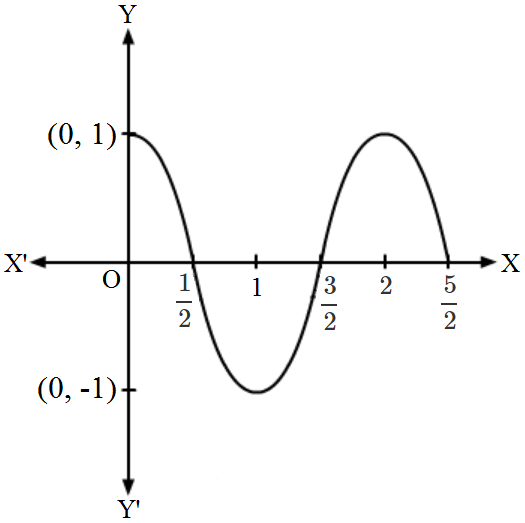
$\text{f(x)}=\cos\pi\text{x}$
Answer$\text{f(x)}=\cos\pi\text{x}$
$\text{y}=\cos\pi\text{x}$
The following graph is:
View full question & answer→Question 815 Marks
$\text{If}\ \text{m}\sin\theta=\text{n}\sin(\theta+2\alpha),$ prove that $\tan(\theta+\alpha)\cot\alpha=\frac{\text{m+n}}{\text{m}-\text{n}}.$
AnswerGiven that $\text{m}\sin\theta=\text{n}\sin(\theta+2\alpha),$
We need to prove that $\tan(\theta+\alpha)=\frac{\text{m+n}}{\text{m}-\text{n}}\tan\alpha$
$\text{m}\sin\theta=\text{n}\sin(\theta+2\alpha)$
$\Rightarrow\ \frac{\sin(\theta+2\alpha)}{\sin\theta}=\frac{\text{m}}{\text{n}}$
Using Componendo - Dividendo, we have,
$\Rightarrow\ \frac{\sin(\theta+2\alpha)+\sin\theta}{\sin(\theta+2\theta)-\sin\theta}=\frac{\text{m+n}}{\text{m}-\text{n}}...(1)$
We know that,
$\sin\text{C}+\sin\text{D}=2\sin\frac{\text{C+D}}{2}\cos\frac{\text{C}-\text{D}}{2}$
and
$\sin\text{C}-\sin\text{D}=2\cos\frac{\text{C+D}}{2}\sin\frac{\text{C}-\text{D}}{2}$
Applying the above formula in equation (1), we have,
$\frac{2\sin\frac{\theta+2\theta+\theta}{2}\cos\frac{\theta+2\theta-\theta}{2}}{2\cos\frac{\theta+2\theta+\theta}{2}\sin\frac{\theta+2\theta-\theta}{2}}=\frac{\text{m+n}}{\text{m}-\text{n}}$
$\Rightarrow\ \frac{2\sin(\theta+\alpha)\cos\alpha}{2\cos(\theta+\alpha)\sin\alpha}=\frac{\text{m+n}}{\text{m}-\text{n}}$
$\Rightarrow\ \frac{\tan(\theta+\alpha)}{\tan\alpha}=\frac{\text{m+n}}{\text{m}-\text{n}}$
$\Rightarrow\ \tan(\theta+\alpha)=\frac{\text{m+n}}{\text{m}-\text{n}}\times\tan\alpha$
Hence proved.
View full question & answer→Question 825 Marks
If $\text{a}=\frac{2\sin\text{x}}{1+\cos\text{x}+\sin\text{x}},$ then proved that $\frac{1-\cos\text{x}+\sin\text{x}}{1+\sin\text{x}}$ is also equal to a.
AnswerWe have, $\frac{2\sin\alpha}{1\cos\alpha+\sin\alpha}=\text{y}$
Now, $\frac{1-\cos\alpha+\sin\alpha}{1+\sin\alpha}=\frac{(1-\cos\alpha+\sin\alpha)}{(1+\sin\alpha)}.\frac{(1+\cos\alpha+\sin\alpha)}{(1+\cos\alpha+\sin\alpha)}$
$=\frac{(1+\sin\alpha)^2-\cos^2\alpha}{(1+\sin\alpha)(1+\sin\alpha+\cos\alpha)}$
$=\frac{1+\sin^2\alpha+2\sin\alpha-1+\sin^2\alpha}{(1+\sin\alpha)(1+\sin\alpha+\cos\alpha)}$
$=\frac{2\sin\alpha(1+\sin\alpha)}{(1+\sin\alpha)(1+\sin\alpha+\cos\alpha)}$
$=\frac{2\sin\alpha}{1+\sin\alpha+\cos\alpha}=\text{y}$
View full question & answer→Question 835 Marks
Prove that:
$\tan82\frac{1^\circ}{2}=(\sqrt{3}+\sqrt{2})(\sqrt{2}+1)=\sqrt{2}+\sqrt{3}+\sqrt{4}+\sqrt{6}$
Answer$\tan82\frac{1^\circ}{2}=\tan\Big(90-7\frac{1}{7}\Big)$
$=\cot7\frac{1^\circ}{2}$
$=\cot\text{A}$ if $\text{A}=7\frac{1^\circ}{2}$
Now,
$\cot\text{x}=\frac{\cos\text{x}}{\sin\text{x}}$
$=\frac{2\cos^2\text{x}}{1\sin\text{x}\cos\text{x}}$
$=\frac{1+\cos^2\text{x}}{\sin^2\text{x}}$
$\cot\text{x}=\frac{1+\cos15}{\sin15}$
$=\frac{1+\cos(45-30)}{\sin15}$
$\frac{1+\Big(\frac{1}{\sqrt{2}}\times\frac{\sqrt{3}}{2}+\frac{1}{\sqrt{2}}\times\frac{1}{2}\Big)}{\frac{1}{\sqrt{2}}\times\frac{\sqrt{3}}{2}-\frac{1}{\sqrt{2}}\times\frac{}{}\frac{1}{2}}$
$=\frac{2\sqrt{2}+(\sqrt{3}+1)}{\sqrt{3}-1}\times\frac{\sqrt{3}+1}{\sqrt{3}+1}$
$=\frac{2\sqrt{2}(\sqrt{3}+1)+(\sqrt{3}+1)^2}{3-1}$
$=\frac{2\sqrt{6}+2\sqrt{2}+4+2\sqrt{3}}{2}$
$\cot\text{x}=\sqrt{6}+\sqrt{2}+2+\sqrt{3}\ .....(1)$
$=\sqrt{2}+2\sqrt{6}+\sqrt{3}$
$=\sqrt{2}(1+\sqrt{2})+\sqrt{3}(\sqrt{2}+1)$
$\cot\text{x}=(\sqrt{2}+1)(\sqrt{2}+\sqrt{3})]\ .....(2)$
From equation (1) and (2)
$\tan82\frac{1^\circ}{2}=\cot7\frac{1^\circ}{2}=\sqrt{2}+\sqrt{3}+\sqrt{4}+\sqrt{6}$
$=(\sqrt{2}+1)(\sqrt{2}+\sqrt{3})$
View full question & answer→Question 845 Marks
Sketch the graphs of the following functions:
$\text{f(x)}=\cot\frac{\pi\text{x}}{2}$
Answer$\text{f(x)}=\cot\frac{\pi\text{x}}{2}$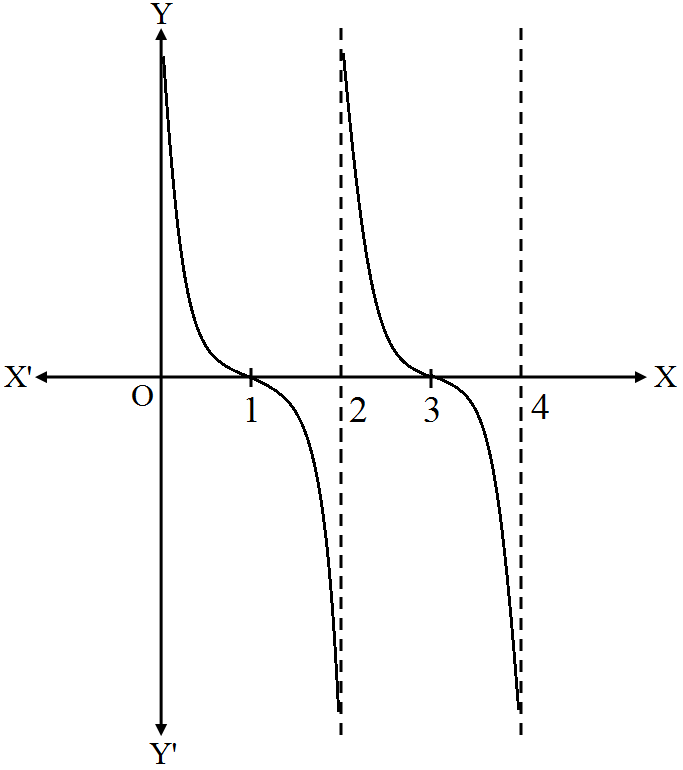
View full question & answer→Question 855 Marks
If the arcs of the same length in two circles subtend angles $65^\circ $ and $110^\circ $ at the centre, find the ratio of their radii.
AnswerLet, $C_1 & C_2$ are two cirdes with same Arc length.
That is AB = AB
Let, $\theta_{1}$ and $\theta_{2}$ are two angle by arc AB and CD on respective circle.
Let, OA = OB = r
Also,
$\theta_{1}=65^{\circ}= \Big(\frac{65\pi}{180}\Big)^{\text{c}}$
$\theta_{2}=110^{\circ}= \Big(\frac{110\pi}{180}\Big)^{\text{c}}$
we know,
$\theta= \frac{\text{arc}}{\text{radius}}$
For $C_1$
$\theta_{1}=\frac{\text{AB}}{\text{r}}$
$\Rightarrow \theta_{1}=\frac{\text{l}}{\text{r}}$
$\Rightarrow\text{r}= \frac{1}{\theta_{1}}\ ...(\text{i})$
For $C_2$
$\theta_{2}=\frac{\text{AB}}{\text{R}}$
$\Rightarrow \theta_{2}=\frac{\text{l}}{\text{R}}$
$\Rightarrow\text{R}= \frac{1}{\theta_{2}}\ ...(\text{ii})$
From (i) and (ii),
$\frac{\text{r}}{\text{R}}= \frac{\frac{1}{\theta_{1}}}{\frac{1}{\theta_{2}}}=\frac{\theta_{2}}{\theta_{1}}$
$=\frac{\frac{110\pi}{180}}{\frac{65\pi}{180}}=\frac{22}{13}$
$\therefore \ \text{r}:\text{R}= 22:13$
View full question & answer→Question 865 Marks
Prove that:
$\sin6\circ\sin42^\circ\sin66^\circ\sin78^\circ=\frac{1}{16}$
Answer$\text{LHS}=\cos6^\circ\cos42^\circ\cos66^\circ\cos78^\circ$$=\frac{1}{4}(2\cos6^\circ\cos66^\circ)(2\cos42^\circ\cos78^\circ)$
$=\frac{1}{4}(\cos72^\circ+\cos60^\circ)(\cos120^\circ+\cos36^\circ)$
$=\frac{1}{4}\Big(\sin18^\circ+\frac{1}{2}\Big)\bigg(-\frac{2}{2}+\frac{\sqrt{5}+1}{4}\bigg)$
$=\frac{1}{4}\bigg(\frac{\sqrt{5}-1}{4}+\frac{1}{2}\bigg)\bigg(\frac{\sqrt{5}+1}{4}-\frac{1}{2}\bigg)$
$=\frac{1}{4}\bigg(\frac{\sqrt{5}-1+2}{4}\bigg)\bigg(\frac{\sqrt{5}+1-2}{4}\bigg)$
$=\frac{1}{64}(\sqrt{5}+1)(\sqrt{5}-1)$
$=\frac{1}{64}(\sqrt{5})^2-1^2)$
$=\frac{1}{64}(5-1)$
$=\frac{1}{16}$
$=\text{RHS}$
View full question & answer→Question 875 Marks
If $\text{a}=\sec\text{x}-\tan\text{x}$ and $\text{b}=\text{cosec x}+\cot\text{x},$ then show that $\text{ab}+\text{a} - \text{b}+ 1=0.$
Answer$\text{L.H.S}=\text{ab + a} - \text{b + }1$
$=(\sec\text{x}-\tan\text{x})(\text{cosec+}\cot)+\sec\text{x}-\tan\text{x}-\text{cosec }\text{x}-\cot\text{x}+1$
$=\Big(\frac{1}{\cos\text{x}}-\frac{\sin\text{x}}{\cos\text{x}}\Big)\Big(\frac{1}{\sin\text{x}}+\frac{\cos\text{x}}{\sin\text{x}}\Big)+\frac{1}{\cos\text{x}}-\frac{\sin\text{x}}{\cos\text{x}}-\frac{1}{\sin\text{x}}-\frac{\cos\text{x}}{\sin\text{x}}+1$
$=\frac{1}{\sin\text{x}\cos\text{x}}+\frac{1}{\cos\text{x}}\times\frac{\cos\text{x}}{\sin\text{x}}-\frac{\sin\text{x}}{\cos\text{x}}\\\ \ \ \times\frac{1}{\sin\text{x}}-\tan\text{x}\times\cot\text{x}+\frac{1}{\cos\text{x}}-\frac{\sin\text{x}}{\cos\text{x}}-\frac{1}{\sin\text{x}}$
$=\frac{1}{\sin\text{x}\cos\text{x}}+\frac{1}{\sin\text{x}}-\frac{1}{\cos\text{x}}-1+\frac{1}{\cos\text{x}}-\frac{\sin\text{x}}{\cos\text{x}}-\frac{1}{\sin\text{x}}-\frac{\cos\text{x}}{\sin\text{x}}+1$
$=\frac{1}{\sin\text{x}\cos\text{x}}-\frac{\sin\text{x}}{\cos\text{x}}-\frac{\cos\text{x}}{\sin\text{x}}$
$=\frac{1\sin^2\text{x}-\cos^2\text{x}}{\sin\text{x}.\cos\text{x}}$
$=\frac{1-(\cos^2\text{x}+\sin^2\text{x})}{\sin\text{x}.\cos\text{x}}$
$=\frac{1-1}{\sin\text{x}.\cos\text{x}}=0$
$=\text{R.H.S. Hence Proved}$
View full question & answer→Question 885 Marks
A railway train is travelling on a circular curve of 1500 metres radius at the rate of 66km/ hr. Through what angle has it turned in 10 seconds?
AnswerWe have,
In circle track
OA = OB = r = 150m
$\angle\text{AOB}= \theta$
Speed of train = 66km/ hr
$=\frac{66\times1000}{60\times60} $
$=\frac{110}{6}$
Train will travel in 10 sec $=\frac{110}{6}\times10=\frac{1100}{6}$
$\text{AB}= \frac{11000}{6}\text{m}$
Thus,
$\theta= \frac{\text{arc}}{\text{radius}}$
$\Rightarrow \frac{11000}{6\times1500}= \frac{11}{90}\ \text{radian}$
The train will turn by angle in 10 sec.
View full question & answer→Question 895 Marks
The upper part of a tree broken by the wind makes an angle of 30° with the ground and the distance from the root to the point where the top of the tree touches the ground is 15m. Using sine rule, find the height of the tree.
AnswerSuppose BD be the tree and the upper part of the tree is broken over by the wind at point A.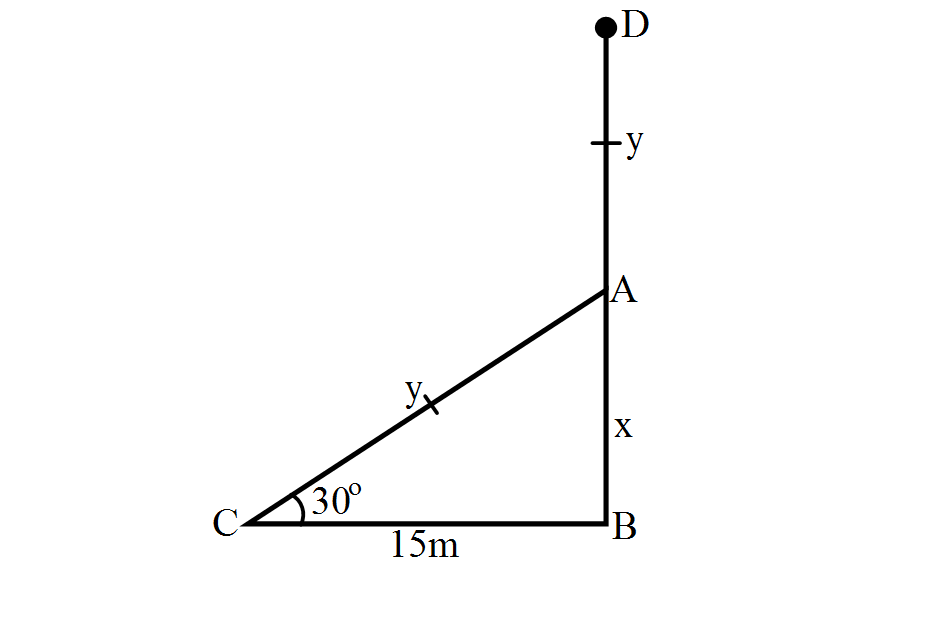
The total height of the tree is x + y.
In $\triangle\text{ABC},$
$\angle\text{C}=30^{\circ}$ and $\angle\text{B}=90^{\circ}.$
$\therefore\angle\text{A}=60^{\circ}.$
So, on using sine rule, we get:
$\frac{\text{AB}}{\sin30^{\circ}}=\frac{\text{BC}}{\sin60^{\circ}}=\frac{\text{AC}}{\sin90^{\circ}}$
$\Rightarrow\frac{\text{x}}{\sin30^{\circ}}=\frac{15}{\sin60^{\circ}}=\frac{\text{y}}{\sin90^{\circ}}$
So, $\frac{\text{x}}{\sin30^{\circ}}=\frac{15}{\sin60^{\circ}}$
$\Rightarrow\frac{\text{x}}{\frac{1}{2}}=\frac{15}{\frac{\sqrt{3}}{2}}$
$\Rightarrow\text{x}=\frac{15}{\sqrt{3}}=5\sqrt{3}$
Also,
$\frac{15}{\sin60^{\circ}}=\frac{\text{y}}{\sin90^{\circ}}$
$\Rightarrow\frac{15}{\frac{\sqrt{3}}2{}}=\text{y}$
$\Rightarrow\text{y}=\frac{30}{\sqrt{3}}=10\sqrt{3}$
So, the height of the tree is $\text{x + y}=5\sqrt{3}+10\sqrt{3}\text{m}$
$=15\sqrt{3}\text{m}$ View full question & answer→Question 905 Marks
Prove the following identities:
$\frac{1−\sin\text{x}\cos\text{x}}{\cos\text{x}(\sec\text{x}−\text{cosec}\text{x})}\cdot\frac{\sin^2\text{x}−\cos^2\text{x}}{\sin^3\text{x}\cos^3\text{x}}=\sin\text{x}$
Answer$\text{L.H.S}=\frac{1-\sin\text{x}\cos\text{x}}{\cos\text{x}\big(\sec\text{x}-\text{cosec}\text{x}\big)}.\frac{\sin^{2}\text{x}-\cos^{2}\text{x}}{\sin^{3}\text{x}+\cos^{3}\text{x}}$
$=\frac{1-\sin\text{x}\cos\text{x}}{\cos\text{x}\big(\frac{1}{\cos\text{x}}-\frac{1}{\sin\text{x}}\big)}\cdot\frac{\big(\sin\text{x}+\cos\text{x}\big)\big(\sin\text{x}-\cos\text{x}\big)}{\big(\sin\text{x}+\cos\text{x}\big)\big(\sin^{2}\text{x}+\cos^{2}\text{x}-\sin\text{x}\cos{\text{x}}\big)}$$$ $\begin{bmatrix}\text{Using a}^2-\text{b}^2=(\text{a - b)(a + b)} \\\text{and a}^3+\text{b}^3\text{(a}^2+\text{b}^2-\text{ab}) \end{bmatrix}$
$=\frac{\big(1-\sin\text{x}\cos\text{x}\big)}{\cos\text{x}\big(\frac{\sin\text{x}-\cos\text{x}}{\cos\text{x}\sin\text{x}}\big)}.\frac{\sin\text{x}-\cos\text{x}}{1-\sin\text{x}\cos\text{x}}$ $ \big(\because\sin^{2}\text{x}+\cos^{2}\text{x}=1\big)$
$=\frac{\cos\text{x}\sin\text{x}}{\cos\text{x}}$
$=\sin\text{x}$
$=\text{R.H.S}$
$\text{Proved}$
View full question & answer→Question 915 Marks
Find the diameter of the sun in km supposing that it subtends an angle of $32'$ at the eye of an observer. Given that the distance of the sun is $91 \times 10^6km.$
AnswerLet, E be the eye of the observer and be the sum.
Now,
$\angle\text{AOB}= \theta= 32'$
$=\Big(\frac{32}{60}\Big)^{\circ}$
$=\Big(\frac{32}{60}\times\frac{\pi}{180}\Big)^{\text{c}}$
$=\frac{\text{AB}}{91\times10^{6}}\text{km}$
$\text{AB}= \frac{91\times10^{6}\times32\times\pi}{60\times180}$
$=8.474074\times10^{5}\text{km}$
$=84707.4\text{km}$
View full question & answer→Question 925 Marks
If $\sec\text{x}\cos5\text{x}+1=0,$ where $0<\text{x}\leq\frac{\pi}{2},$ then find the value of x.
AnswerGiven that: $\sec\text{x}\cos5\text{x}+1=0$
$\Rightarrow\frac{1}{\cos\text{x}}\cdot\cos5\text{x}+1$
$\Rightarrow\cos5\text{x}+\cos\text{x}=0$ $\Big[\cos\text{C}+\cos\text{D}=2\cos\Big(\frac{\text{C}+\text{D}}{2}\Big)\cos\Big(\frac{\text{C}-\text{D}}{2}\Big)\Big]$
$\Rightarrow2\cos\Big(\frac{5\text{x}+\text{x}}{2}\Big)\cdot\cos\Big(\frac{5\text{x}-\text{x}}{2}\Big)=0$
$\Rightarrow\cos3\text{x}\cdot\cos2\text{x}=0$
$\cos3\text{x}=0$ Or $\cos2\text{x}=0$
$\Rightarrow3\text{x}=\frac{\pi}{2}$ Or $2\text{x}=\frac{\pi}{2}$
$\text{x}=\frac{\pi}{6}$ Or $\text{x}=\frac{\pi}{4}$
Hence, the value of x are $\frac{\pi}{6},\frac{\pi}{4}.$
View full question & answer→Question 935 Marks
Prove that:
$\frac{\sin5\text{A}-\sin7\text{A}+\sin8\text{A}-\sin4\text{A}}{\cos4\text{A}+\cos7\text{A}-\cos5\text{A}-\cos8\text{A}}=\cot6\text{A}$
AnswerWe have,
$\text{LHS}=\frac{\sin5\text{A}-\sin7\text{A}+\sin8\text{A}-\sin4\text{A}}{\cos4\text{A}+\cos7\text{A}-\cos5\text{A}-\cos8\text{A}}$
$=\ \frac{-(\sin7\text{A}-\sin5\text{A})+(\sin8\text{A}-\sin4\text{A})}{-(\cos7\text{A}-\cos5\text{A})-(\cos8\text{A}-\cos4\text{A})}$
$=\ \frac{-\Big[2\sin\Big(\frac{7\text{A}-5\text{A}}{2}\Big)\cos\Big(\frac{7\text{A}+5\text{A}}{2}\Big)\Big]+\Big[2\sin\Big(\frac{8\text{A}-4\text{A}}{2}\Big)\cos\Big(\frac{8\text{A}+4\text{A}}{2}\Big)\Big]}{-2\sin\Big(\frac{7\text{A}+5\text{A}}{2}\Big)\sin\Big(\frac{7\text{A}-5\text{A}}{2}\Big)-\Big[-2\sin\Big(\frac{8\text{A}+4\text{A}}{2}\Big)\sin\Big(\frac{8\text{A}-4\text{A}}{2}\Big)\Big]}$
$=\ \frac{-2\sin\text{A}\cos6\text{A}+2\sin2\text{A}\cos6\text{A}}{-2\sin6\text{A}\sin\text{A}+2\sin6\text{A}\sin2\text{A}}$
$=\ \frac{2\cos6\text{A}[-\sin\text{A}+\sin2\text{A}]}{-2\sin6\text{A}[-\sin\text{A}+\sin2\text{A}]}$
$=\ \frac{\cos6\text{A}}{\sin6\text{A}}$
$=\ \cot6\text{A}$
$=\ \text{RHS}$
$\frac{\sin5\text{A}-\sin7\text{A}+\sin8\text{A}-\sin4\text{A}}{\cos4\text{A}+\cos7\text{A}-\cos5\text{A}-\cos8\text{A}}=\cot6\text{A}$ Hence proved.
View full question & answer→Question 945 Marks
$\cot\text{x}+\cot\Big(\frac{\pi}{3}-\text{x}\Big)+\cot\Big(\frac{\pi}{3}-\text{x}\Big)=3\cot3\text{x}$
Answer$\cot\text{x}\cot(60^\circ+\text{x})=\cot(60^\circ-\text{x})=3\cot2\text{x}$
$\text{LHS}=\cot\text{x}+\cot(60^\circ+\text{x})-\cot(60^\circ-\text{x})$
$=\cot\text{x}+\frac{\cot60^\circ+\cot\text{x}}{1-\cot60^\circ\cot\text{x}}-\frac{\cot60^\circ-\cot\text{x}}{1+\cot60^\circ\cot\text{x}}$
$=\cot\text{x}+\frac{\sqrt{3}+\cot\text{x}}{1-\sqrt{3\cot\text{x}}}-\frac{\sqrt{3}-\cot\text{x}}{1+\sqrt{3\cot\text{x}}}$
$=\cot\text{x}+\Bigg[\frac{\sqrt{3}+3\cot\text{x}+\cot\text{x}+\sqrt{3}\cot^2+\sqrt{3}+3\cot\text{x}+\cot\text{x}-\sqrt{3}\cot^2\text{x}}{(1-\sqrt{3}\cot\text{x}(1+\sqrt{3}\cot\text{x})}\Bigg]$
$=\cot\text{x}+\frac{8\cot\text{x}}{1-3\cot^2\text{x}}$
$=\frac{\cot\text{x}-3\cot^3\text{x}+8\cot\text{x}}{1-3\cot^2\text{x}}$
$=\frac{9\cot\text{x}-3\cot^3\text{x}}{1-3\cot^2\text{x}}$
$=3\Big(\frac{3\cot\text{x}-\cot^3\text{x}}{1-3\cot^2\text{x}}\Big)$
$=3\cot3\text{x}$
$=\text{RHS}$
so,
$\cot\text{x}+\cot(60^\circ+\text{x})-\cot(60^\circ-\text{x})=3\cot3\text{x}$
View full question & answer→Question 955 Marks
If $\text{a}\cos2\theta+\text{b}\sin2\theta=\text{c}$ has $\alpha$ and $\beta$ as its roots, then prove that $\tan\alpha+\tan\beta=\frac{2\text{b}}{\text{a+b}}.$
[Hint: Use the identities $\cos2\theta=\frac{1-\tan^2\theta}{1+\tan^2\theta}$ and $\sin2\theta=\frac{2\tan\theta}{1+\tan^2\theta}\Big].$
AnswerGiven that: $\text{a}\cos2\theta+\text{b}\sin2\theta=\text{c}...(\text{i})$
$\Rightarrow\text{a}\Big[\frac{1-\tan^2\theta}{1+\tan^2\theta}\Big]+\text{b}\Big[\frac{2\tan\theta}{1+\tan^2\theta}\Big]=\text{c}$ $\Big[\because\cos2\theta=\frac{1-\tan^2\theta}{1+\tan^2\theta},\sin2\theta=\frac{2\tan\theta}{1+\tan^2\theta}\Big]$
$\Rightarrow\text{a}-\text{a}\tan^2\theta+2\text{b}\tan\theta=\text{c}(1+\tan^2\theta)$
$\Rightarrow\text{a}-\text{a}\tan^2\theta+2\text{b}\tan\theta=\text{c + c}\tan^2\theta$
$\Rightarrow\text{a}-\text{a}\tan^2\theta+2\text{b}\tan\theta-\text{c}\tan^2\theta-\text{c}=0$
$\Rightarrow-(\text{a}+\text{c})\tan^2\theta+2\text{b}\tan\theta+(\text{a}-\text{c})=0$
$\Rightarrow(\text{a + c})\tan^2\theta-2\text{b}\tan\theta+(\text{c}-\text{a})=0...(\text{ii})$
Since $\alpha$ and $\beta$ are the roots of equation (i) we have $\tan\alpha$ and $\tan\beta$ are the roots of (ii)
$\Rightarrow\tan\alpha+\tan\beta=\frac{-(-2\text{b})}{\text{a + c}}$ [sum of roots of a quadratic equation $\text{ax}^2+\text{bx}+\text{c}=0$ is $\frac{-\text{b}}{\text{a}}$]
$\Rightarrow\tan\alpha+\tan\beta=\frac{2\text{b}}{\text{a + c}}.$ Hence proved.
View full question & answer→Question 965 Marks
Find the angle in radians through which a pendulum swings if its length is $75\ cm$ and the tip describes an arc of length.
- $10\ cm$
- $15\ cm$
- $21\ cm$
Answer
- we have,
$OA =$ length of pendulum $= 75\ cm$
$= 0.75m$
Also,
$\theta= \frac{\text{arc}}{\text{radius}}\ ...(\text{i})$
$\Rightarrow\theta= \frac{0.1}{0.75}=\Big(\frac{2}{15}\Big)^{\text{c}}$
$\theta=\frac{2}{15}\ \text{radian}$
- $OA = 75\ cm$
$= 0.75\ cm$
$AB = 15\ cm$
$= 0.15m$
From $(i),$
$\theta- \frac{0.15}{0.75}=\frac{1}{5}$
- $OA = 75\ cm$
$= 0.75m$
$AB = 21\ cm$
$= 0.21m$
From $(i)$
$\theta= \frac{0.21}{0.75}=\frac{7}{5}$ View full question & answer→Question 975 Marks
In any $\triangle A B C$, if $a^2, b^2, c^2$ are in A.P., prove that $\cot A, \cot B$ and $\cot C$ are also in A.P.
Answer$a^2, b^2, c^2$ are in A.P.$\Rightarrow-2\text{a}^2,-2\text{b}^2,-2\text{c}^2,$ are in A.P.
$\Rightarrow(\text{a}^2+\text{b}^2+\text{c}^2)-2\text{a},(\text{a}^2+\text{b}^2+\text{c}^2)-2\text{b}^2,\$\text{a}^2+\text{b}^2+\text{c}^2)-2\text{c}^2$ are in A.P.
$\Rightarrow(\text{b}^2+\text{c}^2-\text{a}^2),(\text{c}^2+\text{a}^2-\text{b}^2),(\text{b}^2+\text{a}^2-\text{c}^2)$ are in A.P.
$\Rightarrow\frac{(\text{b}^2+\text{c}^2-\text{a}^2)}{2\text{abc}},\frac{(\text{c}^2+\text{a}^2-\text{b}^2)}{2\text{abc}},\frac{(\text{b}^2+\text{a}^2-\text{c}^2)}{2\text{abc}}$ are in A.P.
$\Rightarrow\frac{1}{\text{a}}\frac{(\text{b}^2+\text{c}^2-\text{a}^2)}{2\text{bc}},\frac{1}{\text{b}}\frac{(\text{c}^2+\text{a}^2-\text{b}^2)}{2\text{ac}},\frac{1}{\text{c}}\frac{(\text{b}^2+\text{a}^2-\text{c}^2)}{2\text{ab}}$ are in A.P.
$\Rightarrow\frac{1}{\text{a}}\cos\text{A},\frac{1}{\text{b}}\cos\text{B},\frac{1}{\text{c}}\cos\text{C}$ are in A.P.
$\Rightarrow\frac{\text{k}}{\text{a}}\cos\text{A},\frac{\text{k}}{\text{b}}\cos\text{B},\frac{\text{k}}{\text{c}}\cos\text{C}$ are in A.P.
$\Rightarrow\frac{\cos\text{A}}{\sin\text{A}},\frac{\cos\text{B}}{\sin\text{B}},\frac{\cos\text{C}}{\sin\text{C}}$ are in A.P.
$\Rightarrow\cot\text{A},\cot\text{B},\cot\text{C}$ are in A.P.
View full question & answer→Question 985 Marks
If angle $\theta$ is divided into two parts such that the tangents of one part is $\lambda$ times the tangent of other,and $\phi$ is their difference,the show that $\sin\theta=\frac{\lambda+1}{\lambda-1}\sin\phi$
AnswerLet $\alpha\text{ and }\beta$ be the two parts of angle $\theta$ then,$\theta=\alpha+\beta\text{ and }\phi=\alpha-\beta$
Now,$\tan\alpha=\lambda\tan\beta$
$\Rightarrow\frac{\tan\alpha}{\tan\beta}=\frac{\lambda}{1}$
Applying componendo and dividendo, we get$\frac{\tan\alpha+\tan\beta}{\tan\alpha-\tan\beta}=\frac{\lambda+1}{\lambda-1}$
$\Rightarrow\frac{\frac{\sin\alpha}{\cos\alpha}+\frac{\sin\beta}{\cos\beta}}{\frac{\sin\alpha}{\cos\alpha}-\frac{\sin\beta}{\cos\beta}}=\frac{\lambda+1}{\lambda-1}$
$\Rightarrow\frac{\frac{\sin\alpha\cos\beta+ \cos\alpha\sin\beta}{\cos\alpha\cos\beta}}{\frac{\sin\alpha\cos\beta-\cos\alpha\sin\beta}{\cos\alpha\cos\beta}}=\frac{\lambda+1}{\lambda-1}$
$\Rightarrow\frac{\sin(\alpha+\beta)}{\sin(\alpha-\beta)}=\frac{\lambda+1}{\lambda-1}$
$\Rightarrow\frac{\sin\theta}{\sin\phi}=\frac{\lambda+1}{\lambda-1}$ $(\theta=\alpha+\beta\text{ and }\phi=\alpha-\beta)$
$\sin\theta=\frac{\lambda+1}{\lambda-1}\sin\phi$
View full question & answer→Question 995 Marks
If $\tan\text{x}=\frac{\sin\alpha-\cos\alpha}{\sin\alpha+\cos\alpha},$ then show that $\sin\alpha+\cos\alpha=\sqrt{2}\cos\text{x}.$
Answer$\tan\text{x}=\frac{\sin\alpha-\cos\alpha}{\sin\alpha+\cos\alpha}$
$\Rightarrow\tan\text{x}=\frac{\tan\alpha-1}{\tan\alpha+1}$ [Dividing both numerator and denominator by $\cos\alpha$]
$\Rightarrow\tan\theta=\frac{\tan\alpha-\tan\frac{\pi}{4}}{1+ \tan\frac{\pi}{4}.\tan\alpha}$
$\Rightarrow\tan\theta=\tan\Big(\alpha-\frac{\pi}{4}\Big)$
$\Rightarrow\theta=\alpha-\frac{\pi}{4}$ [Removing tan form both sides]
$\Rightarrow\cos\theta=\cos\Big(\alpha-\frac{\pi}{4}\Big)$ [Taking cos on both sides]
$\Rightarrow\cos\theta=\cos\alpha.\cos\frac{\pi}{4}+\sin\alpha.\sin\frac{\pi}{4}$
$\Rightarrow\cos\theta=\cos\alpha.\frac{1}{\sqrt{2}}+\sin\alpha.\frac{1}{\sqrt{2}}$
$\Rightarrow\cos\theta=\frac{\cos\alpha+\sin\alpha}{\sqrt{2}}$
$\Rightarrow\sqrt{2}\cos\theta=\sin\alpha+\cos\alpha$
Hence proved.
View full question & answer→Question 1005 Marks
Solve the following equations:
$\sin\text{x}+\cos\text{x}=1$
AnswerWe have,
$\sin\text{x}+\cos\text{x}=1$
divide both side by $\sqrt{2},$ we get,
$\Rightarrow\frac{1}{\sqrt{2}}\sin\text{x}+\frac{1}{\sqrt{2}}\cos\text{x}=\frac{1}{\sqrt{2}}$
$\Rightarrow\sin\frac{\pi}{4}\sin\text{x}+\cos\frac{\pi}{4}\cos\text{x}=\frac{1}{\sqrt{2}}$
$\Rightarrow\cos\Big(\text{x}-\frac{\pi}{4}\Big)=\cos\frac{\pi}{4}$
$\Rightarrow\text{x}=\frac{\pi}{4}=2\text{n}\pi\pm\frac{\pi}{4},\text{n}\in\text{z}$
$\Rightarrow\text{x}=2\text{n}\pi+\frac{\pi}{2}$ or $2\text{n}\pi,\text{n}\in\text{z}$
View full question & answer→