Question 2015 Marks
If are two different valus of X lying between 0 and which satisfy the equation $6\cos\text{x}+8\sin\text{x}=9$find the value of $\sin(\alpha+\beta).$
AnswerWe have,
$6\cos\text{x}+8\sin\text{x}=9\ ...(1)$
$\Rightarrow8\sin\text{x}=9-6\cos\text{x}$
$\Rightarrow\big(8\sin\text{x}\big)^2=\big(9-6\cos\text{x}\big)^2$
$\Rightarrow64\sin^2\text{x}=81+36\cos^2\text{x}-108\cos\text{x}$
$\Rightarrow64\sin^2\text{x}=81+36\cos^2\text{x}-108\cos\text{x}$
$\Rightarrow64(1-\cos^2\text{x})=81+36\cos^2\text{x}-108\cos\text{x}$
$\Rightarrow64-64\cos^2\text{x}=81+36\cos^2\text{x}-108\cos\text{x}$
$\Rightarrow36\cos^2\text{x}+64\cos^2\text{x}-108\cos\text{x}-108\cos\text{x}$
$\Rightarrow100\cos^2\text{x}-108\cos\text{x}+17=0\ ...(2)$
Since $\alpha,\beta$ are roots of equation ...(i)
$$$\therefore\cos\alpha$ and $\cos\beta$ roots of equation ....(ii)
$\because\cos\alpha+\cos\beta=\frac{17}{100}\ ...(3)$
$\text{Again},6\cos\text{x}+8\sin\text{x}=9$
$\Rightarrow6\cos\text{x}=9-8\sin\text{x}$
$\Rightarrow\big(8\cos\text{x}\big)^2=\big(9-6\sin\text{x}\big)^2$
$\Rightarrow36\cos^2\text{x}=81+64\cos^2\text{x}-144\cos\text{x}$
$\Rightarrow36(1-\sin^2\text{x})=81+64\sin^2\text{x}-144\sin\text{x}$
$\Rightarrow36-36\sin^2\text{x}=81+36\cos^2\text{x}-108\cos\text{x}$ $[\because$ squaring both sides$]$
$\Rightarrow64\sin^2\text{x}+36\sin^2\text{x}-144\sin\text{x}+81-36=0$
$\Rightarrow100\sin^2\text{x}-144\sin\text{x}+45=0\ ...(4)$
$\because\sin\alpha\times\sin\beta=\frac{45}{100}\ ...(5)$
Now, $\cos(\alpha+\beta)=\cos\alpha\cos\beta-\sin\alpha\sin\beta$
$=\frac{17}{100}-\frac{45}{100}$$=-\frac{28}{100}$$=-\frac{7}{25}$ [Using equation (3) and (5)]
Now, $\sin(\alpha+\beta)=\sqrt{1-(\cos\text{x})^2}$
$=\sqrt{1-\Big(-\frac{7}{25}\Big)^2}$$=\sqrt{1-\frac{49}{625}}$ $=\sqrt{\frac{625-49}{625}}$
$=\sqrt{\frac{576}{625}}$$=\frac{24}{25}$ $\therefore\sin(\alpha+\beta)=\frac{24}{25}$
View full question & answer→Question 2025 Marks
$4\Big(\text{bc}\cos^2\frac{\text{A}}{2}+\text{ca}\cos^2\frac{\text{B}}{2}+\text{ab}\cos^2\frac{\text{C}}{2}\Big)=(\text{a + b + c})^2$
Answer$4\Big(\text{bc}\cos^2\frac{\text{A}}{2}+\text{ca}\cos^2\frac{\text{B}}{2}+\text{ab}\cos^2\frac{\text{C}}{2}\Big)=(\text{a + b + c})^2$$\text{LHS}=4\Big(\text{bc}\cos^2\frac{\text{A}}{2}+\text{ca}\cos^2\frac{\text{B}}{2}+\text{ab}\cos^2\frac{\text{C}}{2}\Big)$
$=2\Big(\text{bc.}2\cos^2\frac{\text{A}}{2}+\text{ca.}2\cos^2\frac{\text{B}}{2}+\text{ab}.2\cos^2\frac{\text{C}}{2}\Big)$
$=2(\text{bc.}(1-\cos\text{A})+\text{ca.}(1-\cos\text{B})+\text{ab.}(1-\cos\text{C}))$
$=2\text{bc}-2\text{bc}\cos\text{A}+2\text{ca}-2\text{ca}\cos\text{B}+2\text{ab}-2\text{ab}\cos\text{C}$
$=2\text{bc}-2\text{bc}\frac{\text{b}^2+\text{c}^2-\text{a}^2}{2\text{bc}}+2\text{ca}-2\text{ca}\frac{\text{a}^2+\text{c}^2-\text{b}^2}{2\text{ca}}+2\text{ab}$
$-2\text{ab}\frac{\text{b}^2+\text{a}^2-\text{c}^2}{2\text{ab}}\text{[cos rule]}$
$=2\text{bc}-\text{b}^2-\text{c}^2+\text{a}^2+2\text{ca}-\text{a}^2-\text{c}^2+\text{b}^2+2\text{ab}-\text{b}^2-\text{a}^2+\text{c}^2$
$=\text{a}^2+\text{b}^2+\text{c}^2+2\text{ab}+2\text{ab}+2\text{ca}$
$=(\text{a + b + c})^2=\text{RHS}$
View full question & answer→Question 2035 Marks
If $\text{T}_\text{n}=\sin^\text{n}\text{x}+\cos^\text{n}\text{x},$ Prove that
$\frac{\text{T}_3-\text{T}_5}{\text{T}_1}=\frac{\text{T}_5-\text{T}_7}{\text{T}_3}$
AnswerWe Have $\text{T}_\text{n}=\sin^\text{n}\text{x}+\cos^\text{n}\text{x}\cdots(\text{i})$
To show: $\frac{\text{T}_3-\text{T}_5}{\text{T}_1}=\frac{\text{T}_5-\text{T}_7}{\text{T}_3}$
$\text{L.H.S}=\frac{\text{T}_3-\text{T}_5}{\text{T}_1}$
$=\frac{(\sin^3\text{x}+\cos^3\text{x})-(\sin^5\text{x}+\cos^5\text{x})}{\sin\text{x}+\cos\text{x}}$ [Substituting the value of $T_3, T_5$ and $T_1$ From (i)]
$=\frac{\sin^3\text{x}-\sin^5\text{x}+\cos^3\text{x}-\cos^5\text{x}}{\sin\text{x}+\cos\text{x}}$
$=\frac{\sin^3\text{x}-(1-\sin^2\text{x})+\cos^3\text{x}(1-\cos^2\text{x})}{\sin\text{x}+\cos\text{x}}$
$=\frac{\sin^3\text{x}\cos^2\text{x}+\cos^3\text{x}\sin^2\text{x}}{\sin\text{x}+\cos\text{x}}$ $\Big[\because1-\sin^2\text{x}=\cos^2\text{x}\text{ and }1-\cos^2\text{x}=\sin^2\text{x}\Big]$
$=\frac{\sin^2\text{x}\cos^2\text{x}+(\sin\text{x}+\cos\text{x})}{\sin\text{x}+\cos\text{x}}$
$=\sin^2\text{x}\cos^2\text{x}$
$\text{R.H.S}=\frac{\sin^5\text{x}+\cos^5\text{x}-(\sin^7\text{x}+\cos^7\text{x})}{\sin^3\text{x}+\cos^3\text{x}}$
$=\frac{\sin^5\text{x}-\sin^7\text{x}+\cos^5\text{x}-\cos^7\text{x}}{\sin^3\text{x}+\cos^3\text{x}}$
$=\frac{\sin^5\text{x}(1-\sin^2\text{x})+\cos^5\text{x}(1-\cos^2\text{x})}{\sin^3\text{x}+\cos^3\text{x}}$
$=\frac{\sin^5\text{x}\cos^2\text{x}+\cos^5\text{x}\sin^2\text{x}}{\sin^3\text{x}+\cos^3\text{x}}$
$=\frac{\sin^5\text{x}\cos^2\text{x}(\sin^2\text{x}+\cos^3\text{x})}{\sin^2\text{x}+\cos^2\text{x}}$
$=\sin^2\text{x}\cos^2\text{x}$
$\text{L.H.S=R.H.S }$
$\text{Proved}$
View full question & answer→Question 2045 Marks
Solve the following equations:
$\sin\text{x}-3\sin2\text{x}+\sin3\text{x}=\cos\text{x}-3\cos2\text{x}+\cos3\text{x}$
Answer$\sin\text{x}-3\sin2\text{x}+\sin3\text{x}=\cos\text{x}-3\cos2\text{x}+\cos3\text{x}$
$(\sin\text{x}+\sin3\text{x})-3\sin2\text{x}-(\cos\text{x}+\cos3\text{x})+3\cos2\text{x}=0$
$2\sin2\text{x}\cos\text{x}-3\sin2\text{x}-2\cos2\text{x}\cos\text{x}+3\cos2\text{x}=0$
$\sin2\text{x}(2\cos\text{x}-3)-\cos2\text{x}(2\cos\text{x}-3)=0$
$(2\cos\text{x}-3)(\sin2\text{x}-\cos2\text{x})=0$
$\cos\text{x}=\frac{3}{2}$ or $\sin2\text{x}-\cos2\text{x}-\cos2\text{x}=0$
but $\cos\text{x}\in[-11]\Rightarrow\cos\text{x}\not=\frac{3}{2}$
$\sin2\text{x}=\cos2\text{x}$
$2\text{x}=\text{n}\pi+\frac{\pi}{4}$
$\text{x}=\frac{\text{n}\pi}{2}+\frac{\pi}{8}$
View full question & answer→Question 2055 Marks
$\text{If}\ \frac{\cos(\text{A}-\text{B})}{\cos(\text{A+B})}+\frac{\cos(\text{C+D})}{\cos(\text{C}-\text{D})}=0,$ prove that $\tan\text{A}\tan\text{B}\tan\text{C}\tan\text{D}=-1$
AnswerWe have,
$\frac{\cos(\text{A}-\text{B})}{\cos(\text{A+B})}+\frac{\cos(\text{C+D})}{\cos(\text{C}-\text{D})}=0$
$\Rightarrow\ \frac{\cos(\text{A}-\text{B})}{\cos(\text{A+B})}=-\frac{\cos(\text{C+D})}{\cos(\text{C}-\text{D})}...(\text{i})$
Now,
$\frac{\cos(\text{A}-\text{B})}{\cos(\text{A+B})}=-\frac{\cos(\text{C+D})}{\cos(\text{C}-\text{D})}$
$\Rightarrow\ \frac{\cos(\text{A}-\text{B})}{\cos(\text{A+B})}+1=\frac{-\cos(\text{C+D})}{\cos(\text{C}-\text{D})}+1$
$\Rightarrow\ \frac{\cos(\text{A}-\text{B})+\cos(\text{A+B})}{\cos(\text{A+B})}=\frac{-\cos(\text{C+D})+\cos(\text{C}-\text{D})}{\cos(\text{C}-\text{D})}$
$\Rightarrow\ \frac{\cos(\text{A}+\text{B})+\cos(\text{A}-\text{B})}{\cos(\text{A+B})}=\frac{-[\cos(\text{C+D})-\cos(\text{C}-\text{D})]}{\cos(\text{C}-\text{D})}...(\text{ii})$
Again,
$\frac{\cos(\text{A}-\text{B})}{\cos(\text{A+B})}=-\frac{-\cos(\text{C+D})}{\cos(\text{C}-\text{D})}$ [By equation (i)]
$\frac{\cos(\text{A}-\text{B})}{\cos(\text{A+B})}-1=-\frac{-\cos(\text{C+D})}{\cos(\text{C}-\text{D})}-1$
$\Rightarrow\ \frac{\cos(\text{A}-\text{B})-\cos(\text{A+B})}{\cos(\text{A+B})}=\frac{-\cos(\text{C+D})-\cos(\text{C}-\text{D})}{\cos(\text{C}-\text{D})}$
$\Rightarrow\ \frac{-(\cos(\text{A}+\text{B})-\cos(\text{A}-\text{B}))}{\cos(\text{A+B})}=\frac{-[\cos(\text{C+D})+\cos(\text{C}-\text{D})]}{\cos(\text{C}-\text{D})}$
$\Rightarrow\ \frac{\cos(\text{A}+\text{B})-\cos(\text{A}-\text{B}))}{\cos(\text{A+B})}=\frac{\cos(\text{C+D})+\cos(\text{C}-\text{D})}{\cos(\text{C}-\text{D})}...(\text{iii})$
Dividing equation (ii) by equation (iii), we get
$\frac{\cos(\text{A}+\text{B})+\cos(\text{A}-\text{B})}{\cos(\text{A+B})-\cos(\text{A}-\text{B})}=-\frac{-[\cos(\text{C+D})-\cos(\text{C}-\text{D})]}{\cos(\text{C+D})+\cos(\text{C}-\text{D})}$
$\Rightarrow\ \frac{2\cos\Big\{\frac{\text{A+B+A}-\text{B}}{2}\Big\}\cos\Big\{\frac{\text{A+B}-\text{A+B}}{2}\Big\}}{-2\sin\Big\{\frac{\text{A+B+A}-\text{B}}{2}\Big\}\sin\Big\{\frac{\text{A+B}-\text{A+B}}{2}\Big\}}=\frac{-\Big[2\sin\Big\{\frac{\text{C+D+C}-\text{D}}{2}\Big\}\sin\Big\{\frac{\text{C+D}-\text{C+D}}{2}\Big\}\Big]}{2\cos\Big\{\frac{\text{C+D+C}-\text{D}}{2}\Big\}\cos\Big\{\frac{\text{C+D}-\text{C+D}}{2}\Big\}}$
$\Rightarrow\ \frac{\cos\text{A}\cos\text{B}}{-\sin\text{A}\sin\text{B}}=\frac{\sin\text{C}\sin\text{D}}{\cos\text{C}\cos\text{D}}$
$\Rightarrow\ \frac{1}{-\tan\text{A}\tan\text{B}}=\tan\text{C}\tan\text{D}$
$\Rightarrow\ -1=\tan\text{A}\tan\text{B}\tan\text{C}\tan\text{D}$
$\therefore\ \tan\text{A}\tan\text{B}\tan\text{C}\tan\text{D}=-1$ Hence proved.
View full question & answer→Question 2065 Marks
At the foot of a mountain, the elevation of it summit is 45°; after ascending 1000m towards the mountain up a slope of 30° inclination, the elevation is found to be 60°. Find the height of the mountain.
Answer
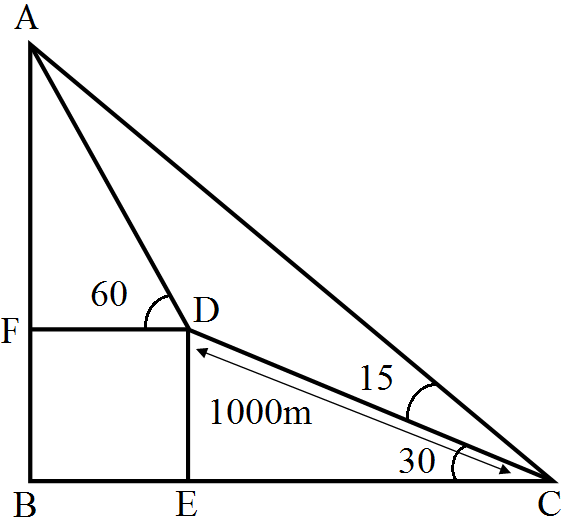 $\text{DE}=1000\sin30=1000\times\frac{1}{2}=500\text{m}=\text{FB}$
$\text{EC}=1000\cos30=1000\times\frac{\sqrt{3}}{2}=500\sqrt{3}\text{m}$
Let AF = xm
$\text{DF}=\frac{\text{x}}{\sqrt{3}}\text{m = BE}$
WE know,
From $\triangle\text{ABC},$
$\tan45=\frac{\text{AB}}{\text{BC}}$
$\Rightarrow1=\frac{\text{AF + FB}}{\text{BE + EC}}$
$\Rightarrow1=\frac{\text{x}+500}{\frac{\text{x}}{\sqrt{3}}+500\sqrt{3}}$
$\Rightarrow\frac{\text{x}}{\sqrt{3}}+500\sqrt{3}=\text{x}+500$
$\Rightarrow\text{x}+1500=\text{x}\sqrt{3}+500\sqrt{3}$
$\Rightarrow1500-500\sqrt{3}=\text{x}\sqrt{3}-\text{x}$
$\Rightarrow500\sqrt{3}(\sqrt{3}-1)=\text{x}(\sqrt{3}-1)$
$\therefore\text{x}=500\sqrt{3}\text{m}$
The height of the mountain is $\text{AB = AF + FB}=500(\sqrt{3}+1)\text{m}$ View full question & answer→Question 2075 Marks
Two ships leave a port at the same time. One goes 24km/ hr in the direction N 38° E and other travels 32km/ hr in the direction S 52° E. Find the distance between the ships at the end of 3hrs.
Answer
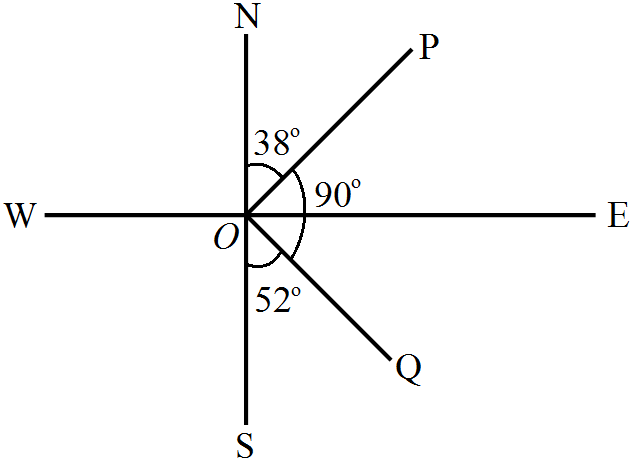 Let P and Q be the position of two ships at the end of 3 hours.
Then,
$\text{OP}=3\times24=72\text{km}$ and $\text{OQ}=3\times32=96\text{km}$
Using cosine formula in $\triangle\text{OPQ},$ we get
$\text{PQ}^2=\text{OP}^2+\text{OQ}^2-2\text{OP}\times\text{OQ}\cos90^{\circ}$
$\text{PQ}^2=72^2+96^2-2\times72\times96\cos90^{\circ}$
$\text{PQ}^2=14400$
$\text{PQ}=120\text{km}$ View full question & answer→Question 2085 Marks
$\text{If}\ \cos(\alpha+\beta)\sin(\gamma+\delta)=\cos(\alpha-\beta)\sin(\gamma-\delta),$
prove that $\cot\alpha\cot\beta\cot\gamma=\cot\delta$
AnswerWe have,
$\cos(\alpha+\beta)\sin(\gamma+\delta)=\cos(\alpha-\beta)\sin(\gamma-\delta)$
$\Rightarrow\ \frac{\cos(\alpha+\beta)}{\cos(\alpha-\beta)}=\frac{\sin(\gamma-\delta)}{\sin(\gamma+\delta)}...(\text{i})$
Now,
$\frac{\cos(\alpha+\beta)}{\cos(\alpha-\beta)}=\frac{\sin(\gamma-\delta)}{\sin(\gamma+\delta)}$
$\Rightarrow\ \frac{\cos(\alpha+\beta)}{\cos(\alpha-\beta)}+1=\frac{\sin(\gamma-\delta)}{\sin(\gamma+\delta)}+1$
$\Rightarrow\ \frac{\cos(\alpha+\beta)+\cos(\alpha-\beta)}{\cos(\alpha-\beta)}=\frac{\sin(\gamma-\delta)+\sin(\gamma+\delta)}{\sin(\gamma+\delta)}...(\text{ii})$
Again,
$\frac{\cos(\alpha+\beta)}{\cos(\alpha-\beta)}=\frac{\sin(\gamma-\delta)}{\sin(\gamma+\delta)}$ [By equation (i)]
$\Rightarrow\ \frac{\cos(\alpha+\beta)}{\cos(\alpha-\beta)}-1=\frac{\sin(\gamma-\delta)}{\sin(\gamma+\delta)}-1$
$\Rightarrow\ \frac{\cos(\alpha+\beta)-\cos(\alpha-\beta)}{\cos(\alpha-\beta)}=\frac{\sin(\gamma-\delta)-\sin(\gamma+\delta)}{\sin(\gamma+\delta)}...(\text{iii})$
Dividing equation (ii) by equation (iii), we get
$\frac{\cos(\alpha+\beta)+\cos(\alpha-\beta)}{\cos(\alpha+\beta)-\cos(\alpha-\beta)}=\frac{\sin(\gamma-\delta)+\sin(\gamma+\delta)}{\sin(\gamma-\delta)-\sin(\gamma+\delta)}$
$\Rightarrow\ \frac{\cos(\alpha+\beta)+\cos(\alpha-\beta)}{\cos(\alpha+\beta)-\cos(\alpha-\beta)}=-\Big[\frac{\sin(\gamma+\delta)+\sin(\gamma-\delta)}{\sin(\gamma+\delta)-\sin(\gamma-\delta)}\Big]$
$\Rightarrow\ \frac{2\cos\big\{\frac{\alpha+\beta+\alpha-\beta}{2}\big\}\cos\big\{\frac{\alpha+\beta-\alpha+\beta}{2}\big\}}{-2\sin\big\{\frac{\alpha+\beta+\alpha-\beta}{2}\big\}\sin\big\{\frac{\alpha+\beta-\alpha+\beta}{2}\big\}}\\ \ \ \ \ =-\Bigg[\frac{2\sin\big\{\frac{\gamma+\delta+\gamma-\delta}{2}\big\}\cos\big\{\frac{\gamma+\delta-\gamma+\delta}{2}\big\}}{2\sin\big\{\frac{\gamma+\delta-\gamma+\delta}{2}\big\}\cos\big\{\frac{\gamma+\delta+\gamma-\delta}{2}\big\}}\Bigg]$
$$$\Rightarrow\ \frac{\cos\alpha\cos\beta}{\sin\alpha\sin\beta}=\frac{\sin\gamma\cos\delta}{\sin\delta\cos\gamma}$
$\Rightarrow\ \cot\alpha\cot\beta=\frac{\sin\gamma\cos\delta}{\cos\gamma\sin\delta}$
$\Rightarrow\ \cot\alpha\cot\beta=\frac{\cot\delta}{\cot\gamma}$
$\Rightarrow\ \cot\alpha\cot\beta\cot\gamma=\cot\delta$
$\therefore\ \cot\alpha\cot\beta\cot\gamma=\cot\delta$ Hence proved.
View full question & answer→Question 2095 Marks
Solve the following equations:
$4\sin\text{x}\cos\text{x}+2\sin\text{x}+2\cos\text{x}+1=0$
Answer$4\sin\text{x}\cos\text{x}+2\sin\text{x}+2\cos\text{x}+1=0$
$\Rightarrow2\sin\text{x}(2\cos\text{x}+1)+1(2\cos\text{x}+1)=0$
$\Rightarrow(2\sin\text{x}+1)(2\cos\text{x+1})=0$
$\Rightarrow2\sin\text{x}+1=0$ or $2\cos\text{x}=-\frac{1}{2}$
$\Rightarrow\sin\text{x}=\sin\frac{7\pi}{6}$ or $\cos\text{x}=\frac{2\pi}{3}$
$\Rightarrow\text{x}=\text{n}\pi+(-1)^\text{n}\frac{7\pi}{6}$ or $\text{x}=2\text{n}\pi\pm\frac{2\pi}{3},\text{n}\in\text{Z}$
View full question & answer→Question 2105 Marks
Prove that:
$\tan\text{x}\tan\Big(\frac{\pi}{3}-\text{x}\Big)\tan\Big(\frac{\pi}{3}+\text{x}\Big)=\tan3\text{x}$
Answer$\frac{\pi}{3}=60^\circ$
$\text{LHS}=\tan\text{x}\tan(60^\circ-\text{x})\tan(60^\circ+\text{x})$
$=\ \frac{\sin\text{x}\sin(60^\circ-\text{x})\sin(60^\circ+\text{x})}{\cos\text{x}\cos(60^\circ-\text{x})\cos(60^\circ+\text{x})}$
$=\ \frac{\sin\text{x}(\sin^260^\circ-\sin^2\text{x})}{\cos\text{x}(\cos^260^\circ-\sin^2\text{x})}$
$=\ \frac{\sin\text{x}\Big(\frac{3}{4}-\sin^2\text{x}\Big)}{\cos\text{x}\Big(\frac{1}{4}-\sin^2\text{x}\Big)}$
$=\ \frac{\sin\text{x}(3-4\sin^2\text{x})}{\cos\text{x}(1-4\sin^2\text{x})}$
$=\ \frac{3\sin\text{x}-4\sin^3\text{x}}{4\cos^3\text{x}-3\cos\text{x}}$
$=\ \frac{\sin3\text{x}}{\cos3\text{x}}$
$=\ \tan3\text{x}=\text{RHS}$
View full question & answer→Question 2115 Marks
prove that:
$\frac{\cos(\text{A+B+C})+\cos(-\text{A+B+C})+\cos(\text{A}-\text{B+C})+\cos(\text{A+B}-\text{C})}{\sin(\text{A+B+C})+\sin(-\text{A+B+C})+\sin(\text{A}-\text{B+C})-\sin(\text{A+B}-\text{C})}=\cot\text{C}$
AnswerWe have,
$\text{LHS}=\frac{\cos(\text{A+B+C})+\cos(-\text{A+B+C})+\cos(\text{A}-\text{B+C})+\cos(\text{A+B}-\text{C})}{\sin(\text{A+B+C})+\sin(-\text{A+B+C})+\sin(\text{A}-\text{B+C})-\sin(\text{A+B}-\text{C})}$
$=\ \frac{2\cos\Big\{\frac{\text{A+B+C}-\text{A+B+C}}{2}\Big\}\cos\Big\{\frac{\text{A+B+C+A}-\text{B}-\text{C}}{2}\Big\}\\+2\cos\Big\{\frac{\text{A}-\text{B+C+A+B}-\text{C}}{2}\Big\}\cos\Big\{\frac{\text{A}-\text{B+C}-\text{A}-\text{B+C}}{2}\Big\}}{2\sin\Big\{\frac{\text{A+B+C}-\text{A+B+C}}{2}\Big\}\cos\Big\{\frac{\text{A+B+C+A}-\text{B}-\text{C}}{2}\Big\}\\+2\sin\Big\{\frac{\text{A}-\text{B+C}-\text{A}-\text{B+C}}{2}\Big\}\cos\Big\{\frac{\text{A}-\text{B+C+A+B}-\text{C}}{2}\Big\}}$
$=\ \frac{2\cos(\text{B+C})\cos\text{A}+2\cos\text{A}\cos(\text{C}-\text{B})}{2\sin(\text{B+C})\cos\text{A}+2\sin(\text{C}-\text{B})\cos\text{A}}$
$=\ \frac{2\cos\text{A}[\cos(\text{B+C})+\cos(\text{C}-\text{B})]}{2\cos\text{A}[\sin(\text{B+C})+\sin(\text{C}-\text{B})]}$
$=\ \frac{\cos(\text{B+C})+\cos(\text{C}-\text{B})}{\sin(\text{B+C})+\sin(\text{C}-\text{B})}$
$=\ \frac{2\cos\Big\{\frac{\text{B+C+C}-\text{B}}{2}\Big\}\cos\Big\{\frac{\text{B+C}-\text{C+B}}{2}\Big\}}{2\sin\Big\{\frac{\text{B+C+C}-\text{B}}{2}\Big\}\cos\Big\{\frac{\text{B+C}-\text{C+B}}{2}\Big\}}$
$=\ \frac{2\cos\text{C}\cos\text{B}}{2\sin\text{C}\cos\text{B}}$
$=\ \frac{\cos\text{C}}{\sin\text{C}}$
$=\ \cot\text{C}$
$=\ \text{RHS}$
$\therefore\ \frac{\cos(\text{A+B+C})+\cos(-\text{A+B+C})+\cos(\text{A}-\text{B+C})+\cos(\text{A+B}-\text{C})}{\sin(\text{A+B+C})+\sin(-\text{A+B+C})+\sin(\text{A}-\text{B+C})-\sin(\text{A+B}-\text{C})}=\cot\text{C}.$ Hence proved.
View full question & answer→Question 2125 Marks
Reduce each of the following expressions to the sine and cosin of a single expression:
$\sqrt{3}\sin\text{x}-\cos\text{x}$
AnswerLet $\text{f(x)}=\sqrt{3}\sin\text{x}-\cos\text{x}$
Dividing and multiplying by $\sqrt{3+1},$ i.e. by 2, We get:
$\text{f(x)}=2\Big(\frac{\sqrt{3}}{2}\sin\text{x}-\frac{1}{2}\cos\text{x}\Big)$
$\Rightarrow\text{f(x)}=2\Big(\cos\frac\pi6\sin\text{x}-\sin\frac\pi6\cos\text{x}\Big)$
$\Rightarrow\text{f(x)}=2\sin\Big(\text{x}-\frac{\pi}{6}\Big)$
Again,
$\text{f(x)}=2\Big(\frac{\sqrt{3}}{2}\sin\text{x}-\frac{1}{2}\cos\text{x}\Big)$
$\Rightarrow\text{f(x)}=2\Big(\sin\frac{\pi}{3}\sin\text{x}-\cos\frac\pi3\cos\text{x}\Big)$
$\Rightarrow\text{f(x)}=-2\cos\Big(\frac\pi3+\text{x}\Big)$
View full question & answer→Question 2135 Marks
If in a $\triangle\text{ABC},\cos^2\text{A}+\cos^2\text{B}+\cos^2\text{C}=1,$ prove that the triangle is right angled.
AnswerLet ABC be any triangle.
In $\triangle\text{ABC},$
$\cos^2\text{A}+\cos^2\text{B}+\cos^2\text{C}=1$
$\Rightarrow\cos^2\text{A}+\cos^2\text{B}+\cos^2[\pi-(\text{B + A})]=1$ $(\because\text{A + B + C} = \pi)$
$\Rightarrow\cos^2\text{A}+\cos^2\text{B}+\cos^2(\text{B + A})=1$
$\Rightarrow\cos^2\text{A}+\cos^2\text{B}=1-\cos^2(\text{B + A})$
$\Rightarrow\cos^2\text{A}+\cos^2\text{B}=\sin^2(\text{B + A})$
$\Rightarrow\cos^2\text{A}+\cos^2\text{B}=(\sin\text{A}\cos\text{B}+\cos\text{A}\sin\text{B})^2$
$\Rightarrow\cos^2\text{A}+\cos^2\text{B}=\sin^2\text{A}\cos^2\text{B}+\cos^2\text{A}\sin^2\text{B}\\+2\sin\text{A}\sin\text{B}\cos\text{A}\cos\text{B}$
$\Rightarrow\cos^2\text{A}(1-\sin^2\text{B})+\cos^2\text{B}(1-\sin^2\text{A})$ $=2\sin\text{A}\sin\text{B}\cos\text{A}\cos\text{B}$
$\Rightarrow2\cos^2\text{A}\cos^2\text{B}=2\sin\text{A}\sin\text{B}\cos\text{A}\cos\text{B}$
$\Rightarrow\cos\text{A}\cos\text{B}=\sin\text{A}\sin\text{B}$
$\Rightarrow\cos\text{A}\cos\text{B}-\sin\text{A}\sin\text{B}=0$
$\Rightarrow\cos(\text{A + B)}=0$
$\Rightarrow\cos\text{(A + B)}=\cos90^{\circ}$
$\Rightarrow\text{A + B}=90^{\circ}$
$\Rightarrow\text{C}=90^{\circ}$ $(\because\text{A + B + C }= 180^{\circ})$
Hence, $\triangle\text{ABC}$ is right angled.
View full question & answer→Question 2145 Marks
If $\text{T}_\text{n}=\sin^\text{n}\text{x}+\cos^\text{n}\text{x},$ Prove that
$6\text{T}_{10}-15\text{T}_8+10\text{T}_6-1=0$
Answer$=-6\sin^2\text{x}\cos^2\text{x}(\sin^4\text{x}+\cos^4\text{x})+6\sin^4\cos^4\text{x}\\\ \ \ +9\sin^2\text{x}\cos^2\text{x}(\sin^4\text{x}+\cos^4\text{x})-3\sin^2\text{x}\cos^2\text{x}$
$=3\sin^2\text{x}\cos^2\text{x}(\sin^4\text{x}+\cos^4\text{x})=6\sin^4\text{x}\cos^4\text{x}-3\sin^2\text{x}\cos^2\text{x}$
$=3\sin^2\text{x}\cos^2\text{x}((\sin^2\text{x})^2+(\cos^2\text{x})^2\\\ \ +2\sin^2\text{x}\cos^2\text{x }2\sin^2\text{x}\cos^2)\\\ \ +6\sin^4\text{x}\cos^4\text{x}-3\sin^2\text{x}\cos^2\text{x}$ $($Adding and subtracting $2\sin^2\text{x}\cos^2\text{x})$$$
$=3\sin^2\text{x}\cos^2\text{x}((\sin^2\text{x}+\cos^2\text{x})^2-2\sin^2\text{x}\cos^2\text{x})\\\ \ +6\sin^4\text{x}\cos^4\text{x}-3\sin^2\text{x}\cos^2\text{x}$
$=3\sin^2\text{x}\cos^2\text{x}(1-2\sin^2\text{x}\cos^2\text{x})+6\sin^4\text{x}\cos^4\text{x}-3\sin^2\text{x}\cos^2\text{x}$
$=3\sin^2\text{x}\cos^2\text{x}-6\sin^4\text{x}\cos^4+6\sin^4\text{x}\cos^4\text{x}-3\sin^2\text{x}\cos^2\text{x}$
$=0$
$=\text{R.H.S}$
$\text{Proved}.$
View full question & answer→Question 2155 Marks
Solve the following equations:
$3\tan\text{x}+\cot\text{x}=5\ \text{cosec }\text{x}$
Answer$3\tan\text{x}+\cot\text{x}=5\ \text{cosec}\ \text{x}$ $\Rightarrow\frac{3\sin\text{x}}{\cos\text{x}}+\frac{\cos\text{x}}{\sin\text{x}}=\frac{5}{\sin\text{x}}$ $\Rightarrow\frac{3\sin^2+\cos^2\text{x}}{\cos\text{x}\sin\text{x}}=\frac{5}{\sin\text{x}}$ $\Rightarrow3(1-\cos^2\text{x})+\cos^2\text{x}=5\cos\text{x}$ $\Rightarrow3-3\cos^2\text{x}+\cos^2\text{x}=5\cos\text{x}$ $\Rightarrow2\cos^2\text{x}+5\cos\text{x}-3=0$ $\Rightarrow2\cos^2\text{x}+6\cos\text{x}-\cos\text{x}-3=0$ $\Rightarrow2\cos\text{x}(\cos\text{x}+3)-1(\cos\text{x}+3)=0$ $\Rightarrow(2\cos\text{x}-1)(\cos\text{x}+3)=0$ $\Rightarrow(2\cos\text{x}-1)=0$ or $\cos\text{x}+3=0$ $\Rightarrow\cos\text{x}=\frac{1}{2}$ or $\cos\text{x}=-3$$\cos\text{x}=-3$ is not possible $(\therefore-1\leq\cos\text{x}\leq1)$
$\Rightarrow\cos\text{x}=\cos\frac{\pi}{3}$
$\Rightarrow\text{x}=2\text{n}\pi\pm\frac{\pi}{3},\ \text{n}\in\text{Z}$
View full question & answer→Question 2165 Marks
If $\text{T}_\text{n}=\sin^\text{n}\text{x}+\cos^\text{n}\text{x},$ Prove that
$2 \text{T}_6 - 3\text{ T}_4 + 1 = 0$
Answer$\text{L.H.S}=2\text{T}_6-3\text{T}_4+1$
$=2(\sin^6\text{x}+\cos^6\text{x})-3(\sin^4\text{x}+\cos^4\text{x})+1$
$=2((\sin^2\text{x})^3+(\cos^2\text{x})^3-2(\sin^2\text{x})^2+(\cos^2\text{x})^2)+1$
$=2((\sin^2\text{x}+\cos^2\text{x})(\sin^2\text{x})^2+(\cos^2\text{x})^2-(\sin^2\text{x}\cos^2\text{x}))\\\ \ \ -3((\sin^2\text{x})^2+(\cos^2\text{x})^2+2\sin^2\text{x}\cos^2\text{x}-2\sin^2\text{x}\cos^2\text{x})=1$ $ [$Using $a^3 + b^3 =(a + b)(a^2 + b^2 - ab)$ and adding and subtracting $2\sin^2\text{x}\cos^2\text{x}\big]$
$=2((\sin^2\text{x}+\cos^2\text{x})^2-3\sin^2\text{x}\cos^2\text{x})-3(1-2\sin^2\text{x}\cos^2\text{x})+1$
$=2(1-3\sin^2\text{x}\cos^2\text{x})-3\sin^2\text{x}\cos^2\text{x}+1$
$=2-6\sin^2\text{x}\cos^2\text{x}-2+6\sin^2\text{x}\cos^2\text{x}$
$=0$
$=\text{R.H.S}$
$\text{Proved}.$
View full question & answer→Question 2175 Marks
Prove that:
$\sin\alpha+\sin\beta+\sin\gamma-\sin(\alpha+\beta+\gamma)\\=4\sin\Big(\frac{\alpha+\beta}{2}\Big)\sin\Big(\frac{\beta+\gamma}{2}\Big)\sin\Big(\frac{\gamma+\alpha}{2}\Big)$
AnswerWe have,
$\text{LHS}=\sin\alpha+\sin\beta+\sin\gamma-\sin(\alpha+\beta+\gamma)$
$=\ (\sin\alpha+\sin\beta)+(\sin\gamma-\sin(\alpha+\beta+\gamma))$
$=\ 2\sin\Big(\frac{\alpha+\beta}{2}\Big)\cos\Big(\frac{\alpha-\beta}{2}\Big)+2\sin\Big(\frac{\gamma-(\alpha+\beta+\gamma)}{2}\Big)\cos\Big(\frac{\gamma+\alpha+\beta+\gamma}{2}\Big)$
$=\ 2\sin\Big(\frac{\alpha+\beta}{2}\Big)\cos\Big(\frac{\alpha-\beta}{2}\Big)+2\sin\Big(\frac{-\alpha-\beta}{2}\Big)\cos\Big(\frac{\alpha+\beta+2\gamma}{2}\Big)$
$=\ 2\sin\Big(\frac{\alpha+\beta}{2}\Big)\cos\Big(\frac{\alpha-\beta}{2}\Big)-2\sin\Big(\frac{\alpha+\beta}{2}\Big)\cos\Big(\frac{\alpha+\beta+2\gamma}{2}\Big)$
$=\ 2\sin\Big(\frac{\alpha+\beta}{2}\Big)\Big[\cos\Big(\frac{\alpha-\beta}{2}\Big)-\cos\Big(\frac{\alpha+\beta+2\gamma}{2}\Big)\Big]$
$=\ 2\sin\Big(\frac{\alpha+\beta}{2}\Big)\Bigg[-2\sin\frac{\Big[\frac{\alpha-\beta}{2}+\frac{\alpha+\beta+2\gamma}{2}\Big]}{2}\sin\frac{\Big[\frac{\alpha-\beta}{2}-\frac{\alpha+\beta+2\gamma}{2}\Big]}{2}\Bigg]$
$$$=\ 2\sin\Big(\frac{\alpha+\beta}{2}\Big)\Big[-2\sin\Big[\frac{2\alpha+2\gamma}{2\times2}\Big]\sin\Big[\frac{-2\beta-2\gamma}{2\times2}\Big]\Big]$
$=\ -4\sin\Big(\frac{\alpha+\beta}{2}\Big)\Big[\sin\Big(\frac{\alpha+\gamma}{2}\Big)\sin\Big[\frac{-(\beta+\gamma)}{2}\Big]\Big]$
$=\ 4\sin\Big(\frac{\alpha+\beta}{2}\Big)\sin\Big(\frac{\alpha+\gamma}{2}\Big)\sin\Big(\frac{\beta+\gamma}{2}\Big)$
$=\ \text{RHS}$
$\sin\alpha+\sin\beta+\sin\gamma-\sin(\alpha+\beta+\gamma)\\=4\sin\Big(\frac{\alpha+\beta}{2}\Big)\sin\Big(\frac{\beta+\gamma}{2}\Big)\sin\Big(\frac{\gamma+\alpha}{2}\Big)$ Hence proved.
View full question & answer→Question 2185 Marks
Prove that:
$\cos\frac{\pi}{15}\cos\frac{2\pi}{15}\cos\frac{3\pi}{15}\cos\frac{4\pi}{15}\cos\frac{5\pi}{15}\cos\frac{6\pi}{15}\cos\frac{7\pi}{15}=\cos\frac{1}{128}$
Answer$\text{LHS}=\cos\frac{\pi}{15}\cos\frac{2\pi}{15}\cos\frac{3\pi}{15}\cos\frac{4\pi}{15}\cos\frac{5\pi}{15}\cos\frac{6\pi}{15}\cos\frac{7\pi}{15}\cos\frac{1}{128}$
$=\cos\frac{\pi}{15}\cos\frac{2\pi}{15}\cos\frac{4\pi}{15}\big(\cos\frac{3\pi}{15}\cos\frac{6\pi}{15}\big)\times\big(-\cos\frac{8\pi}{15}\big)$
$=-\frac{1}{2}\big[\cos\frac{\pi}{15}\cos\frac{2\pi}{15}\cos\frac{4\pi}{15}\cos\frac{8\pi}{15}\big]\times\frac{1}{2}\times\big(\cos\frac{3\pi}{15}\cos\frac{6\pi}{15}\big)$
$=-\frac{1}{2}\times\frac{2^3}{2^4\sin\frac{\pi}{15}}[2\sin\frac{\pi}{15}\cos\frac{\pi}{15}\cos\frac{2\pi}{15}\cos\frac{4\pi}{15}\cos\frac{8\pi}{15}]\times\frac{2}{2^2\times\sin\frac{3\pi}{15}}(2\sin\frac{3\pi}{15}\cos\frac{3\pi}{15}\cos\frac{6\pi}{15})$
$=-\frac{2^3}{132\sin\frac{\pi}{15}}[\sin\frac{2\pi}{15}\cos\frac{2\pi}{15}\cos\frac{4\pi}{15}\cos\frac{8\pi}{15}]\times\frac{2}{4\sin\frac{3\pi}{15}}(\sin\frac{6\pi}{15}\cos\frac{6\pi}{15})$
$=-\frac{2^3}{132\sin\frac{\pi}{15}}[2\sin\frac{2\pi}{15}\cos\frac{2\pi}{15}\cos\frac{4\pi}{15}\cos\frac{8\pi}{15}]\times\frac{1}{4\sin\frac{3\pi}{15}}(2\sin\frac{6\pi}{15}\cos\frac{6\pi}{15})$
$=-\frac{2}{32\sin\frac{\pi}{15}}[\sin\frac{16\pi}{15}]\times\frac{\sin\frac{12\pi}{15}}{4\sin\frac{3\pi}{15}}$
$=-\frac{\sin\big(\pi+\frac{\pi}{15}\big)}{128\sin\frac{\pi}{15}}\times\frac{\sin\big(\pi-\frac{3\pi}{15}\big)}{\sin\frac{3\pi}{15}}$
$=-\frac{-\sin\frac{\pi}{15}}{128\sin\frac{\pi}{15}}\times\frac{\sin\frac{3\pi}{15}}{\sin\frac{3\pi}{15}}$
$=\frac{1}{128}$
$=\text{RHS}$
View full question & answer→Question 2195 Marks
Prove that $(2\sqrt{3}+3)\sin\text{x}+2\sqrt{3}\cos\text{x}$ lies between $-(2\sqrt{3}+\sqrt{15})$ and $(2\sqrt{3}+\sqrt{15}).$
AnswerLet $\text{f(x)}=(2\sqrt{3}+3)\sin\text{x}+2\sqrt{3}\cos\text{x}$
We know that,
$-\sqrt{(2\sqrt{3}+3)^2+(2\sqrt{3})^2}\le\text{f(x)}\le\sqrt{(2\sqrt{3}+3)^2+(2\sqrt{3})^2}$
$\Rightarrow-\sqrt{12+9+12\sqrt{3}+12}\le\text{f(x)}\le\sqrt{12+9+12\sqrt{3}+12}$
$\Rightarrow-\sqrt{33+12\sqrt{3}}\le\text{f(x)}\le\sqrt{33+12\sqrt{3}}$
Disclaimer: Instead of $-(2\sqrt{3}+\sqrt{15})$ and $(2\sqrt{3}+\sqrt{15}),$ it should be $-\sqrt{33+12\sqrt{3}}$ and $\sqrt{33+12\sqrt{3}}.$
View full question & answer→Question 2205 Marks
If X lies in the first quadrant and $\cos\text{x}=\frac{8}{17},$ then prove that
$\cos\Big(\frac{\pi}{6}+\text{x}\Big) +\cos\Big(\frac{\pi}{4}-\text{x}\Big)+\cos\Big(\frac{2\pi}{3}-\text{x}\Big)=\Big(\frac{\sqrt{3}-1}{2}+\frac{1}{\sqrt{2}}\Big)\frac{23}{17}$
AnswerWe have,
$\cos\text{x}=\frac{8}{17}$
$\therefore\sin\text{x}=\sqrt{1-\cos^2\text{x}}=\sqrt{1-\frac{64}{289}}$
$=\sqrt{\frac{225}{289}}$
$=\frac{15}{17}$
Now, $\cos\Big(\frac{\pi}{6}+\text{x}\Big) +\cos\Big(\frac{\pi}{4}-\text{x}\Big)+\cos\Big(\frac{2\pi}{3}-\text{x}\Big)$
$=\Big[\cos\frac{\pi}{6}\cos\text{x}-\sin\frac{\pi}{6}\sin\text{x}\Big]+\Big[\cos\frac{\pi}{4}\cos\text{x}+\sin\frac{\pi}{4}\sin\text{x}\Big]\\\ \ +\Big[\cos\frac{\pi}{4}\cos\text{x}+\sin\frac{\pi}{4}\sin\text{x}\Big]$
$$$=\Big[\cos\frac{\pi}{6}+\cos\frac{\pi}{4}+\cos\frac{2\pi}{3}\Big]\cos\text{x}\\\ \ +\sin\text{x}\Big[-\sin\frac{\pi}{6}+\sin\frac{\pi}{4}+\sin\frac{2\pi}{3}\Big]$
$$$=\Big[\frac{\sqrt{3}}{2}+\frac{1}{\sqrt{2}}+\cos\Big(\frac{\pi}{2}+\frac{\pi}{6}\Big)\Big]\times\frac{8}{17}\\\ +\frac{15}{17}\times\Big[\frac{1}{2}+\frac{1}{\sqrt{2}}+\sin\Big(\frac{\pi}{2}+\frac{\pi}{6}\Big)\Big]$
$$$=\Big[\frac{\sqrt{3}}{2}+\frac{1}{\sqrt{2}}-\sin\frac{\pi}{6}\Big]\times\frac{8}{17}+\frac{15}{17}\times\Big[-\frac{1}{2}+\frac{1}{\sqrt{2}} +\cos\frac{\pi}{6}\Big]$
$=\Big[\frac{\sqrt{3}}{2}+\frac{1}{\sqrt{2}}-\frac{1}{2}\Big]\times\frac{8}{17}+\frac{15}{17}\times\Big[-\frac{1}{2}+\frac{1}{\sqrt{2}} +\frac{\sqrt{3}}{2}\Big]$ $\big[\because\cos\text{A}$ is negative in second quadrant$\big]$
$=\Big[\frac{\sqrt{3}-1}{2}+\frac{1}{\sqrt{2}}\Big]\times\frac{8}{17}\times\frac{15}{17}\times\Big[\frac{\sqrt{3}-1}{2}+\frac{1}{\sqrt{2}}\Big]$
$=\Big(\frac{\sqrt{3}-1}{2}+\frac{1}{\sqrt{2}}\Big)\Big(\frac{8}{17}+\frac{15}{17}\Big)$
$=\Big(\frac{\sqrt{3}-1}{2}+\frac{1}{\sqrt{2}}\Big)\times\frac{23}{17}$
$\therefore\cos\Big(\frac{\pi}{6}+\text{x}\Big) +\cos\Big(\frac{\pi}{4}-\text{x}\Big)+\cos\Big(\frac{2\pi}{3}-\text{x}\Big)=\Big(\frac{\sqrt{3}-1}{2}+\frac{1}{\sqrt{2}}\Big)\frac{23}{17}$
Hence proved.
View full question & answer→Question 2215 Marks
Solve the following equations:
$3-2\cos\text{x}-4\sin\text{x}-\cos2\text{x}+\sin2\text{x}=0$
Answer$3-2\cos\text{x}-4\sin\text{x}-\cos2\text{x}+\sin2\text{x}=0$
$\Rightarrow3-2\cos\text{x}-4\sin\text{x}-(1-2\sin^2\text{x})+2\sin\text{x}\cos\text{x}=0$
$\Rightarrow3-2\cos\text{x}-4\sin\text{x}-1+2\sin^2\text{x}+2\sin\text{x}\cos\text{x}=0$
$\Rightarrow(2\sin^2\text{x}-4\sin\text{x}+2)+2\cos\text{x}(\sin\text{x}-1)=0$
$\Rightarrow2(\sin^2\text{x}-2\sin\text{x}+1)+2\cos\text{x}(\sin\text{x}-1)=0$
$\Rightarrow2(\sin\text{x}-1)^2+2\cos\text{x}(\sin\text{x}-1)=0$
$\Rightarrow(\sin\text{x}-1)(2\sin\text{x}-2+2\cos\text{x})=0$
$\Rightarrow2(\sin\text{x}-1)(\sin\text{x}+\cos\text{x}-1)=0$
$\Rightarrow(\sin\text{x}-1)=0$ or $(\sin\text{x})+\cos\text{x}-1=0$
$\Rightarrow\sin\text{x}=1$ or $\sin\text{x}+\cos\text{x}=1$
$\Rightarrow\sin\text{x}=\sin\frac{\pi}{2}$ or $\frac{1}{\sqrt{2}}\sin\text{x}+\frac{1}{\sqrt{2}}\cos\text{x}=\frac{1}{\sqrt{2}}$
$\Rightarrow\sin\text{x}=\sin\frac{\pi}{2}$ or $\sin\frac{\pi}{4}\sin\text{x}+\cos\frac{\pi}{4}\cos\text{x}=\cos\frac{\pi}{4}$
$\Rightarrow\sin\text{x}=\sin\frac{\pi}{2}$ or $\cos\Big(\text{x}-\frac{\pi}{4}\Big)=\cos\frac{\pi}{4}$
$\Rightarrow\text{x}=\text{n}\pi+(-1)^\text{n}\frac{\pi}{2}$ or $\text{x}-\frac{\pi}{4}=2\text{n}\pi\pm\frac{\pi}{4},\ \text{n}\in\text{Z}$
$\Rightarrow\text{x}=\text{n}\pi+(-1)^\text{n}$ or $\text{x}=2\text{n}\pi+\frac{\pi}{2}$ or $\text{x}=2\text{n}\pi,\ 2\text{n}\pi,\ \text{n}\in\text{Z}$
View full question & answer→Question 2225 Marks
Prove that:
$\frac{\sin\text{A}\sin2\text{A}+\sin3\text{A}\sin6\text{A}}{\sin\text{A}\cos2\text{A}+\sin3\text{A}\cos6\text{A}}=\tan5\text{A}$
AnswerWe have,
$\text{LHS}=\frac{\sin\text{A}\sin2\text{A}+\sin3\text{A}\sin6\text{A}}{\sin\text{A}\cos2\text{A}+\sin3\text{A}\cos6\text{A}}$
$=\ \frac{2[\sin\text{A}\sin2\text{A}+\sin3\text{A}\sin6\text{A}]}{2[\sin\text{A}\cos2\text{A}+\sin3\text{A}\cos6\text{A}]}$
$=\ \frac{2\sin2\text{A}\sin\text{A}+2\sin6\text{A}\sin3\text{A}}{2\cos2\text{A}\sin\text{A}+2\cos6\text{A}\sin3\text{A}}$
$=\ \frac{\cos(2\text{A}-\text{A})-\cos(2\text{A}+\text{A})+\cos(6\text{A}-3\text{A})-\cos(6\text{A}+3\text{A})}{\sin(2\text{A}+\text{A})-\sin(2\text{A}-\text{A})+\sin(6\text{A}+3\text{A})+\sin(6\text{A}-3\text{A})}$
$=\ \frac{\cos\text{A}-\cos3\text{A}+\cos3\text{A}-\cos9\text{A}}{\sin3\text{A}-\sin\text{A}+\sin9\text{A}-\sin3\text{A}}$
$=\ \frac{\cos\text{A}-\cos9\text{A}}{\sin9\text{A}-\sin\text{A}}$
$=\ \frac{-[\cos9\text{A}-\cos\text{A}]}{\sin9\text{A}-\sin\text{A}}$
$=\ \frac{-\Big(-2\sin\Big(\frac{9\text{A}+\text{A}}{2}\Big)\times\sin\Big(\frac{9\text{A}-\text{A}}{2}\Big)\Big)}{2\sin\Big(\frac{9\text{A}-\text{A}}{2}\Big)\times\cos\Big(\frac{9\text{A}+\text{A}}{2}\Big)}$
$=\ \frac{\sin5\text{A}\sin4\text{A}}{\sin4\text{A}\cos5\text{A}}$
$=\ \tan5\text{A}$
$=\ \text{RHS}$
$\therefore\ \frac{\sin\text{A}\sin2\text{A}+\sin3\text{A}\sin6\text{A}}{\sin\text{A}\cos2\text{A}+\sin3\text{A}\cos6\text{A}}=\tan5\text{A}$ Hence proved.
View full question & answer→Question 2235 Marks
$\tan\text{x}\tan(\text{x}+\frac{\pi}{3})+\tan\text{x}(\frac{\pi}{3}-\text{x})\\+\tan(\text{x}+\frac{\pi}{3})\tan(\text{x}-\frac{\pi}{3})=-3$
AnswerWe have to prove that
$\sin5\text{x}=5\cos^4\text{x}\sin\text{x}-10\cos^2\text{x}\sin^3\text{x}+\sin^5\text{x}$
$\text{LHS}=\sin\text{x}=\sin(3\text{x}+2\text{x})$
$=\sin3\text{x}\cos2\text{x}+\cos3\text{x}.\sin2\text{x}$
$=(3\sin\text{x}-4\sin^3\text{x})(2\cos^2\text{x}-1)\\+(4\cos^3\text{x}-3\cos\text{x})2\sin\text{x}\cos\text{x}.$
$=-3\sin\text{x}+4\sin^3\text{x}+6\sin\text{x}\cos^2\text{x}-8\sin^3\text{x}\cos^2\text{x}\\+8\cos^4\text{x}\sin\text{x}-6\cos^2\text{x}\sin\text{x}$
$=8\cos^4\text{x}\sin\text{x}-8\sin^3\text{x}\cos^2\text{x}-3\sin\text{x}+4\sin^3\text{x}$
$=5\cos^4\text{x}\sin\text{x}-10\sin^3\text{x}\cos^2\text{x}-3\sin\text{x}\\+3\cos^4\text{x}\sin\text{x}+4\sin^3\text{x}+2\sin^3\text{x}\cos^2\text{x}$
$=5\cos^4\text{x}\sin\text{x}-10\sin^3\text{x}\cos^2\text{x}\\-3\sin\text{x}(1-\cos^4\text{x})+2\sin^3\text{x}(2+\cos^2\text{x})$
$=5\cos^4\text{x}\sin\text{x}-10\sin^3\text{x}\cos^2\text{x}\\-3\sin\text{x}(1-\cos^2\text{x})(1+\cos^2\text{x})+2\sin^3\text{x}(2+\cos^2\text{x})$
$=5\cos^4\text{x}\sin\text{x}-10\sin^3\text{x}\cos^2\text{x}\\-3\sin^3\text{x}(1+\cos^2)+2\sin^3(2+\cos^2\text{x})$
$=5\cos^4\text{x}\sin\text{x}-10\sin^3\text{x}\cos^2\text{x}\\-\sin^3\text{x}\big[3(1+\cos^2\text{x})-2(2+\cos^2\text{x})\big]$
$=5\cos^4\text{x}\sin\text{x}-10\sin^3\text{x}\cos^2\text{x}\\-\sin^3\text{x}\big[3+3\cos^2\text{x}-4-2\cos^2\text{x}\big]$
$=5\cos^4\text{x}\sin\text{x}-10\sin^3\text{x}\cos^2\text{x}-\sin^3\text{x}\big[\cos^2\text{x}-1\big]$
$=5\cos^4\text{x}\sin\text{x}-10\sin^3\text{x}\cos^2\text{x}+\sin^5\text{x}$
$=\text{RHS}$
View full question & answer→Question 2245 Marks
If than $\alpha=\text{x}+1,\tan\beta=\text{x}-1,$ prove that $2\cot(\alpha-\beta)=\text{x}^2$
AnswerWe have,
$\tan\alpha=\text{x}+1\text{ and }\tan\beta=\text{x}-1$
Now, $2\cot(\alpha-\beta)$
$=\frac{2}{\tan(\alpha-\beta)}$
$=\frac{\frac{2}{\tan\alpha-\tan\beta}}{1+\tan\alpha\tan\beta}$
$=\frac{2(1+\tan\alpha\tan\beta)}{\tan\alpha-\tan\beta}$
$=\frac{2[1+(\text{x}+1)(\text{x}-1)]}{\text{x}+1-(\text{x}-1)}$
$=\frac{2[1+\text{x}^2-1]}{\text{x}+1-\text{x}+1}$
$=\frac{2\text{x}\text{x}^2}{2}=\text{x}^2$
$\therefore2+\cot(\alpha+\beta )=\text{x}^2$
Hence proved.
View full question & answer→Question 2255 Marks
If $\sin\alpha+\sin\beta=\text{a}$ and $\cos\alpha+\cos\beta=\text{b},$ show that
$\sin(\alpha+\beta)=\frac{2\text{ab}}{\text{a}^2+\text{b}^2}$
Answer$\text{a}^2+\text{b}^2=(\sin\alpha+\sin\beta)^2+(\cos\alpha+\cos\beta)^2$
$\Rightarrow\text{a}^2+\text{b}^2=\sin^2\alpha+\sin^2\beta+2\sin^2\alpha\sin^2\beta+\cos^2\alpha+\cos^2\beta+2\cos\alpha\cos\beta$
$\Rightarrow\text{a}^2+\text{b}^2=\sin^2\alpha+\cos^2\alpha+\sin^2\beta+\cos^2\beta+2(\sin\alpha+\sin\beta+\cos\alpha\cos\beta)$
$\Rightarrow\text{a}^2+\text{b}^2=2+2\cos(\alpha-\beta)\cdots(1)$
Now,
$\text{b}^2-\text{a}^2=(\cos\alpha+\cos\beta)^2-(\sin\alpha-\sin\beta)^2$
$\Rightarrow\text{b}^2-\text{a}^2=\cos^2+\cos^2\beta+\sin^2\alpha-\sin^2\beta+2\cos\alpha+\cos\beta-2\sin\alpha\sin\beta$
$\Rightarrow\text{b}^2-\text{a}^2=(\cos^2\alpha-\sin^2\beta)+(\cos^2\beta-\sin^2\alpha)-2\cos(\alpha+\beta)$
$\Rightarrow\text{b}^2-\text{a}^2=2\cos(\alpha+\beta)\cos(\alpha-\beta)+2\cos(\alpha-\beta)$
$\Rightarrow\text{b}^2-\text{a}^2=\cos(\alpha+\beta)\Big(2+2\cos(\alpha-\beta)\Big)\cdots(2)$
From (1) and (2), we have
$\text{b}^2-\text{a}^2=\cos(\alpha+\beta)(\text{a}^2+\text{b}^2)$
$\Rightarrow\frac{\text{b}^2-\text{a}^2}{\text{a}^2-\text{b}^2}=\cos(\alpha+\beta)$
$\Rightarrow\sin(\alpha+\beta)=\sqrt{1-\cos^2(\alpha+\beta)}$
$\Rightarrow\sin(\alpha+\beta)=\sqrt{1-\Big(\frac{\text{b}^2-\text{a}^2}{\text{b}^2+\text{a}^2}\Big)^2}=\sqrt{\frac{\text{b}^4+\text{a}^4-\text{b}^4-\text{a}^4+4\text{a}^2\text{b}^2}{(\text{b}^2+\text{a}^2)}}$
$\Rightarrow\sin(\alpha+\beta)=\frac{2\text{ab}}{\text{a}^2+\text{b}^2}$
View full question & answer→Question 2265 Marks
If then $\text{x}+\tan\Big(\frac{\pi}{3}\Big)+\tan\Big(\text{x}=\frac{2\pi}{3}\Big)=3,$prove that $\frac{3\tan\text{x}-\tan^3\text{x}}{1-3\tan^2\text{x}}=1$
AnswerWe have,
$\tan\text{x}+\tan\Big(\text{x}+\frac{\pi}{3}\Big)+\tan\Big(\text{x}+\frac{2\pi}{3}\Big)=3$
$\Rightarrow \tan\text{x}+\Bigg[\frac{\tan\text{x}+\tan\frac{\pi}{3}}{1-\tan\text{x}\tan\frac{\pi}{3}}\Bigg]+\Bigg[\frac{\tan\text{x}+\tan\Big(\frac{2\pi}{3}\Big)}{1-\tan\text{x}\tan\frac{2\pi}{3}}\Bigg]=3$
$\Rightarrow \tan\text{x}+\Bigg[\frac{\tan\text{x}+\tan\frac{\pi}{3}}{1-\sqrt{3}\tan\text{x}}\Bigg]+\Bigg[\frac{\tan\text{x}+\tan\Big(\frac{\pi}{2}+\frac{\pi}{3}\Big)}{1-\tan\text{x}\tan\Big(\frac{\pi}{2}+\frac{\pi}{3}\Big)}\Bigg]=3$
$\Rightarrow \tan\text{x}+\frac{\tan\text{x}+ \sqrt{3}}{1-\sqrt{3}\tan\text{x}}+\frac{\tan\text{x}-\cot\frac{\pi}{3}}{1+\tan\text{x}\cot\frac{\pi}{3}}=3$
$\Rightarrow \tan\text{x}+\frac{\tan\text{x}+ \sqrt{3}}{1-\sqrt{3}\tan\text{x}}+\frac{\tan\text{x}-\sqrt{3}}{1+\sqrt{3}\tan\text{x}}=3$
$\Rightarrow\tan\text{x}+\frac{\Big(\tan\text{x}+\sqrt{3}\Big)\Big(1+\sqrt{3}\tan\text{x}\Big ) +\Big(\tan\text{x}-\sqrt{3}\Big)\Big(1-\sqrt{3}\tan\text{x}\Big)}{\Big(1-\sqrt{3}\tan\text{x}\Big)\Big(1+ \sqrt{3}\tan\text{x}\Big)}=3$
$\Rightarrow\tan\text{x}+\frac{\tan\text{x}+\sqrt{3}\tan^2\text{x}+\sqrt{3}\tan\text{x} +\tan\text{x}-\sqrt{3}\tan^2\text{x}-\sqrt{3}+3\tan\text{x}}{1-\Big(\sqrt{3}\tan\text{x}\Big)^2}$
$\Rightarrow\tan\text{x}+\frac{8\tan\text{x}}{1-3\tan^2\text{x}}=3$
$\Rightarrow\tan\text{x}+\frac{\Big(1-3\tan^2\text{x}\Big)+8\tan\text{x}}{1-3\tan^2\text{x}}=3$
$\Rightarrow\tan\text{x}-\frac{3\tan^3\text{x}+8\tan\text{x}}{1-3\tan^2\text{x}}=3$
$\Rightarrow\frac{3\tan\text{x}-\tan^3\text{x}}{1-3\tan^2\text{x}}=1$
Hence proved.
View full question & answer→Question 2275 Marks
$\text{a}(\cos\text{B}\cos\text{C}+\cos\text{A})=\text{b}(\cos\text{C}\cos\text{A}+\cos\text{B})\\=\text{c}(\cos\text{A}\cos\text{B}+\cos\text{C}).$
AnswerSuppose $\frac{\text{a}}{\sin\text{A}}=\frac{\text{b}}{\sin\text{B}}=\frac{\text{c}}{\sin\text{C}}=\text{k}$Consider:
$\text{a}(\cos\text{B}\cos\text{C}+\cos\text{A})$
$=\text{k}\sin\text{A}(\cos\text{B}\cos\text{C}+\cos\text{A})$
$=\text{k}(\sin\text{A}\cos\text{B}\cos\text{C}+\cos\text{A}\sin\text{A})$
$=\text{k}\Big[\frac{1}{2}\cos\text{C}\{\sin(\text{A + B})+\sin(\text{A}-\text{B})\}+\sin\text{A}\cos\text{A}\Big]$
$=\text{k}\Big[\frac{1}{2}\{\sin(\text{A + B})\cos\text{C}+\sin(\text{A}-\text{B})\cos\text{C}\}+\sin\text{A}\cos\text{A}\Big]$
$=\text{k}\Big[\frac{1}{2}\big\{\frac{1}{2}\big[\sin(\text{A + B + C})+\sin(\text{A + B}-\text{C})\\+\sin(\text{A}-\text{B + C})+\sin(\text{A}-\text{B}-\text{C})\big]\big\}+\sin\text{A}\cos\text{A}]$
$=\text{k}\Big[\frac{1}{4}\{\sin\pi+\sin(\pi-2\text{C})+\sin(\pi-2\text{B})-\sin(\pi-2\text{A})\}+\frac{\sin2\text{A}}{2}\Big]$ $(\because\text{A + B + C} = \pi)$
$=\frac{\text{k}}{4}(\sin2\text{C}+\sin2\text{B}+\sin2\text{A})...(1)$
and
$\text{b}(\cos\text{A}\cos\text{C}+\cos\text{B})$
$=\text{k}(\sin\text{B}\cos\text{A}\cos\text{C}+\sin\text{B}\cos\text{B})$
$=\text{k}\Big[\frac{1}{2}\cos\text{A}\{\sin(\text{B + C})+\sin(\text{B} -\text{C})\}+\frac{\sin2\text{B}}{2}\Big]$
$=\text{k}\Big(\frac{1}{2}(\sin(\text{B + C})\cos\text{A}+\sin(\text{B}-\text{C})\cos\text{A})+\frac{\sin2\text{B}}{2}\Big)$
$=\text{k}\Big(\frac{1}{4}(\sin(\text{B + C + A})+\sin(\text{B + C}-\text{A})\\+\sin(\text{B}-\text{C + A})+\sin(\text{B}-\text{C}-\text{A}))+\frac{\sin2\text{B}}{2}\Big)$
$=\frac{\text{k}}{2}\Big(\sin\pi+\sin(\pi-2\text{A})+\sin(\pi-2\text{C})-\sin(\pi-2\text{B})+\frac{\sin2\text{B}}{2}\Big)$ $(\because\text{A + B + C}=\pi)$
$=\frac{\text{k}}{4}(\sin2\text{A}+\sin2\text{C}+\sin2\text{B})...(2)$
Similarly,
$\text{c}(\cos\text{A}\cos\text{B}+\cos\text{C})=\frac{\text{k}}{4}(\sin2\text{A}+\sin2\text{B}+\sin2\text{C})...(3)$
From (1), (2) and (3), we get:
$\text{a}(\cos\text{B}\cos\text{C}+\cos\text{A})=\text{b}(\cos\text{C}\cos\text{A}+\cos\text{B})\\=\text{c}(\cos\text{A}\cos\text{B}+\cos\text{C})$
Hence proved.
View full question & answer→Question 2285 Marks
Show that:$\sin(\text{B}-\text{C})\cos(\text{A}-\text{D})+\sin(\text{C}-\text{A})\\\cos(\text{B}-\text{D})+\sin(\text{A}-\text{B})\cos(\text{C}-\text{D})=0$
AnswerWe have,
$\text{LHS}=\ \sin(\text{B}-\text{C})\cos(\text{A}-\text{D})+\sin(\text{C}-\text{A})\\\ \ \ \ \ \ \ \ \ \ \ \ \ \ \cos(\text{B}-\text{D})+\sin(\text{A}-\text{B})\cos(\text{C}-\text{D})$
$=\ \frac{1}{2}[\sin(\text{B}-\text{C})\cos(\text{A}-\text{D})+2\sin(\text{C}-\text{A})\\\ \ \ \ \ \ \ \ \cos(\text{B}-\text{D})+2\sin(\text{A}-\text{B})\cos(\text{C}-\text{D})]$
$=\ \frac{1}{2}\Big[\sin(\text{B}-\text{C+A}-\text{D})+\sin(\text{B}-\text{C}-\text{A+D})+\sin(\text{C}-\text{A+B}-\text{D})\\\ \ \ \ \ \ \ +\sin(\text{C}-\text{A}-\text{B+D})+\sin(\text{A}-\text{B+C}-\text{D})-\sin(\text{A}-\text{B}-\text{C+D})\Big]$
$=\ \frac{1}{2}\Big[\sin(\text{A+B}-\text{C}-\text{D})+\sin(\text{B}-\text{C}-\text{A+D})+\sin(\text{C}-\text{A+B}-\text{D})\\\ \ \ \ \ \ +\sin(\text{C}-\text{A}-\text{B+D})+\sin(\text{A+C}-\text{B}-\text{D})+\sin(\text{A+D}-\text{B}-\text{C})\Big]$
$=\ \frac{1}{2}\Big[\sin(\text{A+B}-\text{C}-\text{D})+\sin(\text{B+D}-\text{C}-\text{A})+\sin(\text{-A+D}-\text{B}-\text{C})\\\ \ \ \ \ +\sin(-\text{A+B}-\text{C}-\text{D})+\sin(-\text{B+D}-\text{A}-\text{C})+\sin(\text{A+D}-\text{B}-\text{C})\Big]$
$=\ \frac{1}{2}\Big[\sin(\text{A+B}-\text{C}-\text{D})+\sin(\text{B+D}-\text{C}-\text{A})-\sin(\text{A+D}-\text{B}-\text{C})\\\ \ \ \ \ \ -\sin(\text{A+B}-\text{C}-\text{D})-\sin(\text{B+D}-\text{A}-\text{C})+\sin(\text{A+D}-\text{B}-\text{C})\Big]$
$=\ \frac{1}{2}\times0$$[\because\ \sin(-\theta)=-\sin\theta]$
$=\ 0$
$=\ \text{RHS}$
$\therefore\ \sin(\text{B}-\text{C})\cos(\text{A}-\text{D})+\sin(\text{C}-\text{A})\\\ \ \ \ \ \cos(\text{B}-\text{D})+\sin(\text{A}-\text{B})\cos(\text{C}-\text{D})=0$
Hence proved.
View full question & answer→Question 2295 Marks
If $\theta$ lies in the first quadrant and $\cos\theta=\frac{8}{17},$ then find the value of $\cos(30^\circ+\theta)+\cos(45^\circ-\theta)+\cos(120^\circ-\theta).$
AnswerGiven that: $\cos\theta=\frac{8}{17}$
$\therefore\sin\theta=\sqrt{1-\Big(\frac{8}{17}\Big)^2}=\sqrt{1-\frac{64}{289}}=\sqrt{\frac{289-64}{289}}=\sqrt{\frac{225}{289}}=\pm\frac{15}{17}$
But $\theta$ lies in I quadrant ans so $\sin\theta$ is positive
$\therefore\sin\theta=\frac{15}{17}$
Now $\cos(30^\circ+\theta)+\cos(45^\circ-\theta)+\cos(120^\circ-\theta)$
$=\cos30^\circ\cos\theta-\sin30^\circ\sin\theta+\cos45^\circ\cos\theta\\+\sin45^\circ\sin\theta+\cos120^\circ\cos\theta+\sin120^\circ\sin\theta$
$=\frac{\sqrt{3}}{2}\cos\theta-\frac{1}{2}\sin\theta+\frac{1}{\sqrt{2}}\cos\theta+\frac{1}{\sqrt{2}}\sin\theta-\frac{1}{2}\cos\theta+\frac{\sqrt{3}}2{}\sin\theta$
$=\frac{\sqrt{3}}2{}(\cos\theta+\sin\theta)-\frac{1}{2}(\sin\theta+\cos\theta)+\frac{1}{\sqrt{2}}(\cos\theta+\sin\theta)$
$=\Big(\frac{\sqrt{3}}{2}-\frac{1}{2}+\frac{1}{\sqrt{2}}\Big)(\cos\theta+\sin\theta)=\Big(\frac{\sqrt{3}-1}{2}+\frac{1}{\sqrt{2}}\Big)\Big(\frac{8}{17}+\frac{15}{17}\Big)$
$=\Big(\frac{\sqrt{3}-1}{2}+\frac{1}{\sqrt{2}}\Big)\Big(\frac{23}{17}\Big)$
Hence, the required solution $=\frac{23}{17}\Big(\frac{\sqrt{3}-1}{2}+\frac{1}{\sqrt{2}}\Big)=\frac{23}{17}\Big(\frac{\sqrt{3}-1+\sqrt{2}}{2}\Big)=\frac{23}{34}(\sqrt{3}-1+\sqrt{2})$
View full question & answer→Question 2305 Marks
If $\alpha+\beta=\frac{\pi}{2},$show that the maximum value of $\cos\alpha\cos\beta\text{ is }\frac{1}{2}.$
Answer$\text{Let y}=\cos\alpha\cos\beta\text{ than},$
$\text{y}=\frac{1}{2}(2\cos\alpha\cos\beta)$
$=\ \frac{1}{2}[\cos(\alpha+\beta)+\cos(\alpha-\beta)]$
$=\ \frac{1}{2}[\cos90^\circ+\cos(\alpha-\beta)]$$[\because\ \alpha+\beta=90^\circ]$
$=\ \frac{1}{2}[0+\cos(\alpha-\beta)]$
$=\ \frac{1}{2}\cos(\alpha-\beta)$
$\Rightarrow\ \text{y}=\frac{1}{2}\cos(\alpha-\beta)$
Now,
$-1\leq\cos(\alpha-\beta)\leq1$
$\Rightarrow\ \frac{-1}{2}\leq\frac{1}{2}\cos(\alpha-\beta)\leq\frac{1}{2}$
$\Rightarrow\ \frac{-1}{2}\leq\text{y}\leq\frac{1}{2}$
$\Rightarrow\ \frac{-1}{2}\leq\cos\alpha\cos\beta\leq\frac{1}{2}$
Hence, the maximum values of $\cos\alpha\cos\beta\text{ is }\frac{1}{2}. $
View full question & answer→Question 2315 Marks
In a $\triangle\text{ABC},$ if $\angle\text{B}=60^{\circ},$ prove that (a + b + c) = 3ca
AnswerGiven, $\angle\text{B}=60^{\circ}$
We know that, $\cos\text{B}=\frac{\text{a}^2+\text{c}^2-\text{b}^2}{2\text{ac}}$
$\Rightarrow\cos60^{\circ}=\frac{\text{a}^2+\text{c}^2-\text{b}^2}{2\text{ac}}$
$\Rightarrow\frac{1}{2}=\frac{\text{a}^2+\text{c}^2-\text{b}^2}{2\text{ac}}$ $\Big(\because\cos60^{\circ}=\frac{1}{2}\Big)$
$\Rightarrow\text{ac}=\text{a}^2+\text{c}^2-\text{b}^2$
$\Rightarrow3\text{ac}-2\text{ac}=\text{a}^2+\text{c}^2-\text{b}^2$
$\Rightarrow3\text{ac}=\text{a}^2+\text{c}^2-\text{b}^2+2\text{ac}$
$\Rightarrow3\text{ac}=\text{a}^2+\text{c}^2+2\text{ac}-\text{b}^2$
$\Rightarrow3\text{ac}=(\text{a + c})^2-\text{b}^2$
$\Rightarrow3\text{ac}=(\text{a + c + b})\text{(a + c}-\text{b})$
$\Rightarrow3\text{ac}=(\text{a + b + c})(\text{a}-\text{b + c})$
Hence proved.
View full question & answer→