Questions · Page 1 of 2

4 Marks Question

🎯

Test yourself on this topic

50 questions · timed · auto-graded

Question 14 Marks
The partnership between A & B was dissolved on March 31, 2005. Their capitals on that date were Rs. 1,70,000 and Rs. 30,000 respectively. Rs. 1,00,000 was owed by the firm to A, and B owed to the firm Rs. 20,000. Creditors on that date were Rs. 2,00,000. The assets realised Rs. 4,50,000 exclusive of what was owed by B. Find the profit or loss on realisation.
Answer
Dr. REALIZATION A/c Cr.
Particulars Amount (Rs.) Particulars Amount (Rs
Sundry Assets
Bank-payment of creditors.
4,80,000
2,00,000
Creditors
Bank – assets realized
Loss transferred to:
A’s Capital 15,000
B’s Capital 15,000
2,00,000
4,50,000
30,000
6,80,000 6,80,000
Working Notes :
MEMORANDUM BALANCE SHEET As on 31.3.05
Liabilities Amount (Rs.) Assets Amount (Rs.)
Capitals
A 1,70,000
B 30,000
A’s loan
Creditors
2,00,000
1,00,000
2,00,000
B’s loan
Sundry Assets
(bal. fig.)
20,000
4,80,000
5,00,000 5,00,000
View full question & answer
Question 24 Marks
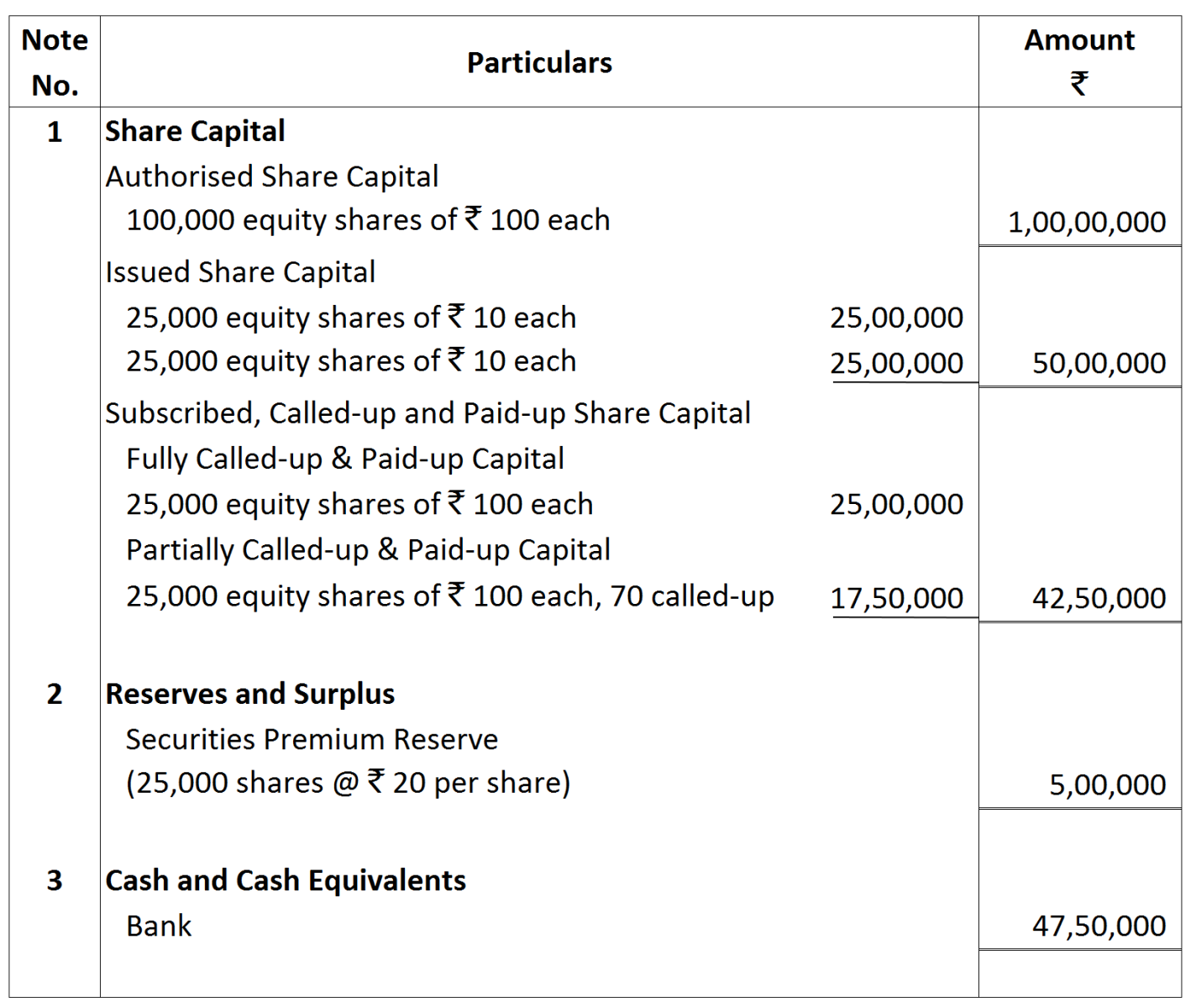
On $1^{st}$​​​​​​​ April, $2012$, Micro-tech Ltd. was formed with an authorised capital of ₹ $50,00,000$ divided into $5,00,000$ equity shares of ₹ $10$ each. The company issued prospectus inviting applications for $4,50,000$ equity shares. The company received applications for $4,20,000$ equity shares. During the first year, ₹ $8$ per share were called. Trilok holding $1,000$ shares and Rajesh holding $2,000$ shares did not pay the first call of ₹ $2$ per share. Rajesh’s shares were forfeited after the first call and later on $1,500$ of the forfeited shares were re-issued at ₹ $6$ per share, ₹ $8$ called up.
Show the following:
  1. Share Capital in the Balance Sheet of the company as per revised Schedule VI Part I of the Companies Act, $1956$.
  2. Also prepare ‘Notes to Accounts’ for the same.
View full question & answer
Question 34 Marks
On $1^{st}$ April, $2012$, Blue Heaven Ltd. was formed with an authorised capital of ₹ $20,00,000$ divided into $2,00,000$ equity shares of ₹ $10$ each. The company issued prospectus inviting applications for $1,80,000$ equity shares. The company received applications for $1,70,000$ equity shares. During the first year, ₹ $8$ per share were called. Arun holding $2,000$ shares and Varun holding $4,000$ shares did not pay the first call of ₹ $2$ per share. Varun’s shares were forfeited after the first call and later on $3,000$ of the forfeited shares were re-issued at ₹ $6$ per share, ₹ $8$ called up.
Show the following:
  1. Share Capital in the Balance Sheet of the company as per revised Schedule VI Part I of the Companies Act, $1956$.
  2. Also prepare ‘Notes to Accounts’ for the same.
View full question & answer
Question 44 Marks
Pass necessary journal entries for the following transactions in the books of Gopal Ltd:
  1. Purchased furniture for ₹ 2,50,000 from M/s Furniture Mart. The payment to M/s Furniture Mart was made by issuing equity shares of ₹ 10 each at a premium of 25%.
  2. Purchased a running business from Aman Ltd. for a sum of ₹ 15,00,000. The payment of ₹ 12,00,000 was made by issue of fully paid equity shares of ₹ 10 each and balance by a bank draft.
The assets and liabilities consisted of the following:

Plant ₹ 3,50,000; Stock ₹ 4,50,000; Land and Building ₹ 6,00,000; Sundry Creditors ₹ 1,00,000.
View full question & answer
Question 54 Marks
On $1^{st}$​​​​​​​ April, $2012$, Vishwas Ltd. was formed with an authorised capital of ₹ $10,00,000$ divided into $1,00,000$ equity shares of ₹ $10$ each. The company issued prospectus inviting applications for $90,000$ equity shares. The company received applications for $85,000$ equity shares. During the first year, ₹ $8$ per share were called. Ram holding $1,000$ shares and Shyam holding $2,000$ shares did not pay the first call of ₹ $2$ per share. Shyam’s shares were forfeited after the first call and later on $1,500$ of the forfeited shares were re-issued at ₹ $6$ per share, ₹ $8$ called up.
Show the following:
  1. Share Capital in the Balance Sheet of the company as per revised Schedule VI Part I of the Companies Act, $1956$.
  2. Also prepare ‘Notes to Accounts’ for the same.
View full question & answer
Question 64 Marks
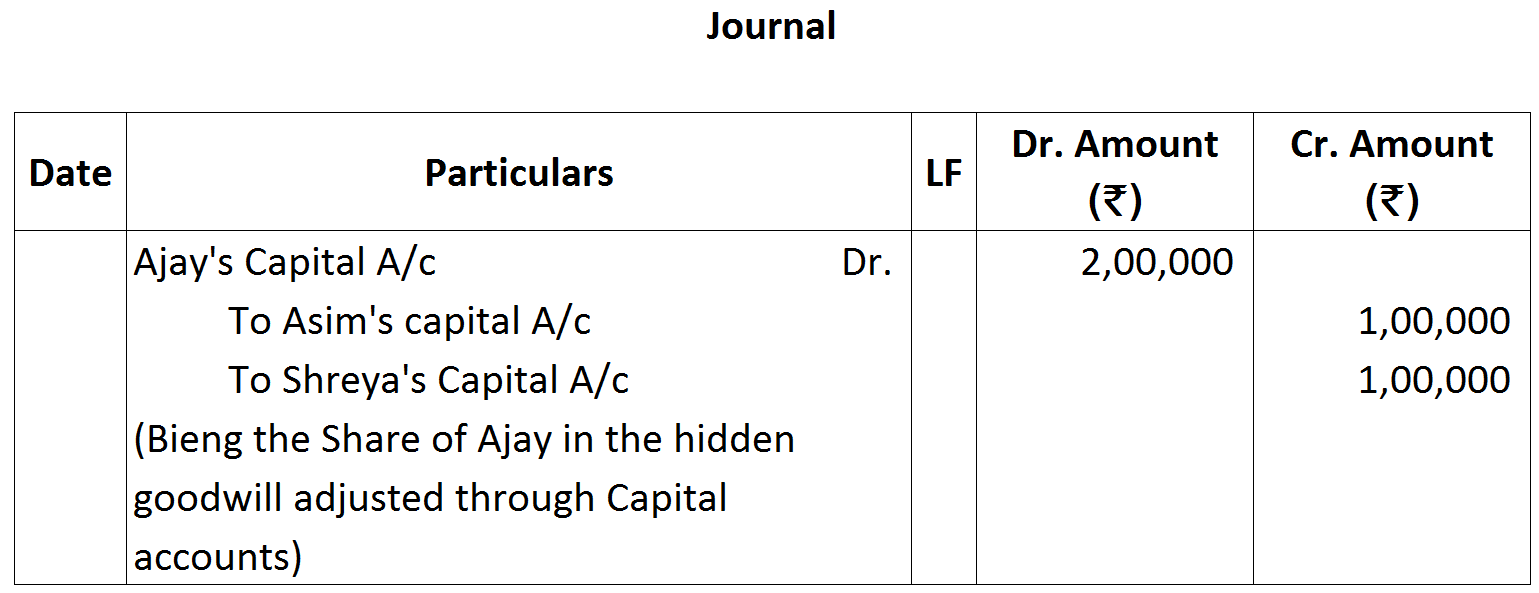
Asin, and Shreyas are partners in a firm. They admit Ajay as a new partner with $5^{th}$ share in the profits of the firm. Ajay brings ₹ $5,00,000$ as his share of capital. The value of the total assets of the firm was ₹ $15,00,000$ and outside liabilities were valued at ₹ $5,00,000$ on that date. Give the necessary' Journal entry to record goodwill at the time of Ajay's admission. Also show your workings.
Answer

Working Notes:
 
Calculation of Hidden Goodwill
(A)
Net worth (including goodwill) of new firm on the basis of capital brought in by Ajay (5,00,000 x 5/1).
25,00,000
(B)
Less: Net 'worth ( excluding goodwill) of new firm
(Adjusted Capital of old partners + Incoming partners' Capital)
[(15,00,000 - 50,000) + 5,00,000]
Value of Firm's Goodwill (A - B)
15,00,000
10,00,000
(C)
Ajay's Share in Goodwill = $₹ \ 10,00,000\times \frac{1}{5}$
= ₹ 2,00,000
View full question & answer
Question 74 Marks
The authorised capital of Suhas Ltd. is ₹ 50,00,000 divided into 25,000 shares of ₹ 200 each. Out of these, the company issued 12,000.shares of ₹ 200 each at a premium of 10%. The amount per share was payable as follows:
₹ 60 on application
₹ 60 on allotment (including premium)
₹ 30 on first call arid
balance oil final call
Public applied for 11,000 shares. All the money was duly received.
Prepare an extract of Balance Sheet of Suhas Ltd. as per Revised Schedule VI Part I of the. Companies Act 1956 disclosing the above information. Also prepare 'notes to accounts' for the same.
View full question & answer
Question 84 Marks
Nikhil Ltd. purchased a running business from Sonia Ltd. for a sum of ₹ 22,00,000 by issuing 20,000 fully paid equity shares of ₹ 100 each at a premium of 10%. The assets and liabilities consisted of the following:
Machinery ₹ 7,00,000, Debtors ₹ 2,50,000, Stock ₹ 5,00,000, Building ₹ 11,50,000 and· Bills Payable ₹ 2,50,000.
Pass necessary Journal entries in the books of Nikhil Ltd. for the above transactions.
View full question & answer
Question 94 Marks
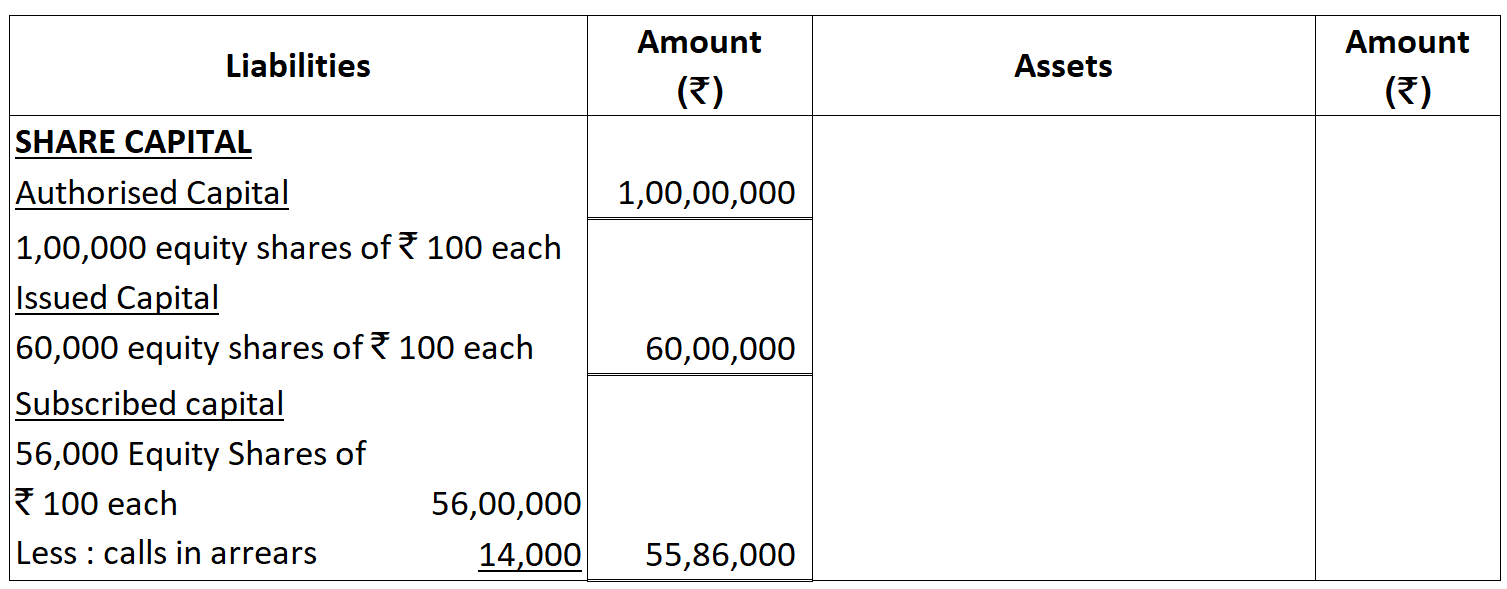
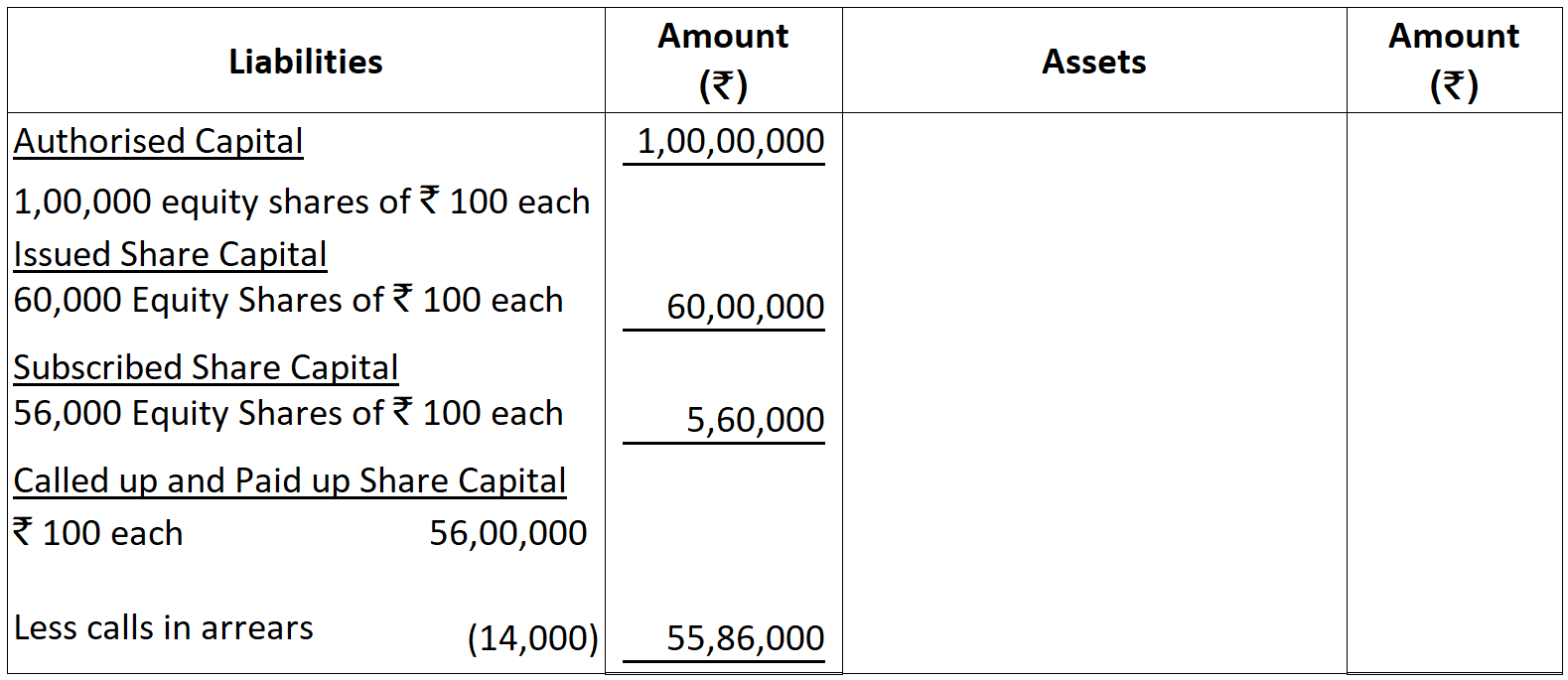
Sagar Ltd. was registered with an authorised capital of Rs. 1,00,00,000 divided into 1,00,000 equity shares of Rs. 100 each. The company offered for public subscription 60,000 equity shares. Applications for 56,000 shares were received and allotment was made to all the applicants. All the calls were made and were duly received except the second and final call of Rs. 20 per share on 700 shares. Prepare the Balance Sheet of the company showing the different types of share capital.
Answer
Balance Sheet of Sagar Ltd. as at ……
Alternate Answer

Balance sheet of Sagar’s Ltd. as at …
View full question & answer
Question 104 Marks
On $1^{st}$ April, $2012$ Mayank Ltd. was formed with an authorised capital of ₹ $25,00,000$ divided into $50,000$ equity shares of ₹ $50$ each. The company issued prospectus inviting applications for $45,000$ shares. The issue price was payable as under:
On Application: ₹ $15$
On Allotment: ₹ $20$
On call: Balance amount
The issue was fully subscribed and the company allotted shares to all the applicants. The company did not make the call during the year. Show the following:
  1. Share capital in the Balance Sheet of the company as per revised Schedule-Vl, Part-I of the Companies Act, $1956$.
  2. Also prepare 'Notes to Accounts' for the same.
View full question & answer
Question 114 Marks
On $1^{st}$​​​​​​​ April, $2012$, Janta Ltd. was formed with an authorized capital of ₹ $50,00,000$ divided into $1,00,000$ equity shares of ₹ $50$ each. The company issued prospectus inviting applications for $90,000$ shares. The issue price was payable as undei:
On Application: ₹ $15$
On Allotment: ₹ $20$
On Call: Balance amount
The issue was fully subscribed and the company allotted shares to all the applicants. The company did not make the call during the year. Show the following:
  1. Share capital in the Balance Sheet of the company as per revised Schedule-VI,. Part-I of the Companies Act, $1956$.
  2. Also prepare 'Notes to Accounts' for the same.
View full question & answer
Question 124 Marks
Pass necessary journal entries for the following transactions in the books of Rajan Ltd:
  1. Rajan Ltd. purchased machinery of ₹ 7,20,000 from Kundan Ltd. The payment was made to Kundan Ltd. by issue of equity shares of ₹100 each at 10% discount.
  2. Rajan Ltd. purchased a running business from Vikas Ltd. for a sum of ₹ 2,50,000 payable as ₹ 2,20,000 in fully paid equity shares of ₹ 10 each and balance by a bank draft. The assets and liabilities consisted of the following:
Plant & Machinery ₹ 90,000; Building ₹ 90,000; Sundry Debtors ₹ 30,000; Stock ₹ 50,000; Cash ₹ 20,000; Sundry Creditors ₹ 20,000.
View full question & answer
Question 134 Marks
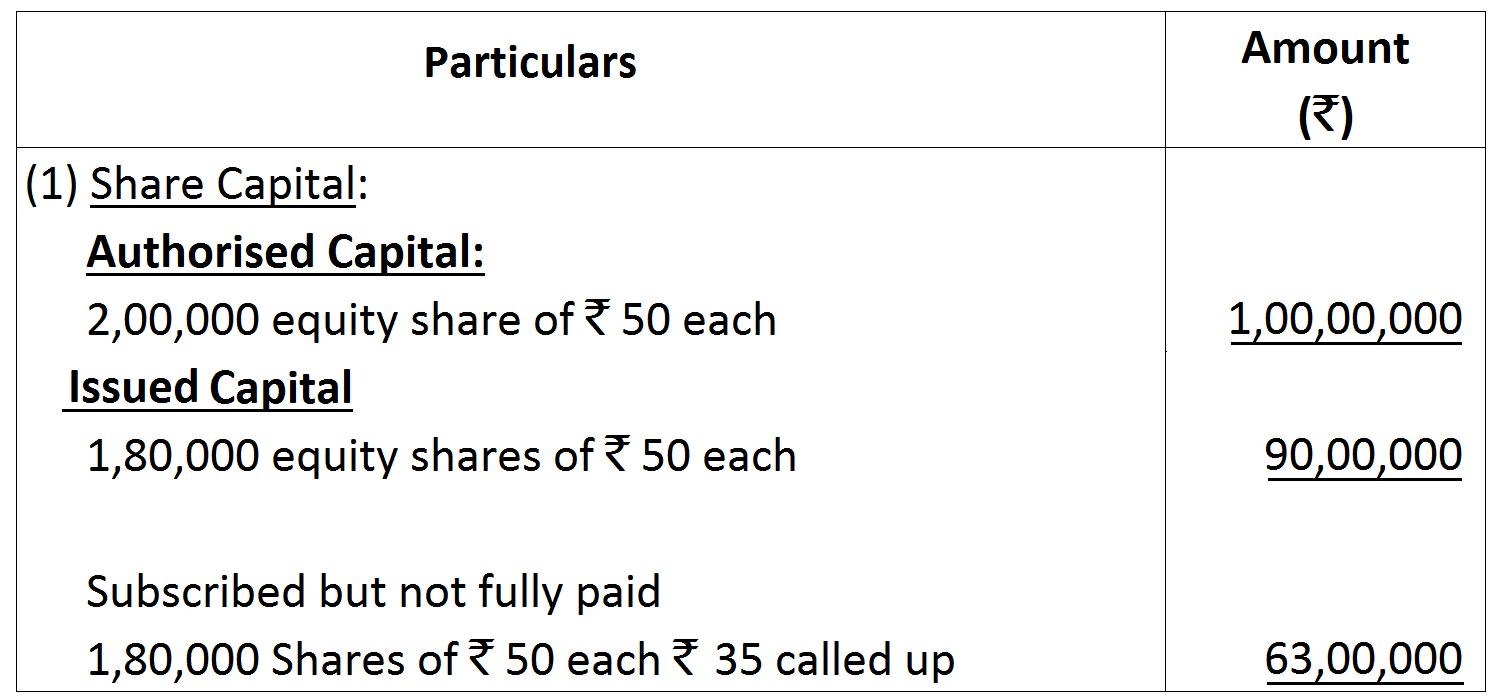
On $1^{st}$​​​​​​​ April, $2012$ Vivek Ltd. was formed with an authorized capital off $1,00,00,000$ divided into $2,00,000$ equity shares of t $50$ each. The company issued prospectus inviting applications for $1,80,000$ shares. The issue price was payable as under:
On Application : 15
On Allotment : 20
On Call : Balance amount
The issue was fully subscribed and the company allotted shares to all the applicants. The company did not make the call during the year.
Show the following:
  1. Share capital in the Balance Sheet of the company as per revised Schedule-VI-Part-I of the Companies Act, $1956$.
  2. Also prepare 'Notes to Accounts' for the same.
Answer
Balance Sheetr of Vivek Ltd.
As at............................................(As per revised schedule VI)

Notes to Accounts:
View full question & answer
Question 144 Marks
The authorised capital of Suhani Ltd. is ₹ 45,00,000 divided into 30,000 shares of ₹ 150 each. Out of these company issued 15,000 shares oft 150 each at a premium of ₹ 1O per share. The amount was payable as follow:
₹ 50 per share on application, ₹ 40 per share on allotment (including premium), ₹ 30 per share on first call and balance on final call. Public applied for 14,000 shares. All the money was duly received.
Prepare an extract of Balance Sheet of Suhani Ltd. as per Revised Schedule VI Part - I of the Companies Act 1956 disclosing the above information. Also prepare 'notes to accounts' for the same.
View full question & answer
Question 154 Marks
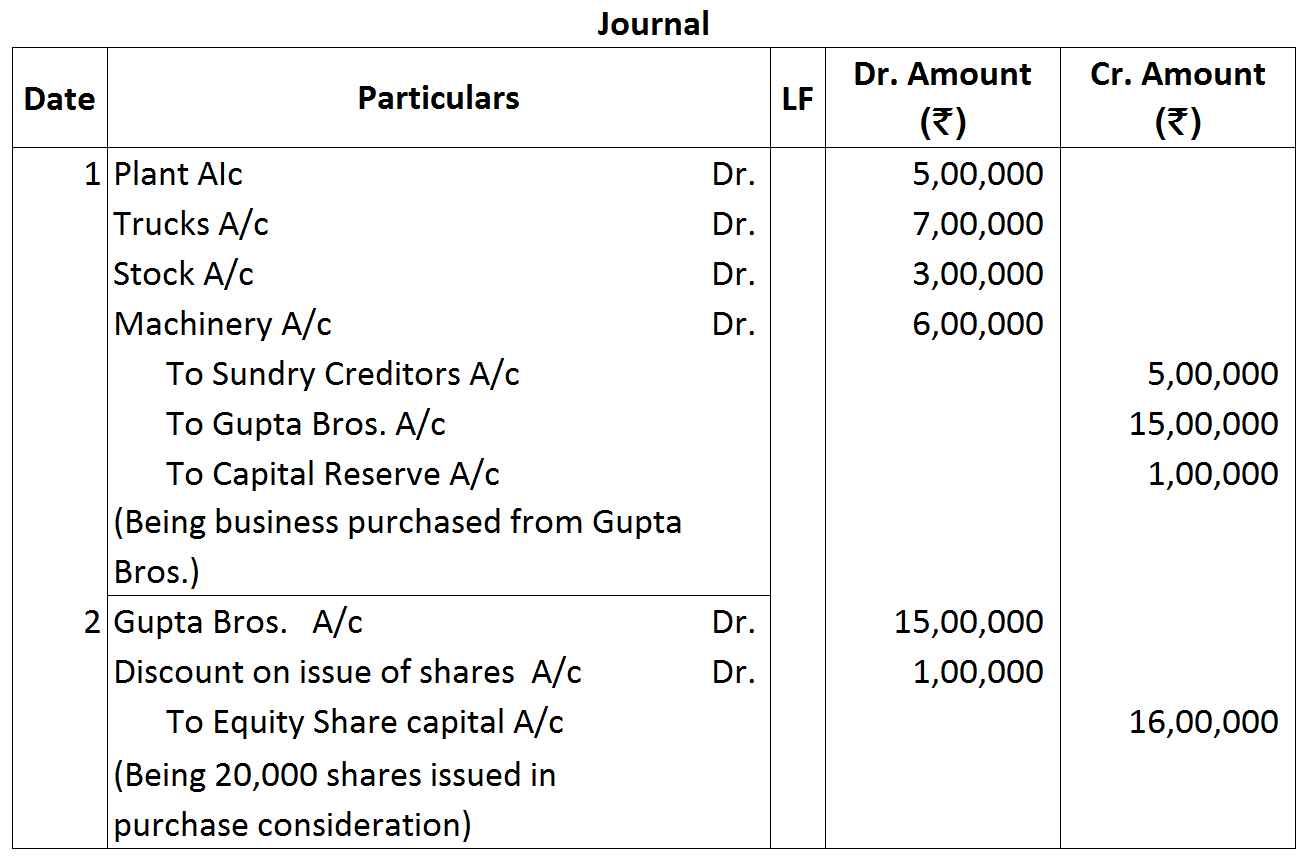
Madhav Ltd. issued fully paid equity shares of ₹ 80 each at a discount of ₹ 5 per share for the purchase of a running business from Gupta Bros. for a sum of ₹ 15,00,000. The assets and liabilities consisted of the following:
Plant ₹ 5,00,000; Trucks ₹ 7,00,000; Stock ₹ 3,00,000; Machinery ₹ 6,00,000 and Sundry Creditors ₹ 5,00,000.
You are required to pass necessary journal entries for the above transactions in the books of Madhav Ltd.
Answer

Working Note:
$\text{No of Shares}=\frac{\text{15,00,000}}{\text{75 }}=20,000\text{ shares.}$
View full question & answer
Question 164 Marks
A Co. issued to the public for subscription 40,000 shares of ₹ 10 each at a discount of 10% payable as ₹ 2 each on application, Allotment and First call and ₹ 3 on the Final call. Applications were received for 60,000 shares and allotment was made pro-rata to 80% of applicants. R to whom 1,600 shares were allotted paid only the application money, and S who had applied for 2,400 shares paid the entire call money due along with the allotment. Pass necessary Journal entries to record the above transactions.
View full question & answer
Question 174 Marks
Petromax Ltd., issued 50,000 shares of ₹ 10 each at a premium of ₹ 2 per share payable as ₹ 3 on application ₹ 5 including premium on allotment and the balance in equal instalments over two calls. Applications were received for 92,000 shares and the allotment was done as under:
A
:
Applicants of 40,000 shares
-
Allotted 30,000 shares
B
:
Applicants of 40,000 shares
-
Allotted 20,000 shares
C
:
Applicants of 12,000 shares
-
Nil
Suresh who had applied for 2,000 shares (Category A) did not pay any money other than application money.
Chandar who was allotted 800 shares (Category B) paid the call money due along with allotment.
All other allottees paid their dues as per schedule.
Pass necessary journal entries in the books of Petromax Ltd. to record the above.
View full question & answer
Question 184 Marks
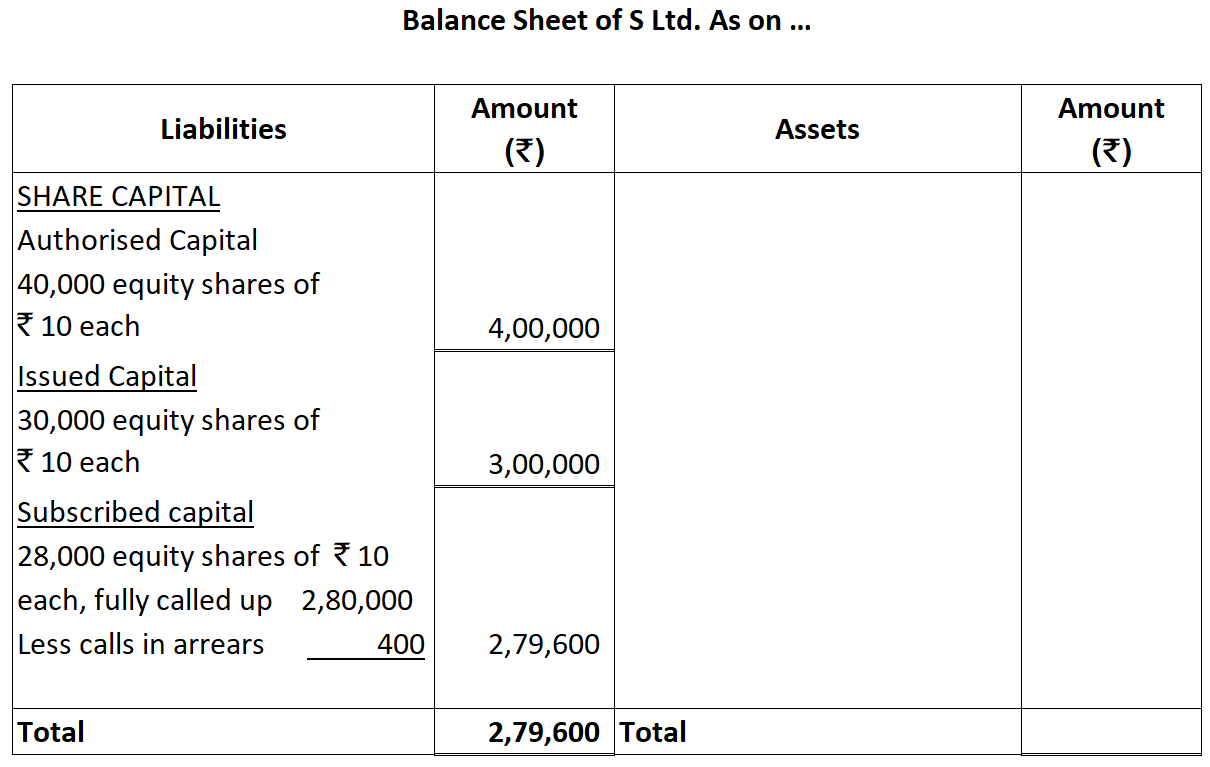
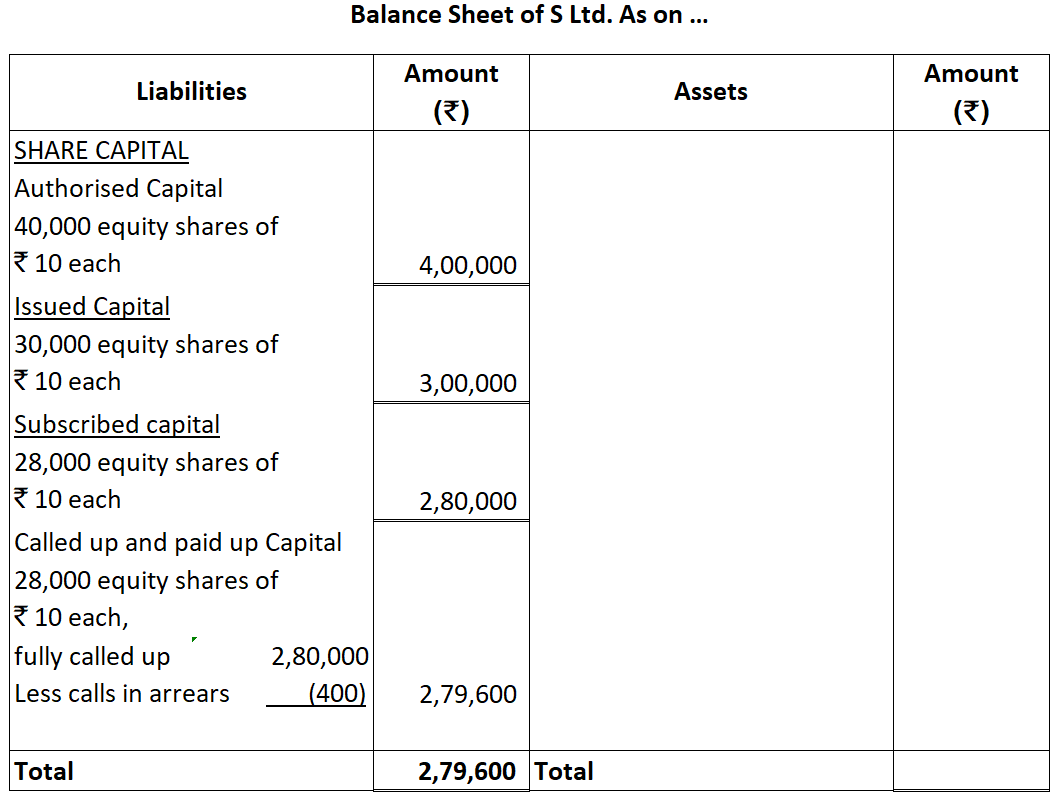
S Ltd. was registered with an authorised capital of Rs. 4,00,000 divided into 40,000 equity shares of Rs. 10 each. The company offered to the public for subscription 30,000 equity shares. Applications for 28,000 equity shares were received and allotment was made to all the applicants. All calls were made and were duly received except the final call of Rs. 2 per share on 200 shares.
Prepare the Balance Sheet of the company showing the different categories of Share Capital.
Answer
Alternate Answer
View full question & answer
Question 194 Marks
Raunit Styles Ltd. was registered with a capital of ₹ 85,00,000 divided into equity shares of ₹ 100 each. The company invited applications for issuing 45,000 shares.
The amount was payable as ₹ 25 on application, ₹ 35 on allotment, ₹ 25 on first call and balance on final call.
Applications were received for 42,000 shares and allotment was made to all the applicants. Kavi, to whom 3,300 shares were alloted, failed to pay both the calls. His shares were forfeited.
Present the Share Capital in the Balance Sheet of the company as per Schedule III of the Companies Act, 2013.
View full question & answer
Question 204 Marks
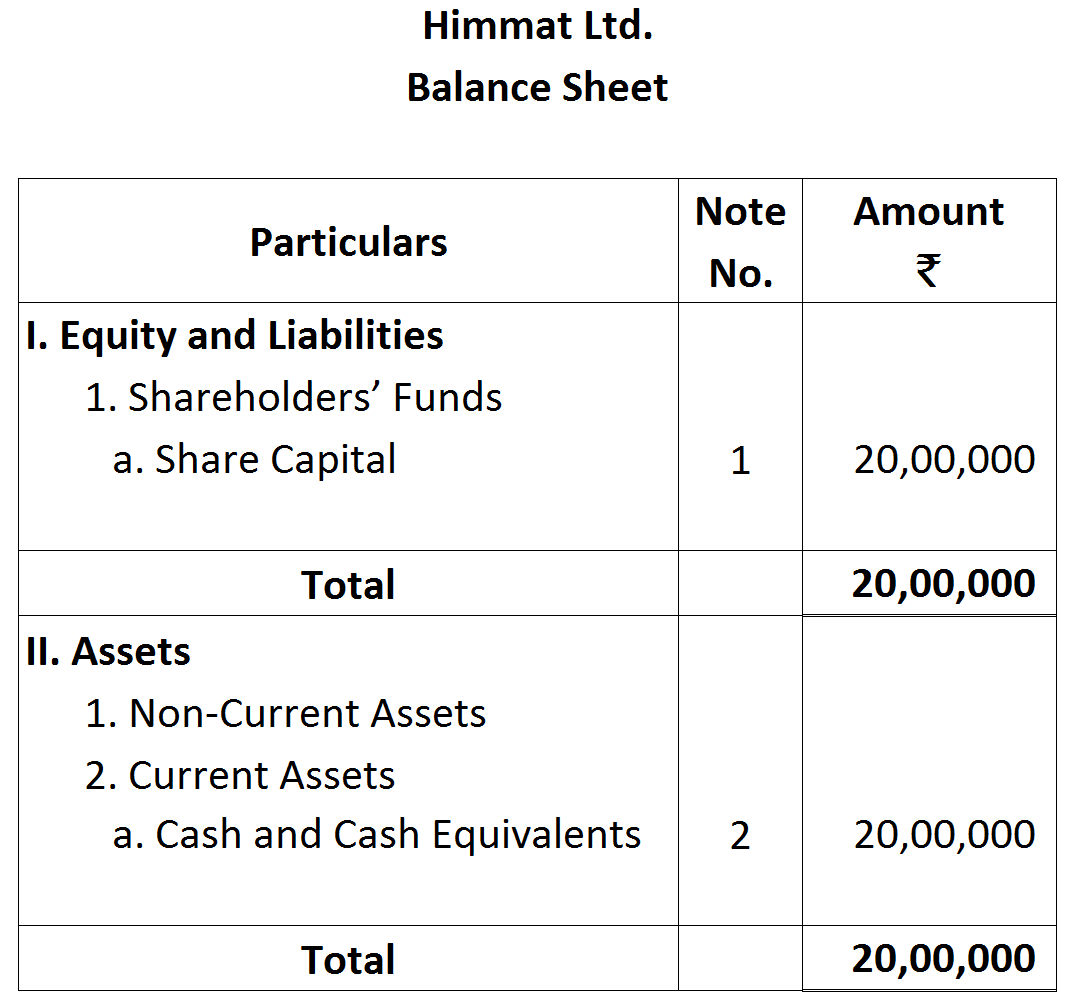
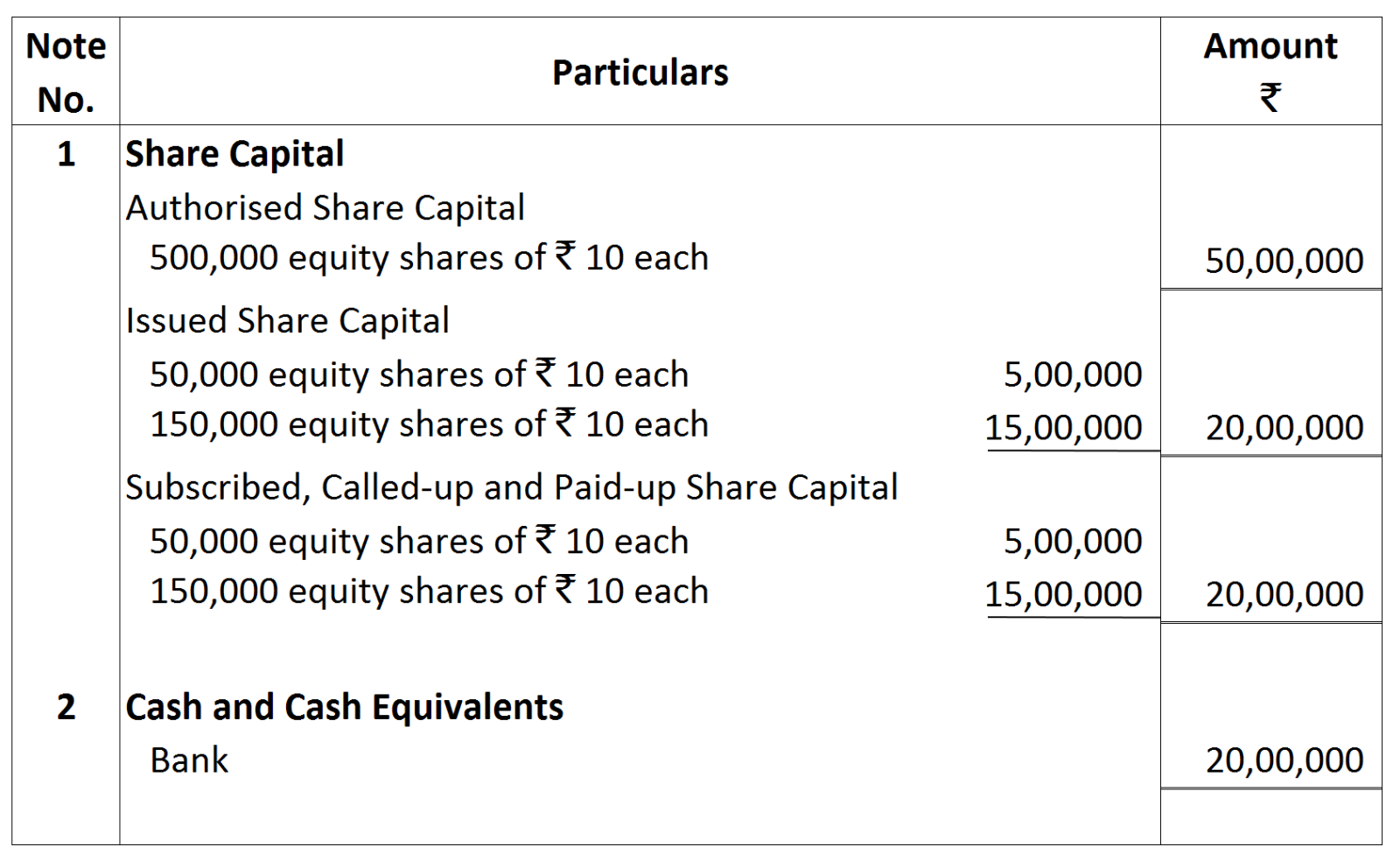
Himmat Ltd has authorised share capital of ₹ 50,00,000 divided into 5,00,000 Equity Shares of ₹ 10 each. It has existing issued and paid up capital of ₹ 5,00,000. It further issued to public 1,50,000 Equity Shares at par for subscription payable as under:
On Application: ₹ 3
On Allotment: ₹ 4 and
On Call: Balance Amount.
The issue was fully subscribed and allotment was made to all the applicants. Call was made during the year and was duly received.
Show share capital of the company in the Balance Sheet of the Company.
Answer

Notes of Account:
View full question & answer
Question 214 Marks
Can forfeited shares be re-issued at a discount? If so, to what extent? Where would you transfer the balance left in the share forfeited account after the re-issue of such shares?
Answer
Directors have the authority to reissue the forfeited shares on such terms as they think fit. That is to say that they are at liberty to reissue the forfeited shares at par, at premium or at discount. However, if the shares are re-issued at a discount the amount of thediscount cannot exceed the amount previously received on these shares.
After the reissue of forfeited shares, the credit balance left in the Share Forfeiture A/c is a 'Capital Gain' to the Company and must be transferred to 'Capital Reserve A/c'. The journal entry for such Transfer will be:
View full question & answer
Question 224 Marks
Pass necessary journal entries in the books of the company for the following transactions:
Vishesh Ltd. forfeited 1,000 Equity Shares of ₹ 10 each issued at a premium of ₹ 2 per share for non-payment of allotment money of ₹ 5 per share including premium. The final call of ₹ 2 per share was not yet called on these shares. Of the forfeited shares 800 shares were reissued at ₹ 12 per share as fully paid-up.
The remaining shares were reissued at ₹ 11 per share fully paid-up.
View full question & answer
Question 234 Marks
Nandan, a Director of 'Nanda Agro Products Ltd.,' proposed in a board meeting that to inculcate the habit of savings among people he wanted to bring a special issue of shares. His proposal was accepted by the company.
The company issued $40,000$ equity shares of $₹ 100$ each. The share money per share was payable as:
On Application ___ $₹ 30$
On Allotment ___ $₹ 50$
On First and Final Call ___ $₹ 20$
Raman, a farmer holding $80$ shares could not pay his call money on time. Nathan, another farmer holding $50$ shares, paid the call money also with allotment.
Raman paid the amount due from him after four months explaining the reason for delay; the company did not charge any interest from him.
  1. Calculate the amount received by the company on allotment.
  2. Identify the value which the company is trying to communicate to the society.
Answer
Calculation of amount received on allotment:
Allotment money due on $40,000$ shares $@\ ₹ 50$ per share $20,00,000$
Add: Call money received in advance on $50$ shares  
$@\ ₹ 20$ per share $1,000$
Amount received in allotment $\overline{\underline{20,01,000}}$
Values:
  • Inculcating the habit of saving.
  • Spreading equity cult.
  • Bringing people in the main stream.
  • Empathy.
View full question & answer
Question 244 Marks
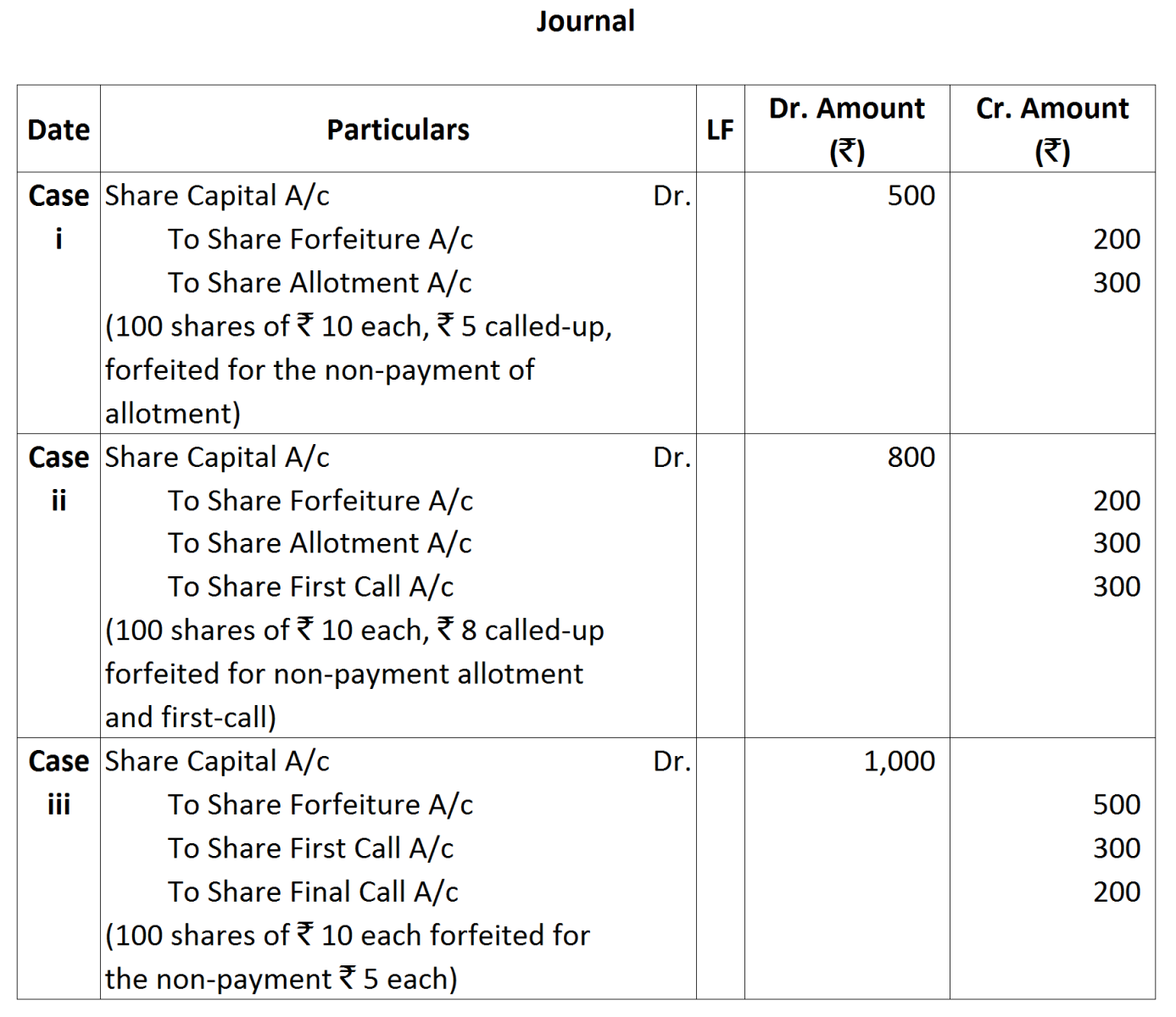
Give journal entries for forfeiture and re-issue of shares:
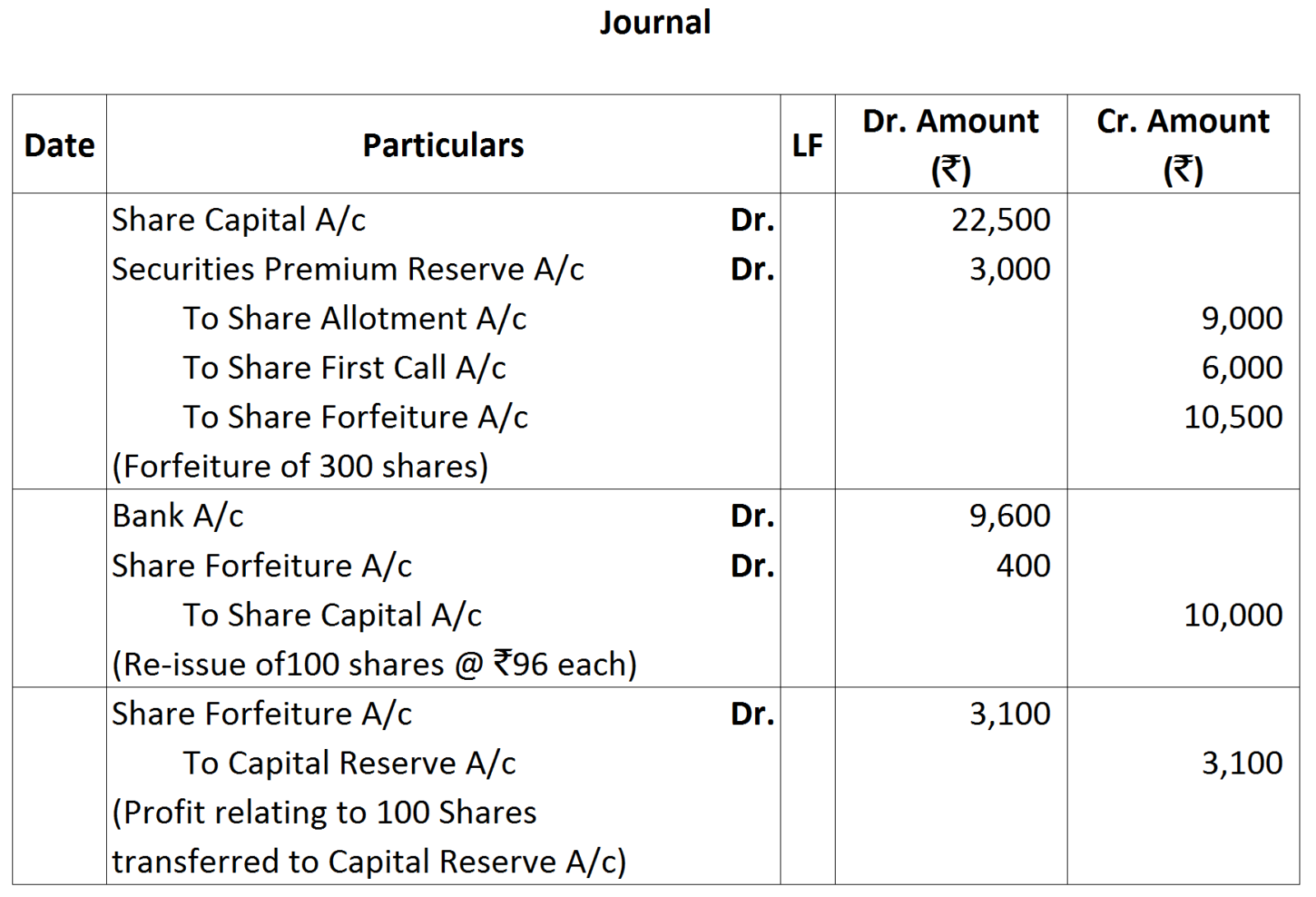
X Ltd. forfeited 300 shares of ₹ 100 each, ₹ 75 called-up, issued at 10% premium (to be paid at the time of allotment) for non-payment of allotment money of ₹ 30 per-share (including premium) and first call of ₹ 20 per share Out of these, 100 shares were re-issued as fully paid-up in such a way that ₹ 3,100 were transferred to capital reserve.
Answer

Note:
As Profit on 300 shares
₹ 10,500
Therefore, profit on 100 shares
(₹ 10,500 ÷300) × 100
3,500
Less: Transferred to Capital
 
3,100
Reserve Loss on Re-issue
 
400
Per Share Loss on Re-issue
(₹ 400 ÷100) = ₹ 4
 
Re-issue Price
₹ 100 - ₹ 4 = ₹ 96
 
View full question & answer
Question 254 Marks
What are the uses of securities premium?
Answer
As per the Section 78 of the Companies Act of 1956, the amount of securities premium can be used by the company for the following activities:
  1. For paying up un issued shares of the company to be issued to members (shareholders) of the company as fully paid bonus share,
  2. For writing off the preliminary expenses of the company,
  3. For writing off the expenses of, or the commission paid or discount allowed on, any issue of shares or debentures of the company,
  4. For paying up the premium that is to be payable on redemption of preference shares or debentures of the company.
  5. Further, as per the Section 77A, the securities premium amount can also be utilised by the company to Buy-back its own shares.
View full question & answer
Question 264 Marks
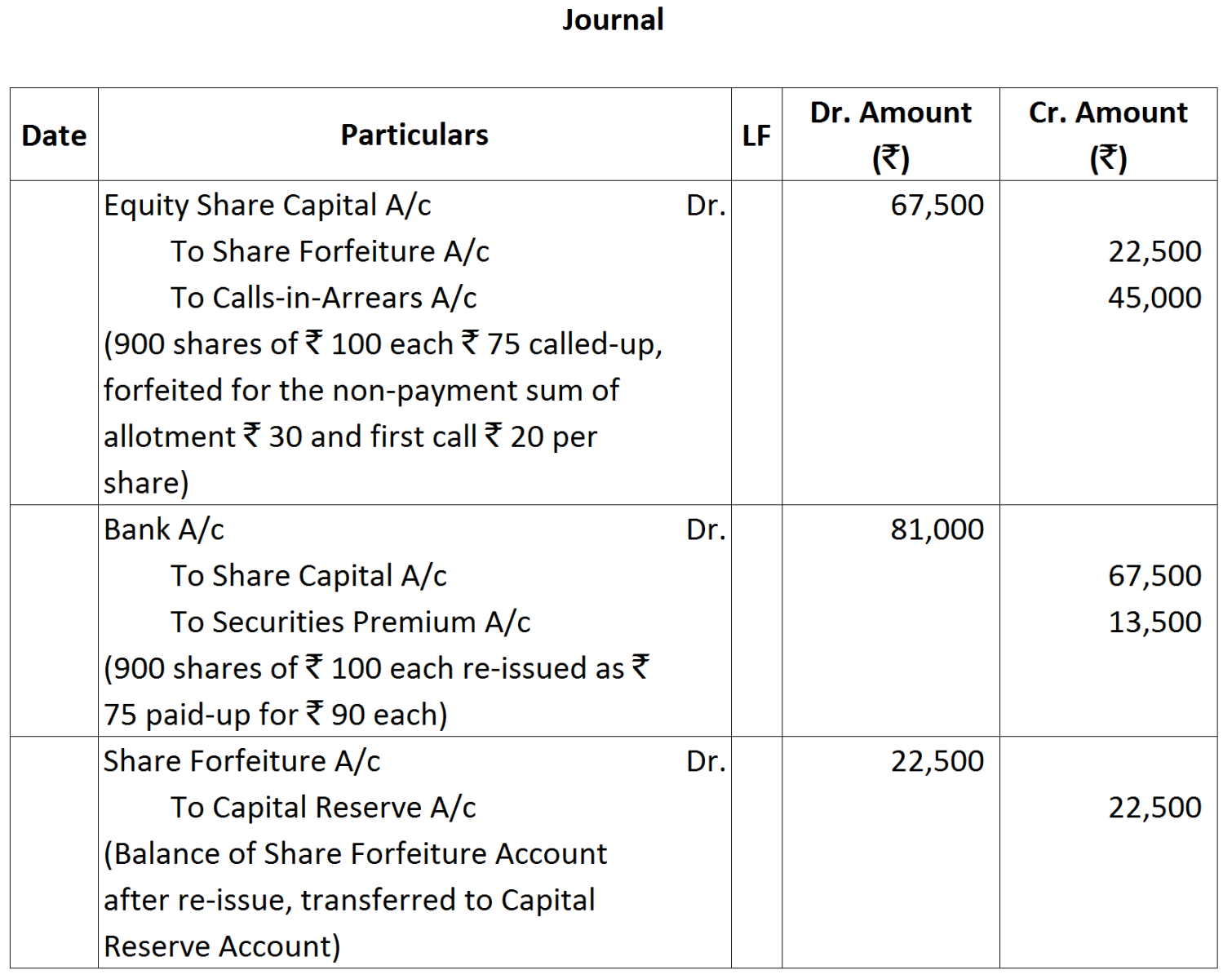
X Ltd. forfeited 900 Equity Shares of ₹ 100 each for the non-payment of allotment money of ₹ 30 per share and the first call of ₹ 20 per share. The second and final call of ₹ 25 per share has not been made. The forfeited shares were reissued for ₹ 90 per share, ₹ 75 paid-up. Journalise the above.
Answer
Application
25
Balancing Figure
Allotment
30
 
First Call
20
 
Final Call
25
Un-called
 
100
 
Called-up ₹ 75 per share

Working Note:
Share Forfeiture Acount credit = Share application money received for 900 shares
= ₹ 25 × 900 shares
= ₹ 22,500
Calculation of Capital Reserve
Share Forfeiture Acount credit = ₹ 22,500
Share Forfeiture Acount credit = NIL
Capital Reserve = ₹ 22,500
View full question & answer
Question 274 Marks
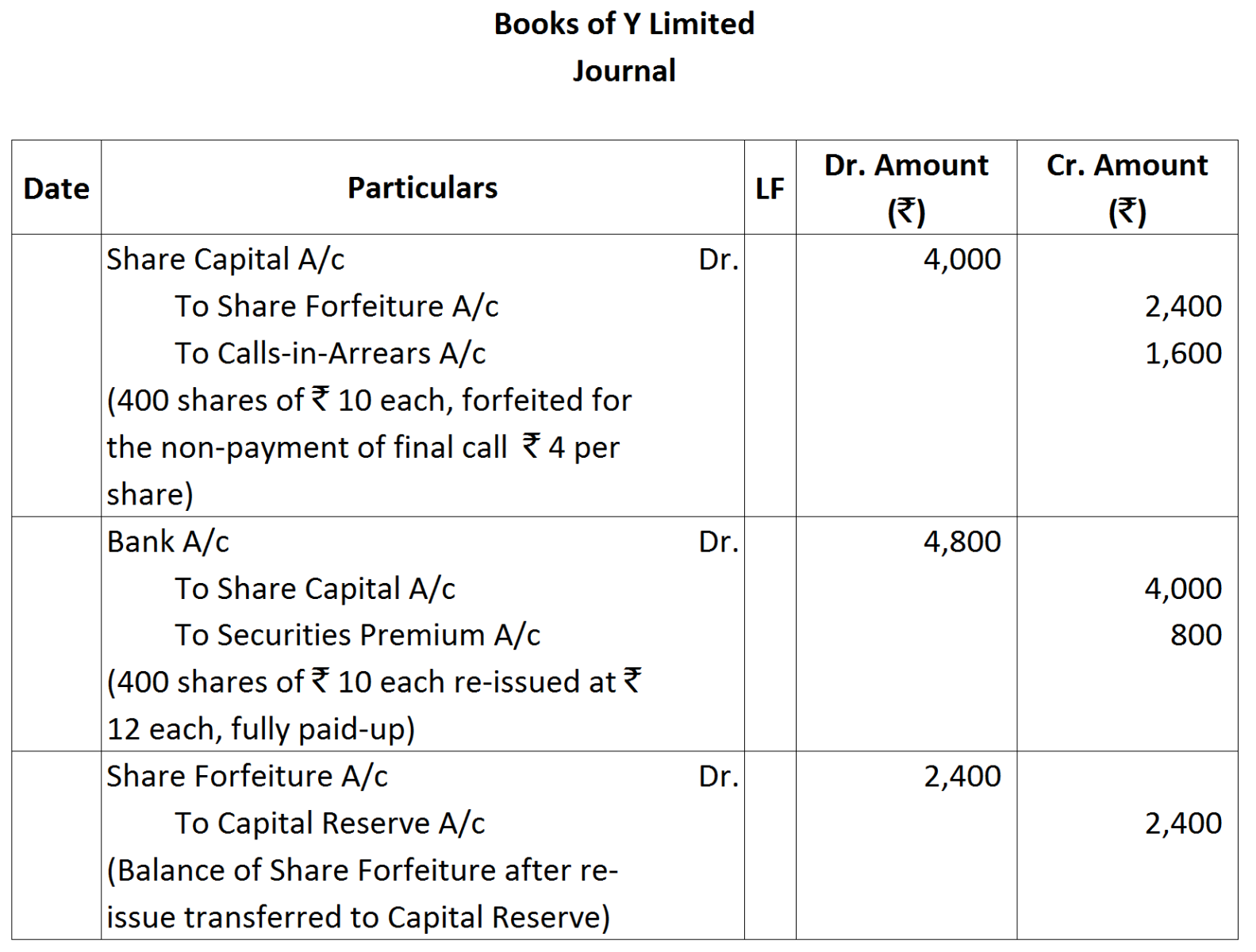
Show the forfeiture and reissue entries under the following cases:
Y Ltd. forfeited 400 shares of ₹ 10 each, fully called-up, held by Mr. B for non-payment of final call money of ₹ 4 per share. These shares were reissued to Mr. T at ₹ 12 per share as fully paid-up.
Answer

Working Notes:
Share Forfeiture Credit (at the time of forfeiture of shares)
₹ 2400
Less: Share Forfeiture Debit (at the time of re-issue shares)
NIL
Balance in Share Forfeiture after re-issue of shares
2,400
Capital Reserve = Balance in Share Forfeiture of re-issue shares
= ₹ 2,400
View full question & answer
Question 284 Marks
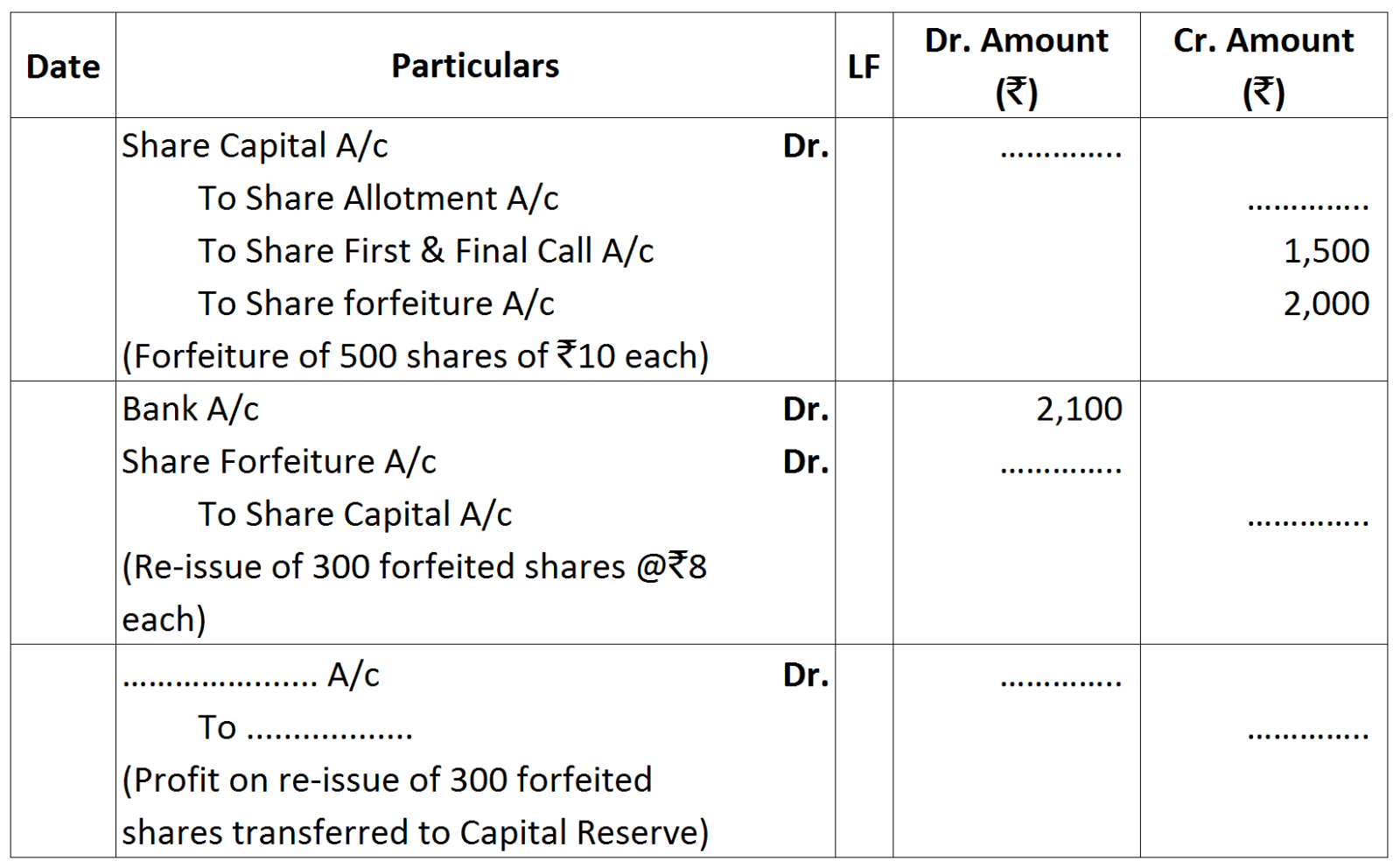
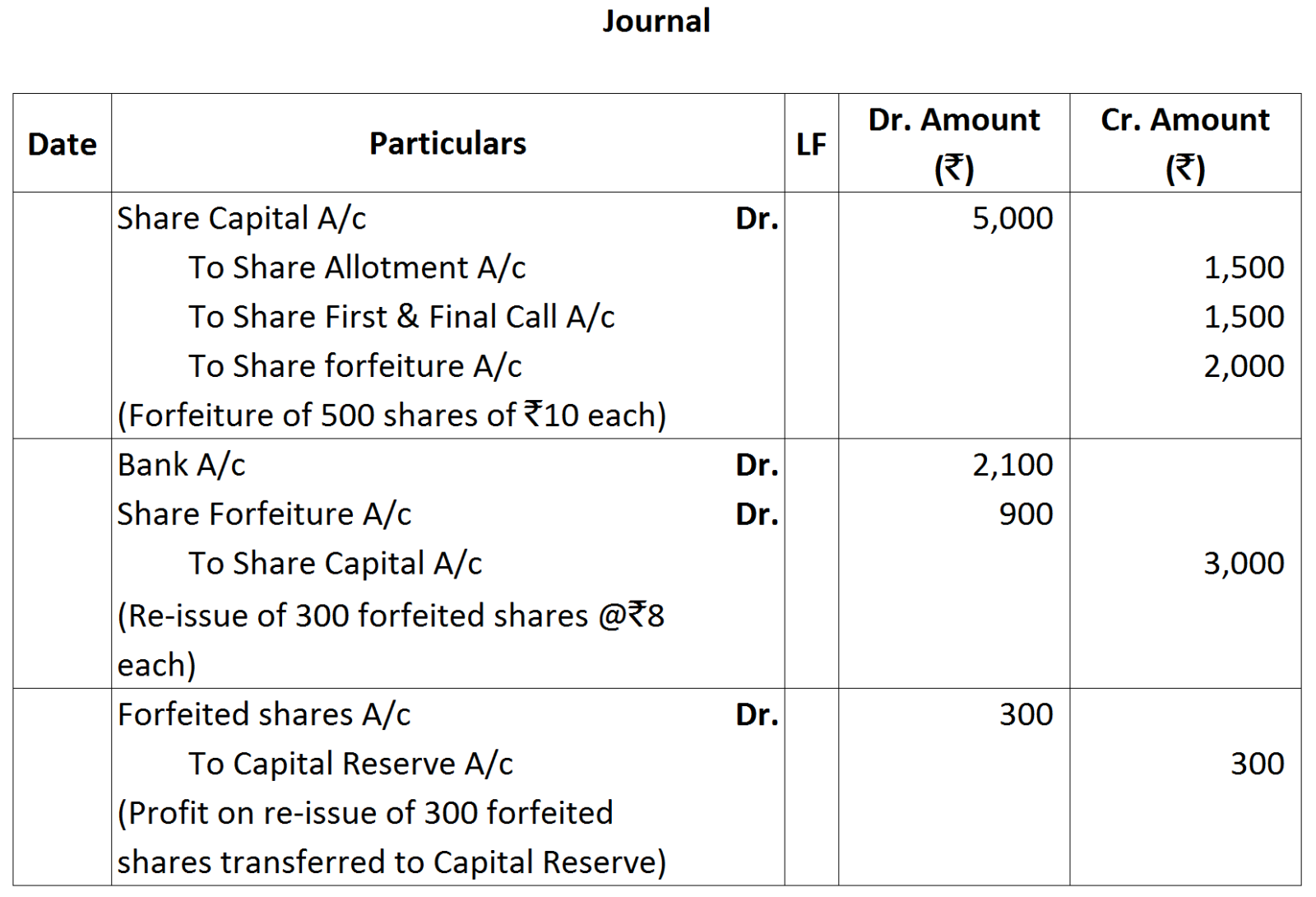
Fill in the missing figures in the following journal entries:
Answer

Working Note:
Amount forfeited on 300 shares = $2,000\times\frac{300}{500}$ = 1,200
Loss on Re-issue
=
    900
Transferred to Capital Reserve       $\overline{\underline{300}}$
View full question & answer
Question 294 Marks
Lennova Ltd. has authorised share capital of ₹ 1,00,00,000 divided into 1,00,000 Equity Shares of ₹ 100 each. It has existing issued and paid up capital of ₹ 25,00,000. It further issued to public 25,000 Equity Shares at a premium of 20% for subscription payable as under:
On Application: ₹ 30
On Allotment: ₹ 60 and
On Call: Balance Amount.
The issue was fully subscribed and allotment was made to all the applicants. The company did not make the call during the year.
Show share capital of the company in the Balance Sheet of the Company.
Note: Problems related to Disclosure of share Capital in compny's balance sheet are also given under the head issue of shares at per and at premium.
Answer

Notes to Account:
View full question & answer
Question 304 Marks
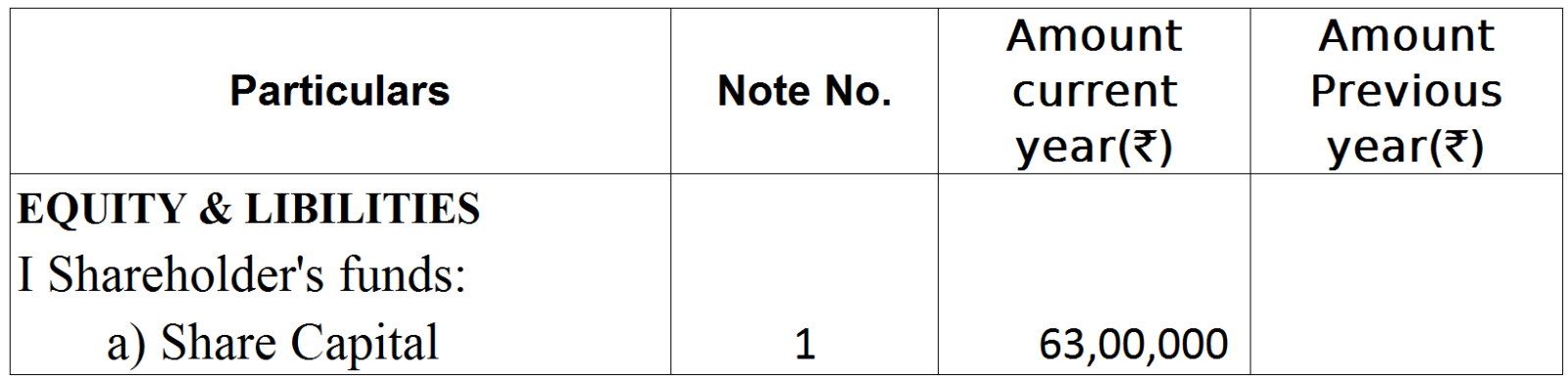
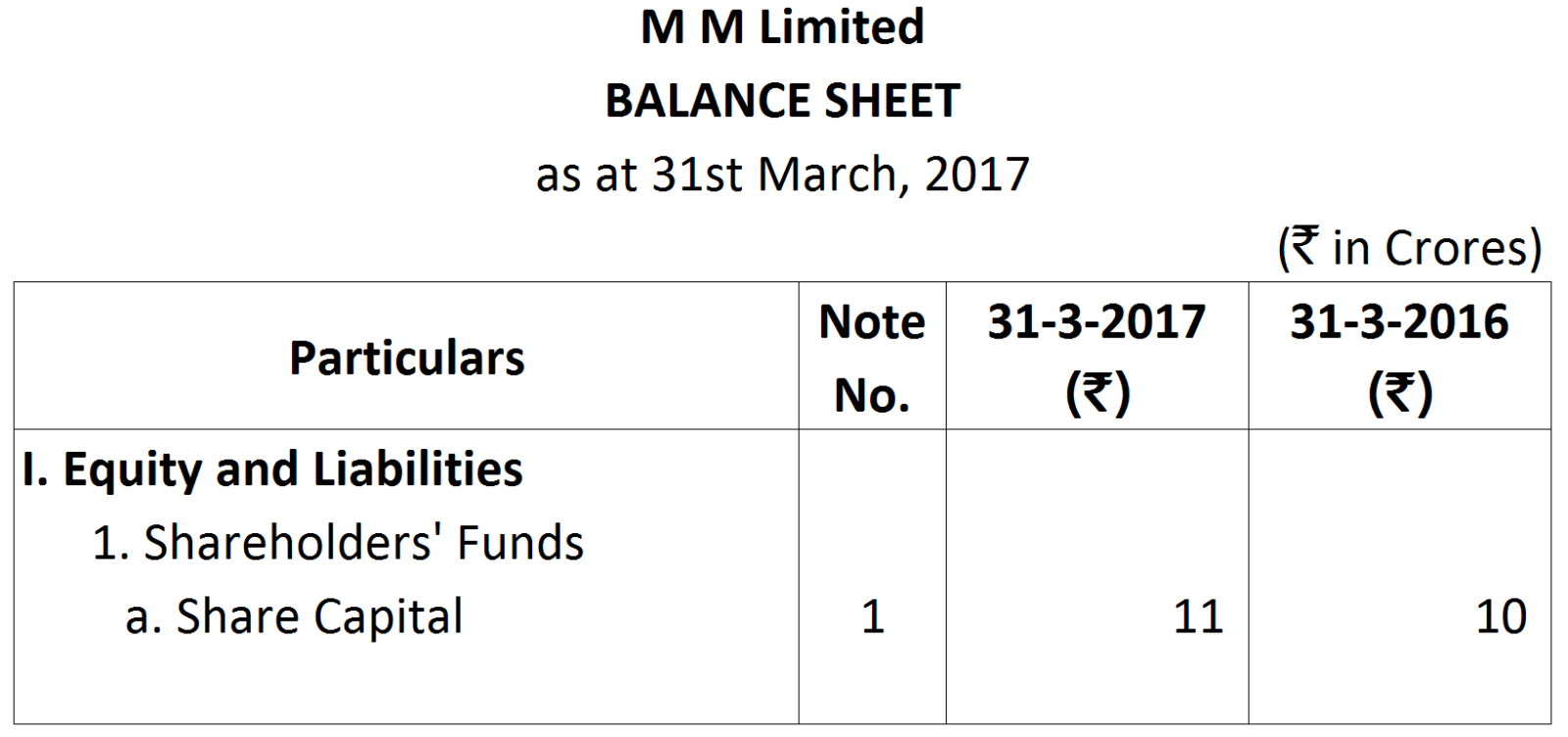
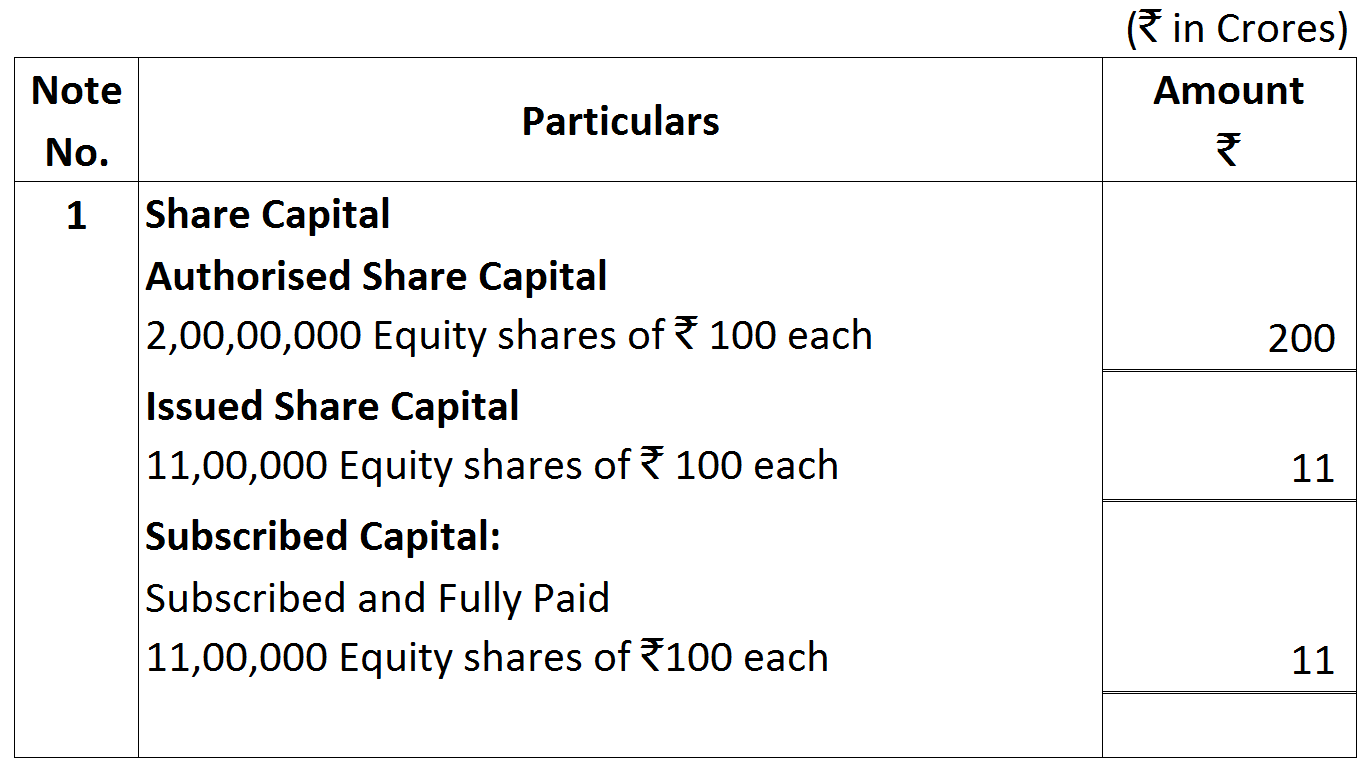
M M Limited is registered with an Authorised capital of ₹ 200 Crores divided into equity shares of ₹ 100 each. On 1st April, 2016 the Subscribed and Called up capital of the company is ₹ 10,00,00,000. The company decided to help the unemployed youth of the naxal affected areas of Andhra Pradesh, Chhattisgarh and Odisha by opening 100 'Skill Development Centres'. The company also decided to provide free medical services to the villagers of these status by starting mobile dispensaries. To meet the capital expenditure of these activities the company issued 1,00,000 equity shares during the financial year 2016-17. These shares were fully subscribed and paid.
Present the share capital of the company in its Balance Sheet. Also identify any two values that the company wants to propagate.
Answer

Notes to Accounts:
Note-Number 1.

Values:
  1. Generation of Employment opportunities in backward areas.
  2. Providing Healthcare/ Medical facilities in rural areas.
View full question & answer
Question 314 Marks
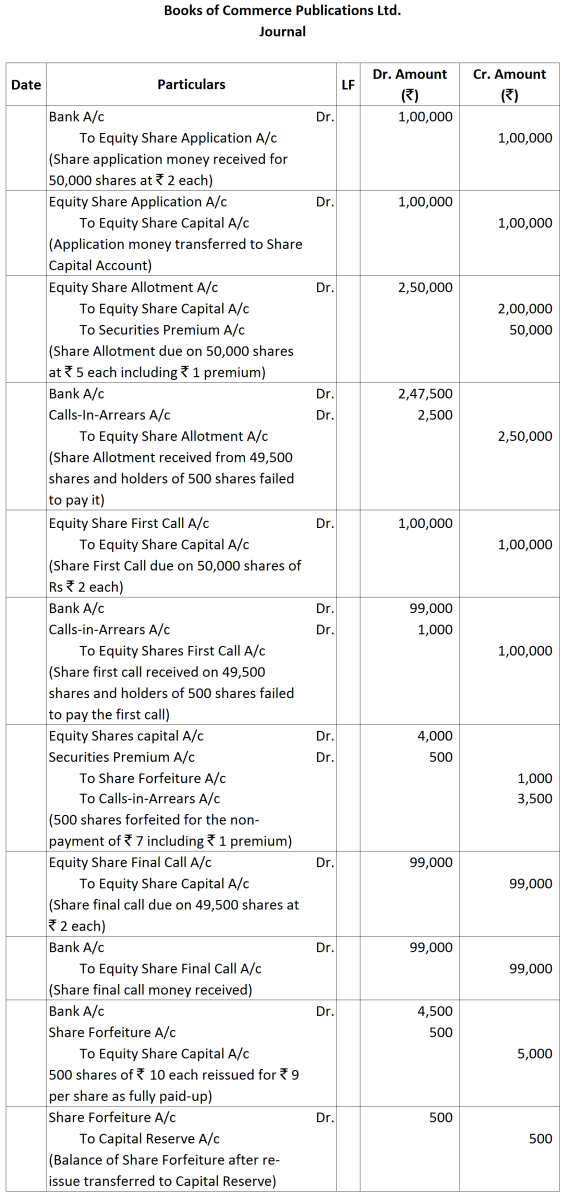
Commerce Publications Ltd. issued 50,000 Equity Shares of ₹ 10 each at a premium of 10% payable as under:
On application
₹ 2,
On first call
₹ 2,
On allotment
₹ 5,
On final call
₹ 2.
The calls were made by the company and all the money was duly received except the allotment and call money on 500 shares. These shares were, therefore, forfeited and later reissued @ ₹ 9 per share as fully paid-up.
Pass necessary journal entries to record the above transactions.
Answer
Issued and applied 50,000 equity shares at ₹ 10 each at a premium ₹ 1.
Application
2
 
Allotment
5
(4 + 1)
First Call
2
 
Final Call
2
 
 
11
(10 + 1) called-up

Working Note:
Share Forfeiture Credit
1,000
Less: Share Forfeiture Debit
500
Balance in Share Forfeiture (after re-issue)
500
Capital Reserve = Balance in Share Forfeiture (after re-issue) = ₹ 500
View full question & answer
Question 324 Marks
A share of ₹ 100 issued at a premium of ₹ 10 on which ₹ 80 (including premium) was called and ₹ 60 (including premium) was paid, has been forfeited. This share was afterwards reissued as fully paid-up for ₹ 70. Give Journal entries to record the above.
View full question & answer
Question 334 Marks
SRCC Ltd. was registered with a capital of ₹ 25,00,000 in shares of ₹ 10 each. It issued a prospectus inviting applications for 25,000 shares at 40% premium payabl;e as follows:
On application ₹ 5 (including ₹ 1 premium), on Allotment ₹ 4 (including ₹ 1 premium), on first call ₹ 3 (including ₹ 1 premium), on second and final call ₹ 2 (including ₹ 1 premium).
Applications were received for 25,000 shares. All money was duly received. Pass the necessary Journal entries.
View full question & answer
Question 344 Marks
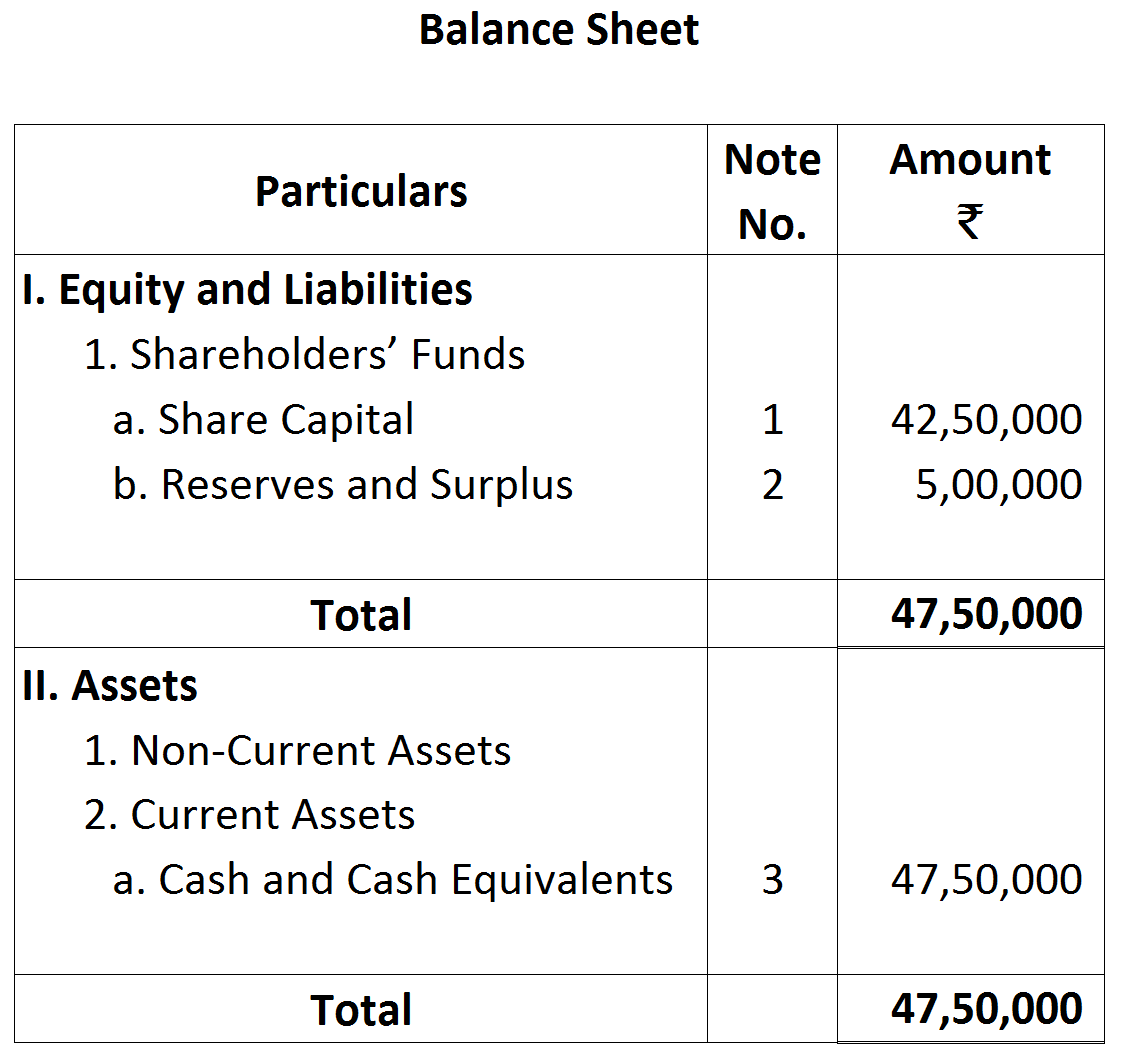
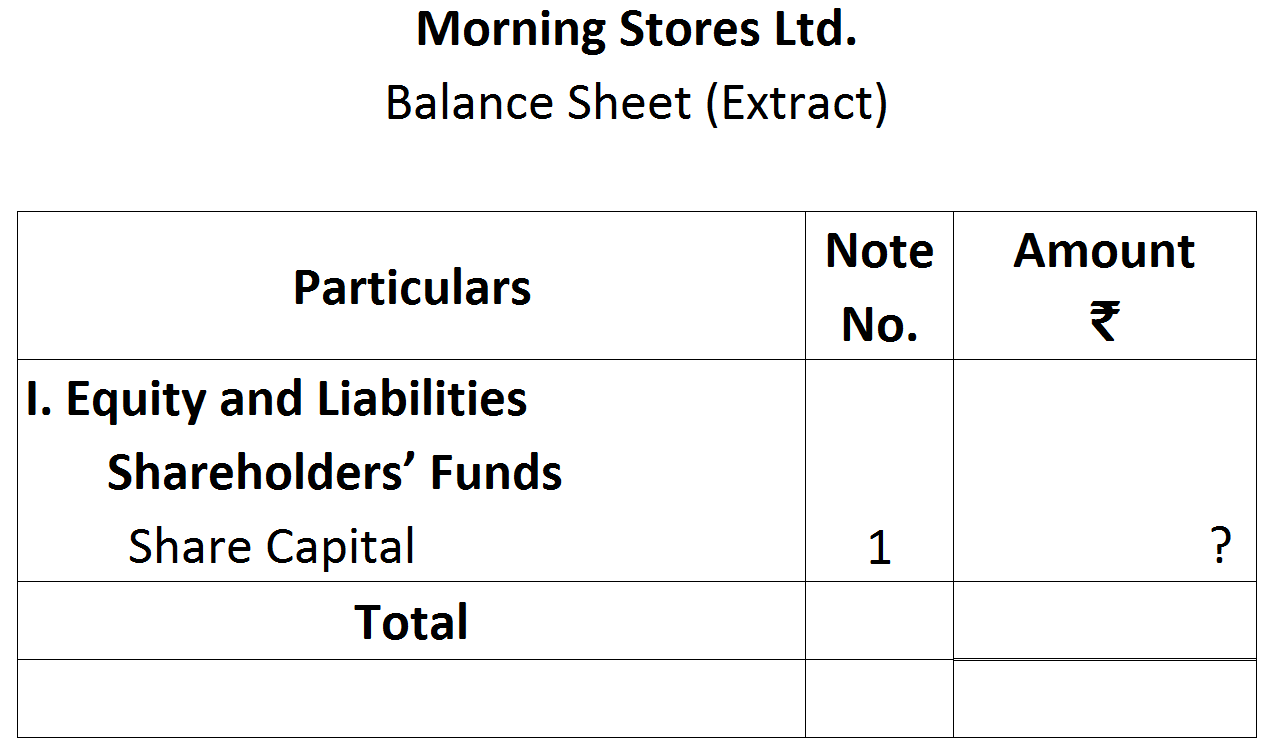
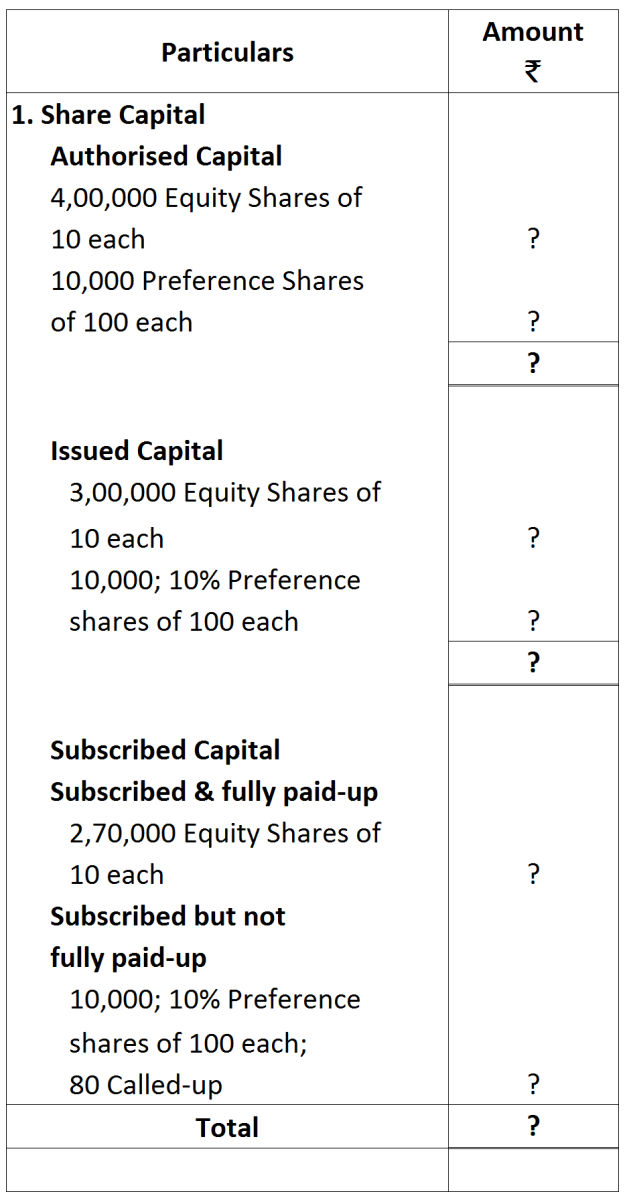
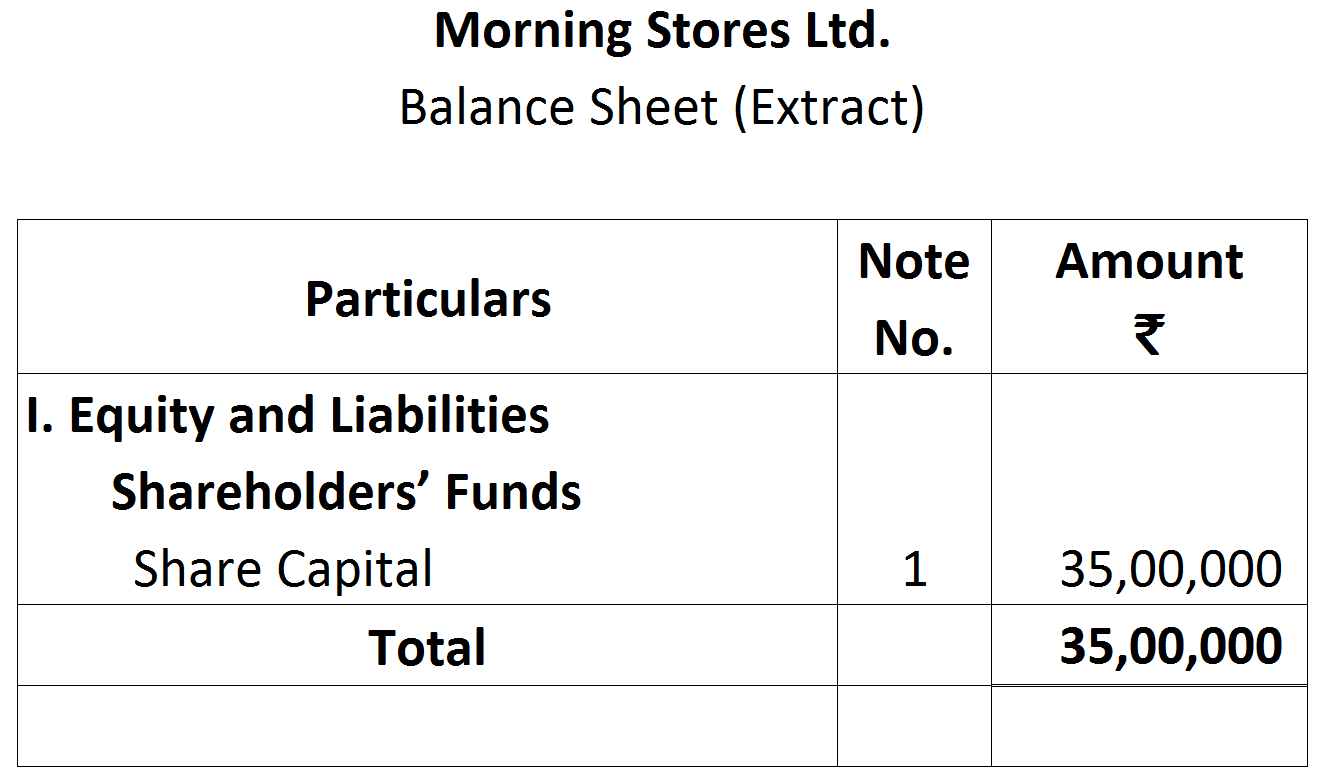
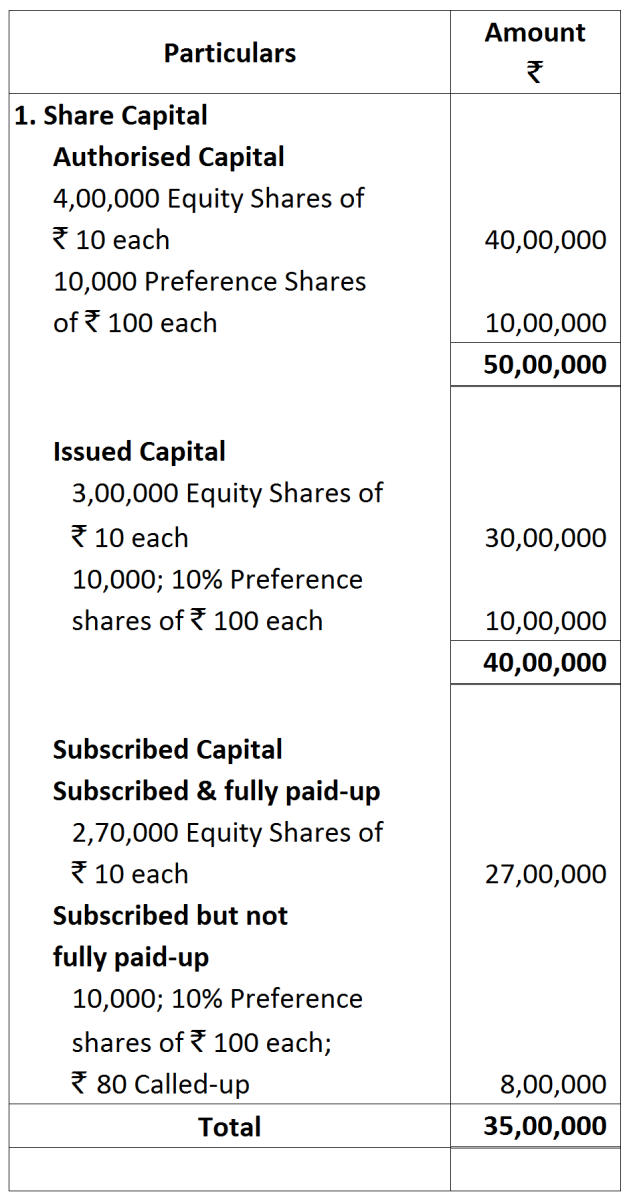
Complete the missing (?) figures in the following Extract of Balance Sheet:
Answer

Notes to Accounts:
View full question & answer
Question 354 Marks
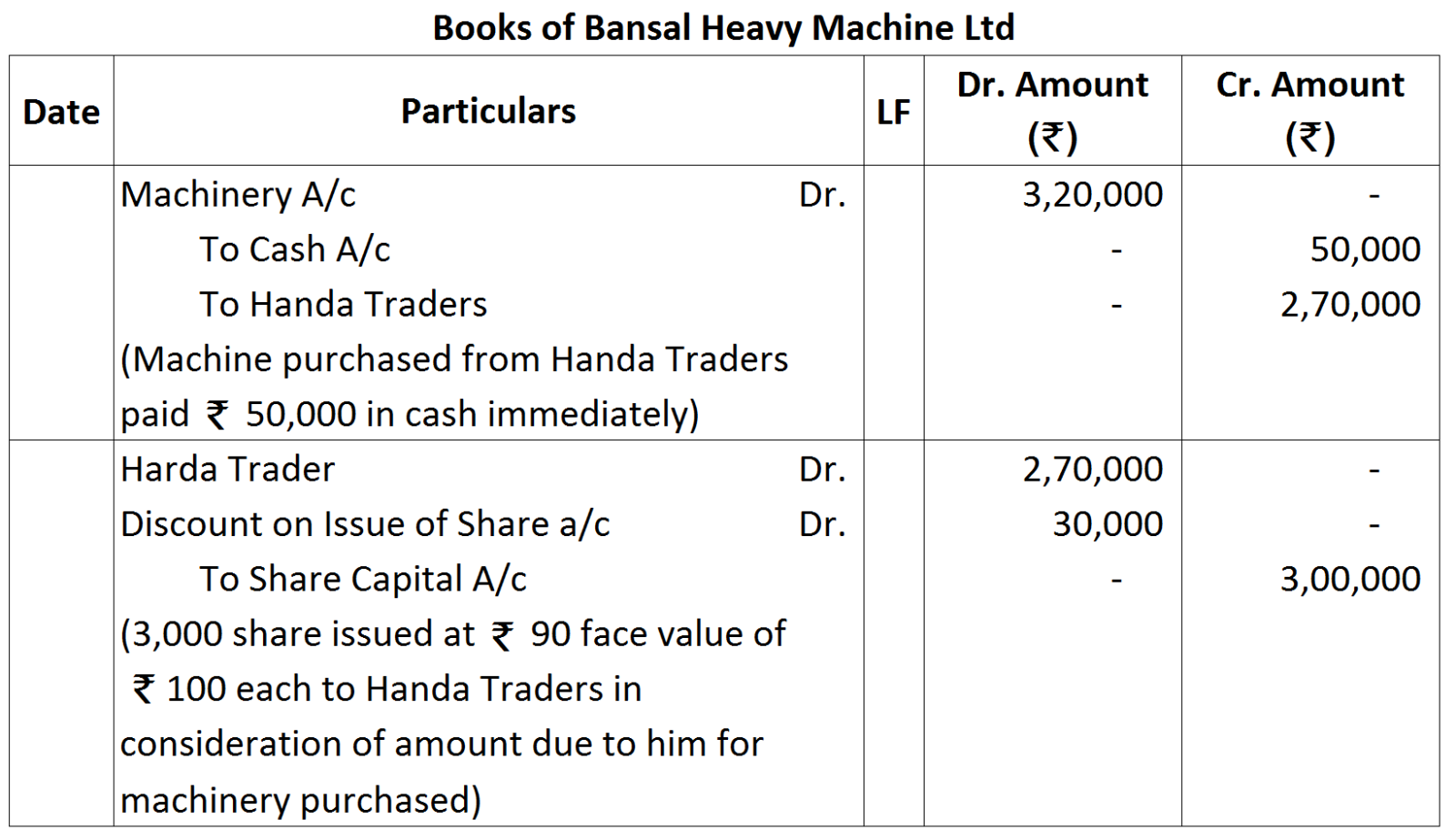
Bansal Heavy machine Ltd purchased machine worth ₹ 3,20,000 from Handa Trader. Payment was made as ₹ 50,000 cash and remaining amount by issue of equity share of the face value of ₹ 100 each fully paid at an issue price of ₹ 90 each.
Answer

Working Notes:-
Number of share issued
$=\frac{\text{Amount Payable}}{\text{Issue Price}}$
$=\frac{2,70,000}{90}=3,000 \ \text{shares}$
View full question & answer
Question 364 Marks
Show the forfeiture and reissue entries under the following cases:
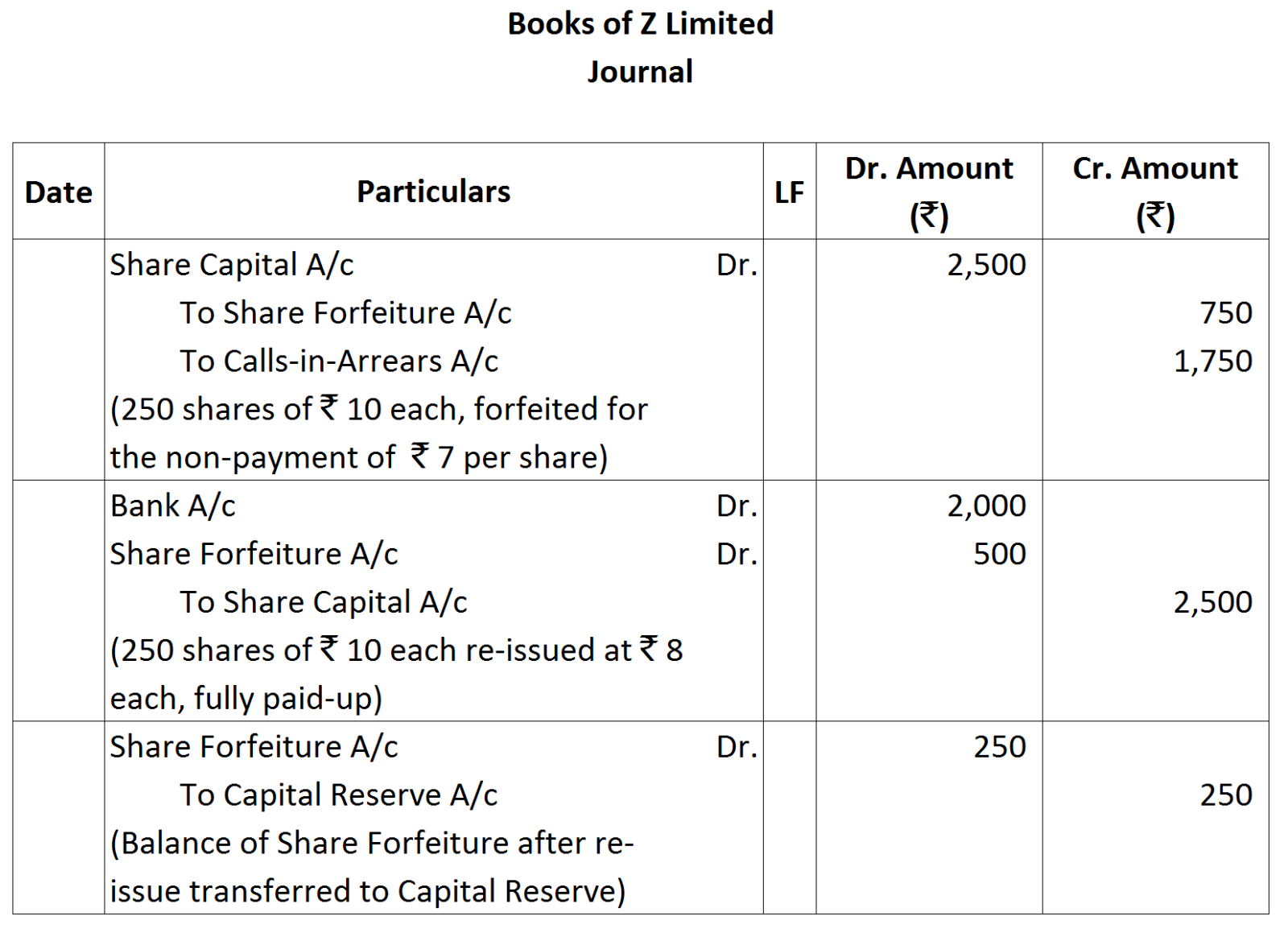
Z Ltd. forfeited 250 shares of ₹ 10 each, fully called-up held by Mr. C for non-payment of allotment money of 3 per share and first and final call money of 4 per share. these shares were reissued @ ₹ 8 per share as fully paid-up to Mr.P.
Answer

Working Notes:
Share Forfeiture Credit (at the time of forfeiture of shares)
₹ 750
Less: Share Forfeiture Debit (at the time of re-issue shares)
₹ 500
Balance in Share Forfeiture after re-issue of shares
250
Capital Reserve = Balance in Share Forfeiture of re-issue shares
= ₹ 250
View full question & answer
Question 384 Marks
Pass journal entries in the following cases:
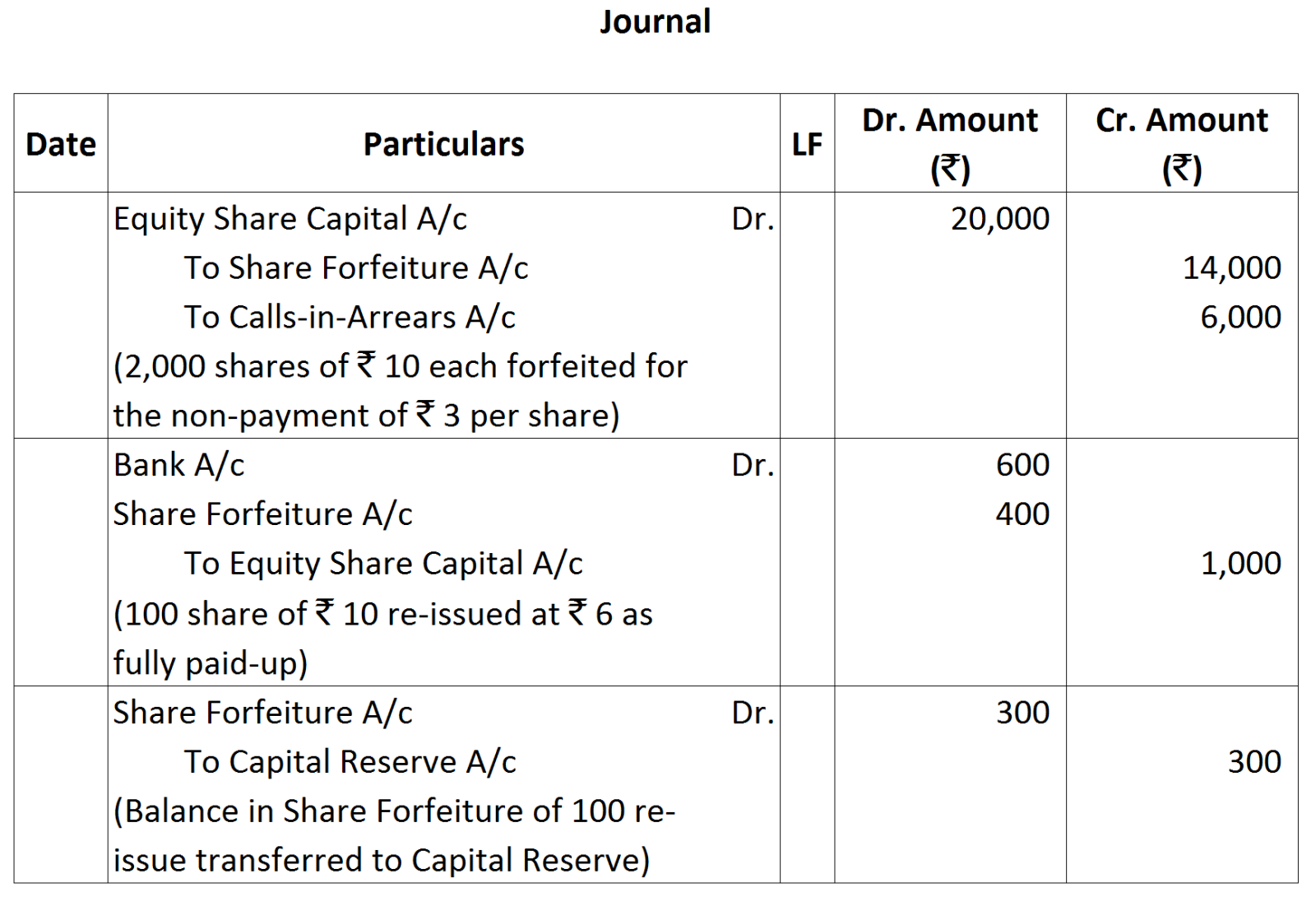
M. Ltd forfeited 200 Equity Shares of ₹ 10 each, issued at a premium of ₹ 5 per share, held by Ram for non-payment of the final call of ₹ 3 per share. Of these, 100 shares were reissued to Vishu at a discount of ₹ 4 per share.
Answer

Working Note:
Share Forfeiture of re-issued shares
Share Forfeiture
Cr.
₹ 7
per share
Share Forfeiture
Dr.
₹ 4
per share
Balance in share forfeiture after re-issue
Cr.
₹ 3
per share
Capital Reserve = Balance in Share Forfeiture after re-issue × No. of shares re-issued
= ₹ 3 × 100 shares
= ₹ 300
View full question & answer
Question 394 Marks
Citizen Watches Ltd. invited applications for 50,000 shares of ₹ 10 each payable ₹ 3 on application, ₹ 4 on allotment and balance on first and final call. Applications were received for 60,000 shares. Applications were accepted for 50,000 shares and remaining applications were rejected. All calls were made and received except First and Final call on 500 shares.
Pass the journal entries in the books of Citizen Watches Ltd.
View full question & answer
Question 404 Marks
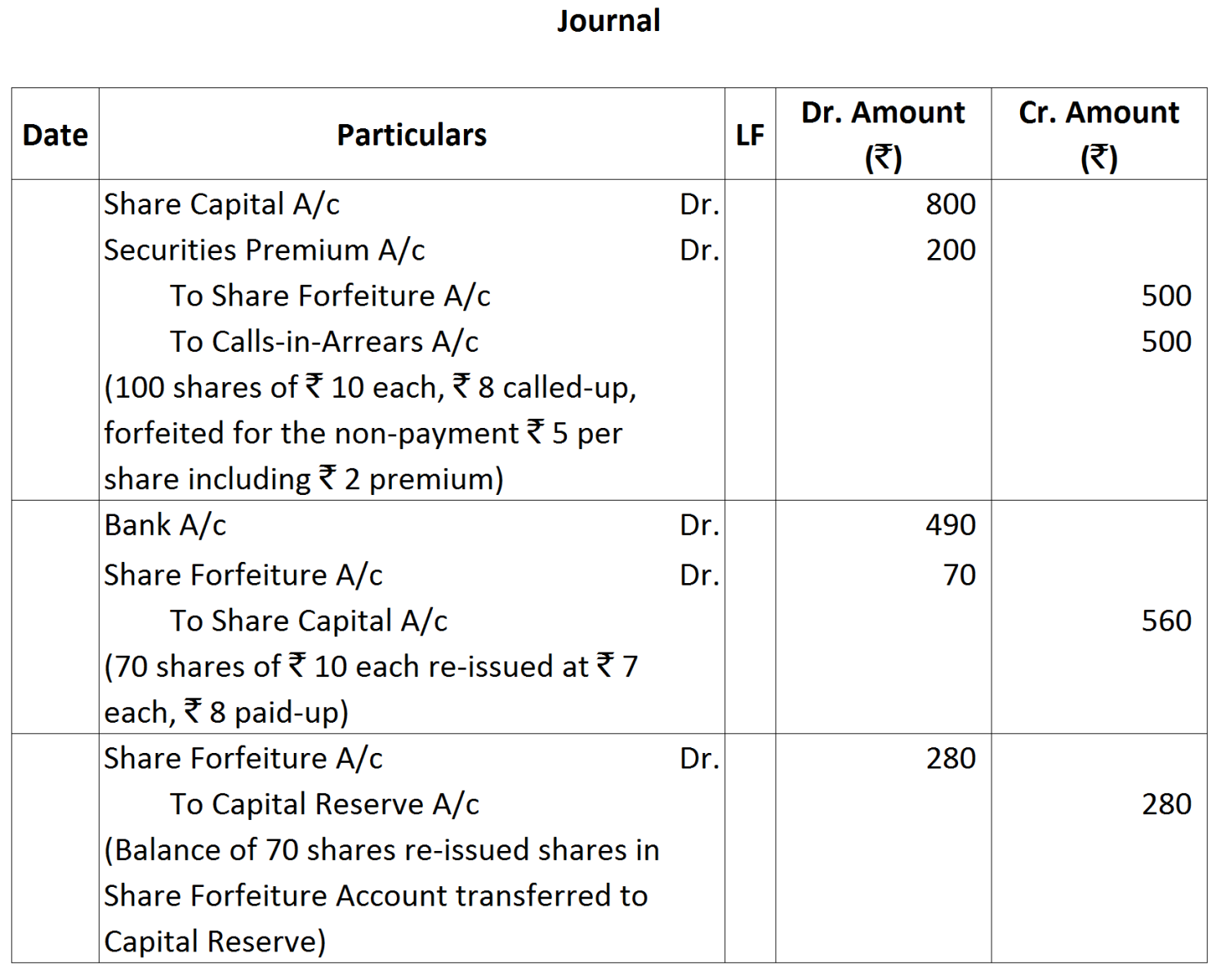
X Ltd. forfeited 100 shares of ₹ 10 each (₹ 8 called-up) issued at a premium of ₹ 2 per share to Mr. R, on which he had paid applications money of ₹ 5 per shar , for non-payment of allotment money of ₹ 5 per share (including premium). Out of these, 70 shares were reissued to Mr. Sanjay as ₹ 8 called-up for ₹ 7 per share. Give necessary journal entries relating to forfeiture and reissue of shares.
Answer

Working Notes:
Share Forfeiture Credit
₹ 5
per share
Less: Share Forfeiture Debit
₹ 1
per share
Balance in Share Forfeiture of re-issued shares
4
per share
Capital Reserve = Balance in Share Forfeiture Account of re-issue shares × No. of shares re-issued
= 70 × 4
= ₹ 280
View full question & answer
Question 414 Marks
Jaya Ltd. issued 60,000 shares of ₹ 10 each at a premium of ₹ 2 per share payable as ₹ 3 on Application, ₹ 5 (including primium) on allotment and the balance on first and final call. Applications were received for 82,000 shares. The Directors resolved to allot as follows:
(A) Applicants of 30,000 shares
20,000 shares
(B) Applicants of 50,000 shares
40,000 shares
(C) Applicants of 2,000 shares
Nil
Ramesh who had applied for 900 shares in category.
  1. And Suresh who was allotted 600 shares in category.
  2. Failed to pay the allotment money. Calculate the amount received on Allotment.
Answer
Total amount due on Allotment (including premium): 60,000 × ₹ 5
 
 
    3,00,000
Less: (i)Excess money received on Application in Category A:
 
 
30,000 Shares - 20,000 Shares = 10,000 Shares × ₹ 3
 
30,000
(ii) Excess money received on Application in Category B:
 
 
50,000 Shares - 40,000 Shares = 10,000 Shares × ₹ 3
 
30,000
(iii) Ramesh who applied for 900 shares must have been allotted
 
 
$\frac{20,000}{30,000} \times 900 = 600 \ \text{Shares}$
 
 
Excess received from Ramesh on Application =
 
 
900 shares - 600 shares = 300 shares × ₹ 3 = ₹ 900
 
 
Amount due from him on Allotment: 600 shares × ₹ 5 =
3,000
 
Less: Excess received from him on Application
900 2,100
(iv) Suresh who was allotted 600 shares must have applied for $\frac{50,000}{40,000} \times 600 = 750 \ \text{shares}$
Excess received from Suresh on Application =
750 shares - 600 shares = 150 shares × ₹ 3 = ₹ 450
Amount due from him on Allotment: 600 shares × ₹ 5 = 3,000
 
Less: Excess received from him on Application
450
2,550
Net amount received on Allotment
 
2,35,350
View full question & answer
Question 424 Marks
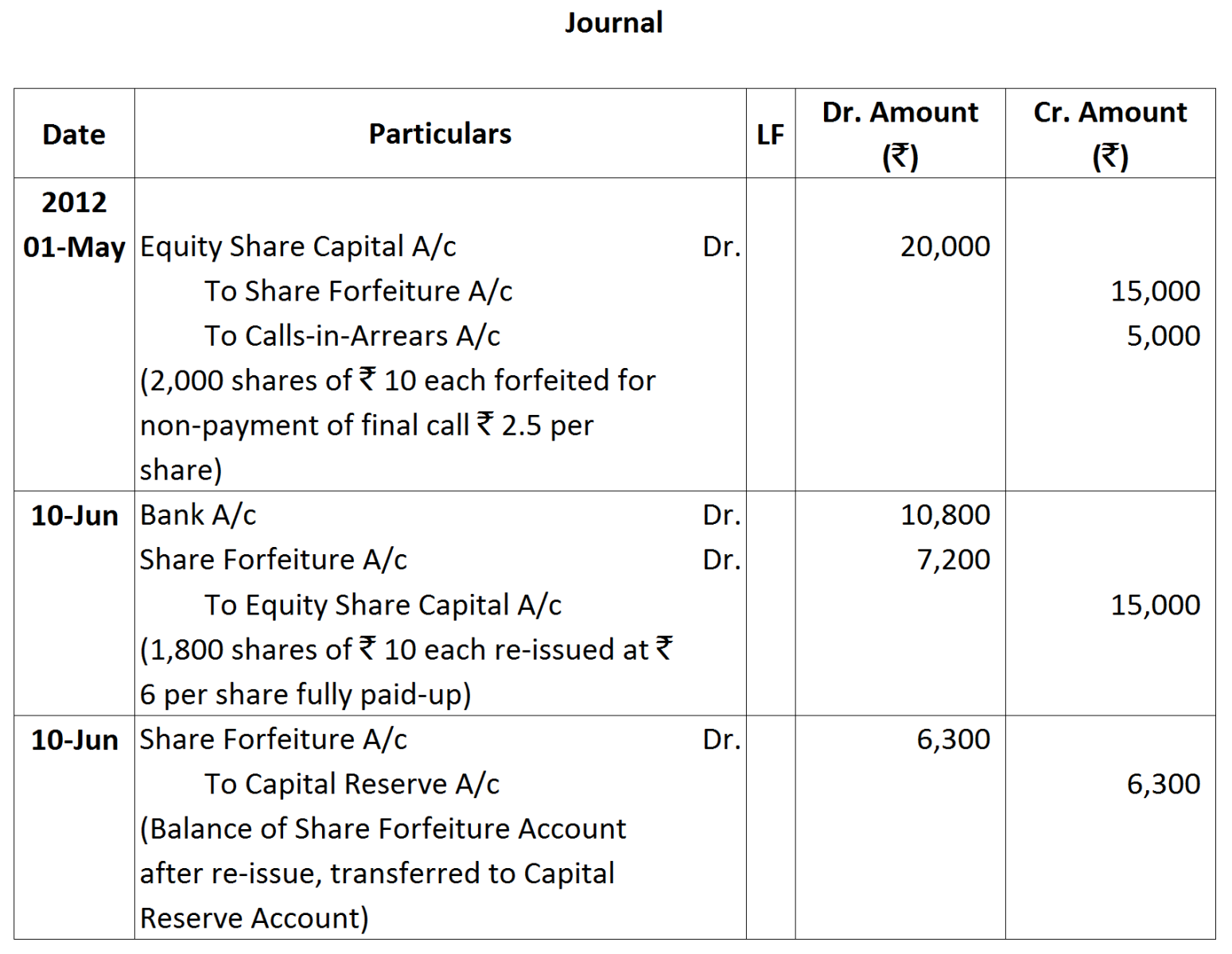
The Directors of M Ltd resolved on 1st May, 2015 that 2,000 Equity Shares of ₹ 10 each, ₹ 7.50 paid be forfeited for non-payment of final call of ₹ 2.50. On 10th June, 2015, 1,800 of these shares were reissued for ₹ 6 per share. Give necessary Journal entries.
Answer

Working Notes:
Share Forfeiture
7.5
Cr.
Share Forfeiture
(4.0)
Dr.
Balance in Share Forfeiture Account after re-issue
3.5
Cr. per share
Capital Reserve = No. of Shares reissued × Balance in Share Forfeiture Account after reissue (per share)
= 1,800 × ₹ 3.5 (per share)
= ₹ 6,300
View full question & answer
Question 434 Marks
Marigold Ltd. was registered with the authorized capital of ₹ 3,00,000 divided into 3,000 shares of ₹ 100 each, which were offered to the public. Amount payable as ₹ 30 per share on application, ₹ 40 per share on allotment and ₹ 30 per share on first and final call. These shares were fully subscribed and all money was dully received. Prepare journal and Cash Book.
View full question & answer
Question 444 Marks
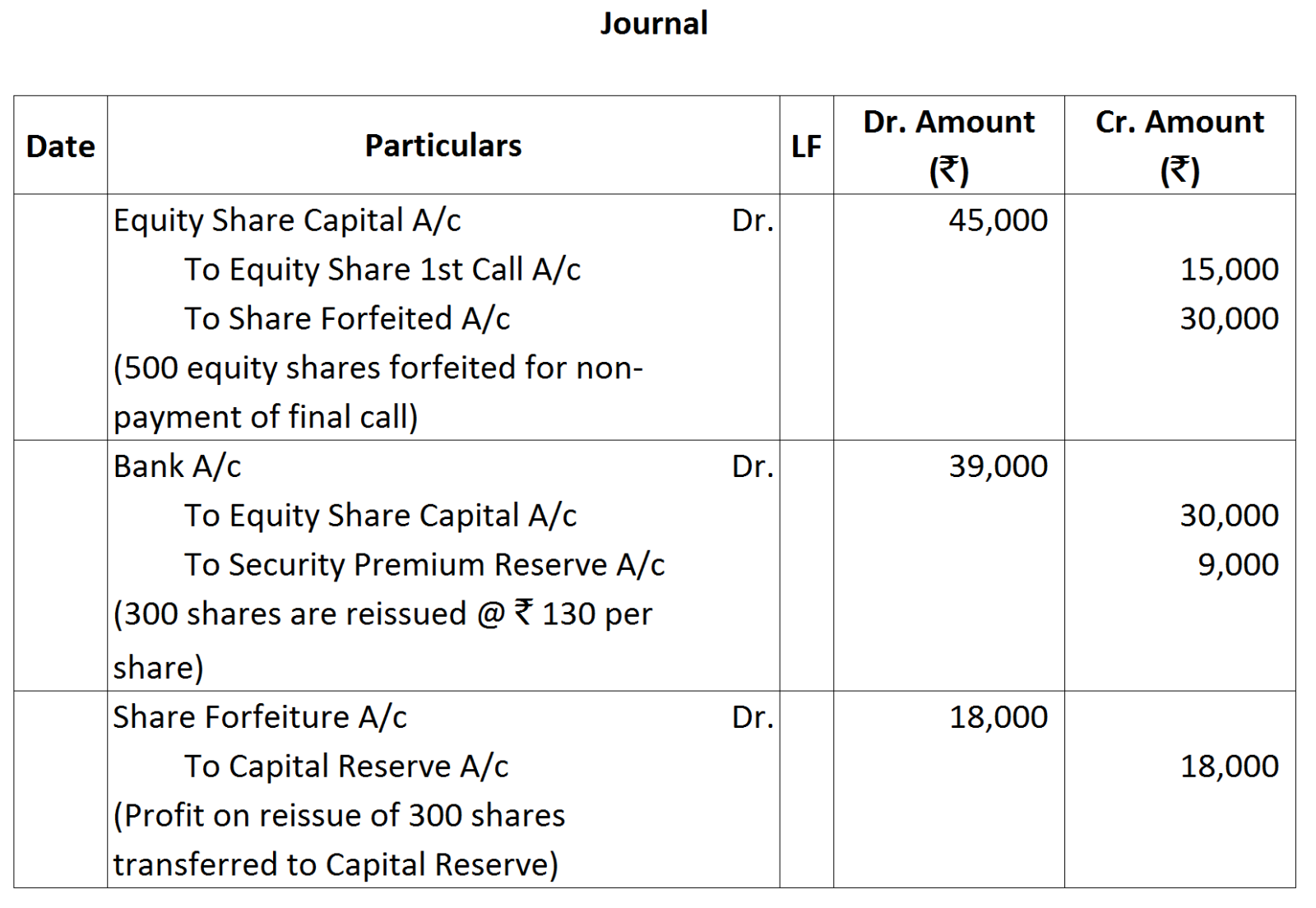
Star Ltd. forfeited 500 Equity Shares of ₹ 100 each for non-payment of first call of ₹ 30 per share. The final call of ₹ 10 per share was not yet made. Out of these, 60% shares were reissued for ₹ 39,000 fully paid. journalise the forfeiture and reissue of shares.
Answer

Working Notes:
Amount transferred to Capital Reserve
Shares Re-issued = 300
Shares Forfeited = 500
Amount forfeited in respect of 300 shares $=\text{Amount Forfeited}\times\frac{\text{Shares Re-issued}}{\text{Shares Forfeited}}$
$=30,000\times\frac{300}{500}=18,000$
View full question & answer
Question 454 Marks
X Ltd. forfeited 1,000 shares of ₹ 20 each issued at a premium of ₹ 2 per share to Ashok (₹ 18 called-up) on which he did not pay allotment of ₹ 6 (including premium) and 1st Call of ₹ 4. Give Journal Entries forforfeiture and re-issue in the following cases:
  1. 600 shares were re-issued to Mohan at ₹ 14 per share as ₹ 18 paid up;
  2. 200 shares to Sohan as fully paid-up for ₹ 24 per share; and
  3. 200 shares to Suresh as, fully paid-up for ₹ 10 per share at different intervals of time.
View full question & answer
Question 464 Marks
To provide employment to the youth and to develop the Naxal affected backward areas of Chhattisgarh, X Ltd. decided to set-up a power pIant. For raising funds the company decided to issue 7,50,000 equity shares of ₹ 10 each at a premium of 50%. The whole amount was payable on application. Applications for 20,00,000 shares were received.
Applications for 50,000 shares were rejected and shares were allotted to the remaining applicants on pro-rata basis.
Pass necessary Journal entries for the above transactions in the books of the company and identify any two values which X Ltd. wants to propagate.
Answer

Values:
  1. Providing employment opportunities.
  2. Development of Backward Areas.
  3. Helping the young people to undertake development activities.
  4. Promoting peace and harmony in the society.
View full question & answer
Question 474 Marks
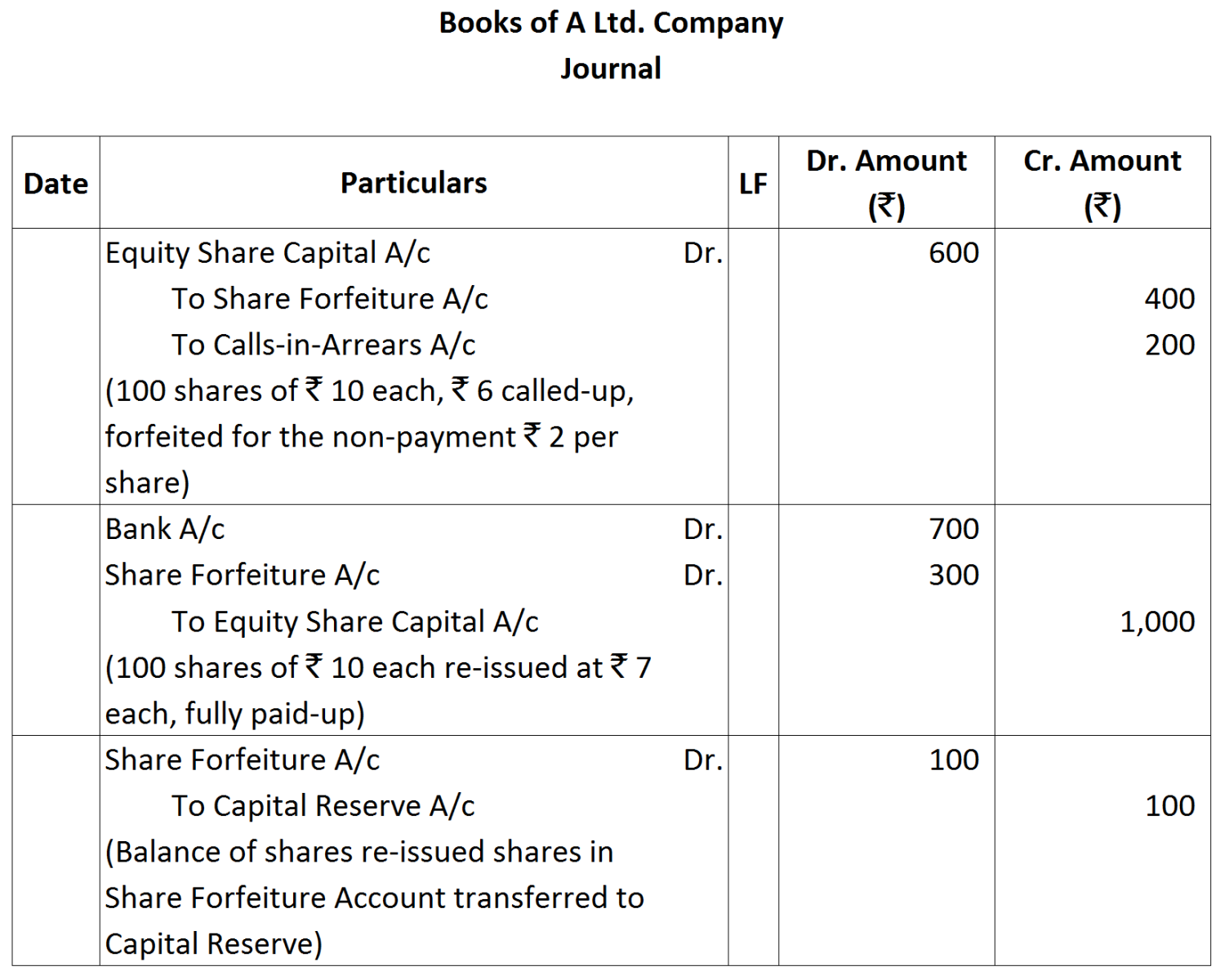
A Limited Company forfeited 100 Equity Shares of the face value of ₹ 10 each, ₹ 6 per share called-up, for non-payment of first call of ₹ 2 per share. The forfeited shares were subsequently reissued as fully paid-up @ ₹ 7 each.
Give necessary entries in the company's journal.
Answer

Working Notes:
Share Forfeiture Credit
₹ 400
Less: Share Forfeiture Debit
₹ 300
Balance in Share Forfeiture of re-issued shares
100
Capital Reserve = Balance in Share Forfeiture Account of re-issue shares
= ₹ 100
View full question & answer
Question 484 Marks
Z Ltd. issued 20,000 Equity Shares of ₹ 10 each at par payable: On application ₹ 2 per share; on allotment ₹ 3 per share; on first call ₹ 3 per share; on second and final call ₹ 2 per share.
Mr. Gupta was allotted 100 shares. Pass necessary journal entry relating to the forfeiture of shares in each of the following alternative cases:
Case I: If Mr. Gupta failed to pay the allotment money and his shares were forfeited.
Case II: If Mr. Gupta failed to pay allotment money and on his subsequent failure to pay the first call, his shares were forfeited.
Case III: If Mr. Gupta failed to pay the first call and on his subsequent failure to pay the second and final call, his shares were forfeited.
Answer
Application
2
Allotment
3
First Call
3
Final Call
2
Total
10
View full question & answer
Question 494 Marks
Write three points of differences between an equity share and a preference share.
Answer
Difference between Preference Shares and Equity Shares:
Basis Prefrence share Equity share
Right to Dividend Divident is paid on preference share before it is paid on equity share. Divident is paid on equity share after it is paid on preference share.
Rate of dividend Rate of divident may be fixed. Rate of divident is proposed by the board of directors every year.
Arreares of Dividend If preference share are cumulated preference shares arrears of dividend is paid before dividend is paid on equity share. Dividend is declared every year in case dividend is not declared during the year it is not accumulated to be paid on comming years.
Convertibility preference share may be converted to equity shares if the term of issue so provided. Equity share are not convertible.
View full question & answer
Question 504 Marks
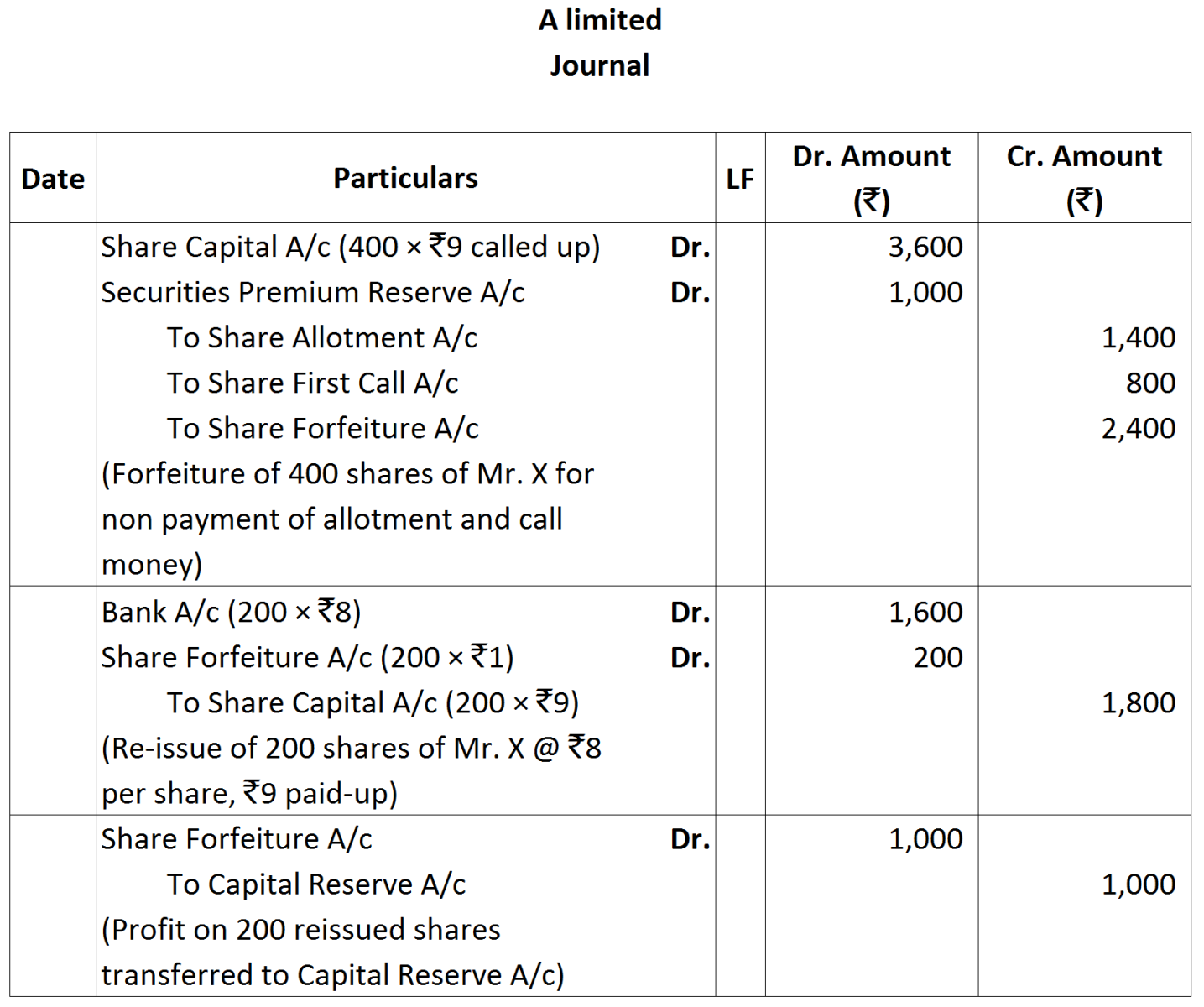
A limited company forfeited 400 shares of Mr. X, who had applied for 600 shares on account of non-payment of allotment money ₹ 3 + ₹ 2.50 (premium) and first call ₹ 2. Only ₹ 4 per share was received with application. Out of these, 200 shares were re-issued to Mr. Y at ₹ 8 per share, ₹ 9 paid-up.
Give journal entries relating to forfeiture and re-issue.
Answer

Working Notes:
(1) Excess received from X on Application =
600 shares - 400 shares = 200 × ₹ 4 = ₹ 800
Amount due from Von allotment = 400 × ₹ 5.50
=
₹ 2,200
Less: Excess received on application
=
₹ 800
Amount not received from X on allotment
=
$\overline{\underline{₹ \ 1,400}}$
View full question & answer
4 Marks Question - Accountancy STD 12 Commerce Questions - Vidyadip