Questions · Page 1 of 2

3 Marks Question

🎯

Test yourself on this topic

50 questions · timed · auto-graded

Question 13 Marks
Total Debt ₹ 60,00,000; Shareholders' Funds ₹ 10,00,000; Reserves and Surplus ₹ 2,50,000; Current Assets ₹ 25,00,000; Working Capital ₹ 5,00,000. Calculate Total Assets to Debt Ratio.
[Hint: Reserves and Surplus are already included in Shareholders' Funds.]
Answer
Total Assets Debt Ratio $=\frac{\text{Total Assets}}{\text{Long-term Debt}}$
Working Capital = Current Assets - Current Liabilities
5,00,000 = 25,00,000 - Current Liabilities
Current Liabilities = ₹ 20,00,000
Long Term Debts = Total Debt - Current Liabilities
= 60,00,000 - 20,00,000 = ₹ 40,00,000
Total Assets = Total Liabilities = Total Debt + Shareholders’ Funds
= 60,00,000 + 10,00,000 = ₹ 70,00,000
Total Assets Debt Ratio $=\frac{70,00,000}{40,00,000}=7:4\text{ or }1.75:1$
View full question & answer
Question 23 Marks
From the following information, calculate Debt to Equity Ratio:
 
10,000 Equity Shares of ₹ 10 each fully paid.
1,00,000
5,000; 9% Preference Shares of 10 each fully paid.
50,000
General Reserve.
45,000
Surplus, i.e., Balance in Statement of Profit and Loss.
20,000
10% Debentures.
75,000
Current Liabilities.
50,000
Answer
Long-Term Debt = Debentures = ₹ 75,000
Shareholder’s Funds = Equity Share Capital + Preference Share Capital + General Reserve + Surplus.
= ₹ 1,00,000 + ₹ 50,000 + ₹ 45,000 + ₹ 20,000 = ₹ 2,15,000.
$\text{Debt-Equity Ratio}=\frac{\text{Long-Term Debts}}{\text{Shareholder' s Funds}}$
$=\frac{75,000}{2,15,000}=0.35:1$
View full question & answer
Question 33 Marks
Equity Share Capital ₹ 15,00,000; Gross Profit on Revenue from Operations, i.e., Net Sales $33\frac{1}{3} \ \% ;$ Cost of Revenue from Operations or cost of Goods Sold ₹ 20,00,000; Current Assets ₹ 10,00,000; Current Liabilities ₹ 2,50,000. Calculate Working Capital Turnover Ratio.
Answer
Net Sales = Cost of Goods sold + Gross ProfitNet Sales $=20,00,000+\frac{1}{3}\text{of Net Sales}$
Let Net Sales = x $\text{x}=20,00,000+\frac{1\text{x}}{3}$ Net Sales (x) $=\frac{60,00,000}{20}$ $=₹\ 30,00,000$ Working Capital = Current Assets - Current Liabilities = 10,00,000 - 2,50,000 = 7,50,000 Working Capital Turnover Ratio $=\frac{\text{Net Sales}}{\text{Working Capital}}$ $=\frac{30,00,000}{7,50,000}=4\text{ Times}$
View full question & answer
Question 43 Marks
From the following details, calculate Inventory Turnover Ratio:
 
Cost of Revenue from Operations (Cost of Goods Sold).
4,50,000
Inventory in the beginning of the year.
1,25,000
Inventory at the close of the year.
1,75,000
Answer
Inventory Tornover Ratio $=\frac{\text{Cost of Goods Sold}}{\text{Average Stock}}$Cost of Goods Sold = 4,50,000
Average Stock $=\frac{\text{Opening Stock+Closing Stock}}{2}$
$=\frac{1,25,000+1,75,000}{2}=1,50,000$
Inventory Turnover Ratio $=\frac{4,50,000}{1,50,000}=3\text{ times}$
View full question & answer
Question 53 Marks
Current Ratio 4; Liquid Ratio 2.5; Inventory ₹ 6,00,000. Calculate Current Liabilities, Current Assets and Liquid Assets.
Answer
$\text{Current Ratio}=\frac{\text{Current Assets}}{\text{Current Liabilities}}=\frac{4}{1}$
$\text{Quick Ratio}=\frac{\text{Liquid Assets}}{\text{Current Liabilities}}=\frac{2.5}{1}$
Inventory = 6,00,000
Let Current Liabilities be = x
Current Assets = 4x
Quick Assets = 2.5x
Stock = Current Assets - Quick Assets
6,00,000 = 4x - 2.5x
x = 4,00,000
Current Assets = 4x = 4 × 4,00,000 = 16,00,000
Liquid Assets = 2.5x = 2. 5 × 4,00,000 = 10,00,000.
View full question & answer
Question 63 Marks
Revenue from Operations, Cash Sales ₹ 4,00,000; Credit Sales ₹ 1,00,000; Gross Profit ₹ 1,00,000 Office and Selling Expenses ₹ 50,000. Calculate Operating Ratio.
Answer
Net Sales = Case Sales + Credit Sales
= 4,00,000 + 1,00,000 = 5,00,000
Cost of Goods Sold = Net Sales - Gross Profit
= 5,00,000 - 1,00,000 = 4,00,000
Operating Expenses = Office and Selling Expenses = 50,000
Operating Cost = Cost of Goods Sold + Operating Expenses
= 4,00,000 + 50,000 = 4,50,000
Oprating Ratio = $\frac{\text{Oprating Cost}}{\text{Net Sales}}\times100$
=$\frac{4,50,000}{5,00,000}\times100=90\%$
View full question & answer
Question 73 Marks
A Limited's Liquidity Ratio is 2.5 : 1. Inventory is ₹ 6,00,000. Current Ratio is 4 : 1. Find out the Current Liabilities.
Answer
Current Ratio $=\frac{\text{Current Assets}}{\text{Current Liabilities}}=\frac{4}{1}$ Quick Ratio $=\frac{\text{Quick Assets}}{\text{Current Liabilities}}=\frac{2.5}{1}$Let the Current Liabilities be = x
Current Assets = 4x Quick Assets = 2.5x Stock = Current Assets - Quick Assets 6,00,000 = 4x - 2.5x or, x = 4,00,000 Current Liabilities = x = 4,00,000.
View full question & answer
Question 83 Marks
Capital Employed ₹ 10,00,000; Fixed Assets ₹ 7,00,000; Current Liabilities ₹ 1,00,000. There are no Long-term Investments. Calculate Current Ratio.
[Hint: Current Assets = Capital Employed + Current Liabilities - Fixed Assets.]
Answer
Capital Employed = 10,00,000
Fixed Assets = 7,00,000
Current Assets = Capital Employed + Current Liabilities - Fixed Assets
= 10,00,000 + 1,00,000 - 7,00,000 = 4,00,000
$\text{Current Ratio}=\frac{\text{Current Assets}}{\text{Current Liabilities}}$
$=\frac{4,00,000}{1,00,000}=4:1$
View full question & answer
Question 93 Marks
Cash Sales ₹ 2,20,000; Credit Sales ₹ 3,00,000; Sales Return ₹ 20,000; Gross Profit ₹ 1,00,000; Operating Expenses ₹ 25,000; Non-operating Incomes ₹ 30,000; Non-operating Expenses ₹ 5,000. Calculate Net Profit Ratio.
Answer
Net Sales = Cash Sales + Creadit Sales - Sales Return
= 2,20,000 + 3,00,000 - 20,000
= 5,00,000
Net Profit = Gross Profit - Operating Expenses - Non-Operating Expenses + Non-operating Incomes
= 1,00,000 - 25,000 - 5,000 + 30,000
= 1,00,000
Net Profit Ratio = $\frac{\text{Net Profit}}{\text{Net Sales}}\times100$
$=\frac{1,00,000}{5,00,000}\times100=20\%$
View full question & answer
Question 103 Marks
A company had Current Assets of ₹ 4,50,000 and Current Liabilities of ₹ 2,00,000. Afterwards it purchased goods for ₹ 30,000 on credit. Calculate Current Ratio after the purchase.
Answer
Current Assets = ₹ 4,50,000
Current Liabilities = ₹ 2,00,000
Purchase of Goods on Credit for ₹ 30,000 will have two effects:
  1. Increase Stock by ₹ 30,000, Current Assets will thereby increase to ₹ 4,80,000 (₹ 4,50,000 + ₹ 30,000)
  2. Increase Creditors by ₹ 30,000 and therefore Current Liabilities will now be ₹ 2,30,000 (₹ 2,00,000 + ₹ 30,000).
$\text{Current Ratio}=\frac{\text{Current Assets}}{\text{Current Liabilities}}$
$=\frac{4,80,000}{2,30,000}=2.08:1$
View full question & answer
Question 113 Marks
Current Assets are ₹ 7,50,000 and Working Capital is ₹ 2,50,000. Calculate Current Ratio.
Answer
Current Assets = ₹ 7,50,000
Working Capital = ₹ 2,50,000
Working Capital = Current Assets - Current Liabilities
2,50,000 = 7,50,000 - Current Liabilities
Current Liabilities = 7,50,000 - 2,50,000 = ₹ 5,00,000
$\text{Current Ratio}=\frac{\text{Current Assets}}{\text{Current Liabilities}}$
$=\frac{7,50,000}{5,00,000}=1.5:1$
View full question & answer
Question 123 Marks
X Ltd. has Current Ratio of 4.5 : 1 and a Quick Ratio of 3 : 1. If its inventory is ₹ 36,000, find out its total Current Assets and total Current Liabilities.
Answer
$\text{Current Ratio}=\frac{\text{Current Assets}}{\text{Current Liabilities}}=\frac{4.5}{1}$
$\text{Quick Ratio}=\frac{\text{Liquid Assets}}{\text{Current Liabilities}}=\frac{3}{1}$
Inventory = 36,000
Let Current Liabilities be = x
Current Assets = 4.5x
Quick Assets = 3x
Stock = Current Assets - Quick Assets
36,000 = 4.5x - 3x
x = 24,000
Current Assets = 4.5x = 4.5 × 24,000 = 1,08,000.
Liquid Assets= 3x = 3 × 24,000 = 72,000.
View full question & answer
Question 133 Marks
Current Liabilities of a company were ₹ 1,75,000 and its Current Ratio was 2 : 1. It paid ₹ 30,000 to a Creditor. Calculate Current Ratio after payment.
Answer
$\text{Current Ratio}=\frac{\text{Current Assets}}{\text{Current Liabilities}}=\frac{2}{1}$
Current Liabilities = ₹ 1,75,000
Payment of ₹ 30,000 to a Creditor will have two effects:
  1. Decrease in Cash by ₹ 30,000 and therefore Current Assets will decrease to ₹ 3,20,000.
  2. Decrease in Creditors by ₹ 30,000 and this will decrease Current Liabilities to ₹ 1,45,000
$\text{Current Ratio}=\frac{\text{Current Assets}}{\text{Current Liabilities}}$
$=\frac{3,20,000}{1,45,000}=2.21:1$
View full question & answer
Question 143 Marks
Capital Employed ₹ 8,00,000 Shareholders' Funds ₹ 2,00,000. Calculate Debt to Equity Ratio.
Answer
Shareholders’ Funds = 2,00,000 Capital Employed = 8,00,000 Long- Term Debts = Capital Employed - Shareholders’ Funds = 8,00,000 - 2,00,000 = 6,00,000 $\text{Debt-Equity Ratio}=\frac{\text{Long-Term Debit}}{\text{Equity}}$$=\frac{6,00,000}{2,00,000}=3:1$
View full question & answer
Question 153 Marks
Calculate Cost Of Ratio from the following information:
Operating Cost ₹ 6,80,000; Gross Profit 25%; Operating Expenses ₹ 80,000. [Operating Ratio = 85%]
Answer
Given:
Operating Cost = ₹ 6,80,000
Operating Expenses = ₹ 80,000
Gross Profit Ratio = 25%
Find out: Operating Ratio
Operating Cost = Cost of Revenue from Operations + Operating Expenses
6,80,000 = Cost of Revenue from Operations + 80,000
Cost of Revenue from Operations = ₹ 6,00,000
Gross Profit = $\frac{1}{4}\text{th}$ of Sales = $\frac{1}{3}\text{rd}$ of Cost
Gross Profit $=\frac{1}{3}\times6,00,000= ₹ \ 2,00,000$
Gross profit Ratio = $\frac{\text{Gross profit}}{\text{Net Sales}}\times100$
$25=\frac{2,00,000}{\text{Net Sales}}\times100$
Net Sales = ₹ 8,00,000
Operating profit Ratio = $\frac{\text{Operating Cost}}{\text{Net Sales}}\times100$
$=\frac{6,00,000}{8,00,000}\times100=85\%$
View full question & answer
Question 163 Marks
Operating Cost ₹ 3,40,000; Gross Profit Ratio 20%; Operating Expenses ₹ 20,000. Calculate Operating Profit Ratio.
Answer
Cost of Revenue from Operations = Operating Cost - Operating Expenses
= 3,40,000 - 20,000 = ₹ 3,20,000
$\text{Gross Profit}=\frac{3,20,000\times20}{80}$
$=₹\ 80,000$
Revenue from Operations = Cost of Revenue from Operations + Gross Profit
= 3,20,000 + 80,000 = ₹ 4,00,000
Operating Profit = Revenue from Operations - Operating Cost
= 4,00,000 - 3,40,000 = ₹ 60,000
Operating Profit Ratio = $\frac{\text{Operating Profit}}{\text{Revenue From Operation}}\times100$
$=\frac{60,000}{4,00,000}\times100=15\%$
View full question & answer
Question 173 Marks
Working Capital ₹ 3,60,000; Total Debts ₹ 7,80,000; Long-term Debts ₹ 6,00,000; Inventories ₹ 1,80,000. Calculate Liquid Ratio.
Hints:
  1. Current Liabilities = Total Debts - Long-term Debts.
  2. Current Assets = Working Capital + Current Liabilities.
  3. Liquid Assets = Current Assets - Inventories.
Answer
Current Liabilities = Total Debts - Long-term Debts
= 7,80,000 - 6,00,000 = 1,80,000
Current Assets = Current Liabilities + Working Capital
= 1,80,000 + 3,60,000 = 5,40,000.
Quick Assets = Current Assets - Stock
= 5,40,000 − 1,80,000 = 3,60,000
$\text{Quick Ratio}=\frac{\text{Quick Assets}}{\text{Current Liabilities}}$
$=\frac{3,60,000}{1,80,000}=2:1$
View full question & answer
Question 183 Marks
Calculate Operating Profit Ratio from the following:
 
Revenue from Operations (Net Sales).
5,00,000
Cost of Revenue from Operations (Cost of Goods Sold).
2,00,000
Wages.
1,00,000
Office and Administrative Expenses.
50,000
Interest on Borrowings.
5,000
Answer
Cost of Goods Sold = 2,00,000
Operating Expenses = Office and Administrative Expenses = 50,000
Operating Cost = Cost of Goods Sold + Operating Expenses
= 2,00,000 + 50,000 = 2,50,000
Net Sales = 5,00,000
Oprating Ratio $=\frac{\text{Oprating Cost}}{\text{Net Sales}}\times100$
$=\frac{2,50,000}{5,00,000}\times100=50\%$
Operating Profit Ratio = 100 - Operating Ratio = 100 - 50 = 50%
View full question & answer
Question 193 Marks
₹ 72,00,000 is the cost of Revenue from Operations (Cost of Goods Sold), during the year. If Inventory Turnover Ratio is 8 times, calculate inventories at the end of the year. Inventories at the end is 1.5 times that of in the beginning.
Answer
Inventory Turnover Ratio $=\frac{\text{Cost of Goods Sold}}{\text{Average Inventory}}$
$8=\frac{2,00,000}{\text{Average Inventory}}$
Let Opening Inventory = x
Closing Inventory = 1.5 × x = 1.5x
Average Inventory $=\frac{\text{Opening Inventory+Closing Inventory}}{2}$
$25,000=\frac{\text{x}+1.5\text{x}}{2}$
or, $2.5\text{x}=50,000$
or, $\text{x}=20,000$
Opening Inventory = x = ₹ 20,000
Closing Inventory = 1.5x = 20,000 × 1.5 = ₹ 30,000.
View full question & answer
Question 203 Marks
Total Assets ₹ 22,00,000; Fixed Assets ₹ 10,00,000; Capital Employed ₹ 20,00,000. There were no Long-term Investments. Calculate Current Ratio.
Hints:
  1. Current Assets = Total Assets - Fixed Assets.
  2. Current Liabilities = Total Assets - Capital Employed.
Answer
Current Assets = Total Assets - Fixed Assets
Fixed Assets = 10,00,000
Total Assets = 22,00,000
$\therefore$ Current Assets = 22,00,000 - 10,00,000 = 12,00,000
Current Liabilities = Total Assets - Capital Employed
= 22,00,000 - 20,00,000 = 2,00,000
$\text{Current Ratio}=\frac{\text{Current Assets}}{\text{Current Liabilities}}$
$=\frac{12,00,000}{2,00,000}=6:1$
View full question & answer
Question 213 Marks
Revenue from Operations, i.e., Net Sales ₹ 8,20,000; Return ₹ 10,000; Cost of Revenue from Operations (Cost of Goods Sold) ₹ 5,20,000; Operating Expenses ₹ 2,09,000; Interest on Debentures ₹ 40,500; Gain (Profit) on Sale of a Fixed Asset ₹ 81,000. Calculate Net Profit Ratio.
Answer
Net Sales = ₹ 8,20,000
Gross Profit = Net Sales - Cost of Goods Sold
= 8,20,000 - 5,20,000
= ₹ 3,00,000
Net Profit = Gross Profit - Operating Expenses - Interest on Debentures + Profit on Sale of Fixed Asset
= 3,00,000 - 2,09,000 - 40,500 + 81,000
= ₹ 1,31,500
Net Profit Ratio = $\frac{\text{Net Profit}}{\text{Net Sales}}\times100$
$=\frac{1,31,500}{8,20,000}\times100=16.04\%$
View full question & answer
Question 223 Marks
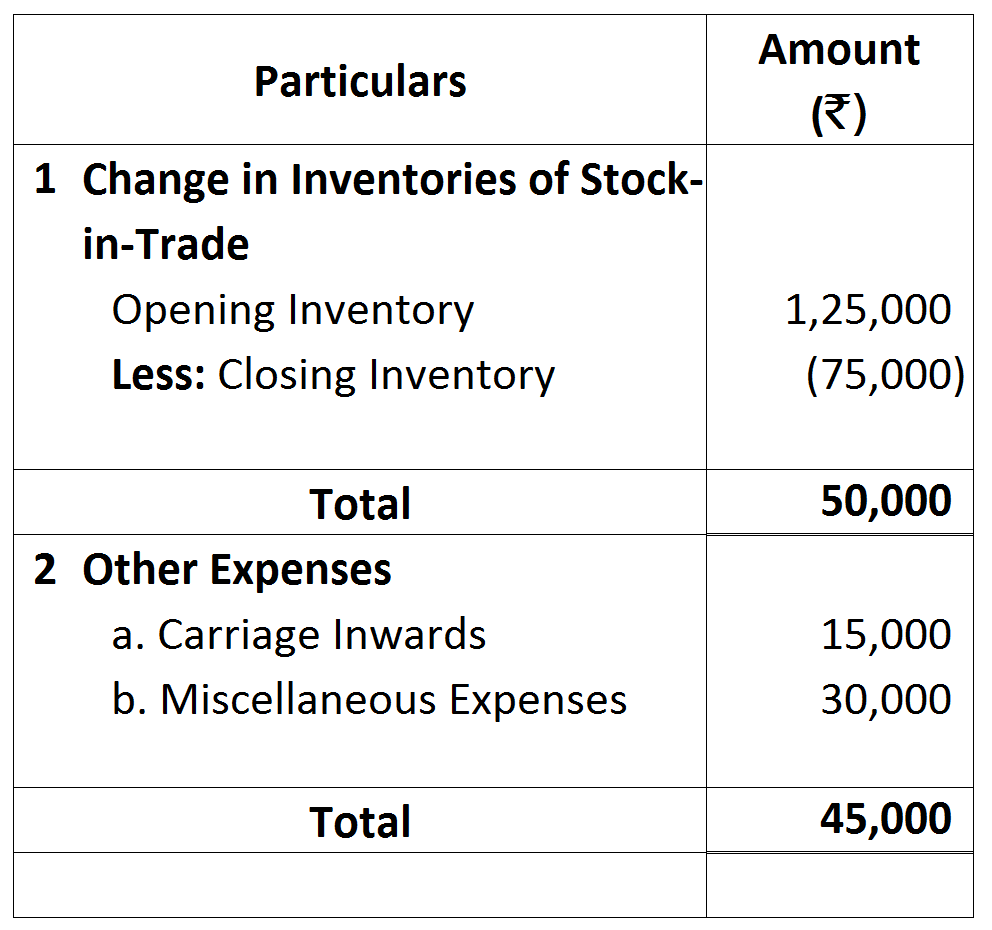
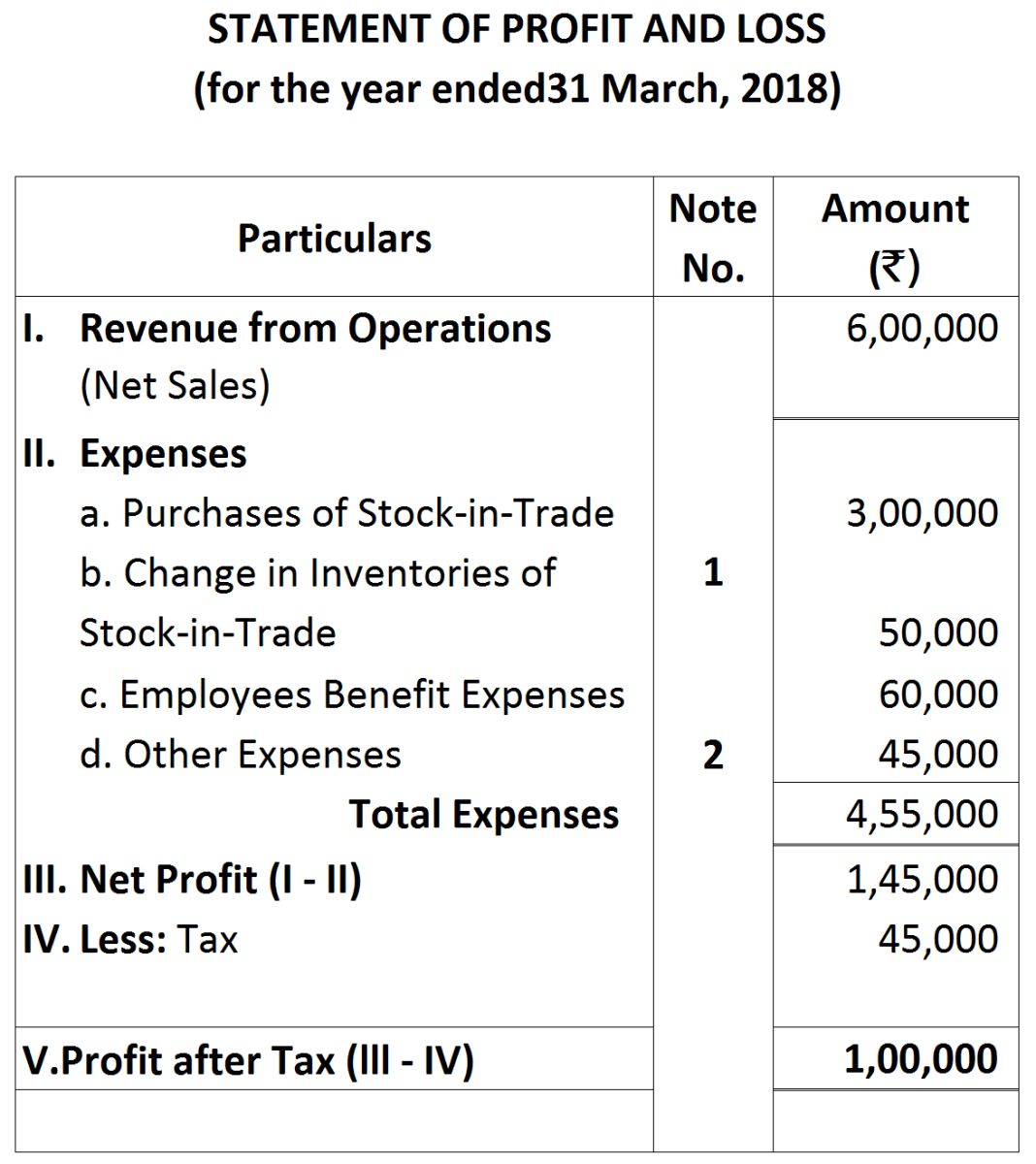
From the following Statement of Profit and Loss for the year ended 31st March, 2018 of Rex Ltd., calculate Inventory Turnover Ratio:
Answer
Cost of Goods Sold = Opening Inventory+ Purchases + Direct Expenses - Closing Inventory.
= ₹ 1,25,000 + ₹ 3,00,000 + ₹ 15,000 - ₹ 75,000 = ₹ 3,65,000
Average Stock $=\frac{\text{Opening Stock+Closing Stock}}{2}$
$=\frac{1,25,000+75,000}{2}=₹\ 1,00,000$
Inventory Turnover Ratio $=\frac{\text{Cost of Goods Sold}}{\text{Avarage Inventory}}$
$=\frac{3,65,000}{1,00,000}=3.65\text{ Times}$
View full question & answer
Question 233 Marks
Working Capital is ₹ 9,00,000; Trade Payables ₹ 90,000; and Other Current Liabilities are ₹ 2,10,000. Calculate Current Ratio.
Answer
Working Capital = ₹ 9,00,000
Current Liabilities = Trade Payables + Other Current Liabilities
= ₹ 90,000 + ₹ 2,10,000 = ₹ 3,00,000
Working Capital = Current Assets - Current Liabilities
₹ 9,00,000 = Current Assets - ₹ 3,00,000
Current Assets = ₹ 9,00,000 + ₹ 3,00,000 = ₹ 12,00,000
$\text{Current Ratio}=\frac{\text{Current Assets}}{\text{Current Liabilities}}$
$=\frac{12,00,000}{3,00,000}=4:1$
View full question & answer
Question 243 Marks
Revenue from Operations ₹ 4,00,000; Gross Profit Ratio 25%; Operating Ratio 90%. Non-operating Expenses ₹ 2,000; Non-operating Income ₹ 22,000. Calculate Net Profit Ratio.
Answer
Net Profit = Operating Profit + Non Operating Incomes - Non Operating Expenses
= 40,000 + 22,000 - 2,000 = ₹ 60,000
Operating Profit Ratio = 100 - Operating Ratio = 100 - 90 = 10%
Operating Profit = 4,00,000 × 10% = ₹ 40,000
Net Profit Ratio = $\frac{\text{Net Profit}}{\text{Revenue From operations}}\times100$
$=\frac{60,000}{4,00,000}\times100=15\%$
View full question & answer
Question 253 Marks
Capital Employed ₹ 12,00,000; Net Fixed Assets ₹ 8,00,000; Cost of Goods Sold or Cost of Revenue from Operations ₹ 40,00,000; Gross Profit is 20% on Cost. Calculate Working Capital Turnover Ratio.
[Hint: Working Capital = Capital Employed - Net Fixed Assets.]
Answer
Cost of Goods Sold = 40,00,000
Gross Profit = 20% of Cost
$\therefore\text{Gross Profit}=\frac{20}{100}\times40,00,000=8,00,000$
Total Sales = Cost of Good Sold = Gross Profit
= 40,00,000 + 8,00,000 = 48,00,000
Workink Capital = Capital Employed - Net Fixed Assets
= 12,00,000 - 8,00,000 = 4,00,000
Working Capital Turnover Ratio $=\frac{\text{Net Sales}}{\text{Working Capital}}$
$=\frac{48,00,000}{4,00,000}=12\text{ Times}$
View full question & answer
Question 263 Marks
XYZ Limited's Inventory is ₹ 3,00,000. Total-Liquid Assets are ₹ 12,00,000 and Quick Ratio is 2 : 1. Work out Current Ratio.
Answer
$\text{Quick Ratio}=\frac{\text{Quick Assets}}{\text{Current Liabilities}}=\frac{2}{1}$
Quick Assets = 12,00,000
$\text{Current Liabilities}=\frac{\text{Quick Assets}}{2}$
$=\frac{12,00,000}{2}=6,00,000$
Current Assets = Quick Assets + Stock
= 12,00,000 + 3,00,000 = 15,00,000
$\text{Current Ratio}=\frac{\text{Current Assets}}{\text{Current Liabilities}}$
$=\frac{15,00,000}{6,00,000}=2.5:1$
View full question & answer
Question 273 Marks
From the following information, calculate Oprating Ratio:
Cost of Revenue
From Operation (Cost of Goods Sold).
52,000
Operating Expenses.
18,000
Revenue from Operation  
Gross Sales. 88,000
Sales Return. 8,000
Answer
Net Sales = Gross Sales - Sales Return
= 88,000 - 8,000 = ₹ 80,000
Operating Cost = Cost of Goods Sold + Operating Expenses
= 52,000 + 18,000 = ₹ 70,000
Operating Ratio = $\frac{\text{Operating Cost}}{\text{Net Sales}}\times100$
= $\frac{70,000}{80,000}\times100=87.5\%$
View full question & answer
Question 283 Marks
Compute Trade Receivables Turnover Ratio from the following:
 
31st March, 2017 ()
31st March, 2018 ()
Revenue from Operations (Net Sales).
8,00,000
7,00,000
Debtors in the beginning of year.
83,000
1,17,000
Debtors at the end of year.
1,17,000
83,000
Sales Return.
1,00,000
50,000
Answer
Average Debtors $=\frac{\text{Opening Debtors+Closing Debtors}}{2}$
In 2017 $=\frac{83,000+1,17,000}{2}=₹\ 1,00,000$
In 2018 $=\frac{83,000+1,17,000}{2}=₹\ 1,00,000$
Debtors Turnover Ratio $=\frac{\text{Net Sales}}{\text{Average Debtors}}$
In 2017 $=\frac{8,00,000}{1,00,000}=8\text{ Times}$
In 2018 $=\frac{7,00,000}{1,00,000}=7\text{ Times}$
View full question & answer
Question 293 Marks
From the following informations, calculate Return on Investment (or Return on Capital Employed):
Particulars
Share Capital.
Reserves and Surplus.
Net Fixed Assets.
Non-current Trade Investments.
Current Assets.
10% Long-term Borrowings.
Current Liabilities.
Long-term Provisions.
5,00,000
2,50,000
22,50,000
2,50,000
11,00,000
20,00,000
8,50,000
NIL
Net Profit before Tax: ₹ 6,00,000.
Answer
Net Profit before tax = 6,00,000
Net Profit before interest, tax and dividend = Net Profit before tax + Interest on long-term borrowings.
= 6,00,000 + 10% of 20,00,000 = 6,00,000 + 2,00,000 = 8,00,000
Capital Employed = Share Capital + Reserves and Surplus + Long-term borrowings
= 5,00,000 + 2,50,000 + 20,00,000 = 27,50,000
Return on Investment $=\frac{\text{Profit before Interest, Tax and Dividend}}{\text{Capital Employed}}\times100$
$=\frac{8,00,000}{27,50,000}\times100=29.09\%$
View full question & answer
Question 303 Marks
Total Debt ₹ 12,00,000; Shareholders' Funds ₹ 2,00,000; Reserves and Surplus ₹ 50,000; Current Assets 5,00,000; Working Capital ₹ 1,00,000. Calculate Total Assets to Debt Ratio.
[Hint: Reserves and Surplus are already included in Shareholders' Funds.]
Answer
Working Capital=Current Assets - Current Liabilities
1,00,000 = 5,00,000 - Current Liabilities.
Current Liabilities = ₹ 4,00,000
Debt = Total Debt - Current Liabilities = 12,00,000 - 4,00,000 = ₹ 8,00,000
Total Assets = Shareholders' Funds + Total Debt
= 2,00,000 + 12,00,000 = ₹ 14,00,000
Total Assets Debt Ratio $=\frac{\text{Total Assets}}{\text{Debt}}$
$=\frac{14,00,000}{8,00,000}=1.75:1$
View full question & answer
Question 313 Marks
Calculate Total Assets to Debt Ratio from the following information:
Particulars
Particulars
Total Assets.
15,00,000
Bills Payable.
60,000
Total Debts.
12,00,000
Bank Overdraft.
50,000
Creditors.
90,000
Outstanding Expenses.
20,000
Answer
Total Assets = ₹ 15,00,000.
Current Liabilities = Creditors + Bills Payable + Bank Overdraft + Outstanding Expenses
= ₹ 90,000 + ₹ 60,000 + ₹ 50,000 + ₹ 20,000 = ₹ 2,20,000
Long-Term Debt = Total Debt - Current Liabilities
= ₹ 12,00,000 - ₹ 2,20,000 = ₹ 9,80,000
$\text{Total Assets Debt Ratio}=\frac{\text{Total Assets}}{\text{Long-term Debt}}$
$=\frac{15,00,000}{9,80,000}=1.53:1$
View full question & answer
Question 323 Marks
On the basis of the following information, calculate Total Assets to Debt Ratio:
Particulars
Particulars
Capital Employed.
50,00,000
Share Capital.
35,00,000
Current Liabilities.
20,00,000
10% Debentures.
10,00,000
Land and Building.
60,00,000
General Reserve.
3,00,000
Trade Receivable.
4,00,000
Surplus, i.e., Balance in.
2,00,000
Cash and Cash.
5,00,000
Statement of.
 
Equivalents.
1,00,000
Profit and Loss.
 
[Hint: Long-term Debts = Capital Employed - Shareholders' Funds.]
Answer
Total Assets Debt Ratio $=\frac{\text{Total Assets}}{\text{Long-term Debt}}$
Total Assets = Land and Buildings + Trade Receivables + Cash and Cash Equivalents + Investments (Trade)
= 60,00,000 + 4,00,000 + 5,00,000 + 1,00,000 = ₹ 70, 00,000
Long Term Debts = Capital Employed - Shareholders’ funds
= 50,00,000 - 40,00,000 = ₹ 10,00,000
Shareholder’s Fund = Share Capital + Reserve and Surplus
= 35,00,000 + 3,00,000 + 2, 00,000 = ₹ 40,00,000
Total Assets Debt Ratio $=\frac{70,00,000}{10,00,000}=7:1$
View full question & answer
Question 333 Marks
Opening Inventory ₹ 1,00,000; Closing Inventory ₹ 60,000; Inventory Turnover Ratio 8 Times; Selling Price 25% above cost. Calculate Gross Profit Ratio.
Answer
Opening Inventory = 1,00,000
Closing Inventory = 60,000
Average Invantory = $\frac{\text{Opening Inventory + Closing Invantory}}{2}$
$=\frac{1,00,000 +60,000}{2}=80,000$
Inventory Turnover Ratio $=\frac{\text{Cost of Goods Sold}}{\text{Average Invetory}}$
$8=\frac{\text{Cost of Goods Sold}}{80,000}$
Cost of Goods Sold = 6,40,000
Gross Profit = 25% on Cost
$\therefore\text{Gross Profit}=\frac{\text{25}}{100}\times6,40,000=1,60,000$
Net Sales = Cost of Goods Sold + Gross Profit
= 6,40,000 + 1,60,000 = 8,00,000
Gross Profit Ratio $=\frac{\text{Gross Profit}}{\text{Net Sales}}\times100$
$=\frac{1,60,000}{8,00,000}\times100=20\%$
View full question & answer
Question 343 Marks
Cost of Revenue from Operations (Cost of Goods Sold) ₹ 5,00,000; Purchases ₹ 5,50,000; Opening Inventory ₹ 1,00,000. Calculate Inventory Turnover Ratio.
[Hint: Closing Inventory = Opening Inventory + Purchases - Cost of Revenue from Operations (Cost of Goods Sold).]
Answer
Cost of Goods Sold = Opening Inventory + Purchases - Closing Inventory 5,00,000 = 1,00,000 + 5,50,000 - Closing Inventory Closing Inventory = 1,50,000Average Inventory $=\frac{\text{Opening Inventory+Closing Inventory}}{2}$
$=\frac{1,00,000+1,50,000}{2}=1,25,000$ Inventory Turnover Ratio $=\frac{\text{Cost of Goods Sold}}{\text{Average Inventory}}$ $\frac{5,00,000}{1,25,000}=4\text{ times}$
View full question & answer
Question 353 Marks
Calculate Current Ratio from the following information:
Particulars
Particulars
Total Assets.
5,00,000
Non-Current Liabilities.
1,30,000
Fixed Tangible Assets.
2,50,000
Non-Current Investments
1,50,000
Shareholders' Funds.
3,20,000
 
 
Answer
Total Assets = Fixed Tangible Assets + Non - Current Investments + Current Assets
5,00,000 = 2,50,000 + 1,50,000 + Current Assets Current Assets
= 5,00,000 - 4,00,000 = ₹ 1,00,000
Total Assets = Shareholder’s Funds + Non - Current Liabilities + Current Liabilities
5,00,000 = 3,20,000 + 1,30,000 + Current Liabilities
Current Liabilities = 5,00,000 - 4,50,000 = ₹ 50,000
$\text{Current Ratio}=\frac{\text{Current Assets}}{\text{Current Liabilities}}$
$=\frac{1,00,000}{50,000}=2:1$
View full question & answer
Question 363 Marks
Total Debt ₹ 15,00,000; Current Liabilities ₹ 5,00,000; Capital Employed ₹ 15,00,000. Calculate Total Assets to Debt Ratio.
Answer
Total Assets Debt Ratio $=\frac{\text{Total Assets}}{\text{Long-term Debt}}$
Capital Employed = Total Assets - Current Liabilities
15,00,000 = Total Assets - 5,00,000 Total Assets = ₹ 20,00,000
Long Term Debt = Total Debt - Current Liabilities
= 15,00,000 - 5,00,000 = ₹ 10,00,000
Total Assets Debt Ratio $=\frac{20,00,000}{10,00,000}=2:1$
View full question & answer
Question 373 Marks
Cost of Revenue from Operations (Cost of Goods Sold) ₹ 2,20,000; Revenue from Operations (Net Sales) ₹ 3,20,000; Selling Expenses ₹ 12,000; Office Expenses ₹ 8,000; Depreciation ₹ 6,000. Calculate Operating Ratio.
[Hint: Operating Expenses = Selling Expenses + Office Expenses + Depreciation.]
Answer
Oprating Expenses = Selling Expenses + Office Expense + Depreciation
= 12,000 + 8,000 + 6,000 = 26,000
Cost of Goods Sold = 2,20,000
Operating Cost = Cost of Goods Sold + Operating Expenses
Operating Cost = 2,20,000 + 26,000 = 2,46,000
Sales = 3,20,000
Oprating Ratio = $\frac{\text{Oprating Cost}}{\text{Net Sales}}\times100$
=$\frac{2,46,000}{3,20,000}\times100=76.875\%$
View full question & answer
Question 383 Marks
Quick Assets ₹ 1,50,000; Inventory (Stock) ₹ 40,000; Prepaid Expenses ₹ 10,000; Working Capital ₹ 1,20,000. Calculate Current Ratio.
Hints:
  1. Current Assets = Quick Assets + Inventory + Prepaid Expenses.
  2. Current Liabilities = Current Assets - Working Capital.
Answer
Quick Assets = 1,50,000
Inventory = 40,000
Prepaid Expenses = 10,000
Current Assets = Quick Assets + Inventory + Prepaid Expenses
= 1,50,000 + 40,000 + 10,000 = 2,00,000
Working Capital = Current Assets - Current Liabilities
1,20,000 = 2,00,000 - Current Liabilities
Current Liabilities = 80,000
$\text{Current Ratio}=\frac{\text{Current Assets}}{\text{Current Liabilities}}$
$=\frac{2,00,000}{80,000}=2.5:1$
View full question & answer
Question 393 Marks
From the following information, calculate Liquid Ratio:
Particular Particular
Current Assets. 2,00,000 Trade Receivable. 1,10,000
Inventories. 50,000 Current Liabilities. 70,000
Prepaid Expenses 10,000    
Answer
Quick Assets or Liquid Assets = Currents Assets - Inventories - Pre-paid Expenses
= ₹ 2,00,000 - ₹ 50,000 - ₹ 10,000 = ₹ 1,40,000
Current Liabilities = ₹ 70,000
Liquid Ratio $=\frac{\text{Liquid Assets or Quick Assets}}{\text{Current Liabilities}}$
$=\frac{₹\ 1,40,000}{₹\ 70,000}=2:1$
View full question & answer
Question 403 Marks
Calculate Operating Profit Ratio from the following information:
 
Opening Inventory
1,00,000
Purchases
10,00,000
Revenue from Operations, i.e., Net Sales
14,70,000
Administrative and Selling Expenses
1,70,000
Closing Inventory 1,50,000
Loss by fire 20,000
Dividend Received 30,000
Answer
Cost of Goods Sold = Opening Inventory + Purchases – Closing Inventory
= 1,00,000 + 10,00,000 - 1,50,000 = 9,50,000
Operating Expenses = Administrative and Selling Expenses = 1,70,000
Operating Cost = Cost of Goods Sold + Operating Expenses
= 9,50,000 + 1,70,000 = 11,20,000
Net Sales = 14,70,000
Oprating Ratio = $\frac{\text{Oprating Cost}}{\text{Net Sales}}\times100$
= $\frac{11,20,000}{14,70,000}\times100=76.19\%$
Operating Profit Ratio = 100 - Operating Ratio = 100 - 76.19 = 23.81%
View full question & answer
Question 413 Marks
Calculate Debt to Equity Ratio: Equity Share Capital ₹ 5,00,000; General Reserve ₹ 90,000; Accumulated Profits ₹ 50,000 10% Debentures ₹ 1,30,000 Current Liabilities ₹ 1,00,000.
Answer
Equity = Equity Share Capital + General Reserve + Accumulated Profits
= 5,00,000 + 90,000 + 50,000 = 6,40,000
Debt = 10% Debentures = 1,30,000
$\text{Debt-Equity Ratio}=\frac{\text{Debt}}{\text{Equity}}$
$=\frac{1,30,000}{6,40,000}=0.203:1$
View full question & answer
Question 423 Marks
From the following information, calculate Total Assets to Debt Ratio:
 
Fixed Assets (Gross).
6,00,000
Non-current Investments.
10,000
Current Assets.
2,50,000
Long-term Borrowings.
3,00,000
Accumulated Depreciation. 1,00,000
Long -term Loans and Advances. 40,000
Current Liabilities. 2,00,000
Long-term Provisions 1,00,000
Answer
Debts = Long-term Borrowings + Long Term Provisions
= 3,00,000 + 1,00,000 = ₹ 4,00,000
Total Assets = Non-Current Assets + Current Assets
= 6,00,000 - 1,00,000 + 10,000 + 2,50,000 + 40,000 = ₹ 8,00,000
$\text{Total Assets Debt Ratio}=\frac{\text{Total Assets}}{\text{Debt}}$
$=\frac{8,00,000}{4,00,000}=2:1$
View full question & answer
Question 433 Marks
Working Capital ₹ 1,80,000; Total Debts ₹ 3,90,000; Long-Term Debts ₹ 3,00,000. Calculate Current Ratio.
Hints:
  1. Current Liabilities = Total Debts - Long-term Debts.
  2. Current Assets = Working Capital + Current Liabilities.
Answer
Total Debts = 3,90,000
Long-term Debts = 3,00,000
Current Liabilities = Total Debts - Long-term Debts
= 3,90,000 - 3,00,000 = 90,000
Working Capital = Current Assets - Current Liabilities
1,80,000 = Current Assets - 90,000
Current Assets = 2,70,000
$\text{Current Ratio}=\frac{\text{Current Assets}}{\text{Current Liabilities}}$
$=\frac{2,70,000}{90,000}=3:1$
View full question & answer
Question 443 Marks
From the following, compute Current Ratio:
 
 
Trade Receivables (Sundry Debtors).
1,80,000
Bills Payable.
20,000
Prepaid Expences.
40,000
Sundry Creditor.
1,00,000
Case and Case Equivalents.
50,000
Debentures.
4,00,000
Marketeble Securities.
50,000
Inventories.
80,000
Land and Building.
5,00,000
Expenses Payable.
80,000
[Hint: Marketable securities means the Short-term Investment.]
Answer
Current Assets = Trade Receivables + Pre-paid Expenses + Cash and Cash Equivalents + Marketable Securities + Inventories.
= ₹ 1,80,000 + ₹ 40,000 + ₹ 50,000 + 50,000 + 80,000 = ₹ 4,00,000
Current Liabilities = Bills Payable + Sundry Creditors + Expenses Payable
= ₹ 20,000 + ₹ 1,00,000 + ₹ 80,000 = ₹ 2,00,000
$\text{Current Ratio}=\frac{\text{Current Assets}}{\text{Current Liabilities}}$
$=\frac{4,00,000}{2,00,000}=2:1$
View full question & answer
Question 453 Marks
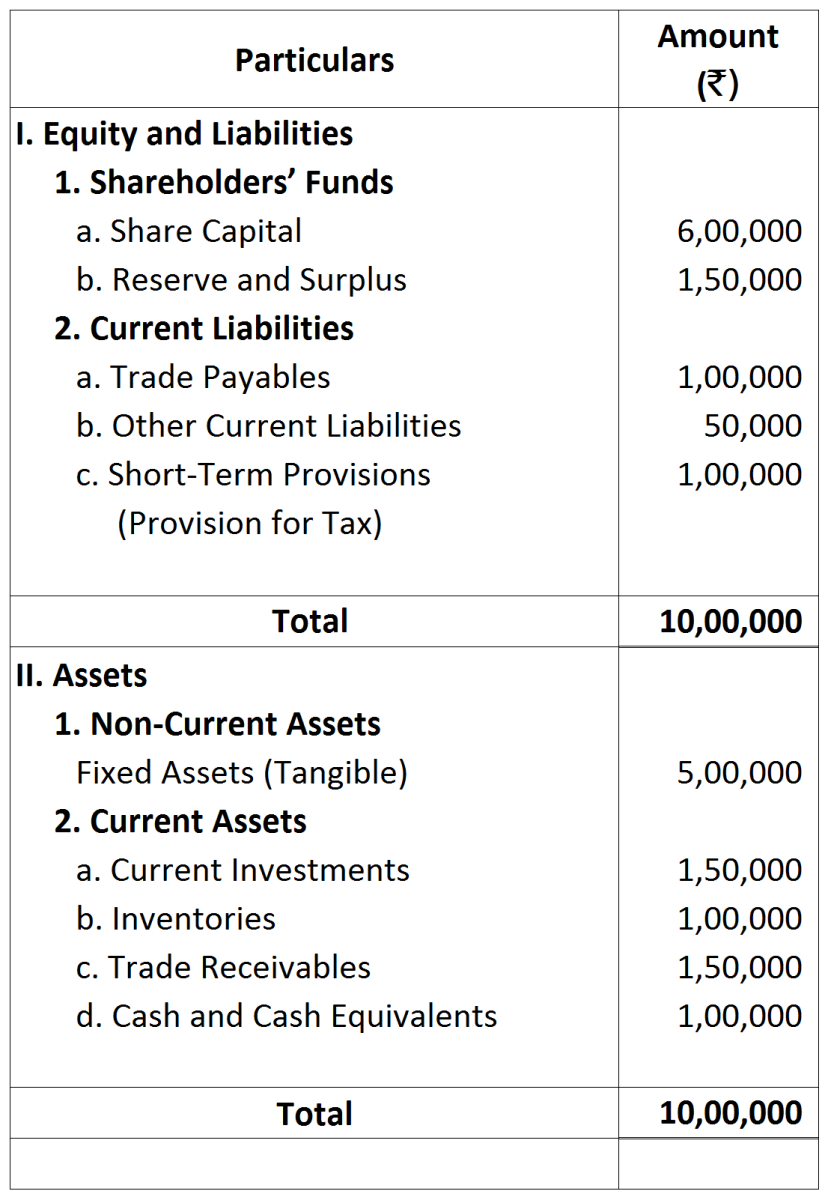
From the following information Calculate Proprietary Ratio:
Answer
Total Assets = Fixed Assets + Short-term Investments + Inventories + Trade Receivables + Cash and Cash Equivalents
= 5,00,000 + 1,50,000 + 1,00,000 + 1,50,000 + 1,00,000 = 10,00,000
Shareholders’ Funds = Share Capital + Reserves and Surplus
= 6,00,000 + 1,50,000 = 7,50,000
$\text{Proprietary Ratio}=\frac{\text{Shareholder's Fund}}{\text{Total Assets}}$
$=\frac{7,50,000}{10,00,000}=0.75:1$
View full question & answer
Question 463 Marks
Calculate Debt to Equity Ratio from the following information:
 
Fixed Assets (Gross).
8,40,000
Accumulated Depreciation.
1,40,000
Non-current Investments.
14,000
Long-term Loans and Advances.
56,000
Current Assets. 3,50,000
Current Liabilities. 2,80,000
10% Long-term Borrowings. 4,20,000
Long-term Provisions. 1,40,000
Answer
Debt = Long Term Borrowings + Long Term Provisions.
= 4,20,000 + 1,40,000 = ₹ 5,60,000
Equity = Total Assets - Total Debts.
= (8,40,000 - 1,40,000 + 14,000 + 56,000 + 3,50,000) - (4,20,000 - 1,40,000 - 2,80,000) = ₹ 2,80,000
$\text{Debt to Equity Ratio}=\frac{\text{Debt}}{\text{Equity}}$
$=\frac{5,60,000}{2,80,000}=2:1$
View full question & answer
Question 473 Marks
Current Liabilities of a company are ₹ 6,00,000. Its Current Ratio is 3 : 1 and Liquid Ratio is 1 : 1. Calculate value of Inventory.
Answer
$\text{Current Ratio}=\frac{\text{Current Assets}}{\text{Current Liabilities}}=\frac{3}{1}$ $\text{Acid Test Atio}=\frac{\text{Liquid Assets}}{\text{Current Liabilities}}=\frac{1}{1}$Current Liabilities = 6,00,000
Current Assets = 3 × Current Liabilities = 3 × 6,00,000 = 18,00,000 Liquid Assets = 1 × 6,00,000 = 6,00,000 Inventory = Current Assets - Liquid Assets = 18,00,000 - 6,00,000 = 12,00,000.
View full question & answer
Question 483 Marks
Average Inventory ₹ 1,60,000; Inventory Turnover Ratio 6 Times; Selling Price 25% above cost. Calculate Gross Profit Ratio.
Answer
Average Stock = 1,60,000
Stock Turnover Ratio = 6 Times
Stock Turnover Ratio $=\frac{\text{Cost of Goods Sold}}{\text{Average stock}}$
$6=\frac{\text{Cost of Goods Sold}}{1,60,000}$
Cost of Goods Sold = 9,60,000
Gross Profit = 25% on Cost
$\therefore\text{Gross Profit}=\frac{\text{25}}{100}\times9,60,000=2,40,000$
Net Sales = Cost of Goods Sold + Gross Profit
= 9,60,000 + 2,40,000 = 12,00,000
Gross Profit Ratio $=\frac{\text{Gross Profit}}{\text{Net Sales}}\times100$
$=\frac{2,40,000}{12,00,000}\times100=20\%$
View full question & answer
Question 493 Marks
Calculate Inventory Turnover Ratio from the following information:
 
Opening Inventory.
29,000
Closing Inventory.
31,000
Revenue from Operations, i.e., Sales Gross Profit Ratio 25%.
3,20,000
View full question & answer
Question 503 Marks
Revenue from Operations ₹ 4,00,000; Gross Profit ₹ 1,00,000; Closing Inventory ₹ 1,20,000; Excess of Closing Inventory over Opening Inventory ₹ 40,000. Calculate Inventory. Turnover Ratio.
Answer
Sales = 4,00,000Gross Profit = 1,00,000
Cost of Goods Sold = Sales - Gross Profit
= 4,00,000 - 1,00,000 = 3,00,000
Let Opening Inventory = x
Closing Inventory = x + 40,000
1,20,000 = x + 40,000
x= 80,000
Opening Inventory = 80,000
Average Inventory $=\frac{\text{Opening Inventory+Closing Inventory}}{2}$
$=\frac{80,000+1,20,000}{2}=1,00,000$
Inventory Turnover Ratio $=\frac{\text{Cost of Goods Sold}}{\text{Average Inventory}}$
$=\frac{3,00,000}{1,00,000}=3\text{ times}$
View full question & answer
3 Marks Question - Accountancy STD 12 Commerce Questions - Vidyadip