Questions · Page 1 of 2

4 Marks Question

🎯

Test yourself on this topic

50 questions · timed · auto-graded

Question 14 Marks
Anirudh Ltd. has 4,000, 8% debentures of Rs. 100 each due for redemption on March 31, 2005. The company has a debenture redemption reserve of Rs. 1,50,000 on that date. Assuming that no interest is due record the necessary journal entries at the time of redemption of debentures.
Answer
JOURNAL OF ANIRUDH LTD.
Date Particular LF Dr. Cr.


P & L Appropriation A/c
Debenture Redemption Reserve
( Debenture Redemption Reserve created)
  50,000
4,00,000
4,00,000
2,00,000
50,000
4,00,000
4,00,000
2,00,000
Debenture A/c
Debenture holders
(Amount of Debentures due)
Debenture holders
Bank A/c
(The amount of the debentures paid to the debenture holders)
Debenture Redemption reserve
General reserve
(Debenture Redemption reserve transferred to general reserve)


View full question & answer
Question 24 Marks
  1. Give the meaning of ‘Long-Term Provisions’.
  2. List any four items other than ‘stock-in-trade’ that are presented under the sub-head ‘inventories’ as per schedule III of the Companies Act, 2018.
Answer
  1. Provisions for which the related claims are expected to be settled beyond 12 months or operating cycle are classified as long term provisions.
  1. Inventories:
1. Raw materials
2. Work in progress
3. Finished goods
4. Stores & Spares
5. Loose Tools
View full question & answer
Question 34 Marks
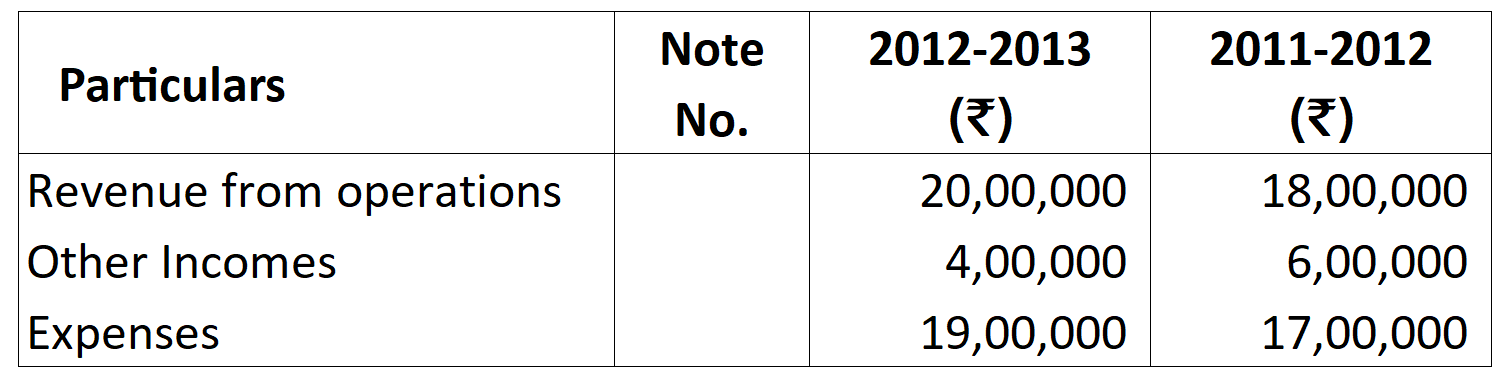
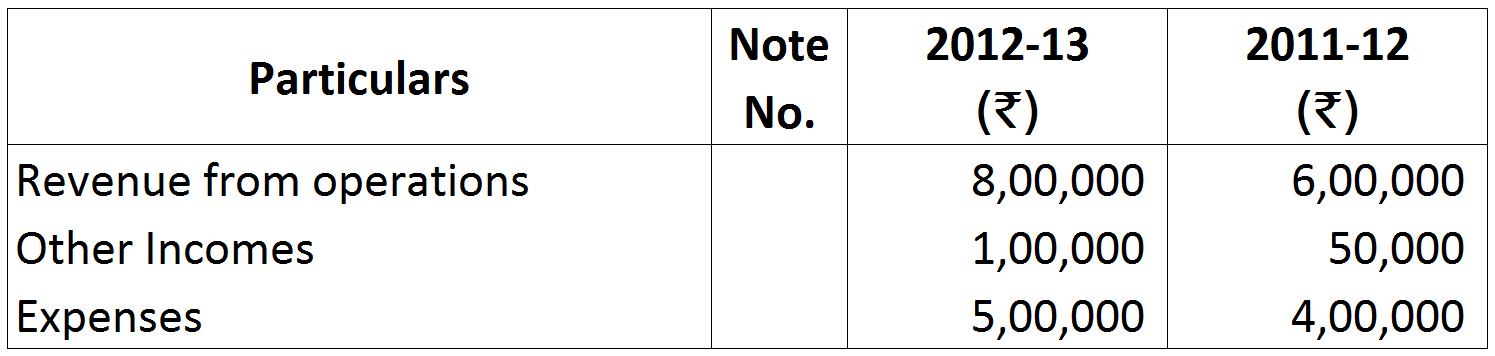
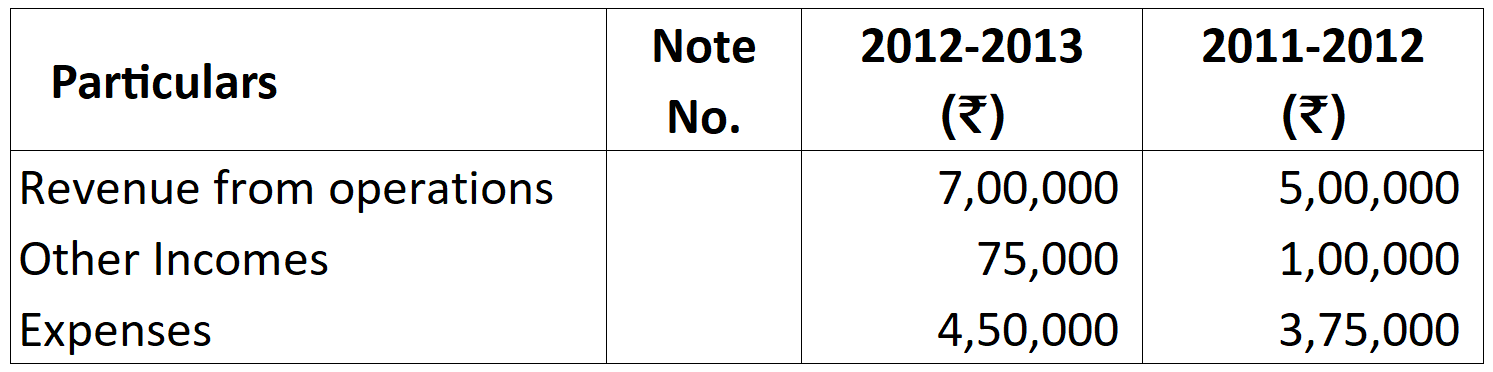
From the following Statement of Profit and Loss of Ajanta Ltd. for the year ended $31^{st}$​​​​​​​ March, $2013$, prepare a Comparative Statement of Profit and Loss:

Rate of income tax was $50\%$.
View full question & answer
Question 44 Marks
State the objectives of ‘Analysis of Financial Statements’.
Answer
Objectives of ‘Financial Statements Analysis’:
  1. To Assess the earning capacity or profitability of the firm as a whole as well as its different departments so as to judge the financial health of the firm.
  2. To Assess the managerial efficiency by using financial ratios.
  3. To Assess the short term and the long term solvency of the enterprise.
  4. To Assess their own performance as well as of others through inter firm comparison.
  5. To Assess developments in future by forecasting and preparing budgets.
  6. To ascertain the relative importance of different components of the financial position of the firm.
View full question & answer
Question 54 Marks
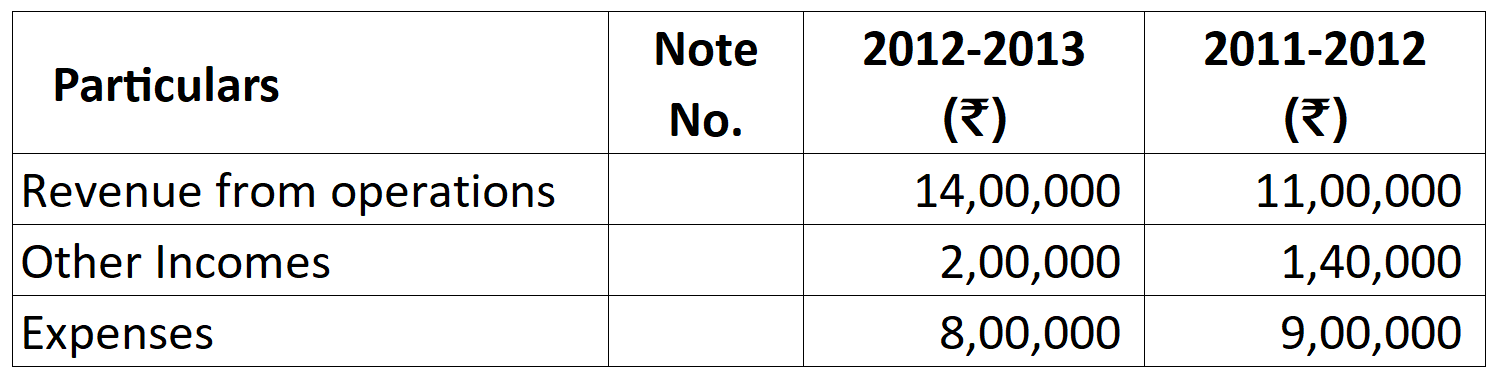
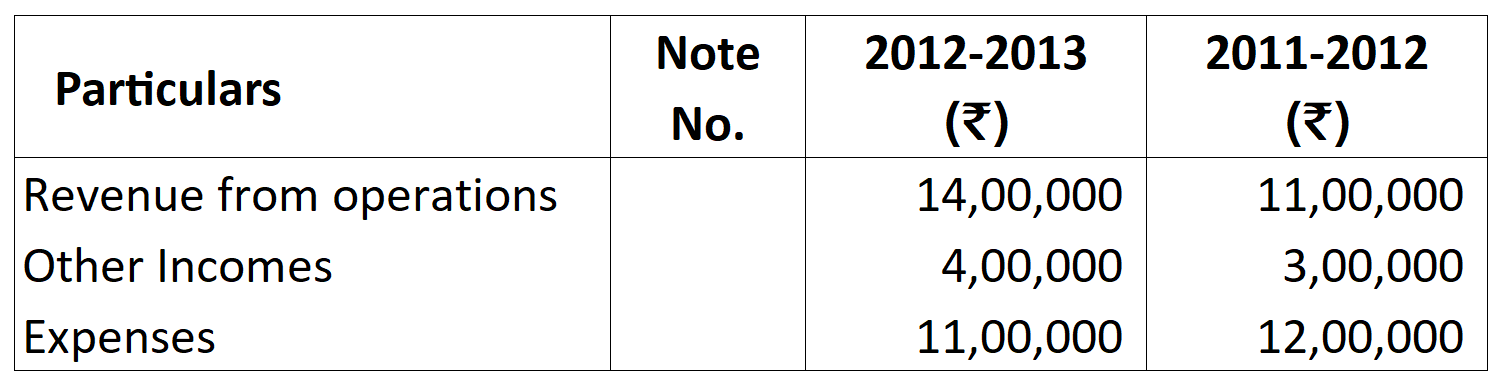
From the following Statement of Profit and Loss of Corex Ltd. for the year ended $31^{st}$ March, $2013$, prepare a Comparative Statement of Profit and Loss:

Rate of income tax was $40\%$.
View full question & answer
Question 64 Marks
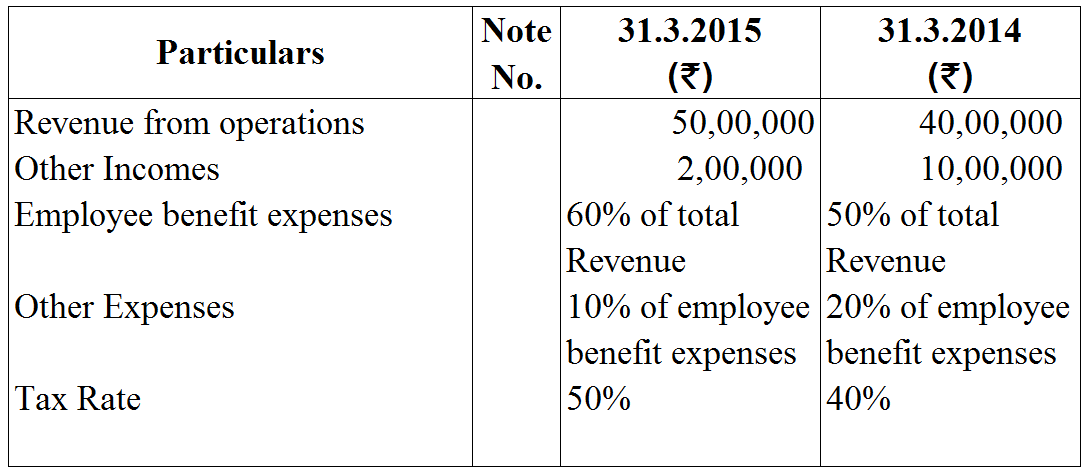
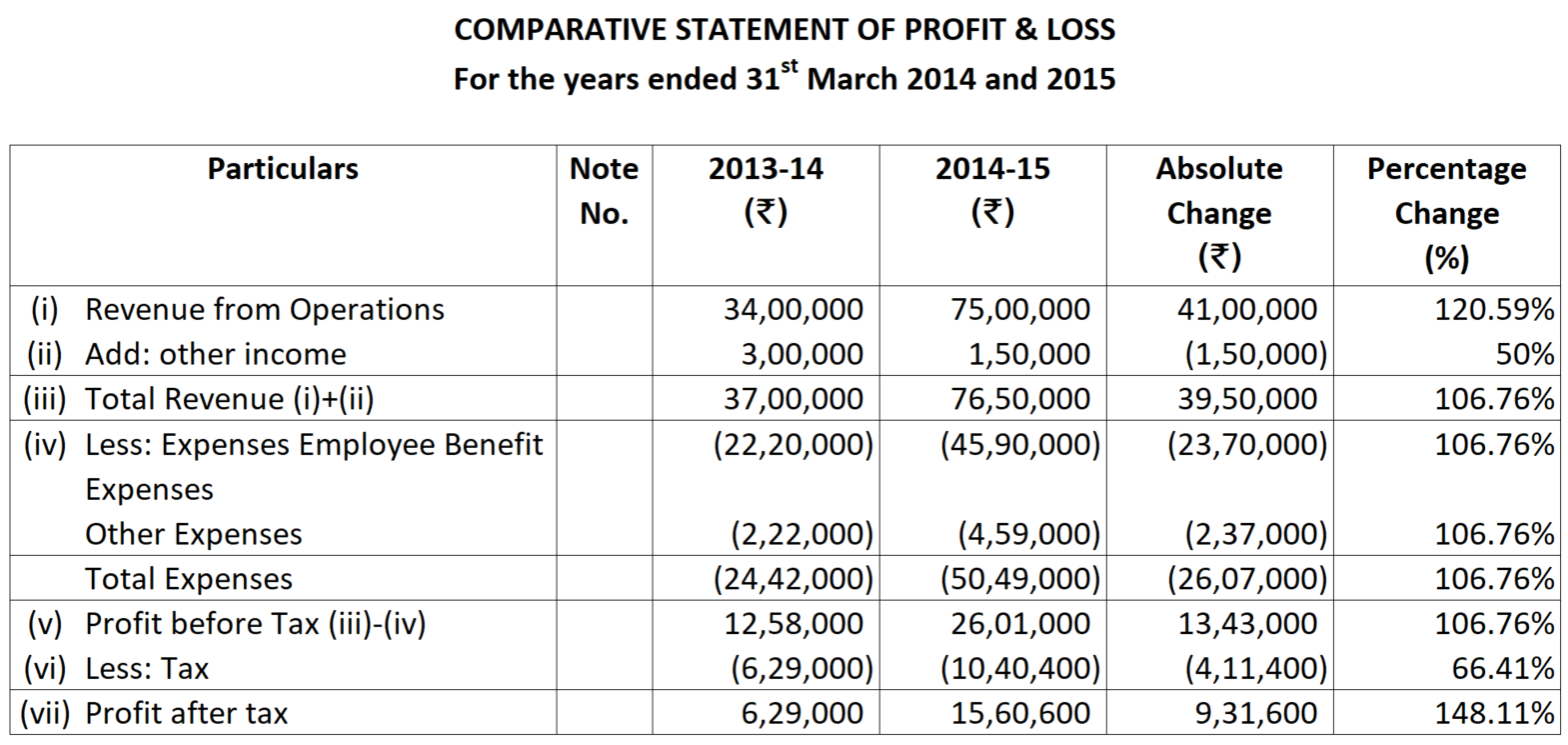
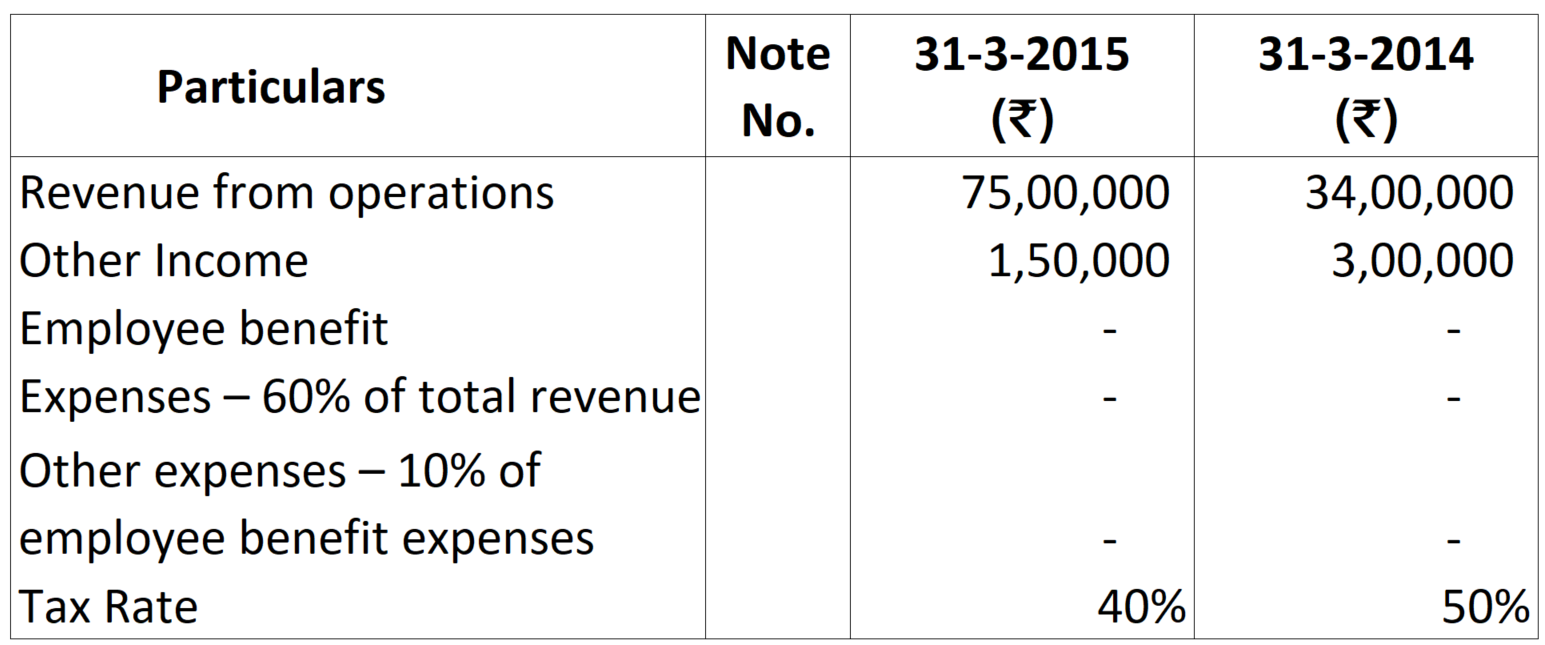
Following is the Statement of Profit and Loss of Moon India Ltd. for the year ended $31^{st}$ March $2015$.

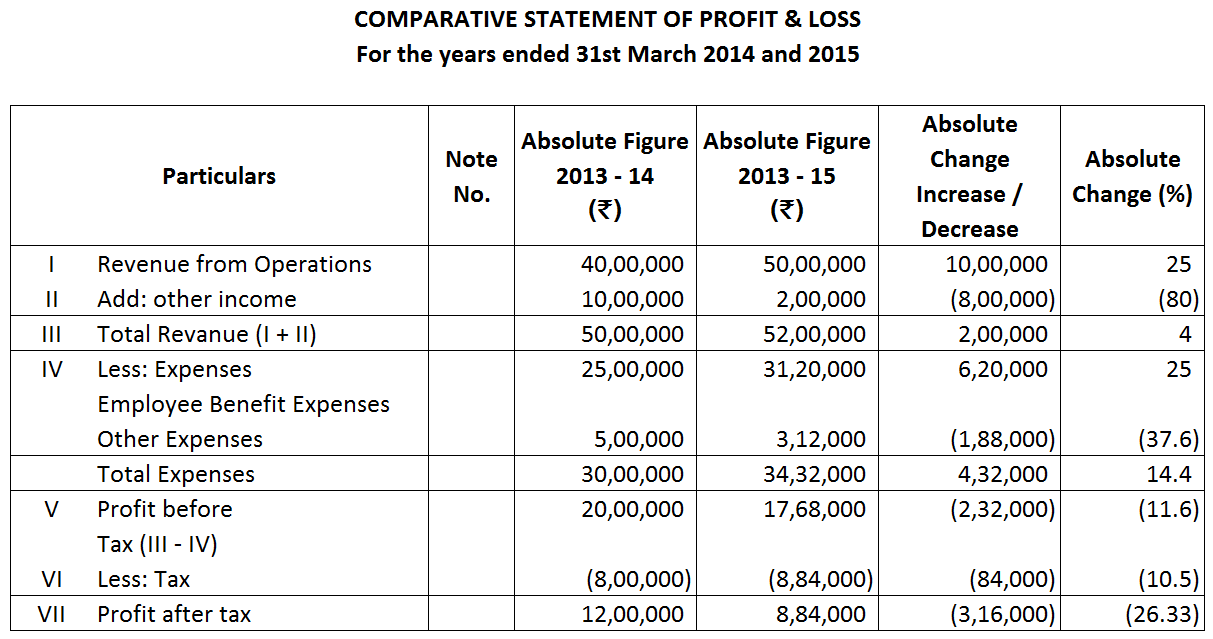
The motto of Moon India Ltd. is to produce and distribute green energy in the backward areas of India. It has also taken up a project of giving vocational training to the girls belonging to the backward areas of Rajasthan. You are required to prepare a comparative statement of Profit and Loss of Moon India Ltd. from the given statement of Profit and Loss and also identify any two values that the company wishes to convey to the society.
Answer
Values:
  1. Promoting economic friendly ways of supplying energy.
  2. Development of rural areas.
  3. Infrastructural development in rural areas to increase accessibility.
  4. Promoting use of indigenous resources.
  5. Providing employment opportunities.
View full question & answer
Question 74 Marks
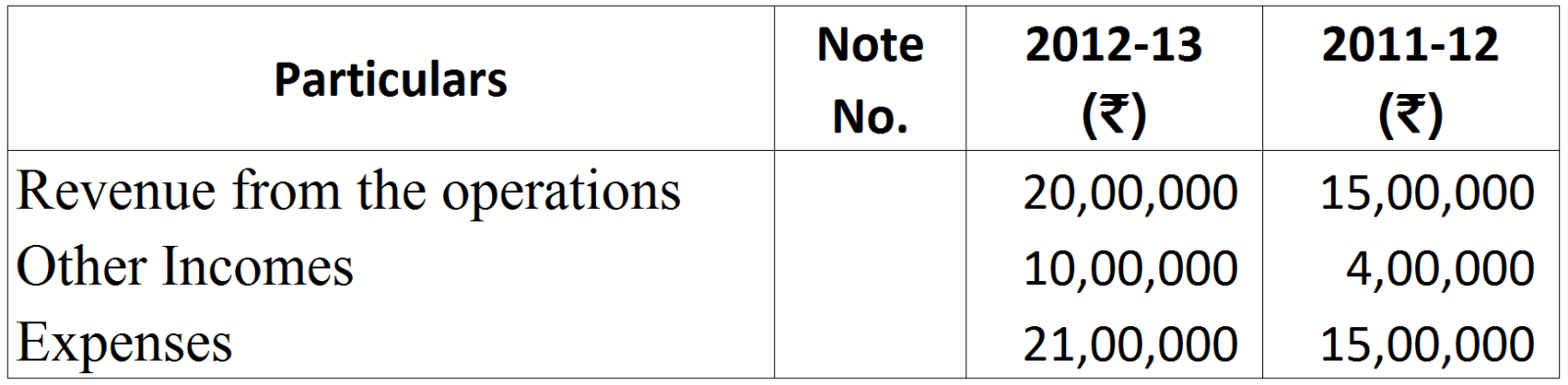
From the following Statement of Profit and Loss of Fenox Ltd. for the year ended $31^{st}$ March, $2013$, prepare a Comparative Statement of Profit and Loss:

Rate of income tax was $40\%$.
View full question & answer
Question 84 Marks
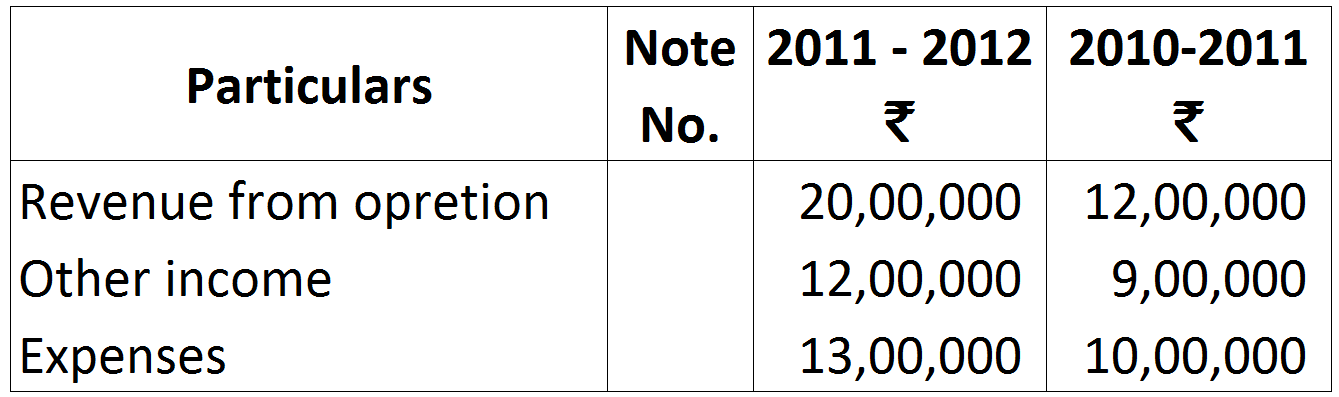
From the following Statement of Profit and loss of Moontrack Ltd., for the years ended $31^{st}$ March $2011$ and $2012$, prepare a 'Comparative Statement of Profit and Loss'.
View full question & answer
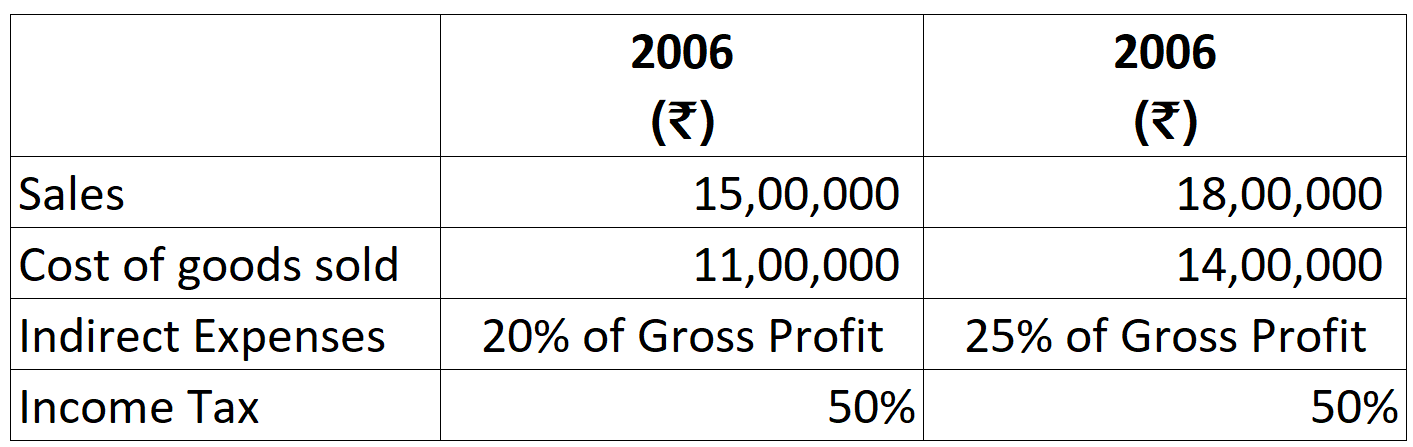
Question 104 Marks
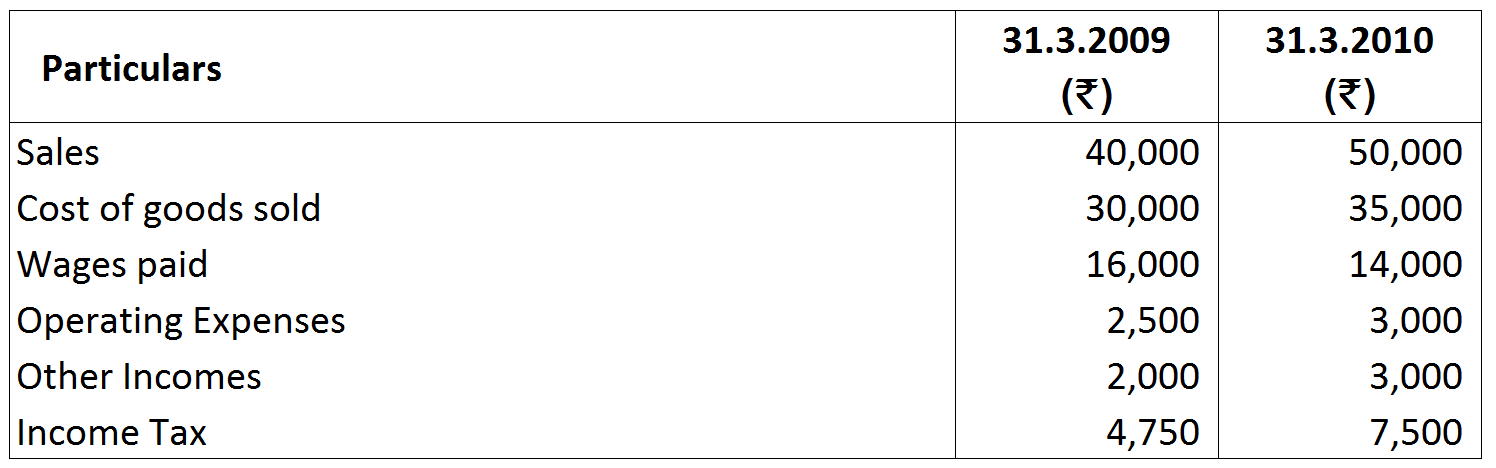
Prepare a Comparative Income Statement from the following:Interest on investments @ ₹ 50,000 and taxes payable @ 50%.
View full question & answer
Question 124 Marks
What is meant by ‘analysis of financial statements’? State any two limitations of such analysis.
Answer
Analysis of Financial Statements is the process of critical evaluation of the financial information contained in the financial statements in order to understand and make decisions regarding the operations of the firm.
Limitations of ‘Financial Statements Analysis’:
  1. Historical Analysis as it analyses what has happened till date. It doesn’t reflect the future.
  2. Ignores price level changes as a change in price level makes analysis of financial statements of different accounting years invalid.
  3. Qualitative aspect ignored as the quality of management, quality of staff etc. Are ignored while carrying out the analysis of financial statements.
  4. Suffers from the limitations of financial statements as the analysis is based on the information given in the financial statements.
  5. Not free from bias of accountants such as method of inventory valuation, method of depreciation etc.
  6. Window dressing to show a better financial position than the actual one by manipulating the books of accounts.
View full question & answer
Question 134 Marks
Briefly explain the significance of ‘Analysis of financial statements’ to:
  1. The Finance Manager, and
  2. Trade Payables.
Answer
  1. Significance to the Finance Manager: Finance Manager can make policies and decisions keeping in mind the liquidity, solvency, efficiency and profitability of the firm.
  2. Significance to Trade Payables: Trade payables can check whether the firm is able to pay their debts on time or not.
View full question & answer
Question 144 Marks
Following is the statement of Profit and Loss of DD Ltd. for the year ended on 31-3-2015.
The motto of DD Ltd. is to produce and supply green energy in the rural areas of India. It has also taken up a project of constructing of a road that will pass through five villages, so that these villages could be connected to the nearby town. It will use the local resources and employ local people for construction of the road.
You are required to prepare a comparative statement of Profit and Loss of DD Ltd. from the given statement of Profit and Loss. Also identify any two values that the company wishes to convey to the society.
Answer

Values:
  1. Promoting environment friendly ways of supplying energy
  2. Development of rural areas
  3. Infrastructural development in rural areas to increase accessibility
  4. Promoting use of indigenous resources
  5. Providing employment opportunities
View full question & answer
Question 154 Marks
What is meant by ‘Analysis of financial statements’? State any two objectives of this analysis.
Answer
Analysis of Financial Statements is the process of critical evaluation of the financial information contained in the financial statements in order to understand and make decisions regarding the operations of the firm.
Objectives of ‘Financial Statements Analysis’:
  1. Assessing the earning capacity or profitability of the firm as a whole as well as its different departments so as to judge the financial health of the firm.
  2. Assessing the managerial efficiency by using financial ratios to identify favourable and unfavourable variations in managerial performance.
  3. Assessing the short term and the long term solvency of the enterprise to assess the ability of the company to repay principal amount and interest.
  4. Assessing the performance of business in comparison to that of others through inter firm comparison.
  5. Assessing developments in future by forecasting and preparing budgets.
  6. To Ascertain the relative importance of different components of the financial position of the firm.
View full question & answer
Question 164 Marks
  1. List any four items that are shown under the sub-heading ‘Cash and Cash Equivalents’ as per Schedule III of the Companies Act, 2013.
  2. What is meant by a ‘Common Size Statement’?
Answer
  1. Cash and Cash Equivalents
  • Balances with banks
  • Cheques, draft on hand
  • Cash in Hand
  • Current Investments
  1. These are the statements which indicate the relationship of different items of a financial statement with some common item as a base by expressing each item as a percentage of the common item.
View full question & answer
Question 174 Marks
State any two limitations and any two objectives of ‘Analysis of Financial Statement’.
Answer
imitations of ‘Financial Statements Analysis’:
  1. It is a historical Analysis as it analyses what has happened till date. It doesn’t reflect the future.
  2. It ignores price level changes as a change in price level makes analysis of financial statements of different accounting years invalid.
  3. It ignores qualitative aspect as the quality of management, quality of staff etc. are ignored while carrying out the analysis of financial statements.
  4. It suffers from the limitations of financial statements as the analysis is based on the information given in the financial statements.
  5. It is not free from bias of accountants such as method of inventory valuation, method of depreciation etc.
  6. It may lead to window dressing i.e. showing a better financial position than what actually is by manipulating the books of accounts.
  7. It may be misleading without the knowledge of the changes in accounting procedure by a firm.
Objectives of ‘Financial Statements Analysis’:
  1. Assessing the earning capacity or profitability of the firm as a whole as well as its different departments so as to judge the financial health of the firm.
  2. Assessing the managerial efficiency by using financial ratios to identify favourable and unfavourable variations in managerial performance.
  3. Assessing the short term and the long term solvency of the enterprise to assess the ability of the company to repay principal amount and interest.
  4. Assessing the performance of business in comparison to that of others through inter firm comparison.
  5. Assessing developments in future by forecasting and preparing budgets.
  6. To Ascertain the relative importance of different components of the financial position of the firm.
View full question & answer
Question 184 Marks
  1. One of the objectives of ‘Financial Statements Analysis’ is to identify the reasons for change in the financial position of the enterprise. State two more objectives of this analysis.
  2. Name any two items that are shown under the head ‘Other Current Liabilities’ and any two items that are shown under the head ‘Other Current Assets’ in the Balance Sheet of a company as per Schedule III of the Companies Act, 2013.
Answer
  1. Objectives of ‘Financial Statements Analysis’:
  1. Assessing the earning capacity or profitability of the firm as a whole as well as its different departments so as to judge the financial health of the firm.
  2. Assessing the managerial efficiency by using financial ratios.
  3. Assessing the short term and the long term solvency of the enterprise.
  4. Assessing their own performance as well as of others through inter firm comparison.
  5. Assessing developments in future by forecasting and preparing budgets.
  6. Ascertain the relative importance of different components of the financial position of the firm.
  7. Understanding complicated matter in a simplified manner.
  1. Other Current Liabilities:
  1. Unpaid Dividend
  2. Interest accrued and due on borrowings
  3. Interest accrued but not due on borrowings
  4. Income received in advance
  5. Calls in advance
  6. Interest on calls in advance
  7. Current maturities of long term debts
  8. Application money received for allotment of securities and due for refund and interest due there on.
  9. Unpaid matured deposits and interest accrued there on.
  10. Unpaid matured debentures and interest accrued thereon.
  11. Other payables(outstanding expenses, provident fund payable, ESI payable, CST payable, VAT payable etc.)
Other Current Assets:
  1. Prepaid expenses
  2. Accrued incomes
  3. Advance Taxes
  4. Unamortised expenses/losses (to be written off within 12 months from the date of balance sheet).
View full question & answer
Question 194 Marks
From the following 'statement of Prolit & Loss' for the year ended $31^{st}$ March, $2013$, prepare a 'Comoarative Statemenl of Profit & Loss' of Better Sales Ltd.

Rate of Income Tax was $50\%$
View full question & answer
Question 204 Marks
State any four limitations of analysis of financial statements.
Answer
Limitations of ‘Financial Statements Analysis’:
  1. It is a historical Analysis as it analyses what has happened till date. It doesn’t reflect the future.
  2. It ignores price level changes as a change in price level makes analysis of financial statements of different accounting years invalid.
  3. It ignores qualitative aspect as the quality of management, quality of staff etc. are ignored while carrying out the analysis of financial statements.
  4. It suffers from the limitations of financial statements as the analysis is based on the information given in the financial statements.
  5. It is not free from bias of accountants such as method of inventory valuation, method of depreciation etc.
  6. It may lead to window dressing i.e. showing a better financial position than what actually is by manipulating the books of accounts.
  7. It may be misleading without the knowledge of the changes in accounting procedure by a firm.
View full question & answer
Question 214 Marks
  1. One of the objectives of ‘Financial Statements Analysis’ is to judge the ability of the firm to repay its debt and assessing the short-term as well as the long-term liquidity position of the firm. State two more objectives of this analysis.
  2. Name any two items that are shown under the head ‘Other Current Liabilities’ and any two items that are shown under the head ‘Other Current Assets’ in the Balance Sheet of a company as per Schedule III of the Companies Act, 2013.
Answer
  1. Objectives of ‘Financial Statements Analysis’:
  1. Assessing the earning capacity or profitability of the firm as a whole as well as its different departments so as to judge the financial health of the firm.
  2. Assessing the managerial efficiency by using financial ratios.
  3. Assessing the short term and the long term solvency of the enterprise.
  4. Assessing their own performance as well as of others through inter firm comparison.
  5. Assessing developments in future by forecasting and preparing budgets.
  6. Ascertain the relative importance of different components of the financial position of the firm.
  7. Understanding complicated matter in a simplified manner.
  1. Other Current Liabilities:
  1. Unpaid Dividend
  2. Interest accrued and due on borrowings
  3. Interest accrued but not due on borrowings
  4. Income received in advance
  5. Calls in advance
  6. Interest on calls in advance
  7. Current maturities of long term debts
  8. Application money received for allotment of securities and due for refund and interest due there on.
  9. Unpaid matured deposits and interest accrued there on.
  10. Unpaid matured debentures and interest accrued thereon.
  11. Other payables(outstanding expenses, provident fund payable, ESI payable, CST payable, VAT payable etc.)
Other Current Assets:
  1. Prepaid expenses
  2. Accrued incomes
  3. Advance Taxes
  4. Unamortised expenses/losses (to be written off within 12 months from the date of balance sheet).
View full question & answer
Question 224 Marks
From the following 'Statement of Profit & Loss' for the year ended $31^{st}$ March, $2013$, prepare a 'Comparative Statement of Profit & Loss' of Vidya Ltd.
Rate of income tax was $50\%$.
View full question & answer
Question 234 Marks
From the following 'Statement of Profit & Loss' for the year ended $31^{st}$ March, $2013$, prepare a 'Comparative Statement of Profit & Loss' of Goods Services Ltd.

Rate of Income tax was $50\%$.
View full question & answer
Question 244 Marks
From the following Statement of Profit and Loss of Suntrack Ltd., for the years ended $31^{st}$ March $2011$ and $2012$, prepare a 'Comparative Statement of Profit & Loss'.
View full question & answer
Question 254 Marks
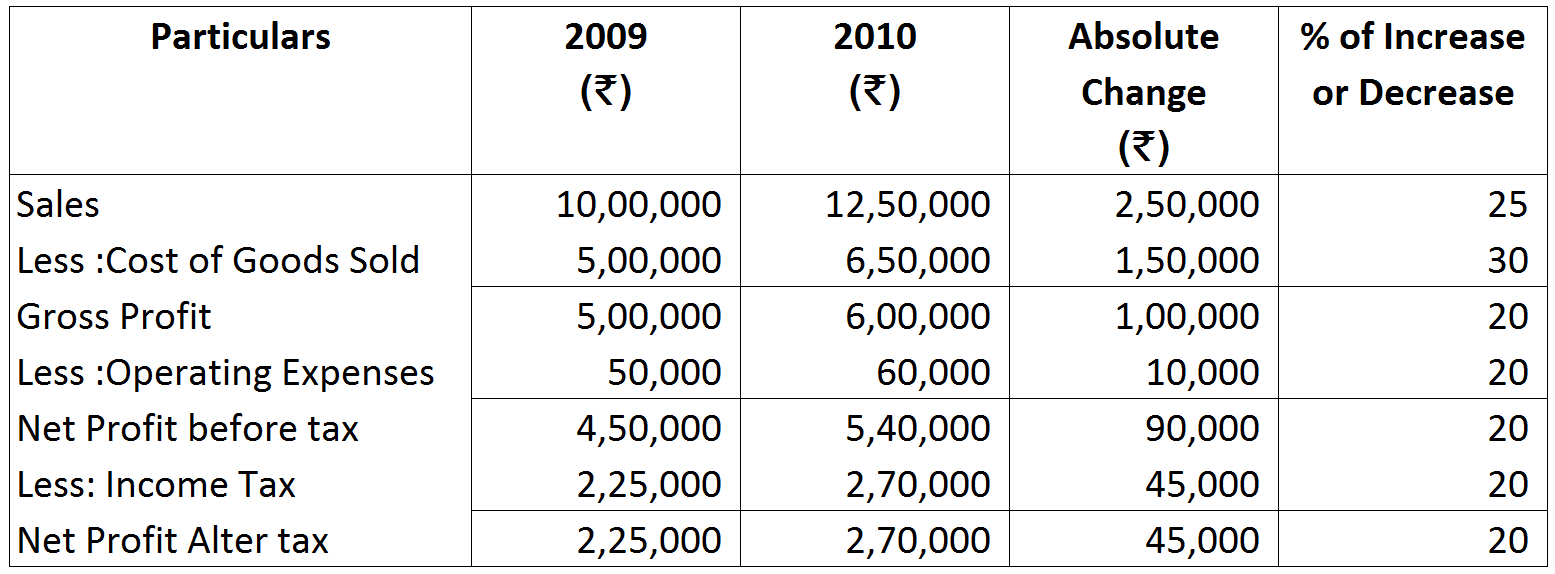
Prepare a Comparative Income Statement from the following information.
  2009 2010
 
Sales 10,00,000 12,50,000
Cost of goods sold 5,00,000 6,50,000
Carriage inwards 30,000 50,000
Operating expenses 50,000 60,000
Income tax 50% 50%
Answer
Comparative Income Statement (as on $31^{st}$ March $2009$ & $2010$)
View full question & answer
Question 264 Marks
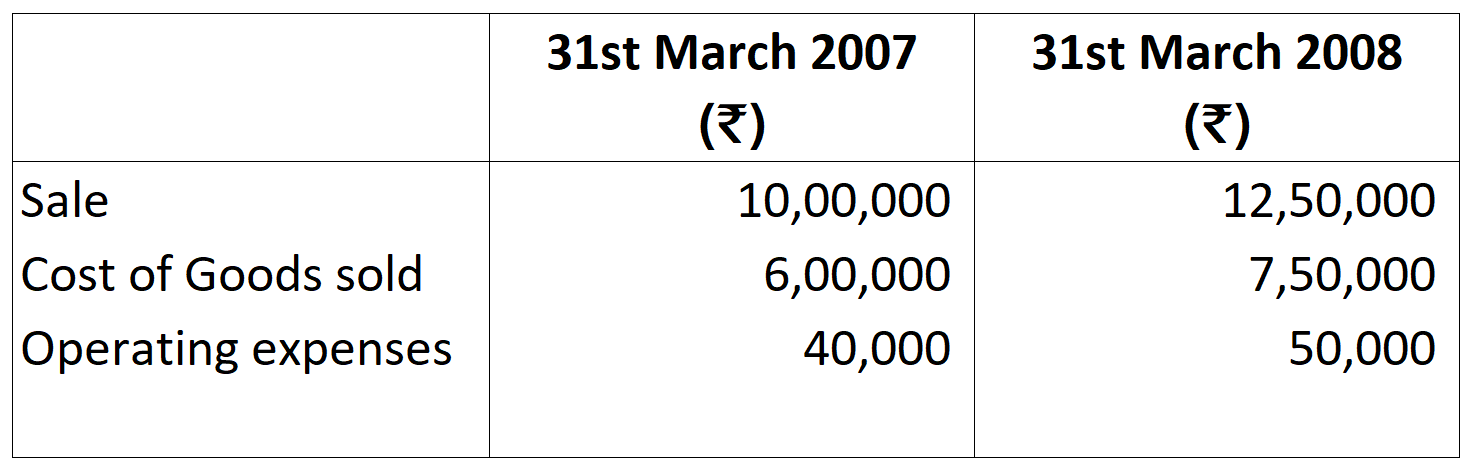
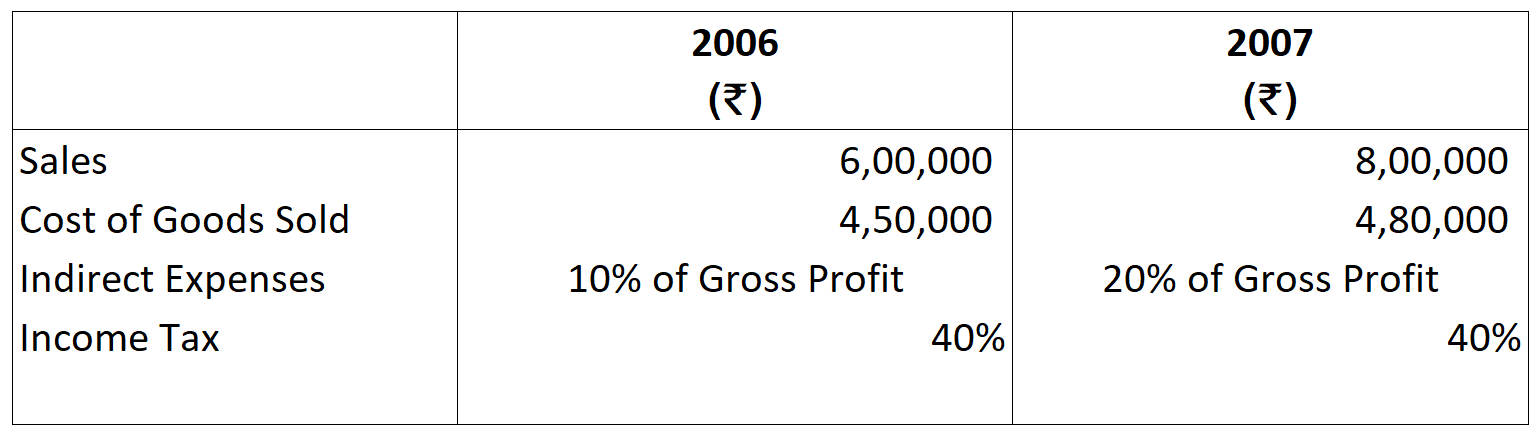
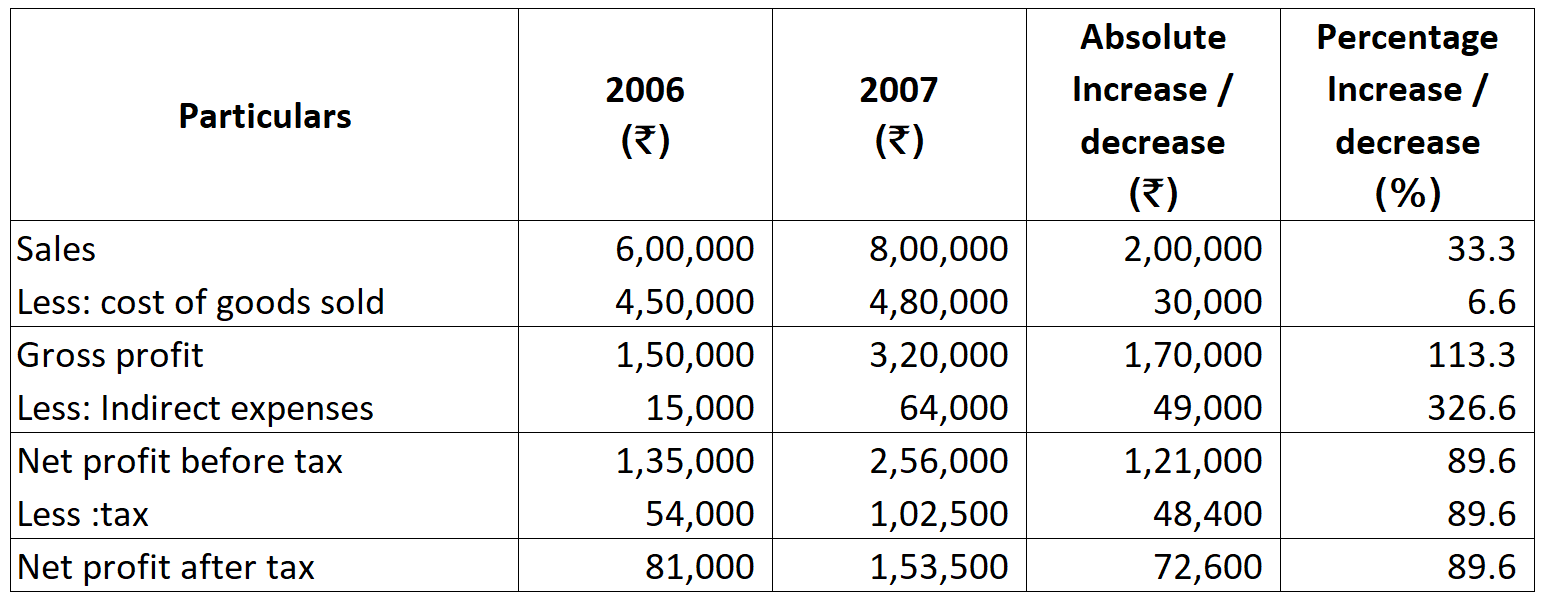
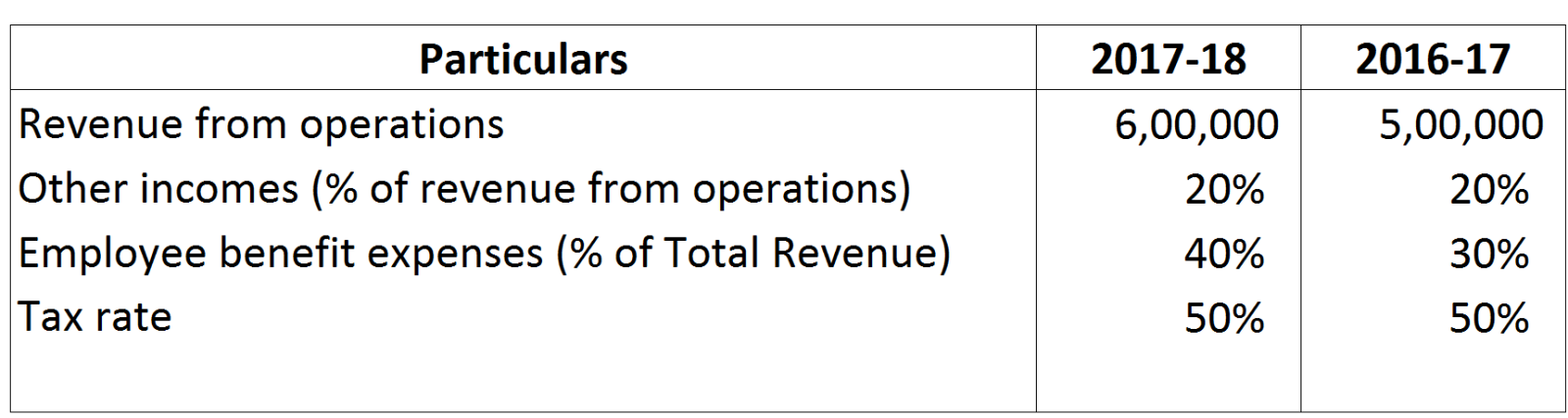
From the following information prepare a comparative Income Statement:
Answer
Comparative Income Statement
For the years ended on 31.12.06 & 31.12.07
View full question & answer
Question 284 Marks
Explain briefly any four objectives of ‘Analysis of Financial Statements’.
Answer
Objectives of ‘Financial Statements Analysis’:
  1. To provide information about economic resources and obligations of a business: They are prepared to provide adequate, reliable and periodical information about economic resources and obligations of a business firm to investors and other external parties who have limited authority, ability or resources to obtain information.
  2. To provide information about the earning capacity of the business: They are to provide useful financial information which can gainfully be utilised to predict, compare, and evaluate the business firm’s earning capacity.
  3. To provide information about cash flows: They are to provide information useful to investors and creditors for predicting, comparing and evaluating, potential cash flows in terms of amount, timing and related uncertainties.
  4. To judge effectiveness of management: They supply information useful for judging management’s ability to utilise the resources of a business effectively.
  5. Information about activities of business affecting the society: They have to report the activities of the business organisation affecting the society, which can be determined and described or measured and which are important in its social environment.
  6. Disclosing accounting policies: These reports have to provide the significant policies, concepts followed in the process of accounting and changes taken up in them during the year to understand these statements in a better way.
View full question & answer
Question 304 Marks
State under which major headings and sub-headings will the following items be presented in the Balance Sheet of a company as per Schedule-III, Part-I of the Companies Act, 2013.
  1. Prepaid Insurance.
  2. Investment in Debentures.
  3. Calls-in-arrears.
  4. Unpaid dividend.
  5. Capital Reserve.
  6. Loose Tools.
  7. Capital work-in-progress.
  8. Patents being developed by the company.
Answer
 
Item
Head
Sub-Head
(i)
Prepaid Insurance
Current Assets
Other Current Assets
(ii)
Investment in Debentures
Non Current Assets
Non Current Investments
(iii)
Calls-in-arrears
Shareholders’ Funds
Share Capital/ Subscribed Capital
(iv)
Unpaid dividend
Current Liabilities
Other Current Liabilities
(v)
Capital Reserve
Shareholders’ Funds
Reserves and Surplus
(vi)
Loose Tools
Current Assets
Inventories
(vii)
Capital work-inprogress
Non Current Assets
Fixed Assets
(viii)
Patents being developed by the company
Non Current Assets
Fixed Assets- Intangible Assets under development
View full question & answer
Question 324 Marks
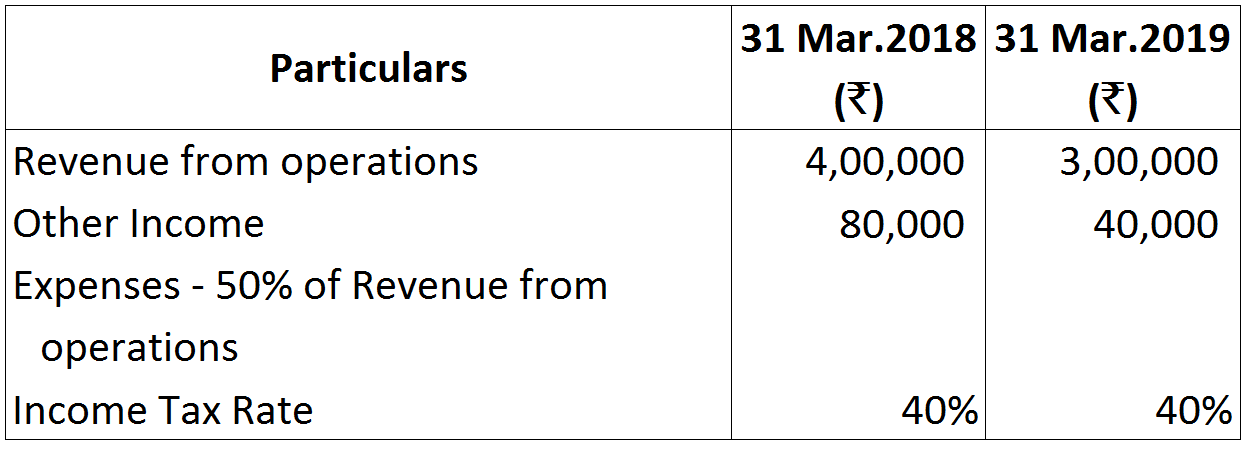
From the following information extracted from the Statement of Profit and Loss for the years ended $31^{st}$ March, $2017$ and $2018$, prepare a Comparative Statement of Profit & Loss.
View full question & answer
Question 334 Marks
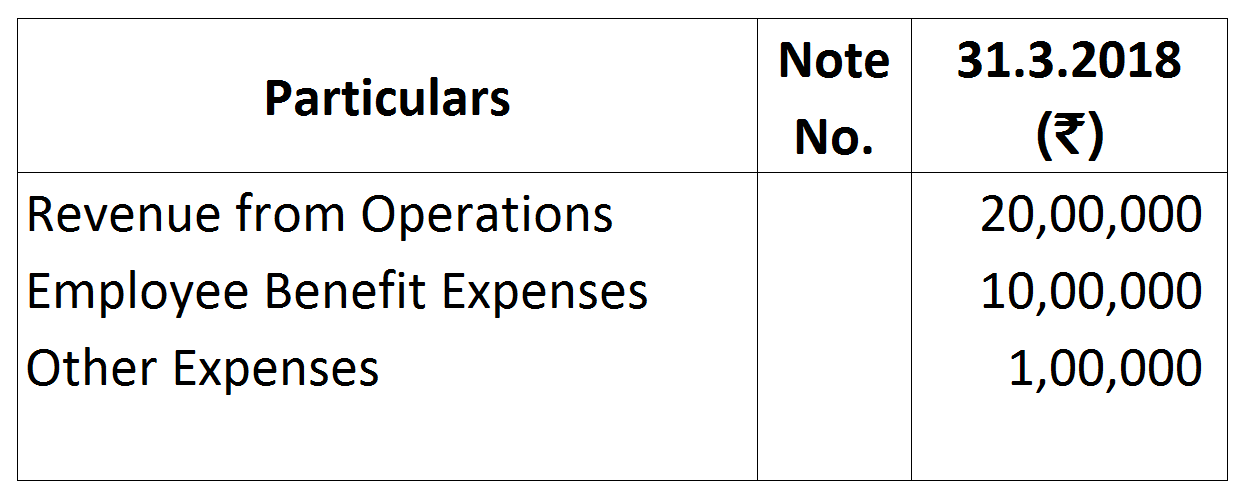
From the following Statement of Profit & Loss, prepare a Common Size Statement of Profit & Loss of Jayant Ltd. for the year ended 31.3.2018:
View full question & answer
Question 344 Marks
What do you understand by analysis and interpretation of financial statements? Discuss their importance.
Answer
Financial Analysis has great importance to various accounting users on various matters. Income Statements, Balance Sheets and other financial data provide information about expenses and sources of income, profit or loss and also helps in assessing the financial position of a business. These financial data are not useful until they are analysed. There are various tools and methods such as Ratio Analysis, Cash Flow Statements that make the financial data to cater varying needs of various accounting users.
The following are the reasons that advocate in favour of Financial Analysis:
  1. It helps in evaluating the profit earning capacity and financial feasibility of a business.
  2. It helps in assessing the long-term solvency of the business.
  3. It helps in evaluating the relative financial status of a firm in comparison to other competitive firms.
  4. It assists management in decision making process, drafting various plans and also in establishing an effective controlling system.
View full question & answer
Question 354 Marks
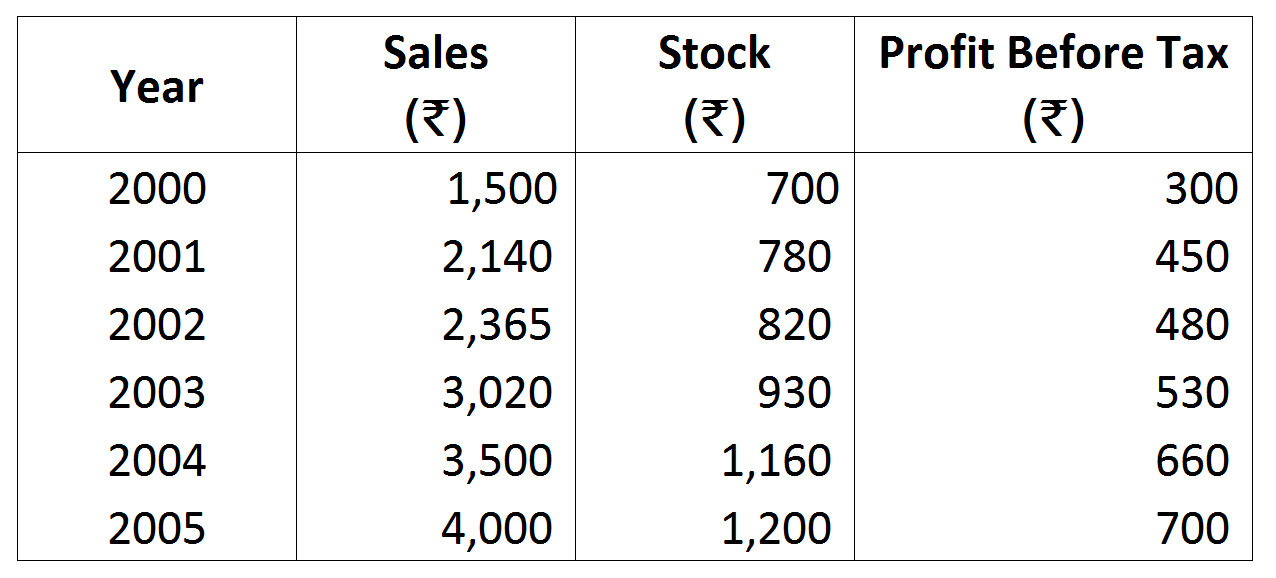
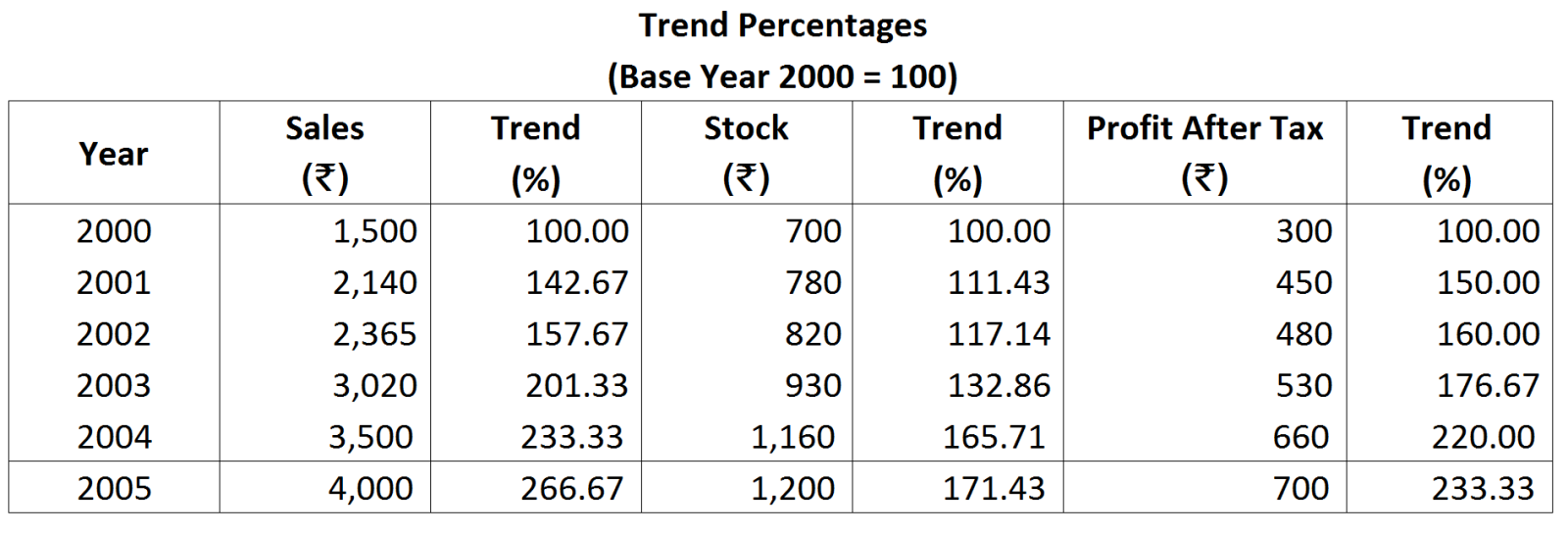
Calculate trend percentages from the following figures of ABC Ltd., taking 2000 as base and interpret them.
Answer
$\text{Trend Percentage}=\frac{\text{Present Year Value}}{\text{Base Year Value}}\times100$
Interpretations
  1. Sales has exhibited continuous increasing trend over the period.
  2. The value of stock also increases, with the increase in value of sales.
  3. Profit increase more in earlier years as compare to later years. It implies cost of goods, sold and operating expenses are increased in later years.
View full question & answer
Question 364 Marks
Describe the different techniques of financial analysis and explain the limitations of financial analysis.
Answer
The various techniques used in financial analysis are as follows:
  1. Comparative Statements: These statements depict the figures of two or more accounting years simultaneously that help to access the profitability and financial position of a business. The Comparative Statements help us in analysing the trend of the financial position of the business. These statements also enable us to undertake various types of comparisons like inter-firm comparisons and intra-firm comparisons. It presents the change in the financial items both in absolute as well as percentage terms. Therefore, these statements help in measuring the efficiency of the business in relative terms. The analyses based on these statements are known as Horizontal Analysis.
  2. Common Size Statements: These statements depict the relationship between various items of financial statements and some common items (like Net Sales and the Total of Balance Sheet) in percentage terms. In other words, various items of Trading and Profit and Loss Account such as Cost of Goods Sold, Non-Operating Incomes and Expenses are expressed in terms of percentage of Net Sales. On the other hand, different items of Balance Sheet such as Fixed Assets, Current Assets, Share Capital, etc. are expressed in terms of percentage of Total of Balance Sheet. These percentage figures are easily comparable with that of the previous years’ (i.e. inter-firm comparison) and with that of the figures of other firms in the same industry (i.e. inter-firm comparison) as well. The analyses based on these statements are commonly known as Vertical Analysis.
  3. Trend Analysis: This analysis undertakes the study of trend in the financial positions and the operating performance of a business over a series of successive years. In this technique, a particular year is assumed to be the base year and the figures of all other years are expressed in percentage terms of the base year’s figures. These trends (or the percentage figures) not only helps in assessing the operational efficiency and the financial position of the business but also helps in detecting the problems and inefficiencies.
  4. Ratio Analysis: This technique depicts the relationship between various items of Balance Sheet and the Income Statements. It helps in ascertaining the profitability, operational efficiency, solvency, etc of a firm. The analysis expresses financial items in terms of percentage, fraction, proportion and as number of times. It enables budgetary controls by assessing the qualitative relationship among different financial variables. This analysis provides vital information to different accounting users regarding the financial position, viability and performance of a firm. It also facilitates decision making and policy designing process.
  5. Cash Flow Analysis: This analysis is presented in the form of a statement showing inflows and outflows of cash and cash equivalents from operating, investing and financing activities of a company during a particular period of time. It helps in analysing the reasons of receipts and payments in cash and change in the cash balances during an accounting year in a company.
Limitations of Financial Analysis:
  1. Ignores Changes in the Price level: The financial analysis fails to capture the change in price level. The figures of different years are taken on nominal values and not in real terms (i.e. not taking price change into considerations).
  2. Misleading and Wrong Information: The financial analysis fails to reveal the change in the accounting procedures and practices. Consequently they may provide wrong and misleading information.
  3. Interim and Final Picture: The financial analysis presents only the interim report and thereby provides incomplete information. They fail to provide the final and holistic picture.
  4. Ignores Qualitative and Non-monetary Aspects: The financial analysis reveals only the monetary aspects. In other words, these analyses consider only that information that can be expressed only in monetary terms. These analyses fail to disclose managerial efficiency, growth prospects, and other non-operational efficiency of a business.
  5. Accounting Concepts and Conventions: The financial analysis are based an accounting concepts and conventions. Therefore, the analysis and conclusions based on such analyses may not be reliable. For example, the analysis considers only the book-value of various items (i.e. according to the Going Concept) and consequently ignores the present market value of those items. Hence, the analysis may not be realistic.
  6. Involves Personal Biasness: The financial analysis reflects the personal biasness and personal value judgments of the accountants and clerks involved. There are different techniques used by different personnel for charging depreciation (original cost or written-down value method) and also for inventory valuation. The use of different techniques by different people reduces the effectiveness of the financial analysis.
  7. Unsuitable for Comparisons: Due to the involvement of personal value judgment, personal biasness and use of different techniques by different accountant, various types of comparisons such as inter-firm and intra-firm comparisons may not be possible and reliable.
View full question & answer
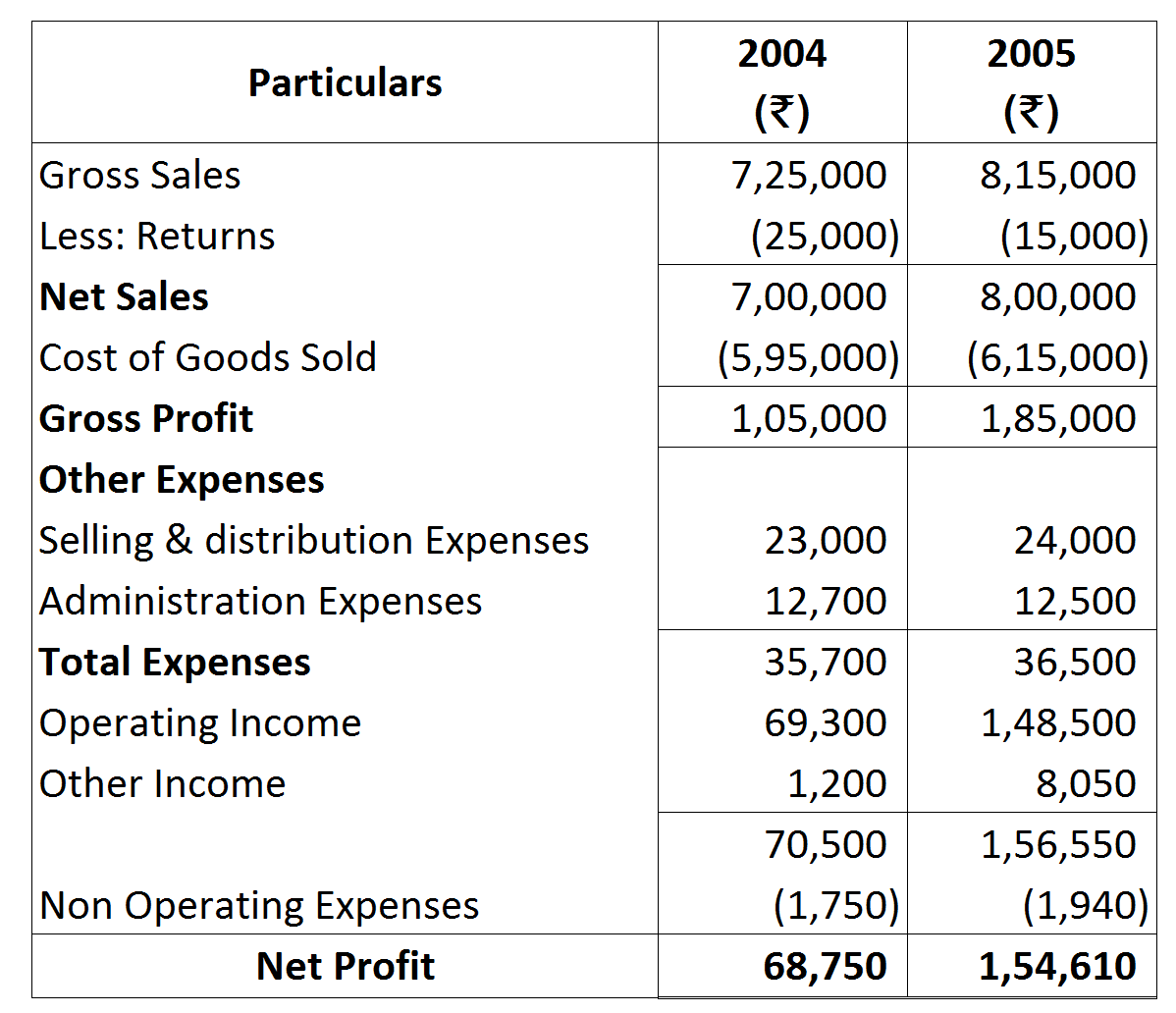
Question 374 Marks
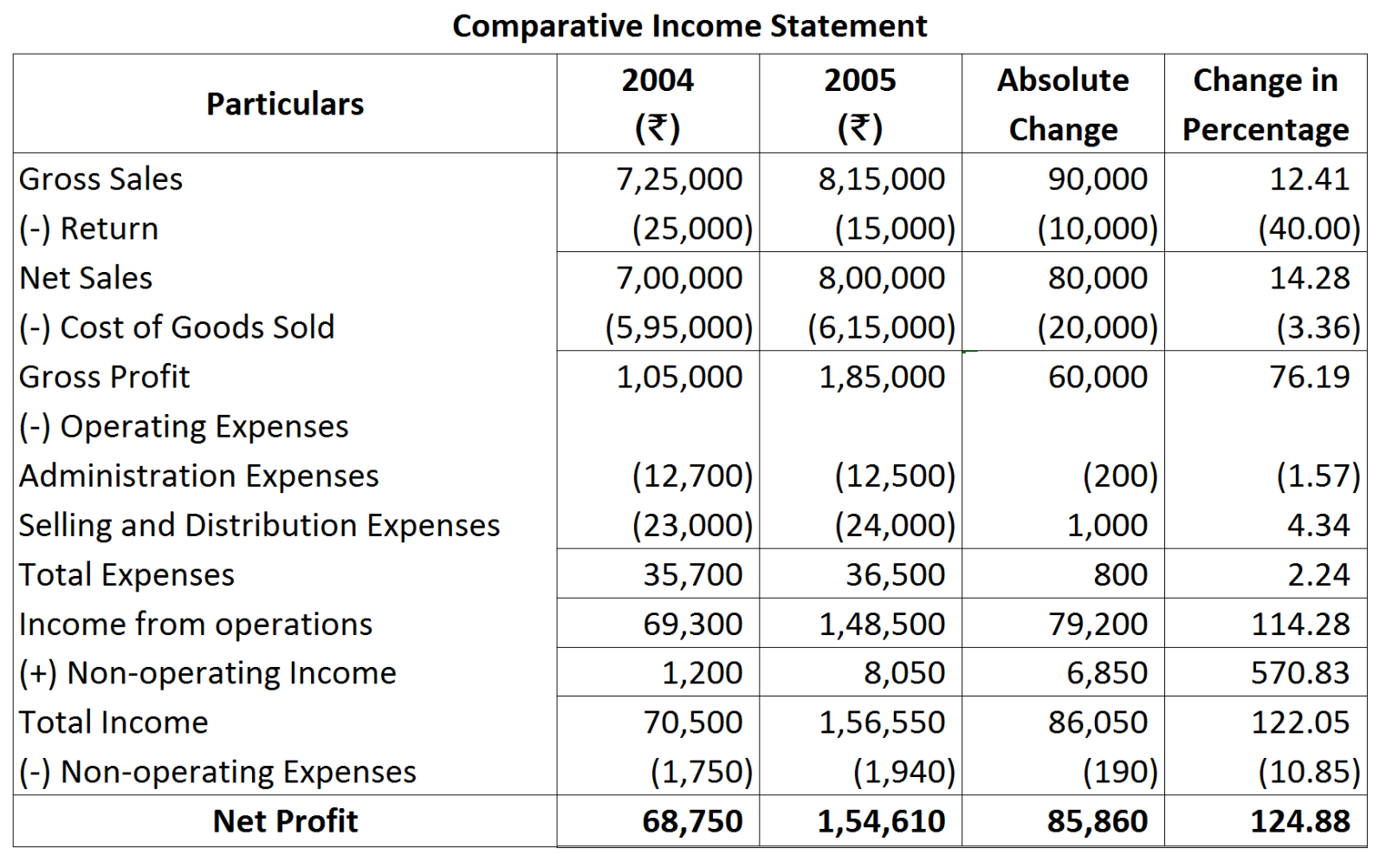
From the following information of Narsimham Company Ltd., prepare a Comparative Income Statement for the years 2004-2005
Answer

Interpretation
  1. The Net Profit of the company increased.
  2. Simultaneously the company has tried to reduce its costs to improve its profit margin.
  3. Profitability of the company has improved over the year.
Working Note
Absolute Change = Current Year - Previous Year

$\text{Change in Percentage}=\frac{\text{Absolute change}}{\text{Previous year}}\times100$
View full question & answer
Question 384 Marks
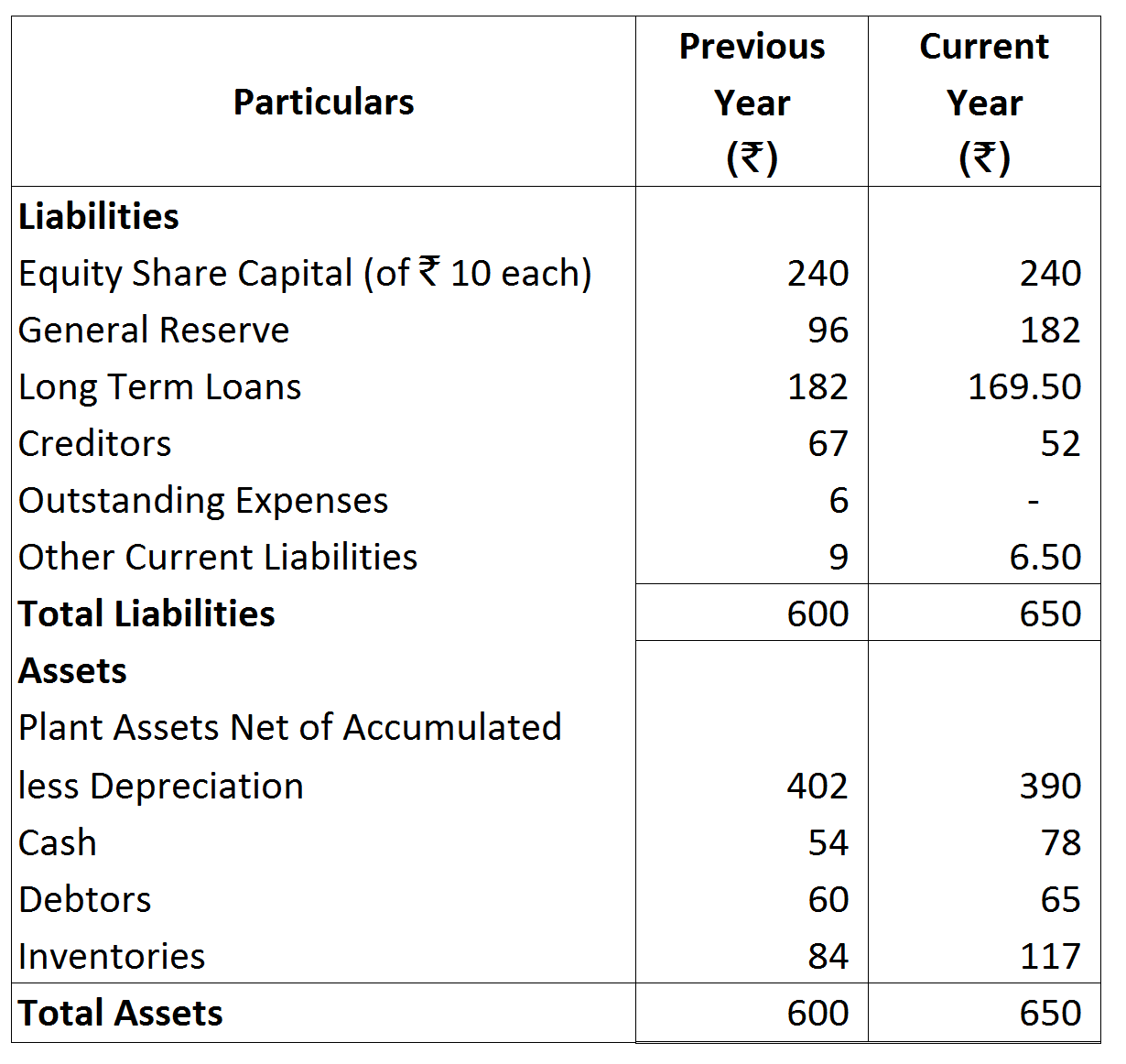
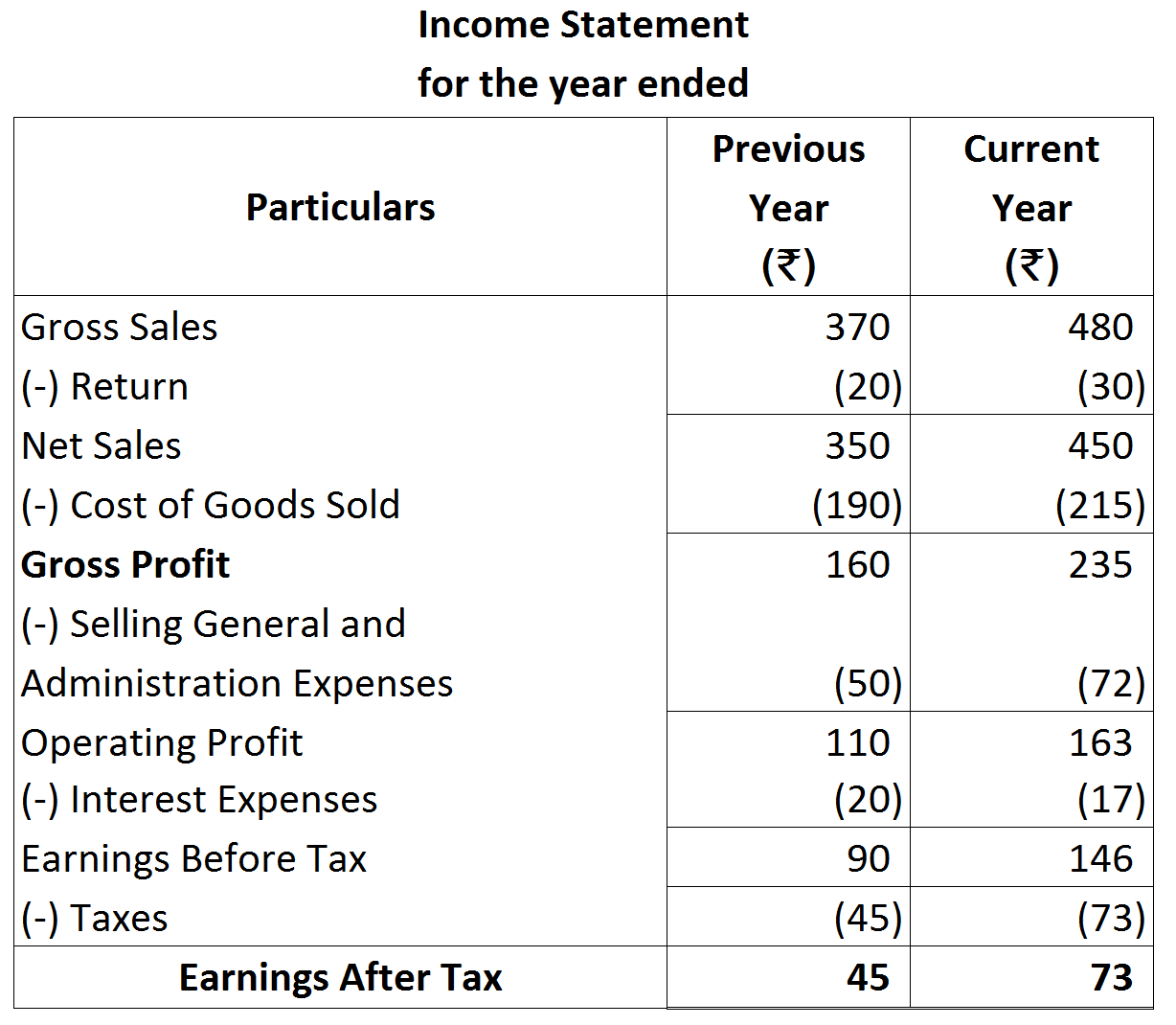
The accompanying balance sheet and profit and loss account related to SUMO Logistics Pvt. Ltd. convert these into Common Size Statements.
Previous Year = 2005 Current Year= 2006

View full question & answer
Question 394 Marks
What is Comparative Statement of Profit & Loss? How is it prepared?
Answer
Statement of Profit and Loss shows the net profit or net loss of that year. A comparative statement of profit and loss shows the net profits for a number of years so that changes in absolute data in terms of money as well as in terms of percentages may be known. Comparative statement of profit and loss provides the following informations:The form of comparative statement of profit and loss also consists of five columns.In the first column items of Statement of Profit & Loss are shown. In the second column the data for previous year is shown and in the third column the data for current year is shown, In the fourth column the increase or decrease in absolute data is shown in terms of rupee amounts. Fifth column shows the increase or decrease in various items in the form of percentages.
View full question & answer
Question 404 Marks
What is meant by 'Financial Analysis'? What is the interest of shareholders and prospective investors in such analysis?
Answer
"Financial statement analysis is largely a study of relationships among the various financial factors in a business, as disclosed by a single set of statements and a study of the trends of these factors as shown in a series of statements."
Investors and shareholders of the business are interested in the longevity of the business enterprise and therefore, they want to know the earning capacity of the business and its prospects for future growth and prosperity. Analysis of financial statements of a company helps them a great deal in assessing the capacity of the business to pay dividend at a higher rate and also the safety of their investments.
View full question & answer
Question 414 Marks
''Financial Analysis is affected by window-dressing and the personal ability and bias of the analyst." Comment.
Answer
Affected by Window - dressing: Some firms resort to window-dressing their financial statements to cover up bad financial position on the eve of accounting date.
For example, they may not record the purchases made at the end of the year or they may overvalue their closing stock. In such cases, the results obtained by analysis of financial statements will be misleadingEffect uf Personal Ability and Bias of the Analyst: Figures given in financial statements do not speak by themselves, hence, any conclusion can be drawn from these figures. Conclusions obtained from the analysis of these figures are affected to a great extent by the personal ability and knowledge of the analyst. for example, for calculating 'return on capital' one analyst may consider the profits after taxes, whereas, the other analyst may consider the profits before taxes. Similarly; the term
'Capital' may mean only the 'Shareholder's Funds' for one analyst, whereas the other analyst may take the 'Shareholder's Funds and Long Tenn Debts' as capital.
View full question & answer
Question 424 Marks
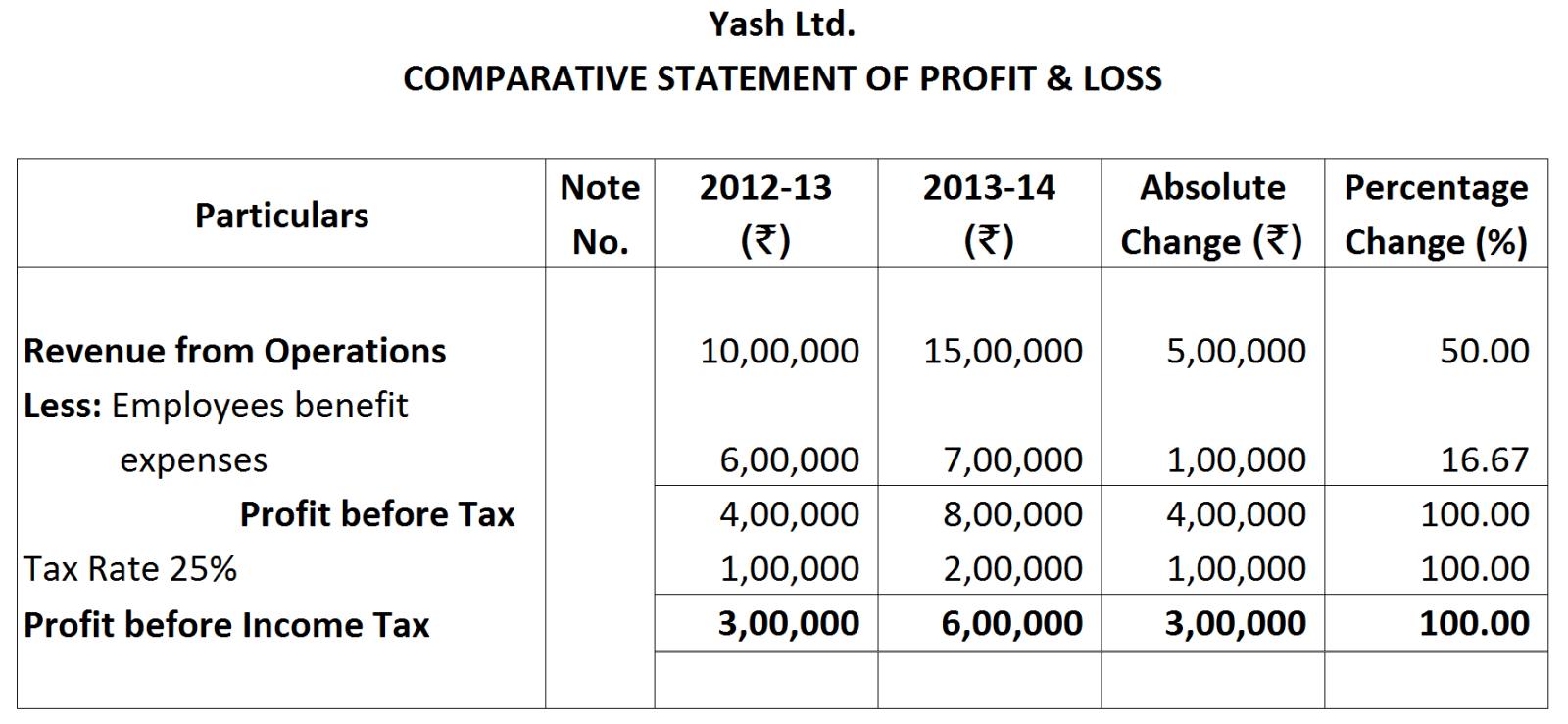
The motto of Yash Ltd., an advertising company is 'Service With Dignity'. Its management and work force is hard-working, honest and motivated. The net profit of the company doubled during the year ended 31.3.2014. Encouraged by its perf onnance company decided to give one month extra salary to all its employees. Following is the Comparative Statement of Profit and Loss of the company for the years ended 31st March 2013 and 2014.
  1. Calculate Net Profit Ratio for the years ending 31st March, 2013 and 2014.
  2. Identify any two values which Y ash Ltd. is trying to propagate.
Answer
  1. Net Profit Ratio $=\frac{\text{Net profit After tex}}{\text{Revenue from Operetions}}\times100$
For 2012-13 $=\frac{3,00,000}{10,00,000}\times100=30\%$

For 2013-14 $=\frac{6,00,000}{15,00,000}\times100=40\%$
  1. Values (Any two):
  1. Trating employees as a part of the company.
  2. Recognition of hardwork and honesty of employees.
  3. Serving the organisation with dignity.
  4. Ethical practices of Company.
View full question & answer
Question 434 Marks
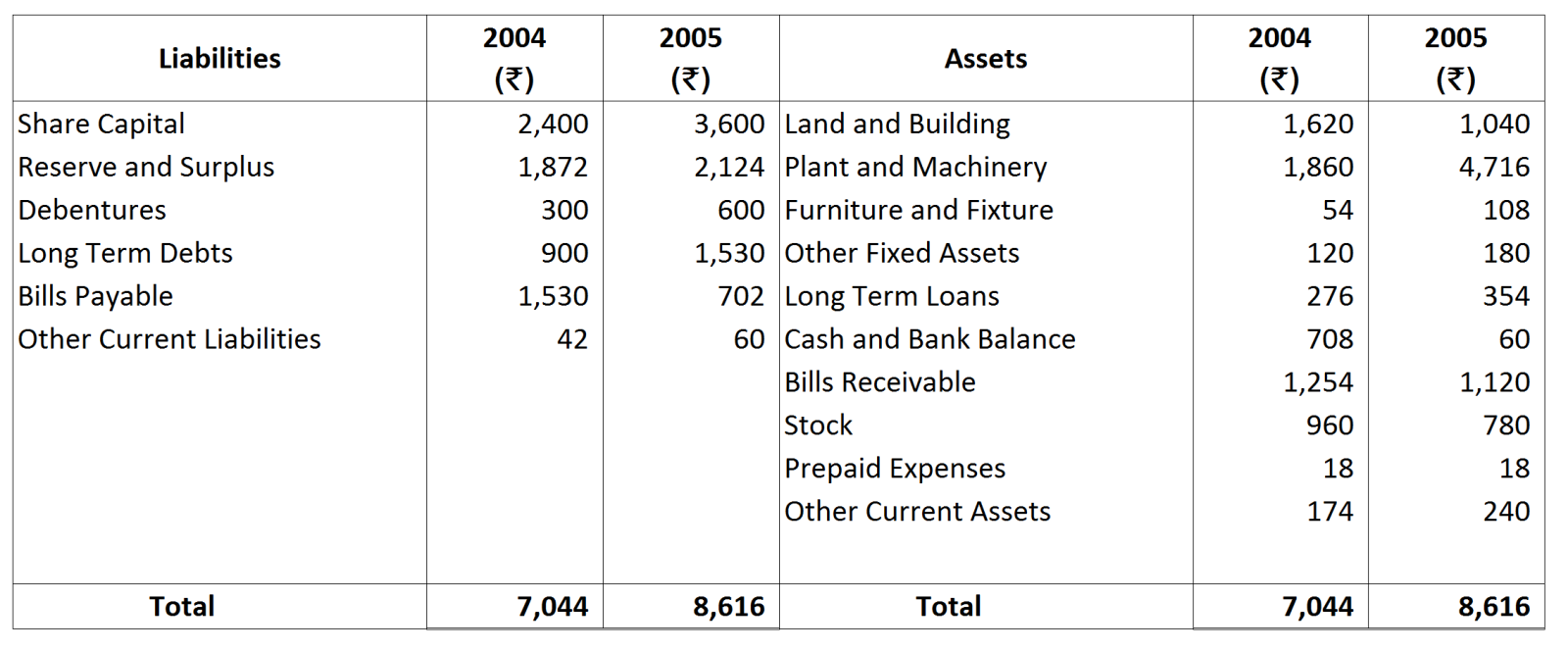
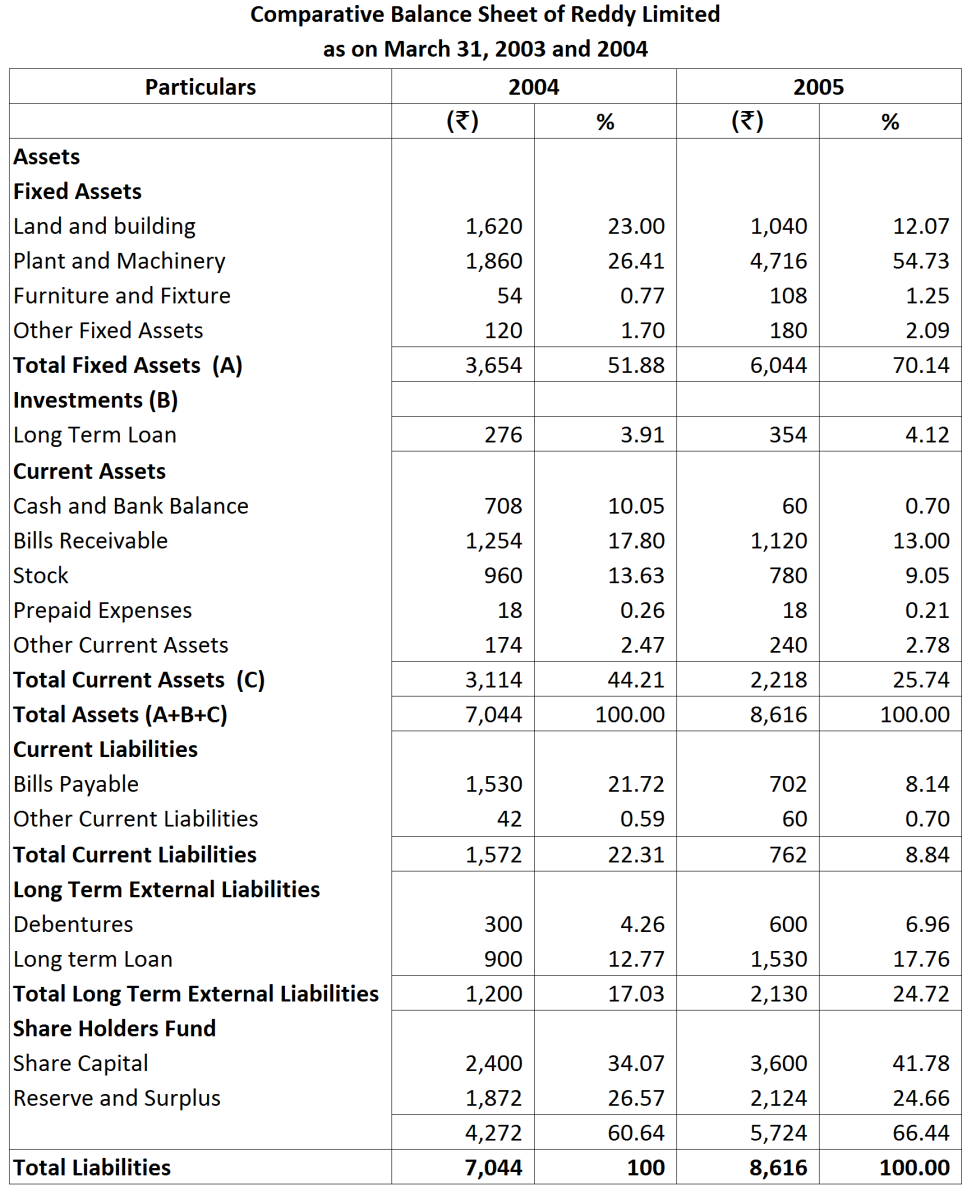
Following are the balance sheets of Reddy Ltd. as on 31 March 2003 and 2004.

Analyse the financial position of the company with the help of the Common Size Balance Sheet.
Answer

Comments
  1. Inspite of decrease in current assets and current liabilities, the current ratio has improved.
  2. Decrease in cash and bank balance indicates that there will be delay in payments.
  3. Increase in fixed assets and share capital shows that assets are purchased with long term sources of finance.
View full question & answer
Question 444 Marks
From the following Statemeat of Profit & Loss ofStar Ltd. for the year ended 31st March 2018, prepare a Common Size Statement of Profit & Loss:
View full question & answer
Question 454 Marks
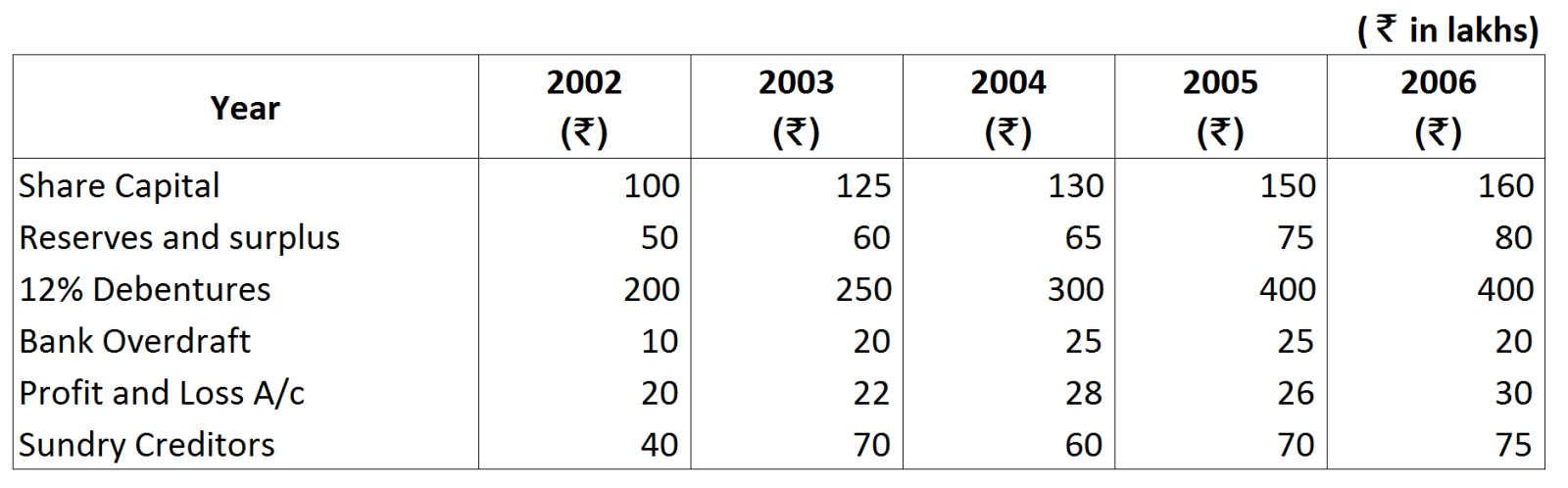
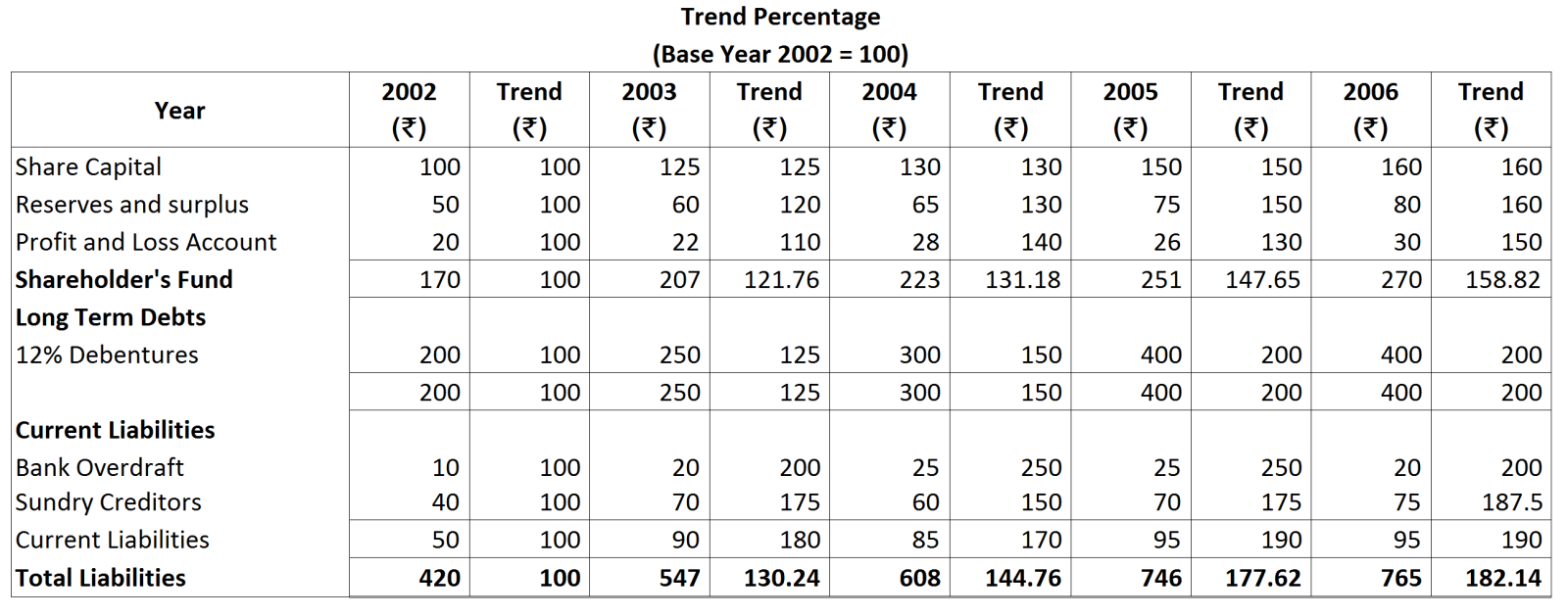
From the following data relating to the liabilities side of balance sheet of Madhuri Ltd., as on 31st March 2006, you are required to calculate trend percentages taking 2002 as the base year.
Answer

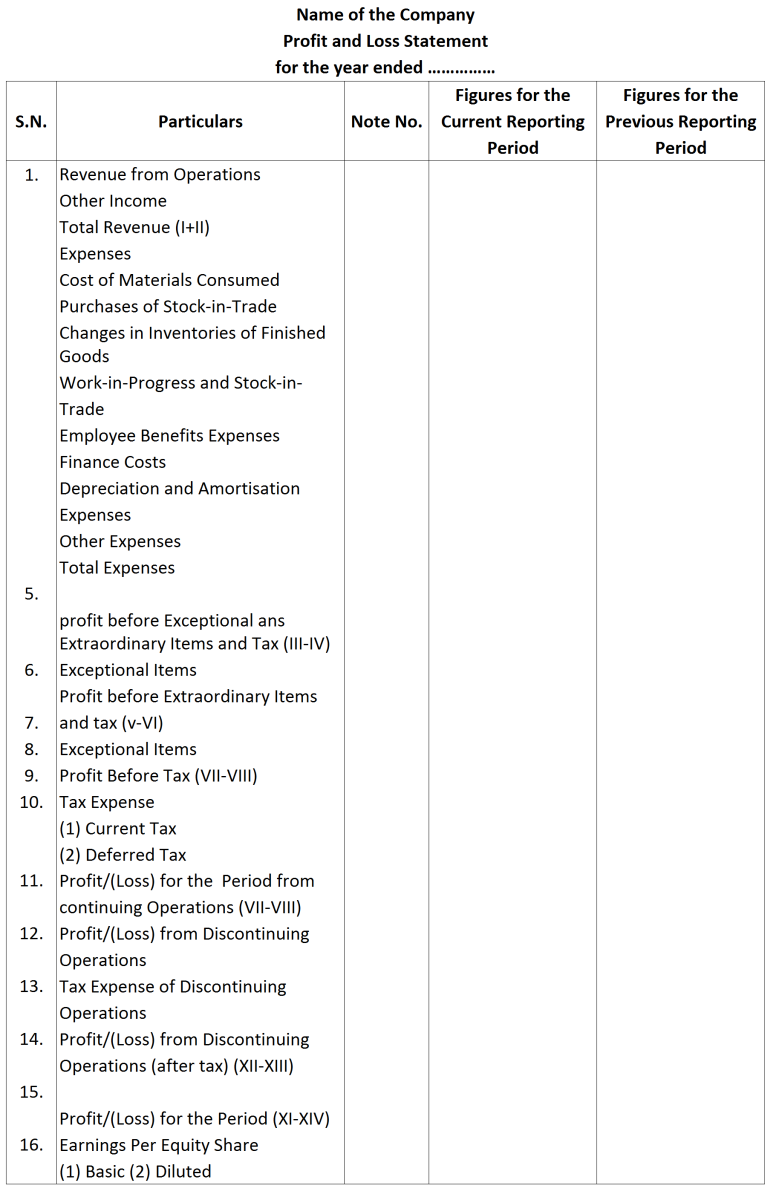
Effects of Revised Schedule VI on Tools of Analysis of Financial Statements As per revised Schedule VI part II the Format of Profit of Loss Statement is as follows.
View full question & answer
Question 464 Marks
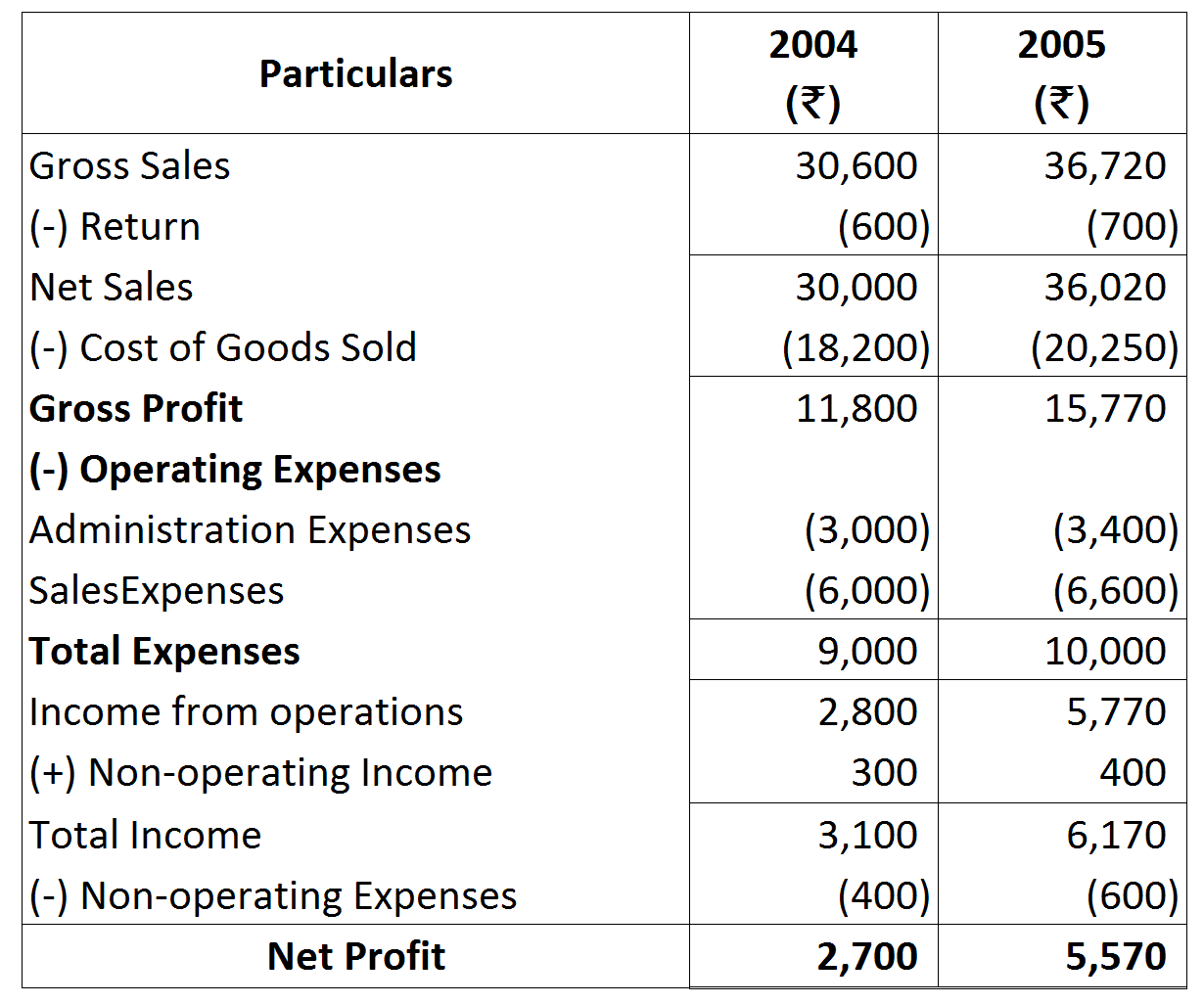
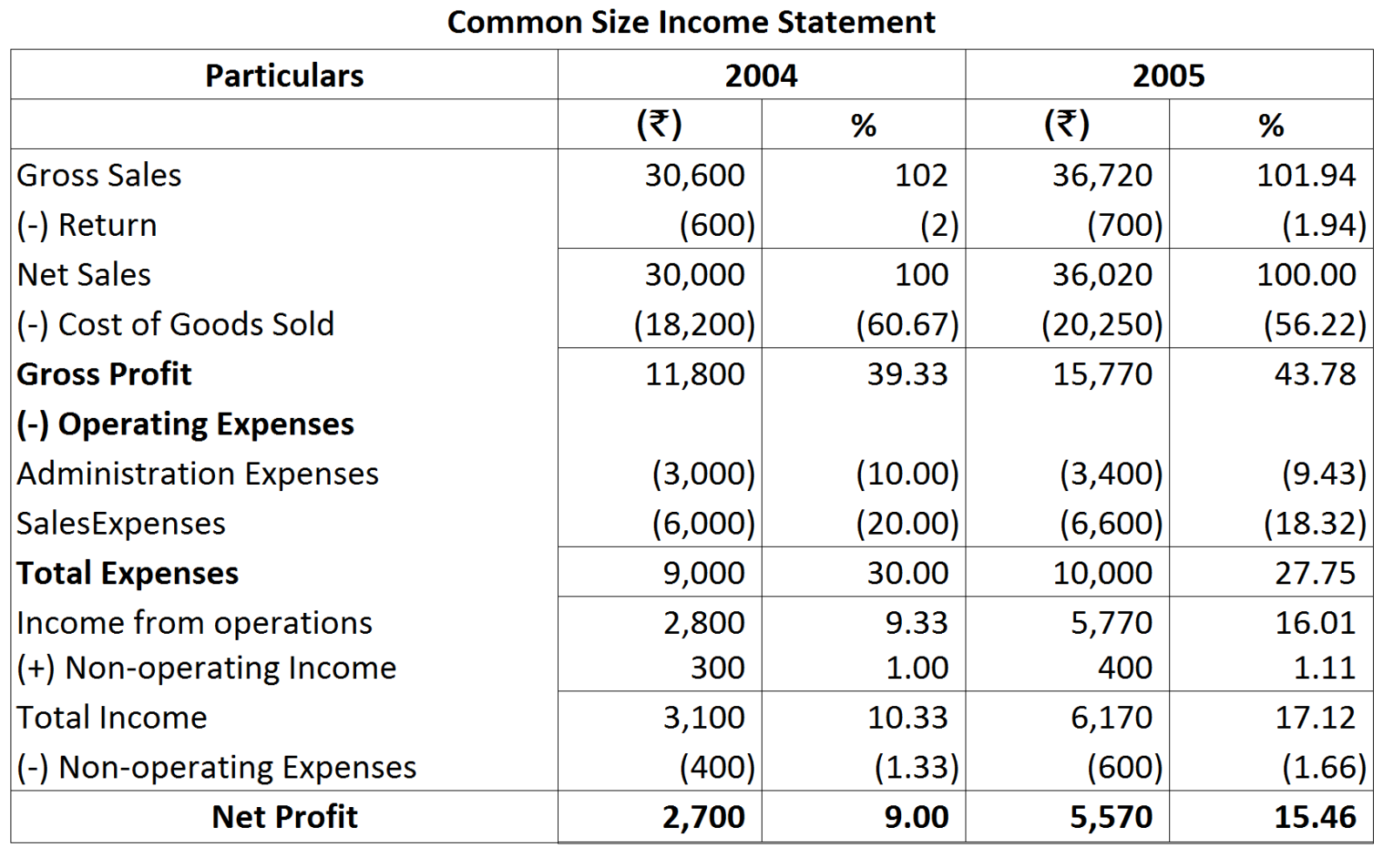
Convert the following income statement into Common Size Statement and interpret the changes in 2005 in the light of the conditions in 2004.
Answer

Comment: Company has reduced its cost and expenses which has resulted in increase in income from operations and net profit.
View full question & answer
Question 474 Marks
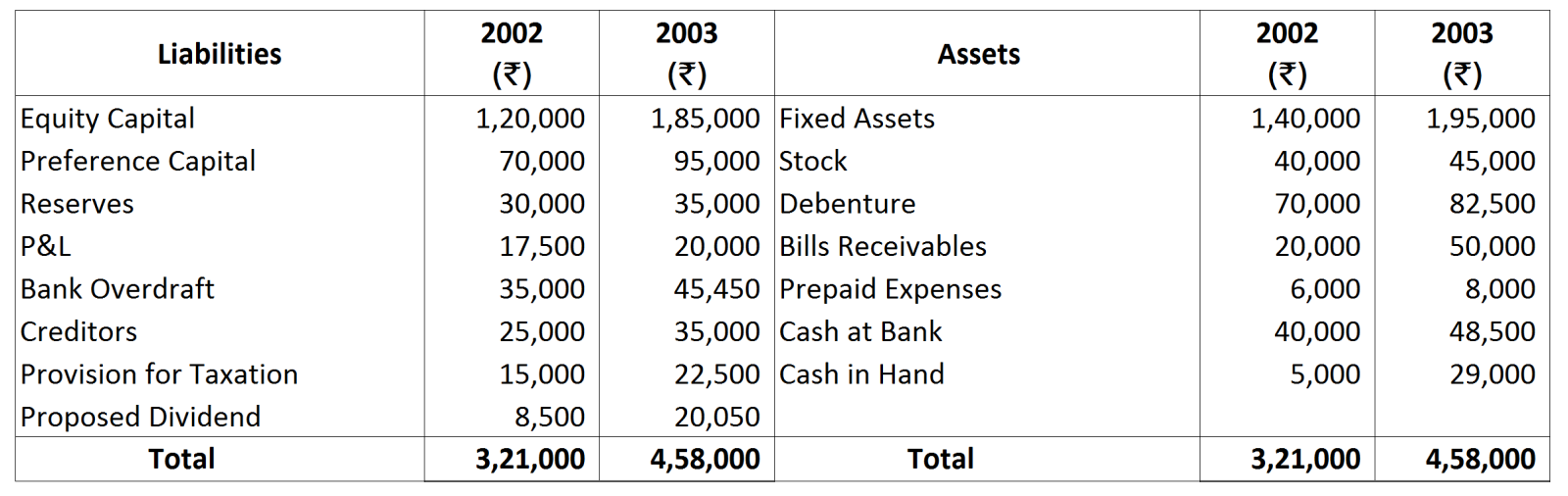
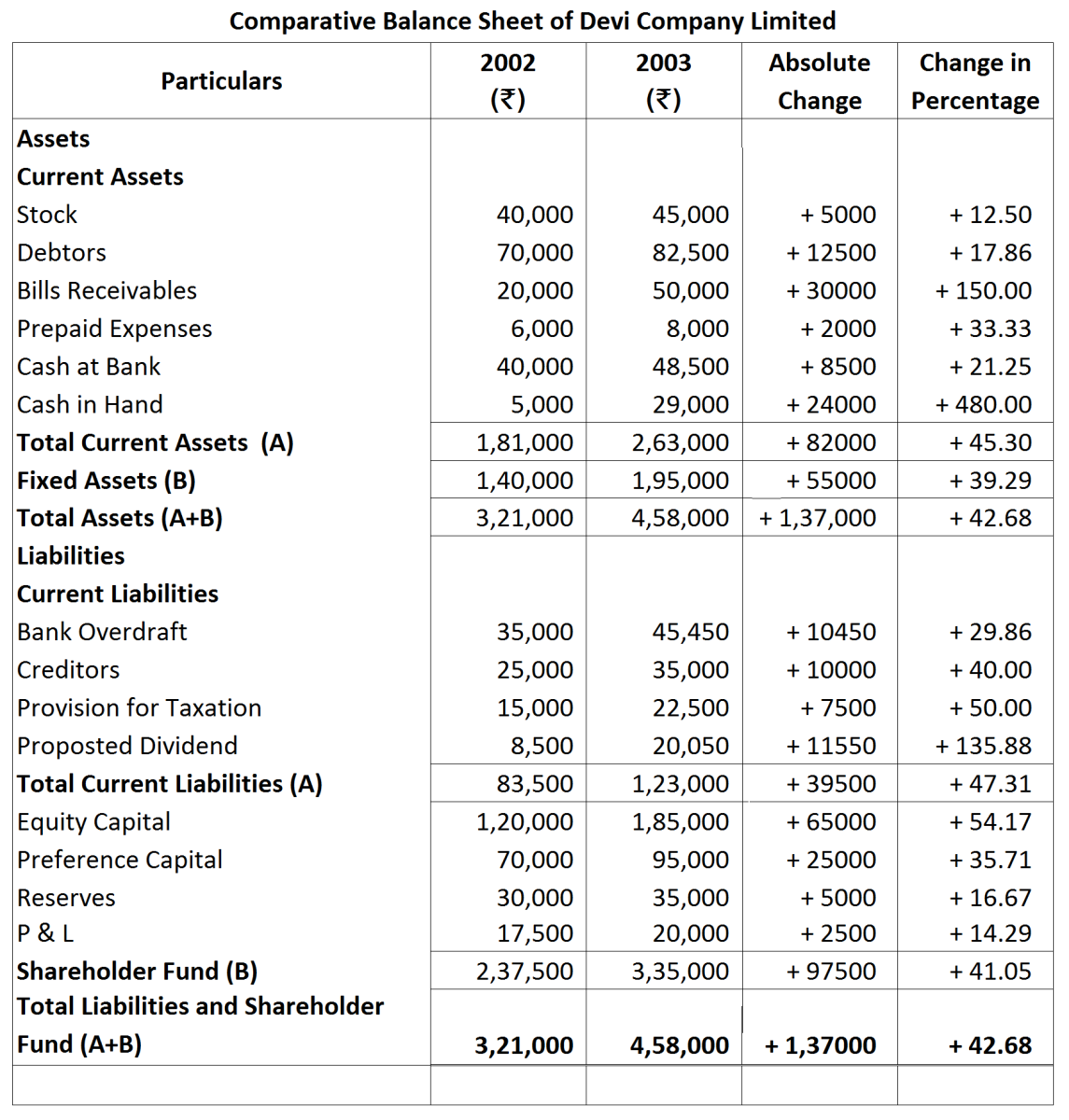
The following are the balance sheets of Devi Co. Ltd at the end of 2002 and 2003. Prepare a Comparative Balance Sheet and study the financial position of the concern.
Answer

Comments
  1. Change in current assets and current Liabilities is almost same. It indicates that ratio is same as of previous year.
  2. Fixed Assets have increased along with share capital which shows that assets are purchased with long term sources of finance.
  3. The overall financial position of company is satisfactory.
Working Note
Absolute Change = Current Year - Previous Year
$\text{Change in precentage}=\frac{\text{Absolute change}}{\text{Previous year}}\times100$
View full question & answer
Question 484 Marks
What is the importance of comparative statements? Illustrate your answer with particular reference to comparative income statement.
Answer
The following are the importance of Comparative Statements.
  1. Simple Presentation: The Comparative Statements present the financial data in a simpler form. Moreover, the year-wise data of the same items are presented side-by-side, which not only makes the presentation clear but also enables easy comparisons (both intra-firm and inter-firm) conclusive.
  2. Easy for Drawing Conclusion: The presentation of comparative statement is so effective that it enables the analyst to draw conclusion quickly and easily and that too without any ambiguity.
  3. Easy to Forecast: The comparative analysis of profitability and operational efficiency of a business over a period of time helps in analysing the trend and also assists the management to forecast and draft various future plans and policy measures accordingly.
  4. Easy Detection of Problems: By comparing the financial data of two or more years, the financial management can easily detect the problems. While comparing the data, some items may have increased while others have decreased or remained constant. The comparative analysis not only enables the management in locating the problems but also helps them to put various budgetary controls and corrective measures to check whether the current performance is aligned with that of the planned targets.
View full question & answer
Question 494 Marks
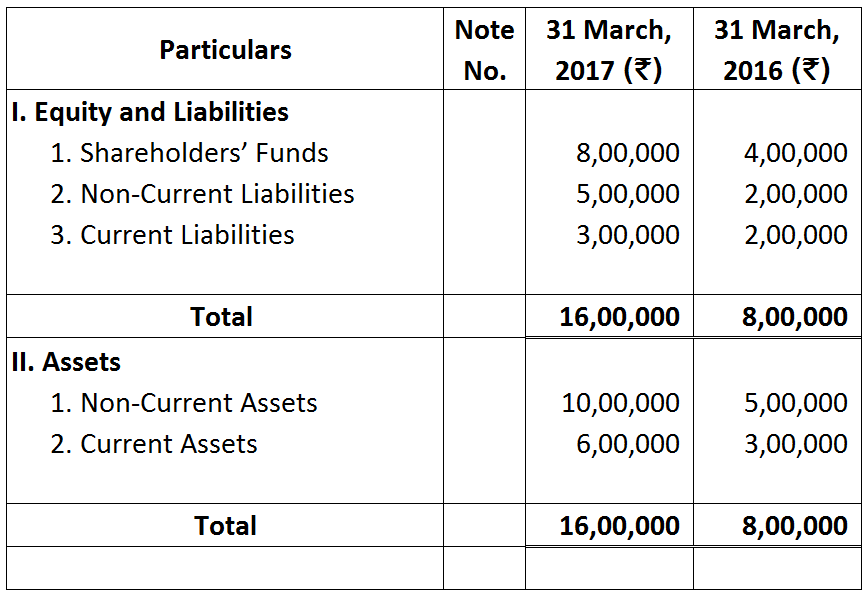
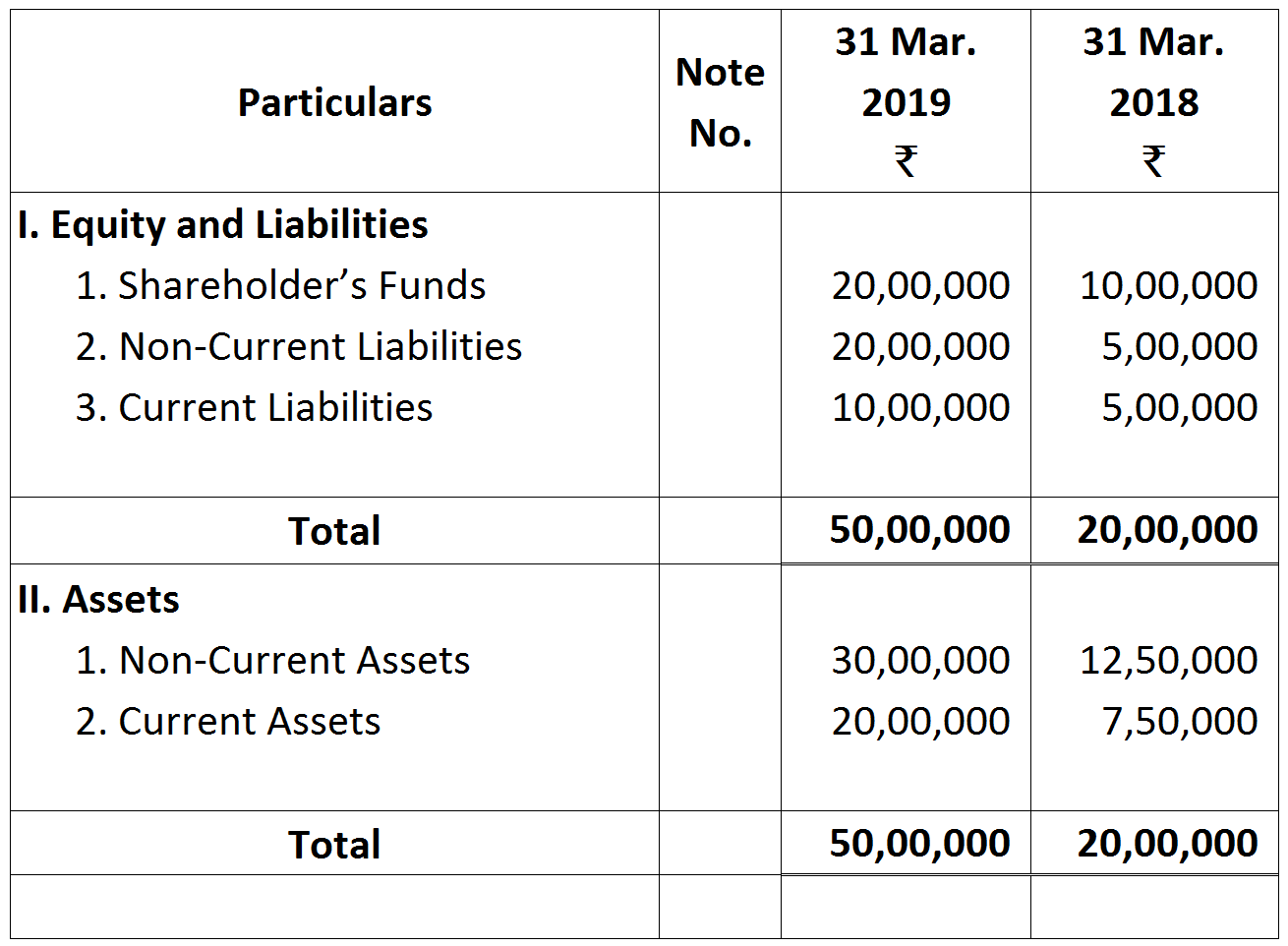
From the Balance Sheets for the year ended March 31, 2016 and 2017, prepare the
comparative Balance Sheet of Omega Chemicals Ltd.:
View full question & answer
Question 504 Marks
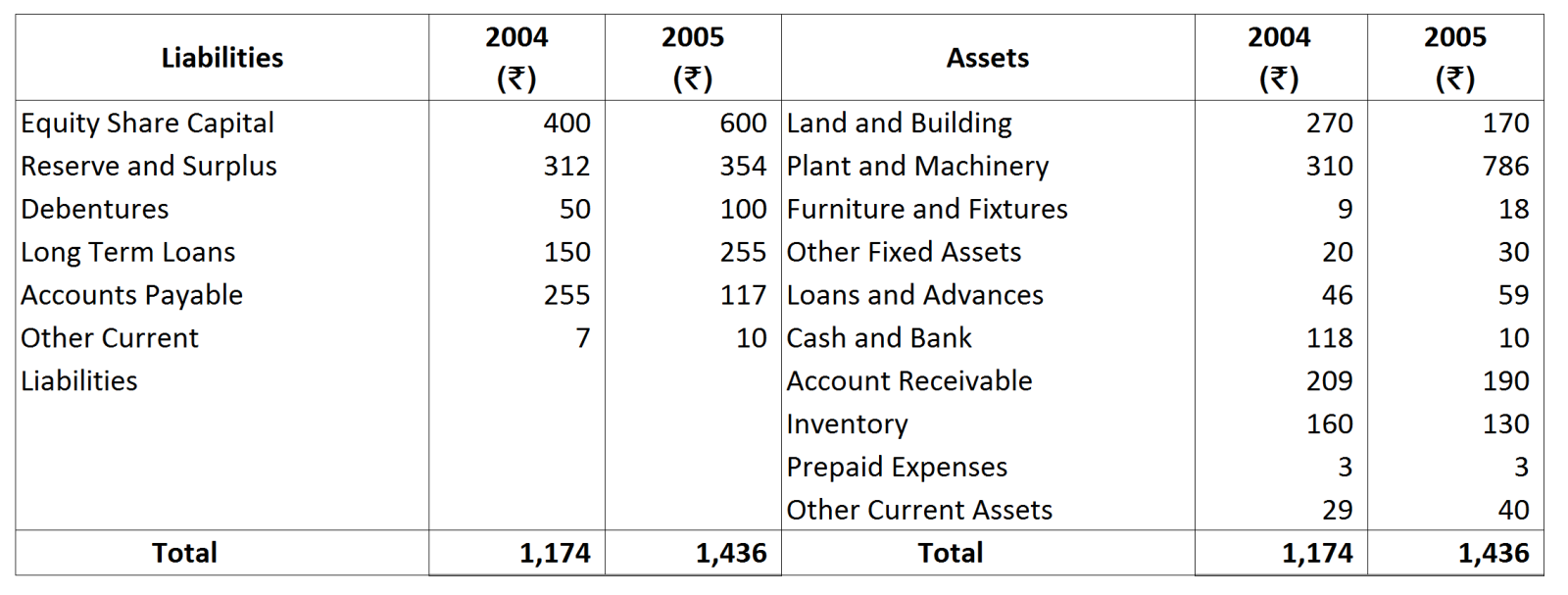
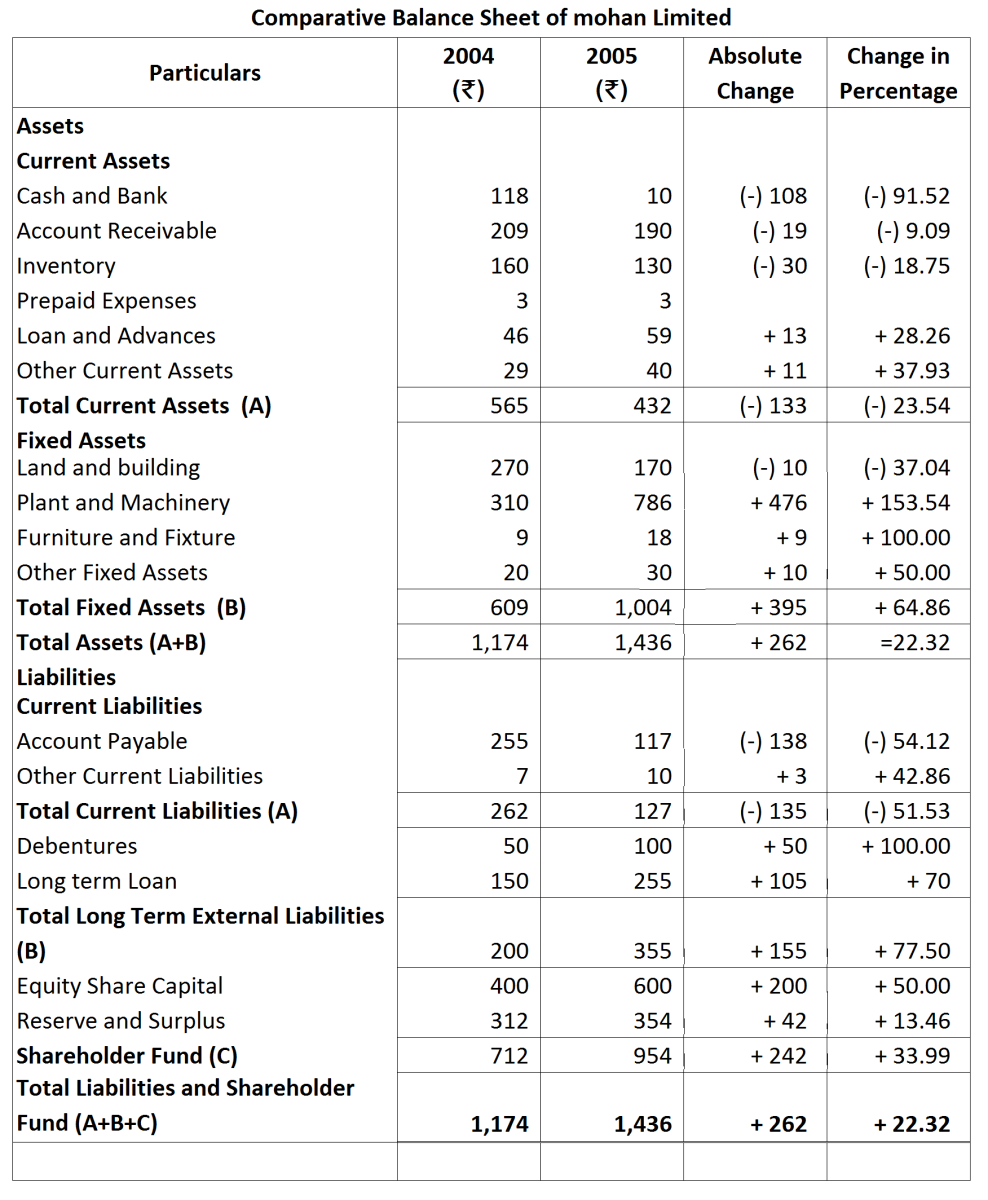
The following are the Balance Sheets of Mohan Ltd., at the end of 2004 and 2005.
Prepare a Comparative Balance Sheet and study the financial position of the company.
Answer

Working Note
Absolute Change = Current Year - Previous Year
$\text{Change in Percentage}=\frac{\text{Absolute change}}{\text{Previous year}}\times100$
Comments
  1. Decrease in current Liabilities is more than decrease in current assets which indicates that the current ratio has improved.
  2. Decrease in cash and bank may result in delay in payments.
  3. Fixed Assets have increased along with share capital. It indicates that such asset has been purchased using Long term sources of finance.
  4. Increase in reserve and surplus is a healthy indicator.
View full question & answer
4 Marks Question - Accountancy STD 12 Commerce Questions - Vidyadip