Question types

Dissolution of Partnership Firm question types

65 questions across 4 question groups — pick any mix to generate a Accountancy paper with step-by-step answer keys.

65
Questions
4
Question groups
5
Question types
Sample Questions

Dissolution of Partnership Firm questions

One sample from each question group in this chapter. Select any group above to see the full set with answer keys.

Unrecorded liabilities when paid are debited to:
  • Realisation Account.
  • B
    Partners' Capital Accounts.
  • C
    elon ergf
  • D
    None of the above.

Answer: A.

View full solution
Where it is agreed that a partner will be paid a lump sum amount for dissolution, if the payment is made by the firm, the payment is debited to:
  • A
    Realisation Account.
  • Concerned Partner's Capital Account.
  • C
    All Partners' Capital Accounts.
  • D
    None of the above.

Answer: B.

View full solution
At the time of dissolution of the firm, if goodwill appears in the Balance Sheet, it is transferred to:
  • Realisation Account.
  • B
    Partners' Capital Accounts.
  • C
    Revaluation Account.
  • D
    None of the above.

Answer: A.

View full solution
At the time of dissolution of the firm, loan from partner's relative is:
  • Transferred to Realisation Account.
  • B
    Not transferred to Realisation Account.
  • C
    Transferred to the Partner's Capital Account.
  • D
    None of the above.

Answer: A.

View full solution
At the time of dissolution of the firm, the assets and liabilities appearing in the Balance Sheet are transferred to:
  • A
    Revaluation Account.
  • Realisation Account.
  • C
    Partners' Capital Accounts.
  • D
    None of the above.

Answer: B.

View full solution
Pass Journal entries for the following:
  1. Realisation expenses of ₹ 15,000 were to be met by Rahul, a partner, but were paid by the firm.
  2. Ramesh, a partner, was paid remuneration of ₹ 25,000 and he was to meet all expenses.
  3. Anuj, a partner, was paid remuneration of ₹ 20,000 and he was to meet all expenses. Firm paid an expense of ₹ 5,000.
View full solution
Q 103 Marks Question3 Marks
Pass journal entries for the following:
  1. Realisation expenses amounted to ₹ 10,000 were paid by the firm on behalf of Alok, a partner, with whom it was agreed at ₹ 7,500.
  2. Realisation expenses amounted to ₹ 5,000. It was agreed that the firm will pay ₹ 2,000 and balance by Ravinder, a partner.
  3. Dissolution expenses amounted to ₹ 10,000 were paid by Amit, a partner, on behalf of the firm.
View full solution
Q 114 Marks Question4 Marks
Lal and Pal were partners in a firm sharing profits in the ratio of 3 : 7. On 1st April, 2015 their firm was dissolved. After transferring assets (other than cash) and outsider's liabilities to Realisation Account, you are given the following information:
  1. A creditor of ₹ 3,60,000 accepted machinery valued at ₹ 5,00,000 and paid to the firm ₹ 1,40,000.
  2. A second creditor for ₹ 50,000 accepted stock ₹ 45,000 in full settlement of his claim.
  3. A third creditor amounting to ₹ 90,000 accepted ₹ 45,000 in cash and investments worth ₹ 43,000 in full settlement of his claim.
  4. Loss on dissolution was ₹ 15,000.
Pass necessary journal entries for the above transactions in the books of firm assuming that all payments were made by cheque.
View full solution
Q 124 Marks Question4 Marks
Rohit, Kunal and Sarthak are partners in a firm. They decided to dissolve their firm. Pass necessary journal entries for the following after various assets (other than Cash and Bank) and the third party liability have been transferred to Realisation Account:
  1. Kunal agreed to pay off his wife's loan of ₹ 6,000.
  2. Total Creditors of the firm were ₹ 40,000. Creditors worth ₹ 10,000 were given a piece of furniture costing ₹ 8,000 in full and final settlement. Remaining Creditors allowed a discount of 10%.
  3. Rohit had given a loan of ₹ 70,000 to the firm which was duly paid.
  4. A machine which was not recorded in the books was taken over by Kunal at ₹ 3,000, whereas its expected value was ₹ 5,000.
  5. The firm had a debit balance of ₹ 15,000 in the Profit and Loss Account on the date of dissolution.
  6. Sarthak paid the realisation expenses of ₹ 16,000 out of his private funds, who was to get a remuneration of ₹ 15,000 for completing dissolution process and was responsible to bear all the realisation expenses.
View full solution
Q 134 Marks Question4 Marks
Pass necessary journal entries for the following transactions on the dissolution of the firm P and Q after the various assets (other than cash) and outside liabilities have been transferred to Realisation Account:
  1. Bank Loan ₹ 12,000 was paid.
  2. Stock worth ₹ 16,000 was taken over by partner Q.
  3. Partner P paid a creditor ₹ 4,000.
  4. An asset not appearing in the books of accounts realised ₹ 1,200.
  5. Expenses of realisation ₹ 2,000 were paid by partner Q.
  6. Profit on realisation ₹ 36,000 was distributed between P and Q in 5 : 4 ratio.
View full solution
Q 144 Marks Question4 Marks
X and Y were partners sharing profits and losses in the ratio of 3 : 2. They decided to dissolve the firm on 31st March 2018. On that date their Capitals were X ₹ 40,000 and Y ₹ 30,000. Creditors amounted to ₹ 24,000.
Assets were realised for ₹ 88,500. Creditors of ₹ 16,000 were taken over by X at ₹ 14,000. Remaining Creditors were paid at ₹ 76,500. The cost of realisation came to ₹ 500.
Prepare necessary accounts.
View full solution
Q 154 Marks Question4 Marks
There are two partners X and Y in a firm and their capitals are ₹ 50,000 and ₹ 40,000. The creditors are ₹ 30,000. The assets of the firm realise ₹ 1,00,000. How much will X and Y receive?
View full solution
Q 166 Marks Question6 Marks
A, B and C were in partnership sharing profits and losses in the ratio of 2 : 1 : 1. They decided to dissolve the partnership. On that date of dissolution,Sundry Assets (including cash ₹ 5,000) amounted to ₹ 88,000, assets realised ₹ 80,000 (including an unrecorded asset which realised ₹ 4,000). A contingent liability on account of bills discounted ₹ 8,000 was paid by the firm. The Capital Accounts of A, B and C showed a balance of ₹ 20,000 each.
Prepare Realisation Account Partners' Capital Accounts and Cash Account.
View full solution
Q 176 Marks Question6 Marks
A, B and C started business on 1st April, 2016 with capitals of ₹ 1,00,000 ₹ 80,000 and ₹ 60,000 respectively sharing profits (losses) in the ratio of 4 : 3 : 3. For the year ended 31st March, 2017, the firm suffered a loss of ₹ 50,000. Each of the partners withdrew ₹ 10,000 during the year.
On 31st March, 2017, the firm was dissolved, the creditors of the firm stood at ₹ 24,000 on that date and Cash in Hand was ₹ 4,000. The assets realised ₹ 3,00,000 and Creditors were paid ₹ 23,500 in full settlement of their claims.
Prepare Realisation Account and show your workings clearly.
View full solution
Q 186 Marks Question6 Marks
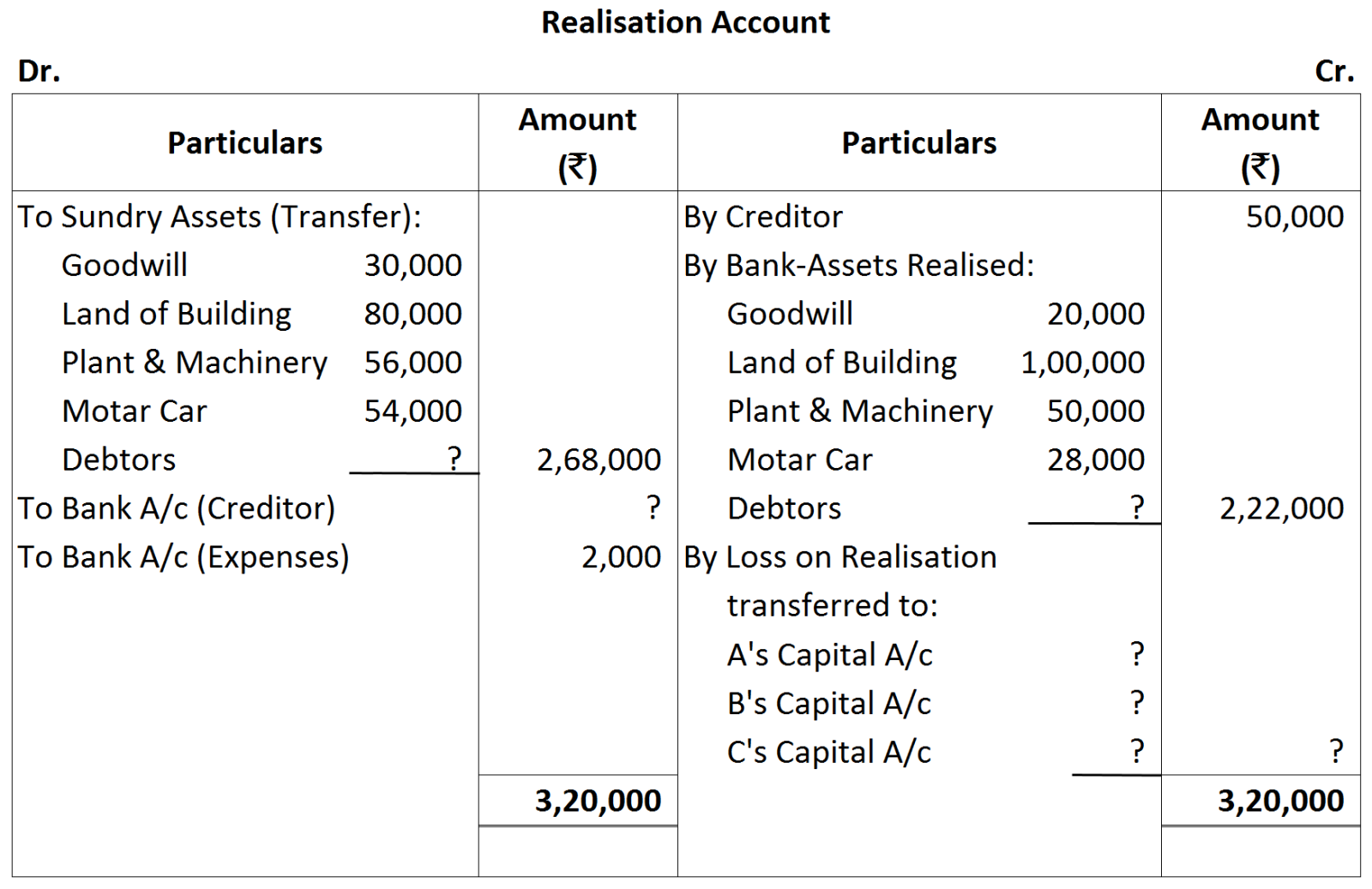
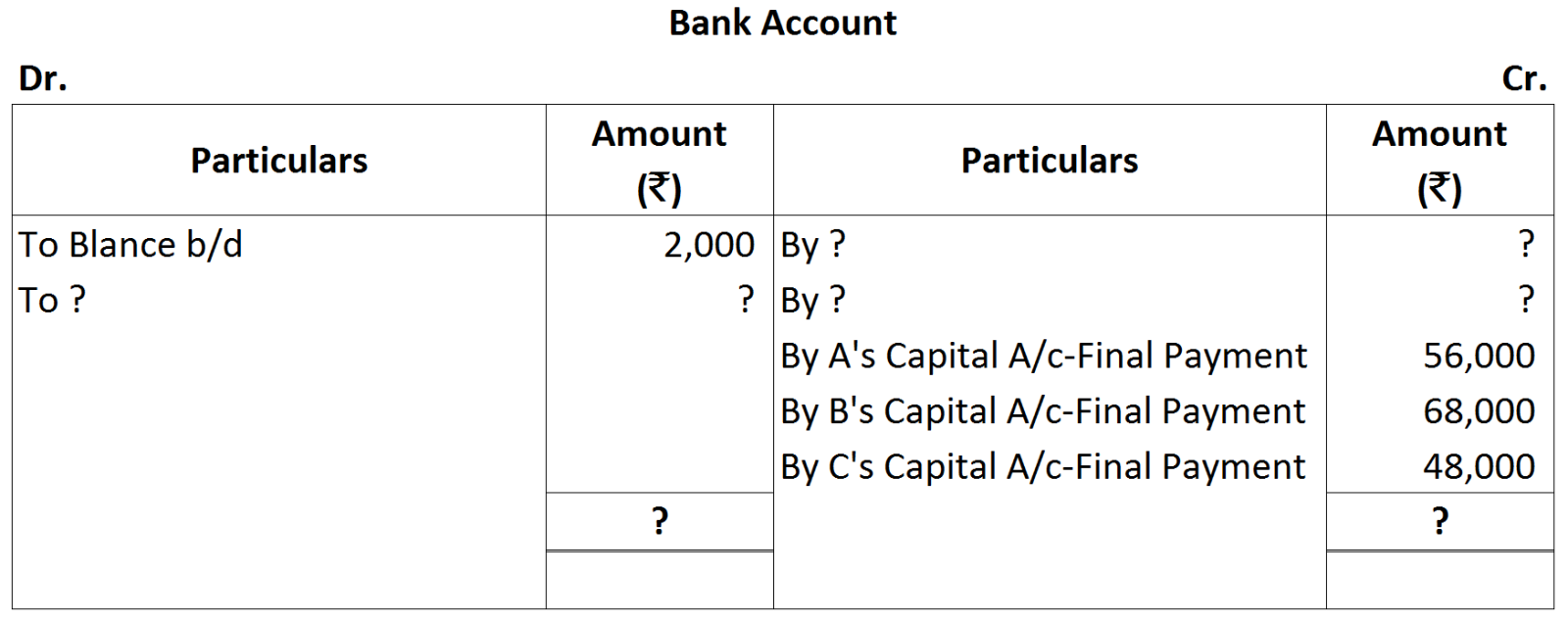
(Dissolution of Firm) A, B and C are partner sharing Profits and losses in the ratio of 2 : 1 : 1.They decided to dissolve their firm on 1st April, 2018. Complete the Realisation Account, Partners' Capital Accounts and Bank Account from the information given below:


View full solution
Q 196 Marks Question6 Marks
Pass journal entries for the following transactions at the time of dissolution of the firm:
  1. Loan of ₹ 10,000 advanced by a partner to the firm was refunded.
  2. X, a partner, takes over an unrecorded asset (Typewriter) at ₹ 300.
  3. Undistributed balance (Debit) of Profit and Loss Account ₹ 30,000. The firm has three partners X, Y and Z.
  4. Assets of the firm realised ₹ 1,25,000.
  5. Y who undertakes to carry out the dissolution proceedings is paid ₹ 2,000 for the same Y.
  6. Creditors are paid ₹ 28,000 in full settlement of their account of ₹ 30,000.
View full solution
Q 206 Marks Question6 Marks
Pass journal entries for the following at the time of dissolution of a firm:
  1. Sale of Asset ₹ 50,000.
  2. Payment of Liabilities ₹ 10,000.
  3. A commission of 5% allowed to Mr. X, a partner on sale of assets.
  4. Realisation expenses amounted to ₹ 15,000. The firm had agreed with Amrit, a partner, to reimburse him up to ₹ 10,000.
  5. Z, an old customer, whose account for ₹ 6,000 was writte off as bad in the previous year, paid 60% of the amount written off.
  6. Investment (Book Value ₹ 10,000) realised at 150%.
View full solution

Generate a Dissolution of Partnership Firm paper free

Pick question groups from the list above, set marks and difficulty, and export a branded PDF with step-by-step answer keys. First 3 chapters free — no signup.

Download App