Questions

3 Marks Question

🎯

Test yourself on this topic

50 questions · timed · auto-graded

Question 13 Marks
How has population explosion and the advent of industrial revolution resulted in environmental crisis?
Answer
With population explosion and with the advent of industrial revolution, to meet the growing needs of the expanding population, the demand for resources for both production and consumption went beyond the rate of regeneration of the resources and the pressure on the absorptive capacity of the environment increased tremendously.
We are now faced with increased demand for environmental resources and services but their supply is limited due to overuse and misuse. Hence, the environmental issues of waste generation and pollution have become critical today.
View full question & answer
Question 23 Marks
Why has environment depletion led to high opportunity costs?
Answer
The nation has to pay heavily on damages to human health (fatal and non-fatal effects), effects on crops and materials, damages caused by global warming provoked by greenhouse gases, cost for correcting global warming impacts. Health of people which is affected due to increased levels of pollution also requires more investment on health facilities.
View full question & answer
Question 33 Marks
You are residing in highly populated area of Mumbai. Due to over population your locality harms the environment, suggest any four measures to your neighbours to protect environment.
Answer
I shall suggest following measures to protect environment:
  1. Avoid the use of plastic.
  2. Promote the use of CNG as fuel.
  3. Promote the use of solar energy.
  4. Promote rain water harvesting.
View full question & answer
Question 43 Marks
How do the following factors contribute to the environmental crisis in India? What problem do they pose for the government?
Industrialisation.
Answer
Industrialisation: Industrialisation, on one hand, enhances our living standards but, on the other hand, it causes deforestation, depletion of natural resources. In the blind rage to achieve economic development, industrialisation acts as a catalyst. In order to speed up the process of industrialisation, natural resources are exploited at a rapid pace. More trees are being felled and, increasing volume of toxics and industrial wastes are dumped into the water bodies. All these culminate to ecological imbalances posing threat to sustainable economic development. Thus, the government should take measures to check undue and unnecessary industrial growth in order to restore ecological balance.
View full question & answer
Question 53 Marks
How are environment and economy interdependent?
Answer
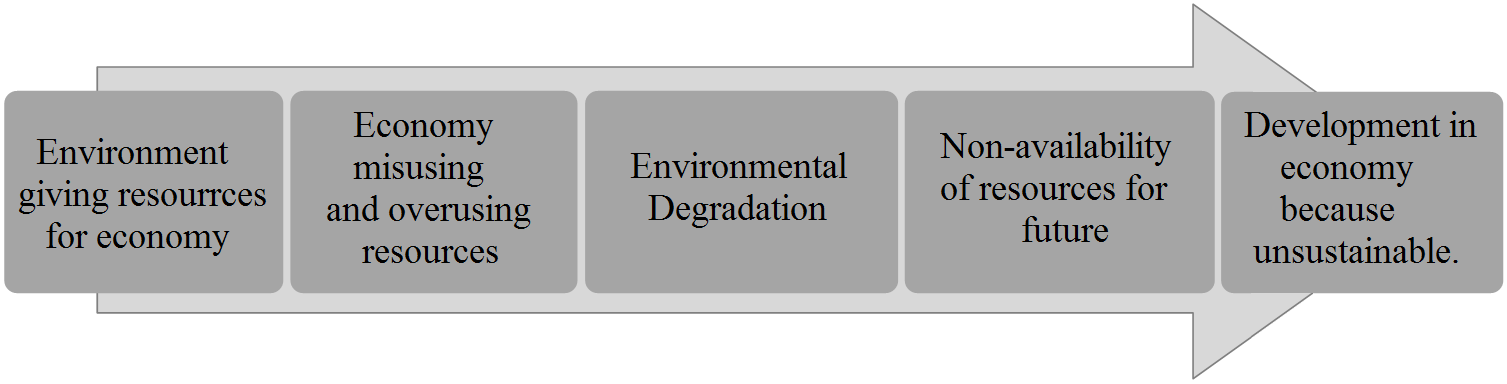
No economy can grow without using resources. But when it overuses or misuses the scarce resources, it crosses carrying capacity of the environment. It leads to environment degradation and makes the development unsustainable. It has been clarified with the help of following diagram.
View full question & answer
Question 63 Marks
Explain the term 'affluence trap'.
Answer
Affluence means economic well-being. Trap is something in which we get caught and we cannot escape out of it. Affluence trap means environmental degradation trap. With affluence or economic well-being more natural resources are used up causing environmental problems. In rich countries, high level of consumption associated with high level of income is using up natural resources at a fast pace. As a consequence, these countries are getting trapped in a situation of severe environmental degradation.
View full question & answer
Question 73 Marks
How has the supply-demand relationship led to degradation of environment?
Answer
The demand for resources for both production and consumption has gone beyond the rate of regeneration of the resources increasing the pressure on the absorptive capacity of the environment. This reversal of the supply demand relationship with demand for resources exceeding the supply has led to degradation of the environment.
View full question & answer
Question 83 Marks
Differentiate between biotic and abiotic elements of environment.
Answer
S.No.
Basis
Biotic elements
Abiotic elements
1.
Meaning
Biotic elements include all living elements.
Abiotic elements include all non-living elements.
2.
Example
The birds, animals and plants, forests, fisheries etc
Abiotic elements include air, water, land rocks and sunlight etc.
View full question & answer
Question 93 Marks
How do the following factors contribute to the environmental crisis in India? What problem do they pose for the government?
Affluent consumption standards.
Answer
Affluent Consumption Standards: The recent influence of the West and a rise in purchasing power of the middle class has led to affluent consumption standards and unnecessary luxuries with a lifestyle of conspicuous consumption have increased. This has resulted into pressure on resources like petroleum, electricity etc, needed to fulfil the demand for such lifestyle. Equipments such as air conditioners are contributing to global warming due to the carbon emissions from them.
View full question & answer
Question 103 Marks
List the factors responsible for land gradation in India.
Answer
Some of the factors responsible for land gradation in India are:
  1. Loss of vegetation on account of deforestation.
  2. Unsustainable fodder extraction and fuel wood.
  3. Shifting cultivation being practised.
  4. Encroachment into forest land by industries.
  5. Rapid use of agro-chemicals such as pesticides and fertilisers.
  6. Over-grazing and forest fires. (any four)
View full question & answer
Question 113 Marks
Explain the supply-demand reversal of environmental resources.
Answer
Supply Demand Reversal of Environmental Resources: The demand for resources for both production and consumption has gone beyond the rate of regeneration of the resources increasing the pressure on the absorptive capacity of the environment. This reversal of the supply-demand relationship with demand for resources exceeding the supply has led to degeneration of the environment.
View full question & answer
Question 123 Marks
What has led to air pollution in urban areas?
Answer
Air pollution is widespread in urban areas where vehicles are the major contributors and in a few other areas which have a high concentration of industries and thermal power plants. Vehicular emissions are of particular concern since these are ground level sources and, thus, have the maximum impact on the general population.
View full question & answer
Question 133 Marks
What kind of development strategy must the present generation adopt to promote sustainable development?
Answer
The present generation must promote development in such a way that it enhances the natural and built-in environment with:
  1. Conservation of resources.
  2. Preservation of the regenerative capacity of the world's natural ecological system.
  3. Avoiding the added costs or risks on future generation.
View full question & answer
Question 143 Marks
How do the following factors contribute to the environmental crisis in India? What problem do they pose for the government?
Illiteracy.
Answer
Illiteracy: It is a social problem leading to the lack of awareness about environment and the harmful effects of various practices or products on the environment. The lack of knowledge and skills may lead to excessive extraction of resources and, thereby, its misuse. Thus, the government should take measures to create awareness and spread technical knowledge among people about various efficient and economising methods.
View full question & answer
Question 153 Marks
Mention four important causes of environmental degradation.
Answer
Important causes of environmental degradation are as follows:
  • Population explosion and industrial revolution has increased the demand for environmental resources, but their supply is limited due to misuse and overuse.
  • The intensive and extensive extraction of both renewable and non-renewable resources has exhausted some of the vital resources.
  • Extinction of many resources and continuous rising population has also resulted in environmental crisis.
  • Due to affluent consumption and production standard of developed world, the waste generated is beyond the absorptive capacity of the environment.
  • The development process has polluted environment, water and atmosphere and there is decline in air and water quality. It has resulted in increased incidence of respiratory and water borne diseases.
View full question & answer
Question 163 Marks
How do the following factors contribute to the environmental crisis in India? What problem do they pose for the government?
Urbanisation.
Answer
Urbanisation: Urbanisation has disrupted most of the earth’s landscape and decreased the cover of wildlife habitat. Urbanisation and deforestation have led to extinction of rare species. Urbanisation enforces pressure on small pieces of lands and leads to land degradation; it leads to reduction in land per individual ratio, rapid reduction of available resources, reduction of agricultural farmland and depletion of forests.
View full question & answer
Question 173 Marks
How do the following factors contribute to the environmental crisis in India? What problem do they pose for the government?
Global warming.
Answer
Global warming: Global warming refers to the phenomenon of sustained increase in global temperature due to environmental pollution and deforestation. It is caused by the emission of Green House Gases that include, particularly, carbon dioxide. The increase in the level of carbon dioxide raises the temperature of the earth surface. This risen temperature accelerates the melting of polar ice that further leads to the rise in the sea level. Thus, the incidence of natural calamities rises due to disturbed ecological balance, thereby, posing a threat to human life.
View full question & answer
Question 183 Marks
How do the following factors contribute to the environmental crisis in India? What problem do they pose for the government?
Reduction of forest coverage.
Answer
Reduction of Forest Coverage: Deforest 9tion due to growing population needs for housing and industrialization has led to a reduction in forest cover frees in the forest help in binding soil and holding water level. Rainfall is also affected due to reduction in forest cover along with lesser absorption of carbon dioxide which has resulted in global warming.
View full question & answer
Question 193 Marks
What is global warming? How does it affect us?
Answer
Global warming is the rise in the general temperature levels on earth. It affects us because environment is our basic need of survival and it affects our environment.
  1. It is causing glaciers to melt.
  2. It is increasing climatic disturbances.
  3. Water level is rising in the sea and oceans.
  4. People's electricity consumptions are increasing to counter it.
View full question & answer
Question 203 Marks
How has indiscriminate felling of trees led to environment problems?
Answer
Indiscriminate felling of trees has led to destruction of forest cover. Trees are natural consumers of carbon dioxide one of the greenhouse gases whose built-up in the atmosphere contributes to global warming. Destruction of trees pumps into the atmosphere even more carbon dioxide, along with methane, another major greenhouse gas. Once forests have been cut down, essential nutrients are washed out of the soil all-together. This leads to "Soil erosion" which makes the land unusable and can, in turn, lead to disastrous flooding since there is no soil to soak up the rain.
View full question & answer
Question 213 Marks
How do the following factors contribute to the environmental crisis in India? What problem do they pose for the government?
Rising population.
Answer
Rising population: The rising population creates pressure on available resources. The intensive and extensive extraction of both renewable and non-renewable resources has led to exhaustion of the vital resources. Also, the explosive population size has triggered excessive demand for housing, thereby, resulting in widespread deforestation and fast depletion of other natural resources leading to ecological imbalances. Therefore, it is high time for the Indian government to take preventive measures to control population explosion.
View full question & answer
Question 223 Marks
Differentiate between renewable and non-renewable resources.
Answer
Difference between renewable and non-renewable resources is summarised below:
S.No.
Basis
Renewable resources
Non-renewable resources:
1.
Meaning
Renewable resources are those which can be used without the possibility of the resource becoming depleted or exhausted. i.e., a continuous supply of the resource remains available.
Non-renewable resources are those which get exhausted with extraction and use.
2.
Example
Examples of renewable resources are the trees, water, sunlight, wind etc.
Petroleum, coal etc.
View full question & answer
Question 233 Marks
How are mini-hydel plants environment friendly?
Answer
Mini-hydel power plants are environment friendly as:
  1. They do not change the land use pattern in areas where they are located.
  2. They generate enough power to fulfill local demands.
  3. They can, thus, do away with the need for large scale transmission towers and cables thus avoiding transmission losses.
View full question & answer
Question 243 Marks
What do you understand by "Ozone-Depletion"?
Answer
Ozone depletion refers to the phenomenon of reduction in the amount of ozone in the stratosphere.
  1. It is caused by the high levels of chlorine and bromine compounds in the stratosphere.
  2. On account of depletion of the ozone layer more ultraviolet (UV) radiation comes to earth and causes damage to living organisms. This radiation is said to be responsible for skin cancer in humans.
  3. It also lowers production of phytoplankton which affects other aquatic organisms.
View full question & answer
Question 253 Marks
What does the environment constitute?
Answer
Environment includes all resources-biotic and abiotic factors that influence each other. While biotic resources include all living elements such as birds, animals, plants, forests, fisheries, etc, the abiotic elements include air, water, land, etc. Rocks and sunlight are all examples of abiotic elements of the environment.
View full question & answer
Question 263 Marks
Explain the relevance of intergenerational equity in the definition of sustainable development.
Answer
Sustainable development is the real economic development which emphasis on satisfying the current needs of population keeping in mind availability of resources for future generation. Sustainable development maximises the welfare of both present and future generations. This development does not mean a check on the existing pace of economic growth. It only means a judicious or optimum utilisation of resources in such a manner that pace of economic growth sustains with inter generational equity.
View full question & answer
Question 273 Marks
What has been the result of Ozone depletion?
Answer
Due to the depletion of ozone layer, the ultra violet radiation is coming to earth directly and causing damage to the living organisms, e.g.,
  1. It causes skin cancer in humans.
  2. It lowers the production of phytoplankton and affects other aquatic organisms.
  3. It influences the growth of terrestrial plants.
View full question & answer
Question 283 Marks
A truck driver had to pay ₹ 1, 000 as challan as his truck was emitting black soot. Why do you think he was penalised? Was it justified? Discuss.
Answer
To check environmental pollution, the government has imposed fines and penalties on vehicles and industries which cause air pollution. Since, the truck was emitting black soot, this implies that it was polluting air. Therefore, the truck driver was penalised. Yes, it was justified because only then the transport operators will adhere to the norms laid down by the government.
View full question & answer
Question 293 Marks
How do certain animals help in biopest control?
Answer
Biopest control is a natural way of controlling pests that harm plants and crops. Natural enemies are used to check the population of pests by using various animals and birds which prey upon insects and animals that harm agricultural produce. Snakes are one of the animals which prey upon rats, mice and various other pests. Large varieties of birds, such as owls and peacocks prey upon vermin and pests. Lizards are also helpful in reducing the population of many insects that harm the plants.
View full question & answer
Question 303 Marks
Explain natural resources.
Answer
Natural resources are the resources which have been provided by the nature in the form of land, air, water, forests, animals, sunshine, etc. Natural resources are free gifts of nature. They are foundation of the prosperity of a country. Natural resources may be of two types:
  1. Renewable natural resources,
  2. Non-renewable natural resources.
View full question & answer
Question 313 Marks
Why is it that the environmental problems did not arise before?
Answer
In earlier times, the demand for environmental resources and services was much less than their supply. Due to rapid urbanisation, increased demand for goods and services has led to advanced industrialisation. This has caused pollution, which is more than the absorptive capacity of the environment. The rate at which the resources are extracted by man has been more than the rate of regeneration of the resources, thereby causing serious environmental problems.
View full question & answer
Question 323 Marks
What do you mean by biocomposting? How is it helpful in promoting sustainable development?
Answer
Biocomposting is the process of converting all biodegradable items into organic manure. Biocomposting offers the benefits of resource efficiency by creating a useful product from organic waste.
Compost has the ability to help regenerate poor soils. It encourages the production of beneficial microorganisms which regenerate the fertility of the soil, promoting higher yields of agricultural crops. Its cost effectiveness remedies soils contaminated by hazardous waste, suppresses plant diseases and pests. It reduces or eliminates the need for chemical fertilizers.
View full question & answer
Question 333 Marks
How do the following factors contribute to the environmental crisis in India? What problem do they pose for the government?
Water contamination.
Answer
Water contamination: Untreated industrial, sewage and agricultural waste is discharged and disposed in the water bodies. This waste leads to imbalance in chemical properties of water bodies which makes them contaminated and unfit for drinking and other related purposes. This water due to modified properties is unsafe for use as it can do a serious harm to health directly or indirectly.
View full question & answer
Question 343 Marks
The Government of India is taking several steps to improve the public transport system. The Metro rail network is one such endeavor. The basic motive behind this strategy is to reduce environmental degradation. What are your views on this strategy?
Answer
I think that the government's strategy is correct. Improving the public transport system will motivate people to use this mode of transport instead of using their personal vehicles. This will definitely help to reduce environmental degradation as studies have indicated that emissions of harmful gases from trains per passenger/ km are nearly half as that of a car. Also, one bus emits far fewer fumes than twenty cars. So, air pollution will reduce and the quality of environment will improve.
View full question & answer
Question 353 Marks
Why has water become an economic commodity?
Answer
It has happened due to supply-demand reversal. Earlier supply of drinking water was more than its supply and hence it was available at zero price but now demand for drinking water is much more than supply of drinking water. It has made water an economic commodity.
View full question & answer
Question 363 Marks
Which are the important mineral reserves in India?
Answer
Iron-ore, coal and natural gas are found in large quantities in India. India alone accounts for nearly 20 percent of the world's total iron-ore reserves. Other mineral reserves are bauxite, copper, chromate, diamond, gold, lead, lignite, manganese, zinc, uranium, etc.
View full question & answer
Question 373 Marks
Sustainable development is a paradigm shift in development thinking. Comment?
Answer
Sustainable development implies meeting the basic needs of all and extending to all the opportunity to satisfy their aspirations for a better life, without compromising on the needs of future. The strategies for sustainable development imply the use of non-conventional sources of energy to minimize the adverse environmental impacts. Promotion of natural resources, conservation, preserving regenerative capacity of ecological system and avoiding the imposition of environmental rules on future generations would lead to sustainable development.
View full question & answer
Question 383 Marks
Name two diseases caused by air pollution, water pollution and noise pollution each.
Answer
Air Pollution: Asthma and lung cancer.
Water Pollution: Diarrhea and cholera.
Noise Pollution: Hearing problems and hypertension.
View full question & answer
Question 393 Marks
Classify the following into renewable and non-renewable resources:
  1. Trees.
  2. Fish.
  3. Petroleum.
  4. Coal.
  5. Iron-ore.
  6. Water.
Answer
  • Water, trees and fish are the renewable resources.
Renewable resources are those which can be used without the possibility of the resource becoming depleted or exhausted. That is, a continuous supply of the resource remains available.
  • Petroleum, coal and iron ore are non-renewable resources.
Non-renewable resources, on the other hand, are those which get exhausted with extraction and use.
View full question & answer
Question 403 Marks
What is meant by environment?
Answer
Environment is defined as the total planetary inheritance and the totality of all resources. It includes all the biotic and abiotic factors that influence each other. Biotic elements are all living elements-the birds, ainimals and plants, forests, fisheries, etc. Abiotic elements are like air, water, land, rocks, sunlight, etc.
View full question & answer
Question 413 Marks
How do the following factors contribute to the environmental crisis in India? What problem do they pose for the government?
Air pollution.
Answer
Air Pollution: Air consists of oxygen that supports life. Air pollution implies contamination of air, i.e. absence of fresh air (oxygen) to breathe. Various pollutants like $CO_2, CO, SO_2, SO$, etc. pollutes air. Air pollution causes hypertension, asthma, respiratory and cardio-vascular problems. Thus, the Indian government should take various steps to control air pollution, avoid deforestation, increase health investment and also search for new alternative pollution free technology such as $CNG$, etc.
View full question & answer
Question 423 Marks
What happens when the rate of resource extraction exceeds that of their regeneration?
Answer
Environment performs several functions, but its essential function of sustaining life carries much significance. Environment provides us with life supporting elements like Sun light, soil, water and air. On extracting resources at a more rapid pace than its regeneration, the carrying capacity of the environment reduces, leading to a failure in its life sustaining function. This results in environmental crises, one of the common problems faced by almost all the countries of the world.
View full question & answer
Question 433 Marks
Throw light on the 'Chipko' movement in the Himalayas.
Answer
  1. The Chipko movement aimed at protecting forests in the Himalayas.
  2. It was against the background of commercial felling by contractors, that the people came up with the idea of hugging the trees with the hope and confidence to protect the forests.
  3. As a result the felling of trees got discontinued and the people were able to save 12,000 trees. This movement spread like wildfire to the neighbouring districts.
View full question & answer
Question 443 Marks
Government allocates forest lands to industries to use forest materials as industrial raw materials. Twelve years after setting up a paper mill in Uttar Kanara area, bamboo has been wiped out from that area. Even if a paper mill employs thousands of workers, but if they deprive the daily needs of million people, is it acceptable? What do you think?
Answer
No, I do not think that it is acceptable. The negative impacts of such a decision far out weights the positive impacts. Deforestation has many adverse effects such as soil erosion, loss of biodiversity, disruption of the climatic cycle, etc. Therefore to benefit a few thousand people, the future of millions should not be compromised upon.
View full question & answer
Question 453 Marks
Give the four vital functions of environment.
Answer
The four vital functions of environment are:
  1. It supplies resources both renewable and non renewable resources.
  2. It assimilates waste.
  3. It sustains life by providing genetic and bio diversity.
  4. It provides aesthetic services like scenery etc.
View full question & answer
Question 463 Marks
What is the dichotomy about causes of environmental degradation in India? How will you solve the dichotomy?
Answer
Rich class blame the poor for environmental degradation by claiming that they misuse resources. They use cow dung cakes and firewood for cooking which pollute environment. They have larger families causing increasing pressure on natural resources and they do not have proper sanitation facilities so they pollute the environment.
On the other hand, poor claim environment is getting degraded because of the rich as they overuse resources of maintaining their affluent standards of living. Number of cars, Ac and TV in a rich family exceeds the number of family members in many cases. Their greed is responsible for degradation in environment.
In my opinion, both are playing an equal role and both need to improve their ways.
View full question & answer
Question 473 Marks
Highlight the serious threats to India's environment caused by development activities.
Answer
The developmental activities in India have resulted in pressure on its finite natural resources, besides creating impact on human health and well-being. The threat to India's environment poses a dichotomy threat of poverty induced environmental degradation on the one hand and at the same time, a threat of pollution from affluence and a rapidly growing industrial sector.
View full question & answer
Question 483 Marks
How do the following factors contribute to the environmental crisis in India? What problem do they pose for the government?
Poaching.
Answer
Poaching: It is the illegal capturing, killing and hunting of animals. Due to this, many animals are on the verge of extinction. The excessive hunting and killing of animals result in serious ecological imbalances. Thus, in order to save the rare species such as Tiger, Asian Elephants, Grevy's Zebra, etc. more sanctuaries and national parks are to be set up. There is also need for various environmental legislations like Endangered Species Act in the USA that imposes strict penalties on the law breakers.
View full question & answer
Question 493 Marks
How population growth is the cause of depletion of natural resources?
Answer
Population growth is the cause of depletion of natural resources. More the number of people, more the demand for goods and services needed to satisfy wants. As the population increases, more natural resources are required to produce goods and services and also the demand for land for housing and agriculture increases. Increasing population has led to more extraction of natural resources from the environment thus resulting in depleting these resources.
View full question & answer
Question 503 Marks
What is carrying capacity of the environment? How is it related to sustainable development?
Answer
Carrying capacity of the environment implies that the resources extraction is not above the rate of regeneration of the resources and the wastes generated are within the assimilating capacity of the environment.
It is related to sustainable development because development is sustainable as long as an economy is operating within carrying capacity of the environment. As soon as we cross carrying capacity, we start facing the problem of environment degradation and development is not sustainable anymore. If these two conditions are not fulfilled, then environment fails to perform its vital functions of life sustenance and it leads to the situations of environmental crises.
View full question & answer