Questions

1 Marks Question

🎯

Test yourself on this topic

32 questions · timed · auto-graded

Question 11 Mark
What do the following terms stand for?
  1. PMRY.
  2. SUSRY.
Answer
  1. Prime Minister's Rozgar Yojana.
  2. Swarna Jayanti Shahari Rozgar Yojana.
View full question & answer
Question 21 Mark
When does economic growth leads to economic development?
Answer
Economic growth leads to economic development only when it helps to eradicate poverty.
View full question & answer
Question 31 Mark
How much minimum calories are prescribed for children below one year and adults performing heavy work?
Answer
The minimum calories required for children below one year are 300 and for adults who perform heavy work, it is 3600.
View full question & answer
Question 41 Mark
What do you understand by 'jail cost of living'?
Answer
In pre-independent India, Dadabhai Naoroji used the menu for a prisoner and used appropriate prevailing prices to arrive at 'jail cost of living'.
View full question & answer
Question 51 Mark
Give two examples of rural poor.
Answer
Landless agricultural labourers and cultivators with very small land holdings are examples of rural poor.
View full question & answer
Question 71 Mark
Which system facilitates the establishment of fair price shops in villages to distribute essential commodities?
Answer
Public distribution system is a system under which fair price shops are set up in villages, towns and backward areas to distribute essential commodities, particularly foodgrains at subsidised prices.
View full question & answer
Question 81 Mark
State the single most important reason of poverty in India.
Answer
Rapidly rising population is the single most reason of poverty in India.
View full question & answer
Question 101 Mark
What rural poor do for their livelihood?
  1. Landless agricultural labourers.
  2. Farmers with very small landholding.
  3. Small Trading Business.
  4. Small-Scale Services Providers.
  5. Landless labourers engaged in non-agricultural jobs.
  6. Tenant cultivators with small landholdings.
  1. i, ii, iii, iv
  2. i, iii, iv, vi
  3. i, ii, v, vi
  4. All of these.
Answer
  1. i, ii, v, vi
View full question & answer
Question 111 Mark
Why are poverty alleviation programmes targeted to rural areas?
Answer
The rural population is four times of urban population and poverty level is more in rural areas than urban areas. So, these programmes are targeted to rural areas.
View full question & answer
Question 131 Mark
What are the key features of the poorest households?
Answer
The key features of the poorest households are starvation, hunger, malnutrition and ill health.
View full question & answer
Question 151 Mark
Give the two basis on which the economists identify the poor.
Answer
They identify them on the basis of their occupation and ownership of assets.
View full question & answer
Question 171 Mark
What do you mean by head-count ratio? How is it calculated?
Answer
The percentage of population below poverty line in a country is called head-count ratio.Head-count Ratio:
$=\frac{\text{Total Number of Poor below Poverty Line}}{\text{Population}}\times100$
View full question & answer
Question 181 Mark
On which basis did Dadabhai Naoroji computed the average poverty line?
Answer
Dadabhai Naoroji computed the average poverty line on the basis of the menu for a prisoner.
View full question & answer
Question 191 Mark
What is the plight of the poor on the employment front?
Answer
As the poor lack on the basic literacy and skills front they face unstable employment.
View full question & answer
Question 201 Mark
Define 'Head Count Ratio'.
Answer
When the number of poor is estimated as the proportion of people below the poverty line, it is known as 'Head Count Ratio'.
View full question & answer
Question 211 Mark
Which people are categorised as churning poor?
Answer
They are the people who regularly move in and out of poverty. e.g. Small farmers and seasonal workers.
View full question & answer
Question 221 Mark
The poverty has shifted from rural to urban areas. Why?
Answer
The poverty has shifted from rural to urban areas because of the overflow of the rural poor who migrated to urban areas in search of alternative employment and livelihood.
View full question & answer
Question 231 Mark
Who are the 'churning poor'?
Answer
Those people who regularly move in and out of poverty are churning poor, e.g. small farmers and seasonal workers.
View full question & answer
Question 241 Mark
Define poverty.
Answer
Poverty may be defined as the inability to secure minimum human needs related to food, clothing, housing, education and health.
View full question & answer
Question 251 Mark
11.8 percent population was below the poverty line in the year 2004-05. (True/ False)
Answer
False.
Explanation:
21.8 percent population was below the poverty line in the year 2004-05.
View full question & answer
Question 261 Mark
Who was the first one to discuss the concept of a poverty line?
Answer
In pre-independent India, Dadabhai Naoroji was the first one to discuss the concept of poverty line.
View full question & answer
Question 271 Mark
UNDP has identified two categories of poverty. Briefly explain those categories.
Answer
United Nations Development Programme (UNDP) has identified two categories of poverty which are explained below:
  1. Income poverty which arises due to lack of necessities of material well-being.
  2. Human poverty which is a denial of opportunity for living a tolerable life.
View full question & answer
Question 281 Mark
Which concept of poverty helps to assess the level of inequality in the country?
Answer
Relative concept of poverty helps to assess the level of inequality in the country. As per this concept, a comparison between the income level of top 5-10% with the bottom 5-10% is made, which reflects the relative standard of poverty. This concept of poverty indicates the relative position of different segments of the population in the income hierarchy.
View full question & answer
Question 291 Mark
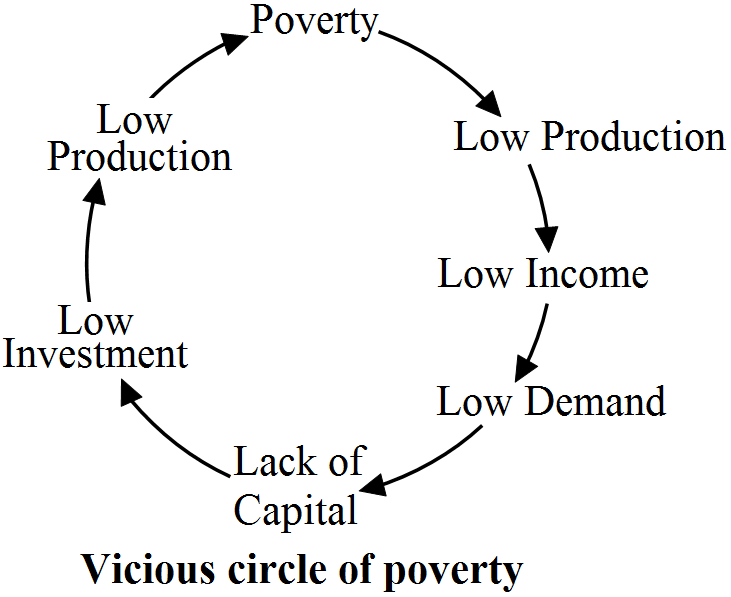
Explain the vicious circle of poverty.
Answer
Vicious circle of poverty implies that poverty is the cause of poverty. There are many vicious circles of poverty. One of them is depicted below:
View full question & answer
Question 301 Mark
Suppose you are from a poor family and you wish to get help from the government to set up a petty shop. Under which scheme will you apply for assistance and why?
Answer
I will apply under Pradhan Mantri Rozgar Yojana (PMRY) for assistance. Under this scheme financial assistance is provided to set up small businesses to educated unemployed from lower income families in rural and urban areas.
View full question & answer
Question 311 Mark
It is not possible to eradicate poverty completely Do you agree?
Answer
No, I do not agree that it is not possible to eradicate poverty completely. In the world as a whole, there are plenty of resources to produce food but still there is hunger. Poverty in the present day world is more of a question of inequitable distribution of income and wealth. It is possible to eradicate poverty completely by complete re-distribution of existing resources and incomes.
View full question & answer
Question 321 Mark
Explain Gini Co-efficient.
Answer
The Gini Co-efficient was proposed by Italian statistician Corrado Gini in 1912 as a measure of inequality of income and wealth, i.e. as a measure of relative poverty. The coefficient varies between 0 which reflects complete equality, and I which indicates complete inequality. India's Gini Index is 0.339.
View full question & answer
1 Marks Question - Economics STD 12 Commerce Questions - Vidyadip