Questions

6 Marks Question

🎯

Test yourself on this topic

22 questions · timed · auto-graded

Question 16 Marks
Explain different causes of poverty.
Answer
Causes of poverty are many Important of them are as follows:
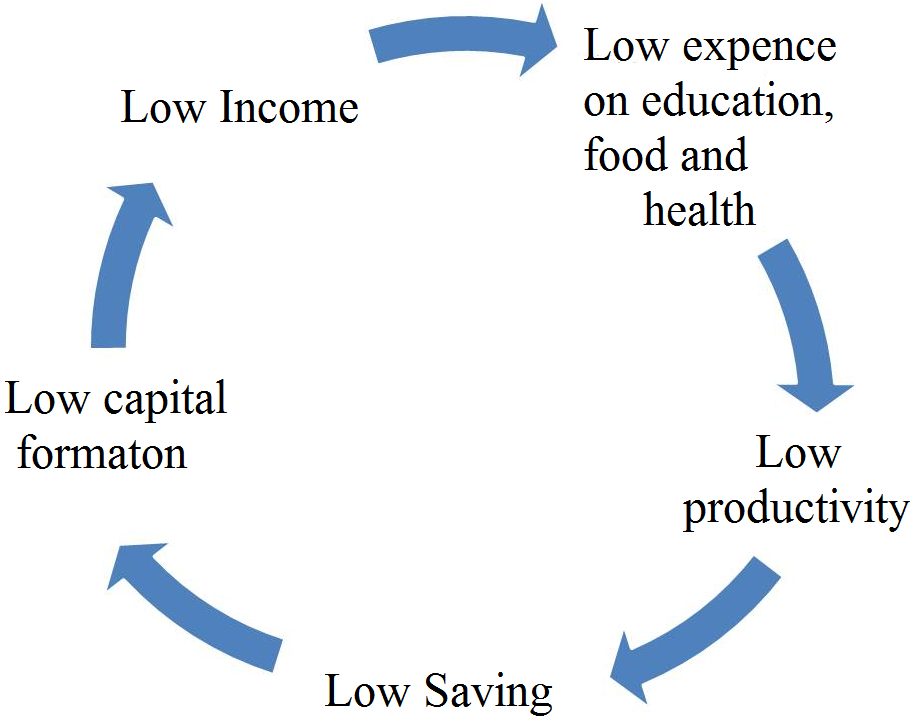
  1. Poverty itself is the biggest cause of poverty: Poverty is a cause as well as effect of poverty. A man is poor because he is poor. It is called vicious circle of poverty.
  2. Low level of economic development: During British Rule; British ruined textile industry of India. They used India as mere exporter of raw material and buyer of finished goods. They exploited our economy and left us as depleted economy.
  3. Income Inequalities: Due to Zamindari System, land was unequally distributed. Even other income generating assets were unequally distributed. Even after independence this inequality continued and exists till date. It caused poverty.
  4. Caste System, gender inequality and other social evils: Social system of India has also played its role in widening of poverty.
  5. Corruption: Due to corruption, poverty alleviation programmes which were framed could not succeed.
  6. Low level of industrial growth: India did not pay much attention on secondary sector. It kept people disguisedly employed in agriculture sector leading to unemployment, low level of output and continuation of poverty.
View full question & answer
Question 26 Marks
The three dimensional attack on poverty adopted by the government has not succeded in poverty alleviation in India. Comment.
Answer
The three dimensional approach of economic growth, employment generation and alleviating poverty could not achieve the desired result. Although there has been a reduction in the percentage of absolute poor in some of the states but still the poor people lack basic amenities, literacy, and nourishment. This is because of:
  • Unequal distribution of land and other assets among rich and poor farmers.
  • Improper implementation of poverty alleviation programmes by ill-motivated and inadequately trained bureaucrats further worsened the situation.
  • Corruption along with the inclination towards interest of elites led to an inefficient and misallocation of scarce resources.
View full question & answer
Question 36 Marks
Economic planners are of the view that poverty could be eradicated through growth oriented approach. Discuss the measures which will help to bring growth in an economy.
Answer
The different measures which will help to bring growth in an economy are:
  1. Income distribution should be improved: The government should try to improve the mechanism of income distribution and try to reduce income inequalities with the help of fiscal and legislative measures.
These are:
  1. Fiscal measures: These measures relate to the provisions related to taxation and subsidy. The government should adopt progressive system of taxation in which the richer section of the society is charged with higher rate of taxes and tax exemption is given to those with low incomes. Also, money collected as tax from the rich can be used to give subsidies to the poor, thus ensuring equitable distribution of income.
  2. Legislative measures: These measures are implemented by passing laws and are mandatory for all those who fall under its purview.
  1. Population control: The government should try to control the population of the country which is rising at a very fast rate. Poverty cannot be eradicated unless and until population of the country is controlled. Inspite of a significant growth in the national income of the country, the per capita income remains low due to excessive rise in population. Population control will reduce the dependent members in a poor household and help them to improve their status.
  2. Other measures:
  1. Development of agriculture and other allied activities.
  2. Maintaining stability in the price level.
  3. Eradication of unemployment.
  4. Promoting labour intensive technique of production.
  5. Developing backward regions.
View full question & answer
Question 46 Marks
Poverty in India is a historical, political, social-economic, religious issue. Comment.
Answer
Yes, It is very true that poverty in India is a historical, political, social-economic, Religious issue.
  1. As A Historical Issue: Poverty has been caused due to the low level of economic development and exploitation of Indian economy during British rule.
  2. As A Political Issue: India could not eradicate poverty due to political instability and lack of commitment from ruling parties in implementation of different poverty alleviation programmes.
  3. As A Social Issue: Caste system, population, superstitions, Traditions, and gender inequality are some of the social causes of poverty.
  4. As An Economic Issue: Unemployment, income inequalities, low rate of industrialization are some of the economic causes of poverty.
  5. As A religious Issue: Expenditure on religious ceremonies leading to indebtedness and wrong religious beliefs giving birth to lethargy and lack of efforts for eradication of poverty.
View full question & answer
Question 56 Marks
How can creation of income earning assets address the problem of poverty?
Answer
The problem of poverty cannot be solved by giving food grains to the poor or distributing clothes lo them as no government can keep doing these activities for long due to lack of resources. Poverty can effectively be eradicated only when the poor start earning for themselves and in turn contribute to growth by their active involvement in the growth process. This is possible by providing income generating assets to the poor in the form of land for agriculture, tools and instruments to set up self employment units and giving them proper training which will enhance their income earning capacity. This can help poor people to participate in economic activities and make them empowered. This will also help create employment opportunities which may lead to increase in levels of income, skill development, health and literacy and thus poor can be assured of income per month which will help him lo come above the poverty line.
View full question & answer
Question 66 Marks
Explain the three dimensional attack on poverty adopted by the government.
Answer
Three dimensional approach to remove Poverty:
  1. Growth oriented approach: This approach is based on an expectation that effects of economic growth (rapid increase in GDP and per capital income) would spread to all sections of the society and will trickle down to the poor section also. It was felt that rapid industrial development and transformation of agriculture through green revolution in selected regions will benefit more backward sections of the community.
  2. Poverty alleviation programme: This is the second approach that has been initiated from the third five year plan and progressively enlarged since then(the government has introduced a variety of programmes for education of poverty Poverty alleviation programmes (PAP) in India:
  • Prime minister's Rozgar Yojana(PMRY)
  • Swarna Jayanthi Shahri Rozgar Yojana (SJSRY)
  • Swarna Jayanthi Gram Swarozgar Yojana (SGSY)
  • Sampoorna Grameen Rozgar Yojana (SGRY)
  • Mahatama Gandhi National Rural Employment Guarantee Act 2005
  • Pradhan Mantri Gramodaya Yojana (PMGY)
  • National Social Assistance Programme (NSAP)
  1. Minimum Needs programmes: The third approach is to provide minimum basic amenities to the people. India was among the pioneers that it would visualize that through public expenditures on social consumption needs. (Foodgrains at subsidized rates, education, health, water supply sanitation) people's living standard could be improved. Programmes under this approach are expected to supplement the consumption of the poor. Three major programmes that aim at improving the food and nutritional status of poor are:
  • Public Distribution System.
  • Integrated Child Development Scheme.
  • Midday Meal Scheme.
View full question & answer
Question 76 Marks
Poverty itself is the biggest cause of poverty. Explain.
Answer
Poverty itself is the biggest cause of poverty. It happens when there is henegg phenomenon. We call it vicious circle of poverty. Vicious circle of poverty says that a man is poor because he is poor. Since a man is poor, he can't afford proper food, medical facilities and education. Therefore, his physical and mental productivity remains low. Since his productivity is low, he continues to remain poor. Same is applicable at macro level. An economy with low level of income can spend less on its physical and human capital and therefore, its productivity continues to remain low. It continues to be a poor economy.
View full question & answer
Question 86 Marks
Is there any relationship between unemployment and poverty? Explain.
Answer
Yes, there do exist a direct and positive relationship between unemployment and poverty. Unemployment leads to poverty and poverty in turn leads to unemployment.
An unemployed person has no means to earn money and cannot fulfill his own and his familyes basic needs. He and his family cannot avail quality education, medical facilities and has no means to create income-earning assets. Such circumstances often compel indebtedness. Consequently, an unemployed person exaggerates poverty for his family due to indebtedness. This confirms the positive relationship between unemployment and poverty.
If government wants to alleviate poverty, then it should aim at creating new employment opportunities. As a result, more people will get employed and perhaps their income will rise. This rise in income will improve their access to quality education, better health care and other basic amenities. Further, these newly employed people will experience appreciation in their living standards and can create income-earning assets. The combined result of all these factors leads to alleviation of poverty. Hence, there exists a positive (but a negative) relationship between unemployment (employment) and poverty.
View full question & answer
Question 96 Marks
Many farmers have reported to have committed suicides in Andhra Pradesh and Maharashtra. Why?
Answer
The opening of the domestic market due to globalization has increased the exposure of farmers and led to agrarian distress and cause for suicides. Scholars have cited several factors that have contributed to this:
  1. Shift from traditional to commercial farming combined with withdrawal of the state assistance.
  2. Decline in public investment in agriculture in the last two decades.
  3. Competition from large global firms, cheap imports leading to low profits.
  4. Crop failure, pest attack and drought.
  5. Debt at very high interest rate.
  6. Lack of access to water for crops, which forced the farmers to borrow money at exorbitant rates of interest.
View full question & answer
Question 106 Marks
The poverty alleviation programmes initiated by the government have not met with much success. Why?
Answer
The poverty alleviation programmes initiated by the government have not met with much success.The reasons for the failure can be attributed to:
  1. Lack of proper implementation by the government officials who are corrupt, dishonest and untrained. Due to this, the benefits of the programme were appropriated by those who did not need it.
  2. Lack of active participation of the poor.
  3. It was difficult to identify the poorest, who are in most need of the help.
  4. Without the basic infrastructure, it is difficult to implement these programmes, especially in rural areas.
  5. Non-participation of the local level institutions in the implementation of the programmes.
  6. The funds allocated for these programmes were also not sufficient.
View full question & answer
Question 116 Marks
"Though India has considerably increased its saving and investment rate since independence, yet this is not adequate enough to give such a high rate of growth that is needed to eradicate poverty". What can be done to solve this problem?
Answer
More efforts should be made by the government to increase domestic savings and expand inflow of foreign resources for further increasing the rate of investement in the economy. Due to high growth of population, the efforts are neutralised. Keeping this in mind, the government should start new projects which will help in providing more employment opportunities to the people. As a result, national income as well as per capita income will increase. Thus, the ultimate effect will be reduction in poverty.
View full question & answer
Question 126 Marks
"Poverty in India has taken deep roots due to two major factors viz., low level of economic development and wide inequalities in income distribution and asset ownership." Added to these two, mention another third important factor that has perpetuated poverty in India and how?
Answer
Third important factor that has perpetuated poverty in India is the high growth rate of population since 1951. Between 1951 and 2001, over 66 crore people were added to India's population. Fast growing population needs high growth rate of GNP to sustain the growing number of people and maintain them even at the minimum living standards. Increasing population reduces savings and capital formation. This limits the GNP growth rate. Consequently, slow rate of growth of GNP and high growth rate of population decreases the growth rate of per capita income.
View full question & answer
Question 136 Marks
Explain the three dimensions of the government's approach to the poverty reduction in India.
Answer
The three dimensions of the government's approach to the poverty reduction in India are:
  1. The growth-oriented approach based on the expectation that effects of economic growth (by way of rapid increase in GDP and PCI) would spread to all sections and world.
Spread to all sections of the society, and trickle down to the poorer sections also. But the fact is population growth led to a very low growth in per capita income (PCI). The gap between the rich and the poor further widened. The Green Revolution augmented disparities between regions and large and small farmers.
  1. Specific poverty alleviation programmes were implemented, in order to raise the incomes and employment for the poor through the creation of additional assets and work generation. Selfemployment programmes like Rural Employment Generation Programme (REGP) and Prime Minister Rozgar Yojana (PMRY) where implemented. Swarna Jayanti Shahari Rozgar Yojana (SJSRY) mainly aimed at creating employment opportunities for self-employment and wage employment in the urban areas.
  2. To meet the basic and minimum needs of the poor by providing minimum basic amenities. Three major programmes to improve the food and nutritional status of the poor were started by way of:
  • Public Distribution System.
  • Integrated Child Development Scheme.
  • Mid-day Meal Scheme.
Additionally, the government also launched a number of other social security programmes like National Social Assistance Progarmme especially for elderly poor and women who are desitutes or widows.
View full question & answer
Question 146 Marks
Explain the process of categorising poverty.
Answer
One of the most popular way of categorising poverty is that:
  1. People who are always poor and those who are usually poor, but sometimes have a little work and thereby earn little money are grouped together as the 'Chronic Poor'.
  2. Another group includes the 'Churning poor', i.e., those who regularly move in and out of poverty, e.g., seasonal and small workers and those who are occasionally poor, i.e., those who are rich but sometimes go through a phase of bad luck. They are grouped together as the transient poor'.
  3. Last group is of never poor called the 'Non-poor'.
View full question & answer
Question 156 Marks
Explain the main causes of poverty in India.
OR
Explain any four main causes of poverty in India.
Answer
The main causes of poverty in India are:
  1. Agriculture even today remains the mainstay of people in India and land is the primary asset owned by the rural people. Those who own land are better-off in material well-being sense and can further improve their living conditions. But those who do not own land (majority) are the worse-off.
  2. With the rapid growth of population and in the absence of alternative sources of employment, the per head availability of land for cultivation has declined. This has further lead to subdivision and fragmentation of land. On account of this, the income from these small landholdings is inadequate to meet even the basic needs of the family.
  3. Industrialization in the economy has not been able to absorb the urban poor who continue to be unemployed or underemployed as casual workers.
  4. Poverty is also an outcome of unemployment and underemployment in the urban and rural areas. This leads to increased indebtedness in both urban and rural areas. As a matter of fact, indebtedness is one of the most important cause of poverty in India.
View full question & answer
Question 166 Marks
Explain the concept of poverty line with the help of the population below poverty line in some states of India.
OR
How is poverty line estimated?
Answer
The person whose consumption expenditure falls below the poverty line as estimated, is said to be living below the poverty line. Poverty line can be estimated in the following ways:
  1. A common method used to measure poverty is based on the income or consumption levels.
  2. A minimum level of food requirement and other basic needs such as clothing, fuel and light, educational and medical requirement, footwear etc, are determined for subsistence.
  3. These are then calculated in terms of money required to consume them by multiplying their physical quantities by their prices in rupees.
  4. According to the new poverty estimates for 2011-12, the poverty line for a person is fixed at 32 per day in the urban areas and 26 per day in the rural areas. The person whose expenditure falls below the poverty line as estimated, are said to be living below the poverty line.
  5. The poorest states in India are Bihar, Manipur and Chattisgarh with almost half the population living below poverty line and West Bengal, Uttar Pradesh, Orissa and Madhya Pradesh with about 30 percent of people living below poverty line.
View full question & answer
Question 176 Marks
Briefly explain the three dimensional attack on poverty adopted by the government.
Answer
The government's attack on poverty had three dimensions:
  1. Growth-oriented approach: Trickle down effect an economic theory that says that the growth of gross domestic product and per capita income by allowing the rich to flourish, would eventually benefit lower income groups also through increased economic activity and reduced unemployment.
It was government's approach to poverty reduction. It was felt that rapid industrial development and transformation of agriculture through green revolution would benefit the underdeveloped regions and the more backward sections of the community.
  1. Creation of income generating assets and poverty alleviation programmes: Creation of income generating assets like land, social networks which encourage empowerment and community services, fixed public assets like wells, clinics, schools, bridges which generate employment. The access to these assets and their use serves as a foundation for earning a livelihood. Rural households in a traditional Indian society produce their own food and diversify their productive activities in every possible way to ensure earning Potential.
  1. Providing minimum basic amenities: The third approach is to provide minimum basic amenities to the people, through public expenditure on social consumption needs, provision of foodgrains at subsidised rates, education, health, water supply and sanitation. Programmes under this approach are expected to supplement the consumption of the poor, create employment opportunities and bring about improvements in health and education.
View full question & answer
Question 186 Marks
Refute/ accept government's claim on decline in the poverty levels in India.
Answer
  1. Despite of the government's policy towards poverty alleviation evolving, over the last 55 years, the poverty levels have failed to decline. There are three major areas of concern in their meaningful implementation.
  2. On account of unequal distribution of land and other assets, the benefits from the so called poverty alleviation programmes have been misappropriated by the non-poor.
  3. The resources allocated for these programmes of poverty eradication are extremely inadequate in comparison to its magnitude.
  4. Corrupt government and bank officials used these resources inefficiently and this thereby led to their wastage.
  5. Alongwith this, the lack of participation of local bodies also turned out to be detrimental in the successful implementation of the programmes.
  6. Last but not the least, only when the poor start contributing by way of their active participation in growth process, then poverty can be eradicated effectively. For this, a 'process of social mobilisation is urgently called for to encourage and empower them.
View full question & answer
Question 196 Marks
What programmes has the government adopted to help the elderly people and poor and destitute women?
Answer
  1. National Social Assistance Programme (NSAP): NSAP was introduced on 15 August, 1995 as a 100 percent Centrally Sponsored Scheme for social assistance to poor households affected by old age, death of primary bread earner and maternity care. The programme has three components, i.e., N ational Old Age Pension Scheme (NOAPS), National Family Benefit Scheme (NFBS) and National Maternity Benefit Scheme (NMBS).
  2. Annapurna: This scheme came into effect from April 1, 2000 as a 100 percent Centrally Sponsored Scheme. It aims at providing food security to meet the requirement of those senior citizens who though eligible for pensions under the National Old Age Pension Scheme, are not getting the same. Foodgrains are provided to the beneficiaries at subsidised rates of ₹ 2 per kg of wheat and ₹ 3 per kg of rice. The scheme is operational in states and 5 union territories. More than 6.08 lakh families have been identified and the benefits of the scheme are passing on to them.
View full question & answer
Question 206 Marks
Illustrate the difference between rural and urban poverty. Is it correct to say that poverty has shifted from rural to urban areas? Use the trends in poverty ratio to support your answer.
Answer
The difference between rural and urban poverty is mainly of the nature of poverty. The poor are identified on the basis of their occupation and ownership of assets. The rural poor work mainly as landless agricultural labourers, cultivators with very small landholdings, landless labourers who are engaged in a variety of non-agricultural jobs and tenant cultivators with small landholdings. On the other hand, the urban, poor are largely the overflow of the rural poor who had migrated to urban areas in search of alternative employment and livelihood, labourers who do a variety of casual jobs and the self-employed who sell a variety of things on roadsides and are engaged in various activities. It can be seen from the following table showing the trends in poverty ratio that poverty has shifted from rural to urban areas.
Yearwise Poverty Ratio:
Year
Poverty ratio
Rural (%)
Urban (%)
Total (%)
1973-74
56.4
49.0
54.9
1977-78
53.1
45.2
51.3
1983
45.6
40.8
44.5
1987-88
39.1
38.2
38.9
1993-94
37.3
32.4
36.0
1999-2000
27.1
23.6
26.1
2004-05
28.3
25.7
27.5
Source Planning Commission Estimates (Uniform Reference Period). It is evident from the above table that rural poverty has declined significantly from 56.4% in 1973-74 to 28.3% in 2004-05 whereas decline in urban poverty (from 49% to 25.7%) is not that significant. Moreover, the gap between the rural and urban poverty ratios which was around 7% in 1973-74 fell to just around 2% in 2004-05 again signifying the shift in poverty from rural to urban areas.
View full question & answer
Question 216 Marks
Why are employment generation programmes important in poverty alleviation in India?
Answer
The importance of employment generation programmes in poverty alleviation efforts in India are as follows:-
  • Direct Relationship between Employment and Poverty Alleviation: There exists a positive relationship between employment and poverty alleviation. If government aims at creating new employment opportunities, then more people will be employed that will raise their income and, thus, will pull them above the poverty line.
  • Higher Standard of Living: With the increase in income, consequent to the new employment opportunities, poverty trodden people can enjoy higher standard of living and greater accessibility to education, better health facilities, proper sanitation, etc.
  • Reduce Rural-Urban Migration: Poor people tend to migrate from rural to urban areas in sought of better employment and earning opportunities. This creates undue burden on the urban areas to provide ample job opportunities to these migrants. Failure of this leads to formation of informal sector that makes these people more vulnerable in the urban areas. A positive point of employment generation programmes is that it generates ample employment opportunities in rural areas so as to reduce rural-urban migration.
  • Creation of Durable Assets: The employment generation programmes aim at creation of durable assets like watershed development works, water harvesting, irrigation facilities, canal building, construction of roads connecting rural areas to urban areas and construction of dams. All these assets play an important role in the social and economic development of the country.
  • Self-sufficiency and Self-reliant Areas: The creation of these durable assets protects the poverty-trodden areas from natural calamities such as floods and droughts thereby facilitating these areas to be self-sufficient and self reliant.
  • Impart and Enhance Skills: Most of the employment generation programmes help in human capital formation by enhancing knowledge and imparting skills to the unskilled labourers. Such skills increase the employment prospect of the unskilled labourers in the industrial and the service sectors. This not only enhances income earning capacities of these people but also alleviates poverty simultaneously.
  • Reduce underemployment and disguised unemployment: Indian agricultural sector is characterised by disguised unemployment. This implies that although a labourer is engaged in agriculture but the total output wont be affected even if the labourer is withdrawn. The role of employment generation programmes in reducing disguised unemployment is very important. These programmes engage these extra labourers in economically fruitful activities, thereby, reducing unnecessary burden on the agricultural sector.
View full question & answer
Question 226 Marks
Suppose you are a resident of a village, suggest a few measures to tackle the problem of poverty.
Answer
Being a resident of a village, I would suggest the following measures to tackle the problem of poverty:
  • Introducing policies for agricultural growth and poverty alleviation
  • Policies for speedy development of rural infrastructure.
  • Accelerating human resource development through opening new skill development centres.
  • Growth of non-farm employment.
  • Providing easy credit facilities for income generating assets.
  • Providing access to job creating assets.
  • Improving the Public Distribution System.
  • Introducing new employment schemes for poor.
  • Opening up of new primary and secondary schools with midday meal programs.
  • People should be made aware about the different employment programmes which are launched by government for their welfare.
  • New social security schemes should be launched for elderly people, destitute women and differently-abled people.
  • Vocational training centres and skill development centres should be opened.
  • Inputs for agricultural production should be made available at cheap rates or at subsidised prices.
View full question & answer
6 Marks Question - Economics STD 12 Commerce Questions - Vidyadip