Questions · Page 1 of 2

5 Marks Question

🎯

Test yourself on this topic

50 questions · timed · auto-graded

Question 15 Marks
"It is an organised mechanism meant for effective and smooth transfer of financial resources from the investors to the entrepreneurs."
  1. Identify the mechanism and list its different types.
  2. Name the association of persons established under the mechanism identified in (a) above. Also, explain any four points of its importance to investors.
Answer
  1. Capital market; primary and secondary market.
  2. Stock exchange.
Importance:
  • Dissemination of useful information: Stock exchange publishes useful information regarding price lists, quotations, etc., of securities through newspapers and journals .The interested persons buy and sell their securities on the basis of information provided by the stock exchanges.
  • Ready market: Persons desirous of converting their shares into cash may easily do so through a member of stock exchange.
  • Investors' interests protected: Stock exchanges formulate rules and regulations so that members may not exploit the investors
  • Genuine guidance about the securities listed: The investors can safely depend upon the information provided by the stock exchanges.
  • Barriers of distance removed: Stock exchange removes the barriers of distance with regard to securities listed there. Without stock exchange the securities of a Delhi company may have a limited market in Delhi only.
  • Knowledge of profit or loss on investments: The investors can estimate the profit or loss on the total amount of investments in securities, by comparing the original amount invested and the price of securities on a particular day.

View full question & answer
Question 25 Marks
What is the objective with which 'Industrial Reconstruction Bank of India' was setup? State any five functions performed by this Bank.
Answer
The main objective of IRBI is to function as the principal credit and reconstruction agency for the purpose of revival of sick industries and bring coordination among various agencies working in the same area.
Functions:
  1. Taking over the management of sick industrial units.
  2. Leasing sick units out.
  3. Selling sick units as running enterprises.
  4. Preparing schemes for reconstructions by scaling down the liabilities.
  5. Assisting and promoting industrial development by granting loans and advances.
  6. Subscribing and underwriting of shares and debentures.
  7. Making provisions for infrastructure facilities, merchant banking, managerial activities and consultancy services.
View full question & answer
Question 35 Marks
State any three 'Direct Assistance' and any three 'Indirect Assistance' provided by Small Industries Development Bank of India.
Answer
Direct Assistances:
  1. SIDBI provides lendings to organisations which are at least private limited companies through its own branches.
  2. Provides assistance to service sector.
  3. SIDBI's direct loans are available for business ventures costing not less than ₹ 150 lakhs and needing a term loan of at leat ₹ 100 lakhs.
Indirect Assistance:
  1. Financial Assistance is primarily channelised through the existing credit delivery system.
  2. Provides refinance to and discounts bills of Primarily lending Institutions(PLl).
  3. All forms of business organizations are eligible for refinance assistance.
View full question & answer
Question 45 Marks
Explain the practical steps involved in setting up a Small-Seale-Enterprise at stage-II.
Answer
The practical steps involved in setting up a small scale enterprise at stage:
  1. Preparation of Project Report.
  2. To obtain No objection certificate.
  3. Obtaining formal sanction of loan.
  4. Construction of building and installation of machinery.
  5. Detailing man power.
  6. Establishing marketing network.
  7. Application for permanent registration.
View full question & answer
Question 55 Marks
Explain the concept of 'Planning Paradigm', and 'The Four Stage Growth Model' of it.
Answer
The Planning Paradigm refers to a general pattern which suggests how to progress from an abstract idea to achieving sustained stability, growth and value added service.The Four Stage Growth Model:
  1. Pre-Start Up Stage: Planning the venture, preliminary work and organising resources.
  2. Start-up stage: Pre-start up implementation, positioning the venture, making operational objectives.
  3. Early Growth stage: Period of moderate or rapid development, venture may undergo changes.
  4. Later Growth stage: Evolution into a large enterprise, active competitors in the market.
View full question & answer
Question 65 Marks
What is meant by Factoring? State any five features of Factoring.
Answer
Factoring means sale of accounts receivable to a bank or finance company.
Features:
  1. It is an arrangement whereby the trade debtors are assigned to the bank or finance company.
  2. The payment is received against the debtor's balance in advance.
  3. It is usually not an option for a new venture.
  4. The factors not only have the task of collecting the cash, but they also carry the cash if the debtor does not pay up.
  5. The entrepreneur interested in availing factoring service has to pay specified charges to the bank or finance company.
View full question & answer
Question 75 Marks
Explain the following sources of finance of an enterprise:
  1. Chit-Fund.
  2. Personal saving.
  3. Deposits from dealers.
  4. Private money-lenders.
Answer
Source of finance:
  1. Chit fund- small amount is contributed by different members and they get money by converting their chit into cash.
  2. Personal savings: savings of the entrepreneur to be used when the amount required is small.
  3. Deposit from dealers: when the dealers are appointed, they are asked to give security deposit. which can be used by the entrepreneur for short term as well as long term.
  4. Private money lenders: they provided money against some security and the rate of interest is very high.
View full question & answer
Question 85 Marks
Name and explain the type of capital which is known as risk capital of an enterprise. State any two advantages and any two limitations of this capital.
Answer
Risk capital: equity shares (owner's capital) owner's fund provides risk capital to enterprise. Provides permanent capital and is non refundable. Provides basis of control over management of the enterprise.Advantages:
  1. Permanent capital.
  2. Right of control over the management.
Limitations:
  1. Difficult to raise.
  2. Depends upon number of persons ready to take the risk of investing their personal savings.
View full question & answer
Question 95 Marks
Name and explain the type of capital which does not provide any right of control over management of the enterprise. State any two advantages and any two limitations of this capital.
Answer
Name borrowed capital - Debentures/term loans. It is the amount of capital borrowed by the entrepreneurs. Interest is payable as a charge and the principal amount is payable as and when due cannot be used as permanent capitalAdvantages:
  1. No risk of control over management of the enterprise.
  2. Interest is tax deductible expense.
Limitations:
  1. Difficult to utilise this source of finance if adequate security is not available.
  2. Fixed obligation to pay interest and the principal amount of loan.
View full question & answer
Question 105 Marks
You propose to set up an automated plant to process and export potato chips. The estimated financial outlay is ₹ 12 crores (not including the cost of land and building) and the working capital estimates are ₹ 30 lakhs per month. Explain what sources of financing you would resort to and the reasons for opting for that source.
Answer
Sources of finance available are shares, debentures, loans from banks and financial institutions.
Merits of issuing shares are:
  1. No repay:- Once equity shares are issued, they are not required to be paid back. It serves as a permanent finance for the company.
  2. Borrowing capacity:- More is the quantity of equity shares, more is the faith earned by the company.
  3. Source of credit:- Equity shares serve as a reason for obtaining credit form the financial market. Higher is the equity share; higher are the chances of obtaining funds from the financial market.
  4. Safe:- Shareholder receives the dividend only after meeting other obligations of the company. Also whether to pay the dividend, how much to pay etc. are at the discretion of the management.
Merits of issuing debenture are:
  1. Low cost:- The cost raising funds through debentures is much cheaper than the equity shares. It does not require much advertisement and promotion.
  2. Control:- No impacts on control of the enterprises as debenture holder have no right to vote in the matter of the enterprises. Thus there is no risks of dilution of power of the management
  3. Scope of other sources:- Other sources of finance can also be used for obtaining funds along with the debentures.
  4. Limited obligation:- The obligation of paying interest and the principal is only for limited period after the lapse of the period the obligation is automatically removed.
View full question & answer
Question 115 Marks
'It is an organised mechanism meant for effective and smooth transfer of financial resources from the investors to the entrepreneurs.'
  1. Identify the mechanism and list its different types.
  2. Name the association of persons established under the mechanism identified in (a) above. Also, explain any four points of its importance to investors.
Answer
  1. Capital market primary and secondary market.
  2. Stock exchange.
importance of stock exchange to the investors:
  • Dissemination of useful information: Stock exchange publishes useful information regarding price lists, quotations, etc., of securities through newspapers and journals.The interested persons buy and sell their securities on the basis of information provided by the stock exchanges.
  • Ready market: Persons desirous of converting their shares into cash may easily do so through a member of stock exchange.
  • Investors' interests protected: Stock exchanges formulate rules and regulations so that members may not exploit the investors.
  • Genuine guidance about the securities listed: The investors can safely depend upon the information provided by the stock exchanges.
  • Barriers of distance removed: Stock exchange removes the barriers of distance with regard to securities listed there. Without stock exchange the securities of a Delhi company may have a limited market in Delhi only.
  • Knowledge of profit or loss on investments: The investors can estimate the profit or loss on the total amount of investments in securities, by comparing the original amount invested and the price of securities on a particular day.

View full question & answer
Question 125 Marks
Differentiate between Preference Shares and Equity Shares on the basis of the following:
  1. Payment of Dividend.
  2. Repayment of Capital.
  3. Voting Right.
  4. Convertibility.
  5. Rate of Dividend.
  6. Redemption order.
Answer
Difference between Preference shares and equity shares:
Basis Preference Shares Equity Shares
Payment of dividend. Preferential right to the payment of dividend. Get the dividend after the payment of dividend to the preference shareholders.
Repayment of capital. Preferential right to mthe repayment of preference share capital. Repayment after making repayment to preference share.
Voting right. Donot carry voting right. Enjoy voting rights.
Convertibility. Can be converted to equity shares. Non-convertible.
Rate of dividend. Fixed. Varies from year to year.
Redemption order. Redeemed during the lifetime of the company. Not redeemable during the lifetime of the company.
View full question & answer
Question 135 Marks
Distinguish between Shares and Debentures on the basis of the following:
  1. Status of the Investor.
  2. Return Rate.
  3. Convertibility.
  4. Right to Vote.
  5. Redemption of Capital.
  6. Charge on Assets.
Answer
Difference between shares and Debentures:
Basis Shares Debentures
Status of Investor. Owners. Creditors.
Return rate. No fixed dividend. Fixed rate of interest.
Convertibility. Not convertible. Convertible.
Right to vote. Carry the right to vote. Do not carry the right to vote.
Redemption of capital. Payment of principal amount after debenture-holders at the time of dissolution of the company. Payment of principal amount repayable before shareholders.
Charge on Assets. Not secured against any charge. Issued for a period exceeding any charge 18 months are always secured against charge.
View full question & answer
Question 145 Marks
What is meant by Retained Profit? Explain any five advantages of Retained Profit.
Answer
Meaning of retained profit: Like an individual, companies too, set aside a part of their profit to meet future requirements. The portion of profits not distributed among the shareholders but retained and used in business is called retained earnings. It is also referred to as ploughing back of profit. This is one of the important sources of internal financing used for fixed as well as working capital. Retained earnings increase the value of shareholders in case of a growing firm.
Advantage of retained profit:
  1. Cheaper Source of Financing: The use of retained earnings does not involve any acquisition cost. The company has no obligation to pay anything in respect of retained earnings.
  2. Financial Stability: Retained earnings strengthen the financial position of a business and thereby give financial stability to the business.
  3. Stable Dividend: Shareholders may get stable dividend even if the company does not earn enough profit.
  4. Market Value: Retained earnings strengthen the financial position of a company and appreciate the capital which ultimately increases the market value of shares.
  5. Floatation Cost: Unlike other sources of financing, the use of retained earnings helps avoid issue- related costs.
View full question & answer
Question 155 Marks
What is meant by venture capital? State any five features of venture capital.
 
Answer
Venture capital: Venture capital is a type of private equity capital provided as seed funding to early-stage, high potential, high risk, growth up companies/ entrepreneurs who lack the necessary experience and funds to give shape to their ideas. Venture capital is an equity based investment in a growth-oriented small to medium business to enable the investors to accomplish objectives, in return for minority shareholding in the business or the irrevocable right to acquire. It is more accurate to view venture capital broadly as a professionally managed pool of equity capital. Venture capital is a way in which investors support entrepreneurial talent with finance and business skills to exploit market opportunities and obtain long-term capital gains. Venture capital has been used as a tool for economic development in a variety of developing regions.
Features of venture capital (any five)
  • It is basically equity finance in relatively new companies.
  • It is long-term investment in growth-oriented small or medium firms.
  • Venture capitalist not only provide capital but also business skills to investee firms.
  • It involves high risk-return spectrum.
  • It is a subset of private equity.
  • The venture capital institutions have a continuous involvement in the business after making the investment.
  • Such institutions disinvest the holdings either to the promoters or in the market.
View full question & answer
Question 165 Marks
Explain the four sources of obtaining funds under financial-resources.
Answer
Four sources for obtaining funds under financial resources:
  1. Loans.
  2. Venture capital.
  3. Grants.
  4. Own funds.
View full question & answer
Question 175 Marks
Answer each of these questions in about one hundred and fifty words:
Rahil (Finance) and Anushk (HR) are doing MBA (IIM Indore) While reading the newspaper Anushk saw the heading 'Sensex goes up. But last week the heading was different that 'Sensex goes down. , now some confusion was going on his mind, immediately he asked his Friend Rahil the same? Now according to you how Rahil will clear the confusion of Anushk? Explain and give some value points.
Answer
Rahil explains him in this way: The Sensex is an “index”. An index is basically an indicator. It gives you a general idea about whether most of the stocks have gone up or most of the stocks have gone down. The Sensex is an indicator of all the major listed companies of the BSE. The BSE, is the Bombay Stock Exchange and the NSE is the National Stock Exchange. The BSE is situated at Bombay and the NSE is situated at Delhi. These are the major stock exchanges in the country. If the Sensex goes up, it indicates that the prices of the stocks (shares) of most of the major companies on the BSE have gone up. If the Sensex goes down, this tells you that the stock price of most of the major stocks on the BSE have gone down. In this way Rahil cleared the confusion of Anushk.Value Points:
  1. Quest for knowledge
  2. Helpfulness
  3. Consideration for others
  4. Awareness of responsibility
  5. Readiness to cooperate
  6. Friendship.
View full question & answer
Question 185 Marks
Write the full forms of various SFIs and when they were established.
Answer
S. No.
Specialised Financial
Institutions (SFis)
Full forms
Year of establishment
1.
SIDC
State Industrial Development Corporation
1956
2.
TFCI
Tourism Finance Corporation of India
1989
3.
SFCs
State Finance Corporations
1951
4.
NABARD
National Bank for Agriculture and Rural Development
1982
5.
IFCI
Industrial Finance Corporation of India
1948
6.
IDBI
Industrial Development Bank of India
1964
7.
ICICI
Industrial Credit and Investment Corporation of India
1955
8.
IIBI
Industrial Investment Bank of India
1971
9.
SIDBI
Small Industries Development Bank of India
1990
View full question & answer
Question 195 Marks
Company A goes for public issue of 10,000 shares @RS. 10 each. Application were received for only 5,000 shares. Can the company proceed with the process of issuing shares.
Answer
In the case of Company A
Issued shares to public — 10,000 Shares @ 10 each.
Applied share public by — 5,000 Shares @ 10 each.
Company receives only 50% of the subscription within 120 days from the date of the issue, then it is called as Minimum subscription.
As per the SEBI guidelines:
  • if the company does not receive 90% of the issue amount from the public subscription including development from underwriters within 120 days from the date of the issue, the amount of subscription received is required to be refunded to the applicant.
  • In case of disputed development also, subscription is required to be refunded if 90% of the issued amount plus accepted.
  • Development from underwriters if any is not received within 120 days of the issue of prospectus, all the money received from the applicants for shares is required to be repaid forthwith without interest and if any such money is not so repaid in the next 10 days (after the expiry of 120 days), the directors of the company are jointly and severally liable to repay that money, with interest from the expiry of the 130 days.
  • The company should refund the amount within 10 weeks of the closing of the subscription list and pay interest, if refunds are delayed by more than 8 days after this period.
View full question & answer
Question 205 Marks
Answer each of these questions in about one hundred and fifty words:
Write down the objectives of IDBI.
Answer
Write down the objectives of IDBI.p
IDBI Industrial Development Bank of India
Established/ Set up IDBI was set up in July 1964 as a wholly owned subsidiary of the Reserve Bank of India.
Purpose The purpose was to enable the new institution to benefit from the financial support and experience of RBI.
Ownership transferred Before 16th February, it was delinked from RBI in 1976 and was made an autonomous corporation. In February 1976, the ownership of IDBI was transferred to Government of India. After the transfer of its ownership, IDBI became the main institution, through which the institutes engaged in finance and made an autonomous corporation.
Government's shareholding Government's shareholding in IDBI stands at 72.14%.
Objectives It is to serve as the apex institution for term finance for industry in India. Its objectives include:
1. Co-ordination, regulation and supervision of the working of other financial institutions such as IFCI, ICICI, UTI, LIC, Commercial Banks and SFCs.
2. Supplementing the resources of other financial institutions and thereby widening the scope of their assistance.
3. planning, promotion and development of key industries and diversifications of industrial growth.
4. Devising and enforcing a system of industrial growth that conforms to national priorities.
View full question & answer
Question 215 Marks
Distinguish between ICICI and SIDBI.
Answer
S.No ICICI SIDBI
1. To assist in the formation, expansion and modernization of industrial units in the private sector. The financial assistance of SIDBI to the small scale sector is channelised through the following two routes:
(i) Indirect assistance. (ii) Direct assistance.
2. To stimulate and promote the participation of private capital (both Indian and foreign) in such industrial units. To stimulate and promote the participation of private capital (Indian) in such industrial units.
3. To furnish technical and managerial aid so as to increase production and expand employment opportunities.
(i) It provides medium and long-term loans in Indian and foreign currency for importing capital equipment and technical services. Loans sanctioned generally go towards purchase of fixed assets like land, building and machinery.
SIDBI has taken over the responsibility of administering following two funds which were previously administered by IDBI i.e.:
(i) Small Industries Development Fund.
(ii) Small Industries Development Assistance Fund.
4. ICICI is a public sector institution. SIDBI is a private sector institution.
5. No such special financial assistance for women entrepreneur. Extends seed capital/ loan assistance under the National Equity Fund Mahila Udyan Nidhi and Mahila Vikas Nidhi and seed capital scheme through specified lending agencies.
View full question & answer
Question 225 Marks
Answer each of these questions in about two hundred and fifty words:
Explain the functions of stock exchange.
Answer
Stock exchange performs a number of functions in respect of marketability of different types of securities for investors and borrowing companies. It’s important functions are:
  1. Continuous and ready market for securities:
  • Stock exchange provides a central market for purchase and sale of securities.
  • It provides ready and continuous outlet for buying and selling of securities.
  • It facilitates and helps all buyers to buy and sell securities as and when they want.
  1. Facilitates evaluation of securities:
  • It is useful for the correct evaluation of industrial securities.
  • It publishes price quotation of the shares of the companies that have been listed with them after thorough analysis of demand and supply position.
  • This enables investors to know the true worth of their holdings at any time.
  1. Checks on brokers: It checks and controls the activities of brokers and protect the investors from being deceived.
While dealing’ if any broker is found indulging in malpractices as overcharging or giving wrong information, his/her licence may be cancelled.
  1. Provides safety and security in dealings:
  • All activities of the stock exchange are controlled by the provisions of the Securities Control (Regulation) Act and this creates confidence in the mind of investors.
  • Each and every dealings and transactions are conducted as per well defined rules and regulations, fraudulent practices stands checked effectively ensuring safety, security and justice in dealings.
  1. Regulates company management: All listed companies in the stock exchange, compulsorily have to follow with rules and regulations of concerned stock exchange and work under the vigilance of their authorities.
View full question & answer
Question 235 Marks
TFCI is playing vital role in the development of entrepreneurship in modern economy‖. Comment.
Answer
The Tourism Finance Corporation of India (TFCI) was born as a result of the Government of India’s decision, in 1987, to promote a separate all-India financial institution for providing financial assistance to tourism-related activities/ projects. It was incorporated as a public limited company under the Companies Act, 1956 on 27 January, 1989. It became operational with effect from 1 February, 1989.It is a specialized all-India development financial institution to cater to the needs of the tourism industry.
Functions:
  1. It provides financial assistance to enterprises for setting up or the development of tourism- related projects, facilities and services such as hotels, restaurants, holiday resorts, amusement parks, entertainment centres, education and sports, rope ways, cultural centres, convention halls, transport, travel and tour operating agencies, air services, tourism emporia and sports facilities.
  2. It provides advisory and merchant banking services in this field.
  3. The projects with a capital cost of Rs 1 crore or above are generally eligible for assistance from TFCI. Smaller projects would also be considered.
  4. TFCI has sanctioned assistance to 2003 projects aggregating to Rs 5.2 billion during the last five years, resulting in more than 12,217 hotel rooms and direct employment to 22,938 people.
Values:
  1. Universal and equality
  2. Resourcefulness
  3. Services to others
  4. Readiness to cooperate
  5. National awareness
  6. Employment opportunities
  7. Fulfilling the needs of the people
  8. Helpfulness and contributing to entrepreneur for the growth of the country.
View full question & answer
Question 245 Marks
Discuss the advantages and disadvantages of financial institutions for an entrepreneur.
Answer
Advantages of financial institutions for an entrepreneur:
  1. Borrowing money from the bank is one of the simplest ways to get needed funds to start or grow your business.
  2. To grant loans and advances.
  3. To underwrite or to subscribe to shares or debentures of industrial concerns.
  4. To guarantee loans raised by industrial concerns in the market.
  5. To provide consultancy and merchant banking services in or outside India.
  6. To provide technical, legal, marketing and administrative assistance to any industrial concern or person for promotion, management or expansion of any industry.
  7. Co-ordination, regulation and supervision of the working of other financial institutions such as IFCI, ICICI.
  8. To act as trustee for the holders of debentures or other securities.
  9. To provide long and medium-term credit to industrial concerns engaged in manufacturing, mining, shipping and electricity generation and distribution.
  10. The bank will serve as a financing institution for institutional credit such as long-term, short-term, and for the promotion of activities in rural areas.
  11. Provides financial assistance to enterprises for setting up or the development of tourism-related projects.
Disadvantages: Procurement of finance involves risk and formalities to comply:
  1. State Financial Corporations only provide long and medium-term loan repayment ordinarily within a period not exceeding 20 years.
  2. Some financial institutions provide financial assistance generally to those industrial concerns whose paid up share capital and free reserves do not exceed Rs 3 crore.
  3. Rate of interest is too high sometimes not able to pay the debt amount and its interest.
View full question & answer
Question 255 Marks
Harish is working as the chief accountant in ABC Infrastructure Ltd. He came to know that the company is planning to announce an interim dividend. He purchased 2000 shares of the company at the market price of ₹215 with the expectation of an appreciation in the market price. When the price increased to₹ 537 he sold his holdings and made a handsome profit. Name the related concept which social values have been affected here?
Answer
The related concept is insider trading. Insider trading means the use of material non-public information in trading the shares of a company by a corporate insider or any other person who owes a fiduciary duty to the company.Consequently, when an insider of a company uses its price sensitive confidential information to buy or sell its securities, thereby making a personal profit, he or she commits acts that have moral as well as legal implications. Social values affected are:
  1. Innocent shareholders and investors stand to loose.
  2. Personal benefits are held in greater regard than societal benefits.
View full question & answer
Question 265 Marks
Explain the functions of stock exchange.
Give some value points to it.
Answer
Stock exchange performs a number of functions in respect of marketability of different types of securities for investors and borrowing companies. It's important functions are:
  1. Continuous and ready market for securities:
  1. Stock exchContinuous ange provides a central market for purchase and sale of securities.
  2. It provides ready and continuous outlet for buying and selling of securities.
  3. It facilitates and helps all buyers to buy and sell securities as and when they want.
  1. Facilitates evaluation of securities:
  1. It is useful for the correct evaluation of industrial securities.
  2. It publishes price quotation of the shares of the companies that have been listed with them after thorough analysis of demand and supply position.
  3. This enables investors to know the true worth of their holdings at any time.
  1. Checks on brokers:
  1. It checks and controls the activities of brokers and protect the investors from being received.
  2. While dealing, if any broker is EL found indulging in malpractices as overcharging or giving wrong information, his/her licence may be cancelled.
  1. Provides safety and security in dealings:
  1. All activities of the stock exchange are controlled by the provisions of the Securities Control (Regulation) PEL Act and all this creates confidence in the minds of investors.
  2. Each and every dealings and transactions are conducted as per well-defined rules and regulations, fraudulent practices stands checked effectively ensuring safety, security and justice in dealings.
  1. Regulates company management:
  1. The companies which are listed also have to operate within the strict rules and regulations.
  2. This ensures safety of dealing through stock exchange.
  3. All of them have to work under the vigilance of stock exchange authorities.
  1. Intensifying capital formation and promoting the habit of saving and investment:
  1. The stock market offers attractive opportunities of investment in various securities.
  2. It encourages people to save more and invest in securities of corporate sector rather than investing in unproductive assets such as gold, silver, etc.
  3. It also creates a habit of risk taking among the investing class by converting their savings into profitable and help them for safe investments.
  1. Facilitates raising of new capital: It facilitates an entrepreneur of existing companies for the need for more capital for further development, organisation or expansion and help them to meet the need.
  2. Facilitates public borrowing: It serves as a platform for marketing government securities. It enables government to raise public debt easily and quickly.
  3. Facilitates healthy speculation: To ensure liquidity and demand of supply of securities, the stock exchange permits healthy speculation of securities and always keeps the exchange active.
  4. Serves as economic barometer: Stock exchange indicates the state of health of companies and the national economy. It acts as a barometer of the economic situation/conditions and is thus referred as pulse of economy or economic mirror.
  5. Facilitates bank lending: Banks easily know the prices of quoted securities. They offer loans to customers against corporate securities. This gives convenience to the owners of securities.
Value Points:
  1. Helpfulness: The stock market helps to value the securities on the basis of demand and supply factors.
  2. Quest for knowledge: The valuation of securities is useful for investors, government and creditors.
  1. The investors know the value of their investment.
  2. The creditors know the value of credit worthiness.
  3. Government knows to impose taxes on value of securities.
  1. Truthfulness and equality: Only STRE listed companies can operate in stock exchange.
  1. To protect national property and economic growth: In stock exchange securities of various companies are bought and sold. This process of disinvestment and reinvestment helps to invest in most productive investment proposal and this leads to capital formation and economic growth.
  2. Readiness to cooperate: Readiness to cooperate and ensures safety of dealing through stock exchange.
  3. Encourage and promotes the habit of savings and honest investment: It offers attractive opportunities of investment in various securities. It encourages people to save more and invest in securities of corporate sector rather than investing in unproductive assets such as gold, silver, etc.
  4. Better transparency, genuine settlement cycle, honest transaction, etc.
View full question & answer
Question 275 Marks
Apoorva wants to start a new business near to her locality, for which she requires capital. State different types of national level and state level financial institutions from where Apoorva can access capital according to her needs and requirements.
Answer
The different types of national level and state level financial institutions from where Apoorva can access capital are as follows:
  1. At national level:
  1. Industrial Development Bank of India (IDBI)
  2. Small Industries Development Bank of India (SIDBI)
  3. Industrial Finance Corporation of India (IFCI)
  4. Industrial Credit and Investment Corporation of India (ICICI)
  5. National Bank for Agriculture and Rural Development (NABARD)
  6. Industrial Investment Bank of India (IIBI)
  1. At state level:
  1. State Financial Corporations (SFCs)
  2. Tourism Finance Corporation of India (TFCI)
  3. State Industrial Development Corporations (SIDCs)
View full question & answer
Question 285 Marks
Answer each of these questions in about fifty words:
State some mushrooming sources of raising finance in the business.
Answer
A company may raise funds for different purposes depending on the time periods ranging from very short to fairly long duration. The total amount of financial needs of a company depends on the nature and size of the business. The scope of raising funds depends on the sources from which funds may be available. Here, we shall discuss some mushrooming sources available to an entrepreneur to raise finance; Long-Term and Medium-Term Capital, they have the following options:
  1. Capital markets:
  • Issue of Shares
Equity shares: The rate of dividend on these shares depends on the profits available and the discretion of directors. Hence, there is no fixed burden on the company. Each share carries one vote.

Preference shares: Dividend is payable on these shares at a fixed rate and is payable only if there are profits. Hence, there is no compulsory burden on the company’s finances. Such shares do not give voting rights.
  • Issue of Debentures.
  1. Angel investors: Business angle or an angle investor, is an affluent individual who provides capital for a business start-up and early stage companies having a high-risk, high- return matrix usually in exchange for convertible debt or ownership equity.
  2. Venture capital: Venture capital is an equity based investment in a growth-oriented small to medium business to enable the investors to accomplish objectives, in return for minority shareholding in the business. It is a way in which investors support entrepreneurial talent with finance and business skills to exploit market opportunities and obtain long-term capital gains.
  3. Specialized financial institutions: Specialized Financial Institutions (SFIs) make an important source of medium and long term financing amongst all the financial institutions in India, to the industry.
At national level/ All India development banks
  1. Industrial Development Bank of India (IDBI).
  2. Small Industries Development Bank of India (SIDBI).
  3. Industrial Finance Corporation of India (IFCI).
At state level
  1. State Financial Corporation (SFC).
  2. Tourism Finance Corporation of India (TFCI).
  3. State Industrial Development Corporations (SIDC).
View full question & answer
Question 295 Marks
Siddharth is an innovative entrepreneur. He has decided to open an online portal which helps people to order food items 24 x 7. But, before implementing his project, he wants to investigate the marketability of his idea. He approached a venture capitalist to fund his investigation. Which form of finance is Siddharth availing of?
Answer
Siddharth is looking for 'seed capital finance'. Seed capital refers to the capital required by an entrepreneur for conducting research at pre-commercialisation stage. During this stage, the entrepreneur has to convince the venture capitalist, why his idea/product is feasible. Venture capitalist may deny to assist, if the findings and investigations are not upto his satisfaction.
View full question & answer
Question 305 Marks
Assuming that you wish to start a small scale industry for manufacturing and selling detergent powder, discuss how would you seek support of financial institutions.
Answer
Yes, to start with a small scale industries for manufacturing and selling is really a tough job in this competitive world where already many other detergent manufacturing units are there. Detergents are also known as synthetic detergents. They are different from oil-based soap though both soaps and detergents are surfactants. There are a number of varieties of detergents varying in percentages of active matter present in them and also different colours. Manufacturing process is very simple and only mixing is involved. Hence, this product is best suited for manufacturing in small-scale sector. An entrepreneur can seek support from various financial institutions and others.
  1. Angel Investors:
  • Business angle or an angel investor is an affluent individual who provides capital for a business start-up and early stage companies having a high-risk, high-return matrix usually in exchange for convertible debt or ownership equity.
  • Apart from investing funds, most angle provide proactive advice, guidance, industry connections and mentoring start-ups in its early days.
  1. Venture Capitalist:
  • Venture capital is an equity based investment in a growth-oriented small to medium business to enable the investors to accomplish objectives, in return for minority shareholding in the business or the irrevocable right to acquire.
  • The private equity capital provided as funding to early-stage, high potential, high risk, growth up companies/ entrepreneurs who lack the necessary experience and funds to give shape to their ideas.
  • Accordingly, it is more accurate to view and go for venture capital broadly as a professionally managed pool of equity capital.
  • Venture capital is a way in which investors support entrepreneurial talent with finance and business skills to exploit market opportunities and obtain long-term capital gains.
State Financial Corporations (SFCs):
  1. It will be to meet the financial needs of small and medium enterprises, established as development banks for their respective regions. Under the Act, SFCs have been established by state governments to meet the financial requirements of medium and small sized enterprises. There are 18 SFCs at present. According to the location I can easily approach the same.
  2. Grant of loans and advances to or subscribe to debentures of, industrial concerns repayable within a period not exceeding 20 years.
  3. Guaranteeing loans raised by industrial concerns which are repayable within a period not exceeding 20 years.
  4. Guaranteeing deferred payments due from an industrial concern for purchase of capital goods in India.
View full question & answer
Question 315 Marks
Hari is an entrepreneur who wants to start an amusement park in Indore. He knows that she needs a huge amount of initial capital. According to you which of the financial institution will be more suitable to him? Suggest and Explain why?
Answer
Accordingly Hari should approach to Tourism Finance Corporation of India (TFCI), the financial institution. TFCI is playing vital role in the development of entrepreneurship in modern economy. The Tourism Finance Corporation of India (TFCI) was born as a result of the Government of India’s decision, in 1987, to promote a separate all-India financial institution for providing financial assistance to tourism-related activities/ projects. It was incorporated as a public limited company under the Companies Act, 1956 on 27 January, 1989.It became operational with effect from 1 February, 1989. It is a specialized all- India development financial institution to cater to the needs of the tourism industry.The various functions:
  1. It provides financial assistance to enterprises for setting up or the development of tourism- related projects, facilities and services such as hotels, restaurants, holiday resorts, amusement parks, entertainment centres, education and sports, rope ways, cultural centres, convention halls, transport, travel and tour operating agencies, air services, tourism emporia and sports facilities.
  2. It provides advisory and merchant banking services in this field.
  3. The projects with a capital cost of 1 crore or above are generally eligible for assistance from TFCI. Smaller projects would also be considered.
Values:
  1. Providing employment opportunities.
  2. Cater to the financial needs of the tourism industry.
  3. To protect national property.
  4. Awareness of responsibility of citizenship.
  5. Initiative.
  6. Proper utilization of time and resources.
View full question & answer
Question 325 Marks
Explain the concept of IFCI.
Answer
S.No.
Logo
Details
1.
IFCI
2.
Establishment/ Set-up
IFCI was established as a statutory corporation on 1st July, 1948 by a special Act passed in the Parliament, IFCI Act, 1948. It was converted into a public limited company on July 1, 1993
3.
Purpose
Its main purpose is to provide medium and long term credit to eligible industrial enterprises in corporate sectors of the economy, particularly to those industries to which banking facilities are not available.
4.
Objectives
Objectives:
The primary role of IFCI is to provide direct financial assistance' on medium and long term basis to industrial projects in the corporate and co-operative sectors. The objectives of the corporation are stated below:
  1. To provide long and medium-term credit to industrial concerns engaged in manufacturing, mining, shipping and electricity generation and distribution.
  2. The period of credit can be as long as 25 years and should not exceed that period.
  3. To grant credit to a single concern up to a maximum amount of rupees one crore. This limit can be exceeded with the permission of the government under certain circumstances.
  4. Guarantee loans and deferred payments.
  5. Underwrite and directly subscribe to shares and debentures issued by companies.
  6. Assist in setting up new projects as well as modernization of existing industrial concerns in medium and large scale sector.
  7. Assist project under co-operatives and in backward areas.
5.
Function
The main functions of I.F.C.I. are as under:
  1. Granting loans and advances for the establishment, expansion, diversification and modernization of industries in corporate and co-operative sectors.
  2. Guaranteeing loans raised by industrial concerns in the capital market, both in rupees and foreign currencies.
  3. Subscribing or underwriting the issue of shares and debentures by industries. Such investment can be held up to 7 years.
  4. Guaranteeing credit purchase of capital goods, imported as well as purchased within the country.
  5. Providing assistance, under the soft loans scheme, to selected industries such as cement, cotton textiles, jute, engineering goods, etc.
  6. Providing technical, legal, marketing and administrative assistance to any industrial concern for the promotion, management and expansion of the industrial concern.
View full question & answer
Question 335 Marks
Rahil (Finance) and Anushk (HR) are doing MBA (IIM Indore). While reading the newspaper Anushk saw the heading 'Sensex goes up. But last week the heading was different that 'Sensex goes down.' Now some confusion was going on his mind, immediately he asked his friend Rahil the same. Now according to you, how Rahil will clear the confusion of Anushk? Explain and give some value points.
Answer
Rahil can clear the confusion of Anushk, by explaining to him about the working of the stock exchange and the terminology used in the above transactions. Sensex is a stock market index which reflects the market direction and indicates day-to-day fluctuations in stock prices. Sensex is the benchmark index of Bombay Stock Exchange (BSE). It is a useful guide for investors in the stock market. It includes most actively traded shares of 30 prominent companies of the country. If the sensex rises, it indicates that the market is doing well and investors are optimistic of the future performance of the economy. The opposite holds true, when sensex falls.Through the computation of sensex, BSE guides the investors regarding their investment decision and also helps them to make safe investment, thereby protecting their hard earned money.
View full question & answer
Question 345 Marks
Explain the concept of IDBI (its full form, establishment year, purpose, objectives, and functions).
Answer
S.No
IDBI
Industrial Development Bank of India
1.
LOGO
2.
Established/
Setup
IDBI was set up in July 1964 as a wholly owned subsidiary of the Reserve Bank Set up of India.
3.
Purpose
The purpose was to enable the new institution to benefit from the financial support and experience of RBI.
4.
Ownership
transferred
Before 16th February, it was delinked from RBI in 1976 and was made an autonomous corporation. In February 1976, the ownership of IDBI was transferred to Government of India. After the transfer of its ownership, IDBI became the main institution, through which the institutes engaged in finance and made an autonomous corporation.
5.
Government's shareholding
Government's shareholding in IDBI stands at 72.14%.
6.
Objectives
To serve as the apex institution for term finance for industry in India. Its objectives include:
(i)
Co-ordination, regulation and supervision of the working of other financial institutions such as IFCI, ICICI, UTI, LIC, Commercial Banks and SFCs.
(ii) Supplementing the resources of other financial institutions and thereby widening the scope of their assistance.
(iii) Planning, promotion and development of key industries and diversifications of industrial growth.
(iv) Devising and enforcing a system of industrial growth that conforms to national priorities.
7.
Functions
1.
The IDBI has been established to perform the following functions - To grant loans and advances to:
(i) IFCI, SFCs.
(ii) Any other financial institution by way of refinancing of loans repayable within 25 years.
(iii) To grant loans and advances to scheduled banks or state co-operative banks by way of refinancing of loans granted which are repayable in 15 years.
(iv) To grant loans and advances to all above mentioned institutions of industrial concerns for exports.
(v) any industrial concern.
2. To discount or rediscount bills of industrial concerns:
(i) To underwrite or to subscribe to shares or debentures of industrial concerns.
(ii) To subscribe or to purchase stock, shares, bonds and debentures of other financial institutions.
3. To provide consultancy and merchant banking services in or outside India.
4. To provide technical, legal, marketing and administrative assistance to any industrial concern or person for promotion, management or expansion of any industry.
5. Planning, promoting and developing industries to fill up gaps in the industrial structure in India.
6. To act as trustee for the holders of debentures or other securities.
View full question & answer
Question 355 Marks
Twitter Tweets
Twitter-named after the sound of chirping birds in 2006, has today established itself as a cultural touchstone, growing from a few thousand geeky users to more than 200 million today.
Most of twitter's revenue comes from advertising. Research firm marketer estimates that Twitter will generate $ 582.8 million in worldwide ad revenue for 2013, up from $288.3 million in 2012.
Twitter's money making potential has minted the company with an estimated market value of $ 10 billion, based on the appraisals of venture capitalists and other early investors who have been helping to fund the business so far.
Aiming for a sustainable future, Twitter, as has been long expected, tweets 'It will go public'.
The law that allowed Twitter to file its initial IPO documents confidentially is called the Jumpstart Our Business Start-ups Act (JOBS) President Barack Obama signed the law in 2012. It is designed to make it easier for small businesses and startups to grow and create jobs. Do you understand the significance of all this........???
Going public could give Twitter the muscle to become the next facebook or Apple - says one analyst.
The capital gains from going public will likely allow the company to make solid investments across the board in hiring, operations and acquisition- that's the power of finance.
  1. What is the full form of JOBS?
  2. Which source of raising finance has been opted for, by Twitter?
  3. Where will the company invest the funds so generated?
Answer
  1. The acronym JOBS stands for Jumpstart Our Business Start-ups Act. It was signed by Barack Obama in 2012.
  2. 'Twitter has opted for public issue as a source for raising finance.
  3. The company will invest the funds so raised in hiring, operations and acquisitions.
View full question & answer
Question 365 Marks
Answer each of these questions in about two hundred and fifty words:
Explain in detail objectives and three important Primary functions of NABARD.
Answer
National Bank for Agriculture and Rural Development (NABARD): On 15th December, 1981, National Bank for Agriculture and Rural Development (NABARD) Bill was passed in the Parliament, which started functioning on 1st July, 1982. NABARD was established according to the Preamble to the Act, for providing credit for the promotion of:
  1. Agriculture.
  2. Small-scale Industries.
  3. Cottage and Village Industries.
  4. Handicrafts and other rural crafts.
  5. Other economic activities in rural areas with a view for promoting IRDP and securing prosperity of rural areas.
Objectives:
  1. The bank will serve as a financing institution for institutional credit such as long-term, short-term, and for the promotion of activities in rural areas.
  2. To provide direct lending to any institution as may be approved by the central government.
Functions: The primary functions of NABARD can be classified under three heads:
  1. Credit Functions: NABARD provides different types of refinance to eligible institutions. They assist entrepreneurs through: Short-term credit to State Cooperative Banks, Regional Rural Banks and Other financial institutions approved by RBI.
  2. Developmental Functions:
    • NABARD coordinates the operations of rural credit institutions.
    • It develops expertise to deal with agricultural and rural problems so as to assist in rural development efforts.
  3. Regulatory Functions:
    • NABARD is empowered to undertake inspection of RRBs and Cooperative Banks, other than the Primary Cooperative Banks.
    • To open a new branch, are commendation of NABARD is imperative by RRBs or Cooperative Banks to seek permission from RBI.
View full question & answer
Question 375 Marks
Answer each of these questions in about two hundred and fifty words:
Write down the features of stock exchanges.
Answer
  1. Association of persons: A stock exchange is an association of persons or body of individuals which may be registered or unregistered.
  2. Recognition from central government: Stock exchange is an organized market. It requires recognition from the Central Government.
  3. Market for securities: Stock exchange is a market, where securities of corporate bodies, government and semi-government bodies are bought and sold.
  4. Deals in second hand securities: It deals with shares, debentures, bonds and such securities already issued by the companies. In short, it deals with existing or second hand securities and hence it is called secondary market.
  5. Regulates trade in securities: Stock exchange does not buy or sell any securities on its own account. It merely provides the necessary infrastructure and facilities to its members and brokers who trade in securities. It regulates the trade activities so as to ensure free and fair trade.
  6. Allow dealings only in listed securities: In fact, stock exchanges maintain an official list of securities that could be purchased and sold on its floor. Securities which do not figure in the official list of stock exchange are called unlisted securities. Such unlisted securities cannot be traded in the stock exchange.
  7. Transactions effected only through members: All the transactions in securities at the stock exchange are effected only through its authorized brokers and members. Outsiders or direct investors are not allowed to enter in the trading circles of the stock exchange. Investors have to buy or sell the securities at the stock exchange through the authorized brokers only.
  8. Working as per rules: Buying and selling transactions in securities at the stock exchange are governed by the rules and regulations of stock exchange as well as SEBI Guidelines. No deviation from the rules and guidelines is allowed in any case.
  9. Specific location: Stock exchange is a particular market place where authorized brokers come together daily (i.e. on working days) on the floor of market called trading circles and conduct trading activities. The price of different securities traded are shown on electronic boards. After the working hours market is closed. All the working of stock exchange is conducted and controlled through computers and electronic system.
  10. Financial barometers: Stock exchanges are the financial barometers and development indicators of national economy of the country. Industrial growth and stability is reflected in the index of stock exchange.
View full question & answer
Question 385 Marks
'Air India has defaulted on working capital loan interest payment of 200 crores due to the financial crisis that the airlines is facing' confirms Air India sources on 21st May, 2011. Air India has high-cost loans worth about 40000 crores.
Air India is facing a tight financial situation and is in talks with lenders to restructure its debt of ₹ 40,000 crores. The lenders have agreed to reduce interest rates on part of the debt that is linked to overseas borrowings. The future of the remaining debt is still uncertain, especially because lenders are seeking a conversion of their debt into equity or equity like instruments. This is perhaps the first time that the national carrier has defaulted on its payments to banks. Sources said the airline had approached banks for more loans but they have declined to help because of the airlines' poor financial health.
And they say 'finance is difficult for new entrepreneurs.......... Its always a major concern.
  1. Air India' has high cost loans worth about₹ 40,000 crores. From the above statement, identify the source of finance Air India.
  2. Give one advantage and one disadvantage of raising finance through this source.
  3. What will be the effect of conversion of debt into equity on the financial health of the company?
Answer
  1. Air India has sourced its funds from external sources.
  2. Advantage is that control is not diluted. Disadvantage is that fixed expenses in the form of interest, prove to be a burden.
  3. The conversion would reduce interest payments for the airline, thereby reducing its burden.
View full question & answer
Question 395 Marks
Interesting History Before World War II, development capital were primarily the domain of wealthy individuals and families. It was not until after World War II, that what is considered today to be true private equity investments began to emerge by the founding of the first two venture capital firms in 1946:
  1. American Research and Development Corporation (ARDC).
  2. JH Whitney Company.
ARDC was founded by George's Doriot, the 'father of venture capitalism' (former dean of Harvard Business School and founder of INSEAD), with Ralph Flanders and Karl Compton (former President of MIT), to encourage private sector investments in businesses run by soldiers who were returning from World War II. ARDC's significance was primarily that it was the first institutional private equity investment firm that raised capital from sources other than wealthy families.
ARDC continued investing until 1971 with the retirement of Doriot. In 1972, Doriot merged ARDC with Textron after having invested in our 150 companies.
  1. Name the first two venture capital firms.
  2. Who is known as the father of venture capitalism?
  3. What was ARDC's significance?
Answer
  1. The first two venture capital firms, established in 1946, were as follows:
  1. American Research and Development Corporation (ARDC).
  2. JH Whitney Company.
  1. George Doriot, the founder of ARDC is known as the father of venture capitalism.
  2. Before World War II, development capital was primarily the domain of wealthy individuals and families. ARDC's significance was primarily that it was the first institutional private equity investment firm that raised capital from sources other than wealthy families.
View full question & answer
Question 405 Marks
Assuming that you wish to start a small scale industry for manufacturing and selling detergent powder, discuss how would you seek support of financial institutions.
Answer
The first step in seeking support from financial institutions lie in the preparation of an effective 'business plan'.
A 'business plan' describes the venture, its product and the entrepreneurial team. Also, it states the money needed by the business, how it will be spent as well as the objectives of the business and how they will be achieved. The key areas addressed in a business plan are:
  1. A short description of the business-history, past achievements, products and services, competition and market position, location and business structure,
  2. Brief details of your experience and background including trade and business references.
  3. The outlook for your business and the industry in which it operates.
  4. The amount and purpose of the loan.
  5. Whether the amount sought makes allowances for unexpected events.
  6. Details of the equity you have in the business.
  7. A statement of your personal financial position
  8. A balance sheet and profit and loss statement for the last 3 years.
  9. An analysis of major influences affecting operating performance over the last 3 years, a cash flow forecast for at least the next 12 months with a separate listing of the assumptions on which it is based.
  10. A listing of debtors and creditors dissected by age and amount outstanding.
  11. Security for borrowings.
  12. ames and contact details of key advisors to the business.
The financial institution reviews a plan on the basis of 5Cs-Character, Capital, Conditions, Capacity and Collateral and if satisfied, approves the loan.

Application should specifically be made to SIDBI, as it has been established to promote small scale sector in the country.
View full question & answer
Question 415 Marks
Financial GamingGoogle purchased Motorola Mobility for 9800000000 (in USD), Microsoft Corporation purchased Skype for 8500000000 (in USD) and Nokia handset and Service business for 720000000 (in USD) as notable merges and amalgamation of 2011 because latters were in financial crisis and formers were financial strong looking for expansion strategies.
What is the reason for the above mergers and acquisitions?
Answer
The companies Motorola Mobility, Skype, and Nokia handset and Service business were in financial crisis and Google and Microsoft were looking for expansion strategies.
View full question & answer
Question 425 Marks
Answer each of these questions in about two hundred and fifty words:
Explain some important sources of raising finance in business.
Answer
A Methods of flotation of new issues: An entrepreneur can raise the required capital in the primary market by the following methods:
  1. Public issue.
  2. Rights issue.
  3. Private placement.
  4. Offer to the employees.
  1. Public issue: Public issue is the most popular method of raising capital these days by the entrepreneurs. This involves raising of funds directly from the public through the issue of prospectus. An enterprise organizing itself as a public limited company can raise the required funds commonly by preparing a prospectus.
    When an entrepreneur offers shares to the public for subscription he/ she is required to comply with all the restrictions and formalities pertaining to the initial issues, prospectus drafting and launch.
    One of the most difficult problems in the new venture creation process is obtaining finance when an entrepreneur decides to go public and become a public company.
  2. Rights issue: Rights issue is a method of raising additional finance from existing shareholders by offering securities to them on pro-rata basis i.e. giving them a right to a certain number of shares in proportion to the shares they are holding.
    Normally, through a circular, rights issues are proposed to the existing shareholders and in case they are not willing to subscribe, they can renounce the same in favour of another person. This method of issuing securities is considered to be inexpensive as it does not require any brokers, agents, underwriters, prospectus or enlistment, etc.
  3. Private placement: Private placement means the direct sale by a company of its securities to a limited number of sophisticated investors. Entrepreneurs, herein, raise funds by selling the issues mainly to the institutional investors like:
    • Unit Trust of India.
    • Life Insurance Corporation of India.
    • General Insurance Corporation of India.
    • Army Group Insurance.
    • State Level Financial Corporations, etc.
    Entrepreneurs both from public limited and private limited sectors bank heavily upon raising funds through the issue of varied financial instruments under this segment as at times they do not wish to disclose information to the open market.
  4. Offer to employees: Stock options or offering shares to the employees has gained much popularity in many countries of the world. This method enables employees to become shareholders and share the profits of the company leading to:
    • Higher efficiency.
    • Low labour turnover.
    • Better industrial locations.
    • Low floatation cost.
    • Wider/ higher generation of funds.
View full question & answer
Question 435 Marks
Interesting History Before World War II, development capital were primarily the domain of wealthy individuals and families. It was not until after World War II, that what is considered today to be true private equity investments began to emerge by the founding of the first two venture capital firms in 1946:
  1. American Research and Development Corporation (ARDC).
  2. JH Whitney Company.
ARDC was founded by George's Doriot, the 'father of venture capitalism' (former dean of Harvard Business School and founder of INSEAD), with Ralph Flanders and Karl Compton (former President of MIT), to encourage private sector investments in businesses run by soldiers who were returning from World War II. ARDC's significance was primarily that it was the first institutional private equity investment firm that raised capital from sources other than wealthy families.

ARDC continued investing until 1971 with the retirement of Doriot. In 1972, Doriot merged ARDC with Textron after having invested in our 150 companies.
  1. Name the first two venture capital firms.
  2. Who is known as the father of venture capitalism?
  3. What was ARDC's significance?
Answer
  1. The first two venture capital firms, established in 1946, were as follows:
  1. American Research and Development Corporation (ARDC)
  2. JH Whitney Compan.
  1. George Doriot, the founder of ARDC is known as the father of venture capitalism.
  2. Before World War II, development capital was primarily the domain of wealthy individuals and families. ARDC's significance was primarily that it was the first institutional private equity investment firm that raised capital from sources other than wealthy families.
View full question & answer
Question 445 Marks
Mr B the financial manager of ABC Company purchases 100 shares of the company just before the rights issue was announced. Is the behaviour of the manager ethical? What would you do as a legal advisor of the company?
Answer
No, the behaviour of the manager is not ethical. He is indulging in 'insider trading'. As the legal advisor of the company, I would advise Mr B, to disclose the above transaction to SEBI. If he fails to do so, legal action can be initiated against him.Market regulatory body, SEBI has penalised the former director of Ranbaxy Laboratories, Mr VK Kaul and his wife for insider trading. They are stipulated to pay almost 60 lakhs for their role in the sale of 6.5 lakh shares of orchid chemicals and Pharmaceuticals.
View full question & answer
Question 455 Marks
Answer each of these questions in about two hundred and fifty words:
"An entrepreneur can raise the required capital in the primary market". Explain the various methods of raising the funds in the primary market by an entrepreneur.
Answer
Yes, an entrepreneur can raise the required capital in the primary market. The various methods of raising the funds in the primary market by an entrepreneur are as follows :
  1. Public Issue.
  2. Rights Issue.
  3. Private Placement.
  4. Offer to the employees.
  1. Public Issue/ Going Public: Public issue is the most popular method of raising capital these days by the entrepreneurs. This involves raising of funds directly from the public through the issue of prospectus. An entrepreneur organizing itself as public limited company can raise the required funds commonly by adopting prospectus.
  2. Right Issues: It is an offer of new securities by a listed company to its existing shareholders only. The right issues are done always on the pro-rata basis (giving them a right to a certain number of shares in proportion to the shares they are holding.)
  • The companies send the letter of offer (circular) to all those existing shareholders whose names are recorded in the books on a particular date to issue rights.
  • The time given to accept the right offer should not be less than 15 days.
  • The circular/ notice issued to the shareholder must state the right of the shareholder to renounce the offer in favour of others.
  • After the expiry of the time mentioned in the notice, the Board of Directors has the right to dispose the unsubscribed shares in any manner as per the benefit of the company.
The existing shareholders whose names are there in the list has four options:
  • They can exercise the rights.
  • They can renounce the rights and sell them the same in the open market in favour of another person.
  • They can renounce part of the rights and exercise the other part.
  • Doing nothing.
This method of issuing securities is considered to be inexpensive as it does not require any brokers, agents, underwriters, prospectus or enlistment, etc.
  1. Private Placement: It refers to the direct sale of newly issued securities by the company to a small number of institutional investors through merchant bankers. They are generally selected clients.
  • Unit Trust of India.
  • Life Insurance Corporation of India.
  • General Insurance Corporation of India.
  • Army Group Insurance.
  • State Level Financial Corporations.
Advantages:
  • Less time taken to issue these shares.
  • Comparatively less amount of cost of capital is req*fired.
  • These issues are tailor-made to suit the requirement of both the parties.
  • Less formalities are required.
  1. Offer to employees: Stock options to the employees refers to the offer given by the company to the employees to become shareholders. This method facilitates the employees to become shareholder and can earn a part of the share of profits.
View full question & answer
Question 465 Marks
“Stock exchange imparts liquidity to investment.” Comment.
Answer
Stock exchanges enhance the marketability of securities and thereby provides liquidity to investments.
  1. From the investor's point of view, this market imparts liquidity to the long-term securities held by them providing an auction market for these securities.
  2. Generally, in the stock market securities are held for long term and get matured after a long time period. But stock market facilitates to sold the securities easily and at any time the security holders want and convert it into cash.
  3. It operates through the medium of stock exchanges which regulates the trading activities in this market and ensures a measure of safety and fair dealings to the investors.
View full question & answer
Question 475 Marks
Answer each of these questions in about two hundred and fifty words:
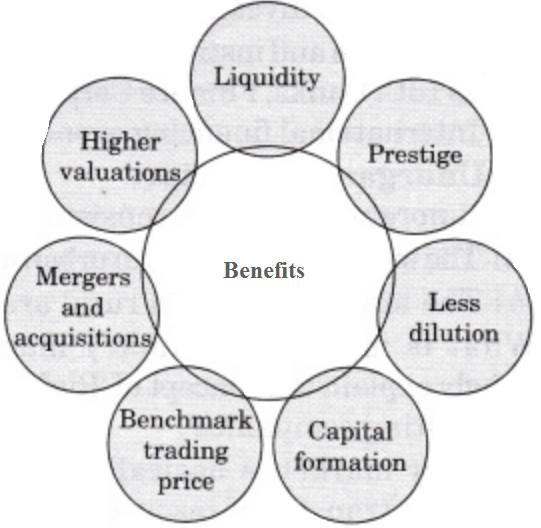
When an entrepreneur decides to go public and become a public company, he/ she tends to be in advantageous positions and get many benefit out of it . Explain the benefits.
Answer

Benefits Explanation
Mergers and acquisitions Public stock of a company can be used for businesses to grow through acquisitions.
Higher valuations Public companies are typically valued more than private companies.
Benchmark trading price The trading price of a public company’s stock serves as a benchmark of the offer price of other securities.
Capital formation Raising capital is typically easier because of the extra liquidity for the investors.
Incentives Stock options and stock incentives can be very helpful in attracting employees.
Reduced business requirements While an underwritten initial public offering requires significant earnings, the lack of earnings does not keep a private company from going public.
Less dilution There is less dilution of ownership control compared to an IPO.
Liquidity A public company provides liquidity for management. mi shareholders, and investors.
Prestige Added prestige and visibility with customers, suppliers, as well as the financial community.
View full question & answer
Question 485 Marks
Explain the necessity of a stock exchange in the economy.
Answer
Stock exchange indicates about the good or bad health of an economy. For the smooth and orderly functioning of corporate sector in a free market economy, stock exchanges are indispensable, because of the different roles played by them for different groups.
  1. Stock exchange indicates about the good or bad health of an economy. It is an investment intermediary which facilitates economic and industrial development of a country.
  2. All the stock markets influence economic activities through the creation of liquidity.
  3. It increases the business and earnings of people and gives a positive impact to the growth of an economy.
  4. Stock exchanges formulate rules and regulations and build a trust between the members and investors so that members may not exploit the investors, with this belief more number of investors are added into it, which is really helpful for the economic growth.
  5. Through easy funds mobilizing, the boosted production fetches more capital, enhancing economic development.
  6. It operates through the medium of stock exchanges which regulates the trading activities in this market and ensures a measure of safety and fair dealings to the investors.
  7. Stock exchanges play a key role in allocating capital to the corporate sector, which has significant effects on the economy as a whole.
  8. Stock exchanges maintain an official list of securities that could be purchased and sold on its floor. In entrepreneurial oriented countries, the growth of listed companies contributes a wide portion of a nation's increase in GDP.
  9. Stock exchange provides a central market for purchase and sale of securities. It provides ready and continuous outlet for buying and selling of securities. Buyers and sellers strongly believe that they would be able to buy and sell securities as and when they want.
View full question & answer
Question 495 Marks
"Stock market contributes to better allocation of capital and intensities capital formation.” Do you agree? Explain.
Answer
Yes, I agree with the statement. Stock market contributes to better allocation of capital and intensifies capital formation. The shares of profit making companies are quoted at higher prices and are actively traded so such companies can easily raise fresh capital from stock market. The general public hesitates to invest in securities of loss making companies. So stock exchange facilitates allocation of investor's fund to profitable channels. Stock exchange intensifies the process of capital formation through creating the habit of saving, investing and risk taking among the investing class by converting their savings into profitable, safe investments.
View full question & answer
Question 505 Marks
Answer each of these questions in about two hundred and fifty words:
Explain the main objectives and functions of ICICI.
Answer
The ICICI has been established to achieve the following objectives:
  1. To assist in the formation, expansion and modernization of industrial units in the private sector.
  2. To stimulate and promote the participation of private capital (both Indian and foreign) in such industrial units.
  3. To furnish technical and managerial aid so as to increase production and expand employment opportunities.
Functions:
  1. It provides medium and long-term loans in Indian and foreign currency for importing capital equipment and technical services. Loans sanctioned generally go towards purchase of fixed assets like land, building and machinery.
  2. It subscribes to new issues of shares, generally by underwriting them or directly subscribing the same.
  3. It guarantees loans raised from private sources including deferred payment.
  4. It provides technical and managerial assistance to industrial units, along with consultancy services for new projects.
  5. It provides assets on lease to industrial concerns. In other words, assets are owned by ICICI but allowed to be used by industrial concerns for a consideration called lease rent.
  6. It provides merchant banking services.
  7. Rs. 5 lakhs is the minimum amount sanctioned by it to a single concern and normally it does not go beyond the maximum limit of Rupees one crore.
View full question & answer
5 Marks Question - Entrepreneurship STD 12 Commerce Questions - Vidyadip