Questions

3 Marks Each

🎯

Test yourself on this topic

7 questions · timed · auto-graded

Question 13 Marks
Differentiate between cardinality and degree of a table with the help of an example.
Answer
Cardinality is defined as the number of rows in a table.

Degree is the number of columns in a table.

Eg: Consider the following tables:

Supposing Table : Account contains 3 rows and 2 columns.

Cardinality of Account table is : 3

Degree of Account table is :2
View full question & answer
Question 23 Marks
Observe the following table and answer the parts (i) and (ii) accordingly

Table: Product

Pno Name Qty PurchaseDate
101 Pen 102 12-12-2011
102 Pencil 201 21-02-2013
103 Eraser 90 09-08-2010
109 Sharpener 90 31-08-2012
113 Clips 900 12-12-2011

(a) Write the names of most appropriate columns, which can be considered as candidate keys.

(b) What is the degree and cardinality of the above table?

Answer
Candidate Key: Pno, Name

Degree:4

Cardinality:5

View full question & answer
Question 33 Marks
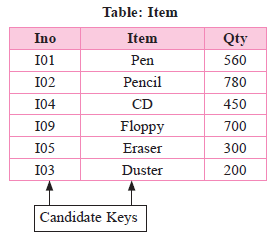
What are candidate keys in a table? Give a suitable example of candidate keys in a table.
Answer
A table may have more than one such attribute/group of attribute that identifies a tuple uniquely, all such attribute(s) are known as Candidate Keys.

Table: Item

View full question & answer
Question 43 Marks
Differentiate between DDL & DMLcommands. Identify DDL & DML commands from the following:

(UPDATE, SELECT, ALTER, DROP)

Answer
DDL stands for Data Definition language and comprises of commands which will change the structure of database object.

DML stands for Data Manipulation Language and comprises of commands which are used to insert, edit, view & delete the data stored in a database object.

DDL Commands are: ALTER, DROP

DML Commands are: UPDATE, SELECT

View full question & answer
Question 53 Marks
Differentiate between Candidate Key and Alternate Key in context of RDBMS.
Answer
Candidate Key: It is the one that is capable of becoming primary key i.e.,a column or set of columns that identifies a row uniquely in the relation.

Alternate Key: A candidate key that is not selected as a primary key is called an Alternate Key.

View full question & answer
Question 63 Marks
Consider the table: CLUB as given below:

Table: CLUB

MEMBER_ID MEMBER_NAME ADDRESS AGE FEE
M002 NISHA GURGAON 19 3500
M003 NIHARIKA NEW DELHI 21 2100
M004 SACHIN FARIDABAD 18 3500

(a) What is the cardinality and degree of the above given table?

(b) If a new column contact_no has been added and three more members have joined the club then how these changes will affect the degree and cardinality of the above given table.

Answer
(a) Degree = 5

Cardinality = 3

(b) After adding one more column Contact_no, then Degree is 6

After adding 3 more members Cardinality is 6.

View full question & answer
Question 73 Marks
Observe the table ‘Club’ given below:

Table: Club

Member_id Member_Name Address Age Fee
M001 Sumit New Delhi 20 2000
M002 Nisha Gurgaon 19 3500
M003 Niharika New Delhi 21 2100
M004 Sachin Faridabad 18 3500

(i) What is the cardinality and degree of the above given table?

(ii) If a new column contact_no has been added and three more members have joined the club then how these changes will affect the degree and cardinality of the above given table.

Answer
(i) Cardinality: 4

Degree: 5

(ii) Cardinality: 7

Degree: 6

View full question & answer
3 Marks Each - Computer Science STD 12 Humanities Questions - Vidyadip