Questions

3 Marks Question

🎯

Test yourself on this topic

35 questions · timed · auto-graded

Question 13 Marks
What do you mean by subsistence agriculture? Explain its two types.
Answer
Subsistence agriculture is one in which the farming areas consume all of the products that are locally grown. It is of two types:
  • Primitive Subsistence Agriculture: It is also called shifting cultivation. Under this vegetation is cleared by fire and land is used for cultivation. These ashes add to fertility of soil and hence, it is also called slash and burn agriculture.
  • Intensive Subsistence Agriculture: Under this type of farming, land holdings are very small and farmers work with the help of family labour leading to intensive use of land with limited used of machinery.
View full question & answer
Question 23 Marks
Describe the main features of market gardening and horticulture. ### List six points to describe market gardening & horticulture.
Answer
The main features of horticulture and market gardening are
  • It specializes in the cultivation of high value crops such as vegetables, fruits and flowers.
  • Crops are cultivated exclusively for the urban markets.
  • Farms are small and are located near urban market.
  • It is both labour and capital intensive.
  • It lays emphasis on the use of irrigation, HYV seeds, fertilizers, insecticides, greenhouses and artificial heating in colder regions.
  • This type of agriculture is well developed in densely populated industrial areas of Europe, North East U.S.A. and the Mediterranean regions.
View full question & answer
Question 33 Marks
Describe the main features of extensive commercial grain cultivation.
Answer
Important features of Extensive Commercial Grain Agriculture are as follows:
  • It is practised in the interior parts of semi-arid lands of the mid latitudes.
  • Wheat is the principal crop though other crops like com, barley, oats and rye are also grown.
  • The size of the farm is very large; therefore all the operations from ploughing to harvesting are mechanised.
  • Yield per hectare is low but yield per person is high because less people and more machines are used.
  • It is best developed in Eurasian steppes, the Canadian and American Prairies, the Pampas of Argentina, the Velds of South Africa, the Australian Downs and the Canterbury plains of New Zealand.
View full question & answer
Question 43 Marks
What do you mean by Kolkhoz? How did it begin? Explain its features.
Answer
Kolkhoz is the name for collective farming in Soviet Union. It was introduced in erstwhile Soviet Union to improve upon the inefficiency of previous methods of agriculture and to boost agricultural production for self sufficiency.
Its features:
  • This type of farming is based on social ownership of the means of production and collective labour.
  • The farmers pool in all their resources like land, livestock and labour.
  • Yearly targets are set by the government and the produce is also sold to the state at fixed prices.
  • Members are paid according to the nature of the work allotted to them by the farm management.
View full question & answer
Question 53 Marks
Write a short note on market gardening?
Answer
In market gardening, high value crops such as vegetables, fruits and flowers are cultivated solely for the urban areas. Under this the size of farms is small and they are located where there are good transportation links with the urban centres where high income consumers are located. It is both labour and capital intensive and lays emphasis on the use of irrigation, HYV seeds, fertilizers, insecticides, green houses and artificial heating in colder regions.
This type of agriculture is well developed in densely populated industrial districts of North West Europe, North Eastern United States of America and the Mediterranean regions.
The Netherlands specializes in flowers and horticulture crops especially tulips, which are exported all over Europe. Those regions where farmers specialize in vegetables only, it is called truck farming.
View full question & answer
Question 63 Marks
In modem times some gathering is market-oriented and has become commercial. Explain. ### Narrate the changes in gathering as an activity in recent times.
Answer
It is absolutely right to say that in modem times, some gathering is market- oriented and has become commercial. Gatherers collect valuable plants and after simple processing sell these in the market.
They use different parts of the plants. For example, they use:
  • Bark of the tree for making quinine, tanin extract and cork.
  • Leaves are used to produce beverages, drugs, cosmetics, fibres, thatch and fabrics.
  • Nuts are used for food and oils.
  • Tree trunk provides rubber, balata, gums and resins.
View full question & answer
Question 73 Marks
Describe four different groups/types of economic activities.
Answer
Economic activities are broadly grouped as Primary activities, Secondary activities, Tertiary activities and Quaternary activities.
  • Primary Activities: It refers to extraction/ utilisation of raw materials from the earth’s surface. These include hunting, gathering, pastoralism, fishing, forestry, mining and agriculture.
  • Secondary Activities: It includes industries that transform raw materials into finished foods having higher value. For example, manufacturing cotton textiles from raw cotton, and iron and steel from iron ore.
  • Tertiary Activities: It includes all kinds of services provided for the people such as education, health, trade and transport.
  • Quaternary Activities: It represents special kind of services, which is related to highly intellectual activities. For example, research and development service, information generation, information processing and transmission.
View full question & answer
Question 83 Marks
Write a short note on commercial livestock rearing.
Answer
Commercial livestock rearing is organized and capital intensive. The ranches on which it is practised are permanent and cover large area, which are further divided into fenced parcels to regulate grazing. When one parcel is grazed, the animals are shifted to another parcel and the number of animals in a parcel are kept according to the carrying capacity of the parcel. Only one type of animal (like sheep, cattle, goat and horses) is reared. Their products like milk, wool and hide are processed and packed scientifically, and then exported to world markets. The main emphasis is here on breeding, health care, disease control and genetic improvement of the animal. This is totally market and profit oriented. The developed countries like New Zealand, Australia, USA practise commercial livestock rearing.
View full question & answer
Question 93 Marks
Write a note on Mediterranean agriculture from the point of view of its importance, areas and crops grown.
Answer
  • Mediterranean agriculture is highly specialized commercial agriculture.
  • It is practised in the countries on either side of the Mediterranean sea in Europe and in north Africa from Tunisia to Atlantic coast, southern California, central Chile, south western parts of South Africa and south and south western parts of Australia.
  • It is an important supplier of citrus fruits. »Viticulture or grape cultivation is a speciality of the Mediterranean region.
  • Best quality wines in the world with distinctive flavors are produced from high quality grapes in various countries of this region. The inferior grapes are dried into raisins and currants.
  • This region also produces olives and figs.
  • The advantage of Mediterranean agriculture is that more valuable crops such as fruits and vegetables are grown in winters when there is great demand in European and North American markets.
View full question & answer
Question 103 Marks
What is intensive subsistence agriculture? What are its types?
Answer
Intensive subsistence agriculture is practiced in the poorer regions of the world, where farmers grow crops for family consumption. Very little is left as surplus for market. There are two types of
  • Intensive subsistence agriculture dominated by wet paddy cultivation: – It is characterized by dominance of the rice crop. Land holdings are veiy small due to the high density of population. Farmers work with the help of family labour leading to intensive use of land. Use of machinery is limited and most of the agricultural operations are done by manual labour. Farm yard manure is used to maintain the fertility of the soil. In this type of agriculture, the yield per unit area is high but per labour productivity is low.
  • Intensive subsidence agriculture dominated by crops other than paddy: Due to the difference in relief, climate, soil and some of the other geographical factors, it is not practical to grow paddy in many parts of monsoon Asia. Wheat, soyabean, barley and sorghum are grown in northern China, Manchuria, NorthKorea and North Japan. In India wheat is grown in western parts of the Indo- Gangetic plains and millets are grown in diy parts of western and southern India. Most of the characteristics of this type of agriculture are similar to those dominated by wet paddy except that irrigation is often used.
View full question & answer
Question 113 Marks
What is transhumance?
Answer
Pastoral nomadism is undertaken either over vast horizontal distances or vertically from one elevation to another in the mountainous regions. The process of migration from plain areas to pastures on mountains during summers and again from mountain pastures to plain areas during winters is known as transhumance. In mountain regions, such as Himalayas, Gujjars, Bakarwals, Gaddis and Bhotiyas migrate from plains to the mountains in summers and to the plains from the high altitude pastures in winters. Similarly, in the tundra regions, the nomadic herders move from south to north in summers and from north to south in winters.
View full question & answer
Question 123 Marks
List the areas where gathering is practiced.
Answer
  • Gathering is practiced in regions with harsh climatic conditions.
  • Generally primitive societies who extract plant and animal products to satisfy their need for food, shelter and clothing, practise it.
It is practised in High latitude zones of Northern Canada, Northern Eurasia and Southern Chile, Low latitude zones of Amazon basin, Tropical Africa, Northern fringe of Australia, interior parts of South East Asia.
View full question & answer
Question 133 Marks
Discuss the important characteristic features of plantation agriculture. Name a few important plantation crops from different countries.
Answer
Originally introduced by the Europeans in colonies situated in the tropics, plantation agriculture is
distinct from other kinds of agricultural practises because of its specific features.
The characteristic features of this type of farming are:
  • Profit oriented large-scale production system
  • Large estates and plantations
  • Huge capital investment
  • Totally market oriented
  • Scientific method of cultivation
  • Cheap and large skilled labour supply
  • Monoculture
  • It is a link between agriculture and industry.
  • They are provided with well-developed transportation facilities where raw material provided by them is processes.
Important Plantation Crops:
  • The French established cocoa and coffee plantations in West Africa.
  • The British set up
    • Large tea gardens in India and Sri Lanka,
    • Rubber plantations in Malaysia and
    • Sugarcane and banana plantations in West Indies.
  • Spanish and Americans invested heavily in coconut and sugarcane plantations in the Philippines.
  • The Dutch once had monopoly over sugarcane plantation in Indonesia.
  • Some coffee fazendas (large plantations) in Brazil are still managed by Europeans.
View full question & answer
Question 143 Marks
Large scale dairy farming is the result of the development of transportation and refrigeration.
Answer
Dairy products are highly perishable in nature. They have a very small shelf life. For their supply to overseas and distant markets, adequate storage facilities with regulated temperature and storage conditions is essential. Initially supply of dairy products was limited to nearby markets but development of storage, preservation and transportation facilities have widened their coverage.
Modem transportation such as refrigerated trucks, ships with special cargoes and faster means of transportation like airways provide with adequate facilities, which allow transportation of dairy products to far off markets without spoilage. Refrigeration prevents dairy products from getting spoiled. It increases their durability. Hence dairy products can be sold over far off places.
View full question & answer
Question 153 Marks
Market gardening is practiced near urban areas. Why?
Answer
Market gardening specializes in the cultivation of high value perishable crops such as vegetables, fruits and flowers, solely for the urban markets. They are situated close to urban markets mainly because of the high value crops.
The crops are costly, hence they need to be situated close to a market where people have high purchasing power and also demand for high valued crops. In such a situation urban areas are the perfect markets.
These crops are perishable in nature; hence farms cannot be situated far away from the main market. Therefore, farms are situated close to the urban markets so as to prevent crops from getting stale.
View full question & answer
Question 163 Marks
Future of shifting cultivation is bleak. Discuss.
Answer
  • These days the biggest problem being faced by the shifting cultivators is of shortening cycles of jhum, which makes the entire practice unsustainable.
  • Also there are several restrictions imposed by governments through forest acts etc., which hinder the free movement of
  • tribes and practice of shifting cultivation.
  • Shifting cultivation is sustainable (only for self -consumption) in nature, hence it is unable to meet with the market demand and therefore there is no scope for it in the increasing globalized markets.
  • With the infiltration of non tribals in the tribal areas, tribals are adopting to modem agricultural practices which are more productive and environmentally sustainable.
  • To support a small population, a huge land resource base is required, ultimately it leads to soil erosion and land degradation.
View full question & answer
Question 173 Marks
Dairy farming is a modern occupation. Explain.
Answer
It is absolutely right to say that dairy farming is a modern occupation. It is a type of agriculture in which major emphasis is on breeding and rearing milch cattle. Its main features are given below which can prove that it is a modem occupation:
  • It is highly capital intensive. Large investments are made on animal sheds, storage facilities for fodder, feeding and milching machines.
  • Special emphasis is laid on cattle-breeding, health care and veterinary services.
  • It is also highly-labour intensive as it involves painstaking care in feeding and milching.
  • There is no off-season during the year.
  • It is practised mainly near urban and industrial market.
  • Dairy farming development depends on transportation, refrigeration, pasteurisation and other preservation processes.
View full question & answer
Question 183 Marks
What is the status of mining in the developed and developing economies of the world?
Answer
Mining is primarily extraction of minerals from surface or beneath the surface of the earth’s crust for further processing in industrial and other uses. It involves more of manual labour and is hazardous, so the developed economies are retreating from mining, processing and refining stages of production due to high labour costs, while the developing countries with large labour force and striving for higher standard of living are becoming more important. Several countries of Africa and few of south America and Asia have over fifty per cent of the earnings from minerals alone.
View full question & answer
Question 193 Marks
“Gathering and hunting are the primitive economic activities meant for the subsistence of tribal societies, but in modern times gathering is market oriented and has become commercial.” Examine the statement.
Answer
Gathering activities: Gatherers collect valuable plants, leaves, bark and medicinal herbs for different uses and sell in market.
The barks are used for making quinine, tannin etc., in different ways; leaves for beverages,-drugs, cosmetics, fibers, thatch, fabrics.
Edible nuts and their oils are also collected. Tree trunks for latex, balata, gums and resins are used as raw materials in various industries. (To be assessed as a whole)
View full question & answer
Question 203 Marks
Classify intensive subsistence agriculture into two categories practised in the world. How are they different from each other? Explain.
View full question & answer
Question 213 Marks
Describe the way of life of nomadic herders in the World.
Answer
Way of life of nomadic herders:-
  • They depend on the primitive subsistence activity.
  • Herders rely on animals for food, clothing, shelter, tools and transport,
  • They move from one place to another with their livestock.
  • They follow well defined territory.
  • A wide variety of animals is kept in different regions.
  • Nomadism is associated with three different regions.
  • In mountainous regions, they practice transhumance.
  • Their numbers are decreasing due to change in life style.
    (Any five points to be described)
View full question & answer
Question 223 Marks
Differentiate between Nomadic herding and commercial livestock rearing, stating any five points of distinction.
Answer
  • Nomadic herding is a primitive subsistance activity. Unlike Nomadic herding, commercial livestock rearing is more organized and capital intensive activity,
  • The Nomades rely on animals for food, clothing shelter, tools and transport. Whereas, commercial livestock rearing is associated with Western culture.
  • Nomadic herders move from one place to another alongwith their livestock. Whereas commercial livestock is practised on permanent ranches where cattle are reared permanently.
  • In Nomadism a wide variety of animals are kept in different regions. On the other hand, commercial livestock rearing is a specialized activity in which only one type of animal is reared.
  • Pastoral nomadism is undertaken either over vast horizontal distances or vertically in the mountain regions. Rearing of animals in ranching is organized on a scientific basis.
  • The quality of livestock is very poor in nomadic herding and production is also very poor. Whereas, in commercial rearing the quality of cattle and productivity both are veiy high.
View full question & answer
Question 233 Marks
Define the term ‘nomadic herding’. Explain
Answer
Nomadic herding is a primitive subsistence activity, in which the herders rely on animals for food, clothing, shelter, tools and transport.
View full question & answer
Question 243 Marks
Explain any five characteristics of dairy farming practised in the world.
Answer
Characteristics:
  • It is highly capital intensive.
  • Special emphasis is laid down on cattle breeding, healthcare and veterinary services.
  • It is highly labour intensive farming.
  • It involves regorous care in feeding and milching.
  • It is practised mainly near urban and industrial centres.
View full question & answer
Question 253 Marks
Explain any three characteristics of hunting and gathering. Give two reasons why gathering has little chance to become important at global level.
Answer
The characteristics of hunting and gathering are:
Characteristics:
  • It involves primitive societies, who extract both plants and animals to satisfy their needs for food, shelter and clothing.
  • This type of activity requires a small amount of capital investment and operates at very low level of technology,
  • The yield per person is very low and little or no surplus is produced.
Reasons:
  • Its products cannot compete in the world market.
  • Synthetic products often of better quality and at lower prices have replaced such many items.
View full question & answer
Question 263 Marks
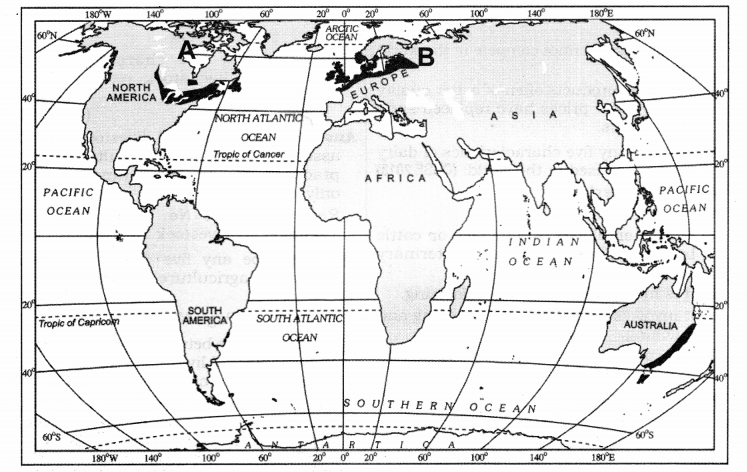
Study the given map showing dairy farming regions carefully and answer the questions that follow:
Image
(i) Identify and name the areas marked as A and B, marked on the map.
(ii) Define ‘dairy farming’.
(iii) Explain any three characteristics of dairy farming.
Answer
  • A : Canada / North-Eastern Canada B: North-western Europe
  • Dairy farming is the most advanced and efficient type of rearing of milch animals,
Characteristics of daily farming are:
  • It is highly capital intensive. Animal sheds, storage facilities for fodder, feeding and milching machines add to the cost of dairy farming.
  • Special emphasis is laid on cattle breeding, health care and veterinary services, rigorous care in feeding and milching.
  • There is no off season during the year as in the case of crop raising.
View full question & answer
Question 273 Marks
What is subsistence agriculture? Mention any four characteristics of primitive subsistence agriculture.
Answer
Subsistence Agriculture is a farming in which its produce is mainly consumed in the farmer’s household.
Characteristics of primitive subsistence agriculture are:
  • Primitive subsistence agriculture or shifting cultivation is widely practised by many tribes in the tropics, especially in Africa, south and Central America and south east Asia.
  • The vegetation is usually cleared by fire, and the ashes add to the fertility of the soil.
  • The cultivated patches are veiy small and cultivation is done with very primitive tools such as sticks and hoes.
  • After sometime (3 to 5 years) the soil looses its fertility and the farmer shifts to another parts and clears other patch of the forest for cultivation.
View full question & answer
Question 283 Marks
What is the meaning of market gardening and horticulture? Describe any four characteristics of this type of agriculture of the world.
Answer
Market gardening and horticulture are those which specialize in the cultivation of high value crops such as vegetables, fruits and flowers, solely for the urban markets.
Characteristics of this types of agriculture are:
  • Farms are located where there are good transportation links with the urban centre where high income group of consumers is located.
  • It is both labour and capital intensive,
  • It lays emphasis on the use of irrigation, HYV seeds, fertilizers, insecticides, greenhouses and artificial heating in colder regions.
  • This type of agriculture is well developed in densely populated industrial districts of North West Europe, north eastern United States of America and the Mediterranean regions.
View full question & answer
Question 293 Marks
State any six characteristics of pastoral nomadism in the world.
Answer
Characteristics of nomadic herding in the world are:
  • Nomadic herding or pastoral nomadism is a primitive subsistence activity.
  • In this activity the herders rely on animals for food, clothing, shelter, tools and transport.
  • The nomadic herders move from one place to another along with their livestock, depending on the amount and quality of pastures and water.
  • Each nomadic community occupies a well-identified territoiy as a matter of tradition.
  • A wide variety of animals is kept in different regions. For example, in tropical Africa, cattle are the most important livestock, while in Sahara and Asiatic deserts, sheep, goats and camel are reared.
  • In the mountainous areas the herders follow transhumance, z.e. seasonal migration of herders with their animals
View full question & answer
Question 303 Marks
Describe four different groups/types of economic activities.
Answer
Economic activities are broadly grouped as Primary activities, Secondary activities, Tertiary activities and Quaternary activities.
  • Primary Activities: It refers to extraction/ utilisation of raw materials from the earth’s surface. These include hunting, gathering, pastoralism, fishing, forestry, mining and agriculture.
  • Secondary Activities: It includes industries that transform raw materials into finished foods having higher value. For example, manufacturing cotton textiles from raw cotton, and iron and steel from iron ore.
  • Tertiary Activities: It includes all kinds of services provided for the people such as education, health, trade and transport.
  • Quaternary Activities: It represents special kind of services, which is related to highly intellectual activities. For example, research and development service, information generation, information processing and transmission.
View full question & answer
Question 313 Marks
Write a short note on commercial livestock rearing.
Answer
Commercial livestock rearing is organized and capital intensive. The ranches on which it is practised are permanent and cover large area, which are further divided into fenced parcels to regulate grazing. When one parcel is grazed, the animals are shifted to another parcel and the number of animals in a parcel are kept according to the carrying capacity of the parcel. Only one type of animal (like sheep, cattle, goat and horses) is reared. Their products like milk, wool and hide are processed and packed scientifically, and then exported to world markets. The main emphasis is here on breeding, health care, disease control and genetic improvement of the animal. This is totally market and profit oriented. The developed countries like New Zealand, Australia, USA practise commercial livestock rearing.
View full question & answer
Question 323 Marks
Write a note on Mediterranean agriculture from the point of view of its importance, areas and crops grown.
Answer
  • Mediterranean agriculture is highly specialized commercial agriculture.
  • It is practised in the countries on either side of the Mediterranean sea in Europe and in north Africa from Tunisia to Atlantic coast, southern California, central Chile, south western parts of South Africa and south and south western parts of Australia.
  • It is an important supplier of citrus fruits. »Viticulture or grape cultivation is a speciality of the Mediterranean region.
  • Best quality wines in the world with distinctive flavors are produced from high quality grapes in various countries of this region. The inferior grapes are dried into raisins and currants.
  • This region also produces olives and figs.
  • The advantage of Mediterranean agriculture is that more valuable crops such as fruits and vegetables are grown in winters when there is great demand in European and North American markets.
View full question & answer
Question 333 Marks
Compare mixed farming and dairy farming.
View full question & answer
Question 343 Marks
Distinguish between the types of farming based on organization.
Answer
Cooperative FarmingCollecting Farming
(i) group of farmers form a co-operative society by pooling in their resources voluntarily for more efficient and profitable farming.(i) the basic principle behind this types of farming is based on social ownership of the means of production and collective labour.
(ii) dividual farms remain intact and farming is a matter of cooperative initiative.(ii) The farmers used to pool in all their resources like land, livestock and labour.
(iii) Co-operative societies help farmers, to procure all important inputs of farming, sell the products at the most favourable terms and help in processing of quality products at cheaper rate(iii) Yearly targets were set by the government and the produce was also sold to the state at fixed prices. Produce in excess of the fixed amount was distributed among the members or sold in the market.
(iv) It has been successful in many western European countries like Denmark, Netherlands, Belgium, Sweden, Italy etc.(iv) This type of farming was introduced in former Soviet Union under the socialist regime which was adopted by the socialist countries. After its collapse, these have already been modified
View full question & answer
Question 353 Marks
“There is low yield per acre but high yield per person.” In which type of agriculture is this evident? Why? Where is this type of agriculture practised?
Answer
This feature is characteristic of extensive commercial grain cultivation. Since it is extensive that is on a very large scale, so use of mechanical devices, irrigation, sprinklers, tractors, low flying aircrafts is common.

In the areas practising commercial grain cultivation, the areas of production are high, as the farming is intensive, but due to the low population and high degree of mechanization, the number of people employed in these farms is less. Due to high level of scientific and technological skills employed in the production activities, the total yield is high, which results in very high per person yield, but due to extensive nature of farming and low pressure per unit area of land, yield per acre is low.

These are found in the developed countries of the world like in the Eurasian Steppes, the Canadian and American Prairies, the Pampas of Argentina, the Velds of South Africa, the Australian Downs and the Canterbury Plains of New Zealand.
View full question & answer
3 Marks Question - Geography STD 12 Humanities Questions - Vidyadip