Questions

4 Marks Question

🎯

Test yourself on this topic

32 questions · timed · auto-graded

Question 14 Marks
Differentiate between simultaneous and successive processing, giving examples.
Answer
Part of ‘PASS’ model
  1. Simultaneous processing:
  • Takes place when we perceive the relations among various concepts and integrate them into a meaningful pattern for comprehension.
  • In RPM test, by grasping the meaning and relationship between the given option of designs and the given abstract figure, the correct option is chosen. Simultaneous processing of all given figures helps in choosing the correct option.
  1. Successive processing:
  • Takes place when all the information is remembered serially so that recall of one leads to the recall of another, e.g. learning of digits, alphabet, multiplication tables etc.
View full question & answer
Question 24 Marks
Explain contextual intelligence with the help of examples.
Answer
Contextual Intelligence:
  1. It is a component of Sternberg’s triarchic theory, also known as practical intelligence.
  2. Involves the ability to deal with environmental demands encountered on a daily basis.
  3. It may be called ‘street smartness’ or ‘business sense’.
  4. Persons high on this aspect easily adapt to their present environment or select a more favourable environment than the existing one.
  5. Modify the environment to fit their need and hence turn out to be successful in life.
View full question & answer
Question 34 Marks
Explain the structural approach to understand intelligence. Describe briefly any two theories based on this approach.
View full question & answer
Question 44 Marks
Explain the psychometric approach to understand intelligence. State two theories based on this approach.
Answer
The psychometric approach: considers intelligence as an aggregate of abilities. It expresses the individual’s performance in terms of a single index of cognitive abilities.
  1. Uni/one factor theory.
  2. Two factor theory.
  3. Theory of primary mental abilities.
  4. Hierarchical model of intelligence.
  5. Structure of intellect model.
View full question & answer
Question 54 Marks
Explain aptitude. Differentiate between aptitude and interest.
Answer
Aptitude: an individual’s underlying potential for acquiring skills.
Alternate Answer
combination of characteristics that indicates an individual’s capacity to acquire some specific knowledge or skill after training.
  1. Interest is a preference for a particular activity, aptitude is the potentiality to perform that activity.
View full question & answer
Question 64 Marks
Explain the competencies of Indian notion of intelligence.
Answer
Competencies of Indian Notion of Intelligence:
  1. Cognitive competence (Capacity) - Sensitivity to context, understanding, discrimination, effective communication and problem solving.
  2. Social competence - Respect for social order, commitment to elders, the young and the needy, concern about others, recognising others perspectives.
  3. Emotional competence - Self-regulation and self-monitoring of emotions, honesty, politeness, good conduct and self-evaluation.
  4. Entrepreneurial competence - Commitment, persistence, patience, hard work, vigilance and goal-directed behaviours.
View full question & answer
Question 74 Marks
Differentiate between Simultaneous and Successive Processing giving examples.
Answer
Difference between simultaneous and successive processing–
Simultaneous Processing:
  • Takes place when we perceive the relations among various concepts and integrate them into a meaningful pattern for comprehension.
  • In RPM test, by grasping the meaning and relationship between the given option of designs and the given abstracted figure, the correct option is chosen. Simultaneous processing of all given figures helps in choosing the correct option.
Successive Processing:
  • Takes place when all the information is remembered serially so that recall of one leads to the recall of another. e.g. in learning of digits, alphabets, multiplication tables etc, successive processing helps.
View full question & answer
Question 84 Marks
Explain componential intelligence with examples.
Answer
Componential intelligence – By Robert Sternberg
  • Knowledge acquisition – Learning and acquisition.
  • Meta/high order components – Involves planning.
  • Performance component – Doing things.
View full question & answer
Question 94 Marks
What is assessment? Explain briefly any two methods of psychological assessment.
Answer
Assessment refers to the measurement of Psychological attributes of individuals and their evaluation. (formal/informal).
Methods:
  • Psychological tests.
  • Interview.
  • Case study.
  • Observation.
View full question & answer
Question 104 Marks
Explain any two methods used for psychological assessment.
Answer
Following are the methods used for psychological assessment:
  1. Psychological test.
  2. Interview.
  3. Case study.
  4. Observation.
  5. Self report.
View full question & answer
Question 114 Marks
Give the meaning of aptitude. How is it measured?
Answer
Aptitude - Refers to special ability in a particular field of activity. It is a combination of characteristics that indicates an individual's capacity to acquire some specific knowledge or skill after raining.
The knowledge of aptitude can help us to predict an individual's future performance.
Measurement of aptitude - Aptitude is measured by using different aptitude tests. There are two forms of aptitude tests-
  1. Test independent (Specialised Aptitude Tests).
    1. Clerical aptitude.
    2. Mechanical aptitude.
    3. Numerical aptitude.
    4. Typing aptitude.
  2. Multiple (Generalised Aptitude Test) - These tests are in the form of test batteries, which measure aptitude in several separate but homogenous areas.
    1. Differential Aptitude Test (DAT).
    2. General Aptitude Test Battery (GATB).
    3. Armed Services Vocational Aptitude Battery (ASVAB).
View full question & answer
Question 124 Marks
Explain Gardner’s theory of multiple intelligences. What is naturalistic intelligence?
Answer
Howard, Gardener proposed the theory of Multiple Intelligences. According to this theory, intelligence is not a single entity but different types of intelligences exist, which are independent of each other. Different type of intelligences interact and work together to. solve a problem.
Names of different types of intelligences mayor may not be mentioned:
Naturalistic Intelligence: The intelligence which involves complete awareness of our relationship with the natural world - Useful in understanding flora and fauna and making discrimination in the natural world. Hunters, Farmers, Tourists, Botanists, Zoologists and bird watchers, etc, possess more of naturalistic intelligence.
View full question & answer
Question 134 Marks
Explain the variations in intellectual ability of mentally challenged and intellectually gifted individuals.
Answer
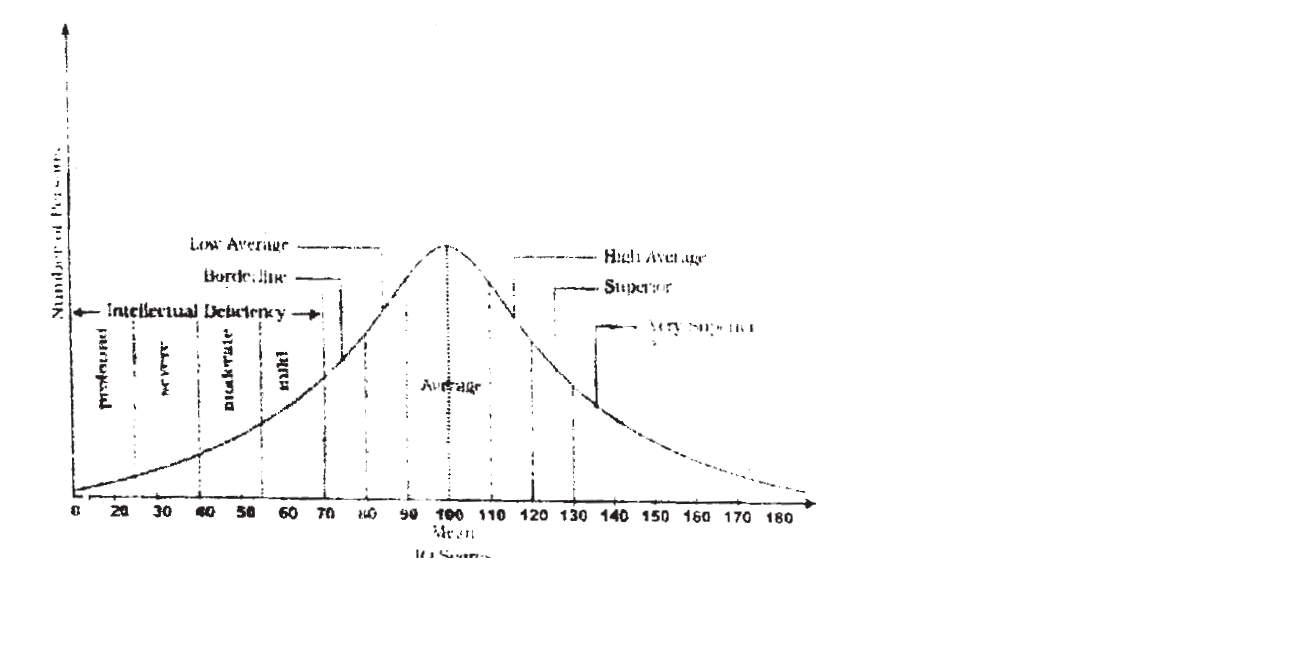
Intelligence or IQ scores are distributed in a population in such a way that most people tend to fall in the middle range of the distribution. This can be graphically shown in the following bell shaped curve.

Children with very low IQ scores, i.e. below 70, face enormous difficulty in learning simple skills and are termed “Mentally Challened” or “Mentally Retarded”.
Categories of Mental Retardation:
  1. Mild retardation (I.Q. 55-69).
  2. Moderate retardation (LQ.40-54).
    1. Severe retardation (LQ.25-39).
  3. Profound retardation (I.Q. below 25).
On the other end of the curve are Intellectually Gifted individuals who show higher performance because of their outstanding potentialities.
Categories:
  1. High average (LQ. 110-119).
  2. Superior (LQ. 120-130).
  3. Very Superior (I.Q. 130 and above).
View full question & answer
Question 144 Marks
Explain briefly PASS model of intelligence.
Answer
PASS Model of Intelligence:
Developed by J P Dass, Jack Naglieri & Kirby– 1994
This model is comprised of the following.
P– PLANNING.
A– AROUSAL/ATTENTION.
S– SIMULTANEOUS.
S– SUCCESSIVE.
Arousal/Attention:
  1. Arousal and attention enables a person to process information- An optimal level of arousal focuses our attention on the relevant aspects of problem.
  2. Too much or too little arousal would interfere with attention
Simultaneous processing:
  1. Takes place when we perceive the relations among various concepts and integrate them into a meaningful pattern for comprehension.
  2. In RPM test, by grasping the meaning and relationship between the given option of designs and the given abstracted figure, the correct option is chosen. Simultaneous processing of all given figures helps in choosing the correct option.
Successive processing:
  1. Takes place when all the information is remembered serially so that recall of one leads to the recall of another, e.g. in learning of digits, alphabets, multiplication tables etc, successive processing helps.
Planning: After the information is attended to and processed, planning is activated.
  1. EffectivenessIt allows us to think of the possible courses of action, implement them to reach the target and evaluate their effectiveness.
  2. If a plan does not work, it is modified to suit the requirement to task or situation.
View full question & answer
Question 154 Marks
State the four competencies of intelligence in the Indian tradition.
Answer
Four competencies of intelligence in Indian tradition:
  1. Cognitive capacity– understanding discrimination etc.
  2. Social competence– respect for social order etc.
  3. Emotional competence– self regulation etc.
  4. Entrepreneurial competence– commitment etc.
View full question & answer
Question 164 Marks
Explain the PASS model of intelligence.
Answer
PASS model of intelligence: J P Dass, Naglieri & Kirby (1994) Intellectual activities involve interdependent functioning of three neurological systems called the functional units of brain. These units are:
  1. Arousal/attention.
  2. Coding or processing.
  3. Planning.
Now explain.
P – Planning.
A – Attention and Arousal.
S – Simultaneous processing.
S – Successive processing.
View full question & answer
Question 174 Marks
What is emotional intelligence? Give two characteristics of emotionally intelligent persons.
Answer
  • Refers to ability to process emotional information accurately and efficiently.
  • It is a set of skills that underlie accurate appraisal, expression and regulation of emotions.
  • It is the feeling side of intelligence.
  • The ability to monitor one’s own and other’s emotions, to discriminate among them and to use the information to guide one’s thinking and actions.
Characteristics:
  • Sensitive to your feelings and emotions.
  • Be sensitive to various types of emotions in others by noting their body language etc.
  • Relate your emotions to your thoughts.
  • Understand the influence of nature and intensity of emotions.
  • Control and regulate emotions to achieve harmony and peace.
View full question & answer
Question 184 Marks
Describe the key features of Case Study Method.
Answer
  • In-depth study of the individual in terms of her/his psychological attributes, psychological history in the context of her/his physical and psychosocial environment.
  • Case studies are widely used by clinical psychologists.
  • Based on data generated by different methods i.e. interviews, observations, questionnaires etc.
  • Case studies of great people can be highly illuminating.
View full question & answer
Question 194 Marks
How does triarchic theory explain intelligence?
Answer
Triarchic Theory - Robert Sternberg (1985).
  • Information processing approach.
  • Componential intelligence (analytical intelligence).
  1. Knowledge acquisition component.
  2. Meta higher order component.
  3. Performance component.
  • Experiential Intelligence ( creative intelligence).
  • Contextual Intelligence (practical intelligence).
View full question & answer
Question 204 Marks
State the Gardner's eight types of intelligences. Describe any ONE with the help of examples.
Answer
Theory of Multiple Intelligence
  • Linguistic intelligence.
  • Logical, Mathematical.
  • Spatial.
  • Musical.
  • Bodily Kinaesthetic.
  • Interpersonal.
  • Intrapersonal.
  • Naturalistic.
View full question & answer
Question 214 Marks
Differentiate between psychometric and information processing approaches to intelligence.
Answer
Differences between Psychometric and information processing approaches to intelligence:
Psychometric approach to intelligence/structural approach
  • Considers intelligence as an aggregate of abilities (describes what intelligence is).
  • Expresses the individual's performance in terms of a single index of cognitive abilities.
Information processing approach to intelligence
  • The process people use in intellectual reasoning and problem solving (how intelligently a person acts).
  • The focus is on studying cognitive functions underlying intelligent behaviour.
  • Triarchy theory/PASS model.
View full question & answer
Question 224 Marks
Mention multiple intelligences as suggested by Gardner. Explain logical-mathematical intelligence.
Answer
Multiple Intelligences by Howard Gardener.
Types of Multiple Intelligences:
  1. Linguistic.
  2. Musical.
  3. Spatial.
  4. Bodily-Kinaesthetic.
  5. Interpersonal.
  6. Intrapersonal.
  7. Naturalistic.
  8. Logical-mathematical.
Logical-Mathematical Intelligence- involves skills in scientific thinking and problem-solving. Can think logically and critically, engage in abstract reasoning, can manipulate symbols to solve mathematical problems. E.g. Scientists and Mathematicians.
View full question & answer
Question 234 Marks
Explain behavioural ratings in assessment of personality.
Answer
  • Behavioural ratings are frequently used for assessment of personality.
  • Behavioural rating is taken from people who know the assessee intimately.
  • Categories of personality are based on behavioural qualities.
Uses:-
In educational and industrial settings.
Limitations:
  1. Halo effect.
  2. Middle category bias.
  3. Extreme response bias.
View full question & answer
Question 244 Marks
Explain the variations in intellectual ability of mentally challenged and intellectually gifted individuals.
Answer
Intelligence or IQ scores are distributed in a population in such a way’ that most people tend to fall in the middle range of the distribution. This can be ‘graphically shown in the following bell shaped curve.
Children with very low IQ scores, i.e. below 70, face enormous difficulty in learning simple skills and are termed “Mentally Challenged” or “Mentally Retarded”. Categories of Mental Retardation:
  1. Mild retardation (I.Q. 55-69).
  2. Moderate retardation (I.Q.40-54).
  3. Severe retardation (I.Q.25-39).
  4. Profound retardation (I.Q. below 25).
On the other end of the curve are Intellectually Gifted individuals who show higher performance because of their outstanding potentialities. Categories:
  1. High average (I.Q. 110-119).
  2. Superior (LQ. 120-130).
  3. Very Superior (LQ. 130 and above).
View full question & answer
Question 254 Marks
Describe verbal, non-verbal and performance tests.
Answer
Verbal, Non-Verbal, or Performance Tests: An intelligence test may be fully verbal, fully non-verbal or fully performance-based or it consist of a mixture of items from each category. Verbal tests require subject to give verbal responses either orally or in written form. Therefore verbal tests can be administered only t o literate people. The non-verbal tests use picture or illustrations as test items. Raven's Progressive Matrices (RPM) Test is an example of a non-verbal test. In this test, the subject examines an incomplete pattern and chooses a fugure from the alternatives that will compete the pattern.
Performance tests require subject to manipulate objects and other material to perform a task. Written langauge is not necessary for answering the items. For example, Koh's Block Design Test contains a number of wooden blocks. The subject is asked to arrange the blocks within a time period to product goven design. A major advantage of perfomance tests is that they can be easily administered to persons from different culture.
View full question & answer
Question 264 Marks
Angad has been a topper in class. He went to the topmost college, where he was neither sensitive to his own self or to others. This led to problems in interpersonal relationships with reference to his condition. Explain the importance of emotional intelligence in his life.
Answer
Emotional intelligence refers to the ability to process emotional information accurately and efficiently.
  • Perceive and be sensitive to your feelings and emotions.
  • Perceive and be sensitive to various types of emotions in others by noting their body language, voice and tone and facial expressions.
  • Control and regulate your emotions and their expressions while dealing with self and others to achieve harmony and peace.
As Angad is lacking in the above characteristics, has problems in interpersonal relationships. Emotional intelligence has beneficial effects on their academic achievement. It encourages co-operative behaviour. It prepares students to face challenges of life outside classroom.
View full question & answer
Question 274 Marks
Explain the relationship between creativity and intelligence. State the important features of creativity tests.
Answer
All creative people are intelligent:
  • Creativity and intelligence in positively correlated.
  • All intelligent people may not be creative creativity tests measure.
Second parts of the questions:
  • Imagination.
  • Spontaneity.
  • They are open ended.
  • Focus on divergent thinking.
  • No right or wrong answers.
  • Originality.
View full question & answer
Question 284 Marks
Intelligence is the interdependent functioning of three neurological systems. Explain this theory.
Answer
PASS model:Interdependent functioning of 3 neurological systems, Attention/ arousal, simultaneous and successive processing and planning.
View full question & answer
Question 294 Marks
How do you define personality? What are the main approaches to the study of personality?
Answer
The word ‘personality’ is derived from the Latin word ‘persona’, which means a mask or false face which Greek actors used to wear when acting on stage. According to Gordon Allport “Personality is the dynamic organization within the individual of those psychological systems that determine his unique adjustments to his environment.”
One of the major approaches to understanding personality was to develop theories on what it was. There are many broad personality theories, which can be grouped into four categories:
  1. Dynamic approaches, which emphasize on-going interaction among motives, impulses and psychological processes.
  2. Type and train approaches, which focus on people’s characteristics, stubbornness, shyness and so forth and how these characteristics are organized into systems.
  3. Humanistic approaches, which emphasize the self and the importance of the individual’s subjective view of the world.
  4. Learning and behavioural approaches, which emphasize the way habits are acquired through basic learning process.
View full question & answer
Question 304 Marks
How is ‘Aptitude’ different from ‘interest’ and ‘intelligence’? How is aptitude measured?
Answer
Aptitude:
  1. Aptitude refers to combination of characteristics indicative of an individual’s potential to acquire some specific skills with training.
  2. It is specific mental ability or teach ability of an individual to learn a particular skill.
  3. It is the potentiality to perform a particular activity.
  4. Aptitude is a determiner to learn a particular skill.
Interest:
  1. Interest refers to preference for a particular activity or what one enjoys doing.
  2. Interest are acquired/ learnt.
  3. Interest is a facilitator.
An individual with high scientific aptitude having strong interest in mechanical activities is more likely to be successful mechanical engineer.
Intelligence:
  1. Intelligence is a global and aggregate capacity of an individual to think rationally, act purposefully and to deal effectively with her/ his environment.
  2. Intelligence is a general mental ability.
  3. It is product of heredity and environment.
  4. It does not require training for the growth.
View full question & answer
Question 314 Marks
What is IQ? How do psychologists classify people on the basis of their IQ scores?
Answer
  1. IQ is an index of brightness.
  2. It is the ratio of mental age to chronological age.
  3. The concept of IQ was given by William. Stern w7ho gave the formula to calculate IQ i.e.,
  $\frac{\text{MA}}{\text{CA}}\times100$
$\text{If MA}>\text{CA}$ Above average
$\text{MA}<\text{CA}$ Below average
$\text{MA}=\text{CA}$ Average
  • IQ is relatively stable.
  • It is a good predictor of potential.
  • IQ scores are distributed in a population in such a way that most people tend to fall in the middle range of the distribution.
  • This can be shown in the form of following table.
Classification of People on the Basis of IQ
IQ Range Descriptive Lebel Per cent in the Population
Above 130 Very superior 2.2
120-130 Superior 6.7
110-119 High average 16.1
90-109 Average 50.0
80-89 Low average 16.1
70-79 Borderline 6.7
Below 70 Mentally challenged/ retarded 2.2
View full question & answer
Question 324 Marks
How do psychologists characterise and define intelligence?
Answer
Psychological motion of intelligence is quite different from the common sensed motion of intelligence.
Generally people saw intelligence as mental alertness, ready art, quickness in learning and ability to understand relationships.
Oxford dictionary explained intelligence as the power of perceiving, learning understanding and knowing.
Accordingly Alfred Binet also used these attributes and defined intelligence as ability to judge well, understand well and reason well. Later Wechsler gave a comprehensive definition in terms of its functionality, i.e., its value for adaptation to environment. He defined intelligence as “the global and aggregate capacity of an individual to think rationally, act purposefully and to deal effectively with his/ her environment.”
Present day psychologists such as Gardner and Sternberg emphasized that “Intelligent individual not only adapts to the environment, but actively modifies or shapes it.”
Sternberg views intelligence as “the ability to adapt, to shape and select environment to accomplish ones goals and those of one’s society and culture.”
View full question & answer
4 Marks Question - Psychology STD 12 Humanities Questions - Vidyadip