Questions

3 Marks Question

🎯

Test yourself on this topic

13 questions · timed · auto-graded

Question 13 Marks
Doctors have shown certain drugs leave a person's bloodstream at a rate that is proportional to the amount present. In an experiment a patient is injected with 450 mg of a substance. Seven hours later it is found that 50 mg of the substance remains. Assuming the proportional model is correct for the particular substance.
(a) Express the differential equation that models this scenario.
(b) Find the time constant, k.(log 9 = 2.197225).
Answer
(a) With the amount of the substance represented as A(t) we can write the differential equation as $\frac{d A}{d t}=k A$
(b) To find the time constant, k, we first write the expression for the general solution as $A(t)=A(0) e^{k t}=450 e^{k t}$
Where, A(0) = 450
Next, we use the fact that 50 mg was found in the bloodstream after 7 hours to solve for k.
$\begin{aligned} A(7) & =450 e^{k .7} \\ 50 & =450 e^{k .7} \\ \frac{1}{9} & =e^{k .7} \\ \log \frac{1}{9} & =k .7\end{aligned}$
$\log \frac{1}{9}=k=\frac{-\log 9}{7} \cong-0.31$
As expected, k is negative since the substance decays over time.
View full question & answer
Question 23 Marks
The surface area of a balloon being inflated changes at a constant rate. If initially, its radius is 3 units and after 2 seconds, it is 5 units, find the radius after t seconds.
Answer
Let r be the radius and S be the surface area of the balloon at any time t. Then,
$S=4 \pi r^2$
$\Rightarrow \quad \frac{d S}{d t}=8 \pi r \frac{d r}{d t}$ ...(i)
It is given that, $\frac{d S}{d t}=$ constant $=k$ (say $)$
Putting $\frac{d S}{d t}$ in eq. (i), we get
$k=8 \pi r \frac{d r}{d t}$
$\Rightarrow \quad k=8 \pi r \frac{d r}{d t}$
$\Rightarrow \quad 8 \pi r d r=k d t$
(By separating the variables)
Integrating both sides, we get
$4 \pi r^2=k t+C$ ....(ii)
Given that at t = 0 r = 3 Putting t = 0 andr r = 3 in eq. (ii), we get
$36 \pi=k(0)+C$
$\Rightarrow$ $C=36 \pi$
Putting t = 2 and r = 5 in eq. (ii), we get
$100 \pi=2 k+36 \pi$
$\Rightarrow$ $k=32 \pi$
Substituting the values of C and k in eq. (ii), we get
$4 \pi r^2=32 \pi t+36 \pi$
$\Rightarrow \quad r^2=8 t+9$
$\Rightarrow \quad r=\sqrt{8 t+9}$
View full question & answer
Question 33 Marks
The population of a town grows at the rate of 10% per year. Using differential equation, find how long will it take for the population to grow 4 times.
Answer
Let initial population be: $P_0$ and population after t years be P
$\frac{d P}{d t}=10 \%$ of $P$
$\Rightarrow \quad \frac{d P}{d t}=\frac{1}{10} P$
$\Rightarrow \quad \frac{d P}{P}=\frac{1}{10} d t$
Integrating both sides, we get
$\int \frac{d P}{P}=\int \frac{1}{10} d t$
$\log P=\frac{1}{10} t+C$
When $t=0, P=P_0 \Rightarrow \log P_0=C$
$\log P=\frac{1}{10} \cdot t+\log P_0$
$\log \left(\frac{P}{P_0}\right)=\frac{1}{10} . t$
Since, population grows 4 times, $P=4 P_0$
$\therefore \quad \log 4=\frac{1}{10} t$
$\Rightarrow \quad t=10 \log 4$
$\Rightarrow 20 \log 2$ (vears)
View full question & answer
Question 43 Marks
Solve the differential equation: $\frac{d y}{d x}=e^{x+y}+x^2 e^y$
Answer
Given, $\quad \frac{d y}{d x}=e^{x+y}+x^2 e^y$
$=e^x e^y+x^2  e^y$
$\Rightarrow \quad \frac{d y}{d x}=e^y\left(e^x+x^2\right)$
$\int \frac{d y}{e^y}=\int\left(e^x+x^2\right) d x$
(integrating both sides)
$\Rightarrow \quad \int e^{-y} d y=\int e^x d x+\int x^2 d x$
$\Rightarrow \quad-e^{-y}=e^x+\frac{x^3}{3}+c$
$\Rightarrow \quad-\frac{1}{e^y}=e^x+\frac{x^3}{3}+c$
or $\quad e^{x+y}+\frac{e^y \cdot x^3}{3}+c e^y+1=0$
is the required solution
View full question & answer
Question 53 Marks
Solve the differential equation: $(x+1) d y-2 x y d x=0$
View full question & answer
Question 63 Marks
Solve : $\left(x^2-y x^2\right) d y+\left(y^2+x y^2\right) d x=0$
Answer
Given, $\left(x^2-y x^2\right) d y+\left(y^2+x y^2\right) d x=0$
$\Rightarrow \quad x^2(1-y) d y+y^2(1+x) d x=0$
$\Rightarrow \quad \frac{1-y}{y^2} d y+\frac{1+x}{x^2} d x=0$
On integration, we get
$\int \frac{1-y}{y^2} d y+\int \frac{1+x}{x^2} d x=0$
$\Rightarrow \int \frac{1}{y^2} d y-\int \frac{1}{y} d y+\int \frac{1}{x^2} d x+\int \frac{1}{x} d x=0$
$\Rightarrow \quad \log \left(\frac{x}{y}\right)-\frac{1}{x}-\frac{1}{y}= C$
$\Rightarrow \quad \log \left(\frac{x}{y}\right)=C+\frac{1}{x}+\frac{1}{y}$
View full question & answer
Question 73 Marks
Find the particular solution of the following differential equation: $x y \frac{d y}{d x}=(x+2)(y+2) ; y=-1$, when $x=1$.
Answer
$x y \frac{d y}{d x}=(x+2)(y+2)$
or, $\frac{y}{y+2} d y=\frac{x+2}{x} d x$
or $\left(1-\frac{2}{y+2}\right) d y=\left(1+\frac{2}{x}\right) d x$
On integrating it, we get
$y-2 \log (y+2)=x+2 \log x+C$
Given $y=-1$, when $x=1$, then from $(i$)
$-1-2 \log (-1+2)=1+2 \log 1+C$
or, $C=-2$, as $\log 1=0$
Then (i) becomes:
$\begin{array}{l}y-2 \log (y+2)=x+2 \log x-2 \\ \text { or } y=x-2+2\{\log (y+2)+\log x\}\end{array}$
or $y=x-2+2 \log \{x(y+2)\}$
This is the required particular solution.
View full question & answer
Question 83 Marks
Find the particular solution of the following differential equation: $(x+1) \frac{d y}{d x}=2 e^{-y}-1 ; y=0$ when $x=0$.
Answer
Given equation can be written as
$\int \frac{d y}{2 e^{-y}-1}=\int \frac{d x}{x+1}$
$\Rightarrow \int \frac{e^y}{2-e^y} d y=\int \frac{d x}{x+1}$
$\Rightarrow-\log \left|2-e^y\right|+\log c=\log |x+1|$
$\Rightarrow \quad\left(2-e^y\right)(x+1)=c$
When $x=0, y=0 \Rightarrow c=1$
$\therefore$ Solution is $\left(2-e^y\right)(x+1)=1$
View full question & answer
Question 93 Marks
Find the particular solution of the differential equation $\log \left(\frac{d y}{d x}\right)=3 x+4 y$, given that $y=0$ when x = 0
Answer
Given differential equation can be written as
$\frac{d y}{d x}=e^{(3 x+4 y)}=e^{3 x} \cdot e^{4 y}$
$\therefore \quad \int e^{-4 y} d y=\int e^{3 x} d x$
or, $\frac{e^{-4 y}}{-4}=\frac{e^{3 x}}{3}+C$
$\therefore \quad 4 e^{3 x}+3 e^{-4 y}+12 C=0$
Taking x = 0 y = 0 we get
$C=-\frac{7}{12}$
$\therefore$ The solution is $4 e^{3 x}+3 e^{-t y}-7=0$.
View full question & answer
Question 103 Marks
Find the particular solution of the differential equation $\frac{d y}{d x}=1+x+y+x y$ given that $y=0$ when x = 1
Answer
$\frac{d y}{d x}=1+x+y+x y$
= (1 + x)(1 + y)
or, $\int \frac{d y}{1+y}=\int(1+x) d x$
$\therefore \quad \log |1+y|=x+\frac{x^2}{2}+C$
When, $x=1, y=0$ or $C=-\frac{3}{2}$
$\therefore$ Solution is:
$\log |1+y|=x+\frac{x^2}{2}-\frac{3}{2}$
View full question & answer
Question 113 Marks
Find the particular solution of the differential equation $e^x \sqrt{1-y^2} d x+\left(\frac{y}{x}\right) d y=0$ given that y = 1 when x = 0
Answer
$e^x \sqrt{1-y^2} d x=\frac{-y}{x} d y$
or, $x e^x d x=\frac{-y}{\sqrt{1-y^2}} d y$
Integrating both sides, we get
$\int x e^x d x=\frac{1}{2} \int \frac{-2 y}{\sqrt{1-y^2}} d y$
or, $x e^x-e^x=\sqrt{1-y^2}+C$
For x = 0, y = 1, C = - 1
$\therefore$ Solution is: $e^x(x-1)=\sqrt{1-y^2}-1$
View full question & answer
Question 123 Marks
Prove that $x^2-y^2=C\left(x^2+y^2\right)^2$ is the general solution of diffrential equations $\left(x^2-3 x y^2\right) d x$ $=\left(y^3-3 x^2 y\right) d y$, where C is a parameter.
Answer
$x^2-y^2=C\left(x^2+y^2\right)^2$
or $2 x-2 y y^{\prime}=2 C \left(x^2+y^2\right)\left(2 x+2 y y^{\prime}\right)$
or $\left(x-y y^{\prime}\right)=\frac{x^2-y^2}{y^2+x^2}\left(2 x+2 y y^{\prime}\right)$
or $\left(y^2+x^2\right)\left(x-y y^{\prime}\right)=\left(x^2-y^2\right)\left(2 x+2 y y^{\prime}\right)$
or $\left[-2 y\left(x^2-y^2\right)-y\left(y^2+x^2\right)\right] \frac{d y}{d x}$
$=2 x\left(x^2-y^2\right)-x\left(y^2+x^2\right)$
or $\left(y^3-3 x^2 y\right) \frac{d y}{d x}=\left(x^3-3 x y^2\right)$
or $\left(y^3-3 x^2 y\right) d y=\left(x^3-3 x y^2\right) d x$
Hence $x^2-y^2=C\left(x^2+y^2\right)$ is the solution of given differential equation.
View full question & answer
Question 133 Marks
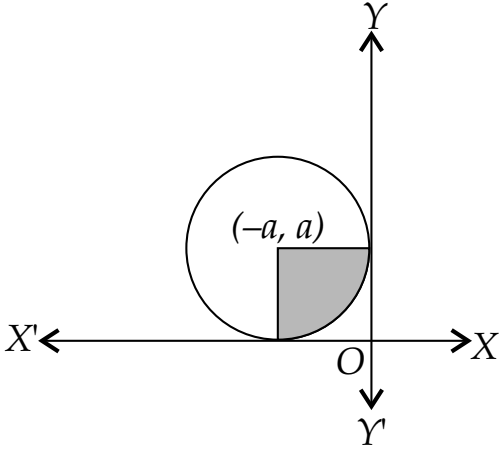
Form the differential equation of the family of circles in the second quadrant and touching the co-ordinate axes.
View full question & answer
3 Marks Question - Applied Maths STD 12 Science Questions - Vidyadip