Questions

5 Marks Questions

🎯

Test yourself on this topic

16 questions · timed · auto-graded

Question 15 Marks
Gymnast Clothing manufactures expensive hockey jerseys for sale to college bookstores in runs of up to $1 5 0$. Its cost (in rupees) for a run of $x$ hockey jerseys is
$C(x)=1500+10 x+0.2 x^2,(0 \leq x \leq 150)$
(a) Gymnast Clothing sells the jerseys at ₹ 90 eac. Find the revenue function
(b) Find the profit function
(c) How many should Gymnast Clothing manufacture to make a profit ? (ROund your answer up to the nearest whole number)
Answer
(a) Since the manufacturer sells the jerseys for ₹ 90 each. the revenue function is
$R(x)=90 x$

(b) Profit is defined to be revenue minus cost, so the profit function is
$P(x)=R(x)-C(x)$
$=90 x-\left(1500+10 x+0.2 x^2\right)$
$=-1500+80 x-0.2 x^2$

(c) In order to make a profit, $P(x)$ must be greater than zero. So, to find how many jerseys we need to make in order to make a profit, we should find the breakeven point. So, we put $P(x)=0$, i.e.,
$-0.2 x^2+80 x-1500=0$
$x=\frac{-80 \pm \sqrt{80^2-4(-0.2)(-1500)}}{2(-0.2)}$
This simplifies to $x=19.7$ or $x=380.2$, but since the problem specifies that the domain is between $x=0$ and $x=150$, we can reject the larger answer. Rounding the other answer up, we get $x=20$. So, if we make 20 jerseys, we will make a profit.
View full question & answer
Question 25 Marks
The cost function for the manufacture of $x$ number of goods by a company is $C(x)=x^3-9 x^2+24 x$. Find the level of output at which the marginal cost is minimum. Further, if the selling price of a unit is $2 x^3+9 x^2$, find the average profit.
Answer
We calculate the marginal cost as
$\frac{d c(x)}{d x}=\frac{d}{d x}\left(x^3-9 x^2+24 x\right)$
$=3 x^2-18 x+24$
In order to be a minimum at $x=x_0$ (say), its derivative must vanish at $x_0$.
Thus, $\left[\frac{d}{d x}\right]_{x=x_0}=0$
or $\quad\left(3 x^2-18 x+24\right)=0$
Thus, $x_0=2,4$
Now, $\frac{d^2}{d x^2}\left(x^3-9 x^2+24 x\right)=6 x-18$
$\left[\frac{d^2}{d x^2}\right]_{x_0=2}=-6$ and $\left[\frac{d^2}{d x^2}\right]_{x_0=4}=6$
By the second derivative test, we can conclude that at $x=4$, the function assumes a minima. Thus, for an output $=4$ finished goods, the marginal cost would be minimum. Now, the average profit as
$\frac{p(x)}{x}=\frac{S P(x)-C P(x)}{x}$
$\Rightarrow \frac{\left(2 x^3+9 x^2\right)-\left(x^3-9 x^2+24 x\right)}{x}$
$\Rightarrow \frac{x^3-24 x}{x} \Rightarrow x^2-24$
View full question & answer
Question 35 Marks
Find the maximum volume of the cylinder which can be inscribed in a sphere of radius $3 \sqrt{3} cm$. (Leave the answer in terms of $\pi$ ).
Answer
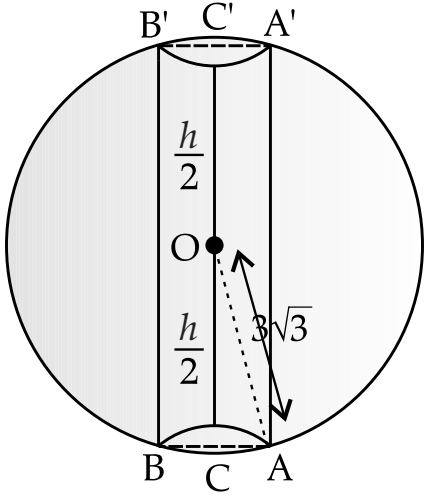
Let $h$ units be the height of the cylinder and $R$ unit be the radius of the cylinder. Given, $3 \sqrt{3} cm$ is the radius of the sphere.
Image
If $V$ is the volume of the cylinder, then ....(i)
$V=\pi R^2 h$
Let $O$ be the centre of the sphere and $C^{\prime} O C \perp B^{\prime} A^{\prime}$ as well as $B A$.
From right angled $\triangle O C A$
$(3 \sqrt{3})^2=\left(\frac{h}{2}\right)^2+R^2$
$\Rightarrow R^2=27-\frac{h^2}{4}$ .....(ii)
$\therefore V=\pi\left(27-\frac{h^2}{4}\right) \cdot h$
$V=27 \pi h-\pi \frac{h^3}{4}$
$\therefore \quad \frac{d V}{d h}=27 \pi-\frac{3 \pi h^2}{4}$
and $\frac{d^2 V}{d h^2}=-\frac{6 \pi h}{4}$
For Maxima/Minima, $\frac{d V}{d h}=0$
$\therefore 27 \pi=\frac{3 \pi h^2}{4}$
$h^2=\frac{4 \times 27}{3}$
$\begin{aligned} h^2 & =36 \\ h & =6,-6\end{aligned}$
and $\left(\frac{d^2 V}{d h^2}\right)_{h=6}=\frac{-6 \pi \times 6}{4}<0$
$\therefore V$ is maximum when $h=6$, putting $h=6$ in equation (ii),
$R^2=27-\frac{36}{4}$
$R^2=18$
$\therefore$ From (i), $V=\pi R^2 h$
$=\pi \times 18 \times 6$
$=108 \pi cm^3$
View full question & answer
Question 45 Marks
A closed right circular cylinder has volume $\frac{539}{2}$ cubic units. Find the radius and the height of the cylinder so that the total surface area is minimum.
Answer
Let $r$ be the radius and $h$ be the height of the cylinder.
$V=\pi r^2 h=\frac{539}{2}$
$\Rightarrow h=\frac{539}{2 \pi r^2}$
Let $S$ be the total surface area, then
$S=2 \pi r h+2 \pi r^2$
$=2 \pi r\left(\frac{539}{2 \pi r^2}\right)+2 \pi r^2$
$=\frac{539}{r}+2 \pi r^2$
$\frac{d S}{d r}=-\frac{539}{r^2}+4 \pi r$
For maxima or minima, $\frac{d S}{d r}=0$
$\begin{array}{l}\Rightarrow-\frac{539}{r^2}+4 \pi r=0 \\ \Rightarrow-539+4 \pi r^3=0 \\ \Rightarrow r^3=\frac{539}{4 \pi}=\frac{539 \times 7}{4 \times 22} \\ \Rightarrow r^3=\left(\frac{7}{2}\right)^3 \\ \Rightarrow r=\frac{7}{2} \text { units } \\ \therefore \frac{d^2 S}{d r^2}=\frac{1078}{r^3}+4 \pi\end{array}$
$\left(\frac{d^2 S}{d r^2}\right)_{r=\frac{7}{2}}=\frac{1078}{\left(\frac{7}{2}\right)^3}+4 \pi>0$
$\therefore S$ is minimum, at $r=\frac{7}{2}$ units
and $h=\frac{539 \times 7 \times 2 \times 2}{2 \times 22 \times 7 \times 7}=7$
$\therefore$ Radius of the cylinder be $\frac{7}{2}$ units and height be 7 units.

View full question & answer
Question 55 Marks
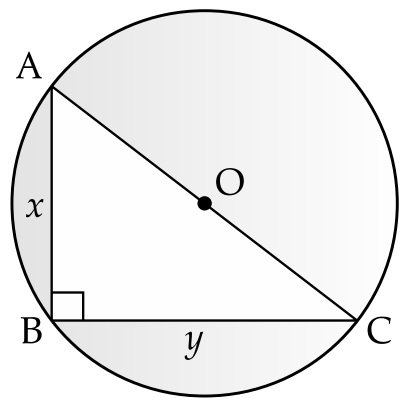
$A B C$ is a right angled triangle of given area $S$. Find the sides of the triangle for which the area of circumscribed circle is least.
Answer
Suppose $A B C$ is a right angled triangle whose area is S.
Image
$S=\frac{1}{2} \times$ Base $\times$ Height
$=\frac{1}{2} \times y \times x$ or, $y=\frac{2 S}{x}$ ....(i)
Circumscribed circle of $\triangle A B C$ is one which passes through points $A, B$ and $C$.
Let $O$ be the centre of circumscribing circle.
$\therefore O A=O B=O C \Rightarrow O A=O C$
Since, $O$ is the mid-point of $A C$.
$\therefore O A=O C=\frac{1}{2} A C$
Now, radius of circumscribing circle
$=\frac{1}{2} \times($ Diameter $)$
$=\frac{1}{2} \times A C=\frac{1}{2} \times \sqrt{x^2+y^2}$ [ using Pythagoras theorom]
Area of circumscribing circle $(A)$
$=\pi \times(\text { Radius of circle })^2$
$=\pi \times\left(\frac{1}{2} \sqrt{x^2+y^2}\right)^2$
$=\frac{\pi}{4}\left(x^2+y^2\right)$ ....(ii)
On putting the value of $y$ in eq. (ii), from eq. (i) we get
$A=\frac{\pi}{4}\left(x^2+\frac{4 S^2}{x^2}\right)$
On differentiating both sides w.r.t. $x$, we get
$\frac{d A}{d x}=\frac{\pi}{4}\left[2 x+\left(\frac{-8 S^2}{x^3}\right)\right]$
$=\frac{\pi}{4}\left(2 x-\frac{8 S^2}{x^3}\right)$
For maximum and minimum area, $\frac{d A}{d x}$ must be zero
i.e., $\quad \frac{\pi}{4}\left(2 x-\frac{8 S^2}{x^3}\right)=0$
$\Rightarrow x-\frac{4 S^2}{x^3}=0$
$x^4=4 S^2$
$\therefore \quad S=\frac{1}{2} x^2$
Now, $\frac{d^2 A}{d x^2}=\frac{\pi}{4}\left(2+\frac{24 S^2}{x^4}\right)$
At $S=\frac{1}{2} x^2, \quad \frac{d^2 A}{d x^2}>0$
Hence, area is least.
On putting $S=\frac{1}{2} x^2$ in Eq. (i) we get
$\frac{1}{2} x^2=\frac{1}{2} \times x y$
$\Rightarrow x=y$
Hence, area of circumscribed circle is least, when $x=y$.

View full question & answer
Question 65 Marks
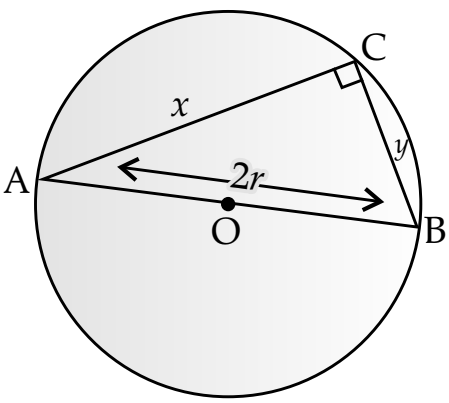
$A B$ is a diameter of a circle and $C$ is any point on the circle. Show that the area of $\triangle A B C$ is maximum, when it is isosceles.
View full question & answer
Question 75 Marks
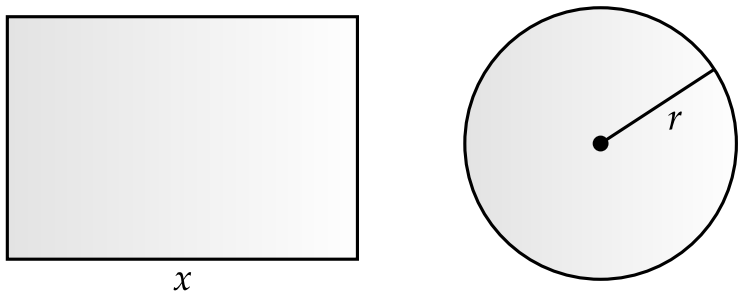
The sum of surface areas of a sphere and a cuboid with sides $\frac{x}{3}, x$ and $2 x$ is constant. Show that the sum of their volumes is minimum if $x$ is equal to the three times the radius of sphere.
Answer
Given $S=4 \pi r^2+2\left[\frac{x^2}{3}+2 x^2+\frac{2 x^2}{3}\right]$
$S=4 \pi r^2+6 x^2$ or $x^2=\frac{S-4 \pi r^2}{6}$
and $V=\frac{4}{3} \pi r^3+\frac{2 x^3}{3}$}
$\therefore V=\frac{4}{3} \pi r^3+\frac{2}{3}\left(\frac{S-4 \pi r^2}{6}\right)^{3 / 2}$
$\frac{d V}{d r}=4 \pi r^2+\left(\frac{S-4 \pi r^2}{6}\right)^{1 / 2}\left(\frac{-8 \pi r}{6}\right)$
$\frac{d V}{d r}=0\left(\frac{S-4 \pi r^2}{6}\right)^{1 / 2}=3 r$
or $r=\sqrt{\frac{S}{54+4 \pi}}$
Now $\quad \frac{d^2 V}{d r^2}=8 \pi r+\left(\frac{-8 \pi}{6}\right)\left(\frac{S-4 \pi r^2}{6}\right)^{1 / 2}$
$+\frac{1}{2}\left(\frac{S-4 \pi r^2}{6}\right)^{-1 / 2} \cdot\left(\frac{-8 \pi r}{6}\right)\left(\frac{-8 \pi r}{6}\right)$
at $r=\sqrt{\frac{S}{54+4 \pi}} ; \frac{d^2 V}{d r^2}>0$
$\therefore$ for $r=\sqrt{\frac{S}{54+4 \pi}}$ volume is minimum
$\begin{array}{l}\text { i.e., } r^2(54+4 \pi)= S \\ \text { or } r^2(54+4 \pi)=4 \pi r^2+6 x^2 \\ \text { or } 6 x^2=54 r^2 \\ \text { or } x^2=9 r^2 \\ \text { or } x=3 r\end{array}$
View full question & answer
Question 85 Marks
A wire of length 50 m is cut into two pieces. One piece of the wire is bent in the shape of a square and the other in the shape of a circle. What should be the length of each piece so that the combined area of the two is minimum?
Answer

Image

Length of wire $=50 m$ (Given)
Let length of one piece for shape of square $=x m$
$\therefore$ Length of other piece for shape of circle
$=(50-x) m$
Now perimeter of square $=4 a=x$
$\Rightarrow a=\frac{x}{4}$
and circumference of circle $=2 \pi r=50-x$
$\Rightarrow r=\frac{50-x}{2 \pi}$
Combined Area $=a^2+\pi r^2$
$=\frac{x^2}{16}+\pi \cdot\left(\frac{50-x}{2 \pi}\right)^2$
$=\frac{x^2}{16}+\pi \cdot \frac{(50-x)^2}{4 \pi^2}$
$A=\frac{x^2}{16}+\frac{(50-x)^2}{4 \pi}$
Differentiating w.r. t. $x$, we get
$\frac{d A}{d x}=\frac{2 x}{16}+\frac{2(50-x)(-1)}{4 \pi}$
$=\frac{x}{8}+\frac{(x-50)}{2 \pi}$
$=\frac{\pi x+4 x-200}{8 \pi}$
$=\frac{x(4+\pi)-200}{8 \pi}$
For maximum and minimum value of $A, \frac{d A}{d x}=0$
$\therefore \quad x(4+\pi)-200=0$
$x=\frac{200}{4+\pi}$
At $x=\frac{200}{4+\pi}, \frac{d^2 A}{d x^2}>0$
$A$ is minimum at $\frac{200}{4+\pi}$
$\therefore$ Length of square wire, $x=\frac{200}{4+\pi} m$
and length of circle wire $=50-x$
$=50-\frac{200}{4+\pi}$
$=\frac{50 \pi}{4+\pi} m$
View full question & answer
Question 95 Marks
Show that the surface area of closed cuboid with square base and given volume is minimum when it is a cube.
Answer
Let the length and breadth be $x$ units (square base), height of cuboid be $h$ unit.
Volume of cuboid $(v)=x^2 h$
$\therefore h=\frac{v}{x^2}$.
Surface area of cuboid$(s)=2\left(x^2+x h+x h\right)$
$\therefore s=2 x^2+4 x h$
$\Rightarrow s=2 x^2+4 x \times \frac{v}{x^2}$
$\Rightarrow s=2 x^2+4 v \frac{1}{x}$
$\therefore \frac{d s}{d x}=4 x-4 v \frac{1}{x^2}$
For maximum and minimum surface, $\frac{d s}{d x}=0$
$\therefore 4 x-4 v \cdot \frac{1}{x^2}=0$
$\Rightarrow 4 x=\frac{4 v}{x^2}$
$\Rightarrow \quad x^3=v$
$\Rightarrow x^3=x^2 h$
$\Rightarrow \quad x=h$
Now, $\frac{d^2 s}{d x^2}=4+\frac{8 v}{x^3}$
At $x=h, \frac{d^2 s}{d x^2}=4+\frac{8 v}{h^3}>0$
$\therefore$ Surface area is minimum, when $x=h$.
i.e., when $x=h$, it is a cube, surface area will be minimum.
x = h
Hence proved.
View full question & answer
Question 105 Marks
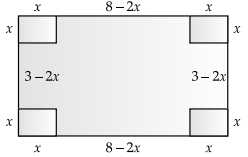
An open topped box is to be made by removing equal squares from each corner of a 3 m by 8 m rectangle sheet of aluminium and by folding up the side. Find the volume of the largest such box.
View full question & answer
Question 115 Marks
Show that the altitude of a right circular cone of maximum that can be inscribed in a sphere of radius $r$ is $\frac{4 r}{3}$.
Answer
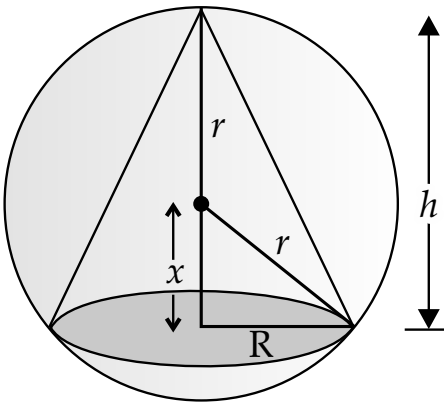
Let $R$ be the radius of base and $h$ be the height of the cone, let $x$ be the distance between the centre of sphere and centre of base of cone.Image
$\therefore \quad h=r+x$
and $R^2=r^2-x^2$
Volume of cone $V(x)=\frac{1}{3} \pi R^2 h$
$=\frac{1}{3} \pi\left(r^2-x^2\right)(r+x)$
$\therefore \quad V^{\prime}(x)=\frac{1}{3} \pi\{-2 x(r+x)$$\left.+\left(r^2-x^2\right)\right\}$
$=\frac{1}{3} \pi(r+x)(-2 x+r-x)$
$=\frac{1}{3} \pi(r+x)(r-3 x)$
For max. and min. volume
$V^{\prime}(x)=0$
$\Rightarrow \quad(r+x)(r-3 x)=0$
$\Rightarrow \quad r=-x($ not possible) or $r=3 x$
$\Rightarrow \quad x=\frac{r}{3}$
Now, $\quad V^{\prime \prime}(x)=\frac{1}{3} \pi\{(r-3 x)-3(r+x)\}$
at $x=\frac{r}{3}, V^{\prime \prime}\left(\frac{r}{3}\right)<0$
$\therefore$ Volume is maximum when $x=\frac{r}{3}$
$\therefore \quad h=r+x=r+\frac{r}{3}=\frac{4 r}{3}$
i.e., height of cone is $\frac{4 r}{3}$.
Hence proved.
View full question & answer
Question 125 Marks
A cone is inscribed in a sphere of radius 12 cm . If the volume of the cone is maximum, find its height.
Answer
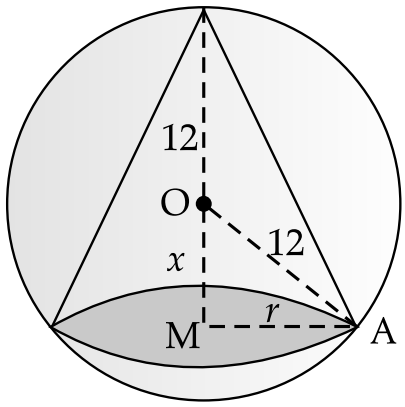
Let $r$ be the radius of cone and $h$ be the height of cone, let $x$ be the distance between centre of sphere and centre of base of cone,
Given, radius of sphere R = 12
$\therefore h=12+x$ ....(i)

Image

Volume of cone $=\frac{1}{3} \pi r^2 h$
$=\frac{1}{3} \pi\left(12^2-x^2\right)(12+x)$
$\left[\because \operatorname{In} \triangle O M A, 12^2=x^2+r^2\right]$
$=\frac{1}{3} \pi\left(144-x^2\right)(12+x)$
$\therefore \frac{d V}{d x}=\frac{1}{3} \pi\left[\left(144-x^2\right) \cdot 1+(12+x)(-2 x)\right]$
$=\frac{1}{3} \pi\left[144-x^2-24 x-2 x^2\right]$
$=\frac{1}{3} \pi\left[144-24 x-3 x^2\right]$
For maximum or minimum volume, put $\frac{d V}{d x}=0 \quad $
$\begin{array}{l}\text { i.e., } \frac{1}{3} \pi\left[144-24 x-3 x^2\right]=0 \\ \Rightarrow 144-24 x-3 x^2=0 \\ \Rightarrow x^2+8 x-48=0 \\ \Rightarrow(x+12)(x-4)=0 \\ \Rightarrow x=-12 \text { and } x=4\end{array}$
Now,
$\frac{d^2 V}{d x^2}=\frac{1}{3} \pi[-24-6 x]$
$\therefore\left(\frac{d^2 V}{d x^2}\right)_{x=4}=\frac{1}{3} \pi[-24-24]<0$
Hence, at $x=4$ volume of cone is maximum and height of cone $(h)=12+x=12+4=16 cm$.
View full question & answer
Question 135 Marks
Show that $y=\log (1+x)-\frac{2 x}{2+x}, x>-1$, is an increasing function of $x$ throughout its domain.
Answer
Given, $y=\log (1+x)-\frac{2 x}{2+x}, x>-1$
Differentiating, w.r.t. ' $x$ '
$\frac{d y}{d x}=\frac{1}{1+x}-\frac{[(2+x)(2)-2 x]}{(2+x)^2}$
$=\frac{1}{1+x}-\frac{[4+2 x-2 x]}{(2+x)^2}$
$=\frac{1}{1+x}-\frac{4}{(2+x)^2}$
$=\frac{(2+x)^2-4(1+x)}{(2+x)^2(1+x)}$
$=\frac{4+x^2+4 x-4-4 x}{(2+x)^2(1+x)}$
$=\frac{x^2}{(2+x)^2(1+x)}$
For increasing order
$\frac{d y}{d x} \geq 0$
$\frac{x^2}{(2+x)^2(x+1)} \geq 0$
$\Rightarrow \quad\left(\frac{x}{2+x}\right)^2 \cdot\left(\frac{1}{x+1}\right)>0$
$\Rightarrow\left(\frac{x}{2+x}\right)^2 \cdot\left(\frac{1}{x+1}\right)>0$
$\Rightarrow\left(\frac{1}{x+1}\right)>0$
This is possible only when $1+x>0$ i.e., $x>-1$
So, $\frac{d y}{d x}>0$ for $x>-1$
When $x>-1$ $\frac{d y}{d x}$ is always greater than zero.
$\therefore y=\log (1+x)-\frac{2 x}{2+x}$ is always increasing through out its domain.
View full question & answer
Question 145 Marks
Prove that the function $f$ defined by $f(x)=x^2-x+1$ is neither increasing nor decreasing in (-1, 1). Hence find the intervals in which $f(x)$ is :
(i) strictly increasing
(ii) strictly decreasing.
Answer
$f^{\prime}(x)=2 x-1$
$f^{\prime}(x)>0, \forall x \in\left(\frac{1}{2}, 1\right)$
$f^{\prime}(x)<0, \forall x \in\left(-1, \frac{1}{2}\right)$
$\therefore f(x)$ is neither increasing nor decreasing in $(-1,1)$.}
$f(x)$ is strictly increasing on $\left(\frac{1}{2}, 1\right)$
and $f(x)$ is strictly decreasing on $\left(-1, \frac{1}{2}\right)$
View full question & answer
Question 155 Marks
If $x=\sin t$ and $y=\sin p t$, then prove that $\left(1-x^2\right)$$\frac{d^2 y}{d x^2}-x \frac{d y}{d x}+p^2 y=0$
Answer
Given, $x=\sin t$ and $y=\sin p t$
On differentiating both sides w.r.t. t , we get
$\frac{d x}{d t}=\cos t$
and $\quad \frac{d y}{d t}=\cos p t \cdot p$
or $\quad \frac{d y}{d x}=\frac{\frac{d y}{d t}}{\frac{d x}{d t}}=\frac{\cos p t \cdot p}{\cos t}$
Now on differentiating both sides w.r.t. $x$, we get
$\frac{d^2 y}{d x^2}=$ $p \frac{[\cos t(-\sin p t \cdot p)-\cos p t(-\sin t)]}{\cos ^2 t} \cdot \frac{d t}{d x}$
or $\quad \frac{d^2 y}{d x^2}=\frac{p[\cos p t \cdot \sin t-\cos t \sin p t \cdot t]}{\cos ^2 t} \cdot \frac{1}{\cos t}$
or $\quad \cos ^2 t \frac{d^2 y}{d x^2}=\frac{p\left[\cos p t \cdot \sin t-p^2 \cos t \sin p t\right]}{\cos t}$
View full question & answer
Question 165 Marks
If $x \cos (a+y)=\cos y$, then prove that $\frac{d y}{d x}=$$\frac{\cos ^2(a+y)}{\sin a}$. Hence, show that $\sin a \frac{d^2 y}{d x^2}+$$\sin 2(a+y) \frac{d y}{d x}=0$
Answer
Given, $x \cos (a+y)=\cos y$
or $x=\frac{\cos y}{\cos (a+y)}$
On differentiating both sides w.r.t. $y$, we get
$\frac{d x}{d y}=\frac{\cos (a+y) \frac{d}{d y} \cos y-\cos y \frac{d}{d y} \cos (a+y)}{\cos ^2(a+y)}$
[by using quotient rule of derivative]
$=\frac{\cos (a+y) \times(-\sin y)+\cos y \times \sin (a+y)}{\cos ^2(a+y)}$
$=\frac{\sin (a+y) \cos y-\cos (a+y) \sin y}{\cos ^2(a+y)}$
or $\frac{d y}{d x}=\frac{\sin (a+y-y)}{\cos ^2(a+y)}$
$=\frac{\sin a}{\cos ^2(a+y)}$
$[\because \sin A \cos B-\cos A \sin B=\sin (A-B)]$
or $\frac{d y}{d x}=\frac{\cos ^2(a+y)}{\sin a}$ ....(i)
Again, on differentiating both sides of Eq. (i) w.r.t. $x$, we get
$\frac{d^2 y}{d x^2}=\frac{1}{\sin a} \frac{d}{d x} \cos ^2(a+y)$
$=\frac{1}{\sin a} \times \frac{d}{d y} \cos ^2(a+y) \times \frac{d y}{d x}$
$=\frac{1}{\sin a} \times 2 \cos (a+y)[-\sin (a+y)] \times \frac{d y}{d x}$
$=-\frac{2 \sin (a+y) \cos (a+y)}{\sin a} \times \frac{d y}{d x}$
$\therefore \frac{d^2 y}{d x^2}=\frac{-\sin 2(a+y)}{\sin a} \frac{d y}{d x}[\because 2 \sin \theta \cos \theta=\sin 2 \theta]$
$\therefore \sin a \frac{d^2 y}{d x^2}+\sin 2(a+y) \frac{d y}{d x}=0$
Hence proved.
View full question & answer
5 Marks Questions - Applied Maths STD 12 Science Questions - Vidyadip