MCQ 11 Mark
The least value of 'a' such that the function $f(x)=x^2+a x+1$ is increasing on (1, 2) is:
Answer(B) -2Explanation : We have, $f(x)=x^2+a x+1$
$\therefore \quad f'(x)=2 x+a$
Now, function f will be increasing in (1, 2),
if f'(x) > 0 in (1, 2)
f' (x) > 0
$\Rightarrow \quad 2 x+a>0$
$\Rightarrow \quad 2 x>-a$
$\Rightarrow \quad x>\frac{-a}{2}$
Therefore, we have to find the least value of a such that
$x>\frac{-a}{2}$, when $x \in(1,2)$
$\Rightarrow \quad x>\frac{-a}{2}$, when $1Thus, the least value of a for f to be increasing on (1,2)
$\frac{-a}{2}=1$
$\Rightarrow \quad a=-2$
Hence, the required value of a is-2.
View full question & answer→MCQ 21 Mark
If the total revenue (₹) received from the sale of x units of a product is given by: $R(x)=3 x^2+36 x+5$
Answer(D) ₹126
Explanation : $R(x)=3 x^2+36 x+5$
Marginal Revenue, $R^{\prime}(x)=\frac{d R}{d x}=6 x+36$
$\therefore$ Marginal Revenue at $x=15$ is $\left.\frac{d R}{d x}\right|_{x=15}$
= 6(15) + 36 =₹126
View full question & answer→MCQ 31 Mark
If $y=A e^{5 x}+B e^{-5 x}$, then $\frac{d^2 y}{d x^2}$ is:
Answer(A) 25y
Explanation: Given $y=A e^{5 x}+B e^{-5 x}$
$\therefore \quad y^{\prime}=5 A e^{5 x}-5 B e^{-5 x}$ [Differentiating w.r.t. x]
$\Rightarrow \quad y^{\prime}=5\left(A e^{5 x}-B e^{-5 x}\right)$
$\Rightarrow \quad y^{\prime}=5\left(5 A e^{5 x}+5 B e^{-5x}\right)$
$\Rightarrow \quad y^{\prime \prime}=5\left(5 A e^{5 x}+5 B e^{-5 x}\right)$ [Differentiating again w.r.t. x]
$\Rightarrow \quad y^{\prime \prime}=25\left(A e^{5 x}+B e^{-5 x}\right)$
$\Rightarrow \quad y^{\prime \prime}=25 y$
or, $\frac{d^2 y}{d x^2}=25 y$
View full question & answer→MCQ 41 Mark
If C(x) and R(x) are respectively Cost function and Revenue function, then the Profit function P(x) is given by:
Answer(C) P(x) = R(x) - C(x)
Explanation: Profit is revenue minus cost
i.e., P(x) = R(x) - C(x)
View full question & answer→MCQ 51 Mark
The point on the curve $x^2= 2 y$ which is nearest to the point (0, 5) is:
- ✓
$(2 \sqrt{2}, 4)$
- B
$(2 \sqrt{2}, 0)$
- C
- D
AnswerCorrect option: A. $(2 \sqrt{2}, 4)$
(A) $(2 \sqrt{2}, 4)$
Explanation: Let a point on the curve be (h, k)
Then, $h^2=2 k$ ......(i)
Distance, $D=\left|\sqrt{(h-0)^2+(k-5)^2}\right|$
$=\left|\sqrt{2 k+k^2+25-10 k}\right|$ ...[from (i)]
$=\left|\sqrt{k^2-8 k+25}\right|$
or, Let $z=D^2=k^2-8 k+25$
$\Rightarrow \quad z=k^2-8 k+25$
$\Rightarrow \quad \frac{d z}{d k}=2 k-8$ ....(ii)
for maxima & minima $\frac{d z}{d k}=0$
$\therefore \quad 2 k-8=0$
$\Rightarrow \quad k=4$
On differentiating again eq. (i), we get
$\frac{d^2 z}{d k^2}=2>0$
$\Rightarrow z$ has a minima at $k=4$
from (i), when $k=4, h^2=8$
$\Rightarrow \quad h= \pm 2 \sqrt{2}$
$\therefore$ Required points are $( \pm 2 \sqrt{2}, 4)$.
View full question & answer→MCQ 61 Mark
The demand function of a commodity is given by:
x = 82 - p
and its total cost function is given by: cost function is given by:
T.C.= 100 + 60x
For maximum profit, the value of x is:
Answer(D) 11 units
Explanation: Here, demand function
p(x) = 82 - x
and cost function c(x) = 100 + 60x
$\therefore$ Profit function, $P(x)=x p(x)-c(x)$
$\Rightarrow \quad P(x)=x(82-x)-(100+60 x)$
$\Rightarrow \quad P(x)=82 x-x^2-100-60 x$
$\Rightarrow \quad P(x)=-x^2+22 x-100$
Now, $\quad$ put $P^{\prime}(x)=0 \quad P^{\prime}(x)=-2 x+22$
i.e - 2x + 22 = 0
$\Rightarrow$ x = 11 $P^{\prime \prime}(x)=-2$
Also, $P^{\prime \prime}(x)=-2<0$ (Hence, maximum
Thus, value of x is 11 units.
View full question & answer→MCQ 71 Mark
The function $f(x)=a^x$ is increasing on $R$, if:
Answer(D) a >1
Explanation : Given, $f(x)=a^x$
$f(x)=a^x \log a$
for increasing function, f(x) > 0
$\therefore$ $a^x \log a>0$
$\Rightarrow a^x>0$ and $\log a>0$ or $a^x<0$ and $\log a<0$
But log function is always positive
$\Rightarrow \quad \log a>0$
$\Rightarrow \quad$$a>1$
View full question & answer→MCQ 81 Mark
Find the slope of the tangent to the curve $y=7 x^3-2 x^2$ at the point x = 2
Answer(B) 76
Explanation: The slope of the longest at x = 2 is given by
$\left.\frac{d y}{d x}\right|_{x=2}=21 x^2=\left.4 x\right|_{x-2}$
$=21(2)^2-4(2)$
=84-8
= 76.
View full question & answer→MCQ 91 Mark
Find the slope of normal to the curve $y=4 x^2-14 x+$5 x = 5
- A
$\frac{1}{26}$
- ✓
$-\frac{1}{26}$
- C
- D
AnswerCorrect option: B. $-\frac{1}{26}$
(B) 19
Explanation: The slope of the tangent at x = 5 is given by
$\left.\frac{d y}{d x}\right|_{x=5}=8 x-\left.14\right|_{x=5}$
=40-14
= 26
Therefore, slope of the normal to the curve is
$-\frac{1}{\text { slope of the longest }}=-\frac{1}{26}$
at x = 5
View full question & answer→MCQ 101 Mark
Find the tangent to the curve $y=3 x^2+x+4$ at x = 3 .
Answer(A) 19
Explanation: The slope of tangent at x = 3 is given by
$\left.\frac{d y}{d x}\right|_{x=3}=6 x+\left.1\right|_{x=3}$
= 18+1
= 19
View full question & answer→MCQ 111 Mark
Find the second derivative of $x^3-5 x^2+x=0$
Answer(B) 6x - 10 .
Explanation :
Let, $f(x)=x^3-5 x^2+x$
So, $f^{\prime}(x)=3 x^2-10 x+1$
And $f^{\prime \prime}(x)=6 x-10$
View full question & answer→MCQ 121 Mark
Nature of the function $f(x)=e^{2 x}$_________
- ✓
- B
- C
- D
Increasing and Decreasing
Answer(A) Increasing.
Explanation
$f(x)=e^{2 x}$
$f^{\prime}(x)=2 e^{2 x}$
As we know $2 e^{2 x}>0$, so it always has a value greater than zero.
Which shows that function f is increasing for all $x \in R$.
View full question & answer→MCQ 131 Mark
Find the intervals in which $f(x)=2 x^2-3 x$ is increasing.
- A
$\left(-\frac{1}{4}, \infty\right)$
- B
$\left(-\frac{3}{4}, \infty\right)$
- C
$\left(\frac{1}{4}, \infty\right)$
- ✓
$\left(\frac{3}{4}, \infty\right)$
AnswerCorrect option: D. $\left(\frac{3}{4}, \infty\right)$
(D) $\left(\frac{3}{4}, \infty\right)$
Explanation: $f(x)=2 x^2-3 x$
$f^{\prime}(x)=4 x-3$
As we know $f^{\prime}(x)=0, x=\frac{3}{4}$.This shows that function f is increasing in interval $\left(\frac{3}{4}, \infty\right)$ for all $x \in R$.
View full question & answer→MCQ 141 Mark
Find the interval in which function $f(x)=x^2-4 x+$5 is increasing
- ✓
$(2, \infty)$
- B
$(-\infty, 2)$
- C
$(3, \infty)$
- D
$(-\infty, \infty)$
AnswerCorrect option: A. $(2, \infty)$
(A) $(2, \infty)$
Explanation: $f(x)=x^2-4 x+5$
$f^{\prime}(x)=2 x-4$
Therefore f' (x) = 0 gives x = 2
Now this point x = 2 divides the line into two disjoint intervals and the interval namely $(2, \infty)$ is increasing on f(x).
View full question & answer→MCQ 151 Mark
What is the nature of function f(x) = 7x - 4 on R?
- A
- B
- ✓
- D
Increasing and Decreasing
Answer(C) Strictly Increasing .
Explanation
Let $x_1$ and $x_2$ be any two numbers in R .
Then $x_1< x_2$
$\Rightarrow \quad 7 \times 1<7 \times 2$
$\Rightarrow \quad 7 \times 1-4<7 \times 2-4$
As $f\left(x_1\right) < f\left(x_2\right)$, thus the function $f$ is strictly increasing on $R$.
View full question & answer→MCQ 161 Mark
The interval in which $y=x^2 e^{-x}$ is increasing in
- A
$(-\infty, \infty)$
- B
- C
$(2, \infty)$
- ✓
Answer(D) (0, 2)
Explanation: Given that,
$y=x^2 e^{-x}$
$\therefore \quad \frac{d y}{d x}=2 x e^{-x}-x^2 e^{-x}$
$=x e^{-x}(2-x)$
Now, $\frac{d y}{d x}=0$
x = 0 and x = 2
The points x = 0 and x = 2 divide the real line into three disjoint intervals i.e $(-\infty, 0),(0,2)$ and $(2, \infty)$ In intervals $(-\infty, 0)$ and $(2, \infty), f^{\prime}(x)<0$ as $e^{-x}$ is always positive
$\therefore f$ is decreasing on $(-\infty, 0)$ and $(2, \infty)$
In interval (0, 2), f'(x) > 0
f is strictly increasing on (0, 2).
Hence, f is strictly increasing in interval (0, 2).
View full question & answer→MCQ 171 Mark
The function f(x) = tan x-x
- ✓
- B
- C
- D
sometimes increases and sometimes decreases
Answer(A) always increases
Explanation: We have,
f(x) = tan x - x
On differentiating with respect to x, we get
$f^{\prime}(x)=\sec ^2 x-1$
$\Rightarrow f^{\prime}(x)>0, \forall x \in R_0$
So, f(x) always increases.
View full question & answer→MCQ 181 Mark
Which of the following functions is decreasing on $\left(0, \frac{\pi}{2}\right)$.
Answer(C) cos x
Explanation: In the given interval $\left(0, \frac{\pi}{2}\right)$
f(x) = cos x
On differentiating w.r.t. x, we get
f'(x) = - sin x
which gives $f^{\prime}(x)<0$ in $\left(0, \frac{\pi}{2}\right)$
Hence, f(x) = cos x is decreasing in $\left(0, \frac{\pi}{2}\right)$.
View full question & answer→MCQ 191 Mark
The function $f(x)=2 x^3-3 x^2-12 x+4$, has
- A
two points of local maximum
- B
two points of local minimum
- ✓
one maxima and one minima
- D
AnswerCorrect option: C. one maxima and one minima
(C) one maxima and one minima
Explanation: We have,
$f(x)=2 x^3-3 x^2-12 x+4$
$f^{\prime}(x)=6 x^2-6 x-12$
Now, $\quad f^{\prime}(x)=0$
$\Rightarrow \quad 6\left(x^2-x-2\right)=0$
$\Rightarrow \quad 6(x+1)(x-2)=0$
$x=-1$ and $x=+2$
On number line for f'(x), we get
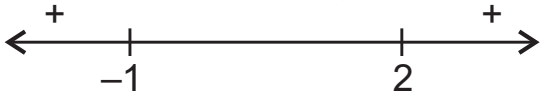
Hence, x = - 1 is point of local maxima and x = 2 is point of local minima.
So, f(x) has one maxima and one minima. View full question & answer→MCQ 201 Mark
The smallest value of the polynomial $x^3-18 x^3+96x$ in [0, 9] is
Answer(B) 0
Explanation: Given that, the smallest value of polynomial $x^3-18 x^2+96 x$ is
On differentiating with respect to x, we get ?"
$f^{\prime}(x)=3 x^2-36 x+96$
So, $f^{\prime}(x)=0$
$\Rightarrow \quad 3 x^2-36 x+96=0$
$\Rightarrow 3\left(x^2-12 x+32\right)=0$
$\Rightarrow \quad(x-8)(x-4)=0$
$x=8,4 \in[0,9]$
We shall now calculate the value of f at these points and at the end points of the interval [0, 9], i.e., at x = 4 and x = 8 and at x = 0 and at x = 9
$f(4)=4^3-18 \times 4^2+96 \times 4$
= 64-288-384
= 160
$f(8)=8^3-18 \times 8^2+96 \times 8$
=128
$f(9)=9^3-18 \times 9^2+96 \times 9$
= 729-1458+864
= 135
and $f(0)=0^3-18 \times 0^2+96 \times 0$
= 0
Thus, we conclude that absolute minimum value of on [0, 9] is 0 occurring at x = 0
View full question & answer→MCQ 211 Mark
If x is real, the minimum value of $x^2-8 x+17 \text { is }$
Answer(C) 1
Explanation: Let,
$f(x)=x^2-8 x+17$
On differentiating with respect to x, we get
f'(x) = 2x - 8
So, f'(x) = 0
$\Rightarrow 2 x-8=0$
$\Rightarrow \quad 2 x=8$
x = 4
Now, Again on differentiating w.r.t. x, we get
$f^{\prime \prime}(x)=2>0, \forall x$
So, x = 4 is the point of local minima.
Minimum value of f(x) at x = 4
f(4) = 4 x 4 - 8 x 4 + 17 = 1
View full question & answer→MCQ 221 Mark
$y=x(x-3)^2$ decreases for the values of x given by:
- A
- B
- C
- D
$0 < x < \frac{3}{2}$
AnswerA) 1 < x < 3
Explanation: Given that,
$y=x(x-3)^2$
$\therefore \quad \frac{d y}{d x}=x \cdot 2(x-3) \cdot 1+(x-3)^2 .1$
$=2 x^2-6 x+x^2+9-6 x$
$=3 x^2-12 x+9$
$=3\left(x^2-3 x-x+3\right)$
$=3(x-3)(x-1)$

So, $y=x(x-3)^2$ decreases for $(1,3)$.
[Since, $y^{\prime}<0$ for all $x \in(1,3)$, hence $y$ is decreasing on $(1,3)]$. View full question & answer→MCQ 231 Mark
The interval on which the function $f(x)=2 x^3+9 x^2+12 x-1$ is decreasing is:
- A
$[-1, \infty)$
- ✓
- C
$(-\infty,-2]$
- D
Answer(B) [-2,-1]
Explanation: Given that,
$f(x)=2 x^3+9 x^2+12 x-1$
$f^{\prime}(x)=6 x^2+18 x+12$
$=6\left(x^2+3 x+2\right)$
= 6(x + 2)(x + 1)
So, $f^{\prime}(x) \leq 0$, for decreasing.
On drawing number line as below:

We see that f(x) is decreasing in [-2,-1] View full question & answer→MCQ 241 Mark
Let $h(x)=f(x)-[f(x)]^2+[f(x)]^3$ for every real number x. Then
- ✓
h is increasing whenever f is increasing
- B
h is increasing whenever fis decreasing
- C
h is decreasing whenever f is increasing
- D
Nothing can be said in general
AnswerCorrect option: A. h is increasing whenever f is increasing
(A) h is increasing whenever f is increasing
Explanation: For the given relation h is increasing whenever f is increasing as:
$h(x)=f(x)-(f(x))^2+(f(x))^3$
View full question & answer→MCQ 251 Mark
The demand function of a toy is , x = 75 - 3p and its total cost function is TC = 100 + 3x For maximum profit the value of x is
Answer(A) 33
Explanation:
TR = px
$=\frac{75 x-x^2}{3}$
P = TR - TC
$=\frac{75 x-x^2}{3}-(3 x+100)$
$\frac{d P}{d x}=22-\frac{2}{3} x$
= 0
$\Rightarrow \quad x=33$
$\Rightarrow \quad \frac{d^2 p}{d x^2}=\frac{-2}{3}<0$
Max. at 33 unit
View full question & answer→MCQ 261 Mark
The variable cost of producing x units is $V(x)=x^2$+2x If the company incurs a fixed cost of ₹10,000, then the level of output where the average cost is minimum is
Answer(C) 100 units
Explanation:
TC = VC + FC
$=x^2+2 x+10000$
$A C=x+2+\frac{10000}{x}$
$\frac{d(A C)}{d x}=1-\frac{10000}{x^2}$
= 0
x = 100
View full question & answer→MCQ 271 Mark
Given that $x=a t^2$ and $y=2 a t$, then value of $\frac{d^2 y}{d x^2}$
- ✓
$-\frac{1}{2 a t^3}$
- B
$-\frac{1}{2 a t^2}$
- C
$\frac{1}{t^2}$
- D
$\frac{-2 a}{t}$
AnswerCorrect option: A. $-\frac{1}{2 a t^3}$
(A) $-\frac{1}{2 a t^3}$
Explanation:
$\frac{d y}{d x}=\frac{\frac{d y}{d t}}{\frac{d x}{d t}}$
$=\frac{2 a}{2 a t}$
$=\frac{1}{t}$
$\Rightarrow \quad \frac{d^2 y}{d x^2}=-\frac{1}{t^2} \times \frac{d t}{d x}$
$=-\frac{1}{2 a t^3}$
View full question & answer→MCQ 281 Mark
The function $y=\frac{1}{x}$ is strictly decreasing in the interval(s)
AnswerCorrect option: C. $(-\infty, 0)$ as well as $(0, \infty)$
(C) $(-\infty, 0)$ as well as $(0, \infty)$
Explanation:
$y=\frac{1}{x}$
$\left.\Rightarrow \quad \frac{d y}{d x}=-\frac{1}{x^2} \right\rvert\,<0$
for $(-\infty, 0)$ and $(0, \infty)$
View full question & answer→MCQ 291 Mark
The total cost function is given by $C(x)=x^2+$30x + 1500 The marginal cost when 10 units are produced is:
Answer(C) 50
Explanation:
$C(x)=x^2+30 x+1500$
$M.C. =C'(x)$
= 2x + 30
M.C. when 10 units are produced
= C'(10)
=₹ 50
View full question & answer→