Question 15 Marks
A company produces soft drinks that have a contract which requires that a minimum of 80 units of chemical A and 60 units of the chemical B go into each bottle of the drink. The chemicals are available in prepared mix packets from two different suppliers. Supplier S had a packet of mix of 4 units of A and 2 units of B that costs ₹10. The supplier T has a packet of mix of 1 unit of A and 1 unit of B that costs ₹4. How many packets of mixes from S and T should the company purchase to honour the contract requirement and yet maintain the minimum cost? Make a LPP and solve graphically.
Answer
View full question & answer→Let x and y units of packet of mixes are purchased from S and T, respectively. If Z is the total cost, then
Z = 10x + 4y...(i)
is objective function which we have to minimize.
Here, constraints are:
$4 x+y \geq 80$...(ii)
$2 x+y \geq 60$...(iii)
Also, $x \geq 0$...(iv)
$y \geq 0$...(v)
Now, 4x + y = 80
and 2x + y = 60...(2)
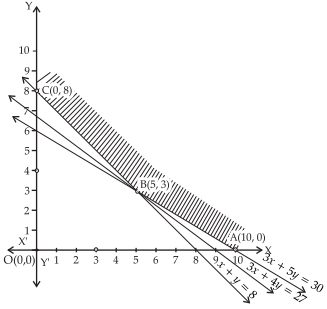
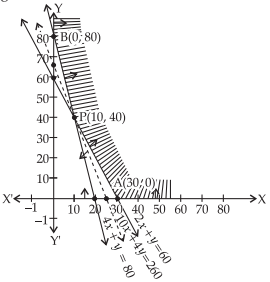
On plotting the graph of above constraints or inequalities (ii), (iii), (iv) and (v), we get shaded region having corner points A, P, B as feasible region. For coordinate of P
Point of intersection of
2x + y = 60 ...(vi)
and 4x + y = 80 ...(vii)
From (vi) - (vii),
2x + y - 4x - y = 60 - 80
- 2x = - 20
x = 10
y = 40
$\because$ Co-ordinates of $P=(10,40)$
Now the value of Z is evaluated at corner points in the following table:
Since, feasible region is unbounded. Therefore, we have to draw the graph of the inequality.
10x + 4y < 260
i.e., 5x + 2y < 130 ...(viii)
Since, the graph of inequality (viii) does not have any point common.
So, the minimum value of Z is 260 at (10, 40).
i.e., minimum cost of each bottle is ₹260, if the company purchases 10 packets of mixes from S and 40 packets of mixes from supplier T.
Z = 10x + 4y...(i)
is objective function which we have to minimize.
Here, constraints are:
$4 x+y \geq 80$...(ii)
$2 x+y \geq 60$...(iii)
Also, $x \geq 0$...(iv)
$y \geq 0$...(v)
Now, 4x + y = 80
| x | 0 | 20 |
| y | 80 | 0 |
| x | 0 | 30 |
| y | 60 | 0 |
Point of intersection of
2x + y = 60 ...(vi)
and 4x + y = 80 ...(vii)
From (vi) - (vii),
2x + y - 4x - y = 60 - 80
- 2x = - 20
x = 10
y = 40
$\because$ Co-ordinates of $P=(10,40)$
Now the value of Z is evaluated at corner points in the following table:
| Corner Point | Z = 10x + 4y |
| A(30, 0) | 300 |
| P(10,40) | $260 \leftarrow$ Minimum |
| B(0, 80) | 320 |
10x + 4y < 260
i.e., 5x + 2y < 130 ...(viii)
Since, the graph of inequality (viii) does not have any point common.
So, the minimum value of Z is 260 at (10, 40).
i.e., minimum cost of each bottle is ₹260, if the company purchases 10 packets of mixes from S and 40 packets of mixes from supplier T.