Questions

3 Marks Question

🎯

Test yourself on this topic

8 questions · timed · auto-graded

Question 13 Marks
Ten individuals are chosen at random from the population and their heights are found to be in inches 63, 63, 64, 65, 66, 69, 69, 70, 70, 71. Discuss the freedom value of Student's -t and 5% level of significance is 2.62.
Answer
x$x-\bar{x}$$(x-\bar{x})^2$
 63 -416
 63 -416
 64-39
 65-24
 66-11
 6924
 6924
 7039
 7039
 71416
 $\sum x$=670 $\sum(x-\bar{x})^2=88$

$\begin{array}{l}=\frac{\sum x}{n} \\ =\frac{670}{10}=67\end{array}$
Now, compute the standard deviation using formula as,
$\begin{array}{l}\sigma=\sqrt{\frac{\sum(x-\bar{x})^2}{n-1}} \\ =\sqrt{\frac{88}{9}}\end{array}$
= 3.13 inches
$H _0=$ The mean of universe, $\mu=65$ inches, we get
$t=\frac{\bar{x}-\mu}{\frac{\sigma}{\sqrt{n}}}$
$=\frac{67-65}{\frac{3.13}{\sqrt{10}}}$
$=\frac{2}{\frac{3.13}{3.16}}$
$=\frac{2}{0.9905}$
= 2.02
The number of degree of freedom = n - 1 = 9 Given that the tabulated value for 9 d.f. at level of significance is 2.62. Since calculated value of t is less than the tabulated value i.e., 2.02 < 2.62, the error has arisen due to fluctuations and we may conclude that the data are consistent with the assumption of mean of height in the universe of 65 inches.
View full question & answer
Question 23 Marks
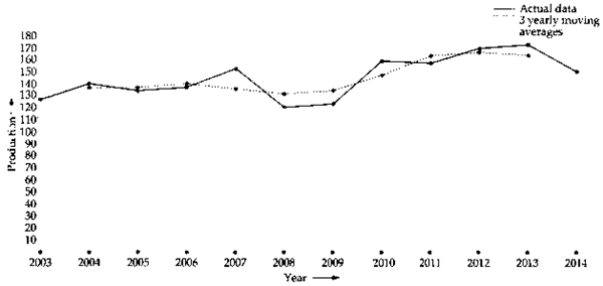
Consider the following data:
 Year:2003 200420052006 2007 20082009 2010 20112012 2013 2014
 Production: 137 140 134 137 151 121 124 159 157 169 172 150
Calculate a suitable moving average and show on a graph against the original data.
View full question & answer
Question 33 Marks
An urn contains 5 white, 7 red and 8 black balls. If four balls are drawn one by one with replacement, what is the
probability that
i. all are white?
ii. only 3 are white?
iii. none is white?
iv. at least three are white?
View full question & answer
Question 43 Marks
Four bad eggs are mixed with 10 good ones. If three eggs are drawn one by one with replacement, then find the probability distribution of the number of bad eggs drawn.
Answer
Since the eggs are drawn one by one with replacement, the events are independent, therefore, it is a problem of binomial distribution
Total number of eggs = 4 + 10 = 14, out of which 4 are bad
If $p=$ probability of drawing a bad egg, then $p=\frac{4}{14}=\frac{2}{7}$, so $q=1-\frac{2}{7}=\frac{5}{7}$
Thus, we have a binomial distribution with p $=\frac{2}{7}, q=\frac{5}{7}$ and $n=3$
If X denotes the number of bad eggs obtained, then X can take values 0, 1, 2, 3
$P (0)={ }^3 C _0 q ^3=\left(\frac{5}{7}\right)^3=\frac{125}{343}$
$P (1)={ }^3 C _1 pq ^2=3 \cdot \frac{2}{7} \cdot\left(\frac{5}{7}\right)^2=\frac{150}{343}$
$P (2)={ }^3 C _2 p ^2 q =3 \cdot\left(\frac{2}{7}\right)^2 \cdot \frac{5}{7}=\frac{60}{343}$ and
$P (3)={ }^3 C _3 p ^3=\left(\frac{2}{7}\right)^3=\frac{8}{343}$
$\therefore$ The required probability distribution is $\left(\begin{array}{cccc}0 & 1 & 2 & 3 \\ \frac{125}{343} & \frac{150}{343} & \frac{60}{343} & \frac{8}{343}\end{array}\right)$.
View full question & answer
Question 53 Marks
A company has approximated the marginal cost and marginal revenue functions for one of its products by MC =$81-16 x+x^2$ and MR = $20 x-2 x^2$ respectively. Determine the profit-maximizing output and the total profit at the optimal output, assuming fixed cost as zero.
Answer
Let P be the profit function. Then,
$\frac{d P}{d x}= MR - MC$
$\begin{array}{l}\Rightarrow \frac{d P}{d x}=\left(20 x -2 x ^2\right)-\left(81-16 x + x ^2\right) \\ \Rightarrow \frac{d P}{d x}=-81+36 x -3 x ^2 \ldots \text { (i) } \\ \Rightarrow \frac{d P}{d x}=-81+36 x -3 x ^2 \text { and } \frac{d^2 P}{d x^2}=36-6 x \end{array}$
For P to be maximum, we must have
$\frac{d P}{d x}=0$
$\begin{array}{l}\Rightarrow-81+36 x-3 x^2=0 \\ \Rightarrow-3\left(x^2-12 x+27\right)=0 \\ \Rightarrow-3(x-3)(x-9)=0 \\ \Rightarrow x=3 \text { or, } x=9\end{array}$
We find that
$\left(\frac{d^2 P}{d x^2}\right)_{x=9}=36-6 \times 9=-18<0$
Thus, the output x = 9 gives maximum profit.
From (i), we obtain
$\frac{d P}{d x}=-81+36 x-3 x^2$
Integrating both sides, we obtain
$P=-81 x+18 x^2-x^3+k \ldots(ii)$
When x = 0, fixed cost = 0 i.e. there is no profit. So, putting x = 0, P = 0 in (ii), we obtain
$P=-81 x+18 x^2-x^3$
Putting x = 9, we obtain
$P=-81 \times 9+18 \times 9^2-9^3=0$
Hence, there is no profit when 9 items are produced.
View full question & answer
Question 63 Marks
Riya invested ₹ 20,000 in a mutual fund in year 2016. The value of mutual fund increased to ₹ 32,000 in year 2021. Calculate the compound annual growth rate of her investment. [Given, log(1.6) = 0.2041, antilog (0.04082) = 1.098]
Answer
Given beginning value of investment = ₹ 20,000
Final value of the investment = ₹ 32,000 No. of years = 5
So, CAGR $=\left(\frac{\text { End Value }}{\text { Begimning Value }}\right)^{\frac{1}{n}}-1$
$=\left(\frac{32000}{20000}\right)^{\frac{1}{5}}-1$
$=(1.6)^{\frac{1}{5}}-1$
$x=(1.6)^{\frac{1}{5}}$
Let,
Taking log both sides, we get
$\log x=\frac{1}{5} \log (1.6)$
$\Rightarrow \log x=\frac{1}{5} \times 0.2041$
$\begin{array}{l}\Rightarrow \log x=0.04082 \\ \Rightarrow x=\text { antilog }(0.04802)\end{array}$
= 1.098
CAGR = 1.098 - 1 = 0.098
= 9.8%
View full question & answer
Question 73 Marks
Solve: $\left( x ^2+1\right) \frac{d y}{d x}+2 xy -4 x ^2=0$ subject to the initial condition $y (0)=0$.
Answer
The given differential equation can be written as
$\frac{d y}{d x}+\frac{2 x}{1+x^2} y=-\frac{4 x^2}{1+x^2} \ldots$ (i)
This is a linear differential equation of the form $\frac{d y}{d x}+ Py = Q$, where
$P =\frac{2 x}{1+x^2}$ and $Q =\frac{4 x^2}{1+x^2}$
$\therefore$ I.F. $=e^{\int P d x}=e^{\int \frac{2 z}{\left(1+z^2\right) d z}}=e^{\log \left(1+x^2\right)}=1+ x ^2$
Multiplying both sides of (i) by I.F. $=\left(1+x^2\right)$, we get
$\left(1+ x ^2\right) \frac{d y}{d x}+2 xy =4 x ^2$
Integrating both sides with respect to x, we get
$y\left(1+x^2\right)=\int 4 x^2 d x+C$ [Using: $y($ I.F. $)=\int Q$ (I.F.) $\left.d x+C\right]$
$\Rightarrow y \left(1+ x ^2\right)=\frac{4 x^3}{3}+ C \ldots$ (ii)
It is given that y = 0, when x = 0. Putting x = 0 and y = 0 in (i), we get
$0=0+C \Rightarrow C=0$
Substituting $C =0$ in (ii), we get $y =\frac{4 x^3}{3\left(1+x^2\right)}$, which is the required solution.
View full question & answer
Question 83 Marks
The rate of increase in the number of bacteria in a certain bacteria culture is proportional to the number present. Given the number triples in 5 hrs, find how many bacteria will be present after 10 hours. Also, find the time necessary for the number of bacteria to be 10 times the number of the initial present. [Given $\log _e 3=1.0986$,$\left.e ^{2.1972}=9\right]$
Answer
Let A be the amount of bacteria present at time t and $A _0$ be the initial amount of bacteria. Therefore,we have,
$\begin{array}{l}\frac{d A}{d t} \propto A \\ \frac{d A}{d t}=\lambda A \\ \frac{d A}{A}=\lambda d t\end{array}$
Integrating both sides,we get,
$\begin{array}{l}\log A =\lambda t + c \ldots( i ) \\ \text { when } t =0, A= A _0 \\ \log A_0=0+ c \\ c =\log A _0\end{array}$
Using equation (i),
$\begin{array}{l}\log A =\lambda t + c \ldots( i ) \\ \text { when } t =0, A= A _0 \\ \log A_0=0+ c \end{array}$
$c=\log A_0$
Using equation (i)
$\log A=\lambda t+\log A_0$
$\log \left(\frac{A}{A_0}\right)=\lambda t . .(ii)$
Given, bacteria triples is 5 hours, so A = 3$A _0$, when t = 5,
therefore from (ii),we have,
$\log \left(\frac{3 A_0}{A_0}\right)=5 \lambda$
$\log 3=5 \lambda$
$\lambda=\frac{\log 3}{5}$
Put the value of $\lambda$ in equation (ii), we have,
$\log \left(\frac{A}{A_0}\right)=\frac{\log 3}{5} t$
Case I: let $A _1$ be the number of bacteria present in 10 hours, then, we have,
$\log \left(\frac{A_1}{A_0}\right)=\frac{\log 3}{5} \times 10$
$\log \left(\frac{A_1}{A_0}\right)=2 \log 3$
$\log \left(\frac{A_1}{A_0}\right)=2(1.0986)$
$\log \left(\frac{A_1}{A_0}\right)=2.1972$
$A _1= A _0 e ^{2.1972}$
$A _1= A _0 9$
Hence, there will be 9 times the bacteria present is 10 hours.
Case II: Let $t _1$be the time necessary for the bacteria to be 10 times, then, we have,
$\log \left(\frac{A}{A_0}\right)=\frac{\log 3}{5} \times t$
$\log \left(\frac{10 A_0}{A_0}\right)=\frac{\log 3}{5} \times t_1$
$5 \log 10=\log 3 t_1$
$5 \frac{\log 10}{\log 3}=t_1$
Required time is $\frac{5 \log 10}{\log 3}$ hours.
View full question & answer
3 Marks Question - Applied Maths STD 12 Science Questions - Vidyadip